
纳豆激酶FU测定方法
ASSAY METHOD OF NATTOKINASEPRINCIPLENattokinase activity can be obtained by the spectrophotometric measurement of the amount of acid-soluble low-molecular products, which is increased owing to hydrolysis of the peptide linkages when nattokinase acts on fibrin.DEFINITION OF ACTIVITY UNITOne unit ( 1 FU ) is defined as the amount of the enzyme which increases the absorbance of the filtrate at 275 nm by 0.01 per minute under the conditions specified in the procedure.APPARATUS(1) Water bath :37±0.3 ℃(2) Test tubes :15×150 mm(3) Mixer :YAMATO SCIENTIFIC MT-31(4) Micro test tubes :EPPENDORF , safe lock 2.0 mL(5) High-speed microcentrifuge ( The Rotor with the radius of 4 cm )(6) Pastuer pipettes :for example IWAKI GLASS , 9 inches length(7) Spectrophotometer(8) Cuvette :10 mm in a path length , 4 mm in a path widthREAGENTS(1) 0.05 mol/L Borate buffer ( pH 8.5 , containing NaCl )Dissolve 19.07 g of Na2B4O7・10H2O and 9.0 g of NaCl in about 900 mL of distilled water. Adjusted pH to 8.5 with concentrated HCl and add distilled water to make 1000 mL.(2) 0.2 mol/L Trichloroacetic acid ( TCA ) solutionDissolve 32.68 g of TCA in distilled water to make 1000 mL.(3) 0.72 % Fibrinogen solutionPipette the 10 mL of 0.05 mol/L Borate buffer into an Erlenmeyer flask, add 96 mg of fibrinogen ( SIGMA , FIBRINOGEN ( FractionⅠ) TypeⅠ-S : From Bovine Plasma , PRODUCT NUMBER F8630 ), and keep standing for some time. Grind the undisolved with glass rod to dissolve completely. Filtrate the mixture through a filter paper ( ADV ANTEC , No .6 , 7 cm ), to remove insoluble materials. Prepare before use. 〔Note Ⅰ〕(4) Thrombin solutionDissolve thrombin ( SIGMA , From Bovine Plasma , PRODUCT NUMBER T6634 ) in 0.05 mol /L Borate buffer to make the 1000 U/mL solution. Dispense it little by little into bottles and make them freeze for storage. Dilute one of them 50-fold with 0.05 mol/L Borate buffer before use.(5) 1 mol/L Acetic acid solutionDissolve 60.1 g of CH3COOH in distilled water to make 1000 mL.(6) 1 mol/L Acetate buffer ( pH 6.0 )Dissolve 129.6 g of CH3COONa・3H2O in distilled water. Add 47.6 mL of 1mol/L Acetic acid solution and add distilled water to make 1000 mL.(7) 10 % Triton X-100 solutionDissolve 10 g of Triton X-100 in distilled water by heating and add distilled water to make 100 mL.(8) DiluentDissolve 0.334 g ( final conc. 2 mmol/L ) of CaSO4・2H2O and 0.585 g( final conc. 10 mmol/L ) of NaCl in distilled water. Add 2.0 mL of 1 mol/L Acetate buffer ( pH 6.0 ), 0.5 mL ( final conc. 0.005 % ) of 10 % Triton X-100 solution, and distilled water to make 1000 mL. 〔Note Ⅱ〕PREPARATION OF SAMPLE SOLUTIONDilute the sample with diluent to give corrected absorbance ( Δ A ) of the filtrate between 0.04 and 0.08. The concentration is normally 0.67 to 1.33 FU/g.PROCEDURE( SAMPLE )1. Dispense the 1.4 mL of 0.05 mol/L Borate buffer and 0.4 mL of 0.72 % Fibrinogen solution into a test tube, and preincubate it in a 37 ± 0.3 ℃ water bath for 5 minutes.2. Add 0.1 mL of Thrombin solution and mix. 〔Note Ⅲ〕3. After exactly 10 minutes, add 0.1 mL of the sample solution, mix for 5 seconds, and incubate at 37 ± 0.3 ℃.4. After 20 and 40 minutes from the time the reaction starts , mix for 5 seconds respectively.5. After exactly 60 minutes, add 2 mL of 0.2 mol/L TCA solution to stop the reaction, mix, and incubate at 37 ± 0.3 ℃ for further 20 minutes.6. Transfer the mixture into a micro test tube and centrifuge at 15000 rpm for 5minutes.7. Transfer the 1 mL of supernatant carefully into a cuvette by Pasteur pipette and read the absorbance ( AT ) at 275 nm.( BLANK )8. Dispense the 1.4 mL of 0.05 mol/L Borate buffer and 0.4 mL of 0.72 % Fibrinogen solution into a test tube, and preincubate it in a 37 ± 0.3 ℃ water bath for 5 minutes.9. Add 0.1 mL of Thrombin solution and mix.10. After exactly 10 minutes, add 2 mL of 0.2 mol/L TCA solution and mix for 5 seconds.11. Add 0.1 mL of sample into solution, mix for 5 seconds, and incubate at 37 ± 0.3 ℃ for 20 minutes.12. Transfer the mixture into a micro test tube and centrifuge at 15000 rpm for 5 minutes.13. Transfer the 1 mL of supernatant carefully into a cuvette by Pasteur pipette and read the absorbance ( AB ) at 275 nm. (4)CALCULATIONNattokinase activity(FU/g)=(AT-AB)/0.01 × 1/60 × 1/0.1 ×DD:Dilution rate of sampleNotesⅠ. The measured activity can vary with the lot of fibrinogen. Accordingly, when fibrinogen’s lot is changed, correct the measured activity by multiplying the correction factor if necessary.Ⅱ. This diluent can be kept 15 days at the room temperature.Ⅲ.Use mixer for every mixing.Ⅳ. The standard sample should be assayed simultaneously at every test batch to confirm the accuracy of the test result.。
纳豆激酶执行标准

纳豆激酶执行标准
纳豆激酶的执行标准在不同地区和组织可能会有所不同。
例如,日本官方健康营养食品协会制定的纳豆激酶产品的标准单位为“FU”,而广东省食品安全地方标准 DBS 44/《纳豆粉》则强调将纳豆激酶活性作为检验的主要理化指标,并将紫外分光光度法与琼脂糖纤维蛋白平板法同时作为纳豆激酶的标准检验方法。
因此,具体的纳豆激酶执行标准需要根据所在地区和相关法规来确定。
建议在购买纳豆激酶产品时,仔细查看产品标签和说明书,了解产品的执行标准和纳豆激酶含量等信息,以确保购买到符合标准的产品。
同时,如果有任何疑问,可以咨询专业人士或相关机构获取帮助。
纳豆激酶FU测定方法
纳豆激酶F U测定方法standalone; self-contained; independent; self-governed;autocephalous; indie; absolute; unattached; substantiveA S S A Y M E T H O D O F N A T T O K I N A S E PRINCIPLENattokinase activity can be obtained by the spectrophotometric measurement of the amount of acid-soluble low-molecular products, which is increased owing to hydrolysis of the peptide linkages when nattokinase acts on fibrin.DEFINITION OF ACTIVITY UNITOne unit ( 1 FU ) is defined as the amount of the enzyme which increases the absorbance of the filtrate at 275 nm by per minute under the conditions specified in the procedure.APPARATUS(1) Water bath :37± ℃(2) Test tubes :15×150 mm(3) Mixer : YAMATO SCIENTIFIC MT-31(4) Micro test tubes : EPPENDORF , safe lock mL(5) High-speed microcentrifuge ( The Rotor with the radius of 4 cm )(6) Pastuer pipettes : for example IWAKI GLASS , 9 inches length(7) Spectrophotometer(8) Cuvette : 10 mm in a path length , 4 mm in a path width REAGENTS(1) mol/L Borate buffer ( pH , containing NaCl )Dissolve g of Na2B4O7?10H2O and g of NaCl in about 900 mL ofdistilled water.Adjusted pH to with concentrated HCl and add distilled water to make 1000 mL.(2) mol/L Trichloroacetic acid ( TCA ) solutionDissolve g of TCA in distilled water to make 1000 mL.(3) % Fibrinogen solutionPipette the 10 mL of mol/L Borate buffer into an Erlenmeyer flask, add 96 mg of fibrinogen ( SIGMA , FIBRINOGEN ( FractionⅠ) TypeⅠ-S : From Bovine Plasma , PRODUCT NUMBER F8630 ), and keep standing forsome time. Grind the undisolved with glass rod to dissolve completely. Filtrate the mixture through a filter paper ( ADVANTEC , No .6 , 7cm ), to remove insoluble materials. Prepare before use. 〔Note Ⅰ〕(4) Thrombin solutionDissolve thrombin ( SIGMA , From Bovine Plasma , PRODUCT NUMBER T6634 ) in mol/L Borate buffer to make the 1000 U/mL solution. Dispense it little by little into bottles and make them freeze for storage. Dilute one of them 50-fold with mol/L Borate buffer before use.(5) 1 mol/L Acetic acid solutionDissolve g of CH3COOH in distilled water to make 1000 mL.(6) 1 mol/L Acetate buffer ( pH )Dissolve g of CH3COONa?3H2O in distilled water. Add mL of 1mol/L Acetic acid solution and add distilled water to make 1000 mL.(7) 10 % Triton X-100 solutionDissolve 10 g of Triton X-100 in distilled water by heating and add distilled water to make 100 mL.(8) DiluentDissolve g ( final conc. 2 mmol/L ) of CaSO4?2H2O and g( final conc.10 mmol/L ) of NaCl in distilled water. Add mL of 1 mol/L Acetate buffer ( pH ), mL ( final conc. % ) of 10 % Triton X-100 solution, and distilled water to make 1000 mL. 〔Note Ⅱ〕PREPARATION OF SAMPLE SOLUTIONDilute the sample with diluent to give corrected absorbance ( Δ A )of the filtrate between and . The concentration is normally to FU/g.PROCEDURE( SAMPLE )1. Dispense the mL of mol/L Borate buffer and mL of % Fibrinogen solution into a test tube, and preincubate it in a 37 ± ℃ waterbath for 5 minutes.2. Add mL of Thrombin solution and mix. 〔Note Ⅲ〕3. After exactly 10 minutes, add mL of the sample solution, mix for 5 seconds, and incubate at 37 ± ℃.4. After 20 and 40 minutes from the time the reaction starts , mix for5 seconds respectively.5. After exactly 60 minutes, add 2 mL of mol/L TCA solution to stop the reaction, mix, and incubate at 37 ± ℃ for further 20 minutes.6. Transfer the mixture into a micro test tube and centrifuge at 15000 rpm for 5minutes.7. Transfer the 1 mL of supernatant carefully into a cuvette by Pasteur pipette and read the absorbance ( AT ) at 275 nm.( BLANK )8. Dispense the mL of mol/L Borate buffer and mL of % Fibrinogen solution into a test tube, and preincubate it in a 37 ± ℃ water bath for 5 minutes.9. Add mL of Thrombin solution and mix.10. After exactly 10 minutes, add 2 mL of mol/L TCA solution and mix for 5 seconds.11. Add mL of sample into solution, mix for 5 seconds, and incubate at 37 ± ℃ for 20 minutes.12. Transfer the mixture into a micro test tube and centrifuge at 15000 rpm for 5 minutes.13. Transfer the 1 mL of supernatant carefully into a cuvette by Pasteur pipette and read the absorbance ( AB ) at 275 nm. (4) CALCULATIONNattokinase activity(FU/g)=(AT-AB)/× 1/60 × 1/× DD: Dilution rate of sampleNotesⅠ. The measured activity can vary with the lot of fibrinogen. Accordingly, when fibrinogen’s lot is changed, correct the measured activity by multiplying the correction factor if necessary.Ⅱ. This diluent can be kept 15 days at the room temperature.Ⅲ.Use mixer for every mixing.Ⅳ. The standard sample should be assayed simultaneously at every test batch to confirm the accuracy of the test result.。
中国纳豆激酶团体标准
中国纳豆激酶团体标准一、纳豆激酶的活性定义和测量方法纳豆激酶是一种从纳豆中提取的酶,具有溶解血栓、降低血液粘稠度等作用。
纳豆激酶的活性是指其在一定时间内分解纤维蛋白的能力,通常以单位表示。
测量纳豆激酶活性的方法有多种,常用的有纤维蛋白平板法、光谱法等。
二、纳豆激酶原料的要求和检测标准纳豆激酶原料应符合以下要求:1.来源:应来自经过严格筛选的纳豆发酵原料,确保无污染、无有害微生物和有害化学物质。
2.活性:原料中纳豆激酶的活性应达到一定标准,如不得低于10000单位/克。
3.稳定性:原料应具有良好的稳定性,确保在生产、储存和使用过程中不易失去活性。
纳豆激酶原料的检测标准包括:1.外观:应呈均匀的黄色或淡黄色,无杂质。
2.气味:应具有典型的纳豆气味,无异味。
3.水分:水分含量应符合规定,以保证原料的稳定性。
4.活性:按照规定的测量方法进行检测,确保达到规定的活性标准。
三、纳豆激酶产品的生产规范和流程纳豆激酶产品的生产应遵循以下规范和流程:1.原料准备:按照规定的标准筛选原料,并进行必要的清洗和干燥处理。
2.提取和纯化:采用适当的提取和纯化技术,如离心、过滤、沉淀等,以获得高纯度的纳豆激酶。
3.制剂制备:将纳豆激酶与其他必要的辅料混合,制备成各种剂型的纳豆激酶产品,如片剂、胶囊、口服液等。
4.质量检测:对每个生产批次的产品进行质量检测,确保符合规定的标准。
5.包装和储存:按照规定的包装要求进行包装,并确保产品在适当的温度和湿度条件下储存。
6.运输:在运输过程中,应采取必要的措施防止产品损坏和污染。
四、纳豆激酶产品的质量控制和安全性评估纳豆激酶产品的质量控制是确保产品质量和安全的关键环节,应遵循以下要求:1.质量标准:制定详细的质量标准,包括性状、鉴别、纯度、活性等方面的规定。
2.质量检验:对每个生产批次的产品进行质量检验,确保符合质量标准。
3.不合格品处理:对不合格品进行标识、记录并按照规定进行处理,防止不合格品流入市场。
纳豆激酶简介

纤溶酶原
活
作用
激
纳豆激酶 纤维蛋白
抑制血小板凝结
降低血液粘度
溶栓 抗凝
第6页/共13页
来自日本、风靡欧美的21世纪超级绿色食品
纳豆激酶
激活
纤维蛋白
纤溶酶原
抑制血小板凝结
第7页/共13页
来自日本、风靡欧美的21世纪超级绿色食品
纳豆激酶溶栓、抗凝、维生素K2起着调节作用
维生素K具有促进凝血的功能,故又称凝血维生 素。维生素K的主要生理功能是促进肝脏合成凝 血酶原及凝血因子Ⅶ、Ⅸ和Ⅹ。而维生素 K(“Koagulation” vitamin)意思是血凝维生素。
第8页/共13页
来自日本、风靡欧美的21世纪超级绿色食品
Vitk的生理功能
Vitk是促进肝脏合成凝血酶原(即凝血因子I),它还调 节另外三种凝血因子Ⅶ、Ⅸ和Ⅹ的合成。
一般情况下,人类很少有Vitk缺乏现象,但当肠道梗阻、 腹泻或自发性脂肪痢引起肠道消化吸收不良,或长期服用广 谱广菌药物,抑制肠道细菌生长情况下,便可能引起Vitk缺 乏。
纳豆激酶的稳定性研究
在55℃以下比较稳定,超过55℃则迅速失 活。纳豆激酶pH在6- 10之间比较稳定, pH6以下活力损失大。(文献:纳豆激酶 的分离纯化及酶学性质研究)
第11页/共13页
来自日本、风靡欧美的21世纪超级绿色食品
影响纳豆激酶稳定性的因素 对纳豆激酶稳定性产生影响的因素有:温度、pH值、金属 离子、有机物等: 温度:纳豆激酶在低于45℃时,活性相对稳定;在40℃下, 30min内没有酶活性丧失;60℃ 以上,酶则迅速变性失活。 pH值:室温下.在pH4~12范围内,该酶酶活性稳定; pH7~9范围内酶活性最为稳定;pH6 3~l0 8范围内.其 活性可持续近40d之久 。带粘质(多聚谷氨酸)的粗酶液在 pH3以下仍有活性。
纳豆激酶酶活测定方法

纳豆激酶酶活测定方法琼脂糖—纤维素平板法:(1)原理:在血液中纤维蛋白溶酶原和纤维蛋白原往往处于结合状态,因此本试验所用纤维蛋白原制剂均包含纤维蛋白溶酶原。
用凝血酶将纤维蛋白原凝结成蛋白平板后,将样品定量滴在平板上,如果有纤维蛋白溶酶原激活剂活性存在,将纤维蛋白溶酶原激活成纤维蛋白溶酶,从而溶解纤维蛋白,出现溶圈。
在纤维蛋白溶酶原过量的情况下,溶圈的大小反映了激活剂的量。
(2)仪器:玻璃平皿(直径12cm)10ul微量进样器变温电炉(1000W)恒温培养箱(±0.5℃)超净工作台游标卡尺电脑扫描仪(3)试剂药品:1、0.1M磷酸盐缓冲液:0.1M磷酸氢二钠:取无水磷酸氢二钠14.2克用蒸馏水稀释到1000毫升。
0.1M磷酸二氢钠:取无水磷酸二氢钠2.4克用蒸馏水稀释到200毫升。
两种溶液按一定比例混合,用PH计测定PH至7.4。
2、尿激酶溶液:尿激酶标准品用磷酸盐缓冲液分别配成每毫升磷酸盐缓冲液含10、20、40、60国际单位溶液(中国药品生物检定所尿激酶标准品)。
3、纤维蛋白原溶液:取一只纤维蛋白原加磷酸盐缓冲液32毫升(中国药品生物检定所牛血纤维蛋白原,每支可凝蛋白77毫克)。
4、凝血酶溶液:配成每毫升磷酸盐缓冲液含25单位凝血酶溶液(中国药品生物检定所凝血酶)。
5、琼脂糖溶液:0.1克琼脂糖(电泳级)加磷酸盐缓冲液40毫升,煮沸加炭素墨水1至2滴,至体积约30毫升,取20毫升。
6、样品溶液:样品提取液用水配成每毫升含相当于10—60单位尿激酶的溶液。
(4)测定方法:在超净工作台上将20毫升琼脂糖溶液加15毫升纤维蛋白原溶液,在40℃左右混合,立即加凝血酶0.5毫升混匀,倒入平皿(表面不得有气泡)。
盖盖静置30分钟,用微量进样器分别吸标准品及样品溶液10微升,针刺入平板底垂直点样。
置于37℃恒温培养箱中16小时,取出。
数据处理方法1:用游标卡尺量出每个溶圈相互垂直的两直径,以两直径乘积为横坐标,标准品浓度为纵坐标在双对数纸上作标准曲线,从标准曲线上查出样品单位数。
纳豆激酶的监测方法
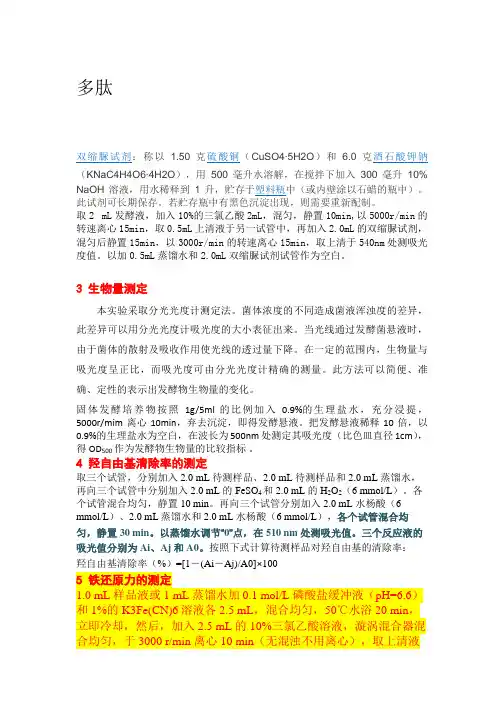
多肽双缩脲试剂:称以 1.50克硫酸铜(CuSO4·5H2O)和 6.0克酒石酸钾钠(KNaC4H4O6·4H2O),用500毫升水溶解,在搅拌下加入300毫升10% NaOH溶液,用水稀释到1升,贮存于塑料瓶中(或内壁涂以石蜡的瓶中)。
此试剂可长期保存。
若贮存瓶中有黑色沉淀出现,则需要重新配制。
取2 mL发酵液,加入10%的三氯乙酸2mL,混匀,静置10min,以5000r/min的转速离心15min,取0.5mL上清液于另一试管中,再加入 2.0mL的双缩脲试剂,混匀后静置15min,以3000r/min的转速离心15min,取上清于540nm处测吸光度值。
以加0.5mL蒸馏水和2.0mL双缩脲试剂试管作为空白。
3 生物量测定本实验采取分光光度计测定法。
菌体浓度的不同造成菌液浑浊度的差异,此差异可以用分光光度计吸光度的大小表征出来。
当光线通过发酵菌悬液时,由于菌体的散射及吸收作用使光线的透过量下降。
在一定的范围内,生物量与吸光度呈正比,而吸光度可由分光光度计精确的测量。
此方法可以简便、准确、定性的表示出发酵物生物量的变化。
固体发酵培养物按照1g/5ml 的比例加入0.9%的生理盐水,充分浸提,5000r/mim离心10min,弃去沉淀,即得发酵悬液。
把发酵悬液稀释10倍,以0.9%的生理盐水为空白,在波长为500nm处测定其吸光度(比色皿直径1cm),得OD500作为发酵物生物量的比较指标。
4 羟自由基清除率的测定取三个试管,分别加入2.0 mL 待测样品、2.0 mL 待测样品和2.0 mL 蒸馏水,再向三个试管中分别加入2.0 mL 的FeSO4和2.0 mL 的H2O2(6 mmol/L)。
各个试管混合均匀,静置10 min。
再向三个试管分别加入2.0 mL 水杨酸(6 mmol/L)、2.0 mL蒸馏水和2.0 mL 水杨酸(6 mmol/L),各个试管混合均匀,静置30 min。
纳豆激酶活性测定
纳豆激酶检测方法目前行业内流行的纳豆激酶检测大致有三种方法,其原理、利弊简介如下:一、 IU纤维蛋白平板法:以尿激酶为对照,与纳豆激酶样品同时在纤维蛋白平板特定条件下所形成水解圈,测量各自水解圈直径,通过计算取得相应纳豆激酶活力。
由于对水解圈直径的认定的认定存在经验人员视觉差异,导致测定粗放,数据波动性强,重复性差,不具权威依据。
二、 FU紫外分光法:纳豆激酶与纤维蛋白在一定条件下作用会产生可溶性低分子物质,通过紫外分光技术检测其浓度,通过计算取得相应纳豆激酶活力,数据稳定,重复性强。
测定硬件条件苛刻,测定成本高,不具权威性依据。
三、 U中性蛋白酶法:纳豆激酶与酪蛋白在一定条件下作用会产生可溶性低分子物质,通过普通比色计检测其浓度,计算取得相应纳豆激酶活力,数据稳定,重复性强。
测定简单,检测成本低,有国家标准为依据。
1)琼脂糖一纤维蛋白平板法是,是目前最常用的纤溶酶溶栓活力测定方法,此法的原理是用琼脂糖作为固体支持,以凝血酶和纤维蛋白原制做人工血栓平板,注入NK,用溶解圈垂直直径的乘积(mm2)表示纤溶活力,以标准UK或纤溶酶为标准品作标准曲线,计算出NK的活性相当于标准品的单位数。
此法简便易行,并可同时测定多个样品,但由于溶解圈面积受恒温反应时间的影响很大,所以对恒温时间的控制十分重要,且恒温时间对粗制酶活性测定的影响比对NK精制产品活性测定的影响大。
2)在直径15mm的硅化试管中依次加入pH值为7.7的咪唑缓冲液、纳豆激酶收集液、凝血酶和纤维蛋白原,立即振摇数秒,使之产生絮状物,置38℃水浴30 min,置冰水中终止反应。
用100目尼龙网过滤试管中未溶解的纤维蛋白,滤纸吸干,用蒸馏水漂洗,再用滤纸吸干,放入小试管中,再加3mL浓度为O.2 mol/L的NaOH溶液,在沸水中煮15min,冷却。
用分光光度计测定溶液在280nm处的吸光值,并根据活力计算公式计算纤溶活力。
纳豆激酶活力=A对照−A样0.5ml×30min×3×1000ug。
纳豆激酶活性测定方法
・ 9 ・
该 方 法 的 优 点 是 , 可 以 同 时 测 多 个 样 品 , 而 且 在 可 对 酶 活 性 进 行 测 定 , 操 作 简 便 、 快 捷 , 样 品 消 4h 内 耗 小 , 成 本 低 。 另 外 , " 的 变 异 系 数 CV% 在 OD655 值 内 , 可 信 度 高 。 5% 以 应 注 意 的 一 点 是 , 人 工 血 栓 的 制 作 对 消 光 值 的 测 定 是 有 影 响 的 。 不 过 如 果 反 应 开 始 时 小 孔 内 的 血 栓 的 吸 光 值 在 O . 2 以 上 , 那 么 人 工 血 栓 的 调 制 对 几 乎 没 有 太 大 的 影 响 。 OD655 值 5
[ 将 其 作 为 预 防 和 治 疗 心 血 管 疾 病 的 药 品 l] 。 l987 年 [ 溶 纤 维 活 性 9] 。 用 溶 解 面 积 来 表 示 NK 的
在 培 养 皿 中 加 入 血 纤 维 蛋 白 原 ( fibrinOgGn) 溶 液 和 凝 血 酶 溶 液 , 搅 拌 使 其 凝 固 制 成 平 板 。 取 不 同 浓 度 品 点 于 平 板 上 , 恒 温 孵 育 测 其 溶 解 NK 样 37C l8h, 圈 直 径 。 可 以 发 现 酶 量 与 溶 解 面 积 成 直 线 关 系 。 以 标 准 纤 溶 酶 ( PIasimin) 作 为 标 准 NK 或 UK 或 品 作 标 准 曲 线 。 活 性 单 位 定 义 为 : 在 37C lmin NK 的 内 分 解 解 于 酸 缓 冲 溶 液 ( pH7 . l nmOI 溶 0 . lmOI / L 磷 中 的 浓 度 4) 5 x l0 - 4 mOI / L 的 H-D-VaI-LGu-Lys-pNA 的 为 或 者 以 UK 或 纤 溶 酶 的 活 性 单 位 来 表 NK 量 lU。 示 。 维 溶 解 面 积 来 表 示 活 性 , 完 全 是 表 观 值 。 如 恒 温 孵 育 时 间 变 化 , NK 的 测 定 值 的 变 化 很 大 。 随 着 恒 温 时 间 的 增 加 , 所 对 应 的 值 显 著 减 少 。 比 之 制 产 品 , 粗 制 酶 活 性 测 定 NK 精 受 孵 育 时 间 影 响 更 大 , 这 可 能 是 粗 酶 中 杂 质 的 影 响 。
纳豆激酶活性测定方法和膳食用量
Hans Journal of Food and Nutrition Science 食品与营养科学, 2020, 9(2), 132-136Published Online May 2020 in Hans. /journal/hjfnshttps:///10.12677/hjfns.2020.92017Methods for Assay of Nattokinase Activityand the Dosage of DietaryYanchun Liu, Lingyun Cai, Xiuling Wang, Shijuan Dou*College of Life Sciences, Hebei Agricultural University, Baoding HebeiReceived: Mar. 17th, 2020; accepted: Apr. 2nd, 2020; published: Apr. 9th, 2020AbstractNatto, which is a must-have food in Japan, has a long history and a unique flavor. Natto has various functions, among which the thrombolytic effect of nattokinase has attracted much attention. A lot of methods have been used to assay the activity of nattokinase. The article summarizes five main methods, including fibrin plate method, fibrin degradation method, casein degradation method, synthetic substrate method and enzyme-linked immunoassay. At present, fibrin plate method and fibrin degradation method are being used commonly. By comparing different methods for assay-ing nattokinase activity, we hope that the assay method can be unified and a uniform standard for dietary dosage of natto produced by different companies can be put forward.KeywordsNatto, Nattokinase, Methods of Nattokinase Activity, Dosage of Dietary纳豆激酶活性测定方法和膳食用量刘艳春,蔡凌云,王秀伶,窦世娟*河北农业大学,生命科学学院,河北保定收稿日期:2020年3月17日;录用日期:2020年4月2日;发布日期:2020年4月9日摘要纳豆历史悠久,风味独特,在日本已成餐桌必备食品。
纳豆激酶
纳豆知识纳豆(natto),学名枯草菌。
日本传统的做法是把煮熟的大豆趁热装在用纳豆菌做成的稻草器皿里,利用稻草上附着的纳豆菌自然发酵而做成的。
用这种方法做成的纳豆中,除了纳豆菌以外,还含有其他杂菌,不仅卫生不过关,而且质量也不好。
1980年的一天,正在美国芝加哥罗宾斯研究所从事血栓研究工作的日本须见洋行教授在比较230多种食品后,赫然发现仅有纳豆菌食品含高浓度的血栓溶解成份。
他将脑血栓患者常服用的溶血栓药物放在定量的人造血栓上,结果耗费一个晚上的时间才能完全溶解,而以同样方法换上一粒纳豆菌食品则只需3小时便可完成。
纳豆激酶,可直接分解血栓,每克湿纳豆溶栓效果相当于尿激酶1600IU。
纳豆激酶对血栓的作用时间长达8-12小时,而尿激酶作用时间只有30分钟。
尿激酶只能注射,纳豆激酶即可注射也可口服,而且可以在毛细血管中发挥作用。
纳豆在日本已食用1000年,是一种安全的食用血栓预防剂。
纳豆和纳豆激酶的生产工艺纳豆的生产过程:精选小粒黄豆→清洗→蒸煮→沥干→降温至恒温→接种→低温培养→分装→冷冻保存→纳豆纳豆是日本的传统食品,是选用优质黄豆经纳豆菌生物发酵而成。
纳豆的外表带有一层白霜,用筷子搅拌时,会拉出粘丝,拉丝越多越好。
这些拉丝所含有的成份大都就是纳豆激酶。
现在市场上销售的纳豆产品因为保存期过长失去大部分功效或者价格过高,所以目前最行之有效的办法就是用科技提取制作,这个技术目前国有只有上海顶舜颖生物科技有限公司所掌握和运用。
这样制作才能满足人体每天2000FU以上的需求。
一、使用器皿和材料①大豆500g②纳豆菌种5g③高压锅④不锈钢盆⑤泡沫饭盒等浅容器⑥泡沫箱子⑦2立升长方形塑胶瓶子或暖水袋⑧温度计二、泡豆蒸豆将大豆充分洗净后,加入3倍量的水浸泡一夜后,倒掉水放进高压锅内蒸到大豆用手捏碎的程度,大约45分钟。
如没有高压锅,煮水时一次不要放得太多。
为了保持大豆的原汁原味,最好是蒸。
三、接种纳豆菌将纳豆菌种用50ml热水(温度最好38-45℃,温度太高会杀死纳豆菌)溶解后,均匀地加入到热大豆中(温度最好38-45℃,温度太高会杀死纳豆菌),迅速搅拌均匀,分装在7个泡沫饭盒里,厚度大约2cm,上面苫上纱布或者在饭盒与饭盒盖之间架上一双筷子,使其充分接触空气。