
人教版八年级下册Review of the unit 9
I don't like English.
Neither does he.
I can play basketball. So do I.
Jenny doesn't understand Japanese .And C ______________. A.so do I B.so am I C.neither do I D.neither am I C I have two children ,and ______of them are working in the west of China. A.all B.both C.neither D.either
go------- gone have/has--- had hear------ heard
keep----- kept know---- known make------- made
hurt------- hurt let------let run-------- run
D 1.Our math teacher ______ in our school for 20 years and he ___here when he was 23 years old. A.has taught ; has come B.taught ; comes C.taught; came D.has taught ; came A 2.How long ____you ____a doctor? Three years. A.have ;been B.have; become C.did; be D.are;/
标志词: 1)for +一段时间 e.g. We have lived in this city for ten years. 2) since +过去点时间 since +一段时间+ago since +从句(从句用一般过去式)
3) so far, once/twice/ three times , all one's life
sit------lose-----say------
sat lost said
take-------- taken mean-----meant run----run
feed------- fed fly-----flown
find------ found give----- given grow------ grown drive----- driven hold------ held
B 2._______of the land in that district _______covered with trees and grass. A.Two fifths; is B.Two fifth; are C.Two fifth ;is D.Two fifths;are 二.Neither /so 引导的倒装语序。 肯定句:so +助动词/情态动词/系动词be+主语 表示 也是 否定句Neither +助动词/情态动词/系动词be+主语 表示 也不是
teach------ taught tell-------- told write----- written meet----- met stand------ stood sweep-swept
think------ thought win---won
sell----sold send------- sent sing--sung
金世教育
Review of Unit 9
JODY
Review of the Present Perfect Tense 现在完成时的构成: have/has + 动词的过去分词 否定形式: have/has not +动词的过去分词 现在完成时的用法: 1表示已完成的某一动作对现在造成的影响或结 果 1) 标志词: 语法回顾
B 3.How long have you ____ the book? ---- For three years. A.borrowed B.kept C.lent D.bought
1.分数的表示方法: 分母用序数,分子用基数。 如:2/3 two thirds 1/3 one third 其主谓一致表示为:若分数后的名词是单数或者 是不可数名词,谓语用单数,;若分数后的名词 是复数名词,则谓语动词用复数形式。 1.The number of the students in our school A is about nine______._______of them are boys. A.hundred ;Two thirds B.hundred; Two third C.hundreds; Two thirds D.hundreds; Two third
4) in the past +一段时间 during the last +一段时间
3. have / has been to
have / has gone to
曾经去过某地 到某地去了
have / has ቤተ መጻሕፍቲ ባይዱeen in
在某地呆了多长时间
动词的过去分词如下:
1.在动词的词尾+ed :
2.在动词的词尾+d : 4.辅音+y ,变y为i +ed: 5.不规则: become------bring------do/does---cost-----become brought did cost
already: 多用于陈述句,位于have/has后,
有时位于句末。 yet: ever : 用于疑问句和否定句,位于句尾。 多用于疑问句,问初次经历。
never: 用于否定句,位于have/has后 just : 多用于陈述句,位于have/has后
before: 可用于各句式,位于句尾。
2. 表示从过去已经开始,持续到现在的动 作 或状态。
work----worked
die------died study---studied build------ built cut------- cut begin----- begun fall------ fallen
3.在动词的词尾双写辅音+ed :stop----stopped
swim------ swum
Review_of_Unit9课件_新目标八年级下 (2)

17. It was _____ I could speak French that I got the job. C A. why B. so C. because D. when 18. The Language School has really ____ me ____ English. D A. helped; learned B. help; learned C. help; learn D. helped; learn A 19. The best way to learn English well is ______ it. A. to use B. to using C. uses D. use
3. 用法:表过去某一时间发生的动作或状态一 直延续到现在(强调现在),动作或状态一般 是延续性的,因此要用表延续性的动词或表状 态的动词。
用括号内动词的适当形式填空. has lived • Mr Lin __________ (live) here since July. Have • A: ______ you been _____(be) to the Great Wall? went B: Yes, I ______ (go) there last Spring. has seen 3. He ____________ (see) the film twice already. enjoyed 4. The children _______ (enjoy) themselves in the park last Sunday morning. 5. Mary _____________ (work) in the factory has worked since she left school three years ago. have been 6. They __________ (be) in Hongkong for ten days. Have heard 7. _____ you ever _______(hear) of him before?
初中英语_八下 Unit9教学设计学情分析教材分析课后反思
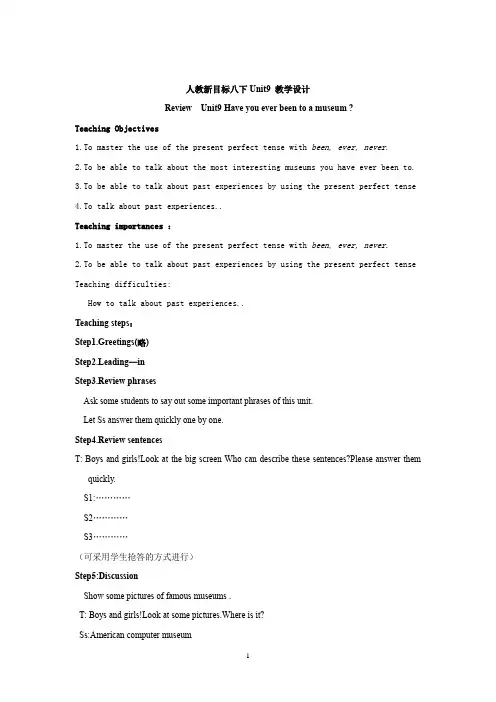
人教新目标八下Unit9 教学设计Review Unit9 Have you ever been to a museum ?Teaching Objectives1.To master the use of the present perfect tense with been, ever, never.2.To be able to talk about the most interesting museums you have ever been to.3.To be able to talk about past experiences by using the present perfect tense4.To talk about past experiences..Teaching importances :1.To master the use of the present perfect tense with been, ever, never.2.To be able to talk about past experiences by using the present perfect tense Teaching difficulties:How to talk about past experiences..Teaching steps:Step1.Greetings(略)Step2.Leading—inStep3.Review phrasesAsk some students to say out some important phrases of this unit.Let Ss answer them quickly one by one.Step4.Review sentencesT: Boys and girls!Look at the big screen Who can describe these sentences?Please answer them quickly.S1:…………S2…………S3…………(可采用学生抢答的方式进行)Step5:DiscussionShow some pictures of famous museums .T: Boys and girls!Look at some pictures.Where is it?Ss:American computer museumT: Who can describe it ?(学生踊跃抢答)T: Look at picture 2. Where is it?Ss:the International Museum of Toilets in IndiaT: Who can describe it ?(学生踊跃抢答)T: Look at picture 3. Where is it?Ss:Hangzhou National Tea MuseumT: Who can describe it ?(学生踊跃抢答)Step6 Work in pairsT: What places have you been to? Ask your partner.Have you visited …?Have you been to …?Have you seen …?Have you tried …?(First let Ss discuss and then ask and answer in pairs )Step7.GroupworkAsk your classmates whether(是否) they have been to these places.Make a survey and reportStep8.拓展延伸Make a list of facts about your hometown or a place you have been to. Think about these topics. Size and location: ________________Population: _____________________Weather: _______________________History: ________________________Places to visit: ___________________Things to eat: ___________________Look at the map of China and write a short passageFor example:I have been to Qingdao many times. It’s a fantastic place to relax and live. Let me introduce Qingdao to you. You can….Step9 Do exercisesStep10 Homework写作要求:写一篇80字的文章描述你的家乡。
人教版初中八年级英语下册第九单元Unit9教案含教学反思
⼈教版初中⼋年级英语下册第九单元Unit9教案含教学反思Section A 单词camera n.照相机;摄影机;摄像机unbelievable adj.难以置信的;不真实的progress v.&n.进步;进展rapid adj.迅速的;快速的unusual adj.特别的;不寻常的toilet n.坐便器;厕所encourage v.⿎励social adj.社会的peaceful adj.和平的;安宁的perfect adj.完美的;完全的itself pron.它⾃⼰collect v.收集;采集German adj.德国的;德语的;德国⼈的n.德语;德国⼈ride n.供乘骑的游乐设施;短途旅程province n.省份amusement n.娱乐;游戏somewhere adv.在某处;到某处invention n.发明;发明物invent v.发明;创造performance n.表演;演出theme n.主题短语amusement park游乐场lead to导致put up搭起think about考虑make tea沏茶tea art 茶艺tea set茶具equator n.⾚道短语take a holiday度假three quarters四分之三at night在夜晚all year round全年be close to 靠近be far from远离……thousands of 数以千计的;许许多多的whether…or…不管……还是……on the one hand…on the other hand…⼀⽅⾯……另⼀⽅⾯……句型1.On the one hand,more than three quarters of the population areChinese,so you can simply speak Putonghua a lot of the time. Onthe other hand,Singapore is an English-speaking country,so it’salso a good place to practice your English! ⼀⽅⾯,超过四分之三的⼈⼝是华裔,因此很多时候你可以只说普通话。
八年级英语下册Review of units 9---10 知识讲解
八年级英语下册Review of units 9---10 知识讲解Revie f units 9---10一重点词语1 as的用法prep①(理由) 因为……例如:As it rained,I staed he (多用于句首)②(比较) as…as… 同…一样例如:He is as tall as I (a)③(表结果、程度) 所以,致使例如:I gt up s earl as t be in tieHe spe s ludl as t be heard b everne④书面语虽然…但是;同thugh 注意词的排序例如:ung as he as,he rs hard2 in the sae ain the sae a 意思为“同样地,用同样的方式”,常接在动词后用作方式状语。
注意:a 和不同的介词连用,有不同的意思,区别如下:in the a 就这样,用这种方式b the a 顺便问一下n the a 在去……路上例如:He finall red ut the prble in the a最后,他就这样解决了问题。
B the a,h ld is ur sn?顺便问一下,你儿子多大了?n the a t shl,he et an ld friend f his在去学校的路上,他碰到了他的一个老朋友。
注意:如果a后接副词时,要省略t。
如:n the a he 在回家的路上3 prefer的用法,宁可,宁愿,更喜欢。
(1)prefer sth例如:I’d prefer eat,please我更喜欢吃肉。
(2)prefer sth / ding t sth /ding例如:I prefer dgs t ats我喜欢狗,不太喜欢猫。
I prefer reading t singing我喜爱读书胜过唱歌。
(3)prefer t d sth例如:uld u prefer e t e n nda?你是否宁可要我星期一?(4)prefer t d … rather than d …例如:He prefers t rite his letters rather than phne the他喜欢自己写信,不愿意给他们打电话。
人教版八年级英语下册 Review of Unit 9 教学课件

more than
19. 四分之三
three quarters
20. 一个说英语的国家 an English-speaking country
21. 在白天
during the daytime
22. 全年
all year round
23. 靠近
close to
24. 离……远
far from …
即时演练 一、根据句意及汉语提示完成单词。 1. He loves _c_o_l_le_c_t_in_g__ (收集) coins. 2. Lauren was a _p_e_r_fe_c_t_ (完美的) girl in every way. 3. Jane has _p_r_o_g_r_e_ss_e_d_ (进步) very rapidly in math. 4. Have you ever been to any museums of __t_o_il_e_ts__
(厕所)?
5. The 2022 Beijing Olympic Games _e_n_c_o_u_r_a_g_e_s__ (鼓励) the public to pay attention to winter sports.
6. The math problem is very difficult. I ___fe_a_r___ (害怕) I can’t work it out.
Review of Unit 9
R·八年级下册
自学指导及检测一:Recite the key words.
camera n. 照相机;摄影机;摄像机 unbelievable adj. 难以置信的;不真实的
progress v.& n. 进步;进展 rapid adj. 迅速的;快速的
初中英语人教版八年级下册Unit 9
invent, unbelievable, progress, unusual, encourage,
peaceful, perfect, collect….
makeprogress, tea art, tea set
Period
1
Procedure
Lead-in
1.Before class, ask students to watch a video about the National Museum of China.
1.Read the magazine articlequicklyand find
out what kinds of museums it talks about.
2.Show a mind-map and check theanswers.
Step 2
Task 2:True or False
Read the article again andjunglethe followingstatementstrue or false.
2.Class begins, ask students :What’s the name of the museum? Have you ever been to the museum?
3.Show some famous museums and ask :What kind of the museum is it? After that, ask them: How many kinds of museums are there?
invent发明;创造peaceful和平的;安宁的
unbelievable难以置信的tea art茶艺
八年级下册新目标英语Review of Unit 9
7. I would like to travel to somewhere quiet, for example, the countryside and forests. I would like to travel to somewhere quiet _______ ______ the countryside and forests. 8. It is a good place to go for a holiday. It is a good place to _______ _______ _____. 9. How many people are there in Zhanjiang? ______ ______ _______ ________ Zhanjiang? 10. There are some people on the boat. There are some people _______ ________.
短语
1.在务员 7.四分之三 7.四分之三 8. 醒来 10.一年到头 11.在白天 10.一年到头 11.在白天 13.而不是 14.东南亚 13.而不是 14.东南亚 16.游乐场 17.听说 16.游乐场 17.听说 19.做某事最好的方式 19.做某事最好的方式 20.做某事遇到问题 困难) 做某事遇到问题( 20.做某事遇到问题(困难) 3.交换生 3.交换生 6.度假 6.度假 9.自然环境 9.自然环境 12.曾经到过 12.曾经到过 15.主题公园 15.主题公园 18.例如 18.例如
Grammar: : 现在完成时present perfect tense 现在完成时 现在完成时的结构是__________________ 现在完成时的结构是 Have/has done • 现在完成时的时间状语 for(段), since(点), so far, ever, ( ( never, just, yet, already, till / until, up to now, in past years, before • 一般过去时的时间状语 一般过去时的时间状语: yesterday, last week,…ago, in1980, in October, just now, 等具体的时间状语
人教版八年级下册英语Unit9(第九单元)优秀教案
人教版八年级下册英语Unit9(第九单元)优秀教案Unit 9 Have you ever been to a museum?第一课时Section A (1a-2d)【学习目标】1.重点单词:amusement2.重点短语:have/has been to,have/has gone to3.重点句式:Have you ever been to a museum?Let's go somewhere different today.Frank's friend has never been to the water park.Have you ever been there?It's a great way to spend a Saturday afternoon.I learned about the inventions that led to color movies,too. We put up a tent and cooked outside.I've never been camping.【学习重点】1.重点短语和句型2.have has been to 和have has gone to 的用法3.现在完成时态【学习难点】1.have has been to 和have has gone to 的用法2.现在完成时态【自主学习】一、预习课本P65-66新单词并背诵,完成下面的汉译英。
1.娱乐二、认真预习1a-2d,找出下列短语和句型。
1.去过某地2.去了某地3.你曾经去过博物馆吗?4.今天让我们去一些不同的地方吧。
5.Frank的朋友从来没有去过水上公园。
6.你去过那里吗?7.这是一个度过周六下午的好方法。
8.我了解到了有关那个导致彩色电影出现的发明。
9.我们支起了一个帐篷并且野炊。
10.我从来没有野营过。
【课堂导学】Step 1情景导入(Show the pictures of amusement parks,water parks,space museums,zoos art museums,and history museums) Teacher:What can you see in the picture?(Look at the pictures and brainstorm the words they can think of,such as space museum,amusement park,water park,zoo,art museum and history museum.)T:Have you ever been to an amusement park?Ss:No.T:Now,we'll learn Unit 9—Have you ever been to a museum?环节说明:通过多媒体图画的谈论问答,并因势引导,采用师生之间的交流方式,自然导入“Have you ever been to a museum?”(“你曾经去过某地吗?”)这一话题。
八年级下册新目标英语Unit 9 review
词汇
1. 也不,两者都不 也不, 2. see的过去分词 的过去分词 3. 岛屿 4. 特别,尤其 特别, 5. 发觉,发现 发觉, 6. 电影 7. 极好的 8. 假日,假期 假日, 9. 四分之一 10. 人口 11. 害怕,担心 害怕, 12. 勇敢的 13. 卓越的,极好的 卓越的, 14. 印度的 15. 黄昏,黑暗 黄昏, 16. 醒来,唤醒 醒来, 17. 狐狸 18. 自然的 19. 环境 20. 温度
17. 一直 19. 乘坐 21. 一个讲英语国家 23. 提高英语 25. 帮助我学英语 27. 度假 29. 练习英语 31. 靠近
18. 走不同路线 20. 和…吵架 吵架 22. 决定做某事 24. 开始做某事 26. 考虑 28. 在一方面 30. 做…有困难 有困难 32. 在秋天
句型转换
21. 无论何时 22. 春天 23. 秋天 24. 季节 25. 醒着的
短语
1. 例如 3. 以…结束 结束 5. 导游 7. 四分之三人口 9. 一年到头,终年 一年到头, 11. 过山车 13. 在白天 15. 玩的开心 2. 在船上 4. 空中服务员 6. 在东南亚 8. 睡醒,醒来 睡醒, 10. 自然坏境 12. 交换生 14. 全世界 16. 看见某人正在做
人教版八年级英语下册Unit-9-Section-Appt课件
Pair work-2c Have you ever been to …? How are we going to get there?
water park
amusement park
Pair work-2c
A: Have you ever been to an amusement park.
B: No, I haven’t. How about you? A: Yes, I have. It’s really interesting. Let’s
Unit 9 Section A
Have you ever been to a museum?
1
Warming up
Which of these places would you like to visit?
space museum
history museum
art museum
I went to these places before, so I can say:
T
Pair work-2c
Look at the map in 2a and make conversations about the places.
A: Have you ever been to the space museum? B: Yes, I have. How about you? A: No, I haven’t. B: Oh, it’s fantastic. Let’s go tomorrow. A: OK. How are we going to get there? B: We can take the subway.
the American Computer Museum - the special computer that can play chess even better than humans. the International Museum of Toilets – many different kinds of toilets. the Hangzhou National Tea Museum – the tea art performances.