
牛津译林版高中英语必修1Unit 1 School Life—reading 同步练习译林版必修1
【同步练习】
一、选择适当的关系代词或关系副词填空:
1. His parents wouldn’t let him play with anyone ______ scores was poor.
A. of whom
B. whom
C. of whose
D. whose
2. She heard a terrible noise, _______ brought her heart into her mouth.
A. it
B. which
C. this
D. that
3. In the dark street , there wasn’t a single person _____ she could get help.
A. that
B. who
C. from whom
D. to whom
4. The day _______ he chose for his son wedding was a lucky day in the lunar calendar.
A. when
B. where
C. that
D. who
5. After living in Pairs for fifty years he returned to the small town ____ he grew up as a child.
A. which
B. where
C. that
D. when
6.This monument is all ______ remains of the ancient kingdom.
A. it
B. that
C. when
D. which
7.He mentioned a book the tile of ______ I can’t remember now.
A.who B.which C.this D.what
8. Recently I bought an ancient Chinese vase , _____ was very reasonable.
A. which price C. the price of which
C. its price
D. the price of whose
9._____ has already been pointed out , grammar is not a set of dead rules.
A. As
B. It
C. That
D. Which
10. He lived in London for 3 months , during ____ time he learned some English.
A. this
B. which
C. that
D. same
11. On the wall hangs a picture, _____ color is blue.
A. whose
B. of which
C. which
D. its
12.I still remember the time ______ I first became a college student.
A. what
B. which
C. that
D. when
13. Mr.Ford still talks like the man______ he was ten years ago.
A. that
B. where
C. which
D. there
14. The boss ____ department Ms King worked ten years ago looked down upon women.
A. in which
B. in that
C. in whose
D. whose
15.I don’t like _____ you speak to her.
A. the way
B. the way in that
C. the way which
D. the way of which
16.I had neither a raincoat nor an umbrella ._______ I got wet through .
A. It’s the reason
B. That’s why
C. There’s why
D. It’s how
17. He made another wonderful discovery , ____ of great importance to science.
A. which I think is
B. which I think it is
C. which I think it
D.I think which is
18. There is only one dish on the table_______ I want to eat .
A. who
B. that
C. what
D. whcih
参考答案
一、1-5 DBCCB6-10 BBCAB11-15 ADACA16-18 BAB。
英语:Unit1《School Life》课件(7)(译林牛津版必修1)
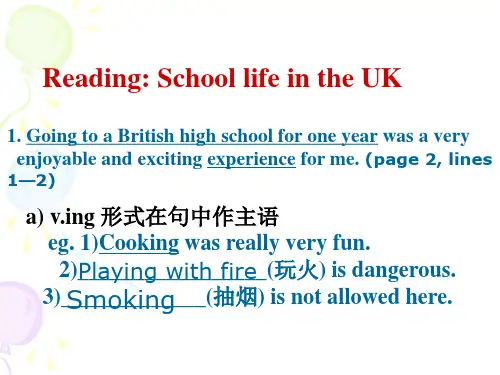
Be meant to do sth. 打算,必须 You are meant to take your shoes off when you enter a Hindu temple. Your friendship means a great deal to me. 有意义,有价值 But I don't believe he means any harm. 有……意图 This picture is meant for me.打算给(谁) What do you mean by coming here this morning?<你……是什么意思?> Adj. be very mean with money
8. It was a struggle for to do…(page 2, line 18) 1). verb Struggle to do sth. I was struggling with the accounts. Struggling young writers 奋斗中的年轻作家 2) noun. Give up the struggle for life
10. challenging adj. challenge vt.邀请,向……挑战 邀请, 邀请 挑战
challenge n.
1) I challenge him to a game of tennis. 2) I challenge you to race me across the lake. 3) She finds her new job very challenging. 4) I am looking for a job with a bit more challenge.
3) A man of much experience /c/ n. The car accident was a terrible experience to him. eg: 那次的车祸对他来说一次可怕的经历。 那次的车祸对他来说一次可怕的经历。
英语周报高中英语 Unit1 School life Reading教案 牛津译林版必修1

Unit1 School life ReadingThe General Idea of This Period:This period is about the reading of the passage School Life in the UK. It will help you to learn more about school life in the UK and the differences between that in the UK and in China. Meanwhile you can learn some reading strategies such as skimming and scanning.Teaching Aims:Train the students’ reading ability.Learn some useful words and expressions.Learn more about school life in the UK and the differences between school life in the UK and in ChinaTeaching Important Points:Help the students to understand the passage better.Learn and master some important words and phrases in this period.Teaching Difficult Point:How to help the students improve their reading ability and understand the passage better.How to master the important language points in this passage.Teaching Methods:Fast reading to get the general idea of the text.Careful reading to understand the passage better.Discussion to help the students understand what they’ve learned better. Explanation to help the students master some language points.Teaching Aids:A tape recorder.A multimedia.Teaching Procedures:Step 1 Greetings1.Greet the whole class as usual.2.Check their home work.Step 2 Reading1. DiscussionT: Last time we learned about some differences between Chinese and British school life. First let’s work in groups and have a discussion about the school life in the UKAsk the students to have a discussion in groups.T: Today we are going to read a passage by Wei Hua, who once studied in the UK. She will give us some detailed information about the school life in the UK.2. Reading strategyT: This is the first time to read a passage, so first let’s share some reading strategies:Reading strategies: skimming and scanningWe skim a text when we want to get a general idea of what it is about. We look at the titles and headlines, the first and last sentences of paragraphs and the first and last paragraphs as well as pictures and charts to guess what the text is about.When we want to find certain information in a text quickly, we scan the text for key words and phrases, dates, numbers, etc. We do not need to read the whole text word by word.3. Skimming and scanningT: Now let’s skim the text quickly and tell the topics mentioned in the text.Next let’s scan the text and answer these questions. Hand up when you get the answers.(T show the questions on the screen.)1. How long did Wei Hua stay in Britain?2. What was the name of Wei Hua’s class teacher?3.What did Wei Hua make in her art class?Suggested answers:1.For one year.2.Mr Heywood.3. A small sculpture.T: Now let’s do some true or false exercises.(T may begin with the T/F questions orally and this is also a good time to test their listening abilities as well as their comprehension of the text.) T: First some true or false questions. If it is false, please try to correct it.1.Wei Hua’s favourite teacher was Mr Heywood.2.Most British classes have fewer than thirty students.3.Wei Hua had more homework in her school in China.4.It was very expensive for Wei Hua to communicate with her parents.5.In the UK, students can choose to stop studying any subject.6. The cake made by Wei Hua did not taste good.Suggested answers:1. Study and high grades2. Because they had different students in some classes.3. Because all the homework was in English.4. All her teachers5. She used English every day and spent an hour each day reading English books in the library.6. Desserts.( You may have some links on the screen when you want to explain those useful expressions , or just explain those on the Bb listed by the students . ) 4. Detailed readingNow let’s read the passage again carefully to check the answers. Underline the new words in the text. Meanwhile, some more questions are waiting for you.(First go through the questions so that they know what to find out. Give thema chance to discuss with their partners if they want)1.What time do British Schools usually begin?2.What time do they usually end?3.On average, how many students are there in a class in the UK?4.Why did Wei Hua find her homework difficult at the beginning of her studyin the UK?5.On Tuesdays, what did Wei Hua do in evening?6.What do British students usually eat after their main meal?7.Which British city did Wei Hua go to?(Write down the new words the students have just listed.)T: Next let’s do some multiple choices and try to choose the best answers to the questions.5. ConsolidationAsk the Ss to talk about the topics mentioned in the text and then fill in the forms.6. Careful reading and practiceAsk the Ss to match the words with correct definitions.Further discussion:Ask the Ss to talk about the two questionsPractice, Listening and ConsolidationT: Now let’s do practice and review some useful words in the text.Next, let’s listen to the tape. You may follow it while listening and please pay attention to your pronunciation.(The teacher plays the tape for the students to listen. After that the teacher gives the students a few minutes to read aloud the passage. Meanwhile, the teacher asks the students to try to remember some details.)T: Please turn to Page 5.Let’s do Exercise E. Complete the letter to Wei Hua using the words below.Suggested answers:1.experienced2.fond3.literature4.dessert5.struggle6.respect7.encouragementStep 3 Discussion:T: Now you’ve known much about Wei Hua’s school life in the UK. From the text we know that they have a variety of subjects to choose from. You may be quite puzzled whether it is necessary for senior students to learn some of them, such as so many languages and art. Here let’s have a discussion: Should students learn more languages? Why or why not?What subjects would you like to take if you could choose? Why?T: Use the conversation below as an example:A: What subjects do you like best and least?B:I really enjoy Cooking and Art classes, because I like making things, but I ‘m not very good at History.A:I like English and Chinese best. Do you think we should learn more foreign languages?Perhaps we should learn….Step 4 Summary and HomeworkT: Today we’ve learned a text about Wei Hua’s experience in the UK. First we learned some reading strategies: skimming and scanning. Master these and put them into use in future while reading. Through reading we know there are many differences both in the timetable and in the curriculum. Read the passage after class and get familiar with these language points. Have a further discussion with your partners about the topic in Part F.。
牛津译林版高中英语必修一高一Unit1SchoollifeSectionⅠWelcometotheunitReading
• 4.itdidnotverybeautifulwhenitwasfinished,
Istilllikeditverymuch.
• 尽管它做完后看起来并不很漂亮,我仍然非 常喜欢它。
• 1.enjoyable/experience
•(
教
材
原
句)GoingtoaBritishhighschoolforoneyearw
• (2)Manyhighschoolstudentshavepart-tim ejobsbytheageof15or16, someevenlater.(F)
• (3)Sixteenistheillegaldrivingageinmostst
Unit1 Schoollife SectionⅠWelcometotheunit,Reading
• Mosthighschoolshaveatleastonesportste amthatcompetesinlocalevents, andallstudentsareencouragedtotakepartina
• Manyhighschoolstudentshavepart-timejo bsbytheageof15or16, someevenearlier.Theirfirstjobsareoftenbab ysittingorcuttinglawns, butlatertheywilllikelygetajobatafast-foodres taurantorclothingshop.
causetheyhadtomovetodifferentclassroom
sfordifferentclassesandalsohaddifferentstu dentsinsomeclasses.Duringherstudy,
江苏省连云港高级中学译林牛津版高中英语必修一课件:unit1unit1schoollife

• Dear Mr. Principal:
• As a new student, I really enjoy being here in this
• school.
• ________________________________________
• ________________________________________
page one and find out the differences between British and Chinese high schools • 2. Complete the chart after your discussion
Word focus
• You may use the following words in your discussion.
• Mary: It’s easy. Go along Main Street. When you get to King Street, turn left. It’s right next to the post office. You can’t miss it.
• Jack: OK. Go up this street and turn left at King Street. It’s beside the post office.
•1. pre-school education (2----5years old) •(UK) play school / nursery school •(China) kindergarten
•2. primary education (5/6----12/13) •(UK) junior school •(China) primary school
【高考英语一轮复习教案】牛津译林版必修一Unit1 School Life

Module 1 Unit1 School Life课标单词短语attend 出席,参加earn vt.获得;赚,挣得respect n.&vt. 尊敬,敬重achieve vt.赢得,取得;实现,成就grade n.学分;成绩;等级literature n.文学average adj.一般的,普通的;平均的challenging adj.具有挑战性的lunchtime n.午餐时间e-mail vt.给……发电子邮件for free 免费extra adj.额外的,外加的cooking n.做饭;烹饪,烹调prepare vt.&vi.准备drop vt.放弃miss vt.思念,想念dessert n.(餐合的)甜点field n. 运动场,操场experience vt.经历,体验article n.文章penfriend n.笔友introduce vt.介绍immediately adv.立即,马上former adj.从前的,以前的recently adv.最近,近来culture n.文化develop vt.培养,养成photograph n.照片,相片donate vt.捐赠,捐献;赠予gift n.赠品,礼物display vt.陈列,展览kindness n.善举;好意,善意guest n.客人,来宾speech n.演说,演讲,讲话flat n.套房attention n.注意,关注pay attention to 注意please vt.使满意,取悦title n.(书的)名称;(文章的)韪目,篇名dynasty n.朝代,王朝cover n.(书的)封面;盖子back cover (书的)封底recent adj.新近的,最近的professor n.教授recent vt.&vt.遗憾,抱歉;后悔,惋惜inform vt.通知,告知run vt.管理,经营host n.主持人;主人,东道主approve vt.&vi.批准,通过;赞成broadcast vt.&vi.广播;播放preparation n.准备,筹备close adj.亲密的;靠近的outing n.短途旅行,远足continue vt.&vi.继续,持续poet n.诗人generation n.一代,一代人poem n.诗,诗歌select vt.选择,挑选require vt.要求scary n. 自然,大自然课文出现短语1. at ease with2. know of sb / sth3. tell the differences between A and B4. on (the) average5. used to do sth6. be happy with sth/ sb7. for free8. such as9. encourage sb to do sth10. introduce A to B11. pass sth on (to) sb12. be available for13. far (away) from14. make sure that15. graduate from university16. upon/ on doing17. surf the internet18. donate sth to sb19. forget to do sth20. inform sb of sth21. prepare for22. be responsible for23. be made up of24. consist of25. come up with26. tell sb about sth27. sound like28. word by word 29. drop some subjects30. play on the school fields31. e-mail sb32. talk to sb about sth33. prepare to do sth34. thank sb for35. invite sb to be/do36. make a speech about37. run a radio club38. approve the idea39. require sb to do sth一.单词应用根据单词的首字母或汉语意思填写正确单词,注意形式变化。
全国通用2024高考英语一轮复习Unit1Schoollife讲义含解析牛津译林版必修1

4.encouragementn.激励→encouragevt.激励→encouragedadj.鼓舞的→encouragingadj.令人鼓舞的
5.satisfactionn.满足→satisfyvt.使……满足→satisfiedadj.满足的→satisfying/satisfactoryadj.令人满足的
6.graduatevi.毕业n.毕业生→graduationn.毕业
7.fluentadj.流利的→fluentlyadv.流畅地→fluencyn.流利
8.paintingn.绘画,绘画作品→paintvt.油漆;绘画→paintern.画家;油漆匠
9.approvevt.&vi.批准,通过;赞成,同意→approvaln.批准,赞成→approvingadj.赞成的,满足的
在(做)某事方面有阅历/在行
inexperiencedadj.缺乏阅历的
[练通]
片段语法填空
④If you are anexperienced(experience) traveler wanting to explore China fully, it is recommended that you should travel to Dunhuang, Zhangye, Jiayuguan, Turpan, Kashi and Urumqi to follow the footprint of Marco Polo and feel theexperiences(experience) of Marco Polo on the journey.This route will beanunforgettable experience for you and it will be fit for you.I believe you can gain lots ofexperience(experience) and knowledge of traveling from this journey.
译林牛津新教材必修一unit 1 Extended reading- school life in the Uk
关于英美学校:
1) Last year, I had the chance to study at a British secondary school as an exchange student. 英美初、高中表达: 英国: secondary school 中学(初中和高中) 美国: high school 中学 junior high school 初中 senior high school 高中
Subjects: Students usually have to learn nine subjects at secondary school. They must study English, Maths and the Science subjects: Biology, Chemistry and Physics. They can also choose from History, Art and Business, etc.
What is your first impression of your school? big, beautiful, high building, more students and teachers, …
alarm n. 闹钟; 恐慌 vt. 使惊慌
biology n. 生物学
butter n. 黄油
• to provide the place and everything that is needed for an organized event; host
• difficult to do; physically/emotionally strong and able to do difficult situations; tough
高一英语(译林牛津版) 必修一教师用书 Unit1 School life
Unit 1School life【美文阅读】School years in different countries当你正在享受假期的时候,世界上有些国家的孩子却还在学校里学习。
由于地域、文化、时区的差异,在世界上不同的国家,学校里的学制、假期及课程安排等也形式各异。
Somewhere in the world, right now, students are hard at work in school and some are enjoying holidays. With over 190 nations across the globe's 24 time zones(时区), there are different types of school year. Here's a brief introduction to the typical school year in the following three countries.AustraliaStudents in Australia attend school for 200 days a year. Their school year lasts from late January to late November. Since Australia is in the Southern Hemisphere(半球), it experiences summer while it's winter in China. Summer vacation for Australian students is from December to late January. The school year in Australia is divided into four terms, with each term lasting 9 to 11 weeks. Students then have two weeks of vacation between each term. The typical school day is from 9 a.m. to 3:30 p.m., and lunch is eaten at school. Students are required to attend school for at least nine years.FranceThe school day in France typically runs from 8 a.m. to 4 p.m., with a half day on Saturday. Lunch is a two-hour break for public school students. Students usually attend school from the age of 6 to 18. The school year lasts from August to June, and is divided into four seven-week terms. Students in the primary grades learn basic skills in reading, writing, and math, as well as participate(参与) in exercises to develop observation,imagination, and physical abilities. Older students study French, math, physical and natural sciences, foreign language, history, etc.JapanMost Japanese schools run on a trimester(三学期制) schedule. The school year begins in April and ends in the following March, with summer, winter and spring holidays to separate the three terms. Uniforms are required and there are many rules for hairstyles, shoes, socks, skirt length, etc. Students in Japan study academic subjects, such as Japanese language, math, reading, social studies, and they also receive moral(道德的) education. Moral education involves teaching students about health and safety, understanding and confidence, public manners, and environmental awareness.From:http://www.factmonster. com【诱思导学】1.What is the difference between our school year and theirs?【答案】We have different terms. There are usually two terms in our school year while in both Australia and France, they have four terms and Japan has three.2.Do you think our present school year is good or not, and why?【答案】It is hard to say good or bad because different countries lie in different time zones, they enjoy different holidays and different schools.3.Do you want to know the school life in the UK?Why or why not?【答案】Yes. Because the school life in the UK interests me very much./No. Because I have no interest in the school life there. It's none of my business.Period ⅠPreviewing(教师用书独具)●教学目标本课时主要是通过学生对学案所给出的内容的学习,了解本课文中所出现的词汇,初步了解课文以及相关的背景知识,对下一堂课课文的全面理解起到一个铺垫作用。
牛津英语必修一修Unit 1 School life作业题详解 (5)
Unit 1 School lifePeriod One Welcome to the unit & ReadingⅠ.用介、副词填空1.I was very happy ________ the school hours in Britain because school starts around 9 a.m. and ends about 3∶30 p.m..2.He also told us that the best way to earn respect was to devote ourselves ________ study and achieve high grades.3.We had to move ________ different classrooms ________ different classes.4.However,it was a bit challenging for me ________ first,because all the homework was ________ English.5.I usually went to the Computer Club ________ the lunch break,so I could send e-mails to my family and friends back home ______ free.6.________ the end of term we held a class party and we all had to cook something.7.They can choose other subjects ________ Art and Computer Science,or languages such ________ Spanish and German.8.After lunch,we usually played ________ the school field.9.I look back ________ my time in the UK ________ satisfaction,and I really hope to go back and study in Manchester again.10.Next year,I plan ________ attending a high school in China ________ a student exchange programme,and I found your article a great encouragement ________ me.Ⅱ.佳句翻译与仿写1.He also told us that the best way to earn respect was to devote ourselves to study and achieve high grades.翻译:________________________________________________________________________ ________________________________________________________________________ 仿写:教练告诫运动员们,赢得比赛的关键是保持冷静,按部就班地做好每一个动作。
译林牛津版高一英语必修一unit1schoollife教案
Unit 1 School lifeTeaching aims of the whole unit:1.Develop students’ ability of reading comprehension by reading an article about school life in the UK and two other articles about school clubs.2.Develop students’ ability of listening comprehension by listening to two talks about school activities.3.Develop students’ speaking ability by discussing daily school life and reporting school activities.4.Develop students’ writing ability by writing a notice about school activities.5.Develop students’ integrated skills of using English by making a poster for a school club.6.Enlarge students’ vocabulary about school facilities.7 Help students understand what an attributive clause is and what relative words function as in attributive clauses; teach students how to use relative pronouns that, which, who, whom and whose.Period arrangement:The whole unit: 12 periodsWelcome to the unit: 1 periodReading: 2 periodsWord power: 1 periodGrammar and usage: 2 periodsTask: 2 periodsProject: 2 periodsSelf-assessment: 1 periodRevision and exercises: 1 periodPeriod 1 Welcome to the unitI. Teaching aims:1 Get students to know the different high school loves between the UK and China.2 Develop students’ English speaking skills.II. Teaching Procedures:Step 1. Warming upLet some students make a self-introduction.1. Introduce themselves.2. Say something about their junior high school life.3. Pair work: brain storm:When we are talking about our school life, what will we probably think of?What words or phrases will we use to describe our school life? Step 2 Presentation1.Say the following to students:It’s the beginni ng of the new term. You’ve just finished your junior high and are about to enter a new period in your studies. I am happy to give your lessons and I hope we can be friends.I can see that some of your are eager to know what studying at senior high will be like. Will it be differ4ent from junior high? Well, there are certainly many differences between junior high and senior high, but there are also some things that are the same in every school in China. What about schools in other countries? Do you have different experiences? Are schools all over the world the same? This is the subject of our first unit.2. Ask students to read the instruction and tell them:Here are three pictures that show some aspects of school life in the UK. Please read the instructions, look at the pictures: what's the difference between schools in China and the UK?Step 3 Discussion1 Ask students the following questions to talk about the words in the four pictures:Huge campus and low-rise buildingsWhat does huge mean?What does low-rise mean?What about campus and school buildings in China?(Schools in China usually have a large enough campus to make sure students have enough space to study and play. But most school buildings have at least 3 storeys.)Lockers for every studentDo you know what a locker is?(There are rows of lockers by the classrooms for students to put their bookd, exercise-books and other belongings.)What do you think about locker for students?Do you think that we should have such locker in our school? Why or Why not?Fewer students in each classHow many students are there in our class?Do you know the number of students in a class in the UK?At ease with our teacherWhat can we know from this picture?What does the word ease mean? What do you think the phrase at ease mean?Were you getting on well with the teacher when you were in junior high?What relationship do you want to have with your teachers in senior high?2 Ask students to work in groups to talk about the four pictures and the differences between schools in the UK and China. Then ask several students to report their discussion to the whole class.aspects In the UK In ChinaHuge campus and low-rise buildings We can see hugecampus andlow-rise buildings.It is the biggestdifference fromschools in ChinaSchools in China usually have alarge enough campus to make surestudents have enough space tostudy and play in.But most school buildings aretaller, at least three storeys.Lockers for every student There are rows oflockers by theclassrooms forstudents to put theirstationary, books,exercise-books andother belongings.Students bring what they need forlessons to school and then take itall back home after school. Mostschools in china do not haveequipment in the classroom.Fewer students in each class There are fewerstudents in a class,no more than 30 perThere are usually more students inhigh school, perhaps 40 to 50 perclass. Recently some schools areclass. beginning to limit the number ofstudents in each class.At ease with our teacher Students have aclose relationshipwith their teachers.They feel at easeand comfortablewith them.It is similar in china. Nowadays,lots of teachers and students haveestablished a good relationshipwith each other. They respect eachother and work to gain a betterunderstanding of each other.3. Ask students to discuss the three questions in pairs, and them ask some of them to report their answers to the questions to the whole class.What is your dream school life like?What kind of school activities do you enjoy?What do you think of your life here in the new school?Step 4 Summary and HomeworkToday we’ve mainly talked about the differences between the high school lives in the UK and in China. After class you should:1) Recall all the new words and expressions that we learn in this lesson.2) Find more about any other differences between the high school lives in the UK and in China, either by surf the Internet or by reading some articles in newspapers or magazines.3) Preview the following part: reading (page 2 to page 4).Period 2 Reading (1) School life in the UKTeaching aims:1. Get students to know what school life is like in a high school in the UK.2. Develop students’ ability of reading comprehension through:1)skimming and scanning.2)Guessing the meanings of some new words from the context3. To learn some expressions about school life.Teaching procedures:Step 1 Lead-in and PresentationSay the following to the students:Yesterday we’ve talked about the differences between the high school lives in the UK and in China. We know well about the high school lives in China, because we are Chinese. But we know a little about the high school lives in the UK. Yeah? Today we are going to read a magazine article which is written by an exchanging student. She has been studying in the UK for one year. Now she gives a clear brief introduction about her school life there.(Bb: School life in the UK) Before we read the article, we are going to learn the reading strategy: skimming and scanning.Please look at page 3: Reading strategy. (Bb the following while learning the reading strategy. )Skimming: to get a general idea of the article, without studying it in detail.Focus on the titles, headings, the first and last sentences or paragraphs, charts and pictures …scanning: to find certain information in an article quickly.Look for key words and phrases, dates and numbers, etc.Step 2. Reading1. Skimming:Question: How does Wei Hua feel about her life in the UK?2. Scanning:1)Ask students to go through the three questions in part A and makesure that each of them know the meaning of each question.(AWoodwork class is a class in which students make somethingfrom wood.)Ask students to read the passage as quickly as possible and try to find answers to the three questions. Remind students only tofocus on and identify the most important information.2)Ask student to reread the passage and complete Part C1individually. Then ask some of them to give the answers to thequestions in Part C13)Ask students to finish Part C2 individually. Then get somestudents to share their answers with the whole class. Ask them to say the true sentences to correct the false ones.3 GuessingAsk students to finish Part D individually. Tell them not to look up the meanings of the words from the wordlists in the textbook. Let themguess the meanings from the context. Then check the answers with the whole class.Step 3 New Words in this UnitStudy the new words appears from page2 to page 5 (from attend to immediately) at page 68.Step 4. Homework.1. Complete part E on page 5.2. Read the two articles in reading on pages 82 and 83 in wb and answers the questions below them.3. Learn all the new words we learned today by heart.Period 3 Reading (2) School life in the UKTeaching aims:1 Help students become more familiar with the article.2 Develop students’ ability of reading comprehension by finding out what topics are covered in the article.3 Develop students’ ability of speaking by discussing the subjects they like in school.Teaching Procedures:Step 1. Revision:Check the homework:1)Have a dictation to go over the words learned last period.2)Check the answers in reading on pages 82 and 83 in wb.3)Ask some students to read the article in Part E to check whetherthey have used the suitable word in each blank.Step 2 Reading1) Ask some students to read the article aloud paragraph by paragraph. Ask other students to find out what topics are covered in it.School hoursSchool assemblyTeachersClass sizeDifferent classes in different classroomsHomeworkSubjects and favourite subjectsWhat to do at lunchtimeBritish food3)Ask students to point out the different high school lives in the UKand in China in these topics.Step 3 DiscussionLet students look at Part F together and discuss the questions in Part F in Pairs. Then get some pairs to act out their discussion in class.Step 4 Language focus1 Ask students to find out the following words, phrases and sentences in the article. Then give some explanations.Words:a)as (since, because, for)b)attend (join, join in, take part in)c)prepared)experiencee)respectf)exciting, excitedg)dropPhrases:a)for freeb)be happy withc)used to do sth.; be/get used to do sth.; be/get used to doing sth.d)the way to do; the way of doing; the way + Attributive Clausee)at the end of; in the end; by the end off)as … asSentences:a)Going to a British school for one year has been a very enjoyableand exciting experience for me.b)I do like eating.c)We also had different students in some class, so it was difficult toremember all the faces and names.2 Ask students to put the following sentences into English in their exercise-books.1) Jim 加入了我们的讨论之列。