
仁爱版英语八年级下册Unit7__Topic2__SectionD学案
仁爱版英语8年级下册
Unit7 Topic2 SectionD参考学案
学习目标
1. Learn some new words and phrases:
southern ,seafood, pick, pick up, around the world, far away from
2. Review the object clauses with “if/whether”
3. Review the comparative and superlative degrees of monosyllabic adverbs.
4. Review sequences: First…,Next…,Then…,After that…,Finally…
5. Talk about the different eating habits in different areas.
预习导纲
1、单词互译与记忆
1) southern , 2)seafood , 3) pick
2、短语互译与记忆
1) around the world_______________________
2) far away from______________________
3) 拿起,捡起,接某人_____________________
4) both of ________________
3、句子理解与熟读
1)People around the world have different eating habits.
2) In parts of India, people use their fingers to pick up the food.
3) … , but it is not polite to use both of them at the same time.
课堂导练:
1、选词填空
1) Yunnan lies in the ____________ part of China.
2) My home is the school, so I go to school by bus.
3) It’s ___________ to say “thanks” when someone helps you.
4) The boy ____________ an ID card on the road and he gave it to a policeman.
5) Kangkang had some rice for the main ____________.
2. 单项选择。
( ) 1. —Can you tell me______ Jane likes fast food?
—Yes, she likes it very much.
A. because
B. when
C. if
D. so
( ) 2. —Which color do you like_____, yellow, green or black?
—Green.
A. good
B. well
C. better
D. best
( ) 3. —When the big dog came to the man, he_____ a stone and threw at the dog.
A. ate up
B. picked up
C. put up
D. cut up
( ) 4. Li Hong studied ______ than Zhang Tao, so she passed the exam..
A. hard
B. hardly
C. harder
D. hardest ( ) 5. I don’t know ______ Miss Chen will come here or not.
A. that
B. when
C. if
D. whether
复习自测:
完形填空。
I saw two very fat students go into an ice cream shop. They sat down and began to
1 their sweet food. Then they went to a(an)
2 club to have exercise. Because they wanted to be healthy. But they have some
3 habits.
We know that healthy 4 is a way to keep fit. It is very 5 to give our body the energy. The energy should come 6 rice, bread, vegetables and fruit. We 7 need to drink a lot of water, six to eight glasses a day. Now many children eat different kinds of 8 foods. They become fatter and walk 9 than before. They feel tired easily.
In fact, doing sports can also help keep healthy. When we exercise, it can make us 10 . It can even help us sleep better at night.
In short, we not only need healthy eating but also need exercise.
( ) 1. A. like B. enjoy C. satisfy D. sell
( ) 2. A. health B. English C. music D. food
( ) 3. A. good B. well C. bad D. worse
( ) 4. A. ways B. eating C. drink D. thoughts
( ) 5. A. difficult B. final C. important D. cheap
( ) 6. A. back B. into C. up D. from
( ) 7. A. hardly B. also C. immediately D. only
( ) 8. A. unhealthy B. same C. regular D. comfortable ( ) 9. A. more slowly B. faster C. most slowly D. fastest
( ) 10. A. slow down B. relax C. imagine D. tired
课文解读:
1. In parts of India, people use their fingers to pick up the food.
在印度的一些地方,人们用手指拿食物吃。
“pick up” 意为“拿起,捡起,接某人”。
如:
The phone rang and I picked it up. 电话铃响了,我那起了话筒
My uncle will pick you up. 我叔叔会来接你的。
2. if和whether引导的宾语从句。
1)if和whether都可引导宾语从句,意为“是否”。
如:
I’m not sure if/whether Kate can make biscuits. 我不能确定Kate是否会做饼干。
2)whether可于or not 连用,而if则不能。
如:
She d oesn’t know whether or not Jack is in the classroom now.
她不知道Jack现在是不是在教室。
3. 副词的比较级和最高级
1)表示“一方比另一方做得更……”要用副词的比较级,其结构为“副词比较级+than…”。
如:Kangkang comes to school earlier than Jane.康康比Jane到校早
2)表示“一方在多方中做得最……”时用副词的最高级,其结构为:
“the + 副词最高级+ in/of…(比较范围)”,意为“某人或某物在某范围内最……”,副词最高级前可省略the 。
如:
Jane did best of the three girls. Jane在三个女孩中做得最好。
评价。
仁爱版八年级英语下册第七单元TopicSectionD教案
Unit7 Topic1 SectionD精品教案Ⅰ. Material analysis本节课建议用1课时完成。
主要活动为Section D的1a和2。
本课学习活动通过呈现Kangkang和小伙伴们为美食节制作的海报来展开,要求学生能读懂并解释海报提供的信息,复习有关邀请的句型,复习邀请函的写法,并能为身边的活动写出简单的邀请函。
本课是本话题的最后一课,要求学生通过本课的学习活动,复习本话题的重点词汇、短语和有用的表达方式,对that引导的宾语从句的用法作以总结。
鼓励学生要有学习英语的愿望和兴趣,乐于参与各种英语实践活动。
Ⅱ. Teaching aimsKnowledge aims:1. 总结that引导的宾语从句的用法。
2. 复习有关邀请的句型。
3. 复习邀请函的写法。
Skill aims:1. 能听懂接近正常语速的有关美食和美食节话题的语段,识别主题,并获取主要信息。
2. 能就邀请他人参加美食节的话题进行交谈。
3. 能从所给海报中找出有关信息。
4. 能写出简单的邀请函。
Emotional aims:有学习英语的愿望和兴趣,乐于参与各种英语实践活动。
Ⅲ. The key points and difficult pointsKey points:1. 总结that引导的宾语从句的用法。
2. 复习有关邀请的句型。
3. 复习邀请函的写法。
Difficult points:从所给海报中找出有关信息,并用含有宾语从句的句子进行讨论。
Ⅳ. Learning strategies在学习中善于结合图文信息深入理解主题。
Ⅴ. Teaching aidsComputer multimedia projector, two or three postersⅥ. Teaching proceduresⅦ. Blackboard designUnit7 Topic1 SectionD精品教案Ⅰ. Material analysis本节课建议用1课时完成。
2021年仁爱版八年级英语下册Unit 7(Topic2 SectionA)导学案.doc
Unit 7 Topic 2 Section A 导学案一、话题导学:(学习目标)1. Learn some new words and phrases:finely, oil, pan, lightly, add, fry, ingredient, pot, cooker, pork, ham, onion, noodle, bowl, quick, healthily, cut up, junk food,fried rice,Well done!2. Learn adverbs of manner: finely, lightly, immediately3. Know the ways to cook Chinese food: “How to make fried rice”4. Talk about sequences: First…, Next…,Then…,After that…,Finally…5. Learn object clauses with “whether”:But I’m not sure whether I can cook it well.二、预习导纲:1、单词互译与记忆1) finely , 2) oil , 3) pan , 4) lightly5) add , 6) fry , 7) ingredient 8) pot ,9) cooker , 10) pork , 11) ham , 12) onion13) noodle , 14) bowl , 15) quick , 16) healthily2、短语互译与记忆1) 炒米饭2) junk food 3)be not sure whether…4)cut… finely 5)切碎,剁碎6)Well done! 7)First…,Next…,Then…,After that…,Finally…3、句子理解与熟读1) But I’m not sure whether I can cook it well.2) But you must cook very carefully.3) First, cut some cooked meat very finely. / Next, you need to put some oil in the pan. / Then fry the meat lightly. / After that,you need to add the rice slowly./Finally, add some salt.4) Well done !.三、课堂导练:1(电的)to cook now.2) are not good for our health.3) First, cut some cooked meat very .4) —Can I help you, sir ?—Yes, please. I’d like a of soup and some rice.5) People in the north of China like .2.单项选择。
仁爱版英语八年级下册Unit7Topic2SetionA教学设计
1.重点:本节课的核心词汇和短语,如:hobby, collect, stamp, coin, postcard等,以及一般现在时描述兴趣爱好的句子结构。
难点:如何引导学生将所学的词汇和句型灵活运用到实际情境中进行交流。
2.重点:听力技巧的培养,尤其是捕捉关键信息的能力。
难点:提高学生在听力过程中的注意力集中,以及对细节信息的准确把握。
6.小组合作:鼓励学生分组讨论,共同完成各种任务,培养学生的团队合作意识和沟通能力。
7.课堂小结:教师引导学生总结本节课所学内容,强调重点知识和技能,巩固学生的学习成果。
8.作业布置:设计富有针对性的作业,让学生在课后巩固所学知识,提高实际运用能力。
9.教学评价:采用多元化的评价方式,关注学生在知识、技能、情感态度等方面的全面发展。
3.教师通过例句和练习,讲解一般现在时在描述兴趣爱好时的句子结构,如:“I like collecting stamps./ He plays the guitar.”。
4.教师针对学生容易出错的地方,进行详细的讲解和指导,帮助学生掌握语法知识。
(三)学生小组讨论
1.教师将学生分成若干小组,每组选择一个兴趣爱好作为讨论主题。
4.学生在学习方法上,已经具备了一定的自主学习能力,但仍需教师在过程中给予适当的指导。因此,在教学过程中,教师应注重引导学生运用所学方法,提高学习效果。
5.学生在团队合作方面,具有一定的合作意识,但部分学生在小组活动中表现出依赖心理。教师应加强学生团队合作能力的培养,提高学生的主动参与度。
三、教学重难点和教学设想
4.提高听力技能,能够理解并获取关于他人兴趣爱好的信息。
5.提高口语表达能力,能够与他人就兴趣爱好进行简单的交流。
仁爱版英语八年级下册:Unit 7 Topic 2. I'm not sure whether I
Unit 7 Food FestivalTopic 2 I’m not sure whether I can cook it wellSection B【学习目标】:1.谈论Kangkang和同学们为美食节做准备,学习西餐中三明治的做法。
复习运用表达请求和允许的功能用语,进一步学习运用表示顺序的副词的用法、以及由whether/ if引导的宾语从句。
2.初步接触单音节副词的比较级和最高级。
3.了解不同国家不同的餐桌礼仪,引导学生乐于接触和了解外国风俗文化,从而更好地为弘扬中国文化服务。
【学习重难点】:运用表达请求和允许的功能用语,进一步学习运用表示顺序的副词的用法、以及由whether/ if引导的宾语从句。
【学习过程】:第一段:短课导学模块一:自主学习学习内容摘记Step1. Leading & Listening1. Students retell the steps of cooking fried rice, using First… Second…Then… Finally…2. (PPT) First, learn the news : snack , butter, pear, pieceThen , T:Do you know how to make a sandwich with some bread and apear? Now,please watch the flash and finish 1b。
3. 播放视频,学生跟读。
Step2 品读----读出理解。
(自主学习:要求独立、安静完成)一、underline the following phrases and sentences1) 在1a 中,圈出这些表示顺序的副词:First…,Next…,Then…,After that…,Finally…;2) cut…into…把…切成…3) Would you mind if we learn to make it from you? 你介意我们跟你一起学做吗?4) Practice makes perfect. 孰能生巧嘛。
仁爱英语八年级下册Unit 7 Topic 2 Section D
Unit 7 Food Festival
Grammar
Object Clauses(Ⅱ)
But I'm not sure whether/if I can cook it well. Can you tell me if/whether it's polite to eat with your arms or elbows on the table in America?
China
Parts of India Thailand Korea
People use their fingers to pick up the food. People eat with a spoon and a fork and they don't use knives at all. People use spoons or chopsticks to eat, but it is not polite to use both of them at the same time.
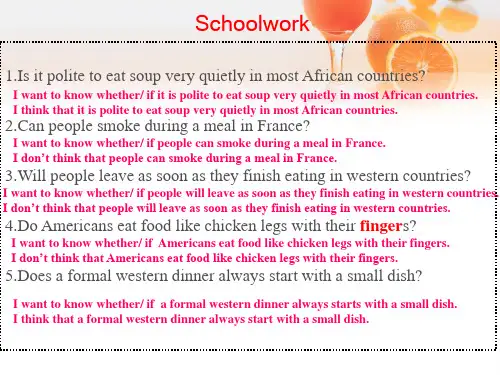
2.Can people smoke during a meal in France?
I want to know whether/ if people can smoke during a meal in France. I don’t think that people can smoke during a meal in France.
3.Will people leave as soon as they finish eating in western countries?
I want to know whether/ if people will leave as soon as they finish eating in western countries. I don’t think that people will leave as soon as they finish eating in western countries.
仁爱八年级下册UNIT7-Topic-2-SectionB教案
Section BSection B needs 1 or 2 periods. Section B需用1~2课时。
The main activities are 1a and 2a. 本课重点活动是1a和2a。
Ⅰ.Aims and demands 目标要求1. Learn some new words:butter, pear, piece, polite, spoon, fork, chopstick2. Go on learning object clauses with “if / whether”:Can you tell me if it’s polite to eat with your arms or elbows on the table in America?Do you know whether they use knives?I don’t know if there’s any need for knives, forks or chopsticks.3. Social communications.(1) Asking for permission:Would you mind if we learn to make it from you?(2) Having meals:Help yourself to some soup.Ⅱ.Teaching aids 教具录音机/图片/小黑板/彩笔Ⅲ. Five-finger Teaching Plan 五指教学方案Step 1 Review 第一步复习(时间: 4分钟)复习Section A中的1a和2a,导入新课。
(检查作业,检查学生对知识的掌握情况。
)T: Let’s check y our homework. Who can tell me how to make a meal for your parents?(学生讲述,教师板书。
新仁爱版八年级英语下册unit7Topic1sectionA教案
unit7 Topic1 sectionA 教案Ⅰ. Material analysis本节课为话题的第一节课,建议用1课时上完。
主要活动为Section A 的1a 和2。
本话题由C raig Kielburger 从12岁起建立解放儿童组织,创办柯氏国际儿童基金展开。
在本课1a 的对话中,为了帮助Craig Kielburger ,Kangkang, Michael, Maria 和Jane 决定举办一次“国际美食节”。
通过让学生了解四个小伙伴为美食节做的种种努力,鼓励他们积极参与有益的课外实践活动,培养关心他人,乐于助人的态度。
本话题的语法重点是学习that 引导的宾语从句。
Ⅱ. Teaching aims Knowledge aims :1. 学生能正确拼读并运用为美食节做准备的词和短语。
2. 学生能简单地掌握宾语从句的用法。
Skill aims :1. 能听懂有关筹集资金计划的对话。
2. 能使用英语简单谈论筹集资金的计划。
3. 能连贯流畅地朗读对话。
4. 能写出简单的帮助他人的短文。
Emotional aims :学习积极参与有益的课外实践活动,关心他人,乐于助人。
Ⅲ. The key points and difficult points Key points :1. 谈论筹集资金的计划。
2. 初步掌握宾语从句的用法。
Difficult points :写出关于筹集资金帮助他人的短文。
Ⅳ. Learning strategies注意发现语言的规律并能运用规律举一反三。
Ⅴ. Teaching aidsComputer Computer multimedia multimedia multimedia projector, projector, projector, the the the pictures pictures pictures of of of Craig Craig Craig Kielburger, Kielburger, Kielburger, a a a poster, poster, poster, the the the pictures pictures pictures of of soup, cheese, cookies, and pancakes, a picture of a blind person, a video of the earthquake in Ya’an.Ⅵ. Teaching proceduresStep Interaction patternStudent activity Teacher activityIntroduction (8 minutes)1. The whole class work. 2. The whole class work. 3. Group work. 4. The whole class work. 5. The whole class work. 1. Focus their attention on the teacher. 2. Students read the passage passage about about about the the the traffic traffic rules rules they they they made made made after after class. 3. Students discuss in groups and ans w er the wer the questions with the structure: I think Iwill…4. Students learn and grasp the new words and phrases with the help of the teacher. 5. Students report the information about Craig Kielburger they collected. 1. Greet students ready for learning. 2. Teacher asks the students to to report report report the the the homework. homework. Let Let the the the students students students read read read the the passage passage about about about the the the traffic traffic rules they made after class. 3. Teacher asks the students to think about the following questions: If someone isin trouble, what will youdo? If someone needs money,what will you do? Then ask the studen ts to answer them with the structure: I think I will…4. 4. Teacher Teacher Teacher teaches teaches teaches the the the new new words by summing up the answers above: “Now Now I I I see, see, see, some some some students students will turn to their their parents, parents, which means they will ask their parents for help. Some students imaginethat they can put on a play to to raise raise raise money. money. money. Y ou Y ou can can try your best to help others, others, I’m I’m I’m so so so proud proud proud of of you!”5. 5. Teacher Teacher Teacher shows shows shows the the the pictures pictures o f Craig Kielburger to the students. Ask the students to to report report report the the the information information about Craig Kielburger they collected. Presentation (10 minutes) 1. The whole class work. 2. Individual work. 3. The whole class work. 4. Individual work. 5. The whole class work. 6. The whole class work. 7. Individual work. 8. The whole class work. 9. Individual work. 10. The whole class work. 1. Students look at the picture of 1a, and understand understand the the the picture picture with the help of the information under it. 2. Students watch the flash, and then mark the sentences of 1b wi th T or F. 3. Students check the answers. 4. Students read the conversation and match the information of 1c. 5. Students check the answers. 6. Students read the sentences aloud. 7. Students find out the same same structure structure structure in in in the the sentences of 1c. 8. Students check the answers. 9. Students watch the flash flash and and and answer answer the questions. 10. Students check the answers. 1. T eacher praises students’ information they collected after after class. class. class. Encourage Encourage Encourage them them to keep on making a preview before before class. class. class. Then Then Then let let let the the students students look look look at at at the the the picture picture of of 1a 1a 1a and and and undund erstand erstand the the picture picture with with with the the the help help help of of of the the information under it. 2. Teacher plays the flash of 1a. Ask the students to watch watch the the the flash, flash, flash, and and and then then mark mark the the the sentences sentences sentences of of of 1b 1b with T or F. 3. Teacher asks two students to tell the answers. 4. Teacher asks the students to to read read read the the the conversation conversation and match the information of 1c. 5. Teacher asks two students to tell the answers.6. Teacher asks the students to read the sentences aloud. 7. Teacher asks the students to find out the same structure in the sentences of 1c. 8. Teacher asks two students to tell the answers. 9. Teacher asks the students to watch the flash again and answer the following questions: (1) How many schools did Free the Children build? (2) What’s Michael’s task?10. Teacher asks two students to tell the answers. Teach the new word p osterposter by showing a real poster to them. Consolidation (10 minutes) 1. The whole class work. 2. The whole class work. 3. Group work. 4. The whole class work. 5. Group work. 6. The whole class work. 7. The whole class work. 1. Students read the conversation after the recording sentence by sentence. 2. Students try to follow the speed, paying attention to the pronunciation and intonation. 3. Students discuss in groups groups to to to find find find out out out the the difficult difficult points points points and and and sum sum up the main points. 4. 4. Students Students Students underline underline underline in in their books and make some notes. Learn and grasp grasp the the the new new new words words and phrases. 5. Students discuss in groups: What will the food festival be like? 6. V olunteers report the result of the discussion. 7. Students act out the conversation of 1a. 1. Teacher plays the recording sentence by sentence. 2. Teacher plays the recording without stopping. 3. Teacher asks the students to learn in groups to find out the difficult points in the conversation. At last let them sum up the main points of the conversation. 4. 4. T eacher T eacher makes makes makes a a a summary summary to to explain the key points and explain the key points and difficult points to the students. (1) have/hold/ organize a food festival (2) turn to sb. /ask sb. for help (3) make a poster (4) get in touch with sb. (5) try one’s best to do sth. (6) make it a success (7) 由that 引导的宾语从句引导的宾语从句5. T eacher lets the students read 1a, and then discuss what the food festival will be like with the the help help help of of of the the the pictures pictures pictures and and the example. Let them practice the usage of the object clauses. 6. Teacher asks four students to report the result of the discussion. Finish 1d. 7. T eacher asks the students to act out the conversation of 1a. Practice (10 minutes) 1. The whole class work. 2. Group work. 3. Individual work. 4. The whole class work. 5. Pair work. 6. Individual work. 7. The whole class work. 1. Students learn and grasp the new words with the help of the teacher. 2. Students discuss what the children children should should should prepare prepare for for the the the food food food festival festival festival in in groups. 3. Students write down the conversations. 4. Students evaluate the conversations, conversations, and and and then then check check the the the answers answers answers with with the teacher. 5. Students act out the conversations in pairs. 6. Students listen and match match the the the people people people with with what we can do. 7. Students check the answers. 1. Teacher teaches the new words soup, cheese, cookies,and pancakes by by showing showing their pictures on the screen. Teach set and set the tableby explaining their Chinese meaning. 2. Teacher asks the students to discuss what the children should prepare for the food festival. 3. Teacher asks four students to write down the conversations on the blackboard. The other students write down at least two conversations in their each workbook. 4. 4. Teacher Teacher Teacher lets lets lets two two two or or or three three students evaluate the conversations on the blackboard. Check the answers. 5. Teacher lets the students act act out out out the the the conversations conversations in pairs. 6. 6. Teacher plays the recording Teacher plays the recording of of 3 3 3 for for for the the the students students students and and lets the students listen and match the people with what we can do. 7. 7. Teacher Teacher Teacher lets lets lets two two two students students tell tell their their their answers. answers. answers. Teach Teach blind by showing a picture of a blind person. Production (7 minutes) 1. Group work. 2. The whole class work. 3. The whole class work. 4. The whole class work. 5. Individual work. 1. Students watch the video and discuss in groups. 2. Students write down their opinions with the structure I think…3. Students share their opinions with with the the whole class. 4. Students summarize Section A with the teacher. 5. Students finish the homework after class. 1. Teacher plays the video of the Ya’an earthquake. Lead the students to discuss in groups: “A terr“A terrible earthquake ible earthquake struck Ya’an in Sichuan Province at 8: 02 on the morning of April 20th this year. Le t’s discuss how to help the p eople in Ya’an.”people in Ya’an.”2. Teacher asks the students to write down their opinions with the structure Ithink…3. Teacher asks four students from different groups to share their opinions. Tell them that we should try our best to help the people in trouble. 4. Teacher shows the summary of this section to the students. 5. Teacher assigns homework: (1) Review the summary after class. (2) Write down a passage about how to help the the people people people in in in Y Y a’an with the sentences containing object clauses. (3) Search some typical foods in different countries to prepare for Section B. Teaching Reflection The students a dmire Craig Kielburger very much. It’s a successful admire Craig Kielburger very much. It’s a successful lesson: lesson: The The The students students students want want want to to to learn learn learn from from from him him him to to to help help help the the the people people people in in trouble. The teacher should introduce more information of Craig Kielburger to the students to encourage them to help others from now on. Ⅶ. Blackboard designUnit 7 Food Festival Topic 1 We’re preparing for a food festival. Section A 1. have/hold/ organize a food festival 2. turn to sb. /ask sb. for help 3. make a poster 4. get in touch with sb. 5. try one’s best to do sth.6. make it a success 7. Kangkang knows (that) Graig comes from Canada. 8. set the table 。
仁爱版八年级英语下册Unit7Topic2SectionA教学设计
3.树立正确的人生观和价值观,明白付出与回报的关系,懂得珍惜和感恩;
4.增强环保意识,关注社会问题,积极参与社会公益活动;
5.提高自信心和自尊心,勇于表达自己的观点和看法,尊重他人的不同意见。
一个全面的志愿者活动介绍。”
2.引导学生关注社会问题,培养他们的同理心和关爱他人的意识;
3.鼓励学生积极参与志愿者活动,将所学知识运用到实际生活中,体验助人为乐的喜悦;
4.培养学生的团队合作精神,让他们在志愿者活动中学会相互尊重、相互帮助;
5.培养学生热爱英语,树立终身学习的观念,为他们的未来发展奠定基础。
三、教学重难点和教学设想
(一)教学重难点
1.新词汇和短语的掌握:本节课涉及多个新词汇和短语,学生需要在实际语境中运用,以达到熟练掌握的程度。
Example:
I志愿者at the local hospital every Saturday. I help the nurses give medicine to the patients and talk to them to make them feel better. I want to be a volunteer because I want to help others and learn more about medical knowledge.
2.学生分享自己在本节课的收获,包括新词汇、句型、语法等方面。
3.教师强调参与志愿者活动的重要性,鼓励学生在日常生活中积极投身于志愿者事业,为社会贡献力量。
4.布置课后作业,要求学生运用所学知识,描述自己参加过的或想参加的志愿者活动,巩固课堂所学。
五、作业布置
1.请学生运用本节课所学的词汇和句型,写一篇关于自己理想中的志愿者活动的短文,不少于80词。要求描述清楚活动的性质、目的以及自己为何想参与其中,以此来巩固学生对一般现在时态的掌握,并激发他们参与社会实践的热情。
仁爱版八年级英语下册Unit7Topic2SectionB优秀教学案例
在学生小组讨论后,我会对讨论情况进行总结归纳。我会邀请学生分享他们在讨论中的亮点和收获,并对他们的表现进行点评。同时,我会对本节课所学知识进行归纳总结,强调重点和难点,让学生对所学内容有一个清晰的认识。
(五)作业小结
在课堂的最后,我会布置作业,让学生巩固所学知识。作业包括两部分:一部分是练习题,让学生运用情态动词can、一般现在时的被动语态和不定代词进行描述;另一部分是写作任务,让学生编写一个关于运动会的小故事。在作业布置后,我会对课堂内容进行小结,提醒学生注意作业的完成时间和质量。
5.教学目标的全面性:本节课的教学目标涵盖了知识与技能、过程与方法、情感态度与价值观三个部分,全面促进了学生的全面发展。在实现教学目标的过程中,学生不仅掌握了英语知识,还培养了良好的情感态度和价值观。
作为一名特级教师,我深知教学案例亮点的重要性。在设计本节课的教学方案时,我力求突出情境创设、问题导向、小组合作、反思与评价和教学目标等亮点,以提高学生的学习兴趣和实际运用能力。通过本节课的教学,我希望学生能够掌握情态动词can的用法、一般现在时的被动语态和不定代词的用法,提高他们的英语水平。同时,我也希望他们能够在学习过程中,培养积极向上的情感态度,树立正确的价值观。
五、案例亮点
1.情境创设的生动性:以学校运动会为背景,通过展示运动会场景的图片和视频,让学生在真实、生动的情景中学习和运用英语。情境创设不仅激发了学生的学习兴趣,还提高了他们的语言运用能力。
2.问题导向的有效性:设计一系列问题,引导学生思考、探究和解决问题。问题导向的运用,使学生在回答问题的过程中,自然而然地掌握了情态动词can的用法、一般现在时的被动语态和不定代词的用法。
(三)小组合作
在教学过程中,我会组织学生进行小组合作,让他们在合作中学习、交流和进步。例如,在教授一般现在时的被动语态时,我会让学生分组完成一个任务:每组编写一个关于运动会的小故事,故事中要包含一般现在时的被动语态。通过小组合作,学生可以互相学习、取长补短,提高自己的语言运用能力。
仁爱版八下英语 Unit 7 Topic 2 Section C 教案
Unit 7 Food FestivalTopic 2 I'm not sure whether I can cook it well.Section C 教学设计Ⅰ. Material analysis本课的阅读部分呈现的是谈论西餐的餐桌礼仪,来引出中西方饮食文化方面的差异,学习有关餐具的词汇,掌握有关就餐的短语,语法方面继续学习由whether和if 引导的宾语从句。
老师要让学生在对比中西餐桌不同礼仪的过程中,让学生互帮互学,开阔视野,既要促进新知的形成,又要激发学生探究学习、自主学习的热情。
在指导学生学习第二部分关于更多不同国家的餐桌礼仪时,要引导学生在了解中国风俗文化的同时,乐于接触和了解外国风俗文化,从而更好地为弘扬中国文化服务。
Ⅱ. Teaching aimsKnowledge aims:1. 继续学习whether/ if 引导的宾语从句。
2. 谈论西餐的餐桌礼仪。
3. 更多地了解不同国家的餐桌礼仪。
Skill aims:1. 能听懂有关餐桌礼仪的短文,识别主题,并获取主要信息。
2. 能使用英语简述西餐的餐桌礼仪。
3. 能从所给语言材料中找出相关信息,理解大意。
4. 能写出简单的文段。
Emotional aims:1. 互帮互学,开阔视野。
2. 乐于接触和了解外国风俗文化,从而更好地为弘扬中国文化服务。
Ⅲ. The key points and difficult pointsKey points:1. 继续学习whether/ if 引导的宾语从句。
2. 谈论西餐的餐桌礼仪。
3. 了解不同国家的餐桌礼仪。
Difficult points:演示西餐的餐桌礼仪。
Ⅳ. Learning strategies了解不同国家的餐桌礼仪有助于更好地进行跨文化交流。
Ⅴ. Teaching aidsComputer multimedia projector; the utensils mentioned in this section; videos of a formal western dinner and a Chinese dinner.Ⅵ. Teaching proceduresStepInteractionpatternStudent activity Teacher activityIntroduction (8 minutes)1. The wholeclass work.2. The wholeclass work.3. The wholeclass work.4. The wholeclass work.1. Focus their attentionon the teacher.2. Students retell the stepsof making the sandwich,with First… Second…Then… Finally…3. Students report thetable manners in differentcountries they searched.4. Students read thesentences of 2.1. Get the students ready forlearning.2. Teacher lets the studentsretell the steps of makingthe sandwich, with First…Second… Then… Finally…3. Teacher asks the students toreport the table manners indifferent countries theysearched. Tell them thatthey must follow the mannerswhen they go to differentcountries.4. Teacher asks the studentsto read the sentences of 2.Teach the new wordselbow, spoon and chopstickby showing the teacher’s5. Group work.6. Individual work.7. Individual work.8. Group work.5. Students discuss if thesebehavior are polite.6. Students match the pictureswith the conversation.7. Students check theanswers.8. Students practice theconversations.elbow, a spoon and chopsticks.5. Teacher lets students discussif these behavior are polite.6. Teacher asks students tomatch the pictures withthe conversation.7. Teacher lets studentscheck the answers.8. Teacher divides the studentsinto two groups. Let thempractice the conversations.One group reads thequestions and the othergroup reads the answers.Then let them change theroles. Finish 2.Presentation (10 minutes)1. The wholeclass work.2. The wholeclass work.3. Individualwork.1. Students watch thevideo to know aboutthe western table manners.2. Students look at thepictures of 1a. Learnand grasp the newwords with the help ofthe teacher.3. Students write downthe words on the linesin the picture of 1a.1. Teacher plays the videoof a formal westerndinner for the students.Lead to the new lesson.2. Teacher lets students lookat the picture of 1a. Teacherperforms the western tablemanners with the utensilsto introduce the new words:napkin, lap, fork, and dish.3. Teacher lets students writedown the words on thelines in the picture of 1a.4. The whole class work.5. The whole class work.6. The whole class work.7. Group work.4. Students check theanswers.5. Students read the passageand underline the othernew words, guessingtheir meanings accordingto the context.6. Students learn the newwords with the help ofthe teacher.7. Students read the passageagain and discuss thequestions.and dish. Know aboutnapkin.4. Teacher lets two studentswrite down their answerson the blackboard tocheck the answers.5. Teacher asks the studentsto read the passage of 1a,and then underline theother new words, guessingtheir meanings accordingto the context.6. Teacher teaches the other newwords and phrases: formal,table manners, eat up, quietlyand drink to sb./sth.7. Teacher asks students toread the passage again, anddiscuss the following questionsand check the answers.(1) Is it polite to eat upeverything on your plate?(2) Is it polite to speak loudlyat the table?(3) Is it polite to drink toomuch during the dinner?Consolidation (10 minutes)1. Individualwork.1. Students read 1a againand then finish 1b.1. Teacher asks the studentsto read 1a again, and then2. The whole class work.3. The whole class work.4. The whole class work.5. Group work.6. The whole class work.7. Pair work.2. Students check theanswers.3. Students read the passageafter the recordingsentence by sentence.4. Students try to follow thespeed, paying attention tothe pronunciation andintonation.5. Students read thepassage by themselves,and then discuss ingroups to find out thedifficult points and sumup the main points.6. Students underline thekey points in theirbooks and make somenotes.7. Students prepare forthe retelling with thehelp of the questionsword dine.2. Teacher asks two studentsto give the answers.3. Teacher plays the recordingsentence by sentence.4. Teacher plays the recordingwithout stopping.5. Teacher lets the students read1a, and then asks them tolearn in groups to find out thedifficult points. At last letthem sum up the mainpoints of the conversation.6. Teacher makes a summary toexplain key points anddifficult points to the students:(1) table manners(2) eat up(3) whether… or not …(4) drink to sb./sth.(5) take (only) a little(6) Remember not to …7. Teacher lets pairs of studentsprepare for the retellingwith the help of theon the screen.questions on the screen:What should you do whenyou sit down at the table?What does the dinnerstart with?What should you do whenyou start eating?What should you do whenyou drink to somebody?Practice (10 minutes)1. Pair work.2. The wholeclass work.3. Individualwork.4. Group work.5. The wholeclass work.6. The whole1. Students retell thepassage in pairs.2. Students evaluate theperformances.3. Students read 1a againand underline the keypoints about westerntable manners.4. Students work in groupsand compare Chinesetable manners withwestern table manners.5. Students report theirresults of comparison.6. Students perform about1. Teacher asks the students toretell the passage in pairs.One student does some actionsand the other describes inEnglish.2. Teacher lets students evaluatethe performances.3. Teacher lets students read1a again and underline thekey points about westerntable manners.4. Teacher plays a video abouta Chinese dinner. Then letstudents work in groups andcompare them with westerntable manners.5. Teacher lets two or threestudents report their resultsof comparison.6. Teacher asks two or threeclass work.7. The whole class work.8. Individual work.9. The whole class work.10. Group work.11. Pair work.the western table mannersand the Chinese tablemanners.7. Students grasp thedifferent table manners.8. Students read theexample of 3.9. Students understand themeanings of the sentencesof 3 and grasp the newword.10. Students discuss eatingcustoms in differentcountries.11. Students practice theconversations in pairsto grasp the usage ofobject clauses.students to perform aboutthe western table mannersand the Chinese table manners.7. Teacher evaluates theperformances and makes asummary.8. Teacher lets students readthe example of 3.9. Teacher lets studentsunderstand the meanings ofthe sentences of 3. Teach thenew word finger bypointing out the fingers.10. Teacher lets students discusseating customs in differentcountries.11. Teacher lets students practicethe conversations in pairs.Let them grasp the usageof object clauses.Production (7minutes)1. The wholeclass work.1. Students prepare thegame of describing.1. Teacher asks the studentsto prepare the game ofdescribing: One studentdoes an action of Part 2 or3, a student from othergroups describes the actionin English. Ask the studentsto consolidate the usageof object clauses. The group2. Individual work.3. The whole class work.4. Group work.5. The whole class work.6. Individual work.2. Students write a shortpassage about tablemanners in China withthe information theycollected in 1c.3. Students check thetwopassage.4. Students discuss andevaluate the two students’written work.5. Students summarizeSection C with theteacher.6. Students finish thehomework after class.which can describe correctlythe most is the winner.2. Teacher lets students writea short passage about tablemanners in China, usingobject clauses and theinformation they havecollected in 1c.3. Teacher lets two studentswrite down the short passageon the blackboard.4. Teacher lets students discussand evaluate the twostudents’ written work,and then make a summary.5. Teacher shows the summaryof this section to the students.6. Teacher assigns homework:(1) Review the summaryafter class.(2) Tell the western tablemanners to your parents.(3) Collect some eatinghabits in differentcountries.Teaching Reflection There are many differences between western table manners and Chinese table manners. Students are interested in trying showing the differences by themselves. And after the practicing of this section, they grasp the usage ofobject clauses very well.VII. Homework1. Remember the new words and expressions in this period.2. Role-play the conversation after class.VIII. Blackboard designUnit 7 Food FestivalTopic 2 I’m not sure whether I can cook it well.Section C1. table manners2. eat up3. whether… or not …4. drink to sb./sth.5. take (only) a little6. remember not to …。