
Unit 3 Could you please clean your room-练习题及答案.doc
Unit 3 Could you please clean your room?练习题及答案姓名:_____________ 年级:____________ 学号:______________一、选择题(共15题) 1.单项填空从每小题所给的A 、B 、C 、D 四个选项中选出一个可以填入空白处的最佳选项。
—Could you please ____________your room, Tom?— ____________.A. cleaning, No problemB. clean, CertainlyC. to clean, Of courseD. clean, No I couldn ’t【答案】B难度:中等 知识点:相似、相近词比较2.—Do you like to_______ your bed?—No ,I hate to_______ chores .A .do ;doB .do ;makeC .make ;doD .make ;make【答案】C难度:中等 知识点:相似、相近词比较3._______ you tell me how I_______ get to the No .168 Middle School?A .Do ;canB .Can ;couldC .Could ;canD .Could ;could【答案】C难度:中等 知识点:情态动词4. Miss White, I ’m going out, could you _______ my child for a while?A. look forB. look overC. look atD. look after【答案】D难度:中等知识点:动词和动词短语5.__________ you like a cup of tea?A. WouldB. DoC. AreD. Could【答案】A难度:中等 知识点:相似、相近词比较6.It is a year of ox. My parents gave _____a nice toy ox on New Year ’s Day.A. IB. meC. mineD. my【答案】B难度:中等 知识点:人称代词7.—Meimei is _____the difficult math problem. — I ’m sure she ’ll _____.A. working on; work it onB. working out; work it outC. working out; work it onD. working on; work it out【答案】D难度:中等知识点:动词和动词短语8.Could you _____the window? I feel a little cold.A. please not openB. please not to openC. not please to closeD. please not to close【答案】A难度:中等知识点:相似、相近词比较9.Many kids like ________ very much, but they are not good for their health.A.singersB. choresC. snacksD.watching TV【答案】C难度:中等知识点:名词10.—Could I use your computer, Dad?—Sorry, you _______. I’m going to work on it.A. wouldn’tB. can’tC. needn’tD. don’t have to【答案】B难度:中等知识点:情态动词11.─ _____ do you do the dishes? ─ Every day.A. How soonB. How longC. How oftenD. When【答案】C难度:中等知识点:相似、相近词比较12.—Could you buy us _________ drinks?—Sorry, I don’t have _____ money.A. any; anyB. any; someC. some; someD. some; any【答案】D难度:中等知识点:相似、相近词比较13.Excuse me, Peter. There’s something wrong with my car. Could I ____________one, Julia?A. the otherB. otherC. othersD. another【答案】D难度:中等知识点:相似、相近词比较15.My dad tells me not to ________ too late in the evening. He says it is dangerous.A. stay outB. grow upC. come outD. get up【答案】A难度:中等知识点:动词和动词短语二、阅读理解(共3题)1.完形填空阅读下列短文,从每小题所给的A、B、C、D四个选项中选出一个最佳选项。
Lisa is serious about the chores in her house. She gives her children things that they ____________do according to their ages. She started by asking John, the ____________the15-year-old. His 13-year-old brother, Dave, now ____________John too. They take turns (轮流) washing the ____________each week. The boys also clean their study tables, make their beds and ____________food from the market on Sunday mornings. Besides (除了) these, the boys also knowhow to cook easy meal7____________live in a big house but they do all the housework themselves. Lisa says, “When I was young, my father wanted us to do things on our own and learn how to ____________ourselves. Now I’m doing it to my kids.”John says, “Doing chores is____________. You can learn important life skills and responsibility (责任).”()1. A. must B. can C. may D. will()2. A. elder B. tallerC. youngerD. shorter()3. A. with B. as C. for D. by()4. A. likes B. finds C. hates D. helps()5. A. hands B. dishesC. fruit D. clothes()6. A. borrowB. cook C. buy D. sell()7. A. when B. how C. what D. why()8. A. two B. three C. four D. five()9. A. work on B.live inC.look at D. take care of()10. A. difficultB. good C. bad D. boring【答案】1B2A3C4D5D6C7A8C9D10B难度:中等知识点:日常生活类2.阅读理解阅读下列短文,从每小题所给的A、B、C、D四个选项中选出一个最佳选项。
Do teenagers in small villages do chores at home? How about the teenagers in big cities? Here is a survey. We asked 4,000 teenagers in China several questions. Half of them come from big cities like Beijing, Shanghai and Guangzhou.The others are from small villages. We made a diagram of the result of our survey. Let’s have a look at it.We found out that teenagers from small villages do more chores than those from big cities. Maybe it is because they live a harder life. Our advice to parents in big cities is that parents should give their children some chores to do. Doing chores teaches teenagers to take care of themselves.Chores2000 teenagers in small villages2000 teenagers in big citiesTake out the trash16001000Sweep the floor1200850Make the bed1400750Do the dishes1100600Fold the clothes9001500() 1. They surveyed ______ teenagers from small villages.A. 1,000B. 2,000C. 3,000D. 4,000() 2. There are 1,000 teenagers from the cities who ______.A. take out the trashB. do the dishesC. make the bedD. fold the clothes() 3. Fewer than ______ teenagers in big cities sweep the floor and make the bed.A. 500B. 1,000C. 1,500D. 2,000() 4. The number of teenagers ______ in big cities is bigger than that in small villages.A. making the bedB. taking out the trashC. folding the clothesD.doing the dishes() 5. Why did they make the survey?A. Because they don’t want teenagers in China to do chores at home.B. Because they thought it’ll help teenagers to take good care of themselves to do chores at home.C. Because they wanted to know if teenagers in China do chores at home.D.Because they thought it’s not necessary for teenagers to look after themselves.【答案】1B2A3D4C5B难度:中等知识点:日常生活类3.An exhausted(筋疲力尽的)looking woman came into the doctor’s office. She said, “Doctor, there are a lot of dogs all over my neighborhood. They bark(犬吠)all day and all night, and I can’t get a good sleep.”“I have good news for you,” the doctor said, taking out a small bottle. “Here are some new sleeping pills(安眠药)that work like a dream. A few of these and your trouble will be over.”“Great, thank you.” the woman was very glad to go back home with the pills.A few weeks later, the woman came again, looked worse than ever. She said, “Doctor, your pills are not good at all. I’m more tired than before.”“I don’t understand how that could be,” said the doctor, shaking his head, “Those are the strongest pills on the market.”“That may be true,” answered the woman, “but I’m still up all night running after those dogs and when I finally catch one, it’s hard to get him to eat the pills.”()1. The woman came to see the doctor because _____.A. her dog was illB. she was bitten(被咬)by dogsC. she couldn’t sleep wellD. her son was ill()2. The doctor gave some pills to the woman for _____.A. the dogsB. herselfC. her sonD. her neighbors()3. The woman got _____ in a few weeks.A. worseB. healthier`C. betterD. stronger()4. Which of the following is RIGHT?A. The doctor gave the woman wrong pills.B. The woman liked to run with the dogs.C. The woman took the pills but the pills didn’t work at all.D. The woman might feel better if she took the pills.()5. When he heard what the woman said, the doctor might think that _____.A. he gave the woman the right pillsB. the woman was a very clever personC. the woman was very foolish(愚蠢的)D. he should give the woman the pills again【答案】1C2B3A4D5C难度:中等知识点:人物传记/故事阅读类三、单词拼写(共1题)1.单词拼写根据首字母及汉语提示,完成下列单词的拼写,使句意明确,语言通顺。
人教新目标版英语八下Unit3《Couldyoupleasecleanyourroom》说课稿1

人教新目标版英语八下Unit 3《Could you please clean your room》说课稿1一. 教材分析人教新目标版英语八下Unit 3的主题是“Could you please clean your room?”,主要讨论了如何请求别人做事以及如何表达感谢和道歉。
本节课的主要语言点包括情态动词could的用法,一般现在时的表达方式,以及一些日常生活中的交际用语。
通过学习本节课,学生能够更好地理解和运用情态动词和一般现在时,提高他们的口语交际能力。
二. 学情分析在进入八年级下学期,学生已经对人教新目标版英语有了初步的了解和掌握,具备一定的英语基础。
他们对于情态动词和一般现在时的概念已经有所了解,但在实际运用中还存在一定的困难。
此外,学生在口语交际方面还存在一定的障碍,需要通过大量的练习来提高。
三. 说教学目标1.知识目标:通过学习本节课,学生能够掌握情态动词could的用法,理解一般现在时的表达方式,并能够运用所学知识进行简单的口语交际。
2.能力目标:学生能够流利地朗读和背诵课文,提高他们的口语表达能力。
3.情感目标:通过学习本节课,学生能够培养良好的生活习惯,学会尊重和理解他人。
四. 说教学重难点1.重点:情态动词could的用法,一般现在时的表达方式。
2.难点:一般现在时的运用,特别是在实际交际中的运用。
五. 说教学方法与手段在本节课的教学中,我将采用任务型教学法,通过设置各种任务让学生在实际操作中学习和运用英语。
同时,我会运用多媒体教学手段,如课件、视频等,来增加课堂的趣味性和互动性。
六. 说教学过程1.导入:通过提问学生日常生活中请求别人做事的经历,激发学生的兴趣,引入本节课的主题。
2.呈现:通过课件展示课文内容,让学生初步感知和理解情态动词could和一般现在时的用法。
3.操练:通过小组活动和角色扮演,让学生在实际交际中运用所学知识。
4.扩展:通过设置任务,让学生在实际操作中进一步运用和巩固所学知识。
八年级英语Unit3.Could-you-please-clean-your-room课件
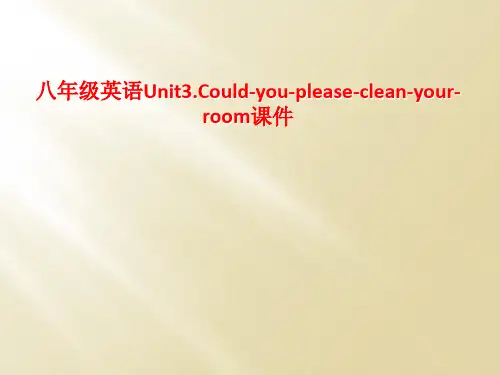
She’s cleaning the floor
Poor Cinderela ! She has to do all the chores at home.
One day, the king invited all the girls to his party. Look! Cinderela’s step mother(继母) is taking her two ugly daughters to the party.
Could I (please) do…?
What chores do you do at home?
We Love our parents. We help do the
chores.
clean the room
sweep the floor
do the dishes
take out the trash fold the clothes
八年级英语Unit3.Could-you-please-clean-yourroom课件
Learning goals(学习目标)
• words and exepressions • making polite requests
Clould you please do …? • asking for permission
Peter wants to…
Peter’s father says…
go to the yes no movies
stay out late
yes no
use the car
yes no
get a ride yes no
His father’s reasons
I have to do some work. You have to clean your room. I need to eat breakfast. you have a basketball game
八年级英语Unit3 Could you please clean your room课文讲解

八年级英语Unit3 Could you please clean your room课文讲解Unit 3: Could You Please Clean Your Room?n A:1."Peter。
could you please take out the trash?" This is apolite request asking Peter to take out the garbage。
"Could you please do something?" is a polite way to ask for ___ or assistance。
"Could" is a more polite way to ask than "can." The response tothis request can be "Sure," "Of course," "Certainly," or "No problem." If the person cannot do it。
they can say "Sorry。
Ican't." "Take out" means to remove something from a place。
When using a pronoun as the object。
it should be placed in the middle of the phrase。
For example。
"You can take it out."2."Can you do the dishes?" This is asking if the person can wash the dishes。
八年级英语下册Unit3知识点总结Couldyoupleasecleanyourroom

Unit3 Could you please clean your room?Peter ,could you please take out the trash? 彼得,你能把垃圾倒了吗?Could you please do sth ?请你(做)......好吗?用于提出请求,希望得到对方的肯定回答,说话的语气比较客气委婉。
Could 不是can的过去式,是委婉、礼貌的说法。
回答用can.【常用答语】肯定回答:Sure./ Of course./ Certainly./No problem. 否定回答:Sorry , I can’t2、take out 取出(v+ adv)【注】: 跟代词做宾语,代词放中间;跟名词做宾语,可放在中间,也可放在后边His teeth hurt badly. The dentist take them out .【短语】take out the trash 倒垃圾take a walk 散步take away 拿走,取走take back 收回take place 发生take off 脱下;起飞3. Can you do the dishes.?那你可以洗盘子吗?do the dishes 洗碗【结构1】do the +名词:do the dishes/ laundry 洗餐具/衣服【结构2】do the +动词-ing do the cleaning 打扫卫生【结构3】do one’s + 名词do one’s housework/ homework 做家务/家庭作业【结构4】do some +动词-ing do some reading/ shopping 读写书/购物Could I at least finish watching this show? 至少让我看完这个节目可以吗?1】Could I do a sth? 我可以做......吗?用于表达请求,语气比较委婉。
人教版八年级英语下册Unit 3 Could you please cleanyour room S
to provide a clean and comfortable environment
at home for their children. And anyway, I think
doing chores is not so difficult. I don’t mind
doing them.
It teaches them how to
stress from school. They have no time to study and
look after themselves. do housework.
It helps children to Their job now is to be students.
and his grades dropped. The earlier kids learn to be Conclusion
independent, the better it is for their future. Ms. Miller
(结论)
Which letter do you agree with? Why?
两,
件要
事么
。旅
。行
,
身
体
和
灵
魂
总
要
我们,还在路上……
Unit 3 Could you please clean
your room?
What is the father asking his daughter doing?
Do you think you should help out with chores at home?
Which one agrees that young people should do chores at home?
Unit 3 Could you please clean your room?(解析版)
Unit 3 Could you please clean your room?1.小明放学后非要帮妈妈做家务,妈妈说你不会干,别捣乱,一边玩去,小明还是坚持要帮忙,说是老师给布置的任务,妈妈说:你们老师屁事真多!第二天,小明把帮妈妈做家务整个过程的日记交给了老师。
2.我曾经尝试过做饭,但每次我都会把厨房变成一个烟雾缭绕的战场。
现在,我确信我的厨艺唯一能做的就是制作烟雾报警器。
3. 有一次,我决定自己洗衣服。
不幸的是,我把红袜子和白衬衫放在了一起。
结果,我得到了一件粉色的衬衫和一堆淡红色的袜子。
看来我在洗衣方面的创新精神比我想象的要强。
4. 老婆总是说我不会做家务。
有一天她不在家,我决定展示一下我的能力。
我打扫了整个房子,甚至把家具都重新布置了。
当老婆回到家时,她看着我,然后说:“你确定你是打扫了,而不是把家里翻了个底朝天?”5. 我试图拖地,但每次拖把都会比我先累。
我猜它可能是在抗议我让它做的太多工作。
6. 我尝试做饭,打开食谱应用程序,发现需要10分钟准备,50分钟烹饪。
到现在我已经花了45分钟在决定做什么菜。
7. 我发现了一种新的家务活动——找东西。
我妻子总是让我找她的钥匙、手机或其他东西。
我想我应该把这个加到我的简历上,我现在是一名专业的“失物搜寻者”。
8. 我妻子总是抱怨我不帮忙做家务。
但我认为我在精神支持方面做得很好——我总是鼓励她去看那些家务做得很好的电视节目。
拓展阅读(一)There are certain things you never imagine yourself saying.“I just got a worm in my eye!” is one of them.And yet I did say it—I screamed it, actually.The family was all here and we were in the garden, when I saw a worm nearby. I asked my six-year-old grandson to come over and remove the worm. He picked up the worm, studied it quickly and then threw it into the air.The worm quickly fell back to earth, landing on my face against my left eyelid. That’s when the screaming started and the jumping up and down.You know how they say when you meet a small creature, that the small creature is just as afraid of you as youare of it? They lie.The worm showed no fear. I, however, am still having nightmares about the experience, which was several days ago.The most important thing in all this is that my grandson said he was sorry to me.I’d just been reading a book that makes a connection between adults doing the slow and hard work of teaching manners to children and greater levels of civility in society.Table manners, language manners and even manners in dress all show levels of self-control.Having self-control limits what we say and how we behave, making many of us appear a good deal better than we really are.Good manners also have the possibility to make mealtime a pleasant experience, even with small children.All of my grandchildren, except the ones that can’t yet talk, ask to be excused before leaving the table.It is a sign of respect for others at the table and a sign of respect for the meal itself. It’s also more pleasant than pushing one’s chair back and running for the back yard.Those tall enough, and even those not tall enough, also take their dishes to the kitchen.Manners are what civilize us—around our tables, in our families, homes and our communities.So when a little boy has the courage to apologize to a grandma who is screaming and jumping up and down, at least we know that our years of teaching young people manners are paying off—one worm at a time. 1.Where were they when the author saw a worm?A.In the house.B.In the garden.C.In the park.D.In the back yard.2.The worm fell down on the author’s________.A.leg B.head C.left eyelid D.right eyelid3.What does the underlined word “nightmares” mean?A.好运B.噩梦C.回忆D.愿望4.The author believed that his grandson’s apology is________.A.a good manner B.a bad behavior C.unnecessary D.a must5.What does the passage tell us?A.The importance of apology.B.The importance of good manners.C.Many kinds of good manners.D.A story of a worm.【答案】1.B 2.C 3.B 4.A 5.B【导语】本文主要以作者与其孙子的故事来讲述礼仪的重要性。
Unit3-could-you-please-clean-your-room-PPT优秀课件
A Could I
B Can I
C Could you D Can you
28
Homework 1“ Tom, f____ your coat and put it away” Mother
said
2 Could you please s____ the floor and make it clean?
2.表示家务的短语。
27
Exercises • 1 My part-time job is to wash the d_i_s_h_e(s盘子)
• 2 Can you f_o_l_d_(折叠)your clothes?
• 3 Jim ,could you pleasem__a_ke__y_ou_r__bed(整理你
5
make your bed
take out the rubbish
= take the rubbish out
动副词组用法:名词放两边,代词只可放中间 6
做家务
洗do餐th具e dishes
倒 tak垃e圾out the rubbish
叠 fol你d 的yo衣ur服clothes
扫 sw地eep the floor
6 Mr. Wang would like two ____to eat
A dish B dishes C the dish D the dishes29
30
31
32
Work on 与work out
• Work on正在使用…从事于… • I’m going to work on it now . • Work out 算出,制定出 • He work on the maths
clean the living room
Unit3-could-you-please-clean-your-room-知识点及短语
Unit3-could-you-please-clean-your-room-知识点及短语Unit3 知识点1. Could you please do sth ?请你(做)......好吗?Could用于提出请求,不是can的过去式,是委婉、礼貌的说法。
回答用can.2. 【短语】take out the trash 倒垃圾take a walk 散步take away 拿走/取走take back 收回take place 发生take off 脱下;起飞3. do the +名词:do the dishes/ laundry 洗餐具/衣服do the +doing: do the cleaning 打扫卫生do one’s + 名词: do one’s housework/ homework 做家务/家庭作业do some +doing: do some reading/ shopping 读写书/购物4. 表示时间、距离、金额、度量等词语作主语时,通常被视作整体,谓语动词用单数形式。
5. enough 修饰名词时,置于名词前/ ;修饰形容词、副词时,后置。
6. the minute = as soon as “一...... 就......”7. in front of指在物体外部的前面in the front of指在物体内部的前面8. come 短语:come over 过来come back 回来come up with想出come true实现come down下来come from=be from来自,出生于come in/into进入,进来come on赶快,加油come along走吧,过来,快点come and go来来去去come up上来come out出来,(花)开,(照片)冲洗出来9. all the time = always 一直;总是time 短语:on time 按时in time 及时at the same time同时the first time 第一次at times 有时last time上次next time 下次10. neither +助动词+主语“某人(主语)也不”neither …nor… 既不…也不…,做主语谓语动词符合就近原则。
人教版八年级下英语Unit 3 Could you please cleanyourroom知识总结
unit 3 Could you please clean your room?话题相关:Could you please+动词原形?表示请求的句子,意为“请你......好吗”,其否定形式是Could you please+not+动词原形?句中could 表示请求,不表示过去,只表示委婉的语气短语do the dishes 洗餐具take out取出;拿出take out the rubbish倒垃圾fold the clothes 叠衣服sweep the floor 扫地make the bed 铺床work on 从事;创作clean the living room 打扫起居室go out 出去stay out 待在外面;不在家help out 帮助做完某事in front of 在......前面come over 过来;顺便来访hang out 闲逛do chores 做家务at least 至少throw down 扔下all the time 频繁;反复in surprise 吃惊地;惊讶地as soon as 一.......就a waste of time 浪费时间spend...on... 在......上花费(时间或金钱)in order to 为了,目的是depend on 依靠;信赖;取决于,由......决定keep it clean and tidy 保持它干净、整洁get into 进入take care of 照顾;处理as a result 结果provide sth. for sb.=provide sb. with sth. 为某人提供某物a developed country 一个发达国家a developing country 一个发展中国家a life of independence 独立的生活an independent country 一个独立自主的国家have no idea “不知道”=don't knowtake care of “照顾;处理”=look after=care for take good care of “好好照顾......”=look after.....well as a result 结果;因此as a result of 由于.......;作为......结果句型和固定结构finish doing sth. 做完某事neither+连系动词be/助动词/情态动词+主语. .....也不hate to do sth. 厌恶做某事let sb. do sth. 让某人做某事spend...doing sth. 花费......做某事provide sth. for sb. 向某人提供某物learn to do sth. 学会做某事learn how to do sth. 学会怎样做某事do one's part in (doing) 尽自己的职责做某事as.....as... 与.......一样not as/so...as... 不如......borrow sth. from sb. “向某人借某物”hate sb./sth. 讨厌某人/某物hate to do sth./doing sth. 厌恶做某事enjoy doing sth 喜欢做某事buy sb.sth.=buy sth. for sb. "给某人买某物invite sb. to +地点名词“邀请某人到某地”invite sb. to do sth. “邀请某人做某事”make sb. do sth. 让/使某人做某事help with sth. =help (to) do sth.帮忙做某事There is no need for sb. to do sth.“对于某人来说,没有必要做某事”解释minute n.分钟;片刻(1)any minute now “随时;马上;在任何时刻”,表示事情有可能在极短的时间内发生或眼下就要发生。
Unit3Couldyoupleasecleanyourroom.SectionA1a-1c教案人教
Students work in groups and each group is a 通过小组活动,
family. Then try to make conversations and act it 学 生 能 将 所 学
out.
输出并表演,巩
Step Ⅳ 2. Enjoy a video
固今日所学。同
students the columns with the heading Peter’s 训练,提高学生
mother and Peter.
抓取关键信息
b. Play the recording for twice. Students listen 的能力,培养学
and check the chores.
生良好的听力
c. Later correct the answers.
习惯,巩固本节
4. Show the listening materials and explain some 课所学。
language points. Then students read it together.
1. Group work
知识体系。
(3 mins)
Choose to do: Help to do some chores in your
home.
Blackboard design
chores
Unit 3 Section A 1a1c
do the dishes take out the rubbish fold your clothes sweep the floor make your bed
chores and students guess what they are. Then speak 短语,为接下来