
最新科普(仁爱)版英语七年级上册Unit4 Topic1 SectionD【市级公开课一等奖课件】
表示数量:
how many + 可数名词(复数) how much + 不可数名词
How many bottles of milk do you need? How much rice do you need?
Functions
Can
looking
think of
want to
many much
最新科普(仁爱)版英语七年级上册精华课件 优质课一等奖课件
Unit 4 Topic 1 What can I do for you?
Section D
Enjoy a song
巧记基数词
基数词,不难记,十二以内词各异; 13数到19去,后加 -teen,莫忘记; 20、30至90,整十之后有 -ty / ti /; 要说基数“几十几”,连字符号“-”别丢弃; a hundred 是“一百”,请你记住别大意。
Write a conversation between the customer and the saleswoman according to the following picture.
Three kilos of oranges, one bag of rice and two bottles of milk.
21 twenty-one 22 —————— 23 twenty-three 24 twenty-four 25 —————— 26 twenty-six 27 —————— 28 twenty-eight 29 ——————
30 thirty 40 ——50 ——60 sixty 70 seventy 80 ——90 ——-
100 one hundred/a hundred 101 ———————————— 185 ———————————— 315 ———————————— 999 nine hundred (and) ninety-nine
可数名词VS不可数名词
an apple
milk
three apples
×5 kilo
Mother: Er, how about ___s_o_m_e____ juice?
Helen: Yes. Good idea!
How much is this bag?
It’s ninety-eight yuan.
¥98
How much are these shoes?
¥243
They’re two hundred and forty-three yuan.
(some+可数名词) some cakes
eggs
vegetables
不可数名词:fish meat rice chicken milk
water tea
(some+不可数名词) some
fish meat milk
食 物 面 包 大 米 饭,
(food, bread, rice)
巧
记
牛 奶 茶 水 橘 汁 甜,
32 yuan.
1. Collect things to sell.
2. Make price tags.
3. Role-play the salespeople and customers.
1. What do you think of …? =How do you like …?
2. Why not try on that pair? 3. How/What about the blue one? 4. Thank you. / Thanks all the same.
不
(milk, tea, orange juice)
可
家 务 工 作 作 业 多,
数
(housework, work, homework)
名
词
幸 福 生 活 鱼 肉 鲜。 (happiness, life, fish, meat)
some 与 any 的用法
I want to buy some clothes for my daughter. How about some bread?
1.Help your mother do some shopping this weekend.
2. Preview Topic 2.
Oh, we don’t have any milk. Do you have any vegetables?
Complete the conversation with some or any. Then practice the conversation with your partner. Mother: Would you like to buy ___s_o_m__e__ food for us?
Helen: Sure. What do we need?
Mother: Mm, __s_o_m_e__ apples, __s_o_m__e__ chicken and __s_o_m__e__ bread. Oh, we don’t have ____a_n_y___ milk.
Helen: OK. I’ll buy __s_o_m__e__. Do we need __a_n_y__ juice?
√5 kilos
× 1 kilos
five kilos of apples
× three milk
√ three bottles of milk
让我们来总结可数名词与不可数名词吧!
名词Biblioteka 可数名词 不可数名词可数名词: cake egg apple banana
vegetable noodle pencil car
Item
Price
apples ¥__6_ a kilo
__r_ic_e__ ¥__3_ a kilo
Quantity __2__ kilos
__4__ kilos
Total: ¥_2_4_.0_0_
I wHaonwt…tombuuchy …is it/are they?
How many
C/HanowI hmelupcyho…u? do you want?
仁爱版英语七年级上册unit4知识点
仁爱版英语七年级上册unit4知识点Unit4 Knowledge Points of Ren'ai English Textbook for Seventh GradersRen'ai English Textbook for seventh graders covers Unit4 Knowledge Points, which includes vocabulary, grammar, reading comprehension, and language skills development. English is a challenging language to learn, but with the help of this unit, students can gradually grasp the basics and lay a solid foundation for further learning. Here are some of the essential knowledge points of Unit4:1. VocabularyVocabulary is the foundation of language learning. In Unit4, the focus is on travel and transportation. Therefore, students are expected to master some essential words and expressions related to this topic. For example, they should know how to ask for directions, how to describe transportation means, and how to book plane tickets. Here are some sample phrases:- Excuse me, where is the nearest bus station?- How much is a one-way ticket to Beijing?- Could you please show me the way to the airport?- I prefer traveling by train, it's more comfortable.2. GrammarGrammar is the structure of language. In Unit4, students learn about prepositions of place, present continuous tense, and comparative adjectives. Prepositions of place indicate the position or location of objects, while the present continuous tense expresses actions that are happening at the moment of speaking. Comparative adjectives are used to compare the differences between two or more things. Here are some examples:- The cat is on the table.- Tom is playing football with his friends.- The car is faster than the bike.3. Reading ComprehensionReading comprehension is the ability to understand and interpret written texts. In Unit4, students read two articles about travelexperiences. The first article is about a family's journey to New York City, while the second one is about a student's trip to Beijing. By analyzing the texts and answering questions, students can improve their reading skills and broaden their horizons. Here are some sample questions:- What did the family do in New York City?- How did the student feel about the Great Wall?- What are the similarities and differences between the two articles?4. Language Skills DevelopmentLanguage skills development refers to the holistic improvement of language abilities, including listening, speaking, reading, and writing. In Unit4, students participate in various activities such as role-plays, games, and group discussions, which aim to enhance their communicative competence. By practicing with their classmates and teachers, students can build confidence and develop their own learning strategies. Here are some sample activities:- Role-play: Two students practice asking for directions and giving responses.- Game: Students play a board game where they need to answer questions about transportation means.- Group discussion: Students share their travel plans and give advice to each other.In conclusion, Unit4 of Ren'ai English Textbook for seventh graders covers a wide range of knowledge points, including vocabulary, grammar, reading comprehension, and language skills development. By mastering these points, students can increase their English proficiency and become more confident in using the language.。
仁爱英语七年级上册Unit4Topic1课件
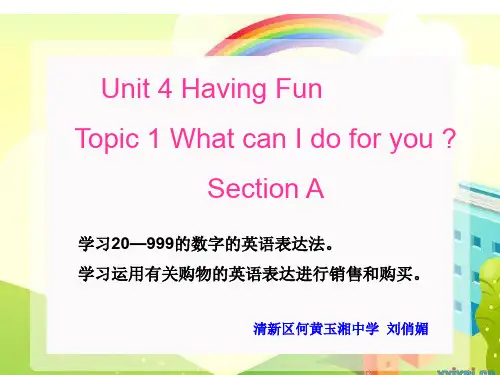
(Maria tries on the coat.)
ቤተ መጻሕፍቲ ባይዱ
7.—What can I do for you ,madam?
—I want a pen __D__my son.
A.at
B. on C. with D.for
学习20—999的数字的英语表达法。 十三到十九 --teen 几十 --ty 几十几 forty-seven 几百 one hundred five hundred 几百几 one hundred and ten two hundred and sixty--nine
Mother: Yes, please. I w_a_n_t_a T-shirt fo__r my son.
What color do you want?/ Salesman: _W__h__a_t_c_o__lo_r__d_o__e_s__h_e__w_a_nt?
Mother:White.
Salesman: What about this one?
⑥ 你想买点什么? __W_h_a_t_c_a_n__I _d_o_f_o_r_y_o_u_?___________________
Mother: Wow! _I_t_l_o_o_k_s_v_e_r_y__n_ic_e__o_n_y_o_u___. H__o_w__m_u_c_h__is__it_? Saleswoman: It’s seventy yuan, madam. Mother: That’s fine! W__e_’l_l_t_a_k_e_i_t ____.
Unit 4 - 七年级英语上册精美课件(仁爱科普版2024)
Learning aims
1.在看、听、说的活动中,了解不同季节的天气特征及适合进 行的活动,形成结构化知识; 2.使用和季节、天气、活动相关的目标语言分享个人在不同季 节最喜欢的活动; 3.在小组内交流各自最喜爱的季节和活动等信息,简要总结后 和全班分享。
[ˈweðər]
summer
autumn
winter
B: It’s __w__a_rm___. /wɔː(r)m/ hot /hɒt/ /hɑːt/ cool /kuːl/ cold /kəʊld/
Activity 1 A.Match the seasons with the pictures (1-4) and then connect each season with its suitable weather.
B: I like _m__ak_i_n_g__a_s_n_o_w_m__a_n_ with my parents/friends. going skiing [ˈskiːɪŋ] going skating [ˈskeɪtɪŋ]
Activity 1 B. Read the sentences and complete them with the words above.
A: What do you like doing in autumn? B: I like hiking with my family.
Activity 1
C. Pair work. Listen and repeat, and then replace the parts in bold and practice with your partner.
科普仁爱版初中英语七年级上册Unit4 Topic1 SectionD 随堂练习

科普仁爱版初中英语重点知识精选掌握知识点,多做练习题,基础知识很重要!科普仁爱版初中英语和你一起共同进步学业有成!Unit4 Topic1 SectionD 随堂练习一、根据括号中的汉语完成句子。
1. I want ________ (两袋) milk.2. May I ________ (试穿) this dress?3. I’ll ________ (考虑) going home this afternoon.4. I don’t want ________ (买) it. It’s too dear.5. Do you want ________ (三公斤) eggs?6. ________ (怎样) this red one?7. Thank you ________ (仍然).8. ________ (多少钱) is that red skirt?二、单项选择1. —What would you like? We have good fish here.—No, thanks. I don’t want fish.A. some; someB. any; someC. some; anyD. any; any2. The book has pages(页).A. two hundred and twenty oneB. two hundreds and twenty oneC. two hundred and twenty onesD. two hundred and twenty-one3. These clothes look nice. Can I ?A. try them onB. try on itC. try it onD. try on them4. —Sorry. We don’t have a T-shirt like that.—A. Thank you all the same.B. You are right.C. Not at all.D. Can I try it on?三、根据所给汉语完成句子。
最新科普(仁爱)版英语七年级上册Unit4 Topic1 SectionB【市级公开课一等奖课件】

1b Listen again and fill in the blanks.
While-listening
听力小策略 When you are listening or reading, you may guess the meaning of a
1、A
word or sentence according to
Listen and write down the prices.
¥7.00
¥18.00
¥25.00
¥5.00
¥100.00
¥108.00
¥139.00
¥180.00
Pre-listening
N to buy a coat for my daughter, she is eighteen years old, and please give me some advice.
Post-listening
Can you remember the conversation?
A Hello. C__a_n_I_ _h_e_lp_y_o_u?
I’m _ju__st_ looking, thanks.
B
Post-listening
Saleswoman: H__o_w_ do you _li_k_e the trousers?
最新科普(仁爱)版英语七年级上册精华课件 优质课一等奖课件
Unit 4 Having Fun
Section B
Revision
Play games
Let’s play a number game, when you
hear a number, please speak it out as quickly as you can. (Number:0-999)
科普版-英语-七上-1单元 Topic 1 SectionD练习(含答案)
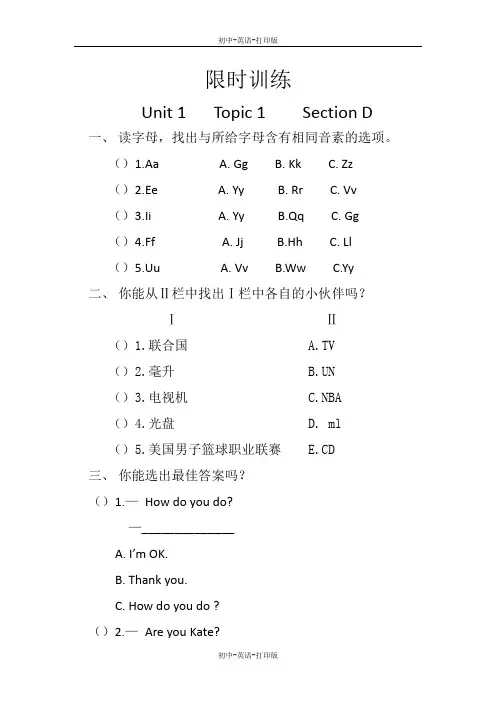
限时训练Unit 1 Topic 1 Section D 一、读字母,找出与所给字母含有相同音素的选项。
()1.Aa A. Gg B. Kk C. Zz()2.Ee A. Yy B. Rr C. Vv()3.Ii A. Yy B.Qq C. Gg()4.Ff A. Jj B.Hh C. Ll()5.Uu A. Vv B.Ww C.Yy二、你能从Ⅱ栏中找出Ⅰ栏中各自的小伙伴吗?ⅠⅡ()1.联合国 ()2.毫升 B.UN()3.电视机 C.NBA()4.光盘 D. ml()5.美国男子篮球职业联赛 E.CD三、你能选出最佳答案吗?()1.—How do you do?—______________A. I’m OK.B. Thank you.C. How do you do ?()2.—Are you Kate?—_________________A.No, you aren’t.B.Yes , I am.C.Yes ,you are.()3.—____you Kate?—Yes, I ______.And this _______Sally.A.Are; am; isB.Am ;is; isC.Is ;are; am() 4.—How are you?—______A.No, thanks.B.I am Jane.C.I’m fine , thanks.()5.—Nice to see you.—______A.I’m fine , thanks.B.How do you do ?C.Nice to see you, too.()6.下列大写字母中由两笔写成的是___组。
A. QPRB.ORTC.SWT()7.下面____组中的字母读音不含共同的音素。
A. SGHIB.FMNSC.BTPV四.选词填空,完成对话。
Alice: Hello, Ben.Ben: 1 , Alice.Alice: How do you do ?Ben: How do you do ?Alice: Ben, this 2 Xiao Zong.Ben: Nice to meet you, Xiao Zong.Xiao Zong: Nice to meet you, 3 ,Ben. Ben: Welcome 4 Shanghai.Xiao Zong: 5 .1.____2.____3.____4.____5.____五、句型转换。
仁爱版七年级上册英语优秀教学案例:Unit4Topic1SectionD
3.引导学生主动提出问题,如“我在学习过程中遇到了什么困难?该如何解决?”培养学生自主学习的能力。
(三)小组合作
1.划分学习小组,鼓励学生分工合作,共同完成任务。如每个小组选择一个国家,调查其节日习俗,并进行汇报。
在教学过程中,我以提高学生的综合语言运用能力为目标,结合学生的认知水平和生活经验,设计了一系列具有针对性和实用性的教学活动。在教学方法上,我采用了任务型教学法和交际法,鼓励学生积极参与课堂讨论,培养他们的合作精神和跨文化交际能力。同时,我注重激发学生的学习兴趣,营造轻松愉悦的课堂氛围,使他们在学习过程中能够充分感受到英语的魅力。
4.学生通过观察、比较、分析等方法,发现并总结不同国家节日习俗的异同,提高观察力和思维能力。
(三)情感态度与价值观
1.学生能够尊重和理解不同国家的文化差异,培养跨文化交际意识。
2.学生在参与课堂活动过程中,培养积极向上、乐观向善的情感态度,树立合作精神。
3.学生通过学习英语,增强自信心,提高自我价值观念,认识到学习英语的重要性。
3.各小组进行汇报,其他小组成员认真倾听,并提出问题和意见。
(四)总结归纳
1.教师引导学生总结本节课所学的知识,如生词、短语、句型和节日习俗等。
2.学生分享自己的学习收获,教师给予肯定和鼓励。
3.教师针对学生的表现,进行点评和反馈,强调本节课的重点和难点。
(五)作业小结
1.教师布置作业,要求学生复习本节课所学的知识,并进行实际运用。如让学生写一篇关于自己喜欢的节日的短文,并用所学的句型进行表达。
3.教师引入本节课的主题:“今天我们将学习关于不同国家节日的知识,希望大家能够通过这节课,更深入地了解世界各地的节日文化。”
仁爱版七年级英语上册 Unit 4 Topic 1 Section D 课件
Choose 选择
Color & Size
Price Decide 决
定
顾客常用语
I want/need/would like…
The color is good. It’s too small/ big/long/short. It fits (适合) me well. Can I try it on?(我能试穿一下吗?)
数词+表示量的名词+of
如: a glass of milk
two glasses of milk.
a kilo of milk
3 kilos of milk
不可数名词不能直接用数词来表示具体数量,只能用+of结构:数词是单数时,
表示量的名词用单数。数词是复数时,表示量的名词用复数。不可数名词没有复
种情况下它们须用复数形式,且后面要加of。 eg:hundreds of teachers 数百位老师
thousands of students数千位学生
We plant ________trees every year.(四川雅安) A.hundreds of B.hundred of C.five hundreds
(5)一百的表示方法为one hundred或a hundred。 要表示“几百”,用 具体数字加上hundred, 如five hundred(500),注意此时的hundred是单 数形式。
表示“几百几”时,要在百位数和十位数(或个位数)之间加and。如: 【难o点ne】huhnudnrderdeda,ndthtowuos(a1n0d2()千。)等的复数形式可表示不确定的数目。在这
仁爱版英语七年级上册课文翻译
Unit1Topic1SectionA-2a你好!Hello!你好!Hello!我是康康。
I'm Kangkang.你是迈克尔吗?Are you Michael?是的,我是。
Yes,I am.你好!你是玛丽亚吗?Hello!Are you Maria?不,我不是,我是简。
No,I'm not.I'm Jane.哦,见到你很高兴,简。
Oh,nice to meet you,Jane.见到你我也很高兴。
Nice to meet you,too.你好,玛丽亚!Hi,Maria!你好,康康!Hi,Kangkang!欢迎到中国来!Welcome to China!谢谢。
Thanks.Unit1Topic1SectionB-1a布朗先生,早上好!Good morning,Mr.Brown!很高兴见到你!Nice to see you.玛丽亚,早上好!Good morning,Maria!我也很高兴见到你。
Nice to see you,too.妈妈,这位是我的老师,布朗先生。
Mom,this is my teacher,Mr.Brown.布朗先生,这位是我的妈妈。
Mr.Brown,this is my mom.你好!How do you do?你好!How do you do?Unit1Topic1SectionD-3你好吗?How are you?我很好,谢谢。
你呢?Fine,thanks.And you?我也很好。
I'm okay.早上好,王老师。
Good morning,Miss Wang!早上好,康康!Good morning,Kangkang!见到你很高兴。
Nice to see you.见到你我也很高兴。
Nice to see you too.你好,我是康康。
Hello!I'm Kangkang.你是南希?Are you Nancy?不是。
我是莉莉。
No.I'm Lily.爸爸,这是王老师。
仁爱版英语七年级上册第四单元topic1知识点
仁爱版英语七年级上册第四单元topic1知识点Unit 4 Topic 1 Knowledge PointsIn Unit 4 of the Renai version of English 7A, Topic 1 focuses on various knowledge points that are crucial for students to comprehend in order to enhance their English language skills. Let's delve into the important concepts covered in this topic.1. Basic Personal InformationThe first set of knowledge points revolves around basic personal information. Students learn how to introduce themselves and others, including their names, ages, nationalities, and occupations. They also practice asking and answering questions about these details to improve their speaking and listening skills.2. Numbers and DatesAnother essential aspect of this topic is numbers and dates. Students are taught how to count from 1 to 1000 and learn the days of the week, months of the year, and seasons. This knowledge is crucial for everyday communication, especially when discussing schedules, appointments, and important dates.3. Time ExpressionsUnderstanding time expressions is also emphasized in Topic 1. Students learn how to read and express time accurately, including telling the time on both analog and digital clocks. Additionally, they practice using prepositions of time such as "at," "on," and "in" to indicate specific moments or periods.4. Descriptions and AdjectivesDescribing people, places, or things is a key skill that students develop in this topic. They acquire a range of adjectives to express physical appearance, personality traits, and emotions. By using descriptive language, students can paint vivid pictures and create detailed narratives in their spoken and written English.5. Simple Present TenseThe simple present tense is another fundamental concept covered in Topic 1. Students learn how to form sentences in the present tense, including affirmative, negative, and interrogative structures. They also practice using present tense verbs correctly and understand the importance of subject-verb agreement.6. Everyday Activities and RoutinesStudents explore vocabulary related to everyday activities and routines in this topic. They learn how to talk about dailytasks, hobbies, and leisure activities using appropriate verbs and adverbs. By discussing their own routines and habits, students can improve their conversational skills and build vocabulary.7. Possessive PronounsPossessive pronouns play a significant role in indicating ownership or relationships. In this topic, students learn how to use possessive pronouns such as "my," "your," "his," "her," "its," "our," and "their" correctly in sentences. They practice expressing possession and identifying the correct forms based on the context.8. Comparatives and SuperlativesComparing and contrasting different things is another skill that students hone in Topic 1. They learn how to form comparatives (e.g., "bigger," "faster," "more interesting") and superlatives (e.g., "biggest," "fastest," "most interesting") to describe differences in size, speed, or quality. By mastering these structures, students can express opinions and make comparisons effectively.In conclusion, Topic 1 of Unit 4 in the Renai version of English 7A covers a wide range of essential knowledge points that are vital for students to build a strong foundation in Englishlanguage learning. By mastering these concepts, students can enhance their communication skills, expand their vocabulary, and improve their overall proficiency in English.。