
外研版八年级下册英语Module8
外研版八年级下册英语Module8 Public Holidays全模块综合试题及参考答案一. 单项选择()1. How long did the film ________ ?A. actB. keepC. lastD. play() 2. Yesterday we left off ________ of page 51.So today we’ll begin _______ page 52.A. at the end, fromB. at the end, withC. in the end, fromD. in the end, with() 3. Tell Tom to call me as soon as she ________.A. will arriveB. gets thereC. has goneD. reach here() 4. He is often made _______ for twelve hours a day by the boss.A. workB. workingC. to workD. to be working() 5. He could neither ________ French nor German. So I ______ with him in English A. speak, talked B. talk, toldC. say, spokeD. tell, talked() 6. She will have a holiday as soon as she ______ the work next week,A. finishesB. doesn’t finishC. will finishD. won’t finish()7. —Shopping with me? —Sorry, I have a lot of clothes ________.A. to washB. washedC. washD. to be washed()8. I don’t know if he ______ if it ______ tomorrow.A. comes, will rainB. will come, rainsC. will come, will rainD. comes, rains()9. They didn’t learn ______ in this lesson.A. something newB. anything newC. new lessonD. new anything()10. ___What day is it? —____.A. It’s a fine dayB. It’s TuesdayC. It’s June 26 thD. It’s wet()11. ___Meimei, ______ it again in English, please. ____OKA. speakB. talkC. tellD. say()12. ___“What’s the _______ today?”___ “It’s June 26.”A. dayB. dateC. timeD. hour()13. China _________ the WTO and became a new member of it last year.A. joinedB. joinC. will joinD. bas joined()14. ___The box looks so big. Can I help you?___ No, thanks. _______ in it. It’s empty.A. NothingB. EverythingC. AnythingD. Something()15. I think the older people must be _______ politely.A. talked aboutB. said withC. told aboutD. spoken to()16. ___ How much did this CD _______ you, Sally?__ I got it for 5 dollars.A. useB. spendC. takeD. cost()17. The twins are coming to Meirmei’s house tonight. She will give them ______ to eat.A. anything deliciousB. something ChineseC. Chinese somethingD. delicious anything()18. Kate _________ to bed until her father returned yesterday evening.A. won’t goB. doesn’t goC. wentD. didn’t go()19. The boys _______ green sports shirts are the fans of Guo’an Team.A. withB. inC. atD. from()20. By the time my parents reached home yesterday, I ______ the dinner already.A. had cookedB. cookedC. have cookedD. cook二. 完型填空One day when Jamie came home after school, his mother had on her “worry face. He knew she was thinking of 1 . “It’s bad out there.. Black clouds are comin g from the sea,” Jamie said.“Yes, I’ m thinking of those fishing boats at sea,” she said.At that moment, 2 went out, Jamie and his mother were in the dark.“The coastline(海岸)will be in the dark,”Jamie’s mother said. She got more worried. 3 always come in threes, I broke my best glasses this morning, and my sister has the cold.”“Now, don’t worry, mum.. They’re 4 to come through this all right.”But Jamie really worried about those fishing boats himself. The fishing boats would 5 the cove(海湾)in the dark, Jamie took flares(火焰信号弹)and rushed into the wind. There was a cliff(峭壁)by the sea. He started to climb. He 6 himself up hand. over hand. At last he reached the top.He 7 three times. On the fourth try he fired off (发射)one of the flares. It rose and cut into the black sky in bright light. Then he saw an answering flare up at sea. Jamie fired off two more. He saw another answering flare up, then another, then another. The answering flares from the fishing boats showed they 8 the entrance to the cove but then changed course (路线)and were 9 sailing (航行)into the cove. They were almost home. Jamie helped 10 the fishermen of the village.()1. A. the wind B. the clouds C. the rain D. the weather()2. A. Jamie B. his mother C. the fire D. the lights()3. A. Messages B. Accidents C. Troubles D. Questions()4. A. sure B. lucky C. safe D. ready()5. A. lose B. miss C. leave D. forget()6. A. pushed B. pulled C. carried D. climbed()7. A. made B. tried C. failed D. finished()8. A. were at B. had found C. had passed by D. were going into()9. A. now B. then C. once D. again()10. A. answer B. save C. find out D. look for三. 阅读理解(A)One of the things I always believe is that no matter how bad something is, you can take something positive out of it. The one time I wasn’t sure of that was on September 11.I usually wake up at 6:30 or 7:00 in the morning. That day, I happened to wake up earlier. I turned on the TV and I saw that a plane had crashed into the North Tower of the World Trade Center. My first reaction was that it was a terrible accident. Then I saw another plane fly into the South Tower and I realized that I was witnessing an act of terrorism.My wife and I spent the day watching the terrible pictures over and over again. When I Watched family members looking for their loved ones, the pain in their eyes was something I woul d never forget. Couldn’t understand how something this terrible could have happened.It wasn’t until a few weeks after September 11 that I began to see that perhaps some good did come from this tragedy. People seem different now, more understanding, more tolerant. Little things that seemed to be such a trouble before are no longer big things. Personally, I am more tolerant than I was. I realize life is too short, and too precious, to let myself get worried over small things. I’ve learned also that you can’t take things for granted, Things change in the blink of an eye. People go to work and don’t come back. One moment they’re living and the next minute they’re not. And, it doesn’t matter who you are, there is nothing yo u can do about it. We never know when our time here will be over, so we all need to make the most of every minute we have.You try to learn from what happened. You can’t be used up it. You can’t live by it. All you can do is just live.注:crash 撞击reaction 反应witness 目击tragedy 悲剧tolerant 宽容的precious 珍贵的take —for granted 认为——是当然的() 1. The word “positive”in the passage probably means _______.A. terribleB. badC. goodD. real() 2. What did the writer see after he turned on the TV that morning?A. fire starting.B. A plane flying.C. A terrible accident.D. An act of terrorism.() 3. According to the passage, which of the following is NOT true?A. The writer and his wife spent the day watching the terrible pictures over and over again.B. The writer is more tolerant than he was.C. The writer didn’t think the accident was a tragedy.D. The writer think people all need to make the most of every minute the have.() 4. From September 11, the writer has realized that _______.A. people should make the most of every minute they haveB. he has become less tolerant towards othersC. he should get worried about little thingsD. life is too short to care about others() 5. What’s the best title (题目)of this passage?A. A Report about September 11B. The Tragedy of September 11C. September 11 and My FamilyD. September 11 and My Turn(B)January 1 is the New Year’s Day, the first day of the year. It is a legal (法定的)holiday, and all banks, stores and schools are closed. Many people invite their friends to come and visit them in the afternoon or evening.The only legal holiday in February is Washington’s Birthday. Althoug h Washington was born on February 22, his birthday is now celebrated on the third Monday of February. Some States also celebrate Lincoln’s birthday on February 12. These two, the Unit ed States’ most famous presidents, were both born in February.The last Monday in May is Memorial Day (纪念日). This holiday remembers the many service members, men and women, who died for their country. Americans celebrate Memorial Day with services in cemeteries (公墓)and churches.America’s great national holiday, Independence Day, falls on the fourth of July. It celebrates the birth of the United States. It was on this day that the colonists (殖民者)announced their independence from England. They had to fight hard for the next seven years to win this independence.The first Monday of September is Labor Day (劳工节). This holiday honors (向——表示敬意)the working people of the United States. There are sorts of celebrations and speeches on this day too. People go to all kinds of places to enjoy the fine weather at the end of summer.() 1. This passage mainly tells us something about _______.A. Independence DayB. America’s holidaysC. Memorial DayD. New Year’s Day() 2. Which festival is NOT a public holiday?A. Labor DayB. Valentine’s DayC. Washington’s BirthdayD. Thanksgiving Day() 3. The American people celebrate _________ on July 4 th every year.A. New Year’s DayB. May DayC. Memorial DayD. Independence Day() 4. From this passage we know _______.A. American people do not work on New Year’s DayB. Memorial Day falls on the first Monday of FebruaryC. Labor Day comes on May 1 in the United StatesD. Americans celebrate Independence Day on June 14() 5. Which of the following is TRUE according to the passage?A. Americans celebrate Memorial Day in order to remember their dead friends.B. On New Year’s Day Americans usually go shopping.C. Washington and Lincoln were born in the same month.D. Americans celebrate Labor Day to remember the dead workers.四. 补全对话A: Morning! What can I do for you?B: We’d like to make a trip for a trip for a weekend holiday , please?A: There are many travel paths.___________ _?B: We’d l ike to choose Jinggang mountains.A: It’s really worth visiting. _______________?B: We are not sure. Which hotel do you think is comfortable?A: The Holiday Home is very good. What’s more important, ________?B: We don’t want to live in an expensive hotel. That’s what we’ll do.A: _____________________?B: OK. I’ll ask wife to fill in this form. By the way, is it all right if we pay by credit card?A: ___________________?. Enjoy your weekend.B: Thank you.五. 完成句子1. 上世纪初许多欧洲人去美国居住。
八年级英语下册 Module 8 Public holidays重难点解析 外研版

Module 8 Public holidays重难点解析(Unit 1)Unit 1 It’s the last day before the new school year begins.一、课文详解(一)生词1.public adj.provided,especially by the government,for t he useof people in general公共的(只能用于名词前作定语)e.g.Now there are few public libraries in the countryside in China.目前,在中国的乡村有很少的公共图书馆。
2.vacation n.one of the periods of time when schools,colleges,universities are closed(美国学校的)假期e.g.Th ey are on vacation in Hawaii right now.他们此时正在夏威夷度假。
3.celebrate v.to show that a day or an event is important by doing sth.special on it庆祝;庆贺e.g.How do people celebrate New Year in your country?你们国家的人们怎样庆贺新年?4.season n.any of the four main periods of the y ear:spring,sum-met,autumn/fall and winter季节。
e.g.The earth turns around the sun,so it makes the changing seasons.地球围绕太阳转,从而产生四季的更替。
5.labour n. work,especially physical work劳动;(尤指)体力劳动e.g.The price will include the labour and materials.此价格中包含人工费和材料费。
外研版八年级下册英语精品教学课件 Module 8 Unit 2
Presentation
2. Work in pairs. What do you know about Zhangjiajie? Can you answer the questions?
4. Where do you __w_i_s_h_ you were right now?
Presentation
6. Work in pairs. Ask and answer the questions in Activity 5.
1. Are there rocks in human or animal shape in your home town?
/'kIlə'mi:tə; kI'lɔmItə/ 千米;公里 n. kilometre
/ʃeIp/
外形;形状 n. shape
/'hju:mən/ /weIk/
人 n.
human
唤醒;醒来 v. wake
唤醒某人
wake sb. up
Presentation
Words and expressions
Presentation
备注:见Module 8 Unit 2 Activity 3
Presentation
3. Read the email and check your answers to Activity 2.
FROM: Betty TO: Mum and dad
SUBJECT: Wonderful time in Zhangjiajie
外研版八年级英语下册Module8Unit1I+can+hardly+believe+w
Everyday English
• Here we are. • Wow! • I can hardly believe… 见视频Module 8 Unit 1 Activity•3That’s too bad. • Come on!
➢Do you like to travel? Where do you want to go? ➢Do you know some world famous tourist attractions?
Look at each picture (symbol building) and say out the name of the city in two seconds.
Now complete the sentences about Beihai Park.
1.Beihai Park is so_q_u__ie_t_ that you can even hear the birds singing.
2. The park is famous for its_l_a_k_e_, bridges and the ancient buildings on the hill.
material and the conversation • To understand the object clause with that in
context • To be able to introduce a place of interest in
your home town
2. Main contents: •Key vocabulary hardly, take up; point out; at the top of; waste •Key structures I can hardly believe we’re in the city centre. I don’t think they allow people to swim in the lake. I hope it will be cooler up here.
【知识梳理】外研版八年级英语下册 Module 8 知识梳理
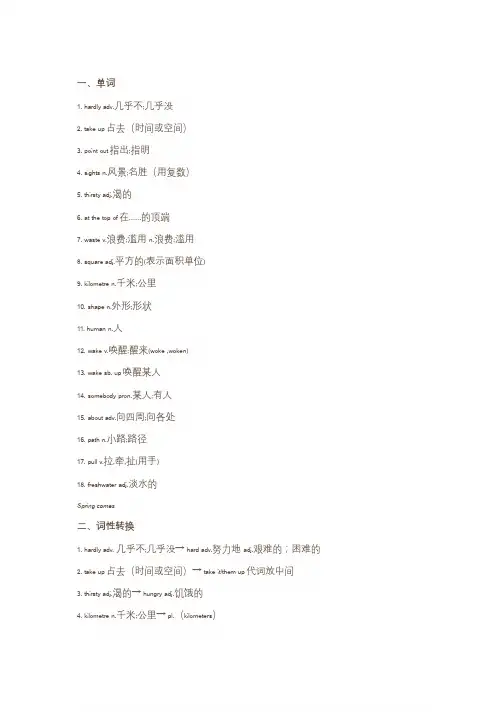
一、单词1. hardly adv.几乎不;几乎没2. take up占去(时间或空间)3. point out指出;指明4. sights n.风景;名胜(用复数)5. thirsty adj.渴的6. at the top of在……的顶端7. waste v.浪费;滥用n.浪费;滥用8. square adj.平方的(表示面积单位)9. kilometre n.千米;公里10. shape n.外形;形状11. human n.人12. wake v.唤醒;醒来(woke ,woken)13. wake sb. up唤醒某人14. somebody pron.某人;有人15. about adv.向四周;向各处16. path n.小路;路径17. pull v.拉,牵,扯(用手)18. freshwater adj.淡水的Spring comes二、词性转换1. hardly adv. 几乎不;几乎没→ hard adv.努力地adj.艰难的;困难的2. take up占去(时间或空间)→ take it/them up代词放中间3. thirsty adj.渴的→ hungry adj.饥饿的4. kilometre n.千米;公里→ pl.(kilometers)5. shape n.外形;形状→ pl.(shapes )6. human n.人→pl.(humans)7. wake v.唤醒,醒来,失去→第三人称单数(wakes)→现在分词(waking)→过去时(woke)→过去分词(woken)8. somebody pron.某人;有人→anybody pron. 任何人→nobody pron. 没有人9. path n. 小路;路径→pl. (paths)10. pull v.(用手)拉,牵,扯→第三人称单数(pulls)→现在分词(pulling)→过去时(pulled)→过去分词(pulled)11. waste v.浪费;滥用n.浪费;滥用→adj. wasteful 浪费的三、单词默写Part11. adv. 几乎不;几乎没______2. 占去(时间或空间)______3. 指出;指明______4. n.(用复数)风景; 名胜______5. adj.渴的______6. 在…的顶端______7. v.浪费; 滥用n.浪费; 滥用______8. adj. (表示面积单位) 平方的______9. n.千米;公里______10. n.外形;形状______Part 211. n.人______12. v.唤醒;醒来______13. 唤醒某人______14. pron.某人;有人______15. adv.向四周; 向各处______16. n.小路;路径______17. (用手)拉,牵,扯______18. adj.淡水的______四、重点短语1. hear about 听说2. Welcome to sp. 欢迎回到某地3. so that 如此…以至于4. be famous for以…而闻名5. take up 占去(时间或空间)6. ancient bridges 古老的桥7. walk along the lake 沿着湖走8. cross the bridge 穿过桥9. climb the hill 爬上山10. point out 指出;指明11. good idea 好主意12. go for a swim 游泳13. allow sb. to do sth. 允许某人做某事14. That’s too bad. 那太槽糕了15. at the top of 在…的顶端16. come on来吧;加油17. promise to do sth. 承诺做某事18. have a wonderful time 玩得高兴19. by a small lake 在一个小湖边20. last night昨晚21. during the night 在夜间22. wake sb. up 唤醒某人23. move about四处移动24. make some noise 制造造影25. look for 寻找26. hope to do sth. 希望做某事27. It was a pity that…多么可惜28. Pull…off从…上扯…29. be back home 回家30. the second-largest freshwater lake第二大淡水湖盛开的地方在那花儿五、重点句型1. Here we are. 我们到了。
外研版八年级英语下册Module8 Unit1 I can hardly believe we’re
3 “I’m so hungry and thirsty.” Does Daming want something to
drink? Daming wants something to drink.
4 “Let’s not waste any more time.” Does Tony think they are spending
Let the word fly
Tips for teacher
Let the word fly板块是帮助学生学 习一些一词多义、熟词生义的词汇。 通过此环节,学生可以对一些常见 词的用法、意思有一个透彻的了解。
收t拾id,y整~ 理
占ta用空ke(间时~)间 up
hu快rr点y ~
出c现om, e发~生
2 “Then I can point out the sights of Beijing for you.”
Does Lingling want them to look at something or listen to something?
Lingling wants them to look at something.
Listen to the conversation and find out what the conversation is about?
The conversation is about going to Beihai Park.
Listen again and choose the correct answer.
He works hard. 他努力工作。 He hardly works. 他几乎不工作。
Practise
Helen was so excited at the news that
八年级英语下册《Module 8 Time off》重点短语及语法汇总外研版
Module 8 Time off 重点短语:1. listen to 听...2. walk along 沿着......走3. allow sb to do sth 允许某人做某事4. climb up 爬上5. be famous for 因...而著名6. take up 占用;占去7. point out 指出8. at the top of 在...的顶部9. so...that... 如此...以至于...10. time off 放假期间11. look like 看起来像12. wake sb up 叫醒某人13. have a wonderful time 玩得高兴14. be back to 返回15. make some noise 制造一些噪音16. look for 寻找17. find out 查出18. not...any more 不再...19. fall asleep 入睡语法总结:1.so...that 如此...以至于hear sb doing sth 听见某人正在做某事hear sb do sth 听见某人做某事It’s so quite here that I can even hear the birds singing.这里如此安静以至于我甚至能听见鸟叫。
2.hardly 几乎不hard adj.难的adv.困难地;努力地I can hardly believe we’re in the city centre. 我几乎不能相信我们在市中心。
He works so hard that he can hardly hear my words.他工作如此努力以至于他几乎听不到我的话。
3.I am sure it will be fantastic to see the city from the top. 我确定从山顶看城市会很棒。
Be sure that 确定It is + adj+to do sth 做...事很...4.allow sb to do sth 允许某人做某事I don’t think they allow people to swim in the lake. 我不认为他们允许人们在湖里游泳。
外研版八年级英语下册Module8 Unit1 课件
2. The park is famous for its __l_a_k_e_, bridges and the
ancient buildings on the hill.
3. The lake takes up _o_v_e_r__h_a__lf__ of the park area. 4. You can point out the___s_ig_h__t_s__ of Beijing from
sights [saits] thirsty [θə:sti] waste [weist] hardly [hɑ:dli] take up point out at the top of
【用复数】风景名胜 渴的 浪费 滥用 几乎不, 几乎没 占据 指出 在……的顶端
Learning aims:(学习目标)
3. The lake takes up over half of the park area. 湖占据了这个公园一半多的面积 take up 表示“占去(时间或空间)”
4. Then I can point out the sights of Beijing for you. 然后可以为你们指出北京的景点 point out 表示“指出,指明”
I’m _h_u__n_g_r_y_. I want to eat some food. I’m _t_h_i_r_s_ty__. I want to drink some water.
•1、使教育过程成为一种艺术的事业。 •2、教师之为教,不在全盘授予,而在相机诱导。2021/10/242021/10/242021/10/2410/24/2021 9:22:13 AM •3、一年之计,莫如树谷;十年之计,莫如树木;终身之计,莫如树人4、智力教育就是要扩大人的求知范围 •5、教育是一个逐步发现自己无知的过程。 •6、要经常培养开阔的胸襟,要经常培养知识上诚实的习惯,而且要经常学习向自己的思想负责任。2021年10月 2021/10/242021/10/242021/10/2410/24/2021
外研版八年级下册英语Module8 Unit1课文翻译
外研版八年级下册英语Module8 Unit1课文翻译1Look at the photo and listen.部分翻译Look at the photo and listen. What is the conversation about?看照片,听录音。
对话是关于什么的?2Listen again and choose the correct answer.部分翻译1 Tony has/hasn't heard about Beihai Park.托尼听说过/没听说过北海公园。
2 Tony guesses that the park is very popular/ not very popular.托尼猜测这个公园很受欢迎/不受欢迎。
3 Lingling suggests that they spend the day there/Daming and Betty come too. 玲玲建议他们在那儿度过一天/大明和贝蒂也来。
4 Lingling thinks/doesn't think the park will be busy.玲玲认为这个公园会/不会人山人海。
3Listen and read.部分翻译Lingling: Here we are. Welcome to Beihai Park.玲玲:我们到了。
欢迎来到北海公园。
Tony:Wow! It's so quiet here that I can even hear the birds singing! I can believe we're jn the city centre.托尼:哇!这里如此安静以至于我甚至能听见鸟儿在歌唱!我几乎不能相信我们在市中心。
Lingling:This park is famous for its lake, bridges and the ancient buildings on the hill. The lake takes up over half of the park area. Let's walk along the lake,cross the bridge and climb up the hill, Then I can point out the sights of Beijing for you.玲玲:这个公园因为它的湖、桥和山上的古建筑而闻名。
八年级英语下册 Module 8 Public holidays课文详解及综合练习 外研版 试题
八年级英语下册 Module 8 Public holidays课文详解及综合练习外研版【同步教育信息】一. 本周教学内容:Module 8 Public Holidays二. 重点内容:时间状语从句三. 具体内容:课文详解1. When do most people take a vacation ? 大多数人什么时候去度假?take a vacation 意为“度假”。
知识扩展:Holiday,vacation和leave的区别这三个单词都可以译为“假期”。
单数形式的holiday 可指一,两日的短期假期,较长期的常用复数形式holidays表示,但可用单数形式holiday; vacation 主要用于美国英语,既可以表示长时间的假期,也可指一两天的短假期。
leave 主要指军人或官员的假期或病期,事假。
例如:Mr Smith is on holiday at present. 目前史密斯先生正在度假。
Where are you going for your vacation ? 你到哪里去度假?The soldiers are given two leaves each year. 士兵们一年可休两次假期。
Do you have any plans for the May Day holiday, Betty ? 贝蒂,五一你有什么打算吗?2. Making plans for the New Year 为新年做计划plan 既可以是名词也可以是动词,名词时表示“计划,规划,方案,”词组为 a plan/plans for sth/doing sth (——的计划),make plans for sth (为某事订计划),动词为“计划,打算”,词组为plan sth/ for sth/ to do sth/ on sth (on doing sth )。
例如:Do you have any plans for the summer? 这个夏天你有什么打算?We need to make plans for the future. 我们必修规划未来。
外研版八年级英语下册Module 8 综合素质评价试卷 附答案 (1)
外研版八年级英语下册Module 8 综合素质评价限时: 120分钟满分: 120分第一部分听力(共四大题, 满分20分)Ⅰ. 短对话理解(共5小题;每小题1分, 满分5分)( )1. Where is Alice?A. B. C.( )2. What are the speakers climbing?A. B. C.( )3. How old is the park?A. Over 400 years old.B. Over 350 years old.C. Over 300 years old.( )4. How many monkeys are there in the tree?A. Two.B. Three.C. Four.( )5. What does the boy want to do?A. Go swimming in the lake.B. Go camping by the lake.C. Go boating on the lake.Ⅱ. 长对话理解(共5小题;每小题1分, 满分5分)听下面一段对话, 回答第6、7题。
( )6. What does the boy usually do during summer holidays?A. He works in the museum.B. He has English lessons.C. He helps in the tourist office.( )7. What does the girl like?A. Singing.B. Dancing.C. Swimming.听下面一段对话, 回答第8至10题。
( )8. How long is Jenny going to stay in Mexico?A. For 28 days.B. For 21 days.C. For 14 days. ( )9. What is Jenny going to do in Mexico?A. Visit famous places.B. Teach at a school.C. Work in a company.( )10. Who is Steve going to Paris with?A. His father.B. His brother.C. His friend. Ⅲ. 短文理解(共5小题;每小题1分, 满分5分)( )11. When did Chen Hui go to Baiyang Lake?A. Last summer.B. Last weekend.C. Last month. ( )12. How large is Baiyang Lake?A. 336 square kilometres.B. 363 square kilometres.C. 366 square kilometres.( )13. Where is Li Ming from?A. Shijiazhuang.B. Tianjin.C. Beijing. ( )14. What didn't you hear in the passage?A. Birds.B. Fish.C. Kites. ( )15. How did Wang Lei get to Xiong'an New Area?A. By train.B. By car.C. By bus. Ⅳ. 信息转换(共5小题;每小题1分, 满分5分)第二部分英语知识运用(共两大题, 满分30分)Ⅴ. 单项填空(共10小题;每小题1分, 满分10分)( )21. Speak aloud, please! I can ______ hear you.A. usuallyB. almostC. hardlyD. nearly ( )22. Sometimes nobody turns off the lights in the classroom, because everybody thinks ________ will do it.A. anybodyB. somebodyC. nobodyD. everybody ( )23. —Have you ever seen the movie 2062?—Yes, but I didn't believe __________ the year 2062 would see the end of the world.A. thatB. whatC. howD. if( )24. I'm very ________. Would you like to get something to drink, Peter?A. hungryB. excitedC. tiredD. thirsty ( )25. —We should do something to stop people ________ food.—Yeah, many people in the world are still hungry.A. tastingB. sellingC. wastingD. buying ( )26. Before the bridge was built _______ the river, the villagers had to take a boat to the other side.A. inB. besideC. acrossD. along ( )27. In the morning, there was nobody to _______ me _______, so I got up late.A. pick; upB. cut; upC. look; upD. wake; up ( )28. Stop watching movies online. It ________ too much of your time, Jimmy.A. takes upB. takes offC. takes backD. takes down ( )29. Daisy is such a good daughter that she ______ most of her spare time with her parents.A. spendsB. costsC. takesD. affords ( )30. —I am too tired to walk any farther, Jack.—______, Daniel. You can do it.A. No hurryB. No problemC. That's allD. Come on Ⅵ. 完形填空(共20小题;每小题1分, 满分20分)A【2022·天津改编】When my sister Gina was born, she had a problem with her heart. She was weakafter a long 31 and had to go to the hospital very often. She had 32 walking, playing with other children, and going to school.Our parents wanted to take Gina to a special place in Florida and hoped Gina could 33 with dolphins (海豚). When Gina knew it, she was 34 because she didn't know whether it was easy to be around dolphins.When we got to Florida, we couldn't wait to 35 the place. Kids who had 36 needs like Gina could come and spend time with dolphins. I thought it was going to be a vacation, 37 it wasn't. Gina had to work hard every day for a week.However, the trip was amazing. Gina 38 and clapped (鼓掌) when she saw the dolphins. One of the dolphins squeaked (尖叫) happily to 39 her. They swam together all day. Gina was able to move her body more than she 40 did at home. Mum and Dad were proud of Gina. I was, too.( )31. A. health B. illness C. peace D. letter ( )32. A. trouble B. success C. trust D. tradition ( )33. A. draw B. cook C. swim D. skate ( )34. A. polite B. sleepy C. worried D. honest ( )35. A. help B. clean C. invent D. visit ( )36. A. boring B. special C. harmful D. careless ( )37. A. but B. because C. so D. and( )38. A. walked B. laughed C. appeared D. swam ( )39. A. hurt B. punish C. forget D. welcome ( )40. A. hardly B. loudly C. usually D. immediatelyBBill and Cathy wanted to go on a holiday. They chose a place called Maldives (马尔代夫). And they decided to 41 there for two weeks in spring, because they heard that the weather there was perfect at that time. They worked very hard for several 42 . Finally, they made enough money for their dream 43 . But their trip was more like a nightmare (噩梦)!The problem began when the flight was put off because of bad weather. Theycouldn't leave 44 night. They finally got on the plane twelve hours later! But they 45 fly to Maldives because there was a storm. They had to fly to the capital city instead (代替). There they stayed in a small hotel near the airport.The hotel was next to the sea, but the sea was 46 dirty that they couldn't swim in it. And the hotel swimming pool was full of leaves! The food was awful,47 . For breakfast there was only bread and milk! The worst part was when the storm came, they felt really 48 . Because of the bad weather, they had to stay for another night in the small hotel. And they had 49 to do. It was so boring. Finally, they 50 in Maldives three days later. And someone told them the weather there had been wonderful all the time!( )41. A. run B. work C. stay D. see( )42. A. minutes B. hours C. days D. months ( )43. A. trip B. job C. college D. clothes ( )44. A. after B. since C. until D. from ( )45. A. needn't B. couldn't C. shouldn't D. won't ( )46. A. hardly B. much C. so D. enough ( )47. A. also B. either C. too D. well ( )48. A. full B. quiet C. happy D. terrible ( )49. A. something B. anything C. nothing D. everything ( )50. A. reached B. arrived C. got D. moved第三部分阅读理解(共两大题, 满分45分)Ⅶ. 补全对话(共5小题;每小题1分, 满分5分)A: Hi, Robot! What fine weather! Will the good weather last tomorrow?B: Yes, of course. The weather report says it'll be sunny tomorrow.A: Really? 51. ________B: That's a good idea! 52. ________A: Sure. It's famous for its water park.B: 53. ________A: Sounds great.B: It's best to take our swimming clothes. We can swim there.A: That's right. 54. ________ By bike or by bus?B: By bike! Along the way, we can enjoy the fresh air.A: 55. ________ Can I ask Alan and Tony to join us?B: Certainly. Let's go and meet them.Ⅷ. 阅读理解(共20小题;每小题2分, 满分40分)A【2021·黄石改编】A beautiful park: Happy Valley (山谷)( )56. Which of the following statements is true according to the passage?A. On Tuesdays and Thursdays school groups are welcome.B. Birthday parties can be held in the theme park at 23: 30.C. You can get to the park by tourist bus No. 21.D. A person in a wheelchair can visit the park.( )57. How much should parents with a child under 3 pay for the All-day tickets?A. ¥ 540.B. ¥ 360.C. ¥ 600.D. ¥ 120. ( )58. Where can we possibly find this kind of information?A. In a story book.B. In a travel brochure (手册).C. In a language book.D. In a magazine.BTraveling can be expensive. But there are some ways to save money when traveling. Try some of the advice below on your next vacation and your wallet will thank you.Look for city tourism cards. With the card, you can pay less at restaurants and shops.You don't have to wait for a long time at busy attractions. You might even get free tickets to top tourist attractions. City tourism cards can save your money and time without question.Don't get the best room. How long will you stay in your room? Will you just be sleeping there? Do you really need a bigger room with a good view (景色)? Find a hotel outside a city. It can help you save some money by choosing a hotel away frombig tourist attractions, for you are always doing the same—go to the attractions and then return to your hotel to sleep.Book (预定) a room with a kitchen. Although some people might not like to cook while on vacation, I don't mind making breakfast in my room. We always eat at a nice restaurant on our last night of the vacation. I'd rather eat breakfast and lunch at the hotel and then spend much money on a delicious supper.( )59. What do you take with you then you can pay less at restaurants and shops?A. ID cards.B. Tourism cards.C. Bank cards.D. Phone cards.( )60. What does the writer advise tourists to do to save some money?A. Get the best room.B. Live near big tourist attractions.C. Live away from big tourist attractions.D. Take a map with them when traveling.( )61. Why does the writer prefer to make breakfast and lunch in the hotel?A. They are healthier and more delicious.B. He likes cookers in the hotel.C. There are not any restaurants in the neighborhood.D. He'd rather spend much money on a delicious supper.( )62. What does the passage mainly talk about?A. How to save money when traveling.B. How to get a tourism card.C. How to find a hotel.D. How to book a room on the Internet.DNowadays more and more people like to travel, especially when vacations come.A great number of people rush out of their homes or companies to travelling spots. They either drive or take a bus, a train, a ship and so on. Some even ride bikes.However, there is another way of travelling—poorism. People have a tour in the poorest areas of the world. Some people may take a one-day poorest tour, and someeven pay to stay in very poor neighborhoods to experience the lowest living standards in the world. Poorism tours take place around the world, and not just in the third world countries. You can, for instance, tour New York neighborhoods in the Bronx, in the Bund of Shanghai. Such tours can take people into the heart of poor areas within some large and rich cities. These tours may awaken people to pay more attention to long-standing poverty, or the effects of war.Some suggest that tours in the poor areas can raise social care. And the money from the tour can be donated to help the people there.( )63. Who like to travel when vacations come?A. Few people.B. Poor people.C. Lots of people.D. Rich people.( )64. What does the underlined word “poorism” mean in Chinese?A. 贫困B. 穷人C. 穷游D. 可怜的人( )65. What do some people choose poorism tours to do?A. To show how rich they are.B. To experience the poor life.C. To enjoy the beautiful scenes.D. To see poor people.( )66. Poorism tours can make people ________.A. care for poverty moreB. know about the countrysideC. go to big citiesD. go into the heart of rich citiesDSafe Travel AbroadPreparing to go traveling abroad can be really stressful, especially if you don't know what to expect. Here is a list of important things to remember, so you know exactly what you need to do before you take off.What vaccines (疫苗) do I need?Go to your doctor for advice as soon as you know you' re going traveling. They will know what vaccines you will need and will be able to advise you on when you need to get a vaccination. Remember, some vaccines need to be given months ahead, so make sure you book an appointment (预约) as early as possible.Do I need a visa (签证)?It's important that you have the correct official documents for traveling abroad. If you don't have the necessary paperwork, they might refuse (拒绝) your entry. You'll need to check that your passport hasn't been out of date either.How do I arrange travel insurance (保险)?Travel insurance is really important. It can protect you if you need medicine or if your planes are canceled (取消). You can arrange your travel insurance easily online or over the phone, but you can always turn to your local travel agency (机构). Travel agents will also be able to give you some advice.( )67. What kind of people will most probably be interested in this text?A. People that work in insurance companies.B. People that need medical treatment.C. People that plan to travel abroad.D. People that want to take vaccines.( )68. What is the second paragraph (段落) mainly about?A. How to stay safe when traveling.B. What vaccines visitors need when traveling.C. How to get passports.D. How to choose travel agencies.( )69. What's the main purpose of the text?A. To help you make a travel plan.B. To tell you how to keep safe while traveling.C. To give you some advice on travel preparations.D. To suggest you buy insurance for your family.EI was traveling alone through the UK. To reach places that were off the public transportation map, I bought an old car, which cost most of my money. I couldn't afford to stay in the hotel, so I had to camp in my car for the rest of the trip.One morning I awoke in my old car on a country road in Ireland and saw a singlehouse. The water in my thermos (保温瓶) had gone cold, so I knocked on the door of the house. A woman opened it. I asked her for some hot water. But she wouldn't let me get away with just that! I was invited indoors. She asked me to sit at the table and have breakfast with her family. They filled my thermos before I left.I was greatly moved. And I decided to pass the kindness on. The other day I met a young man who had been driving around to look for a parking lot. He looked increasingly upset. I was glad that I was able to point one out for him. His thankful smile was the hugest reward (奖赏) for me.( )70. Why did the writer camp in his car?A. He was short of money.B. It was his habit.C. He could have a better rest.D. It would be warmer.( )71. How did the young man feel at last?A. Funny.B. Upset.C. Disappointed.D. Thankful.( )72. What is the best title (标题) for the text?A. Traveling aloneB. Sharing foodC. Passing on kindness (善举)D. Smiling to everyone阅读下面短文, 并用英语回答问题(请注意每小题的词数要求)。