
人教版八年级英语上册 Unit2
does these activities. Number the activities [1–5] in the order you hear them.
3 5 4 2
2b Listen again. Match the activities in 2a with how
often Cheng Tao does them.
Wow!
15
10
13
2
Байду номын сангаас
20
20
45
30
85
2c Read the article again and answer the questions.
1. How many percent of the students do not exercise at all? 2. How many percent of the students use the Internet every day? 3. How often do most students watch TV? What do they usually watch? 4. What does the writer think is the best way to relax? Why? 5. Do you think the students at No. 5 are healthy? Why or why not?
your own. Then ask your classmates how often they do this activity and make a pie chart. Show the pie chart to your class.
3a Look at the information in the chart and complete
2d According to the article and the pie charts, write
sentences with the percentages using always, usually or sometimes.
2e Choose one of these free time activities or think of
and answer them with a partner.
1a Match the words with the pictures.
e a c f d
1b Ask and answer questions. Use the words from 1a.
1c Listen to an interview about two people’s daily
3.
4. 5.
1b Listen and write the activities next to the correct
frequency words.
read watch TV help with housework go shopping watch TV go shopping
2a Listen. Cheng Tao is talking about how often he
2c How often do you do these activities? Fill in the
chart and then make conversations.
2d Role-play the conversation.
Jack: Hi, Claire, are you free next week? Claire: Hmm ... next week is quite full for me, Jack. Jack: Really? How come? Claire: I have dance and piano lessons. Jack: What kind of dance are you learning? Claire: Oh, swing dance. It’s fun! I have class once a week, every Monday. Jack: How often do you have piano lessons? Claire: Twice a week, on Wednesday and Friday. Jack: Well, how about Tuesday? Claire: Oh, I have to play tennis with my friends. But do you want to come? Jack: Sure!
Unit 2 How often do you exercise?
1a Look at the picture. Make a list of the
weekend activities.
1.
2.
help with housework
watch TV exercise read(a book) go shopping
habits. Circle your answer to each question.
1d Listen again. Fill in the blanks in the survey.
hardly ever every day nine never nine
every day never two or three three or four times a week times a week never four times a day
the report.
every day hardly ever usually
often
sometimes
hardly ever never
Good bye!
3a Complete the questions with do or does. Then
match the questions and answers.
does
do do
Do
Does Do
3b Use the words given to write questions. Then ask
2b Read the article and complete the pie charts on
the next page.
Are you healthy? Oh, I’m very healthy. What’s your favorite exercise? I like to play basketball.
人教版八年级英语上册课件:Unit 2(共29张PPT)
要点梳理
( )2. We need a good night’s sleep because we have got a _____ day tomorrow. A. empty B. hungry C. full D. free ( )3. Don’t _____ the bowl with water because it will spill(溢出). A. fill B. full C. filled D. fills
要点梳理
【应用】 ( )1. Sun Yang _____ every day and he swims very well. A. exercise B. exercises C. do exercise D. does exercises
要点梳理
B
( )2. Tom does eye _____ in the classroom after doing math _____ for half an hour. A. exercises; exercises B. exercise; exercise C. exercises; exercise D. exercise; exercises
【举例】He can hardly speak English. 他几乎不会说英语。 They hardly ever spoke another word. 他们几乎没有再说一句话。 He can hardly understand it, can he? 他几乎不懂,是吗?
要点梳理
课前导学
three times a week
use the Internet
swing dance
have to
你周末通常做什么?
Unit2单词知识点讲义人教版英语八年级上册
2023年人教版初中英语八年级上册Unit 2单词知识点讲解(讲义)1 houseworkn.【u】家务事;家务劳动do the houseworkHousework is a never-ending task.She always helps with the housework.2 hardlyadv.几乎不,几乎没有There is hardly any tea in the bottle.We hardly know each other.用于can或者could后表示很难I can hardly keep my eyes open.我都快睁不开眼了。
同义词seldom几乎不3 everadv.从来;任何时候(否定句,疑问句和if引导的句子)Nothing ever happens here.这儿几乎没发生过任何事。
adv.总是;曾经It was raining harder than ever.当下下着前所未有的大雨。
4 hardly ever表示频率非常低,几乎不会发生I hardly ever go to concerts.I hardly ever eat fish.She hardly ever exercises.5 onceadv.一次;仅一次I’ve only been there once.我只去过那里一次。
She cleans his car once a week.她一个周洗一次车。
adv.曾经I once met your mother.The book was once famous, but nobody reads it today.conj. 一旦The water is fine once you’re in.你一旦下了水,就觉得水里很舒服。
at once 立刻;马上once again再一次once more 又一次;再一次once upon a time 从前;很久以前6 twiceadv.两次They go there twice a month.adv.两倍Cats sleeps twice as much as people.猫睡觉的时间比人长一倍。
人教版英语八年级上册Unit2知识点总结与训练

Unit2How often do you exercise?23.more than 多于;超过 24.less than 少于25.at least 至少 26.have dance and piano lessons 上舞蹈课和钢琴课用法集萃1.help sb.with sth.=help sb (to)do sth 帮助某人做某事2.How about…? =What about… ......怎么样? / ……好不好?3.want sb.to do sth.=would like sb to do sth 想让某人做某事4.How many+可数名词复数+一般疑问句?…有多少…?5.主+find+that从句. ……发现……6.spend time with sb. 和某人一起度过时光7.It’s+ adj.+ to do sth. 做某事是……的。
8.ask sb.about sth. 向某人询问某事9.by doing sth. 通过做某事10.What’s your favorite……? 你最喜爱的…是什么?11.the best way to do sth. 做某事的最好方式12.(1).不确定的频度副词:表示动作发生间隔(既频率)的副词。
它们有:always ; usually ; often ; sometimes ; seldom ; hardly ever ; never 等。
always(100%)> usually(约80%~90%)> often(约60%)> sometimes(约30%)> seldom(约20%)> hardly ever(约10%)> never(0%)在句中位置: 频度副词在句中通常放在be动词、助动词、情态动词之后, 在实义动词之前。
She is often late for school./I can never be sure./He always helps me.(2).表示确定的频率短语every day/week/month/year 每天/周/月/年;once a week 每周一次 ; twice a week 每周两次; twice a month 一月两次;three times a day 一天三次。
人教版英语八年级上册Unit2单词
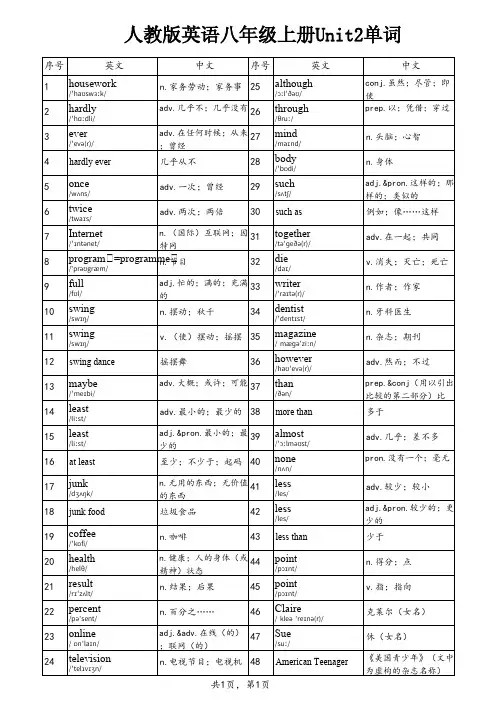
人教版英语八年级上册Unit2单词序号 英文 中文序号 英文中文1housework/ˈhaʊswɜːk/n.家务劳动;家务事25although/ɔːlˈðəʊ/conj.虽然;尽管;即使2hardly/ˈhɑːdli/adv.几乎不;几乎没有26through /θruː/prep.以;凭借;穿过3ever/ˈevə(r)/adv.在任何时候;从来;曾经27mind /maɪnd/n.头脑;心智4hardly ever 几乎从不28body/ˈbɒdi/n.身体5once/wʌns/adv.一次;曾经29such/sʌtʃ/adj.&pron.这样的;那样的;类似的6twice/twaɪs/adv.两次;两倍30such as 例如;像……这样7Internet/ˈɪntənet/n.(国际)互联网;因特网31together /təˈɡeðə(r)/adv.在一起;共同8program(=programme)/'prəʊgræm/n.节目32die/daɪ/v.消失;灭亡;死亡9full/fʊl/adj.忙的;满的;充满的33writer/ˈraɪtə(r)/n.作者;作家10swing/swɪŋ/n.摆动;秋千34dentist/ˈdentɪst/n.牙科医生11swing/swɪŋ/v.(使)摆动;摇摆35magazine/ˌmæɡəˈziːn/n.杂志;期刊12swing dance摇摆舞36however/haʊˈevə(r)/adv.然而;不过13maybe/ˈmeɪbi/adv.大概;或许;可能37than/ðən/prep.&conj(用以引出比较的第二部分)比14least/liːst/adv.最小的;最少的38more than 多于15least/liːst/adj.&pron.最小的;最少的39almost /ˈɔːlməʊst/adv.几乎;差不多16at least至少;不少于;起码40none/nʌn/pron.没有一个;毫无17junk/dʒʌŋk/n.无用的东西;无价值的东西41less/les/adv.较少;较小18junk food 垃圾食品42less/les/adj.&pron.较少的;更少的19coffee/ˈkɒfi/n.咖啡43less than少于20health /helθ/n.健康;人的身体(或精神)状态44point/pɔɪnt/n.得分;点21result/rɪˈzʌlt/n.结果;后果45point /pɔɪnt/v.指;指向22percent/pəˈsent/n.百分之……46Claire /ˌkleə ˈreɪnə(r)/克莱尔(女名)23online/ˌɒnˈlaɪn/adj.&adv.在线(的);联网(的)47Sue/suː/休(女名)24television/ˈtelɪvɪʒn/n.电视节目;电视机48American Teenager《美国青少年》(文中为虚构的杂志名称)共1页,第1页。
人教版八年级英语上册Unit2知识点汇总总结

人教版八年级英语上册Unit2知识点汇总总结01.重点短语1. help with housework 帮着做家务2. use the Internet 使用互联网3. go to the movies 去看电影4. my favorite TV program ( s)我最喜欢的电视节目5. how often 多久一次6. have dance and piano lessons 上舞蹈与钢琴课7. swing dance 摇摆舞 swung ( swing 的过去式)8. hardly ever 几乎从不9. play tennis with friends 与朋友打网球10. stay up late 熬夜11. eat a healthy breakfast 吃一顿健康的早餐12. play sports 进行体育运动13. at least / at most twice a week 一周至少/最多两次14. be good for my health 有利于我的健康 healthy ( health 的形容词形式)15. eat junk food 吃垃圾食品16. drink coffee 喝咖啡 drank ( drink 的过去式)17. No.5 High School students 第5中学学生18. in one’s free time 在某人的空余时间19. ask them about their free time activities 询问他们关于他们的业余活动20. not … at all 根本不…21. go online 上网22. be surprised that ..感到惊讶23. use it for fun 为了取乐而使用它24. the answers to the questions 这些问题的答案25. one to three times a week 一周一到三次26. two percent of the students 2%的学生27. the best way to do sth.做某事的最好方式28. such as 例如29. spend time with your friends 与你的朋友共度时光spent ( spend 的过去式)30. spend time on sth./ in doing sth.花时间在某事上/做某事31. play together 一起玩32. watch TV for over 2 hours 看两个多小时电视33. go to the dentist 去看牙医34. a 16-year-old high school student 一名16岁的中学生35. have a lot of good habits 有许多好习惯36. more / less than two hours 多/少于两小时37. go to the dentist for teeth cleaning 去牙医处清洁牙齿38. go to the shopping center 去购物中心02.重点句子语法聚焦1. --What do you usually do on weekends?你在周末通常做什么?--I always exercise.我总是锻炼。
【人教版】新目标八年级英语上册:Unit 2 单元说课稿

【人教版】新目标八年级英语上册:Unit 2 单元说课稿一. 教材分析新目标八年级英语上册Unit 2主要讲述了关于一般现在时的用法。
本单元包括两个部分:Section 1和Section 2。
Section 1主要介绍了一般现在时的基本结构和用法,通过一个关于家庭成员的对话和一个关于日常活动的,让学生理解和掌握一般现在时的构成和表示含义。
Section 2则通过一个故事和一个任务型阅读,进一步巩固一般现在时的用法,并引导学生运用一般现在时进行叙述和描述。
二. 学情分析八年级的学生已经掌握了英语学习的基本语法和词汇,具备一定的听、说、读、写能力。
但对于一般现在时的理解和运用,部分学生可能还存在一定的困难。
因此,在教学过程中,需要关注学生的个体差异,针对性地进行教学,帮助学生理解和掌握一般现在时的用法。
三. 说教学目标1.知识目标:学生能够理解一般现在时的概念、结构和用法,能够正确运用一般现在时进行叙述和描述。
2.能力目标:学生能够在日常交流中运用一般现在时,提高英语表达的能力。
3.情感目标:通过本单元的学习,学生能够培养对英语学习的兴趣,增强自信心。
四. 说教学重难点1.教学重点:一般现在时的结构、用法和意义。
2.教学难点:一般现在时的运用,特别是在具体情境中的运用。
五. 说教学方法与手段1.教学方法:采用任务型教学法、情境教学法和交际法,让学生在实际情境中理解和运用一般现在时。
2.教学手段:利用多媒体课件、图片、故事等教学资源,激发学生的学习兴趣,提高课堂参与度。
六. 说教学过程1.导入:通过一个与学生生活密切相关的场景,如询问学生家庭成员的姓名和年龄,引导学生进入一般现在时的学习。
2.新课呈现:通过一个关于家庭成员的对话和一个关于日常活动的,展示一般现在时的结构和用法。
3.实践环节:学生分组进行角色扮演,运用一般现在时进行对话,巩固所学知识。
4.任务型阅读:学生阅读一个关于故事的文章,回答相关问题,进一步理解一般现在时的用法。
Unit2笔记人教版八年级上册英语
八年级上学期英语笔记(2)Unit 2 How often do you exercise?I. Important phrases.hardly ever 几乎从不swing dance 摇摆舞how often 多久一次once a week 每周一次twice a week 每周两次be full/free 忙的/有空surf/ use the Internet 上网How e?为什么? at least 至少,不少于at most 最多junk food 垃圾食品such as 例如more than 多于less than 少于stay up 熬夜help with sth帮助某事play sports 做运动on weekends 在周末go to the movies 看电影play puter games 玩电子游戏watch TV 看电视use the Internet 上网go to the dentist 去看牙医go shopping 去购物the most popular 最受欢迎的three times a month每月三次not......at all 一点也不have......lessons 上......课in one’s free time 在某人的空闲时间II. Grammar 频度副词1) 含义:一般用来表示动作发生的频率。
2) 一般来说可按频率大小排列为:(总是)always ﹥(通常) usually﹥(经常) often﹥(有时)sometimes﹥(几乎从不)hardly ever ﹥(从不) never3) 频度副词放在系动词、助动词或情态动词之后,行为动词之前。
eg. I never go shopping.4) 构成频率的表达方式:1. 次数(once/ twice/three times/...)+ a +时间(day/week/month/year/...)2. 次数+ every﹢基数词+时间eg. twice every three weeks once every two years3. every +时间(day,week, month, year...)4. 频度副词对以上四点提问时,一般用how often(多久一次)。
人教版八年级英语上册Unit2语法规则精讲
人教版八年级英语上册Unit2语法规则精讲本文档将为您详细介绍人教版八年级英语上册Unit2的语法规则。
以下是各种语法规则的精要概述:一、一般现在时一般现在时表示经常性、惯性或客观事实。
它的基本形式是主语+动词原形。
例子:- I eat breakfast every day.- She goes to school by bus.二、一般过去时一般过去时表示在过去某个时间发生的动作或存在的状态。
它的基本形式是主语+动词过去式。
例子:- He played soccer yesterday.- They visited their grandparents last weekend.三、现在进行时现在进行时表示现在正在发生的动作。
它的基本形式是:be动词(am/is/are)+动词的现在分词。
例子:- They are watching a movie right now.- She is studying for her exam.四、过去进行时过去进行时表示过去某个时间正在进行的动作。
它的基本形式是:was/were + 动词的现在分词。
例子:- We were playing basketball at 5 p.m. yesterday.- He was sleeping when I called him.五、一般将来时一般将来时表示将来某个时间要发生的动作或存在的状态。
它的基本形式是:will/shall + 动词原形。
例子:- We will go shopping tomorrow.- She will attend the meeting next week.以上是人教版八年级英语上册Unit2的语法规则精讲。
希望对您有帮助!。
八年级上册英语人教版unit2知识点
八年级上册英语人教版unit2知识点八年级上册英语人教版Unit2主要涵盖了关于住房的相关词汇、语法以及句型。
接下来我将为大家详细介绍其中的知识点。
一、房型和家具1. 卧室:bedroom,有单人间(single room)和双人间(double room)之分,卧具包括床(bed),床架(bed frame),床垫(mattress),枕头(pillow),被子(blanket/quilt)等。
2. 客厅:living room,是家庭中用于接待访客和娱乐的地方,包括沙发(sofa/couch),电视(TV),茶几(coffee table),家居装饰品等。
3. 厨房:kitchen,包括炉灶(stove),烤箱(oven),冰箱(refrigerator),洗碗机(dishwasher),水槽(sink)等。
4. 餐厅:dining room,是用餐的地方,通常有餐桌(dining table),餐椅(dining chairs)等。
二、房屋描述1. 地理位置:the location of the house。
例如:Our new house is located at the heart of the city.2. 房屋类型:the type of the house。
例如:She lives in a two-story house with a garden.3. 房屋朝向:the orientation of the house。
例如:Our house faces east, so we can enjoy the sunrise every morning.4. 房间大小:the size of the room。
例如:The living room is spacious enough to accommodate a large sofa and a coffee table.5. 装修风格:the style of the decoration。
人教版八年级英语上册Unit2单词及短语(附例句)
人教版八年级英语上册Unit2单词及短语(附例句)【重点单词】1.housework ['haʊswɜːk] n.家务劳动Xiao Ming helps his mother do housework every day.小明每天帮妈妈做家务。
2.hardly ['hɑːdli] adv.几乎不;简直不;刚刚We hardly ever go out on the weekends.我们很少在周末出去。
Mother hardly ever gets angry with us.母亲几乎从不对我们生气。
3.ever ['evə(r)] adv.曾经;在任何时候I have ever visited the Great Wall.我曾经参观过长城。
4.once [wʌns] adv.一次;曾经I go to the library once a week.我每周去一次图书馆。
5.twice [twaɪs] adv.两倍;两次You can't go to the same place twice.你不可能两次去同一个地方。
6.Internet ['ɪntənet] n.因特网We can get a lot of information from the Internet.我们可以从互联网上得到很多信息。
7.program ['prəʊɡræm] n.节目;程序;课程;节目单This TV program is the best of all.这个电视节目是所有节目中最好的。
This TV program is much better than that one这个电视节目比那个好得多8.full [fʊl] adj.满的;充满的;完全的The bottle is full of milk.瓶子里装满了牛奶。
9.swing [swɪŋ] n.摇摆;秋千v.摇摆;旋转The little sister is swing with her friends.小妹妹正在和她的朋友们荡秋千。