
初中英语人教版七年级下册Unit5复习教案
鍒濅腑,鑻辫,浜烘暀,鐗?涓冨勾绾?涓嬪唽,Unit5,澶嶄範,Unit5澶嶄範鏁欐涓€銆佸涔犵洰鏍囷細1銆佹帉鎻¤繍鐢ㄦ湰鍗曞厓鐨勯噸鐐瑰崟璇嶅拰鐭锛?2銆佸浼氱敤褰㈠璇嶆弿杩板姩鐗╋紱浜屻€佸涔犻噸鐐癸細琛ㄧず鍔ㄧ墿鐨勫悕璇嶃€佸舰瀹硅瘝涓夈€佸涔犻毦鐐癸細why闂彞鐨勮繍鐢?鍥涖€佸涔犺繃绋嬶細1.鏄庣‘瀛︿範鐩爣銆?2.鑷富瀛︿範銆傦紙閲嶇偣鍗曡瘝锛岀煭璇紝鍙ュ瀷锛?锛堜竴锛夐噸鐐瑰崟璇?1.鐔婄尗panda 聽聽聽聽聽2. 鍔ㄧ墿鍥?聽聽聽 zoo聽聽聽聽聽3.鑰佽檸聽聽聽 tiger4.澶ц薄聽 elephant聽聽聽聽5. 鐙瓙聽聽聽聽聽 lion聽聽聽聽聽6. 闀块楣柯? giraffe7. 瓒呰繃;鍦ㄢ€?涓婃柟over聽聽 8. 鍙埍鐨?鏈虹伒鐨劼?cute聽聽聽 9. 鎳掓儼鐨劼? lazy10. 鑱槑鐨劼?smart聽聽聽聽 11. 缇庝附鐨劼?聽聽聽 beautiful聽 12. 瀹犵墿聽聽 pet13. 婢冲ぇ鍒╀簹聽 Australia聽聽 14. 鐫¤聽聽聽聽聽 sleep聽聽聽 15. 鍙嬪ソ鐨劼? friendly16. 瀹崇緸鐨劼?聽 shy聽聽聽聽 17. 鏃楀笢; 鏃椔?聽聽 flag聽聽聽 18. 鏉€姝?寮勬聽 kill锛堜簩锛夐噸鐐圭煭璇?1. kind of聽聽绋嶅井锛屾湁鐐瑰効聽聽聽Africa聽聽鍗楅潪from鈥?come from鏉ヨ嚜鈥β?on two legs聽聽涓ゆ潯鑵胯蛋璺紱绔嬬潃璧拌矾day=the whole day 鍏ㄥぉ锛屾暣澶┞?聽聽friendly to sb. 瀵逛簬鏌愪汉寰堝弸濂斤紱7.a lot聽聽闈炲父锛屽崄鍒喡?聽and white聽聽榛戠櫧鐩搁棿聽聽in (great) danger聽聽澶勪簬(鏋佸ぇ)鍗遍櫓涓?聽聽聽down聽聽鐮嶅€?made of聽聽 +鐗╄川鐢扁€?.鍒舵垚聽聽聽聽12.a symbol of good luck聽聽濂借繍鐨勮薄寰伮?聽the elephant 鎷晳澶ц薄of Thailand鈥檚 symbols 娉板浗鐨勪竴涓爣蹇椔?t from Thailand 娉板浗鐨勫鐢?lost聽聽 =be lost 杩疯矾聽one鈥檚 home 鏃犲鍙綊锛屽け鍘诲鍥?a long time寰堥暱鏃堕棿聽鈥or鈥β?聽鍥犫€︹€﹁€屾潃姝烩€?20.. forget to do sth. 蹇樿瑕佸仛鏌愪簨(鏈仛锛?forget doing sth. 蹇樿鍋氳繃鏌愪簨锛堝凡鍋氾級(涓?閲嶇偣鍙ュ瀷1. 鈥擶hy do you like pandas? 浣犱负浠€涔堝枩娆㈢唺鐚紵鈥擝ecause they鈥檙e kind of interesting. 鍥犱负瀹冧滑鏈夌偣鍎挎湁瓒c€?2. 鈥擶hy does John like koalas? 绾︾堪涓轰粈涔堝枩娆㈡爲琚嬬唺锛?鈥擝ecause they鈥檙e very cute. 鍥犱负瀹冧滑闈炲父鍙埍銆?3. 鈥擶hy don鈥檛 you like tigers? 浣犱负浠€涔堜笉鍠滄鑰佽檸锛?鈥擝ecause they鈥檙e really scary. 鍥犱负瀹冧滑鐪熺殑鍚撲汉銆?4. 鈥擶here are lions from? 鐙瓙鏉ヨ嚜鍝噷锛?鈥擳hey鈥檙e from South Africa. 瀹冧滑鏉ヨ嚜鍗楅潪銆?5. Elephants can walk for a long time and never get lost.澶ц薄鑳借蛋寰堥暱鏃堕棿骞朵笖浠庝笉杩疯矾銆?6. They can also remember places with food and water.瀹冧滑涔熻兘璁颁綇鏈夐鐗╁拰姘寸殑鍦版柟銆?7. But elephants are in great danger.浣嗘槸锛屽ぇ璞″浜庢瀬澶у嵄闄╀箣涓€?8. People cut down many trees so elephants are losing their homes.浜轰滑鐮嶅€掍簡璁稿鏍戯紝鍥犳锛屽ぇ璞℃笎娓愬け鍘诲畠浠殑瀹跺洯銆?9. Today there are only about 3,000 elephants (over 100,000 before)鐜板湪浠呮湁澶х害3000澶村ぇ璞★紙涔嬪墠瓒呰繃10涓囧ご澶ц薄锛夈€?鈥檛 she beautiful?濂归毦閬撲笉缇庝附鍚楋紵锛堝洓锛夊悎浣滄帰绌跺強灞曠ず寮曞鐨勭壒娈婄枒闂彞銆?鐢ㄦ硶锛歸hy 鏄鍘熷洜杩涜鎻愰棶鐨勭枒闂彞锛屽叾绛旇澶氱敤 because 鏉ュ紩瀵笺€?鍙ュ瓙缁撴瀯 Why do you + _________ + 鍏朵粬聽渚嬪锛氫綘涓轰粈涔堝枩娆㈠ぇ璞★紵 ____________________________鍥犱负瀹冧滑鑱槑銆?____________________________寮曞鐨勭壒娈婄枒闂彞璇㈤棶鏉ヂ?聽鑷?聽鍝噷銆?鍙ュ瓙缁撴瀯 Where + ___ + 鍚嶈瘝 + _____?绛旇锛歍hey are + from 鈥?鑰冩媺鏉ヨ嚜鍝噷锛焈__________________________浠栦滑鏉ヨ嚜婢冲ぇ鍒╀簹銆俖__________________________3. one of + 鍚嶈瘝澶嶆暟褰㈠紡聽鎰忎负鈥溾€︹€︿箣涓€鈥?Eg锛欽ack is one of my friends.聽鏉板厠鏄垜鐨勬湅鍙嬩箣涓€銆?銆愭敞鎰忋€戝綋鈥渙ne of + 鍚嶈瘝澶嶆暟褰㈠紡鈥濅綔涓昏鏃讹紝褰撲綔鏁翠綋鐪嬶紝鐢ㄥ崟鏁般€?One of the lions is from Africa. 鐙瓙涓殑涓€鍙槸鏉ヨ嚜闈炴床銆?4. get lost聽杩烽€旓紱杩疯矾聽The little girl can鈥檛 find her home. She gets lost. 灏忓コ瀛╂壘涓嶅埌瀹朵簡锛屽ス杩疯矾浜嗐€?5. be in (great) danger 聽聽澶勪簬锛堟瀬澶э級鍗遍櫓涔嬩腑銆?The boy falls into the lake. He鈥檚 in great danger. 灏忕敺瀛╄惤鍏ユ箹涓紝浠栧浜庢瀬澶у嵄闄╀腑銆?6.聽 cut down聽鐮嶄紣聽 Don鈥檛 cut down trees. 涓嶈鐮嶄紣鏍戞湪銆?7. over 锛堟暟閲忥級瓒呰繃锛浡?鍦ㄢ€︹€︿箣涓?Over one hundred people are in the library. 鏈夎秴杩囦竴鐧句汉鍦ㄥ浘涔﹂閲屻€?There鈥檚 a small bridge over the river. 鍦ㄦ渤涓婇潰鏈変竴搴у皬妗ャ€?8. Why don鈥檛 you like her?聽浣犱负浠€涔堜笉鍠滄濂瑰憿锛?鍙﹀锛學hy don鈥檛 you + 鍔ㄨ瘝鍘熷舰锛岃繕聽聽鏄?聽涓€绉嶆彁寤鸿鐨勫彞鍨嬨€?鎰忎负鈥滀负浠€涔堜笉鈥︹€﹀憿锛熲€?渚嬪锛歐hy don鈥檛 you take a walk?浣犱负浠€涔堜笉鍘绘暎姝ュ憿锛?鈥淲hy don鈥檛 you + 鍔ㄨ瘝鍘熷舰鈥?鐨勫悓涔夊彞鍙互璇达細 Let鈥檚鈥β? 渚嬪锛?Let鈥檚 take a walk. 璁╂垜浠幓鏁f鍚с€?Let鈥檚 drink some tea. 璁╂垜浠枬鐐硅尪鍚с€?缁冧範锛?. Let鈥檚 play volleyball after school. (鏀孤?聽涓哄悓涔夊彞)_____ _____ you play volleyball after school?聽2. Let鈥檚 join the music club. (鏀逛负鍚屼箟鍙?____ ______ you join the music club?9. kind of聽鏈夊嚑鍒嗏€︹€β?鐩稿綋浜庝竴涓壇璇嶏紝聽聽鍚庨潰澶氳窡褰㈠璇?銆備緥濡傦細They鈥檙e kind of scary. 浠栦滑鏈夌偣鍙€曘€?The pandas are kind of cute.聽鐔婄尗鏈夌偣鍙埍銆?銆愭嫇灞曘€慿ind 浣滃悕璇嶆剰涓衡€滅绫烩€?聽聽聽聽聽聽聽聽 a kind of 鈥β?涓€绉嶁€︹€?What kind of bread do you like?聽聽聽聽浣犲枩娆㈠摢绉嶉潰鍖咃紵鎻愰棶瀛︾敓浠ヤ笂鎺㈢┒鍐呭鐨勮璁烘儏鍐碉紝鏁欏笀浜嗚В姣忎釜瀛︾敓鏄惁鑳藉鐪熸鐞嗚В鎺屾彙鏉愭枡鍐呭涓殑閲嶇偣闅剧偣銆?(浜? 绌挎彃宸╁浐銆傛暣鐞嗘湰鑺傚涔犵殑閲嶈鐭ヨ瘑鐐癸紝灏嗗悇鑷殑鐤戦毦闂鍐嶆璁ㄨ鎴栧彂闂€佸笀锛屾⒊鐞嗙瑪璁般€?(鍏? 鑼冩枃璧忔瀽Animal I LikeThere are many kinds of animals in the world. What animal do I like? Let鈥檚 know her.Many people like her very much. I also like her. She is from China. She is very cute. She doesn鈥檛 eat grass and meat at all. She eats bamboo every day. She is so nice. She is black white. She has two big black ears and eyes. And she also has black legs and arms.What animal is she? She is a panda. I like panda very much. Do you like her? What animal do you like?。
人教版七年级英语下册Unit5大单元教学设计
-通过实例句型,如:He always plays soccer on weekends.让学生理解并掌握一般现在时的用法。
(三)学生小组讨论
1.教学活动设计:学生分组,讨论组内成员的周末活动,用一般现在时进行描述。
5.学生对运动、活动等话题较为感兴趣,这为本章节的教学提供了良好的情感基础。教师可充分利用这一特点,激发学生的学习积极性,提高教学效果。
三、教学重难点和教学设想
(一)教学重难点
1.词汇和短语的掌握:本章节的词汇和短语是学生进行有效交流的基础,因此,如何帮助学生熟练掌握并运用这些词汇和短语是教学的重点和难点。
二、学情分析
针对人教版七年级英语下册Unit 5的教学内容,我们对学生的学情进行分析。七年级学生经过上半学期的学习,已经具备了一定的英语基础,包括词汇、语法和简单的句型。在此基础上,他们对本章节的学习有以下特点:
1.学生对英语学习的兴趣较浓,但对词汇的记忆和运用仍存在一定的困难。因此,在教学过程中,应注重激发学生的学习兴趣,同时加强词汇的记忆和运用训练。
3.口语表达能力的提升:提高学生的口语表达能力,让他们能够自信地用英语进行交流。
-教学设想:采用角色扮演、小组讨论、课堂报告等形式,为学生提供充足的口语练习机会。教师应注重个体差异,给予不同水平的学生个性化的指导和鼓励。
(二)教学设想
1.情境教学法:结合本单元主题,创设各种真实的语言环境,让学生在情境中学习、运用英语。
-目的:拓展学生的阅读视野,提高英语素养。
7.视频观看:观看与本单元主题相关的英语视频,如运动教学、日常生活分享等,并尝试用英语复述视频内容。
人教版七年级英语下册unit5教案
Unit 5 Why do you like pandas?Section A (1a-2d)一、教学目标:1. 语言知识目标:1) 能掌握以下单词:tiger, elephant, panda, lion, koala, giraffe, cute, lazy, smart, beautiful, scary, kind, kind of, Australia, south, Africa, South Africa, pet, leg, cat, sleep2) 能掌握以下句型:① What animals do you/does she/ does he like?②Let’s see the …?③Why do you/does she/ does he want to see …?④Because they are ….2. 能力目标:① To observe and describe animals.② To talk about their preferences③ To know the implied meaning of some animals2. 情感态度价值观目标:动物和人类都生活在同一地球上,动物是我们的朋友。
我们人类应该与动物和谐相处,共同生存。
我们应当学会关爱动物,保护动物。
二、教学重难点1. 教学重点:1) 学会描述动物的性格及特点。
2) 学会表达喜欢某类动物及说明喜欢的原因。
2. 教学难点:名词的复数形式表示一类事物;第三人称单数形式三、教学过程Ⅰ. Warming-up and lead inTo create an English environment, the teacher shows the class some pictures of a zoo. And ask some questions about animals:Do you like to go to the zoo?Do you like animals?Then have them to recall the animals they had learned and write them on the blackboard as he/she can.( e.g. animals---sheep, monkey, cat, dog, mouse, cow, duck… )Ⅱ. Presentation1. Ask them to talk with their partners about the animals they like using the words they know (Four students a group).—What animals do you like?—Why do you like…—Because they’re…2. Then show the class some pictures of animals and present other animals. And ask them: What’s this in English?It's a tiger. (Then lion, panda, elephant, koala, giraffe)Ss look at the picture and try to remember the new words of the animals.3. Next, glue the pictures on the blackboard and ask one student to match the pictures with thewords on the cards. Other students turn to page 25 and finish 1a.4. Check the answers with the class.Ⅲ. Game (Guessing game.)T: Show some pictures on the big screen. Let Ss guess what animal it is.Ss try to guess and remember the names of the animals.Ⅳ. ListeningWork on 1b.Tell Ss to listen to the tape and check the animals they hear in 1a.Play the recording again and check the answers with the class.Ⅴ. Pair work1. Ask th e students to imagine “ We are in the zoo, there are many kinds of animals here.”Then ask a student to do the model with you:—Let’s see the lions first.—Why? (why do you /does she /does he like lions?)—Because they are interesting.2. Ss work with their partners practice the conversation using the animal in 1a.Ⅵ. Listening1. Work on 2a;T: Listen to the conversation carefully. Then write the names of the animals you hear on these lines.Play the recording the first time. Students only listen.Play the recording a second time. This time students write in the names of the animals.Check the answers.Point out the adjectives and countries listed on the right. Ask a student to say the words.Say, Now I will play the recording again. This time draw a line between each animal and the adjective and countries you hear.Play the recording and have students match each animal with an adjective and a country. Correct the answers.2. Work on 2bT: Listen again and complete the conversation with the words in 2a.Play the recording for the Ss to listen and write the answers.Check the answers with the class.Ⅶ. Pair work1. Ask two students to read the conversation in 2b to the class.2. Ss practice the conversation in pairs.3. Then show the transcription on the big screen and practice the other two conversations in 2a.4. Ss practice the conversations in pairs.Ⅷ. Role-play1. Ask Ss to look at the picture in 2d. Then Ss read the conversation in 2d and find the answers to the questions:① Does Peter have a pet?② What can Dingding do?③What pet does Jenny’s mom have?④ Does Jenny like the cat? Why?2. Ss read the conversations and try to find the answers to the questions.Check the answers:Yes, he does.He can walk on two legs. He can dance, too.She has a cat.No, she doesn’t. Because it’s very lazy.3. Ss work in pairs and practice the conversation.4. Let some pairs role-play the conversation.Homework:1. Remember the new words and expressions in this period.2. Role-play the conversation after class.3. Write the animal's names as many as possible in the exercises book.板书设计:Section A (Grammar Focus-3c)一、教学目标:1. 语言知识目标:1) 继续练习运用如何做描述动物及表述自己对动物的喜好。
人教版七年级下册英语Unit5SectionB2a2c教学设计
(三)学生小组讨论
1.教学活动设计:
-将学生分成小组,让他们围绕“日常运动习惯”这一主题进行讨论,运用所学运动词汇和一般现在时进行交流。
-提供讨论话题,如:“What sports do you like? How often do you do sports?”等。
二、学情分析
本章节的教学对象为七年级下册学生,经过上一学期的学习,他们已经掌握了基本的英语语法和词汇,具备了一定的听说读写能力。在此基础上,针对本章节内容,学情分析如下:
1.学生对运动相关词汇已有一定了解,但在具体语境中运用时,部分学生可能存在发音不准确、词汇记忆不牢固等问题。
2.在一般现在时的运用上,大部分学生能够正确构成句子,但在实际交流中,部分学生可能存在时态混淆、句子结构不清晰等问题。
-引导学生谈论自己喜欢的运动,询问他们平时是如何进行锻炼的,为新课主题“日常运动习惯”做好情感上的准备。
2.教学实施:
-邀请学生分享自己喜欢的运动项目,鼓励他们用英语进行表达,如:“My favorite sport is basketball.”
-通过提问方式引导学生谈论运动频率,如:“How often do you play basketball?”,为新课中一般现在时的学习打下基础。
-阅读后,思考运动对身心健康的好处,与家人分享阅读心得。
4.实践作业:
-鼓励学生参与家庭或学校的运动活动,记录自己的运动过程和感受,以日记或照片形式记录,培养良好的运动习惯。
-学生与家人或朋友一起制定运动计划,相互监督,共同完成计划,提升团队协作能力。
人教版七年级英语下册教学设计:Unit5(SectionA2d3c)
3.能够运用目标句型进行自我介绍和描述未来职业规划,如:“I will be a... in the future.”和“I want to work with... because...”。
4.提高听力技能,能够理解并获取他人关于未来职业规划的信息。
(4)拓展与提高:播放与本章节相关的听力材料,提高学生的听力理解能力,同时引导学生关注不同职业的特点和要求。
(5)总结与反馈:对本节课的学习内容进行总结,给予学生及时的反馈和鼓励。
3.教学评价:
(1)形成性评价:关注学生在课堂活动中的表现,鼓励学生积极参与,及时给予表扬和鼓励。
(2)终结性评价:通过单元测试、口语表达等方式,评估学生对本章节知识点的掌握程度。
2.难点:
(1)正确使用一般将来时,避免与其他时态混淆。
(2)在口语交流中,能够灵活运用所学词汇和句型,表达自己的职业梦想和规划。
(3)提高听力理解能力,抓住关键信息,理解他人的职业规划。
(二)教学设想
1.教学方法:
(1)采用情境教学法,创设真实语境,让学生在角色扮演中自然地运用所学知识。
(2)利用多媒体教学资源,如图片、视频等,激发学生的学习兴趣,提高课堂参与度。
人教版七年级英语下册教学设计:Unit5(SectionA2d3c)
一、教学目标
(一)知识与技能
在本章节的学习中,学生将掌握以下知识与技能:
1.掌握本单元的核心词汇和短语,如:future, job, want to be, work with, help, achieve, dream, come true等,并能熟练运用到日常交流中。
英语七年级下人教新课标;Unit5教案

英语七年级下人教新课标;Unit5教案英语七年级下人教新课标unit5教案period threestep 1.revision1.greetings.2. review:show the ss some pictures and revise present progressive tense.step 2 prsentationshow the ss a picture about a man watching tv at home.ask the ss:is he watching tv?(yes,he is.)where is he watchingtv?(at home)let ss look a t the pictures in activity 1a and teach the new words.step 3.activity 1a 1b:writing and practice.1. activity 1a: let students complete the chart. check the answers.2.activity 1b:pairwork. ask and answer questions witha partner. make questions and answers like the ones in the picture.then prac tice in pairs.3. ask some pairs to present their conversations to theclass.step 4. activity 2a 2b:listening1. activity 2a:listen to the conversation and complete the chart.2. activity 2b:listen again. write the activities in the chart.check the ss’ answers.get the ss do “ask and answer” practice in pairs,using“ where is tina…?”“what’s he/she doing?”step 5.activity 2c:pair workhelp the ss use the information in the chart to make a new conversation in pairs. practise ,then ask some pairs to present their conversationsin front .step 6. selfcheck 1: review the key vocabulary1. ask students to check all the words they know.give them two mi nutes to memorize the key words. review the structures in this unit.2. then have a dictation.3.ask ss to write five new words in their vocab-builder on page 30.step 7. homeworkwrite five sentences using present progressive tense.period fourstep 1.revision1.greetings.2.show some pictures. revise some places and activities.ask the ss :where is he/she?what’s he/she doing?step2.preasentation.first,t talks about a photo of his family.then talk about the pictures in activity 3a.make sure the ss know wha t the childr en are doing in each picture.step3.activity 3a 3b:reading1. activity 3a :give the ss some time to read the letter by themselves. number the pictures according to the order they read about them in the letter. listen and find out the activities and places.un derline the activities and circle the pl aces. check the answers.deal with any difficult language points.read the letter with the ss.2. activity 3b: fill in the blanks in activity 3b according to the picture. deal with any difficult language points.re ad the letter with the ss.step4.activity 3c 4: speaking writing.1. activity 3c: ask students to bring in some family photos or some pictures of their family or friends.help the ss write similar sentences about their own pictures.ask some ss to read out their passages to the class.2. activity 4:groupwork.put students into groups of four. ask them to share their pictures in groups and do“ask andanswer”practice.step5.self-check 3.1. self-check 3:talk about the pictures in this part.help the ss ask questions about each picture,then dis cuss the answers together.check the answers.teach the new words:camera,bird.2. ask the ss to write short pessages about this story.help ss to tell their stories in class.step 6 just for fun!look at the cartoon pictures and read the conversation.step homework:1.revise the whole unit2.write a letter to sb: write something about your family photo.。
人教版七年级英语下册Unit5复习教案
你能看见那只鸟儿吗?______ _____ _____ the bird?
14.在英语中用because不用so,或用so不用because
Because English is very interesting, I like it.
4._______________________________________________(用so 改写上面句子)
四、检查自学,生生师生互动,质疑解惑。(2分钟)
---Where ______ the lions from? =______ ______ the lions come from?
2.They are__________cute.(非常)
3.They are__________scary(真正地)
4.They are _________smart(相当).
五、讲授新课,师精讲,生精练。(10分钟)
一、重点解析
1.Whydo you like pandas?【解析】Why特殊疑问副词,“为什么”,用来询问原因。
Because English is very interesting, so I like it. ( × )
人教版英语七年级下册教案
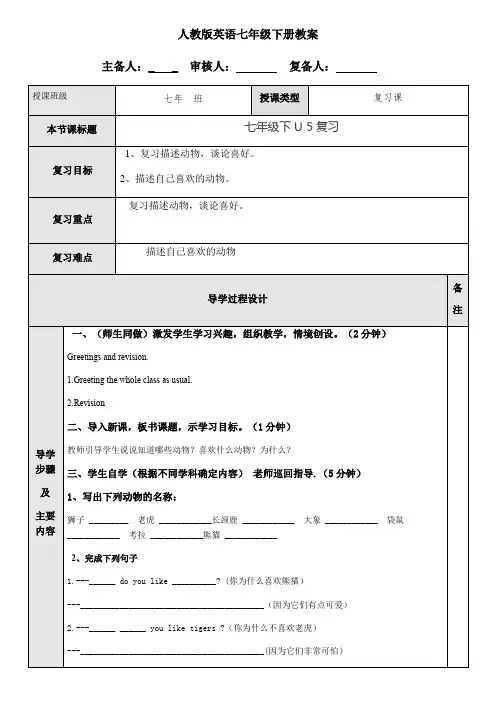
主备人:_ _审核人:复备人:
授课班级
七年 班
授课类型
复目标
1、复习描述动物,谈论喜好。
2、描述自己喜欢的动物。
复习重点
复习描述动物,谈论喜好。
2、描述自
复习难点
描述自己喜欢的动物
导学过程设计
备注
导学步骤
及
主要内容
一、(师生同做)激发学生学习兴趣,组织教学,情境创设。(2分钟)
七年级-人教版-英语-下册-Unit-5-单元复习课
考点突破
4.friendly
(1)friendly 为形容词,意为“友好的”,名词形式为friend。
知识
其反义词为 unfriendly,意为“不友好的”。
复现 (2)be friendly to 表示“对……友好”,其近义短语为 be
good to。
考点突破
5.forget
① 我忘了他的电话号码。
I __f_o_r_g_et__ his _t_e_le_p_h_o_n_e__n_u_m_b_e_r_.
Hale Waihona Puke ② Don’t forget ________ your parents about it.
A.tell
B.telling
C.to tell
③ 她经常把钥匙忘在家里。
She often __l_ea_v_e_s__ her keys ___a_t____ home.
Unit 5 Why do you like pandas? (Period 6)
单元复习课
Do you remember the words we have learned in this unit?
• Animals: panda, tiger, elephant, koala, lion, giraffe, pet, cat …
Describing sentences (描述性句型)
Expressing preferences (表达喜爱)
要点回顾
(1)let’s do sth. (2)kind of (3)sleep (4)friendly (5)forget (6)特殊疑问词
1.Review the key points and grammar in this unit. 2.Write a short passage according to the interview.
人教版新目标七年级英语下册 Unit 5 教案
人教版新目标七年级英语下册 Unit 5 教案一. 教材分析人教版新目标七年级英语下册Unit 5主要讲述了日常生活中的一些活动,如游泳、打篮球、跳舞等。
本单元的话题贴近学生的生活,有利于激发学生的学习兴趣。
教材通过听说读写等多种活动,帮助学生掌握日常生活中的交际用语,提高学生的语言运用能力。
二. 学情分析七年级的学生已经掌握了基本的英语语法和单词,对于日常生活中的交际用语也有了一定的了解。
但部分学生可能在发音和口语表达上还存在困难,需要教师在教学中加以引导和纠正。
此外,学生可能对一些体育活动相关的词汇和表达不够熟悉,需要在课堂上进行拓展和练习。
三. 教学目标1.知识目标:学生能够掌握本单元的生词和短语,了解日常生活中的交际用语。
2.能力目标:学生能够听懂、会说、会读、会写与日常生活相关的英语句子。
3.情感目标:学生能够积极参与课堂活动,提高学习英语的兴趣。
四. 教学重难点1.重点:本单元的生词和短语,日常生活中的交际用语。
2.难点:情态动词can的用法,以及与日常生活相关的句型结构。
五. 教学方法1.任务型教学法:通过设置各种任务,让学生在完成任务的过程中学习英语。
2.情景教学法:创设各种生活情境,让学生在真实的环境中学习英语。
3.交际法:鼓励学生积极参与课堂交际,提高口语表达能力。
六. 教学准备1.准备单词卡片、短语卡片、图片等教学辅助材料。
2.准备与本单元话题相关的视频或音频材料。
3.准备课堂练习题和测试题。
七. 教学过程1.导入(5分钟)利用图片或视频引导学生谈论日常生活中喜欢的活动,引出本课话题。
2.呈现(10分钟)老师展示本课的生词和短语,让学生朗读并解释其意思。
同时,老师用情态动词can提问,引导学生回答。
3.操练(15分钟)学生分角色扮演,用情态动词can进行问答。
老师巡回指导,纠正发音和表达错误。
4.巩固(10分钟)学生完成课堂练习题,老师及时批改和讲解。
5.拓展(5分钟)老师引导学生谈论更多关于日常活动的表达,如游泳、打篮球、跳舞等。
人教版初一英语下册Unit5复习课教案
Unit 5 I’m watching TVperiod 1(周六)教学重点1.掌握重点词汇以及短语2.掌握句型主语+ am/is/are+ doing +其他+时状教学难点1. 现在进行时的构成和使用2. 现在分词与动名词的区分教学过程一.单元知识回顾1.重点单词(方法带读——叫两名学生每人读8个,其他学生听其是否又读错的地方——纠正错误——单词抢答竞赛)答对一个得一颗星星1.打扫;清除 _____clean_____2.读;阅读 _____read_____3.通过;以……的方式 _____on_____4.公寓;住宅 _____apartment_____5.电视节目 _______TV show___6.当然;的确 ______sure____7.等待;等候 ______wait____8.玩具____toy______9.西;西方;西方的;在西方的;向西方的 _____west_____ East,west,home is best.10.活动 ___activity___ economic activity 经济活动 physical activity 身体活动,体育活动;体力活动11.买东西;购物 ______shop____ go shopping12.购物商场;商业街 ______mall____13.水池;水塘 ______pool____14照相机 ________camera__16.鸟 _______bird___ Birds of a feather flock together.A bird in hand is worth two in the bush.2.短语:1.do one’s homework 做某人的作业 do housework 做家务I do not like doing one's homework.They must do their homework .I often help my mother do housework.Everyone should learn to do housework2.talk on the phone 在电话里交谈, talk about……谈论…… talk to(with)sb 和某人交谈It is quite simple, women love to talk on the phone.这很简单,女人喜欢煲电话粥。
人教版英语七年级下册Unit5教学设计
5.写作指导:教师将提供写作框架,引导学生关注文章结构、逻辑关系和语言表达,提高学生的写作能力。
6.情感教育:在教学过程中,教师将关注学生的情感需求,通过分享家庭故事、讨论家庭文化等方式,引导学生珍惜亲情,关爱家人。
2.教师提问:“Can you introduce your family members to us?”让学生尝试用英语介绍自己的家庭成员,为新课的学习做好铺垫。
3.教师根据学生的回答,板书出本节课的主要词汇,如father, mother, brother, sister, grandparent等,引导学生齐读并识记。
2.掌握本单元的句型:学生能够熟练运用一般现在时的句子结构,描述家庭成员及其特征和日常活动,如:She is my aunt. She is kind and funny. He plays football after school.
3.提高阅读理解能力:学生能够理解并获取文本中的关键信息,通过阅读理解练习,提高阅读速度和准确性。
b.根据课堂所学,写一篇关于自己家庭成员的短文,要求使用一般现在时描述每位家庭成员的外貌特征和日常活动,不少于80词。
2.口语作业:
a.与家长进行英语对话,介绍本节课所学的家庭成员词汇和一般现在时的句子结构,让家长了解学生的学习情况。
b.录制一段视频,用英语介绍自己的家庭,并分享给同学和老师,促进同学间的相互了解和交流。
2.重点:提高学生的阅读理解能力,使他们能够从文本中获取关键信息,理解并运用阅读策略。
难点:学生在阅读过程中,对长难句的理解和推断能力较弱,需要教师引导和培养。