
小学英语人教PEP版三年级下册教案Unit 4 Where is my car 第一课时 教案
第一课时课时内容A. Let’s talk. Let’s play.课时分析在Let’s talk部分,呈现了John和Mike之间的对话。
要放学了,Mike在收拾书包时找不到自己的文具盒了,于是询问John,在John的帮助下在书桌里找到了它。
接着又在自己的书下找到了铅笔。
在这个过程中呈现了本课需要学生听懂、会说的句式:Let’s go home! Where is my pencil box? It’s in your desk. Silly me!其中on, in, under, desk都是本单元需要达到听懂、会说、认读的三会单词。
Let’s play的游戏中,黑板上呈现了本课的重点句式结构:Where is my ____? It’s _____ the ________. 吴一凡和Sarah分别拿着单词卡片放在正确的横线上,以补全对话。
这是个帮助学生熟悉、掌握重点句式结构的活动,在玩的过程中,学生可以由初步了解重点句式结构过渡到熟悉句式结构,为自由表达奠定基础。
本课时的主要内容是描述物品的位置,可以在教学过程中,利用教室内的人及物品来进行游戏操练,让学生在熟悉的环境中,真实的场景下使用语言,从而真正达到听懂、会说的目标。
在学习本课重点句式前,有必要复习有关文具的单词,以保证学生能够真实的交流。
课时目标1. 能够听懂、会说单词:in, under, desk2. 能够听懂、会说句型:Where is ...? It’s in/under...?3. 能够在真实或模拟的情景中正确使用句型Where is ...? It’s in/under...?来询问或回答物品的位置。
4. 能够借助实物或图片的帮助与同学进行积极的英语交流。
课时重难点1.重点能够听懂、会说单词:in, under, desk能够听懂、会说句型:Where is ...? It’s in/under...?2. 难点能够在真实或模拟的情景中正确使用重点句型Where is ...? It’s in/under...?来询问或回答物品的位置教学准备1. 多媒体课件、录音机、磁带。
2. 单词卡片,文具实物。
教学过程Step 1 Warm up1. 播放歌曲:Finger family.Daddy Finger, Daddy Finger, where are you? Here I am, Here I am. How do youdo?Mummy Finger, Mummy Finger, where are you? Here I am, Here I am. How do you do?Brother Finger, Brother Finger, where are you? Here I am, Here I am. How do you do?Sister Finger, Sister Finger, where are you? Here I am, Here I am. How do you do?Baby Finger, Baby Finger, where are you? Here I am, Here I am. How do you do?Teacher:Boys and girls, Let’s listen to a song. Then do actions and sing it together.设计意图:这首儿童歌曲节奏欢快,学习起来比较容易,歌词中包含第二单元中学习到的家庭成员类的单词,又有where引导的询问位置的问句,与本课内容紧密相关。
以这首歌曲开场,既可吸引学生的注意力,激发学生的兴趣,又可以起到温故引新的作用。
✪Step 2 Lead in1.询问学生自己手指的位置,引出单词in, under。
Teacher:Boys and girls, this is my Mummy Finger. (把食指放在一本书里)Where is my finger? Say with me, in the book. in, in, in. Let’s spell it together. (板书单词in)(把食指放在书下,再提问)Now, where is my finger? Yes, it’s under the book. Say with me, under, under, under. Under the book. (板书单词under)设计意图:由询问手指的位置来引出本课的重点单词in, under,学生由歌曲内容自然转入新知识的学习。
由手指位置来直观展示新的单词,学生能够自然理解单词的意思。
板书和拼读帮助学生认读单词。
✪Step 3 Presentation1. 把书放在不同的位置,并进行询问,引导学生用完整的句子来回答其位置。
同时,讲解单词desk。
Teacher: Where is my book? (板书句子)Yes, it’s in the desk. Say with me. The book is in the desk. This is the desk. Le t’s spell it,desk. (板书单词desk,再板书句子It’s in the desk.)Now,where is my book? Yes, it’s under the pencil box. Say with me. The book is under the pencil box. (板书句子It’s under the pencil box.)设计意图:由上一环节中用到的书引出完整的问答句,在学生理解重点单词的基础上,使其初步理解重点句式,为理解教材中的对话内容服务。
2.播放教材对话录音,学生认真倾听,寻找答案。
Teacher:I know my book is under the pencil box. And my pencil box is on my book. But Mike doesn’t know where his pencil box is. Now, let’s listen to the dialogue. Try to answer, Where is Mike’s pencil box?Teacher: Now, who can answer my question? Yes, it’s in his desk.设计意图:学生带着任务听录音,以培养他们认真倾听及抓住重点词句倾听的能力。
✪Step 4 Practice1.播放课文录音。
学生跟读课文。
Teacher: Boys and girls, let’s read the dialogue after the tape. Please listen carefully, read carefully.2. 自由读课文,针对对话内容进行交流。
Teacher:Who are they? What does John want to do? Where is Mike’s pencil box? Where is Mike’s pencil? What does Mike think about himself? What do you think about him?设计意图:通过跟读课文掌握重点单词和重点句式的发音。
再通过问答交流,引出其他两个重点句式:Let’s go home! Silly me! 同时检验学生能否真正理解对话的内容。
让学生讨论对Mike的看法,引导学生形成整理自己的文具的习惯和意识。
3. 分角色朗读课文。
Teacher: Let’s read the dialogue in roles. Who wants to be John? Who wants to be Mike? Let’s find the best pair.设计意图:通过分角色朗读课文,使学生能够达到正确朗读对话,理解对话内容的目标。
4. 快速变换自己的物品的位置,请学生说一说。
Teacher: You know where Mike’s pencil box and pencil is. Look, where is my pencil? Where is my pencil now? Where is my book? Where is my pencil box?设计意图:在学生能够正确读出重点句式的基础上,通过实物的帮助,来使学生在真实的场景中正确应用本课学到的重点句式,本活动主要练习答句的表达。
5. 两人小组活动,针对自己的学习用品进行问答练习。
Teacher:Let’s do a pair work. Please ask and answer in pairs. You can use the sentences structures on the blackboard.Teacher:Which pair wants to show your dialogues?设计意图:学生通过黑板上的句式结构来进行两人小组问答。
这样的活动能使所有学生都参与到活动中,同时,既练习了问句也练习了答句。
学生必须根据物品的实际情形来选择使用正确的词汇来进行交流,达到了使其在真实的场景中使用句型的目的。
Step 5 SummaryTPR活动,Where is it? 学生边跟教师说韵句,边把物品放在相应的位置上。
Teacher: Let’s say a chant. And you should put the things at the correct place.Where, where, where, where is the book?In, in, in, it’s in the desk.Where, where, where, where is the book?Under, under, under, it’s under the desk.Where, where, where, where is the pencil?In, in, in, it’s in the book.Where, where, where, where is the pencil?Under, under, under, it’s under the book.教师可根据时间情况,选择更多的物品进行询问,让学生边说边放好位置。
设计意图:这既使学生重现、巩固了重点句式、词汇的听、说,又加深了他们对重点句式、词汇意思的理解。
而且边说边做,调动了学生的多重感官参与,更能加深其记忆。
新人教PEP版三年级英语(下)Unit 4 Where is my car第4课时公开课教案
新人教PEP版三年级英语(下)Unit 4 Where is my car?第4课时公开课教案教学目标1.能听懂、会说句型“Mum,where is my cap?/Is it in your bag?/No,it isn't./Is it in your toy box?/Yes,it is.Thanks,Mum./Bye!/Bye!Have a good time!”,能在真实的情境里进行运用,并能和别人进行交流。
2.能在游戏中自然运用本课语言,达到落实本课语言的目的。
3.通过小组活动和学生的展示活动,培养与他人交流的能力,提高合作的意识。
4.通过正确的自我评价和对他人评价,进一步了解自己,培养自信心和学习英语的兴趣。
教学重点在本单元第一节课的基础上,继续学习如何询问别人东西在哪里的日常交际用语“Mum,where is my cap?/Is it in your bag?/Is it in your toy box?/Have a good time!”。
教学难点1.熟练运用where引导的句型询问物体的方位并做出正确的回答。
2.掌握本课几个礼貌用语“Thanks,Mum.Bye!/Bye!Have a good time!”,并将之运用到生活中去。
教学准备1.教师准备一张地图、一顶帽子和一个大包。
2.教师准备课件或录音机、磁带。
3.教师准备教学投影仪。
4.教师准备单词卡片。
教学过程Step 1Warming upLet's sing.活动方式:全班活动。
播放本单元歌曲“Where is the toy car?”,全班跟节奏拍手齐唱,然后小组间竞赛。
Step 2Revision/Leading inLet's ask and answer.活动方式:Pair work.Step 3PresentationTeach the students the new dialogue.活动方式:教师示范,学生学说并展示。
Unit4Whereismycar_(教案)人教PEP版英语三年级下册

Unit 4 Where is my car?本单元主要围绕“Where is my car?(我的车在哪里)”这一话题展开,主情景图通过孩子们蒙上眼睛猜物品位置的活动及Zoom和Zip的捉迷藏游戏来引出本单元的重点话题:询问或描述物品的位置。
通过本单元的学习,学生能够听、说、认读单词:desk, chair, in, on, under, cap, ball, car, boat, map;能够听懂、会说单词:toy, box。
能够听懂、会说句型Where is...? It’s in/on/under... Is it in/on/under...? Yes, it is. / No, it isn’t. 知道元音字母o在单词中的短音发音/ ɒ /。
能够在图片、实物或情景的帮助下运用句型Where is ...? It’s in/on/under...来询问物品位置并回答。
能够在图片、实物或情景的帮助下运用句型:Is it in/on/under...? Yes, it is./ No, it isn’t. 猜测物品的位置并进行回答。
养成自己收拾书包、收拾玩具的好习惯。
能够逐步做到见到符合发音规律的词能拼读,听到符合发音规律的词能拼写。
本单元学习内容框架如下:Part A Let’s talk【学习目标】1.能够听懂、会说单词:方位单词in, under,课桌desk,句型:Where is ...? It’s in/under...?2.能够在真实或模拟的情景中正确使用句型Where is ...? It’s in/under...?来询问或回答物品的位置。
3.能够借助实物或图片的帮助与同学进行积极的英语交流。
【自我探究】1.Look and answer2.Watch the video and find the answer.3.Act it out with your partner.4.Make up a dialogue.Part A Let’s learn【学习目标】1.能够听、说、认读3个方位单词和两个物品单词:on, in, under, chair, desk。
人教版三年级英语下册Unit 4 Where is my car教学设计及教学反思

人教版三年级英语下册Unit 4 Where is my car教学设计及教学反思教学目标:1. 能够听、说、读、写单词car、bus、bike、train和where。
2. 能够运用句型Where is my car?来询问物品的位置,并能够正确回答。
3. 能够听懂、理解并能够正确运用句型Where is my car?来进行简单的对话。
教学准备:教学课件、实物车、公交车、自行车和火车模型、图片、卡片等。
教学过程:Step 1: Warm-up1. Greeting: Greet the students and ask them how they are doing today.2. Sing a song: Sing the song "The Wheels on the Bus" to review the vocabulary words car, bus, bike, and train.Step 2: Presentation1. Show the pictures of different vehicles (car, bus, bike, and train) and introduce the new words to the students. Use gestures and actions to help them understand the meanings.2. Use the real objects and models to demonstrate the words car, bus, bike, and train. Repeat the words several times and ask the students to repeat after you.Step 3: Practice1. Play a game: Hide the toy car and ask the students "Where is my car?" Encourage them to use the sentence pattern "Where is my car?" to ask questions and help them find the car.2. Show pictures of different locations (e.g. park, school, supermarket) and ask the students to use the sentence pattern "Where is my car?" to ask questions and answer using the correct prepositions (e.g. It's in the park, It's at the school).Step 4: Consolidation1. Role play: Divide the students into pairs and ask them to take turns asking and answering questions using the sentence pattern "Where is my car?" Encourage them to use the correct prepositions.2. Use flashcards or pictures to play a game of "Find the car". Show a flashcard or picture and ask the students to find the corresponding car model or toy car.Step 5: Extension1. Sing the song "The Wheels on the Bus" again and ask the students to act out the actions mentioned in the song.2. Play a memory game: Show pictures of different vehicles and locations on the board. Ask the students to close their eyes and remove one picture. Ask them to open their eyes and guess which picture is missing.Step 6: Summary and Homework1. Review the vocabulary words and sentence pattern with the students.2. Assign homework: Ask the students to draw a picture of their favorite vehicle and write a sentence using the sentence pattern "Where is my ______?".教学反思:通过本节课的教学,学生能够正确听、说、读、写单词car、bus、bike、train 和where,并能够运用句型Where is my car?来询问物品的位置,并能够正确回答。
Unit 4 Where is my car?Part C教学设计-人教PEP版小学英语三年级下册
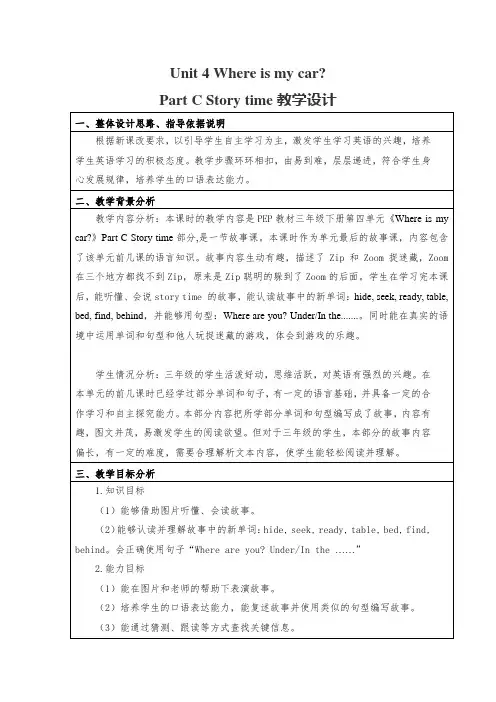
Unit 4 Where is my car? Part C Story time教学设计
Blackboard design(板书设计):
Unit 4 Where is my car?
Part C Story time
Let’s play hide and seek.
Great!
1,2,3....10. Are you ready?
Yes!
Where are you? Under the table?
Under the bed?
In the toy box?
Where are you? I can’t find you!
Ha ha! I’m behind you!
课后反思
本节课是一节趣味故事阅读教学课。
主要要求学生能够借助图片正确理解和阅读故事。
本节课通过实物展示和找一找的游戏自然过渡,帮助学生很好的理解故事主题。
在故事教学时,先通过图片展示让学生自己理解故事内容,有利于培养学生的自主学习能力。
教学中,通过学生表演故事、复述故事、小组合作续写故事等方式,有效激发了学生学习的兴趣和积极性。
在本节课的教学中,对部分的学生仍缺少关注,在以后的课堂中需要尽可能的关注更多的学生,给学生提供更多的口语表达的机会。
人教版(PEP)三下《Unit 4 Where is my car》(第2课时)教案

人教版(PEP)三下《Unit 4 Where is my car》(第2课时)教案一. 教材分析《Unit 4 Where is my car》是人教版(PEP)三年级下册的一篇课文,主题是关于地点的描述。
通过本节课的学习,学生将能够掌握有关地点的词汇,如:library, classroom, toy store等,以及表达位置的短语,如:next to, behind, in front of等。
同时,学生还将学会使用一般现在时描述物品的位置。
二. 学情分析三年级的学生已经掌握了基本的英语发音和一些日常用语,但对抽象的地点描述尚有一定难度。
因此,在教学过程中,教师需要注重引导学生理解和运用地点词汇和表达位置的短语,同时激发学生的学习兴趣,让他们在轻松愉快的氛围中学习英语。
三. 教学目标1.知识目标:学生能够听懂、会说、会读本节课的生词和短语,如:library, classroom, toy store, next to, behind, in front of等;能够用一般现在时描述物品的位置。
2.能力目标:学生能够在图片或情境的帮助下,正确运用所学词汇和短语进行地点描述。
3.情感目标:培养学生热爱生活,关注周围环境的美好情感。
四. 教学重难点1.重点:掌握有关地点的词汇和表达位置的短语,如:library,classroom, toy store, next to, behind, in front of等。
2.难点:运用一般现在时描述物品的位置。
五. 教学方法1.情境教学法:通过设置生活情境,让学生在实际环境中运用英语。
2.游戏教学法:运用趣味游戏,激发学生的学习兴趣。
3.任务型教学法:设计具有实际意义的学习任务,让学生在完成任务的过程中提高英语水平。
六. 教学准备1.课件:制作包含生词、短语和图片的课件。
2.道具:准备一些代表地点的图片或实物,如:library, classroom, toy store等。
三年级英语下册教案-Unit4WhereismycarPEP人教版(4)

三年级英语下册教案-Unit4WhereismycarPEP人教版(4)PEP小学英语三年级下册Unit 4 Where is my car ?B Let’s learn & Let’s do一、Text Analysis(课文分析)本单元学习的主题是描述物品的位置,主情景图通过孩子们蒙上眼睛猜物品位置的活动呈现了本单元的核心句型和词汇。
本部分通过Zoom寻找玩具小船的情景呈现了主要学习的五个单词:cap ball car boat map 本单元的单词与学生学习生活息息相关,学生普遍接触过这些物品。
教师在教学中除了要注意创设合适的情景之外,还应利用图片、实物和课件等教学生词,这样便于激发学生兴趣,容易掌握住所学的知识。
同时要给学生提供语境,使他们勇于开口,乐于表达。
二、Analysis of the students’ situation(学情分析)学生在本单元A部分已经学过了toy box, cap及in, on 和under 三个方位词,并且已学会句型Where is ……? It’s in/on/under… Is it in/on/under…? Yes, it is. /No, it isn’t.所以学生能用方位词描述某个物体的位置。
本单元主要是和方位词有关的教学,通过游戏的操练,学生比较感兴趣,愿意积极主动地投入到学习中。
三、Teaching aims and demands1.Knowledge and ability aims(知识技能目标)(1.)认读新单词:cap ball car boat map .通过听听做做的活动,让学生练习并运用所学的词汇。
(2.)了解一些简单的指示语,要求学生能听懂并按照指令做出相应的动作。
2.A ffective and strategy aims (情感、策略目标)(1)培养学生合理整理房间、放置自己的物品的良好日长习惯。
(2)在听听做做的活动中,培养学生小组合作,合理安排自己的活动时间并与他人进行交流,使学生能够在轻松快乐的氛围中学习。
人教PEP版英语三年级下册Unit4《Whereismycar》教学设计
人教PEP版英语三年级下册Unit 4《Where is my car》教学设计一. 教材分析人教PEP版英语三年级下册Unit 4《Where is my car》的主题是关于地点的描述,通过学习本单元,学生能够掌握表示地点的词汇如:home, school, park等,以及常用的疑问词where,并能用简单的句子描述物品的位置。
本单元的教学内容分为三个部分:part A, part B和part C。
其中,part A和part B主要学习表示地点的词汇和疑问词where,part C则是将所学知识运用到实际情境中,进行地点的描述。
二. 学情分析三年级的学生已经具备了一定的英语基础,能够听懂并简单运用日常英语进行交流。
但对于三年级的学生来说,还需要加强对新词汇的记忆和理解,以及口语表达的准确性。
因此,在教学过程中,需要注重学生的参与和互动,提高他们的学习兴趣和积极性。
三. 教学目标1.知识目标:学生能够掌握表示地点的词汇如:home, school, park等,以及疑问词where,并能用简单的句子描述物品的位置。
2.能力目标:学生能够在日常生活中,运用所学知识进行地点的描述,提高口语表达能力。
3.情感目标:通过小组合作和互动,培养学生的团队意识和合作精神。
四. 教学重难点1.重点:掌握表示地点的词汇和疑问词where,能用简单的句子描述物品的位置。
2.难点:对地点词汇的理解和运用,以及疑问词where在句子中的正确使用。
五. 教学方法1.情境教学法:通过设置实际情境,让学生在情境中学习和运用英语。
2.任务型教学法:通过小组合作和任务完成,激发学生的学习兴趣和积极性。
3.互动式教学法:通过师生互动和学生之间的互动,提高学生的口语表达能力和团队协作能力。
六. 教学准备1.教学PPT:制作包含本单元重点内容的PPT,以便于课堂展示和教学。
2.教学卡片:准备表示地点的词汇卡片,用于教学活动和游戏。
人教PEP版三年级英语下册 Unit4 Where is my car? 教案
(3)请四位学生分别读挂图旁边的句子,其他学生边听边做相应的动作。
(4)教师随意读句子,全体学生做相应的动作。
2.教师拿出一个装有各种文具的大盒子,让学生猜盒子里有什么东西,如:
T:Now,look at me. This is a big box. What's in the box?
S2:It's on the desk.
S1:Where is the crayon?
S2:It's in his/her hand.
S1:Where is the crayon?
S2:It's under the chair.
四、巩固延伸(Consolidation&Extension)
1.A.Let's do.
The Second Period
(A. Let's learnA. Let's do)
课时目标
1.掌握“三会”单词“on”,“in”和“under”。
2.能运用句型“Where is…?”询问物体的位置并进行回答。
3.能根据指令将物体放在相应的位置。
4.初步培养学生的空间意识。
重点难点
重点
1.掌握“三会”单词“on”,“in”和“under”。
(1)教师拿出课前准备的动物玩具,如猴子,说:“This is a toy. Put the toy monkey on the head.(教师将玩具放在自己的头上)Put the toy monkey in the box.(教师将玩具放在盒子里)”
帮助学生理解句型“Put…in/on/under…”的意思。
人教PEP版英语三年级下册Unit 4《Where is my car》教案
人教PEP版英语三年级下册Unit 4《Where is my car》教案一. 教材分析《Where is my car》是人教PEP版英语三年级下册Unit 4的主题课,主要让学生掌握方位词如:up, down, left, right的使用,并能用句子描述物品的位置。
本课通过小猪找车的故事情境,让学生在真实情境中学习、操练和运用英语,提高他们的语言运用能力。
二. 学情分析三年级的学生已经掌握了基本的日常英语对话,对学习英语有较高的兴趣。
但部分学生对方位词的理解和运用还比较困难,需要通过大量的操练来巩固。
三. 教学目标1.能听懂、会说、会读方位词up, down, left, right。
2.能用句子描述物品的位置。
3.能参与角色扮演,进行情景对话。
四. 教学重难点1.重点:掌握方位词up, down, left, right,并能用句子描述物品的位置。
2.难点:在实际情境中运用方位词进行描述和交流。
五. 教学方法采用情境教学法、游戏教学法和任务型教学法,通过真实情境的创设、游戏的互动和任务的完成,激发学生的学习兴趣,提高他们的语言运用能力。
六. 教学准备1.课件:小猪找车的故事情境。
2.实物:小车、卡片等。
3.录音机、磁带。
七. 教学过程导入(5分钟)利用歌曲《Where is my car》进行导入,让学生在轻松愉快的氛围中进入学习状态。
呈现(10分钟)1.老师出示小猪找车的故事情境,引导学生关注小猪和小车。
2.老师分别用up, down, left, right描述小猪和小车的位置,让学生听懂并模仿。
操练(10分钟)1.老师将学生分成小组,每组有一辆小车和相应的卡片。
2.学生分组进行角色扮演,用up, down, left, right描述小车和卡片的位置。
3.每组轮流进行角色扮演,其他组学生倾听并纠正错误。
巩固(5分钟)1.老师出示一幅动物园的图片,让学生用up, down, left, right描述各种动物的位置。
人教版PEP版三年级英语下册 Unit 4 Where is my car?教案 (标准版)
Unit 4 Do you like pears ?第一课时一、教学内容与目标:1.Let’s learn主要学习掌握单词:watermelon peach pear orange, 要求学生能听、说、认读. 2.Let’s play本部分是练习水果和复习颜色的活动。
3.Let’s say本部分学习字母Oo, Pp, Qq,并会说这些字母开头的单词。
4.Let’s chant本部分通过有节奏的歌谣,来复习和巩固A-Q的字母及有关食物的单词。
二、教学重点、难点:单词的记忆。
三、教学准备:教师准备水果(图片)字母卡,单词卡和扑克牌中的Q。
学生准备画笔、颜料和图画纸。
四、教学过程:1.热身/复习(Warm-up/Revision)(1)播放一册三单元chant I can see a rainbow的录音,学生吟唱。
(2)记忆力游戏,一个学生比上一个学生多说一个食物词汇,不得重复。
2.新课展示(Presentation)(1)老师利用卡片或实物引入生词。
如:Look! I have a peach. It’s pink.学生跟读注意教划线字母的发音。
Peach, orange。
(2)由单词中出示新字母Oo, Pp, Qq,并且引入新单词。
(3)让学生听录音,跟读词汇,做到四到。
(4)教师示范,帮助学生理解和学说draw, colour。
并听指令画水果,涂色。
3.趣味操练(Practice)(1)配对游戏:将学生分成两组,一组派一名选手,教师发出指令pear, 谁先找到谁获胜。
其余生一边拍手,一边重复指令。
(2)游戏“看一看,猜一猜”教师出示水果剖面,让学生想想是哪种水果。
(3)小组活动,小组内轮流当group leader。
大家画本课的新单词,并涂色。
4.课堂评价(Assessment)活动手册相应的内容。
目标:检查学生对单词的掌握情况。
字母描红,不能完成的留作家庭作业。
5.课外活动(Add-activities)听录音,跟读单词。