
小学英语新外研版(一起)五年级上册Module1Unit 1第2课时教案
小学英语新外研版(一起)五年级上册
Module 1 Unit 1 There wasn’t a clock here before.
一、教学目标:
1.知识与能力目标
能熟练掌握单词for different bench then playground
能初步运用句型There is(isn’t)
There are(aren’t)
There was(wasn’t)…
There were(weren’t)…
在图文或场景下能用英语描述事物或场景的变化。
能在真实的情景中灵活运用本节课所学内容。
2.情感态度目标
培养小组合作意识,鼓励学生仔细观察,勤于思考。
二、教学重难点:
1、学生能用There be….句型描述事物或场景的变化。
2、过去式的变化形式
重难点突破措施:
小组合作、师生评价
三、教学工具:
单词卡、ppt
四、教学过程:
1.T: We’re going to talk about Sam, Amy and Lingling this term.As we
all know that Sam and Amy are from …(London). Where are they now? Let’s read again and find out the difference of London.
There weren’t any benches here before. (bench)
There was a house. (mouse)
There wasn’t a clock before.
There is a clock now.
2. Show.
※ You can read together.
※ You can read in roles.
3.T: Now you kn ow how to use “There was(n’t)…” “There were(n’t)…” “There is…” “There are…” Now, let’s practise.
A: There weren’t any benches here before.
B: There are benches now.
A: There wasn’t a clock before.
B: There is a clock now.
A: There wasn’t a house or a tree before.
B: There is a house and a tree now.
4. Make some sentences with “There be” to talk about changes in your room.
5. Activity book.
6. homework
Recite Module1 Unit1。
Summary: we viewed Unit1, including the words and sentences and the text. Through checking, the students how to learn them better. Blackboard:
Module1 Unit1
There wasn’t a clock here before.
Then Now
was/were is/are
wasn’t/weren’t isn’t/aren’t
反思:
学生对there be句型的掌握比前一节课熟练了,课文较长,需要进一步家乡机械操练。
外研版一起英语五年级上册 教学设计 Module 1 Unit 2
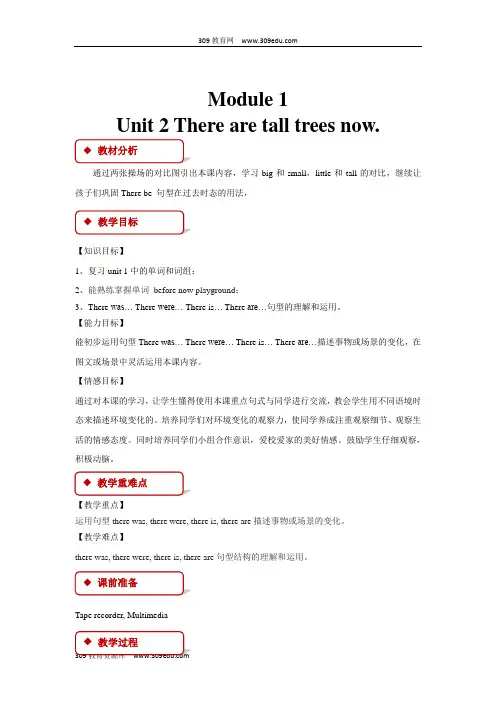
Module 1Unit 2 There are tall trees now.通过两张操场的对比图引出本课内容,学习big和small,little和tall的对比,继续让孩子们巩固There be 句型在过去时态的用法,【知识目标】1、复习unit 1中的单词和词组;2、能熟练掌握单词before now playground;3、There was… There were… There is… There are…句型的理解和运用。
【能力目标】能初步运用句型There w as… There were… There is… There are…描述事物或场景的变化,在图文或场景中灵活运用本课内容。
【情感目标】通过对本课的学习,让学生懂得使用本课重点句式与同学进行交流,教会学生用不同语境时态来描述环境变化的。
培养同学们对环境变化的观察力,使同学养成注重观察细节、观察生活的情感态度。
同时培养同学们小组合作意识,爱校爱家的美好情感。
鼓励学生仔细观察,积极动脑。
【教学重点】运用句型there was, there were, there is, there are描述事物或场景的变化。
【教学难点】there was, there were, there is, there are句型结构的理解和运用。
Tape recorder, MultimediaStep 1. Warm-up出示五张图片,学生认读记忆图片(图片内容以单数形式出现)。
再出示十张图片,其中包含刚才学生读过的五张图,学生根据自己的记忆用There was a …before. There wasn’t a … before.来说。
同样方法出示内容为复数形式的图片,There were … before. There weren’t … before.Step 2. Presentation1. Before Listening:(出示挂图)T: Look at the pictures of the school.Does it look different now?S: Yes, it does.2. While listening:1) 听CD-ROM,每一遍解决一个问题。
五年级英语上册 Module 1 Unit 1(2)教案 外研版

外研版五年级上册英语Modue 1 London一、教学内容Modue 1 London二、教学目标1知识目标:使学生能听说、认读单词when, bac, home, thoe, ice-cream,with, finih, hurr, hurr ue bac”“We came bac……”2、技能目标:通过活动体验,在交流中学会询问和描述过去发生的事情,发展综合语言运用能力。
3、情感目标:培养学生大胆表现自己,敢于说英语的信心。
三、教学向导1语言功能:询问和描述过去发生的事情2语言结构:一般过去时3教学重点和难点:①在真实情景中灵活运用新知识询问和描述过去发生的事情。
②规则动词和不规则动词的过去式。
四、教学程序Unit 1 When did ou come bacⅠ Warm-u e-came, do-did, bu-bought, droe bac2、Free ta ——旅游归来,向组员介绍你的假期生活。
3、任务呈现——制作假期影集师:Did ou have a ha方式LondonLondone bac教学 when, bacA: The came bac at SundaQ5: What did the bu in the e bac2)自己回答这些问题3)采访你的同桌4)填写假期报答。
向全班介绍调查结果。
V.Homewor【作业超市】1、朗读课文,表演对话。
2、完成课堂活动用书活动3和活动4。
选做:1、制作一个你喜欢的假期影集,把影集给你的同学看,并谈论你的假期。
2、写一篇你的假期旅游日记。
外研版英语五年级上册Unit1 Part2a.2b.2c教案

Unit 1 My family Part2a.2b.2c (五年级)东关小学杜美霞备课时间: 2020.9.12教学内容: 外研社Join In五年级上册Unit1 My family Part 2a.2b.2c教材分析: 本课的内容是外研社Join In 五年级上册Unit1 My family第二课时。
本课为语篇听说阅读,学生通过听说阅读学会运用所学词句介绍家庭成员信息。
学情分析: 学生在第一课时已经学习了家庭成员词汇,弄清了家庭成员关系并能简单表述,本节将运用词句继续加深学习。
教学目标:1.听懂、读懂Bob Adams家庭介绍,运用所学词句介绍家庭成员信息并写下来。
2.引导学生爱自己的家庭。
3.保持英语学习热情和兴趣。
教学重点: 通过听说读写寻找相关信息完成学习任务。
教学难点: 熟练运用所学词句介绍家庭成员信息并写下来。
教学准备: PPT课件前置作业内容:1.【画一画】Draw Emma’s family tree2.【说一说】Introduce Emma’s family教学过程:Step1:Pre -readingFree talk: Talk about Emma’s family. (出示前置作业1和2师生交流)Step2:While -reading1.Show Bob’s family picture, then listen and circle the words they hear.2. Listen and write the words of family members.3. Listen and fill in the blanks, then read and learn the words: same, both, their, every, cook.Step3:After-reading1.Draw Bob's family tree and introduce his family.2.Write about Bob’s family.Homework:Draw Bob's family tree and introduce his family, then write them down.板书设计Bob’s family treeBob’s uncle and aunt。
外研版小学英语(一年级起点)五年级上册Module1 Unit1 参考教案
Module1 Unit1 参考教案一、教学内容外语教学与研究出版社(一起点)五级上册第一模块Unit 1 There wasn’t a clock here before.二、教学过程建议(一)热身导入1. 师生互致问候。
教师询问并引导学生运用四年级所学的一般过去时说一说自己的暑假活动。
然后呈现四年级学过的歌曲和韵句,请学生唱歌曲、说韵句,引导学生关注歌曲和韵句中的一般过去时。
2. 展示SB Unit 1活动1的挂图,请学生看图理解语境。
教师问学生:“Whose house was this two years age? Whose house is this now? Where is the mouse?”引导学生回答: “This was the pig s house two years ago. This is the cat’s house now. The cat ate the mouse.”3. 播放动画或录音,先请学生完整地看一遍或听一遍。
再次播放录音,组织学生看图跟读,可以全班跟读、小组跟读、个人跟读、直到学生基本能够正确地说出韵句。
(二)任务呈现教师告诉学生:“学习完今天的内容后,大家要向全班介绍自己家或者周围某地的变化。
现在我们先来学习课文吧。
”(三)课文学习1. 教师对学生说:“Lingling跟随Amy和Sam来到了伦敦。
现在我们和Lingling,Amy, Sam 一起来看一看,伦敦的公园发生了哪些变化吧。
”2. 播放SB Unit 1活动2的动画或录音,请学生看动画或边听录音边看挂图,教师帮助学生理解课文语境。
教师可以告诉学生:“现在世界的发展日新月异,请大家留心观察自己家或者周围某地发生的变化。
”3. 再次播放录音,请学生完整地听一遍课文,进一步理解语句。
播放第三遍录音,请学生逐句跟读。
对学生朗读有困难的语句,教师可以首先带读较难的单词,然后按照意群、节奏带读完整语句。
外研版英语五年级上册Unit 1 第2课时 (3)教案与反思
Period 2投我以桃,报之以李。
《诗经·大雅·抑》翰辰学校李道友组长本课时是第五模块第一单元的第2课时。
本课时学习Unit 1 Activities 3&4。
本课时主要是对上节课学习的重点句型进行复习与巩固。
本课时要求学生通过对话练习,熟练运用句型“There be+基数词+名词(+其他)”描述某物的数量。
知识目标1.复习巩固单词crayon。
2.能够掌握句型“There be+基数词+名词(+其他)”。
3.能够理解活动对话内容,并能朗读、表演对话。
能力目标1.复习巩固本单元的重点单词和句型。
2.能够运用所学单词与句型描述某物的数量。
3.能够积极参加小组活动,分角色进行表演。
情感目标培养学生善于观察、懂得分享和谦让的良好品质。
教学重点复习巩固单词crayon。
教师借助多媒体、教学实物(蜡笔)等多种方式帮助学生记忆。
同时,教师可以给出例句,让学生理解与运用单词。
教学难点熟练运用句型“There be+基数词+名词(+其他)”。
在教学过程中,教师要多注意以游戏的方式与学生或让学生与学生之间进行问答练习。
在这一过程中,教师要多表扬能正确运用句型的学生,引导不会回答的学生,鼓励不敢回答的学生,让学生多说、多练、形成良好的语感。
本课时课件、蜡笔。
Step 1:Warmup1.师生用日常英语进行对话。
2.教师带着学生回忆上一课时的背景知识:Sam and his classmates had a class.They need crayons,so Ms Smart bought some crayons yesterday.What happened next?通过日常英语对话让学生快速调整心态,以一个积极、欢快的心态去学习英语知识;教师带着学生回顾上一课时的背景知识,能让学生快速回忆上一课时的内容,为接下来的学习打下基础。
Step 2:Presetation1.Activity 3·教材意图通过听音频与图片文字相结合的形式,让学生听练结合,复习巩固句型“There be+基数词+名词(+其他)”。
Module1(教学设计)外研版(一起)英语五年级上册
《英语》(新标准)(小学一起)五年级上册M1 教学设计Step 1. Warming-up& Revision (5 mins) 1. 问候同学。
请学生观看活动1动画,说韵句并做动作。
2. 播放活动2录音,请学生听音跟读。
3. 请个别同学领读课文,必要时纠正语音语调。
1. 做动作,说韵句。
2. 听音跟读,复习活动2课文。
3. 争取领读课文,纠正错误的语音语调。
在chant明快的旋律中,调动学生的学习兴趣,从整体复习上节课的内容,为下一步教学做好准备。
Step 2. Focus on the Story (10 mins) 1.(1)课件呈现关于主课文的问题,如有必要,通过翻译检查是否理解问题。
(2)请学生两人一组讨论并回答问题。
(3)请个别学生回答问题,必要时在语法和结构上给予帮助。
(4)请学生两人一组进行问答练习。
2. 用PPT分段出示课文文本,关键词挖空,请个别同学生填空并朗读,然后请学生集体朗读。
1. 理解问题的意思。
2. 同伴合作,讨论并回答问题。
3. 尝试回答问题。
4. 与同伴做问答练习。
5. 会议课文内容,阅读文本填关键词并朗读。
通过回答关于课文的问题及关键词填空帮助学生进一步复习课文,更好地掌握本课目标语句,为下一步完成任务做好铺垫。
Step 3: Focus onthe Vocabulary (8 mins)1. 学习“bench”(1) 课件出示“bench”图片,请个别学生拼写单词。
再请两组同学做“开火车”式练习,朗读单词。
(2)出示“benches”图片,请个别同学说出bench的复数形式,然后请其他同学对比并朗读。
(3)课件出示其他加es变为复数的名词的图片,请学生对比并朗读。
2. 学习“look different”(1) 出示“look different”卡片,请一组同学朗读。
(2)出示课文中以前的和现在的公园对照图并描述:The park looks different. 然1. 尝试拼写、朗读bench。
外研版小学英语五年级上册单元教案-Module1教案
外研版小学英语五年级上册单元教案外研版小学英语五年级上册单元教案Module 1 Unit 1 Did you come back yesterday? I.学标:.学 习目标:1.I can read the new words:met, you, those, ice cream, us, finish, hurry, wait, drop; 2.I can read and understand the text. 3.I can use the key points: “----Did you come back yesterday-----No, we came back last Sunday. Do you live in London too? 10¹ - -→达20¹------→→展示10¹II.时间预设: 小检测5¹5¹------→→自学、对学、群学20¹标测评5¹III. 学法指导:学法指导: A.注意倾听 B.请使用双色笔标出不会的单词 C.注意坐姿 IV.课前预习: 1.听单词和课文录音,跟读听单词和课文录音,跟读3遍。
2.将自己理解的句子意思用铅笔标注在课文中。
将自己理解的句子意思用铅笔标注在课文中。
家长签字 Step1: Check . 单词大闯关(听写→对改→改错→报到)报到)快把写错的单词再正确写两遍吧. Step2: Presentation. 你能在文中找到这些过去式么? 2.meet---- met 遇见 1.go----went 去 e----came 来 3.see----saw看见 6.drop----dropped 掉下5.visit----visited 参观 掉下Step3: Cooperation Answer the questions。
1.Did Amy come back yesterday? 2.Did John live in London too? Step4: Show 孩子们,It’s time to show!请选择一项任务展示。
五年级英语上册 Module1 unit2教案 外研版
Unit 2 Did they buy ice creams?Function: Talking about past activitiesTarget Language: Did you…?Yes, I did. / No, I didn’t.Vocabulary: dear, met (meet), ran (run)Pronunciation: /i:/, /I/, /e/, / /Song: Where did you go?Procedures:Step 1 Warm-up1. Review verb phrases.2. Review Unit 1.Step 2 Introduction1. Prepare a postcard with a picture of own city and ask the children: What’s this?What is the place? What can you see?2. Show the back of the postcard and tell the children that Lingling wrote a letter on it.Step 3 Presentation1. Play the cassette and pause after each utterance for the children to repeat and tickthe actions: went to the park, met John, bought ice creams, went home, ran to the bus, dropped.2. Play the cassette again and ask the children answer the following questions: Whowrote the postcard? Whom did Lingling send the postcard to?3. Write down the words: met, bought, went, ran, dropped and ask the children to guessthe original form.4. Finish activity 2. Ask the children to ask and answer in pairs.Step 4 Sing a song1. Ask the children to look at the pictures carefully.2. Play the cassette and ask the children to listen carefully.3. Teach the sentences of the song one by one.4. Play the cassette several times and ask the children to sing along.Step 5 Homework1. Read the letter and sing the song.2. Finish activity 6: sentence relay.。
小学英语新外研版(一起)五年级上册M1U1 教案
(1)找出文中的过去式,讨论一下这些句子的特点?(小组讨论)
_________________________________________________
_________________________________________________
_________________________________________________
_________________________________________________
自我评价:☆☆☆☆
探究案
用这些表示过去的时间词语造句子,注意时态的运用。
借助听音,学习不会的单词并且纠正发音,将汉语意思写在横线上,读不准的单词标注出来,并且在组内交流合作解决。
小组讨论你的疑问,大家交流,将组内共同的问题整理出来。
三、Summary
本节课我的总结和收获:____________________________
__________________________________________________
小组合作可以选择任务进行组内讨论和练习。
小组长要做好分工,起带头作用。让所有的组员都参与到学习中来。
You _______inChina_______two years. Does London
_______ __________ now? Yes, it ______. This park is
_________.There weren’t ________ benches here before.
____________________________________________
____________________________________________
外研版五年级上册英语教案
外研版五年级上册英语教案外研版五年级上册英语教案Unit 1 Unit 1 Good morning, boys and girls!Lesson 1Teaching Aims:1. To learn and understand the new words and expressions in the lesson.2. To learn to greet and introduce themselves in English. Teaching Procedures:Step 1: Greetings (5 minutes)- Greet the students and make them feel welcome.- Have the students greet each other.Step 2: Warm-up (10 minutes)- Show flashcards of various greetings and teach the students how to say "Good morning", "Good afternoon", and "Good evening". - Practice the greetings with the students.Step 3: Presentation (15 minutes)- Introduce the new words and expressions by showing flashcards and pictures.- Teach the students how to say "What's your name?" and "My name is..." using gestures and actions.- Practice the new words and expressions with the students.Step 4: Listening (10 minutes)- Play the recording of the conversation in the textbook and have the students listen.- Ask the students to repeat the conversation after listening.Step 5: Speaking (15 minutes)- Divide the class into pairs and have them practice greeting and introducing themselves to each other.- Walk around the classroom and monitor the students' speaking. Step 6: Consolidation (10 minutes)- Play a game with the students to review the greetings and introductions.- Have the students stand in a circle and pass a ball while saying a greeting or introducing themselves.Step 7: Homework (5 minutes)- Assign the students to practice greeting and introducing themselves to their family members at home.- Ask the students to write a short paragraph about themselves using the new words and expressions.Final Remarks:- Review the new words and expressions at the end of the class. - Provide positive feedback and encouragement to the students. - Remind the students to bring their textbooks to the next English class.。