
外研版英语七年级下册Module 11 Unit 2《Here are some ways to welcome them》ppt课件
课堂讲练互动
Ⅱ.单项选择 1. ____ is easy ____ her to learn English. A. It; of B. It; for C. That; for D. That; of 2. What about ____ shopping with me, Kate? A. go B. to go C. going D. goes D. Doesn’t open
It’s very polite of you to do that.
课堂讲练互动
Some phrases
1. (be) close to 2. arm in arm 3. move away 4. not at all 距离……近 臂挽臂 搬走 一点儿也不
5. in fact
6. what about…
课堂讲练互动
Language Points
1. not at all 一点儿也不
(1)用来回答感谢,意为:不客气;不用谢。或者用来
回答道歉,意为:没关系。例如:
—Thank you very much. —Not at all. (2)用来作一般疑问句的否定回答,是no加强语气的用 法,意为:一点也不;完全不。
课堂讲练互动
Activity 5
Work in groups. Talk about your class rules.
Stand up when you answer a question in class. Don’t be late for class. Be polite to the teacher. Don’t eat food in class.
Module 11 Body language
Unit 2 Here are some ways to welcome them.
课堂讲练互动
Lead in
What body language do you know? Let’s look at these pictures.
课堂讲练互动
Presentation
2. Is it all right to stand close to people in the Middle East?
Yes, it is. 3. Do the British like touching people? No, they don’t. 4. Do Americans look at people when they talk? Yes, they do. 5. Do people in Greece wave goodbye? No, they don’t.
课堂讲练互动
Language Points
(3)not … at all表示“一点也不……” It isn’t difficult at all to learn math. 2. It’s + 形容词 (for / of sb.)+ to do sth. (对某人来说)做某事是……的
It’s difficult for us to finish the work.
课堂讲练互动
Activity 4
Complete the passage with the words from the box. Britain fact foreign hold move personal polite rude someone wave
foreign countries have different Lingling: People from (1) ________ Britain people don’t body language from us. In (2) _________, like to touch other people, but in South America they hold on to you so you can’t (4) ________ move like to (3) ______ someone from North away. Remember to give (5) _________ personal space. In some America lots of (6) ________
事实上
……怎么样
课堂讲练互动
Practice
Ⅰ.根据句意和汉语提示填单词 polite (礼貌的) to the old. 1. We should be _______ language (语言). 2. We learn English as our second _________ personal (个人的) 3. Don’t ask the foreigners about their _________ questions. 4. He ________ waved (挥手) his hands and then left. fact 5. In ________ (事实上), he is a clever boy.
课堂讲练互动
polite to look at people when you countries it isn’t (7) ______ wave goodbye in Greece. talk. And it isn’t polite to (8)______ rude fact it’s quite (10)______! In (9)______,
finger foot knee n.手指 n.(pl.feet)脚;足 n.膝盖
leg
mouth body
n.腿
n.嘴;口 n.身体,躯干
foreign
personal arm
adj.外国的
adj.个人的 n.臂;手臂
hold
v.(held)握着;使不动
课堂讲练互动
Presentation
move Britain not at all polite somewhere wave v.移动 不列颠;英国 一点儿也不 adj.礼貌的 adv.某处;某个地方 v.挥(手);招(手);摆(手)
fact
in fact bring
n.事实;细节
事实上 v.(brought)带来
课堂讲练互动
eye mouth
finger knee leg
foot
课堂讲练互动
Answer the questions.
1. Is body language the same in different countries? No, it isn’t.
外研版英语七年级下册Module 11 Unit 2 Here are some ways to w
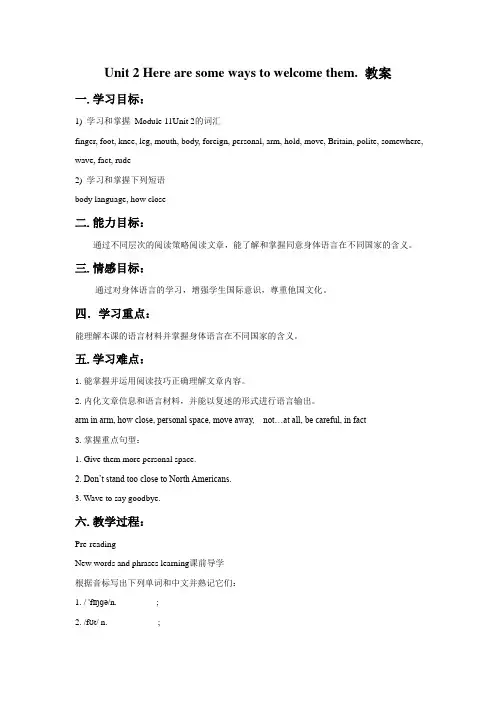
Unit 2 Here are some ways to welcome them. 教案一.学习目标:1) 学习和掌握Module 11Unit 2的词汇finger, foot, knee, leg, mouth, body, foreign, personal, arm, hold, move, Britain, polite, somewhere, wave, fact, rude2) 学习和掌握下列短语body language, how close二.能力目标:通过不同层次的阅读策略阅读文章,能了解和掌握同意身体语言在不同国家的含义。
三.情感目标:通过对身体语言的学习,增强学生国际意识,尊重他国文化。
四.学习重点:能理解本课的语言材料并掌握身体语言在不同国家的含义。
五.学习难点:1.能掌握并运用阅读技巧正确理解文章内容。
2.内化文章信息和语言材料,并能以复述的形式进行语言输出。
arm in arm, how close, personal space, move away, not…at all, be careful, in fact3.掌握重点句型:1. Give them more personal space.2. Don’t stand too close to North Americans.3. Wave to say goodbye.六.教学过程:Pre-readingNew words and phrases learning课前导学根据音标写出下列单词和中文并熟记它们:1. /'fɪŋɡə/n._________;__________2. /fʊt/ n.___________; __________3. /ni:/ adj.____________;___________4. /' leɡ/n.____________; ____________Step 1 Fast reading 快速阅读Read the passage. Match the main ideas with the paragraphs.阅读全文,找出与每段匹配的大意。
外研版英语七年级下册:Module 11 Unit 2 Here are some ways to
Warming up:gamesand talkto review what have learnt about body language
Reading activities:Read for info. read to answer, read for language, read for retelling…
3. Some Sts willbe able to talk briefly about body language people use when they meet in some countries.
4. All stswill be able to notice and understand the useful language points in the passage.
Group work: Discuss and tell about body language people use when they meet.
教学过程
教学环节
教学活动
设计意图
Step I Warming up and leading in:
Step II Fast reading
Step III Reading activities:
To review and test their memory of t
To learn to find the main idea by topic sentences
To learn to find specific info.
To learn the languagethrough reading
2. Sts will be ready to know the cultural differences and try to follow them.
外研版英语七年级下册Module11 Unit2 Here are some ways to welcome them教案
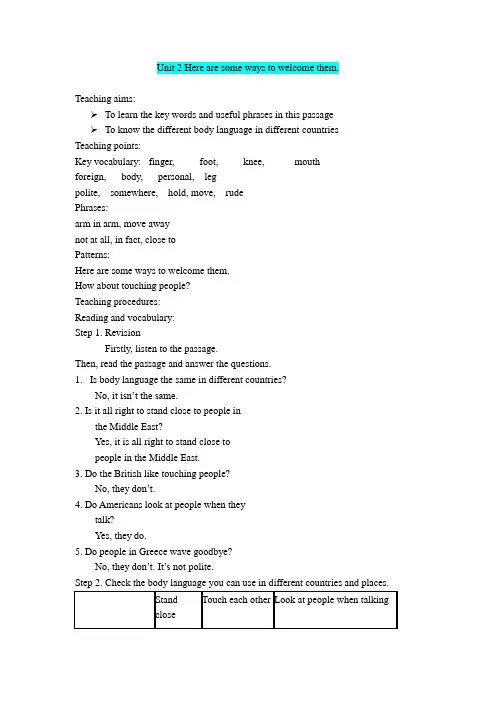
Unit 2 Here are some ways to welcome them.Teaching aims:To learn the key words and useful phrases in this passageTo know the different body language in different countriesTeaching points:Key vocabulary:finger, foot, knee, mouthforeign, body, personal, legpolite, somewhere, hold, move, rudePhrases:arm in arm, move awaynot at all, in fact, close toPatterns:Here are some ways to welcome them.How about touching people?Teaching procedures:Reading and vocabulary:Step 1. RevisionFirstly, listen to the passage.Then, read the passage and answer the questions.1.Is body language the same in different countries?No, it isn’t the same.2. Is it all right to stand close to people inthe Middle East?Yes, it is all right to stand close topeople in the Middle East.3. Do the British like touching people?No, they don’t.4. Do Americans look at people when theytalk?Yes, they do.5. Do people in Greece wave goodbye?No, they don’t. It’s not polite.Step 2. Check the body language you can use in different countries and places.Let the students say their opinions in class.Lingling: People from (1) ________ countries have different bodylanguage from us. In (2) ________ people don’t like totouch other people, but in South America they like to (3) _______ on to you so you can’t (4) _______ away. Remember to give (5) __________ from North America lots of (6) _________ space. In some countries it isn’t (7) _______ to look at people when you talk. And it isn’t polite to (8) ______ goodbye in Greece. In (9) _______, it’s quite (10) _______!Answers:1. foreign2. Britain3.hold4.move5. someone6.personal7. polite 8. wave 9. fact 10.rudeStep 4. Work in groups. Talk about your class rules.Let the students do this by themselves, then check with a partner.— Shall we stand up when we answer a question in class?— Yes, we shall.Step 5. Make a list of class rules for new students in your school.Stand up when you answer a question in class.Don’t be late for class.Be polite to the teacher.Don’t eat food in class.…Step 9. Do some exercisesI.根据英文解释,指出下列各个身体部位。
外研版七年级下册英语Module11 Unit2 Here are some ways
PWP , task-based and interactive approach
教具
Multimedia教学环节及内容个性来自备课教学流
程
精彩导入激活思维
Step1 .Lead in
自主学习发现疑难
Step2 .Learn the new wordsand phrases
1. Introduce the new words.
2. Which picture is right(正确的) for people in the Middle East?
2)Read para3 and choose the right answers.
Like holding your arm
Like walking arm in arm
Don’t like touching at all
2. In Greece , it’s not at all polite.(翻译成中文)
3. _________(事实上),it’s very rude!
Step5Post-reading
Watch the video to learn the passage better and check your pronunciation .
2、能读懂简单的介绍不同国家身势语的短文。
3、能正确用祈使句给出书面指示语和建议。
4、通过阅读,了解世界各地不同地区的地域差异,培养对不同文化的兴趣。
重点
Use the new words,phrases and structures correctly and freely.
难点
正确使用祈使句的用法。
Step6.Retelling
外研版七年级下册英语课件:Module11Unit2Herearesomeways

外研版七年级下册英语 课件:
Module11Unit2Hereare someways
2020/8/18
My Body Parts
head ear neck arm hand
leg
two feet
hair eye nose tooth
two teeth mouth
knee foot
1. Match the words with the parts of the body.
Body language is .d..ifferent around the world.
body language
Do all the peo…p…le…sh…a…ke…h…an…d.s when they meet
?
Body language around the world
① Our new foreign students are going to arrive very soon, and here are some ways to welcome them.
② How close do you stand when you talk to a friend? You can stand too close to people in the Middle East but don’t stand too close to North American! Give them more personal space.
外研版英语七年级下册Module 11 Unit 2《Here are some ways to w
外研版英语七年级下册Module 11 Unit 2《Here are some ways to welcome them》教学设计1一. 教材分析外研版英语七年级下册Module 11 Unit 2《Here are some ways to welcome them》主要介绍了如何欢迎新同学。
本节课的内容围绕如何与他人打招呼、介绍自己、询问他人情况等日常交流展开。
通过本节课的学习,学生能够更好地掌握日常英语交流用语,提高他们的口语表达能力。
二. 学情分析七年级的学生已经掌握了基本的英语语法和单词,具备一定的口语表达能力。
但是,他们在实际交流中还存在一定的困难,如不敢开口、发音不标准等问题。
因此,在教学过程中,教师需要关注学生的心理素质,鼓励他们大胆开口,提高他们的口语表达能力。
三. 教学目标1.知识目标:–能够熟练朗读并理解课文内容;–掌握日常英语交流用语,如问候、介绍自己、询问他人情况等;–学会如何欢迎新同学。
2.能力目标:–提高学生的口语表达能力;–培养学生的团队合作精神。
3.情感目标:–增强学生对英语学习的兴趣;–培养学生积极向上的学习态度。
四. 教学重难点•熟练朗读并理解课文内容;•掌握日常英语交流用语。
•如何在实际交流中运用所学知识;•提高学生的口语表达能力。
五. 教学方法1.情境教学法:通过设定真实的生活情境,让学生在实际交流中运用所学知识;2.任务型教学法:通过完成小组任务,培养学生团队合作精神;3.激励评价法:鼓励学生大胆开口,提高他们的自信心。
六. 教学准备1.准备课文相关图片和视频资料;2.准备课堂活动所需道具;3.制作课件。
七. 教学过程1.导入(5分钟)教师通过展示图片和视频,引出本节课的主题——如何欢迎新同学。
激发学生的学习兴趣,营造轻松愉快的课堂氛围。
2.呈现(10分钟)教师朗读课文,学生跟读。
引导学生关注课文中的日常英语交流用语,如问候、介绍自己、询问他人情况等。
外研版英语七年级下册:Module 11 Unit 2 Here are some ways to
Unit2 Here are some ways to welcome them.教学设计
作者姓名
学校
学科
英语
年级/班级
上课时间
课时名称
Module9 Body language
Unit2 Here are some ways to welcome them.
Step2
Revision
Read the passage and fill in the blanks.
Learn the pattern ofImperative sentences.
Are body languages all the same in different countries? Different countries have different body languages. Let’s revise some of them.
Be polite to the teacher.
2、能力目标:能用正确地使用祈使句给他人提出建议,并且能够给出书面指示与建议。
3、情感和态度目标:能体会、关注不同国家的文化在身势语上体现出的差异。能自觉遵守校规。对于他人不文明的现象,能够提出建议,劝告。
教学过程
学习活动
学生活s
1. Play the game“touch your nose”. Touch the parts of the body as quickly as possible.
2.Play guessing game. Guess the meanings of the teacher’s body language. Choose the possible meanings on the screen.
外研版七年级英语下册Module11 Unit2 Here are some ways to wel
eye finger foot knee
1 eye 2 mouth
3 finger
leg mouth
4 knee
5 leg 6 foot
Fast reading
How many kinds of body languages are mentioned in the passage? What are they?
n. 外国人 北美人
personal arm
arm in arm South American
hold move Britain British
adj. 个人的 n. 臂;手臂 臂挽臂地 南美人 v. (held) 握着;使不动 v. 移动 不列颠;英国
不列颠的;英国的
ห้องสมุดไป่ตู้
not… at all polite
Four.
① stand close or far ② touch people ③ look at people or not look at people ④ say goodbye
Read paragraph 1 and 2
Who is going to arrive very soon?
Lingling’s new foreign students.
--What do people do when they meet in India? --They __p_u_t_ _t_h_e_ir_ _h_a_n_d_s_ _to_g_e_t_h_e_r__ and _n_o_d__th_e_i_r__ _h_e_a_d_s___.
外研版英语七年级下册:Module 11 Unit 2 Here are some ways to
外研版七年级英语Module 11 Body languageUnit 2 Here are some ways to welcome them.教学设计一、教材分析本模块以身势语为话题,向学生介绍一些国家人们常用的身势语,着重介绍了在不同国家初次见面和表达问候时的身势语,目的是通过这些学生了解不同文化,增强国际意识,尊重他国文化,同时也使学生明白包括身势语在内的语言在国际交流中的重要性,这也是英语课程标准中所阐述的教学目标之一。
本模块的任务是制作关于身势语的海报。
本模块语言知识的重点是训练学生对祈使句的理解和使用。
所以在本模块中,学生既需要了解包括中国在内的不同国家关于身势语的习俗习惯的异同,又要掌握相关的词汇和语法知识。
因此,第一单元和第二单元都是为这一任务做铺垫、打基础的,是实现模块任务的阶梯。
在第一单元的听说课中,学生通过听说对话的训练,已经了解了初次见面时俄罗斯人、美国人、印度人以及新西兰毛利人不同的身势语以及描述这些身势语的表达方式。
这些身势语对于对外交流越来越多的中国学生来说是十分实用的。
第二单元是本模块的第二课,是一节阅读写作课。
课文以“Body language around the world”为题,介绍了世界各地一些独特的身势语。
学习这篇文章,学生能了解更多的关注身势语,意识到身势语是文化的一部分。
同时认识到尊重他国的文化就应该了解他们的身势语,这也是在国际交流中必备的知识和素养。
这篇文章是玲玲写的,文章的结构采用了西方人的思维方式,结构上采用了“总述+分述”的结构,有利于学生理解英语国家人的思维习惯。
玲玲在介绍不同国家身势语的不同特点之外,还为学生用祈使句提出建议,使学生在语境中掌握恰当地使用祈使句。
二、课标分析根据教学大纲和新课标的要求,基础教育阶段英语课程的任务是通过各种教学活动,激发和培养学生学习英语的兴趣,养成良好的学习习惯,形成有效的学习策略,发展自主学习的能力与合作精神,培养学生英语的综合运用能力。
外研版英语七年级下册Module 11 Unit 2《Here are some ways to w
外研版英语七年级下册Module 11 Unit 2《Here are some ways to welcome them》教学设计一. 教材分析外研版英语七年级下册Module 11 Unit 2《Here are some ways to welcome them》主要介绍了如何欢迎新同学。
通过本节课的学习,学生能够掌握相关词汇和句型,并运用所学知识进行实际交流。
教材内容丰富,实用性强,有利于提高学生的英语应用能力。
二. 学情分析七年级的学生已经具备了一定的英语基础,能够听、说、读、写简单的英语句子。
但部分学生对英语学习仍存在恐惧心理,缺乏自信心。
因此,在教学过程中,教师需要关注学生的情感态度,鼓励他们积极参与课堂活动,提高他们的学习兴趣。
三. 教学目标1.知识目标:学生能够掌握表示欢迎的词汇和句型,如“Here are someways to welcome them.”, “How about…?”, “I think…is a good idea.”等。
2.能力目标:学生能够用英语谈论如何欢迎新同学,并进行实际交流。
3.情感目标:学生能够积极参与课堂活动,提高学习英语的自信心。
四. 教学重难点1.重点:表示欢迎的词汇和句型的运用。
2.难点:如何运用所学知识进行实际交流。
五. 教学方法1.任务型教学法:通过完成具体任务,让学生在实践中学习和运用英语。
2.情境教学法:创设真实的情境,让学生在实际环境中学习和运用英语。
3.情感教学法:关注学生的情感态度,鼓励他们积极参与课堂活动。
六. 教学准备1.教材:外研版英语七年级下册Module 11 Unit 2《Here are someways to welcome them》。
2.课件:教学课件,包括图片、视频等素材。
3.练习册:配套练习册。
七. 教学过程1.导入(5分钟)教师通过向学生介绍一位新同学,引发学生对如何欢迎新同学的思考。
提问学生:“如果你是这位新同学,你希望同学们如何欢迎你?”让学生发表自己的想法。