
译林版英语七年级上册unit3知识点
7A Unit3 知识归纳与拓展【词汇解析】1.datedate作名词,意思是“日期”,一般多以句子形式出现。
“What’s the date today?”用来询问“今天是几月几号?”,其回答用“It’s+具体的日期”。
一What’s the date today?今天是几月几日?一It’s 10 September.今天是9月10日。
【辨析】“What day is it today?”用来询问“今天星期几?”,其回答用:“It’s+具体的星期几”。
2.gategate作名词,意思是“大门;通道;大门口”,指上面与屋顶不相连的门,通常有两扇。
Look!A boy is at the zoo gate.看!一个男孩在动物园大门口。
【辨析】door作名词,意思是“门”,指上面连着屋顶的“门”,可指大楼房间或家具、车辆的“门”。
3.showshow作动词,意思是“引;带;领”,常构成短语show sb.around(带领某人参观)。
另外,show还有“给某人看;显示”的意思,短语show sb.sth.一show sth.to sb.,表示“把某物给某人看”。
Let me show you around! 我带领你参观吧!Can you show it to me? 你能把它给我看看吗?【拓展】show还可以作名词,意思是“展览;演出”,常用短语为on show,意为“在展出”。
4.in front ofin front of意思是“在……的前面”,指位置“在……外部的前面”。
There is a garden in front of my house.我的房子前面有一个花园。
【辨析】in the front of意思是“在……的前面”,指位置“在……内部的前面”。
My father is in the front of the car.我父亲坐在轿车的前面。
5.taketake作动词,意思是“花费”,表示“做某事花费某人多长时间”用句型“It takes sb.some time to do sth.”,其中it是形式主语,真正的主语是后面的to do sth.。
It takes me an hour to do homework everyday.我每天花一小时做家庭作业。
6.kindkind作名词,意思是“种类”,常构成短语all kinds of(各种各样的)。
The kind of fruit is very nice.这种水果很好。
There are all kinds of food on the table.桌子上有各种各样的食物。
【拓展】kind还可作形容词,意思是“善良的,友好的”,与nice或friendly同义,常构成短语be kind/nice/friendly to sb.,表示“对某人友好”。
7.borrowborrow作动词,意思是“借,借用”,通常指“向别人借”。
表示“向某人借某物”用borrow sth.from sb.May I borrow your pen? 我可以借你的钢笔吗?Tom often borrows some money from his friends.汤姆经常向他的朋友们借一些钱。
8.a fewa few意思是“一些,少量”,用来修饰可数名词的复数形式,表示肯定的意义。
His sister has a few books in her schoolbag.他姐姐书包里有一些书。
【辨析】单独使用few,意思是“不多(的),少数(的)”,也用来修饰可数名词的复数形式,但表示否定的意义。
The boy has few books in his schoolbag.这个男孩的书包里几乎没有书。
9.on footon foot意思是“步行”。
表示“步行上学”用go to school on foot。
His brother goes to school on foot.他哥哥步行去上学。
Do you often go home on foot.你经常步行回家吗?【拓展】短语go to…on foot与walk to…同义。
但短语“步行回家”用go home on foot或walk home。
【注意】“步行”用on foot,但“乘公共汽车”用by bus。
【短语归纳】1.the parents’meeting家长会2.meet at the school gate在校门口见面3.welcome to our school欢迎来到我们学校4.show sb.around带领某人参观5.clean and bright干净明亮6.look modern看起来现代7.have meetings开会8.in a white shirt穿一件白色衬衫9.1et me see让我想想10.after class下课以后11.say hello to sb.向某人问好12.hear sb.well听清某人的话13.on the phone通电话;在电话中14.how long多长时间15.on one’s way back在某人返回的途中16.be open开放17.a11 kinds of books各种各样的书18.borrow books from the library从图书馆借书19.far away from my home离我家很远20.take a bus to school乘公共汽车上学【句型分析】1.Which of the subjects do you like best,Eddie?(P30)埃迪,你最喜欢什么学科?本句中which意为“哪个(些)”,常对同类事物中某一个(些)提问。
Which is your favourite room?哪一个是你最喜欢的房间?Which book do you want to buy?你想要买哪本书?2.So I can eat three!(P30)所以我可以吃三个!本句中so为连词,意为“因此,所以”,连接状语从句;引导的从句通常放在主句之后。
Amy likes English,so she often reads it in the morning.埃米喜欢英语,所以她经常在早晨读英语。
【注意】汉语中通常用“因为……所以……”来表示因果关系,但在英语中,通常用了because 就不能再用so;用了so,就不能再用because。
She gets up late,so she is late for school every day.=She is late for school every day because she gets up late.她起床晚,所以她每天上学都迟到。
3.Pardon?(P36)什么?请再说一遍。
本句通常用来请求对方重复刚才所说的话.相当于:Say it again,please.,有时我们也可用I beg your pardon!来表示。
—Read the instructions for your classmates,please.请向同学们读一下说明。
—I beg your pardon!/Pardon?请再说一遍,好吗?I ask you to read the instructions for your classmates.我请你向同学们读一下说明。
4.How does she get to school?(P37)她是怎么到学校的?这是一种询问“交通方式”的问句,其中get to意为“到达……”,回答通常是表示交通方式的词语或句子,如:on foot(步行),by bus/car/train/plane…(坐公交车/汽车/火车/飞机……)。
——How does Millie get to the school every day?米莉每天怎样来学校的?一By bus./On foot./By car.乘公交车。
/步行。
/乘汽车。
How do the students get to the cinema? 学生们怎么去电影院呢?5.It takes me about half an hour.(P38)我大约花半个小时。
It takes(sb.)some time to do sth.意思是“花费(某/v)……时间做某事”。
其中it是形式主语,真正的主语是to do sth.。
It takes her two hours to walk home every day.她每天花两小时走回家。
【注意】本句型也能替换成:sb.spend(s)sometime doing sth.,因此上一句可转换成:She spends two hours walking home every day.6.I live far away from the school.(P40)我住得离学校远。
此处far为副词,指距离上的“遥远”或“远离”,常用的搭配有far away from,意为“远离……”。
The village is far away from here.那个村庄离这儿很远。
I know a nice little Italian restaurant not far from here.我知道有家不错的意大利小餐馆离这儿不远。
另外,我们还可以用how far来询问距离。
How far is the school from your home? 你家离学校有多远?How far can you throw? 你能扔多远?【语法点拨】人称代词的主格和宾格人称代词是用来代表人或事物的代词,有人称、数(单复数)、格(主格、宾格)以及性别(男女)的变化。
人称代词分为主格和宾格两种形式。
其变化规律如下表所示:1.人称代词的主格人称代词的主格分为单数:I,you,he,she,it和复数:we,you,they。
人称代词的主格在句中作主语。
I have many new friends.They are all very nice.我有很多新朋友。
他们都非常好。
Are you in Class 4,Grade ? 你在七年级四班吗?Kitty is cute.She loves dancing.基蒂很可爱。
她喜欢跳舞。
2.人称代词的宾格人称代词的宾格也分为单数:me,you,him,her,it和复数:us,you,them。
人称代词的宾格在句中作动词或介词的宾语。
Thank you for helping me with my homework.谢谢你帮助我做家庭作业。
(作动词宾语) My school is beautiful.I like it very much.我的学校很漂亮。
译林版英语七年级上册unit3知识点

译林版英语七年级上册unit3知识点Date is a noun that means "the day of the month"。
It is often used in sentences such as "What's the date today?" to ask for the specific day。
and the answer is given in the format "It's + the date".XXX:What's the date today。
It's September 10th.2.XXX or exit"。
It is often used to refer to the entrance of a building or a compound.XXX:Look。
A boy is at the zoo gate.3.Show is a verb that means "to guide or lead someone"。
It is often used in the phrase "show sb。
around" to mean "to give someone a tour of a place"。
It can also mean "to present or display something to someone"。
as in "show sb。
sth." or "show sth。
to sb."Examples:Let me show you around。
Can you show it to me?4.Show can also be a noun that means "an n or performance"。
苏教译林版 七年级英语上册 Unit 3 知识汇总

01Unit 3 单词which[hwɪtʃ] pron.哪一个best[best] (well的最高级)最,最好地so[səʊ] conj.因此,所以biology[baɪˈɒlədʒi] n.生物geography [dʒɪˈɒgrəfi] n.地理history ['hɪstəri] n.历史date[deɪt] n.日期meeting['miːtɪŋ] n.会议;集会o'clock [əˈklɒk] 点钟OK [əʊˈkeɪ] adv.好,对;不错gate[geɪt] n.大门so[səʊ] conj.因此,所以show[ʃəʊ] vt.引,带,领around [ə'raʊnd] adv.到处,向各处showsb around 领某人参观front[frʌnt] n.前面infront of 在…前面building['bɪldɪŋ] n.建筑物,房子,楼房ground [graʊnd] n.地,地面groundfloor <英>底层,一楼bright[braɪt] adj.明亮的modern[ˈmɒd(ə)n] ad现代的;新式的hall [hɔːl] n.礼堂,大厅diary['daɪəri] n.日记lookat 看一看wall[wɔːl] n.墙letme see 让我想想afterclass 下课后parden 什么,请再说一遍phone [fəʊn](=telephone) n.电话onthe phone 通电话from... To ... 从...到...take[teɪk] v.需要…时间,费时getup['getʌp] 起床goto school 去上学a.m.[ˈæntɪmeˈrɪdɪem] 午夜至正午,上午,午前p.m.[piːem]abbr.下午,午后readingroom n.阅览室only['əʊnli] adv 只,只有,仅sure[ʃʊə]adv (口)当然kind[kaɪnd] n.种类allkind of 各种各样的borrow [ˈbɒrəʊ] vt.借,借用borrow... From ... 向...借...letter['letə] n.信,函few [fjuː]不多(的),少数(的)afew 一些,少量away[ə'weɪ] adv.离开,远离faraway from 远离onfoot 走路,步行best[best] (well的最高级)最,最好地allthe best 一切顺利,万事如意02Unit 3知识梳理重点短语:1.like sth best 最喜欢某物2.watch two o four lessons 观摩我们的两节课3.Open Day 开放日4.The parents ’meeting家长会5.at the school gate 在学校大门口6.look beautiful 看起来漂亮7.show sb around (带)领某人参观8.in front of the classroom building 在教学楼前面9.on the ground floor 在底楼10.This way 请走这边11.the man in a white shirt 穿白色衬衫的男人12.have meetings 开会13.look at the picture 看图画14.the picture of... ……的照片15.let me see 让我想想16.after class 课后17.on the phone 通电话;打电话;在电话里18.from...to... 从……到……19.get up 起床20.go to school 去上学21.get to school 到校22.all kinds of 各种各样的23.borrow...from 向……借……24.a few 一些,少量25.far away from 远离26.on foot 走路;步行27.all the best 一切顺利;万事如意28.take a bus 乘公共汽车29.say hello to 向某人打招呼,问候某人30.hear...well 听清楚重要句型:1.一Which of the subjects do you like best,Eddie?埃迪,这些科目中你最喜欢的是哪个学科?一I like Maths我喜欢数学。
Unit3知识点整理牛津译林版七年级英语上册
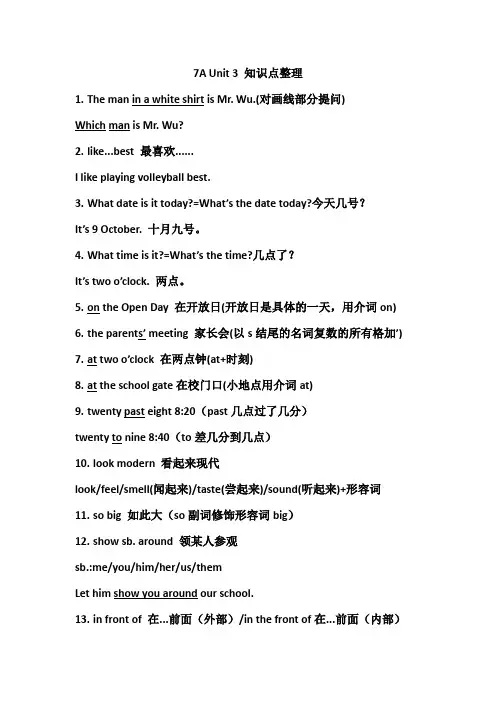
7A Unit 3 知识点整理1.The man in a white shirt is Mr. Wu.(对画线部分提问)Which man is Mr. Wu?2.like...best 最喜欢......I like playing volleyball best.3.What date is it today?=What’s the date today?今天几号?It’s 9 October. 十月九号。
4.What time is it?=What’s the time?几点了?It’s two o’clock. 两点。
5.on the Open Day 在开放日(开放日是具体的一天,用介词on)6.the parents’ meeting 家长会(以s结尾的名词复数的所有格加’)7.at two o’clock 在两点钟(at+时刻)8.at the school gate在校门口(小地点用介词at)9.twenty past eight 8:20(past几点过了几分)twenty to nine 8:40(to差几分到几点)10.look modern 看起来现代look/feel/smell(闻起来)/taste(尝起来)/sound(听起来)+形容词11.so big 如此大(so副词修饰形容词big)12.show sb. around 领某人参观sb.:me/you/him/her/us/themLet him show you around our school.13.in front of 在...前面(外部)/in the front of在...前面(内部)Miss Li is standing in the front of our classroom and writing some new words on the blackboard.There is a tree in front of our house.14.on the ground/first/second/third floor在一楼/二楼/三楼/四楼The cinema is on the third floor.15.two classroom buildings两栋教学楼名词修饰名词时一般第一个名词用单数,但也有一些特例:clothes shops/sports shops/women teachers/men doctors16.have meetings/have a meeting 开会I want to know when to have the meeting.17.the man in a white shirt/the man in white穿着白衬衫的男的/穿着白衣服的男的in介词+颜色/衣服:穿着......(状态) The man in white is my brother.wear动词+衣服:穿着......(状态) I wear a red coat today.put on动词短语+衣服:穿上......(动作)It’s cold outside. Please put on your coat.18.the man with glasses 戴眼镜的那个男的(with介词:戴着)Who is the man with glasses?(句中有谓语,用介词with)Daniel wears glasses.(句中无谓语,用动词wear作谓语)19.look(v.) at=have a look(n.) at 看一看......Let me look at the picture.=Let me have a look at the picture.20.the pictures of my friends 我朋友们的照片21.on the wall 在墙上There is a picture on the wall.(墙上挂的或贴的东西用on)There is a hole in the wall.(墙内部的用in)22.Let me see. 让我想想。
Unit3知识点梳理牛津译林版英语七年级上册

牛津译林版七上Unit 3 知识点梳理1.Which of the subjects do you like best, Eddie? 埃迪,你最喜欢哪一门学科?= Which is your favourite subject, Eddie?like...best:“最喜欢……”= favourite。
which:疑问代词,“哪一个”。
辨析:which/whatwhich:“哪一个”,表示在一定范围内进行选择。
what:“什么”,不强调限定范围。
2.I have two cakes, and you have one. 我有两块蛋糕,你有一块。
辨析:one/itone:指代同类人或物中的一个,但不是同一个。
(同类不同物)复数:onesit:指代上文中提到的事物本身。
(同类同物)复数:they3.So I can eat three! 所以我能吃三块(蛋糕)!so:conj.“因此,所以”。
4.问日期:What date is it...? = What’s the date ...?5.英语日期的表达:(1)日、月、年:“月”与“年”之间用逗号,书写时,“日”用序数词的形式,也可以用阿拉伯数字的形式。
读时,“日”要读成序数词,而且前面要加the。
(2)月、日、年:“日”与“年”之间用逗号,书写时,“日”用序数词的形式,也可以用阿拉伯数字的形式。
读时,“日”要读成序数词。
6.提问具体的时刻:What time is it? = What’s the time?回答:It’s + 具体时间.辨析:what time/whenwhat time:提问具体时刻,通常询问钟点。
when:常询问日期、年份或月份,也可以询问时刻。
英语中时间的表示:(1)先时钟数,后分钟数:six thirty “6:30”;ten fifty “10:50”(2)先分钟数,后时钟数:①当分钟数小于等于30分钟时:twentyfive past nine “9:25”;half past eight “8:30”②当分钟数大于30分钟时:ten to ten “9:50”;three to eleven “9:57”(3)整点:时钟数(+ o’clock)six (o’clock) “6:00”(4)半点:时钟数+ thirty/half past + 时钟数 e ight thirty/half past eight “8:30”注意:15分钟可以用a quarter。
新译林版英语七年级(初一)上册Unit 3知识点归纳总结
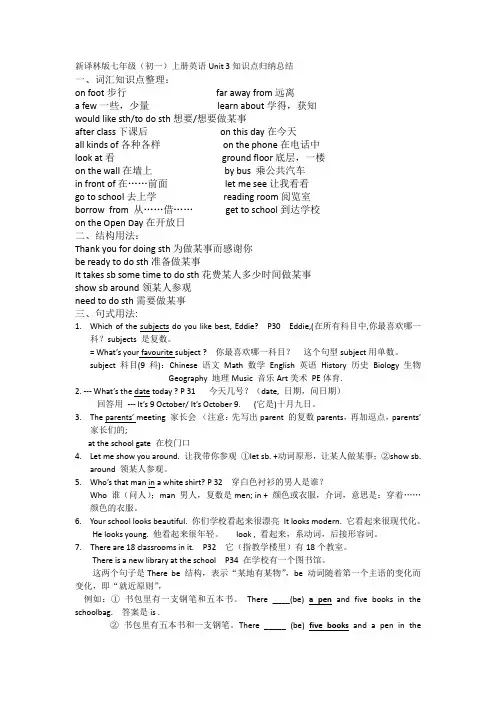
新译林版七年级(初一)上册英语Unit 3知识点归纳总结一、词汇知识点整理:on foot 步行 far away from 远离a few 一些,少量 learn about 学得,获知would like sth/to do sth 想要/想要做某事after class 下课后on this day 在今天all kinds of 各种各样on the phone 在电话中look at 看ground floor 底层,一楼on the wall 在墙上 by bus 乘公共汽车in front of 在……前面 let me see 让我看看go to school 去上学reading room 阅览室borrow from 从……借……get to school 到达学校on the Open Day 在开放日二、结构用法:Thank you for doing sth 为做某事而感谢你be ready to do sth 准备做某事It takes sb some time to do sth 花费某人多少时间做某事show sb around 领某人参观need to do sth 需要做某事三、句式用法:1.Which of the subjects do you like best, Eddie? P30 Eddie,(在所有科目中,你最喜欢哪一科?subjects 是复数。
= What’s your favourite subject ? 你最喜欢哪一科目?这个句型subject用单数。
subject 科目(9科):Chinese 语文Math数学English英语History历史Biology生物Geography 地理Music 音乐Art美术PE体育.2. --- What’s the date today ? P 31 今天几号?(date, 日期,问日期)回答用--- It’s 9 October/ It’s October 9. (它是)十月九日。
牛津译林版七年级上册Unit3知识点汇总附专题特训
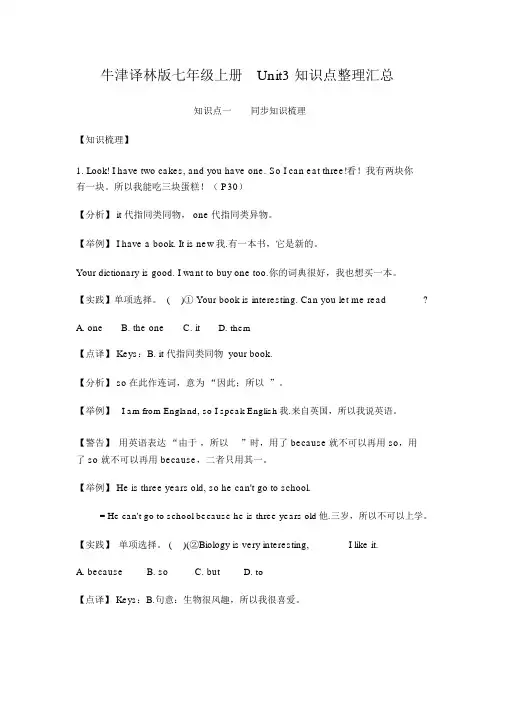
牛津译林版七年级上册Unit3 知识点整理汇总知识点一同步知识梳理【知识梳理】1.Look! I have two cakes, and you have one. So I can eat three!看!我有两块你有一块。
所以我能吃三块蛋糕!( P30)【分析】 it 代指同类同物, one代指同类异物。
【举例】 I have a book. It is new我.有一本书,它是新的。
Your dictionary is good. I want to buy one too.你的词典很好,我也想买一本。
【实践】单项选择。
( )① Your book is interesting. Can you let me read_______?A. oneB. the oneC. itD. them【点译】 Keys:B. it 代指同类同物 your book.【分析】 so在此作连词,意为“因此;所以”。
【举例】I am from England, so I speak English我.来自英国,所以我说英语。
【警告】用英语表达“由于,所以”时,用了 because就不可以再用 so,用了 so 就不可以再用 because,二者只用其一。
【举例】 He is three years old, so he can't go to school.= He can't go to school because he is three years old他.三岁,所以不可以上学。
【实践】单项选择。
( )(②Biology is very interesting, _______I like it.A. becauseB. soC. butD. to【点译】 Keys:B.句意:生物很风趣,所以我很喜爱。
2. which of the subjects do you like best,Eddie? (P30)【用法】 pron. 哪一个【举例】 It's hard to say which is better很.难说哪一个好些。
初中英语新译林版七年级上册Unit 3 单词解析(2024秋)
七年级英语上册Unit 3单词解析1.Building (名词) “楼房;建筑物”,其复数形式为buildings[派生词]build (动词) 建造;建筑Eg: This tall building was built last year. 这个高楼是去年建造的。
2.Sports field 体育场Eg: There are lots of people on the sports field. 在体育场上有许多人。
3.Dining hall 食堂;餐厅Eg: We often have lunch at dining hall. 我们经常在食堂吃午饭。
4.Part (名词) “部分”[常见搭配]a part of... “...的一部分”The best part 最好的一部分Eg: A part of them are made in China. 其中一部分是中国制造。
5.Modern (形容词) 现代化的;先进的;现代的[常见搭配]modern civilization 现代文明Modern technology 现代技术Modern life 现代生活Eg: Stress is a major problem of modern life. 压力是现代生活中的主要问题。
6.As well 也;和;又[易混辨析]as well、also、too与also区别:also (副词) “也”;常常位于实义动词之前too (副词) “也”;常常位于肯定句尾As well “也”,常常位于句尾Either “也”,常常位于否定句句尾Eg: She is also a student. = She is a student, too. = She is a student as well. 她也是一名学生。
She doesn’t like apples, either. 她也不喜欢苹果。
7.Bright (形容词) 明亮的;聪明的;鲜艳夺目的[常见搭配]bright and early 大清早Eg: They walked out of the school into the bright daylight. 他们从学校走出来到明亮的日光下。
Unit3短语知识点牛津译林版英语七年级上册(1)
Wele1. a great place for learning 一个学习的好地方2.different places at school 学校的不同地方3.introduce our school 介绍我们学校4.get to know our school better 更好地了解我们的学校5.discuss them with each other 互相讨论6.classroom building 教学楼7.It’s good to see you. 很高兴见到你8.The best part is the modern library 最好的部分是现代化的图书馆9.How many classrooms does your school have ? 你们学校有多少间教室?10.They’re all bright and clean. 它们又亮又干净。
Reading1.green spaces 绿色空间2.I’m Jack Liu from Grade 9. 我是九年级的刘杰克。
3.They are the perfect places for us to study. 它们是我们学习的最佳场所。
4.Students enjoy spending time here. 学生们喜欢在这里度过时光。
5.Sometimes we chat with teachers about our problems here too. 有时我们也和老师讨论我们在这里遇到的问题。
6.Can you see the students running there? 你能看见学生们在那儿跑吗?7.Lots of exciting sports matches take place on it. 许多激动人心的体育比赛在这里举行。
8.the school noticeboards near the gate 学校的布告栏在大门附近9.Here we can read about school news and stories of star students and teachers. 在这里我们可以读到学校的新闻和明星学生和老师的故事。
新译林版英语七年级上册全册 Unit 3 Welcome to our school!
5 We have a nice dining hall as well. 我们还有一个漂亮的 餐厅。(教材P31)
as well 也 too, either, also 与 as well 四者都有“也”的意思,区别如下:
常用于肯定句或疑 I can help you, too. 我也可以帮 too 问句的句末,其前 你。
描述的是事物的特征。 It is +adj.+for sb. to
这类形容词有different、easy、 do sth. 对某人来说,
hard、important、possible、 做某事是……的。 dangerous、necessary(必要的)等。
描述的是人的性格、品质特征。
It is +adj.+of sb. to do sth. 某人做某 事是……的。
典例(南京市秦淮区期中)—I like our school! —Me too. It looks very __D_ and everything is new.
A. easy B. free C. slim D. modern
[解析] 句意:“我喜欢我们的学校!”“我也是。它看起来 很现代化,一切都是新的。”easy“容易的”;free“自由的”; slim“苗条的”;modern“现代化的”。根据“like our school” 和“everything is new”可推知,modern“现代化的”符合语 境。故选D。
化的图书馆。(教材P31) modern /ˈmɒdn/ adj. 现代化的,先进的;现代的
(1)[形容词]现代化的,先进的 I hope to stay in a modern hotel. 我希望住一家现代化的 酒店。 (2)[形容词]现代的,近代的 只用于名词前作定语。 She has a book about modern history. 她有一本关于近代 史的书。
七年级上册英语unit3知识点译林版
七年级上册英语unit3知识点译林版七年级上册英语Unit 3知识点译林版Unit 3是七年级上册英语课程的一个重要单元,本单元主要涉及到学生日常生活中的一些基本场景和常见对话,为学生提供了一些实用的英语会话技能。
本文将为大家介绍一些关于Unit 3的知识点,以便学生们更好地掌握本单元的学习内容。
一、新单词和短语本单元涉及到了一些基本的新单词和短语,如下所示:1. bathroom:浴室2. kitchen:厨房3. dining room:饭厅4. living room:客厅5. study:书房6. bedroom:卧室7. door:门8. window:窗户9. bed:床10. table:桌子11. chair:椅子12. sofa:沙发13. bookshelf:书架14. picture:画15. clock:钟表16. lamp:台灯17. have a shower:淋浴18. have a bath:洗澡19. watch TV:看电视20. do homework:做作业二、重点语法知识1. 一般现在时一般现在时表示现在经常或者固定性的动作或状态,或者正确的、普遍的观点。
例如:I live in a big house.(我住在一栋大房子里。
)She likes playing basketball.(她喜欢打篮球。
)2. 形容词比较级和最高级形容词比较级和最高级用于比较两个或多个人或事物之间的差异和优劣。
例如:I am older than my sister.(我比我妹妹年龄大。
)This book is the most interesting one I have ever read.(这本书是我读过最有趣的一本。
)3. 表示数量的词汇和句型表示数量的词汇和句型用于表达一些数量,比如数量的大小、比例、时间等。
例如:I have three sisters and two brothers.(我有三个姐妹和两个兄弟。