
人教版 必修一 Unit1 Festivals around the World Reading
What do people in Mexico do in memory of the dead?
They offer____, ______ to the food ________and flowers gifts dead on the Day of the Dead. On that day, People eat food in the shape of ______ skulls and cakes with ______on them. bones
Obon (盂兰盆) in Japan
P 3. Festivals to Honour People
Kinds of Festivals Festivals to Honour People Names of Festivals Dragon Boat Festival Columbus Day Countries
Festivals to Honor People
Match the festivals with the proper people.
National Festival The Dragon Boat Columbus on October 2 Festival Day
India
China
USA
Harvest Festivals
People will ________ on Thanksgiving festivals. 1. decorate churches and town halls 2. get together to have meals 3. win awards for their farm produce
Halloween Parade(游行)
Thanksgiving Day the last Thursday of November
Christmas Day December 25th
New words
starve: 饥饿 origin: 起源 ancestor: 祖先 Obon: 盂兰盆节(日本) grave: 坟墓; 墓地 incense: 熏香 in memory of: 纪念 feast: 节日; 盛宴
Compare the festivals of the dead in Mexico, Japan and China. What things are similar and what things are different?
The Chinese, Japanese and Mexican festivals of honor the dead. the dead all have customs to _______ The Chinese and Japanese __________________ go to clean their ancestors’ graves ________________. However, there are some differences. The eat food in shape of skulls and cakes Mexicans, ________________________________ __________________, with bones on them something the Chinese and Japanese do not do.
Festivals of the Dead
How do Japanese honor their ancestors?
They have a festival called Obon, when people should go to clean______ _____ to graves and light incense ancestors They light ______ honor their __________. lamps and play ________. music
Harvest Festivals
P 5. Spring Festivals
Countries Kinds of Names of Festivals Festivals Spring China Spring Festival Festivals some Western Easter and related holidays countries Cherry Blossom Festival Japan
Different from Thanksgiving festivals in Western countries, what activities do China and Japan have in Mid-autumn festivals?
admire the moon and in China enjoy People _______ ___________. mooncakes
2. What kind of things are done to celebrate the Obon Festival? People should go to clean the graves, light incense, lamps and play music.
3. Why does Indian have a national festival on October 2? To honor Ganhdi who helped gain Indian’s independence from Britain.
P 2. Festivals of the Dead Countries Kinds of Names of Festivals Festivals Festivals Japan Obon of the Dead Day of the Dead Mexico
Halloween
Some Western countries
What festivals are mentioned in each paragraph?
P1. Ancient festivals celebrate the end of the cold weather, planting in spring and harvest in autumn; celebrate when hunters catch animals.
skull: 头骨 dress up: 打扮; 盛装 play a trick on: 搞恶作剧 award: 奖品 rooster: 公鸡 energetic: 充满活力的 carnival: 狂欢节 parade: 游行
Reading
FESTIVALS AND CELEBRATIONS
1. Can you find out the topic sentence of the whole passage? 2. How many kinds of festivals are mentioned?
Do you know the symbols of Easter?
Easter eggs and Easter Bunnies (rabbits).
Careful Reading: True or False
1. The ancient people needn’t worry F 2. Halloween used to be a festival intended to honor the dead. T about their food.
Fill in the blanks according to the passage.
Origins of festivals
Most ancient festivals would celebrate the cold _______, weatherplanting in ______ spring end of the ____ autumn Today’s festivals and harvest in ______. origins some ________, religioussome have many ______, _________and some for special people ______ or seasonal ______. events
China
USA India
festival to honour Gandhi
Columbus Day
P 4. Harvest Festivals
Kinds of Festivals Harvest Festivals Countries Names of Festivals Harvest/ European and Thanksgiving other countries; festivals; mid-autumn festivals China and Japan
Answer these questions.
1. When did people celebrate in Ancient Times?
a. the end of the cold weather; b. planting in spring and harvest in autumn; c. when hunters could catch animals.
4. How do Europeans celebrate Thanksgiving festivals?
Decorate churches and town halls with flowers and fruits; people get together to have meals.
Halloween
Halloween is from __________, America which is celebrated on ____________. October 31 People would dance at the fancy ball and wear ghost costumes (clothes), false _____________________________ faces and witches' hats, _____________________________ frighten in order to __________away spirits looking for bodies to possess.
必修一Unit1 Festival around the world1
Festival Time of What it What people do year/date celebrates
eat zongzi; watch dragon-boat the fifth in memory races; throw rice Dragon day of the of the wrapped in reed Boat leaves into water in beloved fifth memory of Qu Festival/ month in poet Qu Duanwu lunar Yuan who Yuan; put herbs on Festival calendar died in 278 doorways for good health
and relatives
Festival Time of What it What people do year/date celebrates the visit family or founding go to other of the parts of China; National October People’s go shopping Day 1st Republic of China in1949
1. When does it usually take place? 2. How do people celebrate? 3. Why?
fruit
firecracker red packet food work date visit SPRING FESTIVAL new clothes
dumpling fun
Festival Time of What it year/date celebrates
Unit-1-Festivals-around-the-world-课文知识点解析1
7....when people should go to clean the graves and light incense in memory of their ancestors.
……这时候,人们去扫墓,点上香火祭祀祖先。
memory[ C usually plura] n. 表示所记住的事情,记忆
starve vt.&vi. 挨饿,饿死
e.g. Thousands of people will starve if food doesn’t reach the stricken city.
假如食物无法到达这座受灾的城市,成千上万的人将会饿死。
5.They lit fire and made music because they thought these festivals would bring a year of plenty.
他们把食物, 鲜花和礼物献给死者。
offer sth. to sb.= offer sb.sth.供应某物给某人
e.g. He offered me 300 dollars for that television.
他出300美元向我买那部电视机。
12.The festival of Halloween had its origin as an event in memory of the dead.
万圣节起源于纪念已逝的人们。
had its origin as an event 起源于某事
have your or its origin=begin 开始
e.g.Many of the problems had their origin in post-war Europe.
高一Unit 1《Festivals around the world》教案人教版

高一Unit 1《Festivals around theworld》教案人教版高一Unit1《Festivalsaroundtheworld》教案人教版本单元为人教版《高中英语》(NSEc)必修模块3Unit1.Festivalsaroundtheworld.本单元的中心话题是“谈论世界各地的节日”,该阅读课Reading:APioneerForAllPeople。
是本单元第一课时,内容涉及到各国的节日名称,时间,方式和原因,使学生了解不同国家的文化和风俗。
以独立的内容块进行叙述。
的结构特点是平行并列。
针对内容和结构的特点,本课以培养学生阅读比较信息和归纳信息的能力为主,分别将获取的信息通过列表比较,图片匹配,问答游戏等方式,进行比较,使学生找到各国节日庆祝方式的相同和不同之处,归纳总结各国节日产生的原因,推理出人们到对节日的态度,探究到节日是人类对生活怀有美好祝福的心理,是生命的传承实践,从而提高学生跨文化交际的能力和意识。
教学目标知识与技能目标:Thestudentswillbeableto.identifythedifferentfestivalsbycomparingtheinf ormationaboutcelebrations.2.explainthereasonwhythefestivalscomeintobeingbyfin dingoutthesimilaritiesanddifferences.3.describetheirfavoritefestivalsbyusingthelanguagef romthetext.教学重点和难点)为全体学生进行有效性阅读策略的指导,包括语篇分析、猜测词义,逻辑推理、归纳概括等技巧。
2)通过比较信息,归纳总结各国节日产生的原因,推理出人们到对节日的态度和节日的意义。
教学过程教学步骤教学活动设计意图Pre-reading:Step1.Brainstorm:motivatetheSsbyaskingsomequestions.Q1:Doyouanyfestivalsaroundtheworld?Step2.matchthecelebrationwiththefestivals.Q2:DoyouknowhowpeoplecelebratetheseFestivals?Doaquiz.Step2.DiscussionSsdiscussthefollowingquestionsQ1:Howdotheycomeintobeing?Q2:whatdotheyhaveincommon?Andwhataretheredifference amongthem?问题引发了学生的思考,调动学生的已知,将学生的思维活动引导到课文主题上来。
高一英语Unit1 Festivals around the world课件 新课标 人教版 必修
Listening task 2
Listen for details.
Listening strategies:
1. Try to get some background knowledge of the listening task.
3.How long did their holiday last?
Listening task 1
Easter at Home
1.What did Helen and Andy buy for Easter? Some candy eggs and Hot Cross Buns.
2.What was hidden all around the house? Chocolate Easter eggs.
While-listening : Task 2
Listen for details.
What do people do at the festivals?
Halloween:
Children in western countries _d_r_e_s_s_ _u_p_in costumes and go to their n_e_i_g_h_b_o_u_r_s_’ homes. They _a_s_k__ ___f_o_r_ _s_w__e_e_ts__and might __p_l_a_y_ _t_ri_c_k_s_ if they do not get some.
Pre-listening : Task 1
Obon Day of the Dead
Festivals of the Dead
人教版高中英语必修一课文
人教版高中英语必修一课文
Unit 1《Festivals around the World》
本单元主要介绍了世界各地的节日,包括春节、万圣节、圣诞节、新年和复活节等。
文中除了介绍节日的由来和庆祝方式外,还涉及了一些文化背景和相关的习俗。
第一部分:读前探究
本部分通过图片、表格、问答等形式,引出了本单元的
主题:“世界节日”。
第二部分:课文阅读
本部分包括五个具有代表性的节日:中国的春节、美国
的万圣节、英国的圣诞节、印度教的新年和基督教的复活节。
每个节日都有相应的阅读材料和相关练习,旨在让学生掌握节日的历史和文化内涵。
第三部分:课文朗读
本部分以听力练习为主,通过听录音、模仿、评析等环节,帮助学生提高英语口语和听力能力。
第四部分:语言学习
本部分重点介绍了各节日中常用的词汇、短语和句型,
帮助学生理解和运用英语表达与节日庆祝相关的内容。
第五部分:课文扩展
本部分以学生自主学习为主,旨在扩展课文中涉及的文
化背景和节日庆祝方式,培养学生的文化意识和创新思维能力。
例如可以参与的活动包括:研究其他国家/民族的节日、设计
自己的节日等。
第六部分:写作训练
本部分通过例句分析和提供写作范文等方式,引导学生掌握如何用英语表达关于节日庆祝的内容,提高写作能力。
第七部分:文化背景
本部分重点介绍了各节日的文化背景和相关的习俗、传统,帮助学生加深对节日的认识和理解。
第八部分:单元测试
本部分为本单元的测试部分,主要包括听力测试、阅读理解和写作。
旨在检验学生对所学知识点的掌握情况,并为学生未来的学习提供参考。
《高中英语新课标-必修1-Unit1 Festivals around the world 课件》
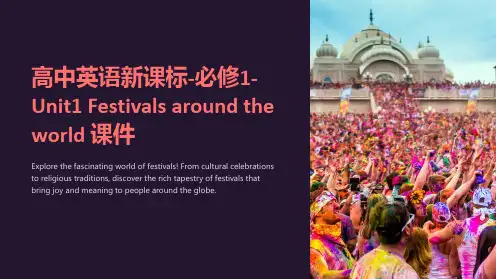
不同国家和文化中的节日
了解世界各国和不同文化中的庆典与节日,体验不同人群庆祝节日的方式, 感受文化的多样性与人类共同的欢庆。
节日的文化意义
探究节日在不同文化中的重要地位,了解它们对于文化传统、身份认同和价 值观的深远影响。
节日的历史渊源
追寻节日的历史根源,了解节日与人类历史和传统之间的联系,以及随着时 间推移如何演变和发展。
宗教节日及其意义
探索各大宗教中的重要节日,了解它们在信仰和宗教-必修1Unit1 Festivals around the world 课件
Explore the fascinating world of festivals! From cultural celebrations to religious traditions, discover the rich tapestry of festivals that bring joy and meaning to people around the globe.
为什么庆祝节日?
了解不同文化中庆祝节日的原因,从人们的欢乐和团结之中体会为什么庆祝节日的重要性。
世界各地不同类型的节日
探索世界各地独特的节日,从传统文化节日到现代庆典,领略各种不同类型 的节日给人们带来的喜悦与意义。
节日 - 生活的庆祝
了解节日作为人们庆祝与享受生活的方式,体验节日带来的喜庆氛围与人们 团聚的温暖。
Unit1_Festivals_around_the_world教案
Unit1_Festivals_around_the_world教案The First Period (Warming up & Pre-reading)Step One: Lead-inFree Talk: Did you have a good time in your winter holidays?When did you feel most happy and excited? Why?( At the Spring Festival. Because it's the most important festival in our country....)Step Two: Warming up1. Let the Ss think about the other Chinese festivals.( Lantern Festival, Pure Brightness Festival, Dragon Boat Festival, Mid-Autumn Festival, New Year's Day, Chung Yeung Festival....)2. Discussion One1)Let the Ss look at the information about Chinese festivals and discuss another four Chinese festivals according to the example in warming up: When does the festival come?What do people celebrate?whole class.3 Discussion TwoTalk about some foreign festivals.( Christmas, April Fools Day, Easter Day, Halloween, Valentine's Day, Thanksgiving Day, Obon...) Step three: Pre-readingLet students think about the questions:1) What is your favourate holiday of the year? Why?2)What festivals or celebrations do you enjoy in your city or town? Do you like spending festivals with your family or with friends? What part of a festival do you like best- the music, the things to see, the visits or the food?Step Four: Language Points1.mean to do 打算做某事mean doing 意味着….I never meant him to work for us.Passing the entrance examination means being admitted into college.2. celebrate vt.(1)do sth to show that a day or an event is important 庆祝;祝贺celebrate Christmas / one’s birthday / a wedding anniversary / a victory(2)p raise and honor 颂扬;称颂The names of many heroes are celebrated by the poets.词语辨析:celebrate, congratulatecelebrate后常接日期、情况或场合。
高中英语 Unit 1 Festivals around the world Period 1 Wa
Unit 1 Festivals around the world单元要览类别课程标准要求掌握的项目话题Festivals; how festivals begin; how to celebrate festivals词汇beauty n. 美; 美人award n. 奖; 奖品vt. 授予harvest n. & vt. & vi. 收获; 收割rooster n. 雄鸡; 公鸡celebration n. 庆祝; 祝贺admire vt. 赞美; 钦佩; 羡慕starve vt. & vi. (使)饿死; 饿得要死energeticadj. 充满活力的; 积极的origin n. 起源; 由来; 起因custom n. 习惯; 风俗religious adj. 虔诚的; 宗教上的clothing n. 衣服ancestor n. 祖先; 祖宗worldwideadj. 遍及全世界的feast n. 节日; 盛宴permissionn. 许可; 允许belief n. 信任; 信心; 信仰fool n. 愚人vt. 愚弄vi. 干傻事trick n. 诡计; 恶作剧; 窍门apologizevi. 道歉; 辩白arrival n. 到来; 到达; 到达者drown vt. & vi. 溺死; 淹死gain vt. 得到; 获得obvious adj. 明显的; 显而易见的independencen. 独立; 自主remind vt. 提醒; 使想起gather vt. , vi. & n. 集合;聚集weep n. 哭vi. 哭泣; 流泪agriculture n. 农业; 农艺; 农学forgive vt. 原谅; 饶恕短语take place发生turn up出现; 到场in memory of纪念; 追念keep one’s word守信用; 履行诺言dress up盛装; 打扮; 装饰hold one’s breath屏息; 屏气play a trick on搞恶作剧; 诈骗; 开玩笑set off出发; 动身; 使爆炸look forward to期待; 期望; 盼望remind. . . of. . . 使……想起……day and night日夜; 昼夜; 整天be proud of以……而自豪as though好像in the shape of以/呈现……的形式/形状have fun with玩得开心be covered with被……所覆盖重要句型1. . . . people would starve if food was difficult to find. (the subjunctive mood)2. The country, covered with cherry tree flowers, looks as though it iscovered with pink snow. (as though. . . )3. Finding that. . . , her grandmother finally decided. . . (the presentparticiple used as adverbial. )4. It was obvious that the manager of the coffee shop was waiting. . .(It is+adj. +that. . . )5. “. . . I don’t want them to remind me of her. ” So he did. (So+S.+do/does/did. )6. There was Hu Jin waving at him and calling, . . . (Inversion)功能 1. Making phone callsMay I speak to. . . ?Can I ring/call back later?Hold/Hang on, please.I’ll ring him/her up again.Just a moment, please.Sorry, he/she isn’t here right now.2. InvitationsI wonder if you are interested in. . . .I’d like to invite you to. . . .Would you like. . . ?Could/Would you please. . . ?I’m looking forward to. . . .I’d love to, but. . . .3. ThanksThank you so much.Thanks a lot.That’s very kind of you.You’re most welcome.Don’t mention it.It’s a pleasure.语法The use of can, could, may, might, will, would, shall, should, must, can’t1. can and couldJin can speak English well. (ability)Could you please show me the way to Beihai Park? (request)2. may and mightMay we see the awards for the teams? (permission; request)She might give you some new clothing. (possibility)3. will and wouldThe Spring Festival is the most fun. The whole family will come for dinner.(promise; agreement)Often he would dress up like a rich man. (past habit; custom)4. shall and shouldThe harvest festival begins on Sunday. We shall be there with our friends.(promise; agreement)You should arrive at the airport two hours before he goes. (advice)5. must and can’tWang Feng wins an award every year. He must be very strong. (speculation) You must be joking. That can’t be true. (guessing)教学重点1. Get students to know about festivals around the world.2. Have students learn some useful new words and expressions about festivals and customs and let them learn effective ways to remember English vocabulary.3. Enable students to grasp and use the expressions of request and thanks.4. Let students learn the new grammar item: the use of can, could, may, might, will, would, shall, should, must and can’t.5. Develop students’ listening, speaking, reading and writing abilities.教学难点1. Enable students to master the use of can, could, may, might, will, would, shall, should, must and can’t.2. Let students learn to write a different ending of a story.3. Develop students’ integrative skills.课时安排Periods needed: 7Period 1 Warming up and readingPeriod 2 Learning about language: Important language points Period 3 Learning about language: GrammarPeriod 4 Using language: Listening and speakingPeriod 5 Using language: Extensive readingPeriod 6 Using language: Speaking and writingPeriod 7 Revision: Summing up and learning tipPeriod 1 Warming up and reading整体设计教材分析This is the first teaching period of this unit. At the beginning of the class, the teacher can lead in the topic of the unit by having a free talk with students about their winter holidays and the Spring Festival.The Warming Up is intended to have students start thinking about the variety of events and festivals that are celebrated in China, and connect them with seasons of the year and reasons for the celebrations. The teacher can use this part to introdu ce information that Chinese students should have about their country’s cultural events.The Pre-reading is a continuation of the Warming Up and it moves the discussion to a more personal level. It is intended to help students enter imaginatively into a discussion of festivals and their importance to the society. It also directs their attention to the variety of events and activities those festivals include. The teacher should let students discuss the questions and predict what kind of information will be introduced in the Reading.The reading passage titled FESTIVALS AND CELEBRATIONS briefly describes the earliest kinds of festivals with the reasons for them, and then four different kindsof festivals that occur in most parts of the world. Encourage students to look at the pictures and the heading of each section to guess what the text might be about. Then let them skim for the general idea for each section, and scan for further understanding. Because this passage introduces a lot of useful new words and expressions which are only used for festivals, in order not to let students feel much difficult, the teacher should deal with any language problems while they are reading. After reading, students are required to do the four exercises in the Comprehending to see how much they have understood the reading passage. The teacher can first let them work in pairs or in groups to find the answers cooperatively, and then check their answers with the whole class.To consolidate the contents of the reading passage, students should be required to talk about festivals in their own words at the end of the class. In order to arouse students’ interest, the teacher can hold a competition between groups.教学重点1. Let students learn more about history and basic knowledge of festivals.2. Get students to learn different reading skills.教学难点1. Develop students’ reading ability.2. Enable students to talk about festivals and celebrations.三维目标知识目标1. Get students to learn the useful new words and expressions in this part: beauty, harvest, starve, origin, religious, ancestor, Mexico, feast, bone, belief, poet, arrival, gain, independence, gather, agriculture, award, rooster, admire, energetic, Easter, clothing, Christian, custom, take place, in memory of, dress up, play a trick on, look forward to, day and night, as though, have fun with2. Let students learn about history and basic knowledge of festivals both in and out of China.能力目标1. Develop students’ reading ability and let them learn different reading skills.2. Enable students to talk about festivals and celebrations.情感目标1. Stimulate students’ love for their own national culture and customs.2. Develop students’ sense of cooperative learning.教学过程设计方案(一)→Step 1 Leading-inHave a free talk with students. Ask them the following questions:Did you have a good time in your winter holidays?When did you feel most happy and excited? Why?(At the Spring Festival. Because it’s the most important festival in ourcountry. . . )→Step 2 Warming up1. Let students brainstorm the other Chinese festivals.(Lantern Festival, Pure Brightness Festival, Dragon Boat Festival, Mid-Autumn Festival, New Year’s Day, Chung Yeung Festival. . . )2. Let students read the information about Chinese festivals below and discuss another three Chinese festivals:When does the festival come?What do people celebrate?What do people do?Festivals Date Festivals DateNew Year January 1st Teachers’ Day September 10th InternationalWomen’s DayMarch 8th National Day October 1stArbor Day March 12th The Spring Festival Lunar New YearInternational Labor Day May 1st Dragon BoatFestivalthe fifth day of the fifthlunar monthInternational Children’s Day June 1st Mid-AutumnFestivalthe 15th day of the 8thlunar monthArmy Day August 1st Lantern Festival the 15th day of the 1stlunar monthChinese Youth Day May 4th Pure Brightness Day April the fifth3. Ask students to fill in the following form and ask some to share their opinions with the whole class. The first one is given as an example.Festivals Time of year/date What it celebrates What people doMid-Autumn Festival autumn/fall the beauty of thefull moon, harvest,time with familyand friendsgive/eat moon cakesand watch the fullmoon with familyand friends4. Talk about some foreign festivals with students.(Christmas, April Fools’ Day, Easter, Halloween, Valentine’s Day, Thanksgiving Day, . . . )→Step 3 Pre-reading1. Let students discuss the following questions:What festivals or celebrations do you have in your city or town? What part of a festival do you like best—the activities, the music, the sights, the food or the people who visit?2. Ask students to look at the pictures and title of the passage in Reading. Discuss in pairs what kind of information will be introduced in the passage.→Step 4 Reading1. Fast readingAsk students to skim the reading passage and then fill in the following chart.Kinds of Festivals Names of Festivals Countries FestivalsFestivalsHarvestSpring(Let students look through the chart and then read the text silently. Three minutes later, check the answers with the whole class. Show the suggested answers on the screen. )2. Intensive readingAllow students to read carefully this time to understand the main ideas of each paragraph and the important details, and then finish the following:1)Choose the best answer to each question or to finish each sentence according to the text.(1)Why do Japanese people light lamps during the Festival of the Dead?A. Because they want to make the festival colorful.B. Because they want to light up their rooms.C. Because they want to light up their way.D. Because they want to lead their ancestors to return to earth.(2)Which of the following was not mentioned as a famous person in the text?A. Mohandas Gandi.B. Christopher Columbus.C. Abraham Lincoln.D. Qu Yuan.(3)The place where people will usually decorate churches and town halls with flowers and fruits is ______________.A. IndiaB. AmericaC. EuropeD. China(4)Easter is held in memory of the return of Jesus for Christians and also celebrates ______________.A. the coming of springB. the autumn harvestC. the Lunar New YearD. the end of a yearSuggested answers: (1)D (2)C (3)C (4)A2)Use the information from the reading passage to answer the following questions.(1)What are festivals of the dead usually for?(2)What makes autumn festivals happy events?(3)What do people usually do at spring festivals?(4)What is one important reason to have festivals and celebrations?(5)Compare the festivals of the dead in Mexico, Japan and China. What things are similar? What things are different?3. Reading and discussionRead the text a third time and then work in pairs to do the following.1)Based on the reading passage, what do most festivals seem to have in common? Why do you think these things might be important to people everywhere? Talk with your partner and fill in the chart below.Three common things Reasons why they are important to people everywhere1.2.3.2)Discuss in pairs which festivals you think are the most important and which are the most fun. Then fill in the chart with your ideas.Type of festival Example of festival Reasons for yourchoiceMost importantMost fun(Let students have enough time to read the passage carefully and discuss the questions and charts with their partners. Encourage them to expand their answers according to their own experiences. )4. ExplanationHelp students analyze some difficult, long and complex sentences and guess the meanings of some new words. Encourage them to try to deal with the language points in the context.Discuss the following important sentences and phrases in the passage.1)Some festivals are held to honour the dead, or to satisfy the ancestors, who might return either to help or to do harm.2)in memory of3)India has a national festival on October 2 to honour Mohandas Gandhi, the leader who helped gain India’s independence from Britain.4)People are grateful because their food is gathered for the winter and the agricultural work is over.5)The most energetic and important festivals are the ones that look forward to the end of winter and to the coming of spring.6)The country, covered with cherry tree flowers, looks as though it is covered with pink snow.Suggested explanations:1)The sentence contains a non-restrictive attributive clause who might return either to help or to do harm. It means people hold some festivals either to show respect to the dead or to make their ancestors happy in case they might come back to do harm.2)in memory of: serving to recall sb. , to keep him fresh in people’s mindsHe wrote a poem in memory of his dearest wife, who died in an accident.in honor of: showing great respect or high public regard3)the leader who helped gain India’s independence from Britain: a noun phrase followed by an attributive clause as the appositive4)two clauses for reason5)energy n. → energetic adj. : full of or done with energylook forward to: “to” is a preposition here.I’m looking forward to hearing from you.be devoted to; be/get used to; get down to; stick to. . .6)covered with cherry tree flowers: a past participle phrase equal to “which is covered with cherry tree flowers”as though: as ifHe talks as though he knew all about it.He looks as if he had seen a ghost.5. Reading aloud and underliningAsk students to read the passage aloud to the tape and let them pay attention to the pronunciation of each new word and the pauses within each sentence. Tell them to pick out all the useful expressions or collocations from the passage while reading and copy them to the notebook after class as homework.→Step 5 ConsolidationAsk students to talk about festivals in their own words according to the text. Then let them complete the following passage with proper words or phrases.There are all kinds of festivals and ______________ around the world, which are held for different ______________. The ancient festivals were mainly held at three times a year—the end of the cold ______________, planting in spring and ______________ in autumn. Some festivals are held to ______________ the dead or ______________ the ancestors, who might return either to help or ______________, while other festivals are held to honor famous people or to the ______________, such as Dragon Boat Festival, Columbus Day, and so on. Harvest and ______________ festivals are happy events because their food is ______________ for the winter and the ______________ work is over, to which Mid Autumn Festival belongs. And the most ______________ and important festivals are the ones that ______________ the end of winter and to the coming of ______________ such as the Lunar New Year, at which people have a very ______________.Suggested answers: celebrations; reasons; weather; harvest; honor; to satisfy; to do harm; gods; Thanksgiving; gathered; agricultural; energetic; look forward to; spring; good time→Step 6 Homework1. Learn the useful new words and expressions in this part by heart.2. Read the reading passage again and again and try to talk about festivals both in and out of China.设计方案(二)→Step 1 Leading in the topic by learning vocabulary about festivals1. Make a circle on the blackboard and write the word “FESTIVAL” in it.2. Ask students, “We have learned ‘festival’. Can you name some festivals? ”3. Students list as many festivals as possible. Then the teacher adds somestudents can’t think of, such as Halloween, Easter, Thanksgiving, Valentine’s Day.4. Let students read them aloud and try to learn them by heart.→Step 2 Warming up by talking about festivalsWork in groups and list three more Chinese festivals that you know. Discuss when they take place, what they celebrate and what people do at that time. Then tell the group which festival is their favorite and why.Festivals Time of year/date What it celebrates What people doMid-Autumn Festival autumn/fall the beauty of thefull moon, harvest,time with familyand friendsgive/eat moon cakesand watch the fullmoon with familyand friends→Step 3 Predicting by looking and discussing1. Look at the pictures and title of the reading passage and discuss in pairs what the passage might be about.2. Two or three students are to give their opinions.→Step 4 Reading1. Give students 2 minutes, and ask them to skim the passage for information to tell if the following sentences are True or False.1)The ancient people needn’t worry about their food. (F)2)Halloween used to be a festival intended to honor the dead. (T)3)Qu Yuan was a great poet who people honor a lot in China. (T)4)The Mid-autumn Festival is held to celebrate the end of autumn. (F)5)Easter celebrates the birth of Jesus. (F)2. Give students 5 minutes to read the passage carefully, and complete the chart according to the passage.Festivals of the Dead Obon in Japan___________________HalloweenFestivals to Honor People ________________________________A national festival in____________ Harvest Festivals _________ in European countries_________ in China and Japan Spring Festivals ________________Carnivals in some Western countries________________________________ in Japan3. Listening and reading aloudPlay the tape of the text for students and let them pay attention to the pronunciation of each new word and the pauses within each sentence. Then ask them to read the text aloud to the tape.→Step 5 Closing down by spoken practice1. Have students get prepared in 3 minutes or so and then ask them to talk about festivals and celebrations.2. Ask as many students as possible to have a try in front of the class.→Step 6 Homework1. Go over the text and try to learn all the useful words and expressions in this part by heart.2. Finish the exercises in Comprehending on Page3.板书设计Unit 1 Festivals around the worldFestivals and celebrationsKinds of Festivals Names of Festivals Countries FestivalsFestivalsHarvestSpring活动与探究Group discussion & speechAs is known from the reading passage, festivals of all kinds are celebrated around the world. Most festivals have celebrations that include food, music, clothing and dances. These events originated from some similar ideas, but they take different forms in different regions and societies. What festivals and celebrations do you know all over the world? Have you ever taken part in them and enjoyed yourself? Discuss festivals in groups and then make speeches.Step 1: The teacher divides the class into four groups and gives the tasks to students in each group. Group 1 will list the festivals around the world as many as possible, and then categorize them according to the origins of these festivals. And they should prepare for a short speech. Group 2 will discuss two traditional Chinese festivals and prepare for their presentation. Group 3 will discuss two Western festivals and prepare for their presentation. Group 4 will discuss the differences between Chinese festivals and Western festivals, then contrast and compare their styles, celebrations, dates and so on. And they should prepare for a short speech.Step 2: Groups 1, 2 and 3 give their speeches on the festivals they have discussed. Group 4 gives their speech on the differences between Chinese festivals and Western festivals.Step 3: The teacher makes proper remarks about students’ speeches and sums up the different cultural practices between China and other countries according to them.。
必修一Unit1 Festivals around the world 重点句型 仿写
M3U1
人们给孩子们压岁钱,盼望美好的未来。 (look forward to)
很遗憾的是有些人由于各种原因,不能参 与这个重大节日的庆祝。(It Spring Festival is one of the most important traditional festivals in China, which always reminds me of the family reunion. During the Spring Festival, people dress up to take part in a variety of activities, and they can express appreciation , make an apology or forgive each other.
Festivals around the World
M3U1
春节是中国最重要的传统节日之一, 它总 是让我们想到家庭团聚。(remind …of)
在春节,人们盛装打扮,参加各种各样的 活动。(dress up; take part in)
人们相互表达感激,原谅或宽恕之情。 (make an apology for)
What is more, they give children lucky money and look forward to the wonderful future. However, it is a pity that some people can’t participate in the celebration of such a great festival for a variety of reasons.
英语Unit1FestivalsaroundtheWorld课件新人教必修
9. With luck, tomorrow (can/could)
___c_o_u_l_d___be a cooler day.
表示猜测
10. You (can/might) ____m__ig_h_t___ be right,
but I’m going back to check it. 表示猜测
更委婉。 例如:
Will you come this way, please? Would you open the window?
a
17
shall和should:
1)shall 的用法 a. shall 在疑问句中用于第一,第三人称,
表示征求对方的意见。 Shall we put off the sports meeting until
a
24
3)表示猜测,语气非常肯定,近乎确定的意 味,一般用于肯定句,意为肯定……。其否 定为can’t,意为不可能…... 。 You must be ill. I can see it from your face. He can’t be at home. I saw him in the classroom just now.
must and can't
a
22
must和can’t:
must 用来表示“命令”、“推测”等含义。 1)表示规定、指令 表示规定、指令时主要指客观上的法律、条文
规定,常常翻译为“应该、必须”之类意思。 mustn't表示禁止
You must have a passport if you want to go
--Yes, you_m_u_s_t______表. 示必须
6. You have been working all day. You _m_u_s_t______ be