
(完整版)语法知识(Gogo开心学英语版)
语法知识(Gogo开心学英语版)一、一般现在时中第三人称单数作主语时谓语动词的使用一般现在时表示的是经常性的动作或现在的状态。
表示一般现在时的词有always , usually , often , sometimes , never , every day , every week 等。
在一般现在时的句子中,当主语是第三人称以外的其他人时,谓语动词一律用原形。
当主语是第三人称单数时,谓语动词就要发生相应的变化,其规则是:1、一般情况下,在原动词后面加-s构成。
如:get →gets 等。
I ______(get) up at 6:00 every day . →He _____(get) up at 6:00 every day .2、以o , sh , ch结尾的动词,在词尾加-es构成。
如do→does(做) , go→goes(去),wash→washes (洗), watch→watches(观看)等。
如:I often ______ (watch) TV in the evening .→My mom often ______ (watch) TV in the evening .3、以辅音字母加y结尾的动词,将y改成i 后再加-es 。
如:study→studies 等。
We ________ (study) hard at school . →John _______(study) hard at school .注意:在句子中,如果使用了助动词does , does n’t , will , won’t , can , can’t , would , wouldn’t , must , mustn’t 等,尽管主语是第三人称单数,谓语动词也不用变化。
如:He doesn’t _________ (want ) to go shopping .Mike won’t __________ ( come ) to school tomorrow .二、现在进行时现在进行时表示现在进行或发生的动作。
现在分词的构成规则:1、一般情况下,在动词原形后面直接加-ing。
如:draw→______ ,read→_____ 等。
2、以不发音的e结尾的单音节词,去e加-ing 。
如:live→______ , take→________ , make→________ , write→_________ 等。
3、以重读闭音节(辅音+元音+辅音)结尾,末尾只有一个辅音字母的词,要双写这个辅音字母后再加-ing 。
如:stop→________ , swim→________ ,run→________ , sit→________ , cut→________ 等。
4、以ie结尾的重读闭音节词,将ie改成y再加-ing 。
如:lie→________ , die→_________ 等。
三、一般将来时一般将来时表示将来某个时间要发生的动作或存在的状态,我们通常用两种形式来表示:1(强调“打算、计划”要做一件事情)2(强调这种计划性,只是客观地说明一件事情将要发生)如:( )1. I’m going to __________ the musum this Sunday .A. visitsB. visitC. visiting( )2. It will ___________ tomorrow .A. rainB. rainsC. raining四、一般过去时一般过去时表示过去某时发生的动作或存在的状态,其谓语动词要用动词过去式。
我们通常也能在一般过去时的句子中找到表示过去的时间的词或词组,如:yesterday (昨天) ,last night (昨晚) , three days ago (三天前) 等。
动词过去式的变化规则:1、一般在动词原形末尾加-ed 。
如:visit→________ , play→________等。
2、结尾是有e的动词加-d 。
如:live→________ , like→________等。
3、以重读闭音节(辅音节+元音+辅音)结尾,末尾只有一个辅音字母的词,要双写这个字母再加-ed。
如:stop→________, drop→________ 等。
4、以辅音节字母加y结尾的动词,先变y为i,再加-ed 。
如:study→_________ worry→__________ 等。
读音:清辅音后面读/ t /;浊辅音、元音后面读/ d /;/ t /、/ d / 后面读/ id / 。
5、常见的不规则动词过去式:am / is→was are→were have→had come→came begin→gegan bring→brought give→gave tell→told take→took run→ransit→sat swim→swam drink→drank see→saw say→saidbuy→bought read→read fly→flew meet→met get→gotwrite→wrote know→knew eat→ate feel→felt keep→kept win→won go→went lose→lost find→found forget→forgot catch→caught fall→fell blow→blew sweet→swept bread→broke五、一般过去进行时过去进行时表示在过去某一时刻或某一段时间内进行或发生的动作。
其形式为last night, last Saturday等。
实战练习:1、()——What were you doing ? ——I _________ .A. was digB. am diggingC. was digging六、形容词和副词的比较级和最高级一般来说,中文意思是“......的”的词是形容词,而中文意思是“……地”的词是副词。
比较级用于二者的比较,表示“更……”之意。
最高级用于三者或三者以上的比较,表示“最……”之意。
形容词和副词的比较级和最高级的构成规则:1、一般情况下,比较级在原词的末尾加-er , 最高级在原词末尾加-est 。
如:tall→_________→________ , small→________→__________ 等。
2、以不发音的e结尾的单音节词,比较级在原词的末尾加-r ,最高级在原词的末尾加-st 。
如:large→___________→___________ 等。
3、以“辅音字母+y”结尾的双音节词,将y改成i再加-er 或-est 。
如:easy→__________→__________ , busy→________→_________ 等。
4、以重读闭音节(辅音+元音+辅音)结尾的形容词和副词变成比较级或最高有,双写末尾的辅音字母后再加-er或-est 。
如:big→________ →________ , hot →________ →__________ 等。
5、多数双音节或多音节变成比较级或最高级,在原词前加more 或most 。
如:beautiful→____________________ →___________________ ,interesting→____________________ →___________________ 等。
比较级和最高级不规则变化的形容词和副词:many / much →more→most; good / well →better→best ;bad / ill→worse→worst ; far→farther / further→furthest ; little→less→least七、数词数词包括基数词和序数词。
基数词:表示数量的词。
如one , two , three ……序数词:表示顺序的词。
如first , second , third ……序数词的构成规则:1、“第一至”第“十二”one→first__ two→_______ three→________ four→_________five→________ six→_______ seven→________ eight→_________ nine→________ ten→_______ eleven→_______ twelve→________ 2、整十的数的序数词先将最后的字母“y”改成“i”,再加-eth。
如:twenty→twentith , thirty→__________ , fifty→_________ ninety ________ 3、“第二十一”到“第九十九”之间的非整数序数词只在个位变序数词。
如:twenty-one→twenty-first , fifty-nine→___________ , enghty-two→________八、代词1、人称代词:表示人称的代词,具体包括我、你、他/她/它、我们/他/她/它们。
2、物主代词:表示所属关系的代词。
物主代词分为形容性物主代词和名词性物主代词。
物主代词也有人称和数的变化。
3、指示代词:用来起指示作用,或用来代替前面已提到过的名词。
主要有:this (这个),that (那个) , these (这些) , those(那些)4、疑问代词:what(什么), who(谁), whom(谁), whose(谁的), which(哪一个), why(为什么), where(哪里), when(什么时候), how(怎么样)九、冠词冠词包括定冠词the和不定冠词a , an 三个。
a用在以辅音发音(不是辅音字母)开头的单数可数名词前,an 用在以元音发音(不是元音字母)开头的单数可数名词前。
如:____ house , ____ banana ; _____ egg , _____ apple 等。
1、We like playing _____ football . A. the B. /2、I go to school by ______ bike . A. the B. /3、Jenny plays _______piano on Sundays . A. the B. /十、名词的单数、复数、所有格可数名词复数的构成1.一般情况,在单数名词后面加-s构成。
如:game→_______ , boy→_______2.以s , x , sh , ch 结尾的单数名词变复数,在词尾加-es构成。
如:box→_________ , bus→________ , dish→_______ , peach→________ 3.以o结尾,表示有生命的事物的单数名词变复数加-es;表示没有生命的事物的单数名词变复数加-s。
开心学英语四年级下册知识点汇总

Unit 1 My school一、要点单词:a teacher ’s office一个教师办公室 a classroom一间教室 a hall一个礼堂a library一个图书室 a music room一间音乐室an art room一间美术室a gym 一个体育馆 a playground一个操场二、要点句型:(下边的 A 指的是某个东西)1、How many + A(复数形式) +are there?那边有多少个A?单数: There is a + A.那边有一个 A。
复数: There are + 数字 +A(复数形式) .那边有 ...个 A。
▲1 例句: How many classrooms are there?那边有多少间教室?单数: There is a classroom. 那边有一间教室。
复数: There are twenty-five classrooms.那边有 25 间教室。
三、音标单词:room 房间moon 月亮cool 凉快的classroom 教室school学校 noodles 面条四、拓展知识点:1、拓展词组:on the playground 在操场上go to school上学at school在学校in your school在你的学校里of course!自然!an idea有一个想法2、Tony borrows a book from a library. Tony从图书室里借一本书。
from :“从 ......”3、数字的复习:1 到 10:one two three four five six seven eight nine ten11 到 19:eleven twelve thirteen fourteen fifteen sixteen seventeen eighteenninteen20到 29:twenty+数字比如: 21:twenty one。
最新版开心学英语六年级上册复习知识点整理
• • • • • • •
What was your bedroom like this morning?今天早上你的卧室是怎样的? It was messy. 凌乱的。 Is it tidy now?现在整洁了吗? Yes,it is.是的。 My books were on the floor this morning. They are on the desk now.我的书今天早上 在地板上,现在在书桌上。 • is的过去式是was, are 的过去式是were。
• What’s wrong with you? 你怎么啦? • I have a headache 头痛 have a toothache 牙痛 have a cold 感冒 have a fever 发烧 have a stomachache 肚子痛
What’s wrong with him/her/Tony?
• • • • • • • •
5.What’s the matter______ Gogo? A. at B. with C. in 6. You should _______ the dentist. A. sees B. see C. seeing 7. I can help ________! A. they B. them C. than 8. They _. digging C. are digging
• • • •
What's the weather like today? It's sunny. What was the weather like yesterday? It was sunny.
th
• • • • • • this 这个 that 那个 father 父亲 these 这些 those 那些 mother 母亲
开心学英语小学六年级毕业复习资料语法与句型

小学六年级英语毕业复习资料(一)时态一、一般现在时: 表示经常性、规律性习惯性的动作或现在存在的状态。
结构:1. 动作词一般用原形,但如果是第三人称单数时(如Tony ,he ,she ),动作词用第三人称单数形式,即加s 或 es ;在主语前加do, does帮助疑问句,后面的动词用原形;在动作词前加don’t, doesn’t 帮助否定句,后面的动词用原形。
2. 句子中没动作词时,用be动词:is , am , are ;is , am , are 放在主语前帮助疑问句;is , am , are 后面加上not帮助否定句。
3. 情态动词can, may, should,must引起的句子是一般现在时,后面接动词用原形;can, may, should,must 放在主语前帮助疑问句,后面接动词用原形;can, may, should, must后面加上not帮助否定句,后面接动词用原形。
4. 肯定祈使:动词原形 + 其它否定祈使句:Don’t +动词原形 + 其它5.感叹句: What a mess! What a beautiful desert! What beautiful flowers! ——What+(形)名How beautiful! How beautiful the flower is! How beautiful the flowers are! —— How+形A. 肯定句:(非第三人称单数)主语+V+其它We come from China.(第三人称单数)主语+Vs+其它He comes from China.主语+be (is, am, are)+其它We are from China.主语+情态动词(can, may, should, must)+V+其它She must go.B. 否定句:(非第三人称单数)主语+don’t +V+其它We don’t come from China.(第三人称单数) 主语+doesn’t +V+其它He doesn’t come from China.主语+be (is, am, are) not+其它I aren’t from China.主语+情态动词(can, may, should, must)+not +V+其它C.一般疑问句:Do +(非第三人称单数)主语+V+其它 Do you come from China?Does +(第三人称单数)主语+Vs+其它 Does he come from China?be (Is, Am, Are)+主语+其它 Are you from China?情态动词(Can, May, Should, Must)+主语+ V+其它She can’t go.D.特殊疑问句:特殊疑问词+do +(非第三人称单数)主语+V+其它 Where do you come from?特殊疑问词+does +(第三人称单数)主语+Vs+其它 Where does he come from?特殊疑问词+be (is, am, are)+主语+其它Where are you from?特殊疑问词+情态动词(Can, May, Should, Must)+主语+ V+其它 Can she go?二、现在进行时:表示现在正在进行的动作。
版开心学英语六年级上册复习知识点整理
第九页,共49页。
Unit 2 Looking for a Hospital
• turn left 向左转 • turn right 向右转
第十一页,共49页。
• We’re looking for a hospital.我们正在找一间医院。 • Where is it它在哪里? • Go straight to the traffic light.直走到交通灯。 • Turn left at the corner. Cross the street.在拐角处向
们把垃圾筐拉到那边。
第二十页,共49页。
Unit 4 Keeping Clean
• warm 暖和的 • cool 凉爽的 • wet 潮湿的 • clean 干净的 • dirty 肮脏的
• tidy 整洁的
• messy 凌乱的
第二十一页,共49页。
• What was your bedroom like this • morning今天早上你的卧室是怎样的? • It was messy. 凌乱的。 • Is it tidy now现在整洁了吗? • Yes,it is.是的。
第十二页,共49页。
or //
• corner 拐角 • horse 马 • short 短的 • morning 早上 • sport 运动 • forty 四十
第十三页,共49页。
练习 一/选择题
• 1. We're looking _____ a hospital.
• A. in B. at C. for
(广东英语版开心英语gogo)五年级下册知识点汇总

Book6Unit1-6单元重点Unit1Making Plans一单词与词组take a test做个小实验play games玩游戏get a haircut理发see the doctor去看病shop for clothes买衣服have a party聚会write a letter写信meet some friends与朋友会面go camping去野营take photos拍照cook some food做些食物have a vacation度假the day after tomorrow后天watch TV看电视read some books读一些书play tennis打网球have fun玩得开心come down下来come up上来tonight今晚tomorrow明天bored感到无聊的vacation假期like喜欢二重点句子1.-What are you going to do today?今天你打算做什么?-I’m going to write a letter.我打算写信。
2.-What is he/she going to do tomorrow?明天他/她打算做什么?-He/She is going to see a movie.他/她打算看电影。
3.-What are they/we going to do the day after tomorrow?后天他们/我们打算做什么?-They/We are going to go camping.他们/我们打算野营。
4.-Are you going to write to your cousin?你打算写信给堂/表兄妹吗?-Yes,I am./No,I’m not.是的。
/不是的。
5.-Is he/she going to the park tomorrow?他/她打算明天去公园吗?-Yes,he/she is./No,he/she isn’t.是的。
开心学英语六年级下册综合复习-语法总结.doc
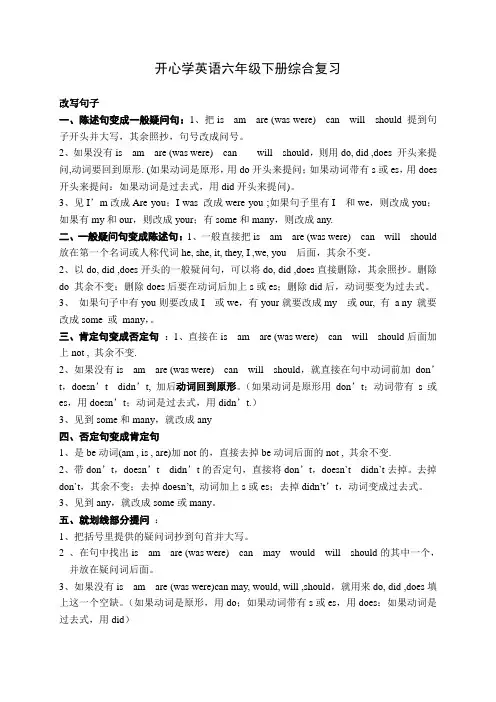
开心学英语六年级下册综合复习改写句子一、陈述句变成一般疑问句:1、把is am are (was were) can will should 提到句子开头并大写,其余照抄,句号改成问号。
2、如果没有is am are (was were) can will should,则用do, did ,does 开头来提问,动词要回到原形. (如果动词是原形,用do开头来提问;如果动词带有s或es,用does 开头来提问:如果动词是过去式,用did开头来提问)。
3、见I’m改成Are you;I was 改成were you ;如果句子里有I 和we,则改成you;如果有my和our,则改成your;有some和many,则改成any.二、一般疑问句变成陈述句:1、一般直接把is am are (was were) can will should 放在第一个名词或人称代词he, she, it, they, I ,we, you 后面,其余不变。
2、以do, did ,does开头的一般疑问句,可以将do, did ,does直接删除,其余照抄。
删除do 其余不变;删除does后要在动词后加上s或es;删除did后,动词要变为过去式。
3、如果句子中有you则要改成I 或we,有your就要改成my 或our, 有a ny 就要改成some 或many,。
三、肯定句变成否定句:1、直接在is am are (was were) can will should后面加上not , 其余不变.2、如果没有is am are (was were) can will should,就直接在句中动词前加don’t,doesn’t didn’t, 加后动词回到原形。
(如果动词是原形用don’t;动词带有s或es,用doesn’t;动词是过去式,用didn’t.)3、见到some和many,就改成any四、否定句变成肯定句1、是be动词(am , is , are)加not的,直接去掉be动词后面的not , 其余不变.2、带don’t,doesn’t didn’t的否定句,直接将don’t,doesn`t didn`t去掉。
开心学英语六年级知识整理
广东版开心学英语六年级第一学期知识总汇一、动词过去式①规则的:⑴直接在词尾加ed:如:plant-planted watch--watched wash--washed cook---cooked listen--listened help---helpedpaint-painted play---played visit---visited walk--walked clean---cleaned stay---stayed talk--talked⑵直接在词尾加d:如:like—liked live—lived use—used move—moved close—closed dance--danced⑶把y改i , 再加ed:如:carry---carried study---studied⑷双写最后一个字母,再加ed 如:stop—stopped trip—tripped drop--dropped shop-shopped②不规则的:如: am\is ---was isn’t---wasn’t are ---were aren’t---weren’t do\does--- did don’t\doesn’t--- didn’t come ---came(来)ride ---rode(骑)write ---wrote(写)take ---took(拿)tell---told(告诉)forget---forgot(忘记) get ---got(得到)make --- made (做)eat --- ate(吃)drink--- drank(喝)sing--- sang(唱)feel-- -felt(觉得)see --- saw(看见)sit--- sat(坐)buy--- bought(买)say --- said(说)go ---went(去)have\has--- had(有)dig ---dug(挖)meet ---met(会面)swim---swam(游泳) buy ---bought(买)run---ran(跑) fly---flew(飞)teach---taught(教)③过去式与原形不变的:如:put---put(放)read---read(阅读)hurt---hurt(受伤)④Be动词现在式:am\ is\ are am\is----was (单数)过去式was\were are---were(复数)二、时间:过去式现在进行将来时\-------------------\-------------------\yesterday now tomorrow过去:last(week)上个(星期) , yesterday昨天, the day before yesterday前天this morning 这个下午before之前 just now刚才then 那时(动词用过去式) I cooked last week . Did she cook yesterday ?现在:now现在\today(今天)(用am\is\are+动词ing形式) I am cooking now . What are you doing now ?将来:today今天, tomorrow 明天, next(week) 下个(星期), the day after tomorrow后天,tonight今晚, later 稍后(用am\is\are+going to+ 动词原形或 will+ 动词原形)I am going to cook tomorrow . I will cook tomorrow .一般现在式:频率副词:every(day)每(天) , usually 通常, always总是,often 经常,sometimes,never,I cook every day . \ She cooks every day .三、可数名词的复数形式:①把y改i,再加es 如:strawberry---strawberries cherry---cherries dictionary---dictionarieshobby---hobbies body—bodies diary—diaries butterfly—butterflies ②以o,x,s,sh,ch, 结尾的在词尾加es如: peach---peaches box---box es glass---glasses bus---buses watch---watches③一般的直接在词尾加s 如:paper clip---paper clip s tree--trees④不规则的:如: sheep---sheep knife---knives wolf--wolves leaf--leaves this---these that---those foot---feet tooth---teeth child---children photo---photos people---people㈡动词现在分词(ing):(分词前面一定有be动词(am\is\are\was\were)①在词尾直接加ing如:think--- think ing 思考talk --- talking 谈话work --- work ing 工作do ---do ing 做go--- go ing 去 help---helping帮助wash --- wash ing 洗play---play ing 玩\打read --- read ing阅读②去掉e,再加ing如:move---moving have--having ice skate---ice skating take--taking ride--riding make--making③双写最的一个字母,再加ing如:put---putting dig---digging sit---sitting stop---stopping cut---cutting hop-hopping swim---swimming run---running shop---shopping jog---jogging get--getting用法:⑴I can help her\him\us\you\me\them . I play with her\him\us\you\me\them .This bedroom is for her\him\us\you\me\them .⑵The book is mine . It’s my book . This is our classroom . The classroom is ours .②在should, can, will, to, do\does, don’t\doesn’t, did\didn’t, Let’s, Please, help,make 这些词后面的动词要用动词原形。
gogo版开心学英语(三到六年级)全部单词
《启心教英语》单词汇复习之阳早格格创做第一册Unit 1hello您佳 hi您佳 goodbye再睹 bye再睹 apple苹果 banana 香蕉 cat猫 ant蚂蚁 bear熊 carrot胡萝卜Unit 2table桌子 desk书籍桌 chair椅子 book书籍原 pencil铅笔eraser橡皮揩dog狗 elephant大象 fish鱼 duck鸭子egg鸡蛋fox狐狸Unit 3fly飞 read阅读 sing唱歌 draw画画 swim游泳 cook烹调goat山羊 hippo河马 girl女孩hat帽子 insect昆虫 ink朱火Unit 5family家庭 mother母亲 father女亲 sister姐妹 brother兄弟friend伙伴 juice果汁 lion狮子 kite风筝 lemon柠檬jam 果酱Unit 6teacher西席 student教死 parent女亲或者母亲 baby婴女 boy 男孩 monkey猴子 noodles里条 melon苦瓜 nose鼻子 orange 桔子Unit 7whale鲸 polar bear北极熊 queen女王 rabbit兔子 piano钢琴 question问题 rice米饭Unit 9red红色 yellow黄色blue蓝色green绿色orange橙色purple紫色 sun太阳 tiger老虎 soccer足球 TV电视 unhappy快乐的Unit 10balloon气球 candle蜡烛 present礼物cookie小苦饼plate碟子cup杯子 violin小提琴 watch脚表 volleyball排球exercise训练、锻炼Unit 11cake蛋糕cheese奶酪 ice cream雪糕 bread里包 salad色推soda汽火 yo-yo溜溜球 zebra斑马 yogurt酸奶 zoo动物园第两册:Unit 1notebook条记原 snake蛇 soup汤 pink粉红色pencil case笔盒butterfly蝴蝶steak牛排 gray灰色 this那 that那 these那些those那些 mother母亲 father 女亲Unit 2happy下兴的 heavy沉的 hot热的 big大的 sad快乐的 light沉的 cold热的 small小的 thin薄的 bathroom浴室 thumb脚指 thick薄的 math数教 thanks开开Unit 3soccer足球 baseball棒球 badminton羽毛球 tennis网球basketball篮球 dodge ball躲躲球volleyball排球ping-pong乒乓球 play玩 game游戏 rain雨 airplane飞机Unit 5bed床 pillow枕头 window窗户 clock 钟 mirror镜子 blanket 毛毯 door门 lamp灯 black乌色的 white红色 brown棕色shirt衬衫 shoe鞋子 shorts短裤 shark鲨鱼 sheep绵羊Unit 6strawberry草莓pear梨子 peach桃子grape葡萄 cherry樱桃orange桔子 mango芒果 pineapple菠萝 watermelon西瓜plum李子 bus公同汽车Unit 7in正在、、、内里 on正在、、、上头 sock袜子 skirt裙子under正在、、、底下 between正在、、、之间 pants裤子jacket中套 foot足 push推 look瞅 wood木头 pull推Unit 9one一 two 两 three三 four四 five五 six六 seven七 eight八 nine九 ten十 eleven十一 twelve十两o’clock面钟 ride 骑 bike自止车 light光Unit 10thirteen十三 fourteen十四 fifteen十五 sixteen十六seventeen十七 eighteen十八 nineteen十九 twenty两十glove脚套 above正在、、、之上 dove鸽子 wave海浪Unit 11fork叉 spoon汤匙 knife小刀 chopsticks筷子 napkin餐巾glass玻璃杯 tissue纸巾 bowl碗 cap帽子 map天图 rope 绳子 ship船 sleep睡眠 soap肥黑第三册Unit 1hungry 饥饥的 thirsty渴的 short矮的、短的 tall下的、少的grandfather爷爷、公公 grandmother奶奶、婆婆 ruler曲尺stapler 订书籍机 bird 鸟 big大的 friend伙伴 fly飞 jet喷气式飞机Unit 2Sunday星期日 Tuesday星期两 Thursday星期四 Saturday 星期六 Monday星期一 Wednesday 星期三 Friday星期五week星期 today即日 play 玩violin小提琴 ball球 mom妈妈 birthday死日Happy birthday 死日快乐Unit 3go去 have有 buy买 call挨电话 use 使用 borrow借watch瞅 listen 听 ice cream cone蛋卷雪糕 balloon 气球like喜欢 come back回去 Sure天然了 Thank you. 开开You’Unit 5English英语 music音乐 art好术 math 数教 science 科教history 履历 P.E.体育 subject 科目 and战Unit 6computer game电子游戏 puzzle 拼图游戏 skateboard 滑板toy car玩具汽车 doll 玩具娃娃stuffed animal 布制的动物玩具drum饱 guitar凶他 want 要Unit 7closet衣柜 glasses眼镜 know 知讲 behind正在、、、后里floor天板 sofa沙收 bookcase书籍架 wallet钱包 next to 紧挨着 in front of 正在、、、前里Unit 9play 玩 shop买物品 study教习 paint画画 eat吃 run跑步sleep睡眠 write写 read读 swim游泳 fish鱼Unit 10eye眼睛 ear耳朵 nose鼻子 mouth嘴巴 hand脚arm脚臂leg腿 feet足 touch摸 open挨启 close关关 body身体head头 dance跳舞 Look out!留神Unit 11my尔的 mine尔的 your您的/您们的 yours您的/您们的his他的 her她的 hers她的 our咱们的 ours咱们的 their他们的theirs他们的 boat 小船 car汽车 bag 书籍包 doughnut油炸里圈饼第四册Unit 1shoulder肩膀 teeth牙 knee膝盖 finger脚指 toe足趾 wave 摆荡 put搁、晃 move移动 sit 坐 rabbit兔子 draw画图dance跳舞 desk书籍桌 now当前Unit 2exercise锻炼、训练 work处事 shout喊喊 think念 practice 训练 talk道话 cut切割 color涂颜色thump沉打声 dad 爸爸Unit 3sweep the floor浑扫天板 clean the windows揩窗户do the dishes 洗碗碟 make the bed铺床fold the clothes合叠衣服 water the plants给动物浇火dust the furniture取消家具上的灰尘wash the clothes洗衣服busy 闲碌的 cook煮食 breakfast 早餐 wait 期待Unit 5movie theater影戏院 swimming pool游泳池 hospital医院bank银止 shopping mall买物核心 restaurant餐馆 park公园beach海滩 bus公同汽车Unit 6get up起床 get dressed脱衣服 brush (my) teeth刷牙go to school上教 get home回到家do (my) homework搞功课eat dinner用饭 go to bed睡眠 lake湖 tomorrow 来日诰日wake up 醉去 go to sleep睡眠 twenty—one两十一 thirty三十 forty四十 fifty五十 sixty六十Unit 7play video games玩电子游戏 listen to music听音乐 watch TV瞅电视 visit (my) friend探视(尔的)伙伴 ride (my) scooter滑(尔的)滑板 play cards玩扑克make models创制模型 read comic books瞅漫画书籍hobby业余快乐喜爱 ice skate滑冰Unit 9pajama(s)睡衣裤 slipper(s)拖鞋 underwear内衣裤 towel毛巾key钥匙 money钱 handkerchief脚帕 swimsuit游泳衣裤 red 红色 blue蓝色 yellow黄色 green绿色 socks袜子 pants裤子 skirt裙子 jacket中套 shirt衬衫 pen钢笔Unit 10go to the park到公园去see the movie瞅影戏play outside正在表里玩 go home回家 take a walk集步 take a nap午睡do a puzzle玩才华游戏 surf the Internet上互联网 bored感触厌烦的 make制制snowman雪人 wing翅膀 body身体head头Unit 11taxi driver出租车司机 fire fighter消防队员police officer警察office worker办公室处事人员secretary秘书籍 doctor医死nurse护士 teacher西席 magician把戏师第五册Unit 1farmer 农夫 factory worker 工人 aunt 姑妈;婶婶;姨妈;舅妈uncle 伯伯;叔叔;姑女;cousin 堂兄弟(或者堂姐妹)calendar日历dictionary字典 diary日记 fly 飞 island岛屿with 战(所有)Come with me! 跟尔去! badminton 羽毛球Unit 2staple拆订书籍针 scissors剪刀 stamp邮票envelope疑启paper clip纸夹,回形针paper纸tape揭胶戴 glue 胶火any一些(用于可定句战疑问句)but然而是 some 一些(用于肯定句)rubber band 橡皮圈something 某些物品 fix 建理 hangglider 滑翔翼 Hurray! 佳哇!Unit 3juice果汁 rice米饭salt盐sugar糖meat肉;肉类 vegetable 蔬菜tofu 豆腐 fruit 火果 need 需要Me,too! 尔也是! cook煮饭;煮食 and战 food食物Here! 那里! Come on.去吧.Wow !哇!(表示惊讶) Cool!表示惊讶Unit 5spring秋天 summer夏天 fall秋天 winter冬天 sunny阴朗的rainy下雨的 windy有风的 cloudy多云的 hot热的 look at 瞅 flower花朵 leaves树叶(leaf的复数形式)cold 热的 weather 天气Unit 6January 一月 February 两月 March三月 April四月 May 五月June六月 before 正在……之前 after 正在……之后 when 什么时间winter holiday 热假 go ice-skating 去滑冰 now当前 beach 海滩Unit 7July 七月 August 八月 September 九月 October 十月 November 十一月December 十两月1st 一号 2nd 两号 3rd 三号 4th 四号 20th 两十号 21st两十一号 22nd 两十两号 23rd两十三号 30th三十号 31st三十一号 birthday 死日 date 日期party 早会 grandma 奶奶,婆婆Unit 9warm 温战的 cool 凉爽的 wet 干润的 dry 搞燥的 clean 搞净的 dirty 邋遢的 tidy 整净的 messy 凌治的bedroom 卧室 wasam,is的往日时形式were are的往日时形式 nice 佳瞅的;漂明的 garbage 垃圾there 正在(到)何处 here 正在(到)那里 yesterday 今天Unit 10plant培植help 助闲 paint 画画 call 挨电话did do的往日时形式 study 教习 tree 树 Tree Planting Day 植树节 last 上一个,刚刚往日的 year年 What? 怎么啦?Unit 11useacomputer使用电脑 practice the piano 训练弹钢琴jump 跳跃 cleanthewindows 揩窗 last night 昨早the day before yesterday 前天 ofcourse 天然parade 游止 trumpet 小号第六册Unit 1good 佳的 bad 坏的 tasty好味的;好味的yucky 易吃的;味讲很短佳的 snowy下雪的 spicy 辣的Canada 加拿大 Thailand 泰国 food食物 Here comes......去了circus马戏团 from自……come from从……去many 许多 place 场合 week星期 month月份Unit2went去(go的往日时形式) made搞(make的往日时形式) ate 吃(eat的往日时形式) drink喝;饮喝;drank饮(drink的往日时形式) read 读(read的往日时形式) wrote写(write的往日时形式) rode骑(ride的往日时形式) sang唱(sing的往日时形式) What a...! 如许……啊! beautiful优好的 desert沙漠 feel感触 sick没有适的;抱病的 rest戚息 chocolate巧克力 chicken鸡肉water 火anything所有实物;所有物品 bottle 瓶子 genie妖怪Unit 3saw 瞅睹(see的往日时形式) blow 吹;刮blew 吹;刮(blow的往日时形式) fall 倒塌fell 倒塌(fall的往日时形式 sat 坐(sit的往日时形式)break 挨破broke 挨破(break的往日时形式)swept 扫(sweep的往日时形式) took 拿(take的往日时形式) came 去(come的往日时形式) mess纷治;纯治typhoon台风 happen爆收 wind风 blow away吹走 hat 帽子 in theair正在空中 boat 船 coat 大衣,中套 said (say的往日时形式)Unit5take a test搞小考验 goon vacation去度假 get a haircut 理收see the doctor去瞅医死shop for clothes买衣服 have a party举止散会write letters写疑 meet some friends取伙伴会里bored感触厌烦的 ask提问 question问题Unit 6have a picnic 去家餐 visit relatives探访亲戚 help dad助闲爸爸take some photos拍照 play with friends战伙伴玩 surfthe net上钩read some books瞅书籍 vacation假期 next 下一个fruit 火果 the GreatWall Of China 华夏少乡 do tai chi挨太极拳Unit7headache头痛 toothache牙痛 co1d感冒fever 收烧stomachache 肚子痛;胃痛 take some medicine 服药see the dentist 去瞅牙医 stay in bed躺正在床上 should该当hurt受伤; 伤害 be careful 留神 next time下一次well 火井 them 他们 worry担心 Don't worry. 别担心easy简单的Unit9tomorrow 来日诰日the day after tomorrow 后天afternoon下午evening 夜早snow雪rain 雨Welcome to …欢迎去weather office 局里台tell 报告 about 关于very非常 stop停止dinner早饭 only只;只是Unit 10apartment公寓kitchen厨房 living room客厅dining room 餐厅bedroom卧室garden花园balcony阳台 bathroom浴室 new新的 kid孩子fine佳的everyone每部分nice佳瞅的roller coaster 环滑车Unit11turn on(the light) 启(灯) turn off(the TV) 关(电视) putaway(yourbooks) 支拾佳(您的书籍)trash 垃圾takeout(your notebook)拿出(您的条记原) put on(your coat) 脱上(您的中衣)in a minute过一会女hang up(your clothes)挂起(您的衣服) later稍后cleanup(theroom)挨扫支拾(房间) busy闲的。
(完整版)英语语法学习资料
英语语法学习资料(完整版)第一讲名词⏹1.1名词的分类⏹名词可以分为专有名词(Proper Nouns)和普通名词 (Common Nouns),专有名词是某个(些)人,地方,机构等专有的名称,如Beijing,China等。
普通名词是一类人或东西或是一个抽象概念的名词,如:book,sadness等。
普通名词又可分为下面四类:1)个体名词(Individual Nouns):表示某类人或东西中的个体,如:gun。
2)集体名词(Collective Nouns):表示若干个个体组成的集合体,如:family。
3)物质名词(Material Nouns):表示无法分为个体的实物,如:air。
4)抽象名词(Abstract Nouns):表示动作、状态、品质、感情等抽象概念,如:work。
个体名词和集体名词可以用数目来计算,称为可数名词(Countable Nouns),物质名词和抽象名词一般无法用数目计算,称为不可数名词(Uncountable Nouns)。
归纳表格如下⏹ | |专有名词 | || 名 | | 个体名词 | || | |------------| 可数名词|| | | 集体名词 | || |普通名词 | | || 词 | | 物质名词 | || | |------------| 不可数名词|| | | 抽象名词 | |⏹) 以y 1结尾的专有名词,或元音字母+y 结尾的名词变复数时,直接加s变复数:如:two Marys the Henrysmonkey---monkeys holiday---holidays比较:层楼:storey ---storeys story---stories2) 以o 结尾的名词,变复数时:a. 加s,如: photo---photos piano---pianosradio---radios zoo---zoos;b. 加es,如:potato--potatoes tomato--tomatoesc. 均可,如:zero---zeros / zeroes3) 以f或fe 结尾的名词变复数时:a. 加s,如: belief---beliefs roof---roofssafe---safes gulf---gulfs;b. 去f,fe 加ves,如:half---halvesknife---knives leaf---leaves wolf---wolveswife---wives life---lives thief---thieves;c. 均可,如:handkerchief:handkerchiefs / handkerchieves名词复数的不规则变化1)child---children foot---feet tooth---teethmouse---mice man---men woman---women注意:与 man 和 woman构成的合成词,其复数形式也是 -men 和-women。
开心学英语四年级语法知识整理
广东版开心学英语四年级语法知识整理一、动词变形:1、什么时候该加ing?⑴be 动词(is am are)后;⑵like/go 后。
2、动词ing怎么加?⑴动词倒数第二的字母是辅音,最后一个字母是e时,要去掉e再加ing。
如: dance---dancing跳舞write---writing写have---having有skate---skating溜冰 exercise---exercising锻炼,练习 make---making制作practice---practicing练习 ice-skate - ice-skating ride-riding dance-dancing ⑵两个辅音字母夹着一个元音字母时,要双写最后一个字母,再加ing。
例如:swim---swi mming run---ru nning shop---sho pping sit---sit ting cut---cu tting get—getting jog---jog ging put---pu tting(放)stop---sto pping(停止)注意:但若第二个音节重读时,则不用。
⑶其他情况直接加ing。
如:do ---doing 做go--- going 去study---studying学习paint---painting 绘画eat---eating 吃sleep---sleeping 睡觉fish---fishing 钓鱼fly---flying 飞sing---singing 唱draw---drawing 画画 wash --- washing 洗play --- playing 玩watch --- watching观看sweep—sweeping扫地、打扫clean---cleaning清洁/擦fold---folding折叠work---working工作talk---talking谈话help---helping帮助think---thinking思考、想shout---shouting叫喊wait---waiting等候read --- reading阅读 listen --- listening听cook---cooking烹调(煮)color--- coloring 涂颜色dust---dusting除尘dry---drying弄干3、什么时候该用动词原形?⑴情态动词(can,can't,may,may not,do,does,don't,doesn't)后面。