
人教版新目标八年级英语上册复习课件
4. milk, junk food, health, unhealthy, habit
本单元的重点句型: 1. What does she usually do on weekends? 2. How often do you exercise ?
Unit2 Talk about your health and give advice.本单元要求学生学会 询问病情(What’s the matter?)和述说病痛(I have a ---)或不适 (I am tired----),掌握身体各部位的名称,并根据不同的情况提出建 议(You should / shouldn’t----)。 同学们需要掌握以下词汇: 1.head, nose, eye, ear, mouch, tooth, neck, stomach, back, leg, arm, hand, foot 2.tired, hungry, thirsty, stressed out 3.cold, fever, headache, toothache, stomachache, sore throat 本单元的重点句型: 1. What’s the matter? 2. I have a headache / toothache / sore throat---/she is tired 3. You should drink some tea / go to bed--You shouldn’t go to the party--4. That’s too bad. I hope you feel better soon.
How does he get to school? He takes the subway to get to school.
He gets to school by subway.
I take the plane to get to school. I fly to school.
I get to school by plane.
Unit6
Talk about personal traits.使用形容词的比较等级来描述个人
的性特征。形容词比较级的构成和比较级的用法是本单元的重点。 同学们需要掌握的词汇有: 1.taller, shorter, thinner, longer, calmer, wilder, quieter, funnier, heavier, more intellectual, athletic, popular 2.same, different 3.hair, curly hair, serious, outgoing 同学们需要掌握的句型有:
I walk to school. I get/go to school on foot.
I ride my bike to school. I get/go to school by bike. I get to school on my bike. I take the plane to school. I fly to school. I get to school by plane./ by air I get to school on the plane.
She is taking the train. How does she get to school?
She takes the train to school.
She gets to school by train.
What’s he doing?
He is taking the subway.
我可以骑你的自行车去吗?
Let’s go for a ride in a car this afternoon.
I get tdoing?
They are taking the ship.
How do they get to school? They take the ship to get to school.
They get to school by ship.
介词短语around the world是students的定语,介词短语
作定语总是放在所修饰词之后,“教室的学生”不能译成:
in the classroom students,而是the students in the classroom, 此句是用how引导的特殊疑问句,询问乘坐怎样的交通 工具是本单元的重点句型。
3. bus ride在此意为:乘车。ride作名词,意为:乘坐。
ride除了可用于骑自行车,骑马,也常用于乘坐汽车。
如:Do you want me to give you a ride home?
要我开车送你回家吗?
An hour’s ride in the bus will take you to your destination. 搭乘公共汽车一个小时便能到达目的地。 Can I have(take) a ride on your bike?
1. What is he like?
2. Is that Sam? No, that isn’t Sam. 3. He has shorter hair than Sam. 4. He is calmer than Sam.
unit4
What’s he doing?
He is riding his bike.
Unit3 Talk about future plans.本单元主要是谈论将来的计划。如: 你假期将做些什么?本单元要求同学们学会现在进行时表将来的 用法,这是现在进行时除了可以表达此时此刻正在发生的动作外 的另一新用法。 同学们需要掌握的词汇有: 1.relax, visit, spend, babysit 2.bike riding, sightseeing, fishing 3.taking walks, renting videos 本单元的重点句型有: 1. What are you doing for vacation? 2. When are you going? I’m going next week. 3. How long are you staying? We’re staying for two weeks. 4 Where are they going?
How does he get to school? He rides his bike to school.
He gets to school by bike.
What’s he doing?
He is taking the bus.
How does he get to school? He takes the bus to school.
Unit4 Talk about how to get to places.本单元的主要话题是谈论去某 地的交通方式。要求同学们学会用动词walk, take a bus, ride a bike---或介词短语by bus, on a bike,by train---来表达交通方式及 距离的长短的表达法和路程所需时间的表达法。 本单元必须掌握的词汇有: 1. bicycle, subway, car, bus, train 2. bus stop, train station, bus station, subway station 3. ride, walk 4. minute, kilometer, mile 本单元必须掌握的句型有: 1. How do you come to school? I take the bus. / I come on the bus(by bus). 2. How long does it take? It takes 20 minutes. 3. How far is it? It is ten miles.
I take the train to school.
I get to school by train.
I get to school on the train I take the car to school./ I drive to school. I get to school by car. I get to school on the car. I take the bus to school. /I drive to school. I get to school by bus。 I get to school on the bus。
He gets to school by bus.
What’s she doing?
She is walking. How does she get to school? She walks to school. She gets to school on foot.
What’s she doing?
take a bus/ take a catch get on a bus 上车 get off a bus 下车
drive to 驾车去 … fly to 飞到… walk to 步行到…
How do students around the world get to school?
世界各地的学生们是怎样去学校的?
I take the subway to school. I get to school by subway. I get to school on the subway.
take (乘坐 ) + 交通工具 to … =go to … by 交通工具
by +交通工具(原型)=== take a on a/the 交通公具 交通工具
Unit5 Make, accept and decline invitaions. Talk about obligation. 学会用can发出邀请,接受邀请和拒绝邀请是本单元的主要话题。 同时,本单元的另两个重点是学会用have to表达“不得不”,和复 习用现在进行时(be doing)表将来的用法。 本单元同学们需要掌握的词汇有: 1.study, help, play, visit, test, piano, lessons, party, mall 2.Monday, Tuesday, Wednesday, Thursday, Friday, Saturday, the day after tomorrow, next week, tomorrow 3.brother, sister, doctor, mom, aunt 4.have 本单元同学们需要掌握的句型有: 1. Can you come to my birthday party?/Yes, I can/I can’t 2. Yes, I’d love to. /thank you for your invitation. 3. Sorry, I can’t. I have to study for a test. 4. I’m sorry. I’m playing soccer on Saturday. 5. When is the party? It’s at seven-thirty. 6. I have to go to the dentist.
合集下载
人教版八年级上册英语复习课件

• 5. Mom wants me to get up at 6:00 and play ping-pong with her . • want to do sth. 意思是“想要做某事”; • want sb. to do sth.意思是“想要某人做某事”。 如: • Do you want to go to the movies with me? • 你想和我一起去看电影吗? • The teacher doesn't want us to eat hamburgers. • 老师不想让我们吃汉堡包。 • 6. She says it’s good for my health. • be good for...表示“对……有益(有好处)”;其 反义为:be bad for...。(这里for 是介词,后 跟名词、代词或动词ing) • 如:It's good for us to do more reading. 多读书 对我们有好处。
• 2. “What do you usually do on weekends?” “ I usually play soccer.” • “周末你通常做什么?”“我通常踢足球。” • 第一个do为助动词, 在这起帮助构成疑问的作用;而 第二个do则是实义动词。 • 翻译: What do you usually do on weekends? I often go to the movies. • What does she usually do on weekends? She sometimes go hiking.
• 13. Is her lifestyle the same as yours or different? • =Is her lifestyle the same as your lifestyle or is her lifestyle different from yours? be the same as … / be different from … • 14. What sports do you play ? • 15. A lot of vegetables help you to keep in good health . • keep in good health = keep healthy = stay healthy • 16. You must try to eat less meat . • try to do sth.表示“ 尽力做某事 ” ,不包含是否成功的意思,less是 little的比较级
人教版新目标英语八年级上册《Unit 2 How often do you exercise》课件
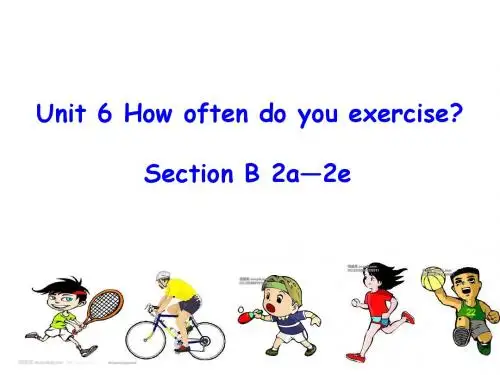
Last month we asked students about free time activities.
20% 1-3 times a week
no exercise
Topic(主题)
10% 3-4 times 3-4 times aa week week
15% every day
every day
Para 4
Para 5
Conclusion(结论)
Para 2
Last month we asked students about free time activities.
15 %
every day
every day
20 % 1-3 times 1-3 a week times a
week
20 % never
Para 4
Para 5
Conclusion(结论)
Para 5
no exercise every day
Last month we asked students about free time activities.
3-4 times a week
4-6 times a week
1-3 times a week
every day 90% every day
every day
Use the Internet
Watch TV
The best way to relax is through exercise. “old habits die Conclusion(结论) hard”. So start exercising before it’s too late.
Today I asked Class 4 students about reading books after class. Here are the results.
20% 1-3 times a week
no exercise
Topic(主题)
10% 3-4 times 3-4 times aa week week
15% every day
every day
Para 4
Para 5
Conclusion(结论)
Para 2
Last month we asked students about free time activities.
15 %
every day
every day
20 % 1-3 times 1-3 a week times a
week
20 % never
Para 4
Para 5
Conclusion(结论)
Para 5
no exercise every day
Last month we asked students about free time activities.
3-4 times a week
4-6 times a week
1-3 times a week
every day 90% every day
every day
Use the Internet
Watch TV
The best way to relax is through exercise. “old habits die Conclusion(结论) hard”. So start exercising before it’s too late.
Today I asked Class 4 students about reading books after class. Here are the results.
初中人教版新目标英语八年级上册精品课件Unit3 Section B2 39页PPT文档
9. leave (left) 离开; 遗留 He left Beijing three days ago. 三天前,他离开了北京。
A: What are you doing this weekend? B: Well, I’m going shopping on
Saturday ….
Notes
1. something different 不同的事情 形容词修饰不定代词时放在不定代词 后面。如:something important 2. plan n. make plans
Words preview
famous 著名的;出名的 take a vacation 去度假
Greece 希腊 Spain 西班牙
Europe 欧洲 something 某物;某事
lake 湖;湖泊
Words preview
leave 离开;出发 countryside 农村;乡村
nature 大自然;自然界 forget 忘记
spend 以人做主语
花费 take 以 it 做形式主语
cost
以物做主语
It takes me twenty minutes to walk to
school.
The video costs me ten yuan.
5. can’t wait to do sth. 迫不及待地做某事
He can’t wait to eat the delicious food. 6. finish + v-ing He finished drawing a horse an hour
Because Canada is beautiful, and there are many people who speak French.
Units 1---5 复习( 课件)-2024-2025学年人教版英语八年级

八年级上册英语人教版
Review the words of unit 1
任务一:我指你说
anyone
everyone someone bird
umbrella
anywhere of course diary
bicycle wet
wonderful myself enjoyable building because of
戏院;剧场 (n.) 使人舒服的;舒适的 (adj.) 座位;坐处(如椅子等) (n.) 银幕;屏幕 (n.) (在空间、时间上)接近 (adj.) 票;入场券 (n.)
worst 最差(的);最坏(的);最糟(的) (adj.& adv.) cheaply 便宜地;低廉地 (adv.)
song 歌;歌曲 (n.) choose 选择;挑选 (v.) carefully 细致地;小心地;谨慎地 (adv.) reporter 记者 (n.)
few
yourself activity trader
below
quite a few hen
decide
wonder enough
most
pig
try
difference hungry
something seem
paragliding top
as
noting
bored feel like wait
hill
review the grammar 一、一般过去时
一.概念:表示过去发生的动作,常与过去状语连用。 for example:yesterday, the day before yesterday,last week,three days ago,just now
Review the words of unit 1
任务一:我指你说
anyone
everyone someone bird
umbrella
anywhere of course diary
bicycle wet
wonderful myself enjoyable building because of
戏院;剧场 (n.) 使人舒服的;舒适的 (adj.) 座位;坐处(如椅子等) (n.) 银幕;屏幕 (n.) (在空间、时间上)接近 (adj.) 票;入场券 (n.)
worst 最差(的);最坏(的);最糟(的) (adj.& adv.) cheaply 便宜地;低廉地 (adv.)
song 歌;歌曲 (n.) choose 选择;挑选 (v.) carefully 细致地;小心地;谨慎地 (adv.) reporter 记者 (n.)
few
yourself activity trader
below
quite a few hen
decide
wonder enough
most
pig
try
difference hungry
something seem
paragliding top
as
noting
bored feel like wait
hill
review the grammar 一、一般过去时
一.概念:表示过去发生的动作,常与过去状语连用。 for example:yesterday, the day before yesterday,last week,three days ago,just now
新目标英语八年级上册复习课件(一)Units 1—3[八年级上册](共39张PPT)
](https://360docs-1393072327.cos.ap-beijing.myqcloud.com/eccca72edd36a32d73758187.webp)
由“My mother prefers to take a bus to her 解析 office”可知后半句译为“虽然她自己有一辆小汽车”,故 选C。
自学反馈
重点突破
第6课时┃ Units 1—3 [八年级上册]
巧 辨 异 同 ●1 hardly/hard 词条 hardly 词性 副词 副词 意义 几乎不;几乎没有 辛苦地;努力地;猛烈地
自学反馈 重点突破
第6课时┃ Units 1—3 [八年级上册] 类别 课标考点要求
quietly noisy 8. quiet→(副词) ________→( 反义词) ________ 9.compete→(名词)竞赛,比赛___________→( competition 名 competitor 词)竞争者,参赛者___________ carefully 10.care→(形容词) ________→( 副词) ________ careful →(形容词的反义词) ________ careless 词汇 拓展 11. little→(比较级) ________→( 比较级的反义词) less ________→( 最高级) ________→( 最高级的反义 more least 词) ________ most 12.say→(名词) ________→( 过去式) ________→ saying said says (第三人称单数) ________
hard
形容词 困难的(相当于difficult); 硬的;勤奋的;苛刻的
He always works hard, but he can hardly make money. 他总 是努力工作,但他几乎赚不到钱。
自学反馈 重点突破
第6课时┃ Units 1—3 [八年级上册]
新人教版八年级英语上册期末总复习课件

单词复习
famous著名的 well-known著名的 nature自然地 agree同意 normal一般的 unless除非不 certainly无疑的 serve服务 look after 照顾 invitation邀请
again再一次 angry发怒的 understanding善解人意的 careless粗心的 often多久 as far关于,至于 natural自然地 turn down拒绝 reply回复 forward发送
until直到 how often多久 how long 多长时间 how soon多久才... lendar日历 daytime白天 in half分成两半 halfway在中途 else别的,其他的
单词复习
how munch多少钱 how far多远 be good for对....好 be good at擅长...... be bad for 对.......有坏处 be good with 与....相处的好 wrong怎么了? halfway在中途 else别的,其他的
今日复习的重点
本单元的所有单词、短语、语法、长难句、课文
grow成长 meeting遇见 pollute污染 prepare准备 prepare for准备 two两个 twice两次 one一个 once一次 health健康 healthy健康的
单词复习
upset沮丧的 different不同的 unhealthy不健康的 difference差异 foot脚 feet脚步 advice建议,劝告 another其他的 happen发生 expect 期待
单词复习
mistake错误 week一周 a lot of 大量 be good for 对什么好 stress压力 get back返回 careful小心的 careless粗心的 advice建议 solve步骤 during在........期间
(人教版新目标)八年级英语上册全册各单元知识点期末总复习讲解教学课件
2. nothing to dobut do sth“除......之外; 只有” I have nothing to do but watch TV all day long. 我 整天除了看电视什么也没干。
3. feel like “感受到;摸起来”,后跟宾语 从句或名词。 I felt like I was a bird. 我感觉我是一只鸟。 It feels like a stone. 它摸起来像一块石头。
eg.something special; somewhere wonderful. 2.不定代词做主语时,谓语动词用第三人称单数。 eg.Is everybody here? 大家都到齐了吗?
1. get to/reach/arrive 都是“到达“的意思。
get to+sp=reach+sp = arrive at+sp(小)=arrive in+sp(大) 若他们后面要加地点副词here, there, home等,则 不需要加介词。
25、up and down上上下下 26、come up出来 27、enjoy oneself=have fun=have a good time
玩的开心
二、重要句子(语法):
1.Where did you go on vacation? 你到哪里去度假了?
I went to New York City. 我去了纽约城。
三、习惯用法、搭配
1. buy sth. for ab./ buy sb. sth. 为某人买某物 2. taste + adj. 尝起来…… 3. nothing to do but do除了……之外无事可干 4. seem + (to be) + adj 看起来 5. arrive in + 大地方 / arrive at + 小地方 到达某地 6. decide to do sth=make a decision决定做某事 7. try doing sth. 尝试做某事
3. feel like “感受到;摸起来”,后跟宾语 从句或名词。 I felt like I was a bird. 我感觉我是一只鸟。 It feels like a stone. 它摸起来像一块石头。
eg.something special; somewhere wonderful. 2.不定代词做主语时,谓语动词用第三人称单数。 eg.Is everybody here? 大家都到齐了吗?
1. get to/reach/arrive 都是“到达“的意思。
get to+sp=reach+sp = arrive at+sp(小)=arrive in+sp(大) 若他们后面要加地点副词here, there, home等,则 不需要加介词。
25、up and down上上下下 26、come up出来 27、enjoy oneself=have fun=have a good time
玩的开心
二、重要句子(语法):
1.Where did you go on vacation? 你到哪里去度假了?
I went to New York City. 我去了纽约城。
三、习惯用法、搭配
1. buy sth. for ab./ buy sb. sth. 为某人买某物 2. taste + adj. 尝起来…… 3. nothing to do but do除了……之外无事可干 4. seem + (to be) + adj 看起来 5. arrive in + 大地方 / arrive at + 小地方 到达某地 6. decide to do sth=make a decision决定做某事 7. try doing sth. 尝试做某事
人教版英语新目标八年级上册复习ppt课件
• 3)这些不定代词做主语时,谓语动词用第三人 称单数。如:
• Is everybody here? 大家都到齐了吗?
• something,somebody,someone, somewhere用于肯定句及表示请求或建议的疑问 句中,而anything,anybody,anyone, anywhere用于否定句及疑问句中。如:
Unit 1 ┃ 易错点针对训练
┃易错点针对训练┃
( A )1. There are ________ people on the bus.
C.too much
D.much too
( C )2. —Who cleaned the room yesterday? —Tom ________.
A. are
B. is C. 精选ppt be
D. wer9e
11.And because of the bad weather, we couldn’t
see anything below. 因为坏天气,我们也没能看到下面的任何景色
1)辨析:because of与because
a. because of介词短语,意为“因为,由于”,
A.I'm afraid not
B.I'm not sure
C.Of course
D.I hope so
( A )4. There are ________ bananas at home. Would you
like to buy some?
多少糖。
精选ppt
14
语法(1)
• decide to do sth.决定去做某事 • try doing sth.尝试做某事 / try to do sth.尽力去做某事 • forget doing sth.忘记做过某事/ forget to do sth.忘记做某事 • enjoy doing sth.喜欢做某事 dislike doing sth.不喜欢做某事 • want to do sth.想去做某事 start doing sth.开始做某事 • stop doing sth. 停止做某事 stop to do sth • keep doing sth.继续做某事 • Why not do. sth.?为什么不做……呢? • so+adj.+that+从句 如此……以至于…… • tell sb. (not) to do sth. 告诉某人(不要)做某事
人教版新目标八年级上册英语--教学ppt课件-Unit2-复习
8. make a difference _ _ _ _ __
9. go shopping 去购物_
10.have a party _ _ ___ 11. go to the movie _ __ _
12. once a week _ _ _ _ _ 13. hardly ever _很少__ 14. twice a week _ _ _ _
Unit 2
How often do you exercise?
Review
Review
I want to be healthy. It’ s good for my health.
Is Jane healthy? What about
Jane likesJitmo?watch TV. On weekends, she never exercises and she doesn’t like fruits or vegetables. She eats lots of junk food. And she never goes to see the doctor.
Exercises
1. how often _ _ _ __
2. as for__ _
_
3. junk food_ _ _ _ __
4. eating habit _ _ _ _ __
5. of course__ _ ___
6. look after _ _ _ ___
7. start with _ _ _ _ _
plays, watches
B.
play, watch
C. doesn’t play, watches
D. plays, doesn’t watch
9. go shopping 去购物_
10.have a party _ _ ___ 11. go to the movie _ __ _
12. once a week _ _ _ _ _ 13. hardly ever _很少__ 14. twice a week _ _ _ _
Unit 2
How often do you exercise?
Review
Review
I want to be healthy. It’ s good for my health.
Is Jane healthy? What about
Jane likesJitmo?watch TV. On weekends, she never exercises and she doesn’t like fruits or vegetables. She eats lots of junk food. And she never goes to see the doctor.
Exercises
1. how often _ _ _ __
2. as for__ _
_
3. junk food_ _ _ _ __
4. eating habit _ _ _ _ __
5. of course__ _ ___
6. look after _ _ _ ___
7. start with _ _ _ _ _
plays, watches
B.
play, watch
C. doesn’t play, watches
D. plays, doesn’t watch
最新人教版八年级英语上册复习课件全册
4. full 【归纳】 “忙的”,同义词为busy。 “满的”,反义词为empty (空的)。 “吃饱了的”,其反义词为hungry。
【运用】选出下列句子中full的含义。 A. 忙的 B. 满的 C. 吃饱了的 ( A ) (1) Her life was so full that she found no time for hobbies. ( C ) (2) No more for me, thanks — I’m full. ( B ) (3) Do you want a full cup of tea or half a cup?
3. start 【归纳】 v. “开始;着手”。 常用结构为start to do/ doing sth.,“开始做某事”。 【运用】完成句子,每空词数不限。 格蕾丝每天早上6点开始跑步。 starts to run/ running at 6 Grace ____________________ o’clcok every morning.
16. _________ junk food 垃圾食品 17. ___________ keep a diary 记日记 18. _____________ keep doing sth. 继续做某事 less than 少于 19. _________ look at the map 看地图 20. ______________ 21. __________ more than 多于 22. ______________ most of the time 大部分时间 23. _________ of course 当然;自然 24. __________ quite a few 相当多;不少 stay at home 待在家 25. ____________