
人教版七年级下册英语Unit7SectionA知识讲解
Unit 7 Will people have robots?Section A 知识讲解一.paper1. n. “纸,纸张”,U。
“一张纸”用a piece of paper,“两张纸”用two pieces of paper。
There is____________ paper on the table. 桌子上有一张纸。
2. paper n. “试卷”,C,有复数形式。
I lost _______________ paper. 我丢了一份历史试卷。
【例1】The teacher marked(批分数) the exam ______ and wrote the students' grades on a piece of ______.A.papers;paper B.paper;papers C.paper;paper D.papers;papers 二.提问“in+时间段”时用特殊疑问词how soon 或when。
—How soon/When will they return? 他们多久/什么时候返回?—In three weeks.三周后。
In,later和afterin 后接一段时间,不能接时间点,表示“一段时间后”,一般用于将来时。
I'll clean the blackboard in a moment.稍后我就擦黑板。
after 后接表示一段时间的词语时,用于过去时;接时间点时,可与将来时态连用。
He ______ to play soccer after an hour.一小时后他开始踢足球。
We______ go to school after 10:30.十点半后我们要去上学。
Later 副词"一段时间+later"短语,用于过去时;如果单独使用,可与将来时或过去时连用。
Nine months later they werediscovered.九个月之后,他们被发现了。
【例1】My father will be back from Shanghai ______ a week.A.for B.after C.in D.at【例2】—______ will everything be free?—In 100 years.A.How long B .How far C.How soon D.How often 【例3】用in和after,later填空1.My mother has gone to Hong Kong,she will be back a week.2.He went to his hometown three years.3.---How soon will the plane take off?--- about five minutes.4.---They will meet us in two hours.---That's to say, three o'clock?5.His father went to Beijing a week ago.Two days ,he went to Tianjin.6.Our work will be finished ______ an hour.7.Our work will be finished ______ 9:00.三.fewer,less和more【例1】We'll try our best to do the work with ______money and ______ people.A.few;little B.a few;a little C.less;fewer D.fewer;less【例2】根据汉语意思完成下句我想要更多水、更少的食物。
I would like ______ water and ______ food.四.Do you think there will be robots in people's homes?1.Do you think...? 结构通常用来征求对方的意见或看法,后面接宾语从句,从句用陈述语序。
其答语要去掉do you think,再答。
本句的肯定回答用"Yes,there will.",否定回答用"No,there won't."。
---Do you think there will be robots in school?你认为学校将来会有机器人吗?---Yes, there will. 是的,会有。
2. there will be是there be句型的一般将来时,意为"将有...",也可用there is\are going to be来表示。
拓展:there be 句型的时态变化时态句子结构一般现在时there is\are...一般过去时there was\were...一般将来时there will be...\there is\are going to be...注意:there be句型中不能用have\has表示"有...";there be 后面接并列名词时,谓语动词应与最近的名词在单复数上保持一致。
EX:1.---Do you think Tina will go to Hong Kong? -- .A.Yes,she does.B.No,I don't.C.Yes, she will.D.No,she doesn't.2.---Do you think there will be a football match on TV tonight.--- .A.Yes,I do.B.No,I will.C.Yes, there won't.D.No,there won't.3.There a sports meeting in our school next Monday.A.will haveB.is going to haveC.will beD.are going to be4.---Dale,there a dictionary and some books on your desk.Please put them away.---OK,mum.I'll do it right away.A.isB.areC.hasD.have补充练习:1. There ___ any rice in the bowl.A. areB. isC. isn’tD. aren’t2.There___ not ___ milk in the cup .A. are, manyB. are , muchC. is ,manyD. is ,much3.There ___ many apples on the tree last year. A. have been B. were C. are D. is4.Do you know if ___ a meeting next Sunday ?A. there was going to haveB. there was going to beC. is there going to beD. there will be5.-Is this the last exam we have to take ? -No, but there ____ another test three months later.A. will be going toB. isC. will beD. has been6. There isn't ____ paper in the box. Will you go and get some for me?A. anyB. someC. aD. an7.There _____ a film tomorrow evening.A.will have B.have C.is going to be D.Has8.There's going to ____ in tomorrow's newspapers.A. have something newB. have new somethingC. be something newD. be new something9.____ is there on the table?A. How many applesB. How much breadC. How much breadsD. How many food10.There is some milk in the bottle, ____ ?A.isn't there B.aren't there C.isn't it D.are there11.How many boys ____ there in Class one? A. be B. is C. are D. am12. ----There is no air or water on the moon. Is there? --- ____.A. Yes, there areB. No, there isn'tC. Yes, there isn'tD. No, there is13.----What did you see in the basket then ? --There ____ a bottle of orange and some oranges.A. isB. areC. wasD. were五.future n.将来;未来,常构成短语:1. in the future 在将来;在未来,指的是将来的某一时刻,不一定从现在开始。
Who can tell what will happen in the future? 谁能说得清将来会发生什么事?2. in future今后,指从现在开始的以后,相当于from now on。
We should study hard in future. 今后我们应该努力学习。
【例题】They are thinking about the life ______future.A.on the B.in the C.at the D.for the六.pollute v. 污染1. People shouldn't _________ water in the river. 人们不该污染河水。
人教版七年级英语下册第七单元知识点总结
人教版七年级英语下册第七单元知识点总结本文档旨在总结人教版七年级英语下册第七单元的知识点,并提供简洁清晰的概述。
一、语法知识点1. 动词be的用法:- be动词有三种形式:am, is, are,分别对应于第一人称单数、第三人称单数和其他所有人称。
- be动词在句中用来表示人或物的身份、特征、状态等。
2. 人称代词:- 人称代词用来代替特定的人物或事物。
- 人称代词分为主格和宾格两种形式,主格用于作主语,而宾格用于作宾语或介词后的宾语。
3. 形容词的比较级与最高级:- 比较级用来对两个事物进行比较,最高级则用来对多个事物进行比较。
- 形容词的比较级一般在词尾加-er,最高级在词尾加-est。
- 有些形容词的比较级和最高级形式不规则,需要特别记忆。
二、词汇知识点1. 家庭成员:- 爸爸:father- 妈妈:mother- 哥哥:brother- 姐姐:sister- 弟弟:younger brother- 妹妹:younger sister2. 学校设施:- 图书馆:library- 实验室:laboratory- 体育馆:gymnasium- 教室:classroom- 游泳池:swimming pool三、交际用语1. 问候与告别:- 问候:Hello! / How are you?- 回答:I'm fine, thank you. / Not very well.- 告别:Goodbye! / See you later.2. 自我介绍:- My name is [姓名]. I am [年龄] years old. I am from [国家/城市].3. 询问与回答:- 询问:What's your name? / How old are you?- 回答:My name is [姓名]. / I am [年龄] years old.以上为人教版七年级英语下册第七单元的主要知识点总结,希望对您的学习有所帮助。
人教版英语七年级下册Unit7 SectionA 教材知识详解
Unit7 SectionA 教材知识详解1. How’s the weather in Shanghai?上海的天气怎么样?How’s the weather in +地点?=What’s the weather like+地点?意为“天气怎么样?”其答语为“It’s+表示天气状况的形容词。
”如:How’s the weather in Jinan?=What’s the weather like in Jinan?济南的天气怎么样?weather作名词,意为“天气”,是不可数名词,不能与不定冠词a/an连用。
如:I like cold weather.我喜欢寒冷的天气。
2.Rick speaking.我是里克。
/It’s Steve.我是史蒂夫。
电话用语:①向外拨打电话:1. May/Could/Can I speak to…? 请……接电话好吗?2. Is that...(speaking)? 你是……吗?3. Who is (that) speaking?/ Who is that? 你是谁?②接听电话:This/It is...(speaking). 我是……3. —How’s it going?近来可好?—Not bad, thanks. 不错,谢谢。
(1) How’s it going?是询问对方近况或事情进展情况的习惯用语,意为“近况如何?事情进展的怎样?”,后面可跟介词短语with sb/sth,可与How is everything?互换。
其答语为:Terrible!(很糟糕)!/Not bad (还不错)/Pretty good(相当不错) /Great!(很好)!如:How’s it going with Tom’s study?最近汤姆的学习情况怎么样?(2) not bad 意为“不错;比预料的好”,也可以用not so bad, not too bad等表达。
常用来回答别人对于自己近况(How’s it going?)或身体健康情况(How are you?)的询问。
人教版英语七年级下册Unit7SectionA2d–3b说课稿
2.句型:It is + adj. today./How is the weather today?/What is the temperature today?等询问和描述天气的句型。
(2)通过听力练习,培养学生的听力理解能力。
(3)通过口语练习,提高学生1)培养学生关注天气变化,关心生活的态度。
(2)通过小组合作,培养学生团结协作、积极向上的精神风貌。
(3)培养学生热爱大自然,保护环境的意识。
(三)教学重难点
1.教学重点:
(1)词汇:cloudy, rainy, sunny, windy, snowy等表示天气的形容词;temperature, degree等与天气相关的名词。
3.语法:一般现在时态的运用。
(二)教学目标
1.知识与技能:
(1)学生能够听懂并运用本节课所学的词汇和句型描述天气情况。
(2)学生能够正确运用一般现在时态描述天气。
(3)学生能够通过本节课的学习,提高听力理解和口语表达能力。
2.过程与方法:
(1)通过小组讨论、角色扮演等方式,让学生在实践中运用所学知识。
五、板书设计与教学反思
(一)板书设计
我的板书设计注重布局合理、内容精炼、风格清晰。板书分为三个部分:标题、知识点和总结。标题部分明确标注本节课的主题;知识点部分按照词汇、句型和语法顺序呈现,每个知识点下方配以示例;总结部分归纳本节课的重点内容。板书在教学过程中的作用是提供视觉辅助,帮助学生理解和记忆。为确保板书清晰、简洁,我会提前规划板书内容,避免冗余,使用简洁明了的文字和图表,并在教学过程中适时更新板书内容,确保学生能够把握知识结构。
人教七年级下册英语Unit7 SectionA 课件(共68张PPT)

(It) Sounds like you had a good time on your trip.
听起来你旅行玩得蛮开心的。
The pizza _________ good. I’d like some
Could you just tell him to call me back? 你能否叫他给我回个电话?
以上两句话中的情态动词can 和could 相当于汉语中的“可以”、“能不能”, 用于表达请求,只是could 在语气上比 can 更加委婉、客气。
message n. 消息;信息
There is an important message for you from your brother.
5.2. —你在做什么I’?m_c_o_o_k_i_n_g_. _________
6. —我在做饭。______________
3. — 他们在做什么?
__W__h_a__t _a_r_e_t_h_e_y__d_o_i_n_g?
— 他们正在公园里打篮球。
They’_r_e__p_la__y_in_g__b_a_s_k__e_tb__a_ll_i_n__t_h_e_p__a_rk. 4. — 他在做什么?W___h_a_t_’s__h_e_d__o_in__g?
询问他人正在做什么
They're playing basketball in the park.
What's he doing?
He's studying at his friend's home.
询问近况如何
How's it going?
(完整版)人教版初中英语七年级下册Unit7SectionA教材全解

(完整版)⼈教版初中英语七年级下册Unit7SectionA教材全解⼈教版初中英语七年级下册Unit7SectionA教材全解Unit 7 It’s raining!.Unit 7 Section A教材全解1.raining下⾬【重点注释】rain在这⾥是动词,意为“下⾬”,raining是动词rain的现在分词(v.ing形式)。
例如:It often rains in summer.夏天经常下⾬。
It is raining outside.外⾯正在下⾬。
【拓展记忆】1)rain还可作名词,是不可数名词,意为“⾬;⾬⽔”。
例如:There is a lot of rain here in summer.这⼉夏天⾬⽔很多。
We have too much rain this summer.今年夏天⾬⽔太多了。
2)在表⽰“下⾬”时,可以⽤rain的不同形式来表达。
例如:⊙北京在下⾬——There is rain in Beijing.(rain作名词,表⽰“⾬”)=It is rainy in Beijing.(rain的形容词形式rainy表⽰“下⾬的”)=It is raining in Beijing.(rain的现在分词形式raining表⽰“下⾬”) ⊙明天将要下⾬——It will _____ tomorrow.It will be _____ tomorrow.There will be ____tomorrow.(第⼀空“rain”,will之后加动词原形;第⼆空“rainy”,be是系动词,之后加形容词;第三空“rain”,这⾥rain是名词,不可数名词,意为“有⾬”) 3)⽤heavy (heavily=hard)/light表⽰⾬的⼤/⼩。
例如:∵∵∵There will be a heavy rain tomorrow.明天会下⼤⾬。
It is raining heavily / hard here now。
最新人教版七年级下册英语课件七单元sectionA
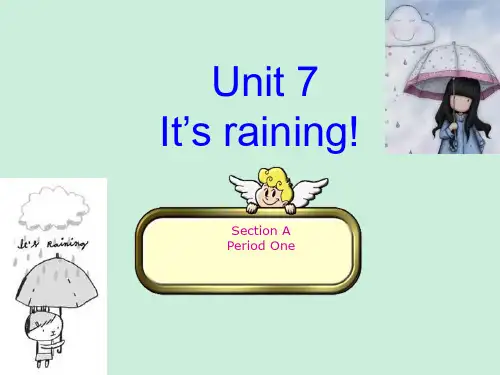
It’s cloudy.
How is the weather down there in Shanghai? 上海南边
down
up
*地理上,由南往北,用up 由北向南,用down *问话人的所在地一定是在上海以北的地区,所以问话中插个“down there” *一个在北京的人,可以问“How is the weather up there in Changchun?”
Unit 7 It’s raining!
Section A Period One
Words Review
rain
v. 下雨 n. 雨水
windy cloudy
sunny snow
adj. 多风的 adj. 多云的
adj. 晴朗的 v. 下雪 n. 雪
weather n. 天气
Talk about the weather.
课时重点回顾
How is the weather in …? What is the weather like in …?
sunny. cloudy. It’s windy. raining. snowing.
名词
形容词
动词
snow 雪 snowy 下雪的 snow 下雪
cloud 云 cloudy 多云的 无
rain 雨 rainy 下雨的 rain 下雨
sun 太阳 sunny 晴朗的 无
wind 风 windy 多风的 无
Fill in the blanks
1. 北京的天气怎样?天气晴朗。
-- ________ _______ _________in Beijing? -- It’s ________. 2. Jeff 在干什么?他在玩电子游戏。 -- What ______ Jeff _______? -- He _____ _________ computer games.
人教版初中英语七年级下册Unit 7 Section A名师课件(二课时)
Rick: Hello, Rick speaking. Steve: Hi, Rick. It’s Steve. How’s it going? Rick: Not bad, thanks. The weather’s great. What are you doing?
3. cloudy e
4. sunny c
5. snowing d
1b Listen and write these city names in the boxes.
Toronto
Beijing
Beijing
Moscow Toronto
Boston
Moscow Shanghai
Boston Shanghai
talking
2. Who does Steve want to talk to? Rick’s brother.
2d Read the dialogue and answer the questions.
1. How’s it going with Rick? Not bad.
2. What’s the weather like? The weather’s
Steve: doing?
常用于接电话时的自我介绍。
Rick: I’m playing basketball with some friends at the park. Steve: Sounds like you’r要e 与ha某vi人ng通电a 话go时od可t说im:e. Rick: Yeah. Is your brotM瑞haey克r 。Iatspheoamke?to Rick, please? 我 找
2020-2021学年人教版英语七年级下册 Unit7 SectionA 1a-2d 课件
Describe the weather
Describe the weather
Shanghai
Describe the weather
Moscow
1a Match the words with the pictures.
c
1. raining _a_
2. windy __
3. cloudy__ b
Unit 7 It’s raining!
Section A
Guess: What are the pictures about ?
New words
rain v. 下雨 n. 雨水
windy adj. 多风的 cloudy adj. 多云的 sunny adj. 晴朗的
snow v. 下雪 n. 雪
Pair work
Ask and answer questions about the weather in different cities.
Example Xuanhua
A :How’s the weather in Xuanhua? B :It’s raining. A :Is it raining? B :Yes, it is. A : Is it a rainy day? B : Yes, it is. A :Do you like the rainy day? B :No ,I don’t. I like the sunny day.
Group work: talk about the weather
A: How’s the weather in London?
B: Is it sunny? A: No, it isn’t. C: Is it snowy? A: No, it isn’t. D: Is it rainy? A: Yes, it is. It’s a
初中英语七年级下册 Unit7. SectionA(1a-2d)说课稿
初中英语七年级下册 Unit7. SectionA(1a-2d)说课稿一. 教材分析《初中英语七年级下册Unit7. SectionA(1a-2d)》是人教版新目标英语的重要内容。
本节课主要讨论日常生活中常见的活动,如看电视、听音乐、做家务等。
通过本节课的学习,学生可以提高他们的听、说、读、写能力,并能运用所学知识进行日常交流。
教材内容丰富,贴近学生生活,有利于激发学生的学习兴趣。
二. 学情分析面对七年级的学生,他们已经掌握了基本的英语语法和词汇,具备一定的听、说、读、写能力。
但部分学生对英语学习仍存在恐惧心理,缺乏自信心。
因此,在教学过程中,教师需要关注学生的心理素质,鼓励他们积极参与课堂活动,提高他们的英语水平。
三. 说教学目标1.知识目标:学生能够掌握日常生活中常见的活动词汇,如watch TV、listen to music、do homework等;理解本节课的主要句型,如“What doeshe/she do?”“He/She watches TV.”等。
2.能力目标:学生能够熟练运用所学知识进行日常交流,提高听、说、读、写能力。
3.情感目标:激发学生学习英语的兴趣,培养他们积极向上的学习态度,增强自信心。
四. 说教学重难点1.重点:学生能够掌握日常生活中常见的活动词汇和主要句型,进行简单的日常交流。
2.难点:学生能够运用所学知识进行复杂的日常交流,并能正确运用一般现在时。
五. 说教学方法与手段1.教学方法:采用任务型教学法,让学生在完成任务的的过程中,自然地学习和运用英语。
2.教学手段:利用多媒体课件、图片、卡片等教学辅助工具,提高课堂教学效果。
六. 说教学过程1.导入:教师通过提问学生日常生活中喜欢的活动,激发学生的学习兴趣,引入新课。
2.呈现:教师展示与本节课相关的图片和卡片,引导学生说出相应的活动词汇和句型。
3.Practice: 学生分组进行角色扮演,运用所学知识进行日常交流。
Unit7+讲义 人教版英语七年级下册
Unit7 It’s raining!1.It’s raining!rain:v下雨;n雨(不可数名词)注意:作为不可数名词时,当它前面有heavy(大)/light(小)修饰时,形容词前要加冠词aEg:There was a heavy rain this morning.2.How’s the weather in Shanghai?对天气提问的句型:How’s the weather (in+地点)?What’s the weather like(in+地点)?答语:It is+形容词.(表天气)Eg:---How’s the weather in Wuhan?---It’s sunny.---What’s the weather like in Wuhan?---It’s sunny.由“名词+y”构成的天气形容词Eg:cloud(n云)---cloudy(adj 多云的)rain(n 雨)---rainy(adj 下雨的)wind(n 风)---windy(adj 有风的)sun(n 太阳)---sunny(adj 晴朗的)snow(n 雪)---snowy(adj 有雪的)storm(n 暴风雨)---stormy(adj 有暴风雨的)shower(n 阵雨)---showery(adj 有阵雨的)weather为不可数名词天气与weather相关的短语weather forecast/report 天气预报weatherman天气预报员感叹句:(1).What+(a/an)+adj+n+主谓!(2)How+adj/adv+主谓!Eg:What a fine day it is!How fine the day is!多么好的天气啊!3.Aunt Sally is cooking.cook:v 烹饪;煮n厨师cooker:厨具Eg:The cook is cooking with some cookers.用法:cook sth.for sb./ cook sb. sth.为某人做饭(同buy的用法)Eg:My mom is cooking a big dinner for us.My mom is cooking us a big dinner. 妈妈正在为我们做丰盛的晚餐4.How’s it going? 最近怎么样?询问对方近况/事情进展情况,可跟with sb./sth.相当于How is everything(going)?该用语的常见答语有:Great!Pretty good!(相当好) Not bad!(还不错)Just so-so!(一般般/马马虎虎) Terrible!(糟糕透了) Everything is going well.(一切都好)Eg:---How’s it going with your tests?--- Pretty good!注意:How are you doing? 你最近好吗?What are you doing? 你正在做什么?5.Can I take a message for him?message:(可数名词)消息;信息take a message for sb. 为某人捎个口信拓展与message相关的常用短语:take a message to sb.捎信给某人send a text message to sb.给某人发短信leave a message 留言6.Could you just tell him to call me back?could:(情态动词)能;可以(语气上比can委婉、客气)当could用于一般疑问句时,作肯定回答要用:Yes,...can. 也可用:Sure/Certainly/Yes,please.Eg:-Could you help me carry the box?-Sure.call sb.back 给某人回电话拓展与back相关短语come back 回来go back回去bring back 带回来take back 收回fight back 回击7.Sure,no problem.no problem没问题(道谢、道歉、询问能力等语境中)Eg:(1)-Thank you.-No problem.(没什么)(2)-I’m sorry.-No problem.(没关系)(3)-Can you do it?-No problem.(没问题)8.I’m having a great time visiting my aunt in Canada. visit: v 拜访,参观visit+sb. 拜访某人visit+地点参观某地visit: n 逗留、游览、参观常用短语:go on a visit to...去...参观pay a visit to sb.去某人处做客on a visit to去...游览visitor 访问者;参观者Canada(加拿大)---Canadian(加拿大人/加拿大人的) America(美国)---American(美国人/美国的)Russia(俄罗斯)---Russian(俄罗斯人/俄罗斯的)Europe(欧洲)---European(欧洲人/欧洲人的)9.Are you studying hard,or are you having fun?hard:adv 努力地;艰难地;猛烈地/ adj 坚硬的;困难的Eg:Young people should work hard.(努力地)It’s raining hard now.(猛烈地)The stones are too hard.(坚硬的)The maths problem is kind of hard.(困难的)注意:hard 本身有adv词性,hardly(adv)几乎不;几乎没有10.My family and and I are on a vacation in the mountains.on a vacation:在度假拓展:与vacation相关的短语on vacation 在度假take a vacation 度假Eg:Miss Yi is on vacation now.I will go to Yunnan to take a vacation.辨析:vacation,holiday,festival,leave,offvacation:学校、机关等假期(时间一般比较长)(美国)holiday:泛指休息日,常指较长时间的休假(英国)festival:指悠久历史的传统节日leave:(n)请假(被批准后离开一段时间)Eg:He asked for a six months’ leave.off:常用结构:have+时间+off 请假,休假Eg:I have half a month off every day.一般现在时VS现在进行时区别11.It’s hot in your country now,isn’t it?反意疑问句:由两部分构成:陈述句+附加问句遵循:前肯后否,前否后肯两部分的时态要保持一致,附加问句部分一般由“助动词/系动词/情态动词的肯定或否定形式+代词”,否定形式通常使用缩写形式Eg:It’s raining now,isn’t it?(正在下雨,不是吗?)She likes playing games,doesn’t she?(她喜欢打游戏,不是吗?)He can’t play basketball,can he?(他不会打篮球,是吗?)当反意疑问句的主句部分含有表示否定含义的never、little、few、no、hardly等词时,附加问句则用肯定形式Eg:They never watch TV on weekends, do they?There is little milk in the fridge,is there?My father hardly smokes,does he?反意疑问句的回答:(1)Yes,+肯定回答. No,+否定回答Eg: -She is a doctor, isn’t she?-Yes,she is. No,she isn’t.(2)如果前面的陈述部分为否定句的反意疑问句,回答时yes/no的翻译与通常情况正好相反-She isn’t a doctor, is she?(她不是医生,对吗?)-Yes,she is. / No,she isn’t.(不,她是。