
(沪教牛津版)三年级英语上册教案Module3Unit3(3)
沪教牛津版三年级上册英语
Module 3 Places and activities
Unit 3 Parks and playgrounds
第三教时(3st PERIOD)
一、主要新授内容(Main new contents )
Look and learn: sky, cloud, tree, boat, slide, swing
Look and say: Look at … /Point to…
二、学习目标(Learning objectives)
1.学生能够用英语表述围绕在他们周围的一些事物;
2.学生能够掌握冠词a, an,the的区别及用法;
3.学生能够运用Look at … /Point to…发指令并作出相应的动作;
4.学生能够根据实际情景,灵活运用所学单词及句型。
三、活动介绍(ACTIVITIES)
(一)任务前期准备(PRE-TASK PREPARATION)
Pre-task preparation的环节中,通过在记忆猜谜等游戏中的对话热身运动使学生快速进入学习状态。
另外,通过师生或者生生间的交流,创设真实的语境,为后面新知的引出打下埋伏。
Activity 1 Playing a memory game
1.教学辅助(Aids)
1)电脑屏幕(3A-M3-U3-P3-1)
2)屏幕
2
Activity 2 Playing a guessing game
1.教学辅助(Aids)
一盒蜡笔
2
(二)任务实施过程(WHILE-TASK PROCEDURE)
1. 新知识的引入(PRESETATION)
学生通过听听、说说和做做的活动,自然引出新授内容,让学生对所要学习的知识进行视听上的感知。
Activity 1 Saying and doing
1.教学辅助(Aids)
1)电脑录像(3A-M3-U3-P3-2)
2)屏幕
Activity 2 Answering the questions
1.教学辅助(Aids)
图片
2.新知识的操练(PRACTICE)
1)机械性操练(MECHANICAL PRACTICE)
学生通过模仿、变换声音及儿歌等形式的仿说活动来操练单词和句型,做到语音语调基本正确,并能理解其的含义。
Activity 1 Imitation
1.教学辅助(Aids)
电脑屏幕(3A-M3-U3-P3-3)
Activity 2 Imitation
1.教学辅助(Aids)
各色卡片
Activity 3 Changing voices 1.教学辅助(Aids)
Activity 4 Rhyme
1.教学辅助(Aids)
2)意义性操练(MEANINGFUL PRACTICE)
学生通过玩接龙游戏、听指令做动作和快速反应等活动,进一步熟练单词和句子的发音,加深对新知的理解与应用。
Activity 1 Playing a chain game
1.教学辅助(Aids)
1)电脑屏幕(3A-M3-U3-P3-4)
2)图片
Activity 2 Commands and actions
Activity 3 Guessing game
1.教学辅助(Aids ) 图片
2.活动过程(Process ) (三)任务后期活动(POST-TASK ACTIVITY ) 1.新知识的运用
在单词句型反复操练的基础上,教师通过创设情景,使学生把所学到的单词与句子运用到实际生活中,并进行交际。
Activity 1 Reading comprehension
1.教学辅助(Aids )
1)
电脑屏幕(3A-M3-U3-P3-5)
Activity 2 Making a dialogue
1.教学辅助(Aids)
彩色图片若干
2.课后作业(ASSIGNMENT)
回家作业是课堂教学的延伸,它也是完成任务阶段的活动,布置适当适量的回家作业,帮助学生复习巩固课堂所学知识,从三年级开始要求读写跟上,有句子的认读和书写的要求,因此除了布置口头作业外,还要增加书面作业的量,但注意不要布置大量的机械抄写和简单的替换练习,可以变换练习的形式,提高兴趣,增强实效。
口头:模仿跟读M3U3 P32
书面:1. 根据Post-task activity 中句型编写一小段对话。
2. 抄写单词和句型。
附件:
媒体制作说明:建议使用Powerpoint 或Authorware制作
3A-M3-U3-P3-1:收集八张彩色图片,每张图片上有一样东西,可用
Powerpoint制作成幻灯片。
3A-M3-U3-P3-2:拍摄一段公园的录像。
3A-M3-U3-P3-3:拍摄一段公园的录像。
3A-M3-U3-P3-4:收集一些有关公园的图片,用Powerpoint制作成幻灯片,
每点击一次,图片上的依次突现其中的一种事物,其余变淡。
3A-M3-U3-P3-5:拍摄一段儿童乐园的录像并配有文字。
如:Today is Sunday. It
is fine. Look at the sky. It’s so blue. Ben and Kitty are in the
Children’s Palace. Look at the slide. It is red. Kitty likes it. B en
points to the swing and says, Look at that swing. It is white. I
like it. There is a big tree near the swing. It is green. Ben and
Kitty are playing. They are happy.
接着屏幕上出现以下问题。
如:
1. What colour is the sky?
2. Is the slide white?
3. Does Ben like the swing?
4. Is the tree small and green?。
沪教牛津版三年级上册英语Unit3第3课时教学课件
名词:扇子
第十三页,共二十一页。
Learn the letters
E for egg. F for fan. I have an egg and a fan.
第十四页,共二十一页。
随堂练习
从下面的单词中找出字母Ee, Ff
yes
fine
aree
Miss页。
Good morning.
Good morning.
第十八页,共二十一页。
Let's read
Peter meets Miss Fang at the school gate.
Are you Miss Fang?
Yes, I am.
第十九页,共二十一页。
Let's read
Peter meets Miss Fang at the school gate. No, I'm not. I'm Peter.
Are you Miss Fang?
Yes, I am.
第四页,共二十一页。
Y?es, I am.
Enjoy a story
Wow, sheep!
第五页,共二十一页。
单元新词
sheep 名词:羊
注意:一只羊我们说a sheep, 两只羊我们说two sheep。 sheep的单复数形式是一样的。
3.认读词汇:sheep,wolf 4.能力目标:(1)能够询问对方的名字和性别,
并回答对方提出的问题;
(2)能够描述对方的性别和身份。
第二页,共二十一页。
温故知新
Are you Kitty?
No, I'm?not. I'm Alice.
第三页,共二十一页。
牛津上海版(试用)三年级上册英语 Module 3 Unit 3 《In the park》 课堂实录 教学设计
Teaching Plan for Oxford English3AM3 Places and activitiesUnit 3 In the parkI. Unit analysis(单元分析)(1)单元教学任务:这是牛津上海版三年级第一学期第三模块,主题是Places and activities(地方和活动),分别围绕My school(我的学校),Shopping(购物)以及In the park(在公园里)这三个与孩子学习、生活息息相关的话题而展开。
本单元主题是In the park(在公园里),是学生比较感兴趣的。
学生在已学颜色单词和描述物品的形容词基础上,学习新授单词:boat,kite, balloon,flower四种公园里常见景物,关注其音形义,单复数。
在故事情境中,能运用Look at …It’s …How …!等句型来描述公园中的景物,关注其特点。
运用What colour is it? It’s …来问答公园景物的色彩。
在所学的情境中熟悉和运用语言,提高语言交际能力和合作学习能力。
在学习的过程中感受公园中不同的景物、不同的特征,充分感受自然界的色彩美,感受公园活动所带来的快乐。
同时,学习字母u在单词中的发音/ju:/,并能准确朗读。
(2)单元教学设计:第一课时,借助场景(Meeting in the park),以小熊(Bobo)和松鼠(Lily)为主角,通过用纸船、风筝、气球和花朵互相传递信件和感情的有趣绘本故事学习公园里的常见景物:boat,kite,balloon,flower,关注其音、形、义,感受公园中不同景物及其特点。
第二课时,借助场景(Colours in the park),在第一课时绘本故事情节的基础上,通过小熊(Bobo)和松鼠(Lily)这对好朋友在公园游玩,学习与运用Look at…What colour is it? It’s …等单元核心句型进行对话,进一步感受公园里所见物品的色彩与特点,学会观察、学会描述,感受自然世界的色彩美。
牛津沪教三上Module3Unit3Parksandplaygrounds
沪教牛津版三年级上册英语Module 3 Places and activitiesUnit 3 Parks and playgrounds第二教时(2st PERIOD)一、主要新授内容(Main new contents )Look and learn: pink, grey, violet, colourPlay a colour game: Is it…? Yes, it is./No, it isn’t.Learn the sounds: sounds: i二、学习目标(Learning objectives)1.学生能够进一步用英语表述表示颜色的单词;2.学生能够运用Is it …?Yes, it is./No, it isn’t.进行正确的回答;3.学生能够根据实际情景,灵活运用所学单词及句型;4.学生能够通过学习对大自然有进一步的认识,从而更加热爱自然。
三、活动介绍(ACTIVITIES)(一)任务前期准备(PRE-TASK PREPARATION)Pre-task preparation的环节中,通过游戏对话热身运动使学生快速进入学习状态。
另外,通过师生或者生生间的交流,创设真实的语境,为后面新知的引出打下埋伏。
Activity 1 Playing a game1.教学辅助(Aids)1)电脑屏幕(3A-M3-U3-P2-1)2)屏幕3)图片2Steps Contents Methods Purpose1 Quick response 在屏幕上依次显示不同颜色的气球,请学生说出看到何颜色的气球。
如: a redballoon等通过游戏的形式,引发学生的学习兴趣,在复习旧知的同时让学生快速进入学习英语的状态。
2 Quick response 在屏幕上播放不同颜色的东西,如:风筝,伞等,请学生看着屏幕进行两两问答。
在游戏中替换,在不断替换中复习旧知,以让学生在愉快的氛围内进行复习活动。
三年级英语上册教案 Module 3 Unit 3

沪教牛津版三年级上册英语Module 3 Places and activitiesUnit 3 Parks and playgrounds第五教时(5th PERIOD)一、主要新授内容(Main new contents )Revision二、学习目标(Learning objectives)1.学生能够用英语表述表示颜色的单词和围绕在他们周围的一些事物;2.学生能够根据实际情景,灵活运用所学句型What colour is it? Is it …?Yes, it is./No, it isn’t.等;3.学生能够运用L ook at … /Point to…等发指令并作出相应的动作;4.学生能够进一步巩固冠词a, an,the及指示代词this,that的区别及用法;5.学生能够用Thank you.及回答That’s OK.来进行日常表达。
三、活动介绍(ACTIVITIES)(一)任务前期准备(PRE-TASK PREPARATION)通过说唱,击鼓游戏快速反应等形式,复习本单元祈使句,同时活跃课堂气氛,培养学生乐学的心理,为接下来的课堂教学做铺垫。
Activity 1 Rhyme1.教学辅助(Aids)1)录音2)电脑屏幕(3A-M3-U3-P5-1)Activity 2 Commands and actions(二)任务实施过程(WHILE-TASK PROCEDURE)通过创设情景,设置操练环节,使学生能够复习巩固本单元所学习的内容,并通过讨论、完成练习册上的内容,达到听说读写四能并进的目的。
Activity 1 Guessing game1.教学辅助(Aids)图片2.活动过程(Process)Activity 2 Listening comprehension 2.教学辅助(Aids)1)录音2)电脑屏幕(3A-M3-U3-P5-2)Activity 3 Exercises1.教学辅助(Aids)1)配套练习册2)录音机Activity 4 Exercises活动过程(Process)1.教学辅助(Aids)1)配套练习册2)录音机(三)任务后期活动(POST-TASK ACTIVITY)1.新知识的运用在学生能够巩固所学知识的基础上,教师通过创设情景,提供阅读材料的手段,使学生能够将所学知识与生活实际相联系,通过对话达到学以致用的目的。
牛津沪教三年级上册module 3《unit 3 parks and playgrounds》优秀教案之一(重点资料).doc
沪教牛津版三年级上册英语Module 3 Places and activitiesUnit 3 Parks and playgrounds第四教时(4th PERIOD)一、主要新授内容(Main new contents )Say and act: newIs this…? Is that…?Excuse me,… That’s OK.二、学习目标(Learning objectives)1.学生能够进一步区分和使用指示代词this,that。
2.学生能够运用Is this…? Is that…?进行提问及正确的回答;3.学生能够用Thank you.及回答That’s OK.来进行日常表达;4.学生能够根据实际情景,灵活运用所学单词及句型。
三、活动介绍(ACTIVITIES)(一)任务前期准备(PRE-TASK PREPARATION)Pre-task preparation的环节中,通过猜谜游戏对话热身运动和儿歌使学生快速进入学习状态。
另外,通过师生或者生生间的交流,创设真实的语境,为后面新知的引出打下埋伏。
Activity 1 Playing a guessing game1.教学辅助(Aids)1)电脑屏幕(3A-M3-U3-P4-1)2)屏幕3)图片2.活动过程(Process)Activity 2 Reading a rhyme1.教学辅助(Aids)2.活动过程(Process)(二)任务实施过程(WHILE-TASK PROCEDURE)1. 新知识的引入(PRESETATION)通过看录像听录音,自然引出新授内容,让学生对所要学习的知识进行视听上的感知。
Activity 1 Watching the video1.教学辅助(Aids)1)电脑录像(3A-M3-U3-P4-2)2)屏幕2.活动过程(Process)Activity 2 Making a dialogue 1.教学辅助(Aids)图片2.活动过程(Process)2.新知识的操练(PRACTICE)1)机械性操练(MECHANICAL PRACTICE)学生通过模仿、变换声音及角色扮演等形式的仿说活动来操练单词和句型,做到语音语调基本正确,并能理解其的含义。
(沪教版)三年级牛津英语教案3BModule3Unit3
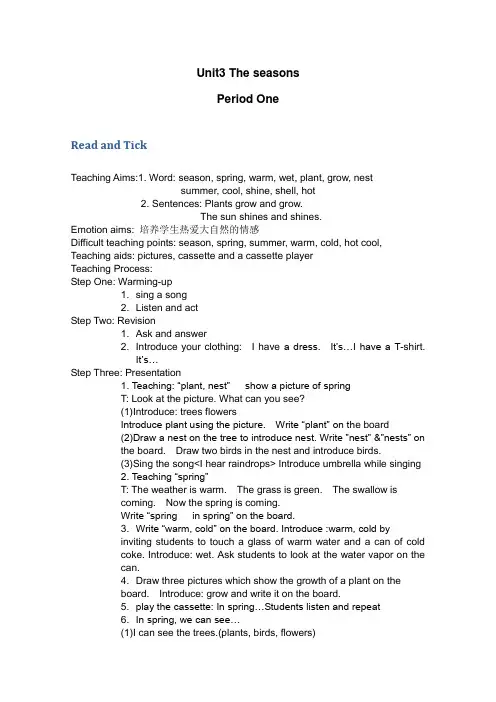
Unit3 The seasonsPeriod OneRead and TickTeaching Aims:1. Word: season, spring, warm, wet, plant, grow, nestsummer, cool, shine, shell, hot2. Sentences: Plants grow and grow.The sun shines and shines.Emotion aims: 培养学生热爱大自然的情感Difficult teaching points: season, spring, summer, warm, cold, hot cool, Teaching aids: pictures, cassette and a cassette playerTeaching Process:Step One: Warming-up1. sing a song2. Listen and actStep Two: Revision1. Ask and answer2. Introduce your clothing: I have a dress. It’s…I have a T-shirt.It’s…Step Three: Presentation1. Teaching: “plant, nest” show a picture of springT: Look at the picture. What can you see?(1)Introduce: trees flowersIntroduce plant using the picture. Write “plant” on th e board(2)Draw a nest on the tree to introduce nest. Write ”nest” &”nests” onthe board. Draw two birds in the nest and introduce birds.(3)Sing the song<I hear raindrops> Introduce umbrella while singing2. Teaching “spring”T: The weather is warm. The grass is green. The swallow iscoming. Now the spring is coming.Write “spring in spring” on the board.3. Write “warm, cold” on the board. Introduce :warm, cold byinviting students to touch a glass of warm water and a can of coldcoke. Introduce: wet. Ask students to look at the water vapor on thecan.4. Draw three pictures which show the growth of a plant on theboard. Introduce: grow and write it on the board.5. play the cassette: In spring…Students listen and repeat6. In spring, we can see…(1)I can see the trees.(plants, birds, flowers)(2)In spring, we can’t see umbrellas.(3)In spring, is the weather cold? No, it’s warm.warm---coolIn spring, it’s wet. Plants grow and grow.7. Teaching : summer ,shellsShow summer on the picture. Encourage the students to predictwhat they can see in summer and tick the appropriate boxes.Introduce: shells , summer Write them on the board8. Play the cassette: In summer…Students listen and check theprediction.9. Write hot, cool on the board. Introduce: hot, cool by invitingstudents to touch a glass of hot water and a can of cool coke.10. Draw: the sun on the board. Introduce: shines by drawing linesout from the sun. Add a match stick figure wearing a pair ofsunglasses.Step Four: Consolidation1. Divide students into groups. Invite each group to read page36aloud.Step Five: Homework1. Listen to the tape2. Copy the wordsPeriod TwoRead and TickTeaching Aims: 1. Words: dry, fall, autumn, bicycle, scarf, winter, wind, gloves2. Sentences: Leaves fall and fall.The wind blows and blows.Emotion aims: 培养学生热爱大自然的情感Difficult teaching points: autumn, winter, dry, scarves, gloves,windTeaching aids: pictures, cassette and a cassette playerTeaching Process:Step One: Warming-up1. Listen and act2. Ask and answerStep Two: Revision1. In spring, what can you see? I can see…/ I can’t see…How is the weather in spring? Is it cold?2. Read “In spring”3. In summer, what can you see? I can see…/I can’t see…4. Read “In summer”Step Three: Presentation1. Teaching “autumn, dry”Show the picture of autumn.(1)What can you see? I can see kites, slides, bicycles…Is it spring? No, it isn’t. It is autumnWrite “autumn in autumn” on the board.Say after teacher(2)Soak a tissue with water. Ask students to feel the wet tissue and adry one. Introduce: dry2. Teaching :fallIntroduce: fall by drawing some falling leaves. Add an arrow toshow that they are falling down from the tree to the ground.Say : Leaves fall and fall3. Play the cassette: In autumn…Student s listen and repeat4. Look at the picture, ask and answer(1)In autumn. What can you see?We can see… We can’t see…(2)Is it hot(cool, warm, wet, dry)? Yes, it is. No, it isn’t.5. Teaching: winter, scarves,glovesShow the picture of autumn.(1)What can you see? I can see hats, coats…Is it autumn? No, it isn’t. It is winterWrite “winter in winter” on the board.Say after teacher(2) Introduce: gloves scarves using the pictureWrite “scarf scarves” on the board6. Teaching :wind ,blow(1)T: In winter, is it hot? No, it’s cold. Is it wet? No, it’s dry.Imitating the sounds of the wind and draw some lines on theboard to introduce “wind”What can you hear? Write wind on the board(2)Ask students to imitate the sounds of the wind loudly orquietly. Introduce: The wind blows and blows.7. Play the cassette: In winter…Students listen and repeat8. Look at the picture, ask and answer(1)In winter. What can you see?We can see… We can’t see…(2)Is it hot(cool, warm, wet, dry)? Yes, it is. No, it isn’t. Step Four : Consolidation1. Listen to the tape2. Tick the correct boxStep Five: Homework1. Listen to the tape2. Write down the sentencesPeriod ThreePlay a game Learn the soundsTeaching Aims: 1.Asking “wh-“ques tions to find out the time of year2. Asking “yes/no” question to obtain simple responses3.Learn the sound // //Emotion aims: 要求学生大胆模仿,善于观察Difficult teaching points: What season is it? Is it winter?Yes, it is. / No, it isn’t.Teaching aids: pictures, cassette and a cassette playerTeaching Process:Step One: Warming-up1. Sing a song.2. Ask and answerStep Two: Revision1. Read the new words2. Answer the following questions:In spring, what can you see?What can you see in summer?What can you see in autumn?In winter, what can you see?3. warm---cool hot---cold wet---dry4. Tick the correct boxseason warm cool hot cold wet drySpringSummerAutumnStep Three: Presentation1. Teaching : What season is it?(1)Look at the picture. We can see plants. We can hear theraindrops. IWhat season is it? To elicit: Is it spring?(summer)(2) It is wet. It is warm. What season is it? To elicit: Is itspring(summer)?(3) Write “What season is it ?” on the board. Ask and answer/eg: S1:It is wet. It is hot. What season is it?S2: Is it summer?S3: Yes, it is.2. Tell students that there are four seasons in a year. Invite them tolist the four seasons on the board.3. Pretend to be swimming. Ask students to look at the book of page38 and see in which season characters are dong the same thing asyou. Ask and answer.4. Invite individual students to come to the board and demonstratethe actions of the characters on the book. Prompt those students to ask:What season is it? To elicit guesses from the class: Is it…? They thenrespond to their classmates’ guesses: Yes, it is./No, it isn’t.5. Play the cassette. Students listen and repeat.6. Ask and answer(1) Which do you like? Spring or summer? Why?(2) Which season do you like best? Why?7. Learn the sound // //(1)Play the cassette. Students listen(2)Play the cassette again. Students listen and repeat.(3) Find out the words of the sound // //(4) Read the sentences loudStep Four: Consolidation1. Workbook page282. Grammars practice book page37Step Five: Homework1. Listen to the tape2. Copy the words课后随笔Period FourLook and sayTeaching Aims: 1.New words: his, her2. Asking “wh-” question to obtain simple responses3. Using pronouns to refer to people and thing.Emotion aims: 教育学生要有助人为乐,相互关心的好品质Difficult teaching points: his herThat’s his/ her …Teaching aids: pictures, different objects, cassette and a cassette player Teaching Process:Step One: Warming-up1. Sing a song.2. Ask and answerStep Two: Revision1. Review: my your by holding up your belongings and yourstudents’ belongings. Say: This is my… That is your …Students work in pairs2. Ask: Is this my…? Is this your… to elicit Yes, it is. / No, it isn’t.Students ask and answerStep Three: Presentation1. Teaching: his her That’s hie/her…(1) Invite students to put their belongings on the teacher’s desk.(2) Introduce : That’s (a boy’s name) …. That’s his …by pointingat that boy as well as his belongings on the desk.Write “his ” on the board.(3) Introduce: That’s (a girl’s name) …. That’s her …by pointingat that girl as well as her belongings on the desk.Write “her ” on the board.(4). Students work in pairs That’s (a student’s name). That’shis/her …2. Teaching: Here’s your…Return the belongings to th e owners and say Here’s your…to elicit:Thank you./ Thanks3. Teaching: Where’s my…?Hide one belonging in one student’s desk and ask: Where’s my ,…?To elicit: Here it is./ Here you are.Students work in pairs.4. Play the cassette. Students listen and follow in their books.5. Play the cassette again. Students repeat.6. Divide students into groups to act the story.7. Students vote for the best group.8. Encourage students make a new storyStep Four: Consolidation1. Play the cassette the third time. Ask the students to read the pageand fill in the blanks.2. Students work in pairs to check answers.3. Invite individual students to point at the pictures on the page andread a loud the sentences in Point and say.4. Exercise: Write my ,your, his or her(1) This is Ben. This is _______bicycle.(2) I am Kitty. ______ bag is blue(3) She’s Alice. That’s _____ umbrella.(4) You are Mr Li. ______ car is black.(5) Is this ______ hat? Yes, it’s my hat.(6) That’s my mother. That’s _____ coat.(7) Where’s ______ scarf? Here you are.(8) He’s Mr Wang. _____ gloves are new.Step Five: Homework1. Listen to the tape2. Work book page30 31Period FiveSay and actTeaching Aims: 1. Using imperatives to give instructions2. Asking “wh-” question to find out the time of year3. Using predicative adjectives to describe conditionsEmotion aims: 鼓励学生与他人的交流,发表自己的观点Difficult teaching points: Use appropriate intonation in questions and statements Teaching aids: pictures, photograph, cassette and a cassette playerTeaching Process:Step One: Warming-up1. sing a song2. Read the wordsStep Two: Revision1. Show students pictures of four seasons.Ask and answer(1)What can you see in spring/summer/autumn/winter?(2)Is it hot / cold / warm / cool?(3)Is it wet / dry?(4)It is hot. We can see shells. What season is it?(5)Do you like spring?(6)Which season do you like best? Why2. Invite students to say the rhyme: Four seasonsEncourage individual students to say the rhymeStep Three: Presentation1. Encourage students to say : In spring / summer / autumn / winter,it’s…/ We can see…2. Show a photograph and say: Look at the photograph. To elicit : Whois he/she. Then answer: He’s my…/She’s my …Take out studen t’s photograph and introduce the person in thephotograph.Students work in pairs. Ask and answer.3. Talk about the season4. Ask : Do you like …(season)?5. Play the dialogue on the cassette while students follow in theirbooks. Students content through listening.6. Play the dialogue in four parts. Students follow the tape and repeat.7. Divide students in pairs. Ask them to act out the dialogue.8. Encourage the more able students to make a new dialogue.eg: S1: Look at this photograph. Who is she?S2: She’s my big sister, Rose.S1: What season is it?S2: It is summer. It’s hot. The sun is shining. Rose has herblue sunglasses.S2: She has a nice dress. It is pink.S1: I like summer. It’s hot. I like swimming. I like ice-creams.Do you like summer?S2: No, I don’t like it. I like autumn. I like kites. It is not hot.It is cool.S1: But in autumn it is dry. The leaves fall.S2: Yes, it is.Step Four: ConsolidationWorkbook page321. Students first work in pairs to finish the exercises orally. Theyneed to look at each picture, and find the corresponding word fromthe centipede.2. Students write the correct words in the blanks provided.3. Students exchange their work and check answers.Step Five: Homework1. Listen to the tape2. Write 5 sentences about your favorite season.。
(沪教版)三年级牛津英语教案Module3Unit3
Module 3 Places and activitiesUnit 3 Parks and playgroundsPeriod OneTeaching contents: Look and learn Look and sayTeaching Aims:1. 知识目标:1) Using imperatives to draw attention to something2) Using adjectives to describe colours2. 能力目标:1) Open/maintain an interaction by eliciting a response2) Identify key words in an utterance by recognizing stree3. 情感目标:指点学生认识多彩的大自然,热爱五彩的生活Difficult and key points:1) New words: red orange yellow green blue black white sun sky cloud kite boat ball balloon2) New sentences: Look at the ______. It’s ____(colour). Teaching aids: tape, colour pencil, wallpicture, realiaTeaching procedure:Period TwoTeaching contents: Look and learn Point, ask and answerTeaching Aims:1. 知识目标:1) Using simple imperatives to give instruction2) Using Wh-questions to find out various kinds of specific information about a thing.3) Using pronouns to refer to a particular thing .2. 能力目标:1)Open an interaction by eliciting a response2) Maintain an interaction by providing information to factual questions3. 情感目标:要求学生仔细观察身边的事物Difficult and key points:1) New word: slide swing2) New sentences: Point to the _____.What c olour is it? It’s ______Teaching aids: tape, some pictures, some word cards, maskTeaching procedure:Period ThreeTeaching contents: Play a colour game Learn the sounds Teaching Aims:1. 知识目标:1) Using imperatives to draw attention to something2) Using Wh-questions to find out specific information abouta thing. Using pronouns to refer to a particular thing.3) Using yes/no questions to obtain a simple response4) Pronounce correctly words in isolation with initial sounds / ai /& / i /2. 能力目标:1) Maintain an interaction by providing information inresponse to factual questions2) Discriminate between words with vowel sound ‘i’ inboth open and closed syllable forms3. 情感目标:培养学生相互协作的精神,共同学习Difficult and key points:1)New sentences: Is it _____(colour)?Yes, it is. No, it isn’t.2) Vowel sound: I i--/ ai /& / i /Teaching aids: tape, some word and pictures cardsTeaching procedure:Period FourTeaching contents: Say and actTeaching Aims:1. 知识目标:1) Using formulaic expressions to attract people’s attention2) Using yes/no question to obtain simple response2. 能力目标:1) Open an interaction by attracting someone’s attention2) Maintain an interaction by providing information in response to factual question3. 情感目标:赞扬助人为乐的优良品质,鼓励学生在生活和学习上要互相帮助,做到礼貌待人。
最新沪教牛津版三年级上册英语Module 3教案
通过情景表演,让学生在模仿、学习、表演的过程中掌握在教室使用的日常用语。
情感、态度与价值观:
通过模仿、游戏、听读等各种形式让学生掌握教室中使用的日常用语及blackboard等单词。
教学重点
1.字母Mm和Nn的正确书写和发音。
2.词汇blackboard, door, window, clean, close, late, look at, open, please, the
T: Please sat after me. Look at the blackboard, please.
Ss: Look at the blackboard, please.
最后,借助门、窗等实物帮助学生理解Open/close the door/window的含义。
2.让学生通过快速反应活动来操练祈使句Look at/close the door/ open…,please。老师说句子的前半句,学生快速完成句子。
T: Please come in.
S1: Thank you, Miss Fang.
T: Please close the door.
S1: Yes, Miss Fang.
T: You’re late, Kitty.
S1: I’m sorry.
…
然后让学生分组表演对话。请几组学生上来表演对话,并请全班学生做评委,选出表演得最好的一组。
3.句型句Open/Close/Look at /Clean…,please.
教学难点
掌握祈使句中please的位置。如:Close the door, please. Please close the door.
教学方法
听读法、情境表演法
牛津沪教版三上英语Unit 3 Are you Kitty 教案3
Module 1 Unit 3 教案3教学重点字母:E 和F句型:Are you a sheep?教学目标1 帮助学生学习字母E和F2通过故事欣赏,将本模块的三个单元的教学内容有机整合,让学生在说说演演的过程中既运用了语言又感悟道理。
Pre-task preparations1.带领学生玩接龙游戏,学生从第一排开始,一个接一个依次问Are you…(a boy/girl)?被问到的学生要用Yes, I am./No, I’m not. I'm a boy/girl回答,以此复习句型。
T: Are you a boy?S: Yes, I am. / No, I'm not. I'm a girl.)Are you…?S2: Yes I am. / No, I'm not. I'm…2.通过猜动物游戏引出Enjoy a story中的故事人物。
先模仿羊的叫声,请学生猜猜这是什么动物,然后模仿狼的叫声,请学生猜猜这是什么动物。
T. (imitate the sound that a sheep makes) Baa…Baa.S1: Are you a sheep?T: Yes, I'm a sheep.T: (imitate the sound that a wolf makes) Am I a sheep?S2: No.T: I'm not a sheep.Ss: You're not a sheep.T: (imitate the sound that a wolf makes) Who am I?S3: You're …While-task procedures1利用挂图呈现Enjoy a story的图片,根据图片提问,引出单词wolf和sheep,激发学生对故事的兴趣。
教师可以提示答案。
T: What's this?Ss: It's a wolf播放Enjoy a story的故事录音,请学生自己读故事,然后回答问题。
Module3Unit3Inthepark(教案)牛津上海版(试用本)英语三年级上册
Oxford English 3A M3U3 In the park第一课时:Let’s go to the park!第二课时:We are in the park.第三课时:A story in the park.一.单元内容与要求二、单元教学目标❖知识与技能1、能够正确朗读字母包含‘u’的单词:pupil, tube等。
2、在In the park的语境中理解并学习本单元核心词汇:boat, balloon, flower, kite, red, orange, yellow.等。
3、在In the park的语境中能初步运用Look at…What colour is it? It’s…来对事物颜色进行问答。
4、在In the park的语境中能够熟练地运用核心句型What colour is it? 来询问、了解有关事物颜色的信息,并能够熟练运用核心句型It’s…进行回答。
5、在In the park的语境中能够尝试运用can, row a boat, smell the flower, swing, nice, fun, happy等词汇描述在公园中的快乐活动。
❖文化与情感通过在In the park语境中的学习,来激发学生热爱自然、亲近自然的品质,体验公园玩乐中的快乐。
❖学习策略1、通过听说读的方式,以语篇语境带动核心词句的学习。
2、以师生交流、生生交流的方式初步运用核心词汇和句型。
3、以角色扮演活动、小组交流活动等方法,进一步运用核心词汇和句型。
4.通过表演、描述等法,综合运用核心词汇和句型,提高语用能力。
【教学重难点】围绕在In the park的语境,熟练运用Look at…What colour is it? It’s…来对事物颜色进行问答,通过学习激发学生热爱自然、亲近自然的品质, 通过学习体验公园玩乐中的快乐。
三、学情与教材分析四.单课教学目标五、单课时的文本内容与教学过程Period 1 Let’s go to the park!一、第一课时文本主体学习文本:Let’s go to the park!Dad: Do you like the park?Kitty: Yes, I like the park! Look at the flower. It’s purple. How beautiful! Alice: Look at the tree. It’s green. How nice!Dad: Let’s go to the park!Kitty&Alice: Great!Dad: I have a kite.Kitty: What colour is it?Dad: Look! It’s orange.Kitty: Wow! How nice! I have a balloon.Alice: What colour is it?Kitty: Look! It’s blue.Alice: Wow! How beautiful! I have a boat.Dad: What colour is it?Alice: Look! It’s red.Dad: Wow! How cool!辅助文本辅助文本(一)White and red! What colour is it? I don’t know. White and red! What colour is it? It’s pink.辅助文本(二)Kite, kite. (boat)I have a kite. (boat)Colour the kite. (boat)DIY!预设输出语言:I have a …What colour is it?Look! It’s …Wow! How …!二、第一课时教学过程Period 2 We are in the park!一、第二课时主体学习文本第二课时辅助文本High up high,Swing to the sky.The sky is blue,I don’t know why.High up high,Swing to the sky.The sun is round,I don’t know why.High up high,Swing to the sky.The clouds are white,I don’t know why.第二课时预设输出语言: A: Look at the ____.What colour is it?B: It’s ___. (And we can _____.) A: Wow! How ____!三、第二课时教学过程教学反思:Period 3 A story in the park !一、第三课时文本主体学习文本:预设输出语言:A: Look at …’s ____.What colour is it?B: It’s ___. (And we can _____.)A: Wow! How ____!二、第三课时教学过程Procedures Contents Methods Purpose六、单元评价量表。