
人教版小学三年级英语下册第四单元ppt课件
新PEP人教版三年级英语下册全册完整课件
Read and match
Canada‘s National Tower (加拿大国家电视塔) CN Tower
beaver
maple leaf
I’m Amy . I’m from the UK.
I’m Kangaroo.
I’m from Australia.
Canada (CAN)
小学英语
全册精品PPT课件
Unit 1 Welcome back to
school!
A
2套 A
Unit 2 My family
2套 A
Unit 3 At the zoo
2套
B
2套 B
2套 B
2套
C
2套 C
2套 C
2套
Unit 4
Unit 5
Where is my car? Do you like pears?
2.Oral English
What is it? Where is it from? It is a eagle.It is from America.
What is it? Where is it from? It is a panda.It is from China.
1.Read after the tape.
b.PRC
c.China
the statue of liberty
eagle
a. the United States of America b. the USA c. America
the big ben
a. the United Kingdom of Great Britain and Northern Ireland b. the UK c. England
人教版新课标PEP《小学英语 三年级下册》说课稿Unit 4 Do you like pears A Let’s talk of说课稿(英文版)
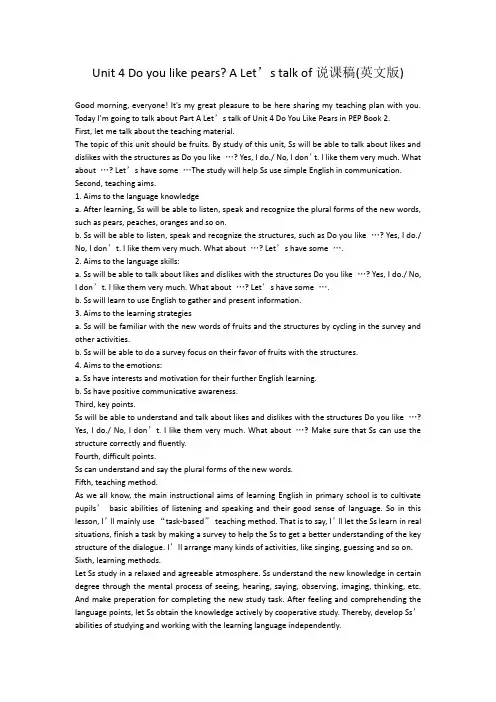
Unit 4 Do you like pears? A Let’s talk of说课稿(英文版)Good morning, everyone! It's my great pleasure to be here sharing my teaching plan with you. Today I'm going to talk about Part A Let’s talk of Unit 4 Do You Like Pears in PEP Book 2.First, let me talk about the teaching material.The topic of this unit should be fruits. By study of this unit, Ss will be able to talk about likes and dislikes with the structures as Do you like …? Yes, I do./ No, I don’t. I like them very much. What about …? Let’s have some …The study will help Ss use simple English in communication. Second, teaching aims.1.Aims to the language knowledgea. After learning, Ss will be able to listen, speak and recognize the plural forms of the new words, such as pears, peaches, oranges and so on.b.Ss will be able to listen, speak and recognize the structures, such as Do you like …? Yes, I do./ No, I don’t. I like them very much. What about …? Let’s have some ….2.Aims to the language skills:a. Ss will be able to talk about likes and dislikes with the structures Do you like …? Yes, I do./ No, I don’t. I like them very much. What about …? Let’s have some ….b. Ss will learn to use English to gather and present information.3. Aims to the learning strategiesa. Ss will be familiar with the new words of fruits and the structures by cycling in the survey and other activities.b. Ss will be able to do a survey focus on their favor of fruits with the structures.4. Aims to the emotions:a. Ss have interests and motivation for their further English learning.b. Ss have positive communicative awareness.Third, key points.Ss will be able to understand and talk about likes and dislikes with the structures Do you like …? Yes, I do./ No, I don’t. I like them very much. What about …? Make sure that Ss can use the structure correctly and fluently.Fourth, difficult points.Ss can understand and say the plural forms of the new words.Fifth, teaching method.As we all know, the main instructional aims of learning English in primary school is to cultivate pupils’basic abilities of listening and speaking and their good sense of language. So in this lesson, I’ll mainly use “task-based”teaching method. That is to say, I’ll let the Ss learn in real situations, finish a task by making a survey to help the Ss to get a better understanding of the key structure of the dialogue. I’ll arrange many kinds of activities, like singing, guessing and so on. Sixth, learning methods.Let Ss study in a relaxed and agreeable atmosphere. Ss understand the new knowledge in certain degree through the mental process of seeing, hearing, saying, observing, imaging, thinking, etc. And make preperation for completing the new study task. After feeling and comprehending the language points, let Ss obtain the knowledge actively by cooperative study. Thereby, develop Ss’abilities of studying and working with the learning language independently.Seventh, teaching aids.I will use the multimedia player and a colourful picture of a fruit shop. And I’ll also make a lively PPT which can attract Ss’attentions very well.Eighth, teaching procedures and purposes of my designing.I’ll teach this lesson in 5 parts.Part I. Warm-upAs language can be learned gradually but not immediately, it’s important for the teacher to find out the links between the language learnt and the new language items. It can lead Ss into the new language items naturally. In this class, Ss will sing a song and take part in free talk with the teacher to recall their memories. Ss will be guided to understand the questions What colour do you like? Do you like …? What about …? and try to express their own favors of colours with the structures I like …Yes./ No.Part II. PresentationThe main purpose of this step is to present new language items. Usually we’d better put it under a real situation.In this class, I will use a big picture of a fruit shop, and show small parts of it. They are in different colours and can help Ss guess What’s in the picture? According to Ss’answer, the new words of fruits will be showed. And next, there will be a quick-response activity which focus on the new words. Then the whole picture will be showed. It will brings Ss into a situation In a fruit shop. I think the way of presentation can really arouse Ss’interests very well. And Ss will be able to understand and say the plural forms of the fruit words with the structures learnt in Unit 3 How many …can you see? I can see …. Guide Ss to pay more attention on their pronunciation. With the help of the lively picture, I will ask S what they like and if they like pears/…. While asking and answering, I will use expression, gesture to help present the target language Do you like …? What about …? and acts as a demonstrator. At that time, three facial expression cards will be presented. I will use to present Yes, I do. Use to present No, I don’t. Use to present Yeah, very much. When Ss have understood the structures, I will get the class to repeat it all together.After that, Amy and her mother will be introduced. Ss will try to find Amy’s likes and dislikes by listening to the tape of Let’s talk. According to Ss’feedback, I will show the class a copy of the questionnaire grid and fill in the blanks as a demonstration.FruitName pears peaches oranges watermelons applesAmyAnd next Ss will watch the video to understand the whole dialogue and learn to read the dialogue correctly. Then Ss will try to act out the dialogue in pairs.Part Ⅲ. PracticeThe main purpose of this step is to help Ss learn the language items by heart and make the language relevant, practical, and communicative.Task 1: Make a new dialogueHowever, as any children’s teacher will know, it is important for Ss to learn a lot more thanEnglish in their English classes. Not only for the intellectual but also the emotional development. So I will guide Ss to make a new dialogue between Amy and her mother. For example, Amy asks her mother: Mom, do you like …? What about …? Let’s have some …Task 2: Make a new chantWe have all experienced that music an rhythm make it much easier to imitate and remember language than words which are ‘just spoken’. So I will present a chant and guide Ss to make a new chant by themselves.For example:Do you likepeaches? Do you likepeaches?Yes, I do. Yes, I do. / Yeah, very much. Yeah, very much.Do you likeoranges? Do you like oranges?No, I don’t. No, I don’t.Task 2: Make a surveyAs we know, younger learners respond to language according to what it does or what they can do with it, rather than treating it as an intellectual game or abstract system. It is important to bear in mind that children need to see the reason for doing the activity, for example, to find information in order to make a survey. Give out copies of the questionnaire grid and guide Ss to ask their neighbours for information.FruitName pears peaches oranges watermelons applesLet’s havesome …Part Ⅳ. ConsolidationAs to this step, the main purpose is to consolidate what Ss have learned during the class and deal with the exercises of the workbook.Part Ⅴ. HomeworkIn order to extend Ss’ability of using English, I think it’s necessary to give Ss some good and proper homework. And according to Ss’level, it should be largely orally based. So I will ask Ss to do a family survey and try to use English as more as possible.Above is the lecture notes of my lesson. Thank you very much!。
新人教版PEP版小学英语三年级下册Unit 4 Where is my car课件.ppt(1)(精品).ppt

例句:—Is the pen in your bag?钢笔在你的包里吗? —No, it isn’t.不,它不在。
注意Yes后面要跟肯定形式,No后面要跟否 定形式。
典例 —Is your cap in your bag? —____B____ A. Yes, it isn’t. B. Yes, it is. C. No, it is.
整体记忆法:如:“all”再加上不同的字母,可组成tall (高的),ball(球),wall(墙)等。
快快长大:各种球的英语表达
football
basketball baseball volleyball
/kɑː(r)/n.(名词)小汽车 例句:Where is my car?
我的小汽车在哪里? 复数:cars 形近词:card 卡片
box /bɒks/n.(名词)盒;箱【二会】 例句:My map is in the box.
我的地图在箱子里。 考向 复数:boxes 合成词:pencil box铅笔盒
形近词:fox(狐狸)
以Is开头的一般疑问句 问句句型:“Is it in/on/under+ 其他?”,用来 确定物品所在的位置。it指前面提到过的某物, 也可以替换成所问的具体物品。 肯定回答:Yes, it is.是的,它在。 否定回答:No, it isn’t.不,它不在。
点拨:“Yes”后面要跟肯定形式,排除A项;“No” 后面要跟否定形式,排除C项;故选B。
知识点 2 Have a good time! 玩开心点儿!
考向 用法:本句是口语中常见的祝福用语。是当对方 去参加宴会或晚会、去外地游玩、参加某项活动 时,向对方说的祝福语。 例句:—I will go to Beijing.我将要去北京。 —Have a good time! 玩开心点儿!
人教版PEP三年级英语下册全册ppt课件

A
2套 A
2套 A
Unit 6 How many?
2套
B
2套 B
2套 B
2套
C
2套 C
2套 C
2套
每课均提供了两套精美课件!
Unit One 1
Welcome Back to School!
Period 4
We are friends. We like to play. We are friends. We like to play. A boy from Canada. A girl from the UK. Friends from China and the USA.
B Let’s talk
Free talk Hi! I’m ______. I’m a ________(boy/girl). I’m from_______.
Where are you from?
…Where are you from? I’m from ________.
UK=British
__I__’m___f__r_o_m___CS_h_h_ia_n_na. dong
五岳独尊
Let’s chant
WWhheerere,,wwhheerere.. WWhheerereaarereyyoouuffroromm?? _C_h_i_na_,__C,hi_n_a._____. II’m’mffroromm_C_h_i_na_.___.
Word bank: UK USA
Canada China
___, I’m ___. I’m a ____. I’m from__t_h_e_U__K_.
I’m a new _s_t_u_d_e_n_t_.
人教版PEP小学三年级英语下册全册完整ppt课件
Hello. My name’s Xi Yangyang. I am a boy.
Hello. My name’s ____. I am a ____.
We have a new friend today. 今天
Hi, My name’s __Z_h_e__n_g__K.ai
I’m from S__h_a_n_g_h__a.i I’m from China.
I am a boy.
This is a boy.
I am a girl.
This is a girl.
I am a boy.
This is a boy.
I am a girl.
This is a girl.
I am a girl.
This is a girl.
I am a boy.
This is a boy.
A
2套 A
2套 A
Unit 6 How many?
2套
B
2套 B
2套 B
2套
C
2套 C
2套 C
2套
每课均提供了两套精美课件!
Unit1 Welcome back to school
Part A Let's talk
kangaroo eagle panda lion beaver
I’m……I’m from…
student
This is … . He/She is a … . He/She’s from … .
This is … . He/She is a … . He/She’s from … . He/She’s … years old. …
介绍同桌。
HelWloh,Aemreya._r_e_y_o_u__fr_o_m_______?
新人教版小学三年级英语下册《How many》ppt课件
The black one is a bird! 黑色的那个是只鸟!
one在此为代词,意为“那个”。为了避免重复, 指代前文出现的kite。
例如:I have three pens. I like the blue one. 我有三只钢笔。我喜欢蓝色的那支。
--How many kites do you see?
Wow, so beautiful !
How many kites do you see?
No! The black one is a bird!
1,2… I see 12! Oh!
Watch again and circle
How many kites do they see?
A.Eleven kites B.Twelve kites
Extension
询问对方看到物品的数量及其回答: —How many kites do you see? —I see 12!
本问句是由疑问词how many引导的特殊疑问句。 how many意为“多少”,后面跟可数名词的复数。 例如:—How many pandas do you see?
你看见多少只熊猫? —I see three.
Part A
Unit 6
How many?
第1课时
激情导入
课文学习
Watch and circle
How many kites do they see?
A.Eleven kites B.Twelve kites
--How many children?
-Two.
Look at the kites!
beautiful!
Bai Ling:Let's fly kites(放风筝)!
新人教版PEP小学英语三年级下册第四单元partA-let's-learn说课+授课复习课程
教学步骤和设计
我的整个教学过程主要分为 热身(Warm-up)、 呈现(Presentation)、 操练(Practice)、 巩固(Consolidation) 四个部分来进行。
(一)热身(Warm-up)
1、Greeting.
2、 Talking.( 出示课件,one picture about Mike)课前导入采用Free talk的形式更有利于学 生从母语环境迅速进入英语学习状态。通过创设 情境的方式讨论图片问题,自然过渡到新课。
(二)呈现(Presentation)
1、The words
1)学习单词desk、chair:通过询问在zip的房间 看到了什么自然引出单词desk和chair。 2)通过zip的三个问题呈现今天的句型,从而引 出方位介词on、in、under。
3、教学手段
根据学生的年龄特点和本课内容,我主要采用实 物、图片、单词卡片以及教师丰富的体态语言等 教学手段进行教学,它们能活化教材,辅助教师 对教学内容进行有序讲解,在讲解的过程中,能 充分利用有效的教学时间,改善信息的传递方式, 增强信息的传递能力,使外语学习变得生动活泼, 加深学生对教学内容的理解。
三年级下册
Unit 4 Where is My Car?
Part A Let’s learn
说 课稿
145269030邱素贞
说教材分析 说教法、学法
说教学目标 说教学重点难点
说教学步骤与设计 结束
一、说教材
本课内容出自新PEP教材三年级下册第四单元《Where is my car ?》,第二课时包括Let’s learn。主要教学五 个单词in、 on、 under、chair 、 desk,并能根据指令 做出相应的动作。教学实践中我们发现:基于学生学习心 理和各阶段身心发展特点,很多相关的知识点采取了分散 教学的方法,让学生循序渐进地掌握。本单元是学生学习 PEP教材过程中,第二次遇到关于方位的话题,是上册运 用英语谈论方位的巩固和延续,为以后学习其他方位词作 铺垫,起着承上启下的作用。本课时是单词和句型的教学。
PEP人教版小学英语三四年级教材解读PPT课件
演讲人:XXXXXX 时 间:XX年XX月XX日
单元主题下的词汇教学
B部分 START TO READ READ AND WRITE
功能和意图
增加学生语言的输入量,逐步提高阅读 能力,以及仿写的能力。
处理和使用方法
1.作为整体的阅读教学,树立简单的篇章概念 2.单元教学完毕时,作为复习部分的综合运用
A部分 Letters and sound /Let’s spell
三上U1
通过趣味活动强化对字母 (shape)的认识; 建议与letters and sounds部 分结合完成
通过单词认读:关注单词词形 及词形与意义的匹配 建议与B Let’s learn 部分结 合完成
Start to read/Read and write (设计意图及要求)
三下U1 在语境中认读单词及核心句型 建议与B Let’s talk部分结合 完成
三下U1
四上Unit 1 My classroom
P8 B Read and write 阅读组句或文段,看图完成读后 活动; 所读核心句型主要来自A/B部分 的对话。 第一步:有意义的抄写单词活动
看图、读句子、选词抄写,完成 句子。四线格中的句子均为对话 及阅读部分强化学习过程的核心 句型。 第二步:个性化书写活动
Let’s learn (PART A-B)
功能和意图 1.在Let’s talk 的基础上,运用单元核心句型
呈现词汇 2.关于先句型还是先单词进行讨论,教材编写
者的意图是:词不离句,所以句为先。 处理和使用 1.在一定语言场景下,结合句型,学习词汇 2、A 为基础,B 为补充拓展,联合AB,开展
pep小学三年级下册unit4课件16260
orange A orange D
orange B
Game: Lucky(幸运的) Orange
What do you like? I like _E
What colour is an orange? It’s orange.
They’re small and sweet(甜的). Some are yellow, some are green and some are red. What are they?
watermelons
Do you like
red watermelons
or yellow watermelons
?
(或者)
Do you like
the big watermelon
or
the small watermelon
?
apples
oranges
pears I don’t like watermelons.
I like oranges.
watermelons peaches
apples
oranges …
pears What do you like? I like ____, I don’t like ____.
watermelons peaches
小组活动,谈论各自喜爱的水果。
Group work
(good, yummy, sweet…)
What is this? What are they?
What is this?
Maybe it’s a/an … . (也许)
an orange
What is this?
Maybe it’s a/an … . (也许)
最新人教版小学三年级英语下册《My family》(第4课时) ppt教学课件
知识精讲
例句:—Is he your brother? 他是你的哥哥吗? — Yes, he is. 是的,他是。
典型例题
Is ___B_____ your mum?
A. he
B. she
Practice
This is Linlin. This is her family.
Work in pairs
Thanks and see you next time!
Ann:Yes, she is.
Ben:___B_____(3)
Ann:He's my brother.
Summary
句子: —Who's that boy? —He's my brother. —Is he/she your ... ? —Yes, he/she is. —No, he/she isn't.
Part B
Unit 2
My family
第4课时
激情导入
Let's play
Who's that boy?
Guess.
Is he your brother?
No, he isn't. He's my dad.
Work in pairs
Who’s that _____?
Guess.
Is he/she your _____?
Is he your father?
Yes, he is.
Is she your mother? No, she isn't.
Is she your mother? Yes, she is.
Is she your sister? Yes, she is.