
西城区2014-2015学年七年级第一学期期末考试英语试题及答案
北京市西城区2014-2015学年第一学期七年级期末考试英语试卷试卷卷面共90分,口试10分,合计100分。
笔试时间共100分钟。
听力理解(共20分)一、听对话。
选出与对话内容相符的图片。
每段对话读两遍。
(共4分,每小题1分)二、听句子。
选择恰当的答语。
每个句子读两遍。
(共3分,每小题1分)5. A. Beef. B. Oranges. C. Coffee.6. A. Oh. Who is your grandma? B. Wow! Can I cook it? C. Really? How does it work?7. A. I see. Here you are.B. Yes. it’s a good idea to watch,TV.C. Oh. thank God. We’ll have a blue sky.三、听对话。
选出最佳答案。
每段对话读两遍。
(共6分,每小题1分)请听一段对话,完成第8至第9小题。
8. Where are they going?A. Paris.B. London.C. New York.9. When are they going there?A. In January.B. In February.C. In March.请听一段对话,完成第10至第11小题。
10. When can the students have breakfast at school?A. At half past six.B. At six.C. At ten past six.11. How many rules have they talked about?A. One.B. Two.C. Three.请听一段对话,完成第12至第13小题。
12. What can Steven do?A. Play football.B. Drive a car.C. Cook.13. What can we know about from the game?A. A country.B. A friend.C. A school.四、听短文,根据短文内容记录关键信息。
短文读两遍。
(共4分,每小题1分)Time to get upAt 14. __________a. m.Things to do for her jobWork in a newspaper 15. __________and write something for most of the day.Time to get upAt 5:45 a. m.Things to do for his jobWalk about 12 miles. stop at about 90 buildings and 17. __________about 500 letters a day.五、听短句。
把句子填写补充完整。
每个句子读两遍。
(共3分,每小题1分)18. I ____________________________.19. _____________Australia?20. _____________friend.语言知识运用(共20分)六、单项填空(共10分,每小题1分)从下面各题所给的A、B、C、D四个选项中,选择可以填入空白处的最佳选项。
21. Mr. Brown has three children,and ___________names are Alex,Amy and Jane.A. theyB. hisC. theirD. he22. Emma's books ___________everywhere—on her bed. on the sofa and under the chair.A. isB. areC. beD. have23. —Excuse me,can you tell me what the weather is like in Beijing in winter?—It’s ___________,so put on your warm clothes.A. warmB. coldC. hotD. cool24. —Look at the picture. Where is the frog?—It is ___________the box.A. inB. underC. onD. next to25. —Are there ___________vegetables in the fridge?—No,there aren’t,but there are ___________fruits.A. some;someB. some;anyC. any;anyD. any;some26. —Do you like this game?—Yes,but I don’t like ___________one.A. thoseB. theseC. thisD. that27. —What does your friend Carl do after school?—He ___________chess in a club. He’s a good player.A. playB. playsC. is playingD. to play28. Let’s go and help John. He ___________flowers in the garden.A. wateringB. is wateringC. watersD. water29. —___________English classes do you have every we ek?—Four.A. How manyB. How muchC. WhichD. What30. He has got ___________time to play because he often helps his mother with the housework.A. manyB. muchC. fewD. little七、完形填空(共10分,每小题1分)阅读下面的短文,掌握其大意,然后从短文后各题所给的A、B、C、D四个选项中,选择最佳选项。
What can a city do about litter(扔垃圾)? Garbage in the streets is a big problem. There are some answers to this problem. A city can buy more garbage cans(垃圾桶). ___31___usually that doesn’t help much. In some cities,people don’t use garbage cans.The police can ___32___. They can watch for litterbugs. Litterbugs are people who throw(扔)garbage on the ground. The police can tell them to ___33___! But sometimes even the police cannot help much. Some people don’t care(关心). They ___34___throw garbage on the ground.All people must want to keep parks and streets ___35___. Advertisements(广告)can help. People can talk about the problem ___36___the radio and television. They can ask for help. You can ask for help. You can ask your neighbours to care about the ___37___.There is a popular saying,“Every little bit counts. ”In a city,every little bit of litter makes a difference. Every little bit of garbage makes a city ___38___. Every “litter” bit of garbage in a garbage can helps to ___39___a clean city.People can make a city clean or dirty. In fact,only ___40___can make the difference between clean and dirty.31. A. But B. So C. Or D. And32. A. use B. answer C. help D. save33. A. leave B. stop C. stay D. 1ie34. A. also B. too C. never D. still35. A. quiet B. clean C. different D. traditional36. A. on B. in C. with D. to37. A. school B. park C. house D. city38. A. clean B. dirty C. special D. green39. A. sweep B. search C. make D. visit40. A. people B. police C. parents D. students阅读理解(共26分)八、阅读选择(共20分,每小题2分)阅读下面短文,根据短文内容,从短文后各题所给的A、B、C、D四个选项中,选择最佳选项。
A41. What does Michael Black do?A. A singer.B. A student.C. A football player.D. A nurse.42. What is the nineteen-year-old boy’s family name?A. Black.B. Brown.C. Klassz.D. Ryder.43. Who are from the same country?A. Steven and Jenny.B. Annie and Jenny.C. Michael and Annie.D. Jenny and Michael.BMy Dog MandyThis is Mandy. She is the best dog! I got her a few months ago when she was just a little puppy(baby dog). She has grown a lot since then! She is a small,brown and white dog with a cute nose and ears.Over the past few months we h ave become good friends. We have spent lots of time together having fun. We go to the park almost every day. We have friends that we meet at the park, so Mandy has other dogs to play with.They run and bark(犬吠)together. Mandy is a small dog but she barks quite loudly. Mandy has learned how to catch a ball. Her favorite toy is a small blue and yellow ball that she can catch in her mouth very easily. She has short legs but she can jump high! It is a game that she likes to play,so we have played it a lot! She is happy and wags (摇)her tail when she catches the ball.She has been good company. Mandy has learned how to jump up on my lap(大腿)when we are at home. Mandy and I have become very close friends and I love her a lot.44. What does Mandy look like?A. She has a small nose.B. She has big ears.C. She is large,black and white.D. She is small,brown and white.45. The writer often takes Mandy to the park because ___________.A. Mandy likes to barkB. Mandy likes jumpingC. Mandy wants to have funD. The park is beautiful46. What can we learn about the writer and Mandy?A. They often run together.B. They work in the same company.C. They often watch games together.D. They are good friends.CCome to the library. Please come in. Are you a student? This is a good place to study. Please,close the door softly. Everyone is quiet here. Students study in quiet places.There are many books here. There are many different kinds. You can use them for your classes. Thereare books about other countries,like Japan and Mexico. You can find history books,too. Take one. Read about the old days. Or read a literature(文学)book. Read stories. Stories are one kind of literature. The library is a quiet place. So it is a good pl ace to study. Many students come here. They use the computers. They read school books of all kinds. For example,they read science books. The students study their lessons. They find answers to questions in books. There is a big dictionary,too. It is on a special little table. It’s in the corner. There is information at the library for students’ papers.There are librarians here. Librarians help students. They know all about books. They can find information fast. They help students with their work.One librarian is Bill Church. Bill is a quiet man. But you can talk to him. You can even call him on the telephone. You can ask him questions. He will help you. He finds answers to questions. He uses the computers in the library. He knows answers to many questions. He can find books and information fast.There are many things to do. You can read for fun. You can look at pictures. You can play on the computer s. But don’t talk loud! Libraries are quiet places for people to read. A person must not talk loud ina library. A person must whisper. Go to the library and enjoy it. But please,be quiet for other people.47. Students come to the library ____________.A. to make friendsB. to read for funC. to make phone callsD. to talk with librarians48. What does the underlined word “whisper” mean?A. Talk quietly.B. Speak loudly.C. Be quiet.D. Read fast.49. What does a librarian do to help students?A. He reads books for students.B. He saves some documents for students.C. He finds books fast for students.D. He writes down the students’ names.50. What is the best title?A. Let’s Read TogetherB. Come To The LibraryC. A Good Place To Work AtD. Libraries Have Big Dictionaries九、阅读短文,根据短文内容回答问题。
2014-2015学年度上期期末考试七年级英语试题

2014-2015学年度上期期末考试七年级英语试题(满分150分,时间120分钟,所有试题做在答题卷上,交卷时只交答题卷。
)一.听力测试。
(30分)Ⅰ. 句子理解。
(5分)听两遍,根据你所听到的内容从A、B、C三个选项中选择适当的图片。
1. A B C2. A B C3. A B C4. A B C5. A B CⅡ. 情景反应。
(7分)听两遍,根据你所听到的句子从A、B、C三个选项中选择最佳答语。
6. A. Nice to meet you, too. B. You’re welcome. C. Fine.7. A. I like this ID card. B. Yes, it is. C. It’s hers.8. A. Yes. It’s nice. B. It’s black. C. It’s on the table.9. A. No, they aren’t. B. Yes, please. I want a pen. C. I don’t know.10. A. He has a baseball. B. He likes eggs. C. No, he doesn’t.11. A. That sounds good. B. Yes, it is. C. Good morning.12. A. It isn’t nice. B. Thank you. C. They’re my parents. Ⅲ. 对话理解。
(8分)听两遍,根据你所听到的对话及问题从A、B、C三个选项中选择最佳答案。
13. A. Green. B. Yellow. C. Black.14. A. Yes, it is. B. No, it isn’t. C. It’s hers.15. A. It’s on the sofa. B. It’s on the table. C. It’s in the bookcase.16. A. Yes, she does. B. No, he doesn’t. C. Yes, he does.17. A. He’s ten. B. He’s eleven. C. He’s twelve.18. A. Math. B. English. C. Chinese.19. A. Jack. B. Smith. C. Green.20. A. 6 dollars. B. 10 dollars. C. 12 dollars.Ⅳ. 短文理解。
2014—2015学年度第一学期期末考试七年级英语(冀教版)试题
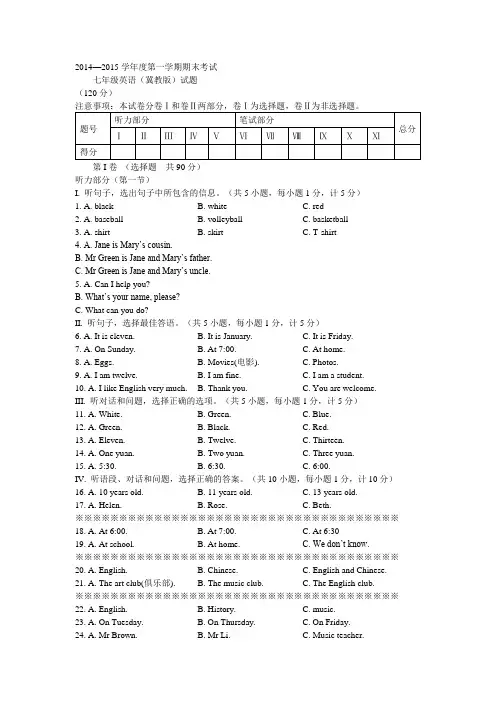
2014—2015学年度第一学期期末考试七年级英语(冀教版)试题(120分)第I卷(选择题共90分)听力部分(第一节)I. 听句子,选出句子中所包含的信息。
(共5小题,每小题1分,计5分)1. A. black B. white C. red2. A. baseball B. volleyball C. basketball3. A. shirt B. skirt C. T-shirt4. A. Jane is Mary’s cousin.B. Mr Green is Jane and Mary’s father.C. Mr Green is Jane and Mary’s uncle.5. A. Can I help you?B. What’s your name, please?C. What can you do?II. 听句子,选择最佳答语。
(共5小题,每小题1分,计5分)6. A. It is eleven. B. It is January. C. It is Friday.7. A. On Sunday. B. At 7:00. C. At home.8. A. Eggs. B. Movies(电影). C. Photos.9. A. I am twelve. B. I am fine. C. I am a student.10. A. I like English very much. B. Thank you. C. You are welcome.III. 听对话和问题,选择正确的选项。
(共5小题,每小题1分,计5分)11. A. White. B. Green. C. Blue.12. A. Green. B. Black. C. Red.13. A. Eleven. B. Twelve. C. Thirteen.14. A. One yuan. B. Two yuan. C. Three yuan.15. A. 5:30. B. 6:30. C. 6:00.IV. 听语段、对话和问题,选择正确的答案。
2014-2015学年度第二学期七年级英语期末复习基础知识过关测试
A)根据所给提示及句意,写出句中所缺单词,使句子完整正确。
51. We should try not to eat the food with . /æt/. / l D kt/53. There is a dog lying in the (角落) of the room.54. The door is wide enough for three people to go at the same time. (通过)55. We were all after we heard what he said(激动的).56. Why not money for children in need? (募集)57. You can’t leave the lights when you leave the house. (开)58. It’s dangerous for the children to play with .(火柴)59. My cat is very lazy. It can sleep . (任何地方)B) 根据句意,用括号中所给词的适当形式填空。
60. When my cat is full, he always likes (lie) on the bed.61. She (weigh) twenty-five kilos when she was eight.62. When I walked past, I saw her (build) camps out of sticks.63. One of the (policeman) dogs is searching the forest for something important.64. Look at Mrs. Lin. Is she saying to (she)?65. He tried his best (carry) the boy to the safe place.66. I don’t like the train. It is hot, (noise) and dirty.67. She always asks her son (not be) late for school.68. You should (brush) your teeth twice a day.C) 根据括号中的要求,完成下列句子。
北京市西城区2014—2015学年度第一学期期末试卷

北京市西城区2014—2015学年度第一学期期末试卷第二部分:知识运用(共两节,45分)21. They’ve moved to a different house _____ their children can attend a better school.A. in caseB. as long asC. so thatD. even though22. _____ his ID card, Philip had to go to the police station in person and reapply for a new one.A. Having lostB. LosingC. To loseD. Lose23. I believe that the world is _____ you think it is. So smile at the world and it will smile back.A. whatB. howC. thatD. which24. —I was very angry with Kelvin yesterday.—I know your feelings, but if you forgive him, you _____ a bigger man.A. have beenB. would beC. will beD. were25. —What do you do as a volunteer in Africa?—_____! There are many poor people there. They need a lot of help.A. NoneB. SomethingC. LittleD. Everything26. Arriving at the party in a great hurry, we were disappointed to find that the band _____ playing.A. stoppedB. will stopC. has stoppedD. had stopped27. The sign at Gate 8 reads that you _____ show your boarding pass and passport before getting onthe plane.A. canB. mustC. mayD. would28. This ferryboat _____ to transport passengers between the harbor and the island for years.A. is usedB. was being usedC. is being usedD. has been used29. It is becoming a threat to the Chinese language and culture _____ some people can’t writeChinese characters properly.A. whichB. thatC. whetherD. how30. _____ the travelling needs of passengers, China Railway Corporation has decided that peoplecan book tickets 60 days in advance.A. MeetB. To meetC. MetD. Meeting31. The Alibaba Group, _____ was founded in 1999, has become China’s largest e-commercecompany.A. whichB. whatC. whoseD. that32. —Hi, Lucy! What’s the schedule for tomorrow?—Let me check. You _____ an appointment with Thomas at three o’clock.A. haveB. hadC. were havingD. have had33. Peter would have the chance to present his talents in the competition now if he _____ last term.A. signed upB. had signed upC. signs upD. has signed up34. There are 12 lamps hanging _____ the ceiling in the restaurant.A. onB. inC. fromD. around35. In Singapore, people _____ eating or drinking on the subway can be fined up to 500 Singaporedollars.A. having caughtB. catchingC. caughtD. catchCAACD DBDBB AABCC第二节完形填空(共20小题;每小题1.5分,共30分)Each of us struggles for self-respect and self-worth to some degree. I spent much time trying to achieve perfection in every aspect of my life.I was a happy kid with a lot of friends and a supportive family. But growing up was really36 and even scary sometimes.During my childhood, I was constantly involved in something that included people’s viewing my achievements or my 37 . I wanted everyone’s praise and acceptance, but I was my own toughest critic(挑剔的人).After I graduated from high school, my 38 to be “thin” began to trouble me. I began trying to diet by 39 my food.In the beginning, I felt great—attractive and successful, almost superhuman. I even thought that I was better than everyone else. What I di dn’t see was that I was slowly 40 myself.People around me began to 41 my weight loss. They said with concern. “You’re losing too much weight.” “Elisa, you’re so thin.” All their words only suggested that I was getting closer to “42 ” .Sadly, I took my physical 43 the first important in my life, 44 that it was the way to become successful and accepted.Then I cut down my 45 more and more, until a 46 day consisted of half a teaspoon of nonfat yoghurt and coffee in the morning, and a cup of grapes at night.But my poor 47 began to cause me to lose 48 . Then one night, like many nights before, I couldn’t sleep, and my heart felt as though it might beat out of my chest. I tried to49 , but I couldn’t. The beating became so rapid and so strong that I could no longer50 . What I had done to diet nearly caused me to have a heart attack. I stood up, and immediately fell down. I was really 51 , and I knew I needed help. My roommate rushed me to the52 , beginning the long road to my 53 . It took a lot—doctors, nurses, nutritionists, food supplements…And most important, a sense of what was true about myself got back on track with reality. I realized that, with my 54 of trying to be “perfect” on the 55 , I had sacrificed who I was on the inside. What I know now is, we are—each and every one of us—already perfect.36.A. natural B. hard C. easy D. possible37.A. natures B. backgrounds C. failures D. scores38.A. problem B. desire C. way D. promise39.A. collecting B. checking C. controlling D. balancing40.A. killing B. forgetting C. asking D. questioning41.A. help B. accept C. reject D. notice42.A. perfection B. devotion C. destination D. attention43.A. strength B. exercise C. examination D. appearance44.A. believing B. realizing C. pretending D. declaring45.A. expense B. movement C. food D. travel46.A. pleasant B. difficult C. different D. typical47.A. memory B. nutrition C. knowledge D. taste48.A. weight B. h ope C. sleep D. job49.A. walk B. relax C. cry D. talk50.A. breathe B. resist C. wake D. remember51.A. scared B. annoyed C. discouraged D. disappointed52.A. bed B. office C. school D. hospital53.A. glory B. recovery C. discovery D. victory54.A. skill B. decision C. experience D. deal55.A. whole B. face C. mind D. outsideBCBCA DADAC DBCBA ADBCD第三部分:阅读理解(共两节,40分)AWelcome to OysterOyster is a smart card which can hold Pay as you go credit, Travelcard and Bus & Tram(有轨电车) Pass season tickets. It is the cheapest way for you to pay for single journeys on bus, Tube, tram, DLR, London Overground and most National Rail services in London.Pay as you go on your Oyster cardUsing Pay as you go is cheaper than paying cash for most journeys.Daily limitIf you’re unsure of the number of journeys you’re going to make, Oyster pay is easy for you to use. Make as many journeys as you like and you’ll never pay more than the daily limit for the zones you’ve travelled in. Daily limits are calculated over a 24-hour period, covering all the journeys starting between 4:30 and 4:29 the next day. There are different limits for different types of transport and times of day.The system calculates the daily limit based on when and how you travel. Money will be taken away from your card each time you travel, until you reach a daily limit. This includes Pay as you go travel on bus, Tube, tram, London Overground and most National Rail services in London. River services and the Emirates Air Line do not contribute to your daily limit. For more information, visit /oyster.Season tickets on your Oyster cardYou can buy Travelcards and Bus & Tram Passes on Oyster. With a Travelcard, you can travel as many times as you like on bus, Tube, London Overground and National Rail services on the dates, and across the trav el zones you’ve paid for. Please ensure your Travelcard covers all the zones you travel through. If your Travelcard includes zone 3, 4, 5 or 6, you can also use it on tram services. Bus & Tram Passes can be used on trams and London buses displaying the red roundel bus symbol on the dates you’ve paid for.The red roundelWhen you first get an Oyster card, you will need to pay a £5 refundable (可退款的) deposit. If you no longer need your Oyster card, we’ll refund any remain ing pay. Find out more at /refunds.56. What do we know about the daily limit?A. You’ll stop paying once you reach the daily limit.B. River services help contribute to your daily limit.C. The daily limit is fixed no matter when you travel.D. You’ll pay more than the daily limit for your travel.57. Season tickets include _____.A. Oyster card and TravelcardsB. Pay as you go and TravelcardsC. Travelcards and Bus & Tram PassesD. Pay as you go and Bus & Tram Passes58. Where is the text probably taken from?A. A brochure.B. A report.C. A novel.D. An essay.56.A 57.C 58.ABMy morning routine varies little from day to day. I walk the dog, eat breakfast at the kitchen counter with Katie and Matt, and then settle in for a day at the computer. And because I work mostly from home, I have learned that little walks into the outside world are important for psychological well-being. So before I begin attempting to put sentences together, I walk over to a little coffee shop in my neighborhood, and chat with the folks behind the counter.The coffee shop is on the other side of the historic Chesapeaker & Ohio Canal from my house. Whenever in season, tourists line up to take a slow boat, if not to India, at least into the 19th century.One warm day last fall, I turned the corner to see one of the boatmen sitting alone on the boat, bathed in early-morning light. He was playing the violin. The scene stopped me in my tracks. What I witnessed could only be described as a perfect moment. Ten seconds at most. But months later I still remember just standing there, watching, listening, and taking it all in.We all have such moments put before us. Little surprises. Whether we’re wise enough to see them is another thing.I thought of the violin man one Sunday afternoon while reading the biographies of those killed in the Columbia incident. The specialist Laurel Clark, talking from the shuttle a few days before it was to land, said it was blissful to see the simple unexpected wonders of space, like a sunset. “There’s a flash; the whole payload bay turns this rosy pink,” she said. “It only lasts about 15 seconds, and then it’s gone.”I once had a friend who had a strange habit that never stopped to amuse me, maybe because I never quite knew when she was going to spring it on me. It could come in the middle of a particularly lively dinner with old friends. Out of the blue, she’d say, “Stop! I want to remember this moment.” I realize now, after her death, what wise advice that is.59. The author goes out for a walk every day in the morning mainly because _____.A. she needs to walk the dog and enjoy the fresh airB. she considers that it is good for her physical healthC. she hates to be left alone at home when others are outD. she benefits psychologically from contacting the outside world60. The underlined word “blissful” in Paragraph 5 probably means _____.A. enjoyableB. valuableC. agreeableD. reasonable61. The main purpose of the passage is to tell people to _____.A. develop a good habitB. enjoy life to the fullestC. catch the valuable moments in lifeD. be willing to follow friends’ advice62. “I” in the passage is probably a _____.A. violinistB. writerC. sailorD. waitress59.D 60.A 61.C 62.BCA lot of us think that we should visit the dentist every six months. Whether those check-ups are really necessary is, however, a matter of debate. In 2000, three-quarters of dentists surveyed in New York were recommending six-monthly check-ups, despite the absence of evidence. Today, many organizations still recommend six-monthly check-ups. But for several decades some have been arguing that the choice of six months as the ideal space between visits is rather questionable. For example, Aubrey Sheiham, a professor of dental public health, published a paper complaining about the lack of evidence for six-monthly check-ups. Almost 40 years, he’s still making the same point.Last year the Cochrane Collaboration performed a review of the research that had been done and they were disappointed with what they found. The quality and quantity of the research was simply too poor to back up the idea of six-monthly check-ups.There’s something else we have to bear in mind. Even when a study finds, for example, that children who go to the dentist frequently have fewer fillings, there may be other factors(因素) at work. Those same children may have other advantages; they may eat more healthily and have better quality dental equipment.How often should you visit the dentist, then? Bodies like Nice, which provides guidance for the National Health Service in England and Wales, say that the frequency of dental visits all depends on the individual. They recommend that children go at least once a year because their teeth can decay(蛀蚀) faster, while adults without problems can wait as long as two years. They even go as far as to say that longer than two years is OK for people who have shown commitment to caring for their teeth.Where does this leave the rest of us the next time we receive a card in the mail reminding us our next dental visit is due? We’d all like an excuse to go less often, and the good news is that if you don’t have any problems you can probably w ait a little longer than six months between visits. But exactly how long you can wait before your appointment with the dentist’s chair will depend on the assessment you and your dentist make of your own risk.63. Who supports six-monthly dental check-ups?A. All the dentists.B. Many organizations.C. Aubrey Sheiham.D. The National Health Service.64. The research may not prove the idea of six-monthly check-ups because _____.A. the researchers were not qualifiedB. the number of the subjects was bigC. there might be other factors at workD. there was a lack of quality dental equipment65. We can learn from the last two paragraphs that _____.A. people often find excuses to avoid the next dental visitB. the frequency of dental visits varies for different peopleC. people should decide when to go to the dentist by themselvesD. the healthier a person is, the less frequent the dental visits are66. What is the best title for this passage?A. How can we go to the dentist less?B. Why do we need to visit our dentist?C. Who should go to the dentist frequently?D. How often do we need to visit our dentist?63.B 64.C 65.B 66.DDDo we really know our best friends?I like my close friends a lot, and yet, on an almost daily basis, they shocked me. I have a friend who thinks voting is a waste of time; I have another friend who never takes any arrangement to meet at a given time and place seriously.It’s generally held that friends are people with whom we choose to develop relationships because we find their personalities agreeable, or similar to our own, and yet experience regularly contradicts this. What is a friend, really? All that one can safely say is that a friend is someone one likes and wishes to see again.The truth is that we don’t know our friends. Numerous studies show that we tend to assume our friends agree with us more than they really do. The striking part is that the problem doesn’t appear to lessen as a friendship deepens. When the researchers Michael Gill and Bill Swann questioned students sharing rooms, they found that, as time passed, people became even more confident in the accuracy of their judgments about the other, and yet, in reality, the judgments grew no more accurate. Two people might become dear friends, yet remain ignorant about vast areas of each other’s inner lives.This seems strange, until you consider, that many of the benefits that friendship provides don’t necessarily depend on perfect familiarity; they come from something closer to reliability. Friendship may be less about being drawn to someone’s personality than about finding someone willing to keep you company, or lend an ear. A friend provides the “social-identity support” we desire. You needn’t be a close match with someone, nor deeply familiar with their mind. And once a friendship has begun, you want to like it, if only to confirm that you made the right decisi on. We don’t want to know everything about our friends. We don’t base friendships on what we learn about people; we decide what to learn about people, and what to ignore, based on having decided to be friends.Perhaps there’s something moving about viewing friendshipas an agreement to keep each other company, ignore each other’sfaults and not probe (刨根问底) too deeply in ways that mightweaken the friendship. Perhaps a true friend is someone whodoesn’t ask many awkward questions.67. Why does the author tell the stories of his two friends in thefirst paragraph?A. To provide background information.B. To introduce the topic of the passage.C. To stress the importance of friendship.D. To show the difference between friends.68. The underlined word “they” in Paragraph 4 refers to _____.A. friendsB. judgmentsC. researchersD. benefits69. It can be concluded from the passage that _____.A. close friends usually know each other in depthB. real friends are people you like but don’t wish to see oftenC. we do not necessarily share personalities with close friendsD. the longer we stay with friends, the more accurately we judge them70. Which statement about friends will the author probably accept?A. Stay friends but keep a distance.B. It takes a long time to grow an old friend.C. Real friends will tell you when your face is dirty.D. True friends know all about you and still like you.67.B 68.D 69.C 70.A第二节(共5小题;每小题2分,共10分)Real-life Room Escape GamesReal-life room escape games are a type of physical adventure game in which people are locked in a room with other participants and have to use the things in the room to settle a series of puzzles, find clues (线索), and escape the room within a set time limit.The games are based off Escape the Room video games, such as Crimson Room and QP-Shot, created by TAKAGISM Inc. by Toshimitsu Takagi in 2005, in which the player is locked inside a room and must explore his or her surroundings in order to escape. 71 Other inspirations include adventure board games and movies. Real-life room escape games are becoming popular in the United States, Japan, and China. 72 For example, some games require you escape prison cells while others require you escape space stations.73 Soon, they were exported to North America, Asia and Australia. Examples include the two pioneer companies Hint Hunt and Adventure Rooms.The games were so successful that new locations began opening up across China, in cities big and small, according to Want China Times. In the southern city of Shenzhen, for example, the first escape game location opened last August. 74 “These real-life escape games can help those who stay at home on their computers and iPads all day to experience real social circles,” Tian Xiaochuan, who owns two room escape game stores in Jinan, told Want China Times.Earlier this year, The South China Morning Po s t said the real-life escape games are a hit among “highly stressed students and overworked young professionals.” 75 Some players get so involved that they tear down equipment or decorations inside their “prisons”, as Zhu Yumeng, chief operating officer of Beijing room escape game store Taoquan told China Daily.A. Each game adds local themes to settings.B. And seven new game locations quickly followed.C. They should also be brave enough to face their fears.D. Sometimes the excitement becomes a bit much, though.E. Weekend or day event escape games have been held in some stores.F. Permanent real life escape games in a fixed location were first opened in Europe.G. Players must be observant and use their critical thinking skills to escape the room.71.G 72.A 73.F 74.B 75.D第四部分:书面表达(共两节,35分)第一节(15分)你的英国笔友Chris要来北京参加一个汉语冬令营。
宜宾市2014—2015学年秋第一学期期末教学质量监测七年级英语试题、听力及答案
宜宾市2014—2015学年秋第一学期期末教学质量监测七年级英语试题考生须知:1.本试卷分为试题卷和答题卡两部分。
满分为120分,考试时间为120分钟。
2.答题前,考生先将自己的姓名、学校、班级用碳素笔或钢笔填写清楚。
3.必须在答题卡的对应位置上答题,写在其他地方无效。
答题方式详见答题卡上的说明。
4.考试结束后,试题卷和答题卡一并上交。
第I卷选择题(共四部分,满分90分)第一部分:听力(共四节, 满分20分)第一节:听录音,选出句子中所包含的信息。
每个句子读两遍(每小题1分,共5分)1. A. October B. December C. November2. A. about B. at C. for3. A. look B. late C. lunch4. A. 1708 B. 1780 C. 18075. A. at that time B. at the party C. at school第二节:听句子,选择最佳答语。
每个句子读两遍(每小题1分,共5分)6. A. It’s mine. B. Here you are. C. She is my sister.7. A. No, I don’t. B. No, I’m not. C. No, I can’t.8. A. She is under the tree. B. She is Miss Miller. C. She is 28.9. A. 7284628. B. 8 years old. C. $15.10. A. Sounds good. B. You’re right. C. Yes, I do.第三节:听下面五段对话,选择最佳答案。
每段对话读两遍(每小题1分,共5分)11. What food doesn’t Steven like?A. Salad.B. Chicken.C. Vegetables.12. Where is the baseball?A. Under the table.B. In the schoolbag.C. On the desk.13. What does the woman want to buy?A. A sweater.B. Hamburgers.C. A pair of trousers.14. Who is Mike?A. The girl’s father.B. The girl’s uncle.C. The girl’s brother.15. What kind (种类) of books does the boy like?A. Math books.B. English books.C. History books.第四节:听下面一段短文,选择最佳答案。
2023-2024学年北京市西城区七年级上学期期末考试英语试卷含答案
北京市西城区2023—2024学年度第一学期期末试卷七年级英语2024.1听力理解(共20分)一、听对话或独白,根据对话或独白的内容,从下面各题所给的A、B、C三个选项中选出最佳选项。
每段对话或独白你将听两遍。
(共12分,每小题1.5分)请听一段对话,完成第1至第2小题。
1. How old is Peter’s brother?A. 10.B. 13.C. 23.2. What is Peter’s father’s job?A. A policeman.B. A taxi driver.C. A doctor.请听一段对话,完成第3至第4小题。
3. What is Betty’s favorite animal?A. The cat.B. The lion.C. The tiger.4. What do they plan to do after school today?A. Visit the zoo.B. Sing a song.C. Watch a movie.请听一段对话,完成第5至第6小题。
5. When do they have science class?A. On Tuesday.B. On Wednesday.C. On Friday.6. Why does the girl love history?A. Because she is good at it.B. Because the homework is easy.C. Because she thinks it is interesting.请听一段独白,完成第7至第8小题。
7. What can you know from the speaker?A. The visitors will go to a museum.B. There is no free time for the visitors.C. The visitors will eat three meals together.8. Why does the speaker give this talk?A. To show people some fun places.B. To invite people to join a travel group.C. To tell people about a one-day trip plan.二、听独白,记录关键信息。
北京市西城区2019-2020学年七年级上学期期末考试英语试题
北京市西城区2019-2020学年度第一学期期末试卷 七年级英语 2020.1听力理解(共20分)一、听下面四段对话。
每段对话后有两道小题, 从每题所给的A,B,C 三个选项中选出最佳选项。
每段对话你将听两遍。
(共12分, 每小题1.5分)请听一段对话, 完成第1至第2小题。
1. What is the girl doing?A. Teaching English.B. Reading a letter.C. Visiting a school.2. Where is the girl's aunt now?A. In China.B. In America.C. In England.请听一段对话, 完成第3至第4小题。
3- What is the boy's favourite sport?A. Football.B. Swimming.C. Tennis.4. How often does the boy do it?A. Every day.B. Once a week.C. Every month.请听一段对话, 完成第5至第6小题。
5. When does the girl need to meet Julie?A. On Saturday morning.B. On Saturday afternoon.C. On Saturday evening.6. What do the two speakers want to do at last?A. See a movie.B. Clean the house.C. Make dinner.请听一段对话, 完成第7至第8小题。
7. What can we know from the conversation (对话)?A. It's easy for the girl to make all kinds of paper cuts.B. The girl is putting the paper cut on her door.C. The boy is interested in paper cutting.8. Where are the two speakers going next?A. To the girl's home.B. To the boy's home.C. To a paper cut shop.二、听独白,记录关键信息。
2023年1月西城七年级英语答案及评分参考
北京市西城区2022—2023学年度第一学期期末试卷七年级英语答案及评分参考2023.1听力理解一、听对话或独白,选答案。
1. A2. B3. C4. B5. A6. C7. B8. C二、听独白,填信息。
9. 90 10. Panda 11. playing 12. healthy知识运用三、单项填空13. B 14. A 15. A 16. C 17. B 18. A 19. A20. B 21. B 22. C四、完形填空23. B 24. C 25. D 26. A27. B 28. A 29. C 30. A 31. B 32. C阅读理解五、阅读短文,根据短文内容选出最佳选项。
33. A 34. B. 35. C 36. B 37. A 38. A 39. C40. A 41. C 42. A 43. B六、阅读短文,根据短文内容回答问题。
44. Tiger sharks.45. Because the water is too deep and not clear enough.46. By tracking signals.47. Large underwater animals are useful in helping to learn more about lifeunder the sea.书面表达七、根据句意和音标填写单词。
48. cut 49. film 50. funny 51. driver八、根据中文意思和英文提示词语写出句子。
52. The students are cleaning the classroom.53. Jack often watches football matches with his father.54. There are many new books in the library.20222023学年度第一学期期末试卷第1页(共4页)九、文段表达55.Possible version:My Family Fun TimeMy family fun time is on Friday night. It is the time when we are free to enjoy relaxing family activities. We always talk to one another while having a big dinner. Watching movies together is also one of my favourite family activities.Family fun time is important to me because some of my best memories have been the times we’ve spent together doing activities around the house. My family is filled with so much love!评分标准:说明:先根据文章整体内容确定档次,然后在该档次内评出分数。
七英上期末思博英语试卷 -
学校 班级 座号 姓名__________________________◆◆◆◆◆◆◆◆◆◆◆◆◆◆◆装◆◆◆◆◆◆◆◆◆◆◆◆◆◆◆订◆◆◆◆◆◆◆◆◆◆◆◆◆线◆◆◆◆◆◆◆◆◆◆◆◆◆◆◆思博学校七年级期末考试英语试卷(2014-2015学年度第一学期)第一部分 听力部分Ⅰ.听力测试。
(本大题分为A 、B 、C 、D 四部分,共30分)A. 听句子(本题有5小题,每小题1分,共5分)根据所听的句子的内容和所提的问题,选择符合题意的图画回答问题,并将最佳选项的字母编号填写在相应位置上。
每小题听一遍。
( )1. How much is the bag?A B C¥90 ¥19 ¥9 ( )2. What does Mike give his teacher on Teacher ’s Day?A B C( )3. What ’s Sally ’s favorite subject?A B C( )4. What ’s on the sofa?A B C( )5. What does Tom like for breakfast?A B CB . 听对话(本题有10小题,每小题1分,共10分)回答每段对话后面的问题,在各题所给的三个选项中选出一个最佳答案,并将字母编号填写在相应位置上。
每段对话听两遍。
听第一段对话,回答第6小题。
( )6.What does Bruce have? A. A volleyball B. A basketball. C. A baseball. 听第二段对话,回答第7小题。
( ) 7. Who has the pingpong bat? A. Linda B. John C. Paul. 听第三段对话,回答第8小题。
( ) 8. Where is the dictionary?A. In Lucy ’s backpackB. In Lily ’s backpackC. In Jim ’s backpack 听第四段对话,回答第9小题。
2014—2015学年度上学期期末考试七年级英语试卷
2014—2015学年度上学期期末考试七年级英语试卷(全卷4个部分,共8页;满分120分,考试用时120分钟)注意事项:1.本卷为试题卷。
考生解题作答必须在答题卷上。
答案书写在答题卷相应位置上,在试题卷、草稿纸上作答无效。
2.考试结束后,请将试题卷和答题卷一并交回。
第一部分听力(共4节,满分30 分)3. A. B. C.4. A. B. C.5.A. B. C.第二节听句子,选出与所听句子内容相符的正确答语,并将所选答案的字母代号填入答题卷相应空格内。
每个句子听两遍。
(共5小题,每小题1分,满分5分)6.A. Good-bye. B. You’re welcome. C. Let me help you.7. A. Oh, I’d love to. B. Here you are. C. No, I don’t want to go.8. A. I am Sally. B. This is Sally. C. See you then.9. A. That’s OK. B. Yes, I do. C. Sure.10. A. Excuse me. B. I see. C. Good idea.第三节听对话,选出能回答问题的正确选项,并将其字母代号填入答题卷相应空格内。
每B. Short blond hair and a small nose.C. Short blond hair and a big nose.What color is her dress?Red. B. Purple. C. Pink.听第三段对话,回答第15-17题。
Where are they ?At school. B. In a restaurant. C. On a bus.What would he like to drink?A glass of orange juice. B. A glass of apple juice. C. A glass of banana juice.He wants to eat ______________Rice , chicken and vegetables. B. Rice , chicken and fish. C. Rice , vegetables and fish.听第四段对话,回答第18-20题。