
最新人教版英语七年级Unit8_When_is_your_birthday_SectionB
Dates
September 21st
October 12th October 15th October 22nd November 3rd November 30th December 3rd
Activities school trip soccer game volleyball game school day art festival English party book sale
January February March April May June
Twelve months of the year
&July &August &September &October &November &December
December
一 二 三 四 五 六 日
1st 2nd 3rd 4th 5th 6th 7th 8th 9th 10th 11th 12th 13th 14th 15th 16th 17th 18th 19th 20th What’s the date today? st 22nd 21 23rd 24th 25th (今天几号?) 26th 27th th December It’s ninth. 28 29th 30th 31st
Role-play the conversations in 3b. A: How old are you, Grace? B: I’m twelve. A: And when is your birthday? B: My birthday is on March 12th. How about you and Tom? A: Well, my birthday is on July 5th, and Tom’s birthday is in December.
2b Read the passage and
Dear students, 1. Is this a busy term? We have some interesting and fun things for you this term. On September 21st, we have a school trip in the afternoon. October is a great month. On the 12th and the 15th, we have two ball games, soccer and volleyball. School Day is on October 22nd. Your parents can come to our school. Next month, we have an art festival. It’s on November 3rd. We have an English party on November 30th. And on December 3rd, we have a book sale in the school library. This is a really busy term! Have a good time!
Sally’s birthday party
Pairwork
When is John’s school trip?
1d
Ask and answer questions about John’s calendar.
It’s on September 25th.
It’s on October 2nd. It’s on October 5th.
2) have 表示“举行;举办”,后面跟表示 活动的名词,指举办某种活动。如: have a class meeting 开班会 have a music festival 举办音乐节 have tennis games 举办网球赛 have a book sale 举行减价售书活动
[归纳] have的其他用法: (1) have有“有;拥有”之意。如: I have three soccer balls, but my brother doesn’t. 我有三个足球,而我弟弟没有。 (2) have有“吃;喝”之意。如: I usually have an apple and a hamburger for breakfast. 早饭我通常吃一个苹果和一个汉堡。 (3) have用于某些短语中,如: have a look 看一看。
(2) 以s或es结尾的复数名词,在词尾加 “ ’ ”。如: the teachers’ reading room 教室阅览室 (3) 表示几者共同拥有时,只须在最后一个 名词后加“’s”;若表示各自所有,则 必 须在各个名词后加“’s”。如: This is Tom and Lucy’s room. 这是汤姆和露西共有的房间。 These are Tom’s and Lucy’s rooms.
answer the question.
Read the school notice again and list the activities and the date. 阅读指导: 该文是按时间顺序,列举了学校一学期的大事活 动安排。 首先,浏览表格,确定阅读任务。由Dates和Activities两词可知,可知是找出活动及举行日期。 然后,带着任务快速阅读短文,画出关键信息。 最后,按时间的先后顺序,将日期与活动一一列 出。如:由句子“Next month, we have an art festival. It’s on November 3rd.”可知,在 November 3rd这天,举行的活动是art festival。
2c
Discuss the questions with your partner.
1. What activities from 2b do you like? I like… ? school trip art festival School Day book sale soccer game volleyball game English party 2. What other activities do you like? I like… basketball game Sports Day ? English Day
H om e w or k
1. Remember all the new words and expressions. 2. Review Section B 2b. Try to retell the passage.
a. School Day b. book sale c. Sports Day d. art festival e. English Day f. basketball game g. volleyball game h. school trip i. Soccer game j. English test k. English party
1c Listen again. Fill in
John’s calendar.
SEPTEMBER 24 25 26 the school trball game
27 28 the school trip 4 5
29 30 the English trip 6 7
basketball game
soccer game
volleyball game
party
school trip
English test
I love English!
Sports Day
English Day
School Day
art festival
book sale
in the morning
1. __ d English test 3. __ b school trip 2. __ 4. __ a basketball game c party
Listen and circle the 1b events you hear in 1a.
Listen again and fill in the blanks:
3. Have a good time! 在课文中一个表示祝福 的句子,意为“祝你玩得高兴!”。 have a good time也是一个固定词组,意为 “玩得高兴;过得愉快”,相当于have fun 或enjoy oneself (oneself随主语的变化而变化)。 如: Eric has a good time there every day. =Eric has fun there every day. =Eric enjoys himself there every day. 埃里克在那里每天过得都很愉快。
When is the basketball game? When is Sally’s birthday party?
2a Check (√) the activities you
have at your school.
Soccer game school trip book sale English Day Sports Day party School Day art festival
(4) 表示无生命事物的名词所有格需要借助 介词of来表示。如:a photo of my family 我家的全家福 the windows of the house 房 子的窗户
2. Next month, we have an art festival. 下个月,我们举行艺术节。 1) month用作名词,意为“月;月份”,其 复数形式为months,不可写为monthes。 There are twelve months in a year. 一年有十二个月。
in the afternoon
in the evening
We have a school trip tomorrow (明天). some interesting and fun things
人教版英语七年级上册Unit8When’syourbirthday优秀教学案例
(一)知识与技能
1.让学生掌握关于日期和时间的表达方式,如月份、星期、序数词等,并能够运用这些词汇描述自己的生日。
2.培养学生运用一般疑问句和特殊疑问句询问他人生日的能力,如"When's your "和"Is it on the first of May?"等。
3.使学生掌握与生日相关的词汇,如birthday, present, celebrate, party等,并能运用这些词汇进行简单的句子构建。
四、教学内容与过程
(一)导入新课
在导入新课的环节,教师将运用生动有趣的方式引起学生对本章节主题的兴趣,为接下来的学习打下良好基础。
1.教师以一首英文歌曲《Happy Birthday》作为课堂的开场,让学生在轻松愉快的氛围中进入学习状态。
2.教师展示一张班级同学的生日照片,引导学生关注生日庆祝活动,并提问:“Do you know whose birthday it is?”、“How do you celebrate your birthday?”,让学生自由发表观点,为新课的学习做好铺垫。
(二)讲授新知
在讲授新知环节,教师将系统地介绍本章节的核心知识点,并结合实例进行讲解,帮助学生更好地掌握英语表达。
1.教师通过PPT展示月份、星期、序数词等日期表达方式,并结合实际案例进行讲解,如:“My birthday is on the second of June.”。
2.引导学生学习一般疑问句和特殊疑问句询问他人生日,如:“When's your birthday?”、“Is it on the first of May?”等。
在这个优秀教学案例中,教师将通过多样化的教学活动,如小组讨论、角色扮演和生日派对模拟等,激发学生的学习兴趣,使他们能够在轻松愉快的氛围中掌握英语知识。此外,案例还将注重培养学生的跨文化交际意识,让他们了解并尊重不同国家的生日习俗,从而提高他们的综合素质和国际视野。通过本章节的学习,学生将能够自信地用英语谈论自己的生日,并为他人庆祝生日,实现学科知识与实际生活的紧密结合。
Unit8 When is your birthday SectionA七年级上册英语课件(人教版)
C. second
2. —Tom, are these books _______?
—No, they are _______. Mine are on that shelf.
A. mine; Jenny
B. yours; Jenny’s
C. mine; Jenny’s
D. yours; Jenny
Lead in
When is Mary’s birthday? Her birthday is on _M__a_r_c_h_8_t_h_.
When is Mike’s birthday? His birthday is on _F_e_b_r_u_a_r_y__9_th_.
Mar.
8
Feb.
9
Lead in
Presentation
1. _W__h_e_n__is your birthday? It's _o_n__J_a_n_u_a_r_y_t_w_e_n_t_y_-_fi_r_s.t 你的生日在什么时候? 在1月21日。 2. _W__h_e_n__ is her birthday? It's __o_n_M__a_y__e_ig_h_t_h_______. 她的生日在什么时候? 在5月8日。 3. _W__h_e_n__ is his birthday? It's _i_n_M__a_r_c_h_______. 他的生日在什么时候? 在3月。
② 表示时间、距离、价格时,可用’s所有格。 例:工作十小时后,我非常累。 After ten hours’ work, I’m very tired.
Language points
③表示住所、商店或办公场所等时,’s所有格后通常不出现它所 修饰的名词。
最新人教版七年级上册Unit 8 When is your birthday教案

2013—2014年度人教版七年级上册英语教案Unit 8 When is your birthday?主备人:备课时间:2013年月日成员:The 1st period (Section A 1a—2d)Teaching aims:Words:when, January, February, March, April, May, June, July, August, September, October, November, December Sentences: -----When is your birthday? -----My birthday is on May 2nd.-----When is your father’s birthday? -----His birthday is on June 3rd.Teaching keys:1.The names of the twelve months and the usage of ordinal numbers.2.Ask about the birthdays of other people.Teaching difficulties:1.The names of the twelve months and the usage of ordinal numbers.2.Ask about the birthdays of other people.Teaching methods:Task-based Language Teaching, Visual teaching method, situational teaching methodTeaching steps:Ⅰ. Warming-up and revision1. Greet the Ss as usual. Check the homework.2. Review the numbers 0 ~ 31 in English.Ⅱ. Presentation(Sing the song "Happy birthday to you!". )1. T: When is my birthday? My birthday is on May 2nd. When is your birthday? This class, we'll learn how to express dates. (Show the pictures of the twelve months on the screen, or show a big calendar to the Ss. Learn the names of the twelve months: January, February, March, April, May, June, July, August, September, October, November, December )2. Work on 1a. Play the recording for the Ss to listen and repeat the new words. Ss read the new words and try to remember them.3. T: My birthday is in May. It's on May 2nd. When we talk about months, we use "in"; When we talk about dates, we use "on".e.g.in January/February/March/ April/May/June/July/August/September/October/November/Decemberon January 1st. on February 2nd, on March 3rd …4. Ss read and try to remember the phrases.5. T: When is your birthday, S1? S1: My birthday is on March 4th.T: OK, S2. When is his birthday? S2: His birthday is on March 4th.6. Ss read the conversation after the teacher. Then practice the conversation with the partner.Ⅲ. Listening drills (1b)1. T: Listening to the conversations in 2b and number them [1-3]. (Play the recording for the Ss to listen and number.)2. Check the answers.Ⅳ. Pair work1. T: Practice the conversations above with your partner.2. Make a survey about the birthdays in your group.S1: When is your birthday?S2: My birthday is January 5th. When is your birthday, S3?S3: My birthday is on May 16th. When is your birthday, S4?S4: …3. Write the birthdays on the chart.Ⅴ. Listening drills (2a)1. T: Look at the chart below. Find out the rules.2. 规则揭示:(学生记忆下列口诀)3. Play the recording for the Ss to listen and repeat.4. Then let Ss try to remember them.Ⅵ. Listening drills (2b and 2c)1. T: In 2b, the teacher is asking some Ss about their birthdays.Listen to the recording and circle the numbers you hear in 2a.(Play the recording for the first time, Ss only listen. Play the recording again. This time, Ss listen and listen and circle the numbers in 2a)2. T: In this conversation, the teacher asks four students about their birthdays. Look at the chart below. They are Alice, Frank, Eric, Jane. Now please read the name, months and dates by yourselves.(Ss read the names, months and dates.)3. Now, listen to the recording again and match the names, months and dates.(Play the recording again, Ss listen and match the names, months and dates. Then check the answers.)Ⅶ. Pair work1. (Ask some Ss about the birthdays of the four students in 2c.T: When is Alice's birthday, S1? S1: Her birthday is on September 5th.T: When is Frank's birthday, S2?S2: His birthday is on …T: Now ask and answer about the birthdays of the four students in 2c with your partner.(Ss work in pairs to ask and answer about their birthdays.)2. Do you know your parents' birthday? Ask your partner about the birthday in his or her family?S1: When is your father's birthday? S2: His birthday is on September 10th.S1: When is your mother's birthday? S2: Her birthday is on August 20th. …….(Then S2 ask S1 about the birthdays in his or her family.)Homework:1. Review the new words we learned in this period.2. Make a survey: The birthdays of your friends.教学反思:The 2nd period ( Section A 2d – 3c)Teaching aims:Target language:1. Words &phrases:second, third, fifth, sixth, seventh, eighth, ninth, eleventh, twelfth, thirteenth, fourteenth, sixteenth, seventeenth, eighteenth, nineteenth, twentieth, thirtieth, date, happy, happy birthday2. Key sentences:When’s your mother’s birthday?Her birthday is September fifth.Ability goals:Enable students to talk about date of birth.Learning ability goals:Help students learn how to talk about date of birth.Teaching keys:How to use the ordinal numbers to express the birthdays.Teaching difficulties:The structure of the ordinal numbers.Teaching methods:Task-based Language Teaching, Visual teaching method, situational teaching methodTeaching steps:Ⅰ. Warming- up and revision1. Greeting the Ss as usual. Check their homework.2. Let's review the cardinal numbers together. Count from first to thirty-first.3. Play a number game:T: Your partner says a ordinal number and you say a cardinal number. Then exchange roles.S1: eleven S2: eleventh; twentyS1: twentieth; thirteen S2: thirteenth; sixteen4. Ask your partner a question chain like this:T: How old are you? S1: I'm thirteen.T: When is your birthday? S1: My birthday is October 16th.T: When is your mother's birthday? S1: Her birthday is on June 3rd.T: When is your father's birthday? S1: His birthday is July 5th.Ss work with their partner ask and answer in a question chain.Ⅱ.Role-play1. Bill and Alan are talking about their ages and birthdays. Now read the conversation and fill the chart below.2. Check the answers with the class.3. Practice the conversation with your partner.4. Let some pairs act out the conversation in front of the class.Ⅲ.Grammar Focus.Ⅳ. Work on 3a1. Now let's work on 3a. Read the questions and answers then match the questions and answers.2. Ss read the questions and answers. Find the answers to the questions. Then check the answers with the class.3. Ss work with his or her partner. Ask and answer the questions.Ⅴ. Practice 3b1. T: Grace and her friends are talking about their ages and birthdays. Read the conversation and fill in the blanks.2. Ss read and complete the conversation.3. Check the answers with the class.4. Practice the conversation with your partner.5. Ask some pairs act out the conversation.Ⅵ. Survey1. T: Do you know your classmates' ages and birthdays. Now let's make a survey of everyone's ages and birthdays. Then line up from the youngest to the oldest.2. Ss ask and answer about each other's age and birthdays.-----How old are you? -----I'm …-----When is your birthday?-----My birthday is on…3. Make a report.…students' birthdays are in January. …students' birthdays are in February. …students' birthdays are in March…4. Then line up all the students from the youngest to the oldest.Homework:Review and copy the Grammar Focus.教学反思:The 3rd period (Section B 1a –1e)Teaching aims:Target language:1. Words & expressions:birth, age, old, how old2. Key sentences:How old are you? Line up from the youngest to the oldest.Ability goals:Enable students to talk about date of birth and age.Learning ability goalsHelp students talk about date of birth and age.Teaching keys:Train Ss listening skills.Teaching difficulties:Ask and answer about the date.Teaching methods:Task-based Language Teaching, Visual teaching method, situational teaching methodTeaching steps:Ⅰ. Warming- up and revision1. Greet the Ss as usual and check the homework.Ⅱ. DictationHave a dictation. ( 10 words together)Ⅲ. ReviewReview the cardinal numbers together. Count from first to thirty-first.Play a date game:T: Your partner says a date in Chinese, you say the date in English quickly. e.g.S1: 11月7日S2:November eleventh; 12月9日S1: December ninth; 8月30日;S2: August thirtieth; 10月3日S1: October, third Report some of your family members' birthdays.S1: My birthday is on January 10th. My father's birthday is on July 23rd. My mother's birthday is on June 7th.My grandfather's birthday is on…Ⅳ. Presentation1. (Show some school activities on the screen. Teach Ss the school activities)basketball game, soccer game, volleyball game, English test, school trip, School Day, English Day, Sports Day, book sale, art festival, party2. Ss read and try to remember the activities.3. Look at the activities 1a. Then look at the pictures below. Match the pictures with the events.4. Ss work on 1a. Then check the answers.Ⅴ. Listening1. John and Sally are talking about his calendar. Listen to the recording and circle the events you hear in 1a. (Play the recording for the first time, Ss only listen. Play the recording again. Ss listen and circle the events they hear in 1a.)2. Check the answers. Let some Ss read the answers.3. This time let's listen and fill in John's calendar. Write the proper activity in the right date chart.(Ss listen and write the proper activity in the right date chart.)4. Play the recording again for the Ss listen and check the answers.Ⅵ. Pair work1. Look at the John's calendar. Ask and answer questions about it with your partner.S1: When is Sally's birthday party? S2: It's on October 5th.S1: When is the basketball game? S2: It's October 2nd.S1: When is …S2: …2. Then exchange roles. S2 ask S1 about John's calendar again.Homework:1.Listen to the tape for at least 30 minutes.2.Remember the words learned today.教学反思:The 4th period (Section B 2a – 2c)Teaching aims:Target language:1. Words & phrases:English, test, party, trip, basketball game2. Key sentences:When is the English test?It’s October fifth.Ability goals:Enable students to talk about the events at school.Learning ability goals:Help students learn how to talk about the events at school.Teaching keys:How to get the key information of passages quickly.Teaching difficulties:How to improve Ss reading skills.Teaching methods:Task-based Language Teaching, Visual teaching method, situational teaching methodTeaching steps:Ⅰ.Greeting and review1. Greet the class as usual.2. Ask and answer questions about dates.Eg: When is your mother’s birthday party? It’s on October 5th.Ⅱ. Work on 2a1. Look at the activities in 2a. First, let some Ss read aloud. Make sure they know the meaning of everyactivity.2. Check (√) the activities you have at your school and write down the dates behind the activities.3. Then it's your partner's turn to ask you questions. (You must answer the questions according to your partner's answers.)S2: Do we have a soccer game? S1: Yes, we do.S2: When is it? S1: It's on October 11th.S2: Do we have a school trip? S1: No, we don't.Ⅵ. Reading1. ScanningT: Look at 2b. This is a school notice. It tells you about the main events in this term.Now scanning the notice and find the answer to this question:Is this a busy term? (Ss read the notice and find the answer to the questions. Let some Ss say their answers to this question.)2. Careful readingT: Read the notice carefully and find the activities they have this term. Then list the activities and the dates.3. Ss read the notice and list the dates and activities in the chart.4. Check the answers with the class.Ⅶ. Discussing1. T: Well, S1, do you like school trip? S1: Yes, I do.T: Do you like soccer game? S1: No, I don't.T: What other activities in 2b do you like? S1: Well, I like School Day and art festival.2. OK. Now discuss the questions with your partner.1) What activities from 2b do you like? 2) What other activities do you like?Write down your likes and dislikes on your workbook. I'll let you report it to the class.You can report like this: I like…I don't like…3. Ss discuss with their partners and write down their likes and dislikes. Then try to make a report.4. Let some Ss report their result to the class. e.g.I like soccer game, school trip, book sale. And I like English day, Sports Day, too.I don't like party, volleyball game.Homework:1. Review the new words we learned in this class.2. Write your report about the activities you like and dislike on your workbook.教学反思:The 5th period (Section B 3a – Self-check)Teaching aims:Target language:1. Words && phrases:volleyball game, school day, art, festival, Chinese, music, year, year(s) old2. Key sentences:Do you have an Art Festival?Ability goals:Enable students to talk about the events at school.Learning ability goals:Help students learn how to talk about the events at school.Teaching keys:How to write notes correctly.Teaching difficulties:How to improve Ss writing skills.Teaching methods:Task-based Language Teaching, Visual teaching method, situational teaching methodTeaching steps:Ⅰ. Warming- up and revision1. Greet the Ss as usual. Check the homework.2. Review the school activities. Let some Ss say all the school activities they know.S1: basketball game, volleyball game, soccer game, tennis game, school trip, art festival…S2: School Day, Sports Day, English Day, book sale, English test, party…3. Then let some Ss report what activities they like and dislike.(Tell Ss to use the sentence structure: I like …, but I don't like…)S1: I like basketball game, volleyball game and soccer game, but I don't like English Day, book sale, English test or party.S2: I like tennis game, school trip and art festival, but I don't like Sports Day, English Day or book sale.4. Ask and answer about the activities in your school like this?S1:Do you have a soccer game? S2: Yes, we do.S1: When is it? S2: It's on October 28th.Ss ask and answer about the activities in pairs.Ⅱ. Writing1. Guo Pen gives Alan a note, but some of the words are missing. Can you guess what words they are.Read the note carefully and complete the note with the words in the box. First let's read the words in the box and make you know the meaning of every word.2. Let some Ss read the words in the box. Then let other Ss say the meaning of the words.3. Ss read and fill in the note. Then check the answers.4. Let Ss try to remember the note and retell it to the class.Ⅲ. Writing1. T: Our school has an English party next week. It's on November 12th. Can you write your friend to our school English party? First answer my questions to help you.①What is your friend's name? S1: My friend's name is Xiao Fang.②What does she like to do? S1: She likes English.③What activity do you have in your school? S1: We have an English party.④When is the party? S1: It's on November 12th.2. T: Well, write a note with the help of the answers above. S1: OK.Dear Xiao Fang,Do you like English? Please come to our school next week. We have an English party. It's on November 12th. See you there!Da Ming.3. T: Very good. Now, please answer the questions in the chart first. Then with the help of the answers, write your own note to a friend. Invite him/her to an activity in your school.(Ss write a note by themselves. Then exchange their notes with their partners. Check each other's notes.)4. Let some Ss read their notes to the class.Ⅳ. Self Check 11. T: Now let's review the cardinal numbers and ordinal numbers. First, let's recite them. Your partner recites the ordinal numbers, you recite the cardinal numbers. Then you recite the ordinal numbers, your partner recites the cardinal numbers. (Ss do as the teacher asks.)2. T: Now look at Self check 1. Complete the chart with the correct forms of the numbers.3. Check the answers with the class.Ⅴ. Self Check 2T: We have many holidays in China. For example: Picture 1: Children's DaySs: 儿童节T: Picture 2: National DaySs: 国庆节(Show other pictures, let Ss know Women's Day, New Year's Day, Labors' Day,…)Now let's look at Self check 2. Write the dates for these holidays in China. Check the answers with the Ss. Homework:1. Review the note in 3a and 3b.2. Write the holidays and the dates of the holidays you know.教学反思:。
人教版七年级上册英语_Unit_8_When_is_your_birthday_Section_A_精品课件PPT模板教学说课多媒体(36页)

Listening 1a Listen and repeat.
January July
February August
March September
April October
Mayer
1b Listen and number the
conversations [1-3]. 1 A: When is your birthday, Linda?
1. when是疑问副词,意为“什么时候; 何时”,常见结构为 “When + be/助动 词 +主语(+其他)?” 用来询问时间,既 可询问某个时段或时刻,也可询问具体 的日期。如:
— When is the football match? 足球比赛在什么时候?
— It’s on September 15th. 在九月15号。
— When do you watch TV? 你什么时候看电视?
— At eight o’clock. 在八点钟。
2. October 2nd(10月2日)是日期的表达 法。表达具体日期通常为“月份 + 序数 词”,月份为专有名词,首字母必须大写、 书写时日期可以是序数词,也可以是基数 词。如:
Lead-in Listen to the song:
Happy birthday to you!
Ja一nu月ary
F二eb月ruary
M三ar月ch
A四p月ril
五M月ay
J六un月e
J七u月ly
八Au月gust
S九ep月tember
十Oc月tober
N十o一ve月mber
D十e二cem月ber
人教七上Unit 8 When is your birthday 重难知识点总结全面讲解和拔高练习(
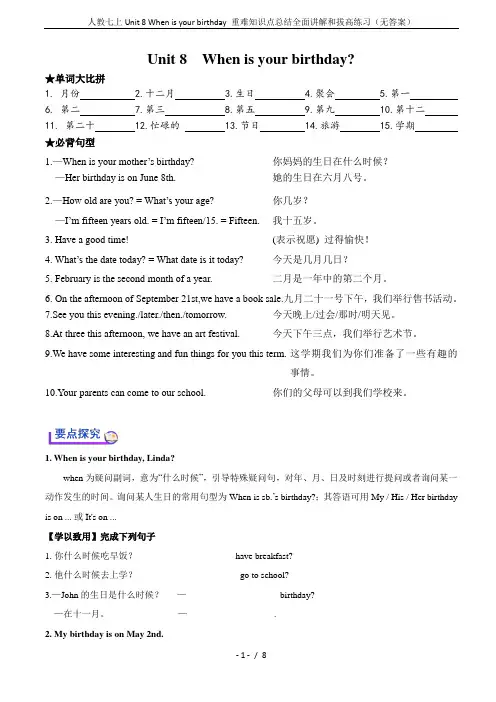
Unit 8 When is your birthday?★单词大比拼1. 月份2.十二月3.生日4.聚会5.第一6. 第二7.第三8.第五9.第九 10.第十二11. 第二十 12.忙碌的 13.节日 14.旅游 15.学期★必背句型1.—When is your mother’s birthday? 你妈妈的生日在什么时候?—Her birthday is on June 8th. 她的生日在六月八号。
2.—How old are you? = What’s your age?你几岁?—I’m fifteen years old. = I’m fifteen/15. = Fifteen. 我十五岁。
3. Have a good time! (表示祝愿) 过得愉快!4. What’s the date today? = What date is it today?今天是几月几日?5. February is the second month of a year. 二月是一年中的第二个月。
6. On the afternoon of September 21st,we have a book sale.九月二十一号下午,我们举行售书活动。
7.See you this evening./later./then./tomorrow. 今天晚上/过会/那时/明天见。
8.At three this afternoon, we have an art festival. 今天下午三点,我们举行艺术节。
9.We have some interesting and fun things for you this term. 这学期我们为你们准备了一些有趣的事情。
10.Your parents can come to our school. 你们的父母可以到我们学校来。
1. When is your birthday, Linda?when为疑问副词,意为“什么时候”,引导特殊疑问句,对年、月、日及时刻进行提问或者询问某一动作发生的时间。
最新人教版英语七年级Unit8_When_is_your_birthday_SectionB
Joe: OK, and when is the basketball game?
Sally: The basketball game? Oh, it’s_O_c_to_b_er_2_n_d___.
Joe: Good. And, um, how about the school trip?
Sally: The school trip is S__e_p_te_m__b_e_r_2_6_t_h___ and 2_7_t_h___.
Eric has a good time there every day. =Eric has fun there every day. =Eric enjoys himself there every day.
埃里克在那里每天过得都很愉快。
Homew ork
1. Remember all the new words and expressions.
Role-play the conversations in 3b.
A: How old are you, Grace? B: I’m twelve. A: And when is your birthday? B: My birthday is on March 12th. How
about you and Tom? A: Well, my birthday is on July 5th, and
Dates
September 21st October 12th
October 15th October 22nd
November 3rd November 30th December 3rd
Activities
school trip soccer game volleyball game school day art festival English party book sale
人教版七年级上册英语Unit8Whenisyourbirthday
人教版七年级上册英语Unit8 When is your birthday一. 教材分析人教版七年级上册英语Unit8主要讲述了一年中的重要日期以及询问和回答生日的能力。
本节课的主要内容包括了日期名称的介绍,如何询问和回答生日以及如何表达年龄。
通过本节课的学习,学生能够掌握基本的日期名称,学会用英语询问和回答别人的生日,并能够用英语表达自己的年龄。
二. 学情分析七年级的学生已经初步掌握了英语的基本语法和词汇,具备了一定的听说读写能力。
但是对于一些特殊的日子如“春节”,“国庆节”等可能还不知道其英文表达。
此外,对于如何用英语询问和回答生日,学生可能还比较陌生。
因此,在教学过程中,需要注重基础知识的讲解和实际操作的练习。
三. 说教学目标1.知识目标:学生能够掌握日期名称的英文表达,学会用英语询问和回答生日,并能用英语表达自己的年龄。
2.能力目标:学生能够听懂、说对日期名称和生日询问回答的句子,能够在实际情景中运用所学知识进行交流。
3.情感目标:通过本节课的学习,学生能够增强对英语学习的兴趣,提高自信心,培养合作意识。
四. 说教学重难点1.重点:日期名称的英文表达,用英语询问和回答生日。
2.难点:如何正确使用疑问词“When”询问生日,以及如何用英语表达年龄。
五. 说教学方法与手段1.情境教学法:通过设定生日派对等实际情景,让学生在真实的环境中学习和使用英语。
2.任务型教学法:通过完成各种任务,如制作生日卡片,让学生在实践中学习和运用英语。
3.直观教学法:通过展示图片、实物等直观教具,帮助学生更好地理解和记忆英语单词和句型。
六. 说教学过程1.导入:教师通过提问学生“你喜欢过生日吗?”等问题,引出本节课的主题——生日。
然后向学生介绍本节课的主要内容,引导学生进入学习状态。
2.呈现:教师通过展示生日派对等图片,引导学生说出日期名称的英文表达,并教授疑问词“When”的用法。
3.操练:教师学生进行生日询问和回答的句型练习,让学生在实际情景中运用所学知识。
新人教版初中英语七年级上册Unit 8 When is your birthday学案及典型中考例题讲解
Unit 8 When is your birthday? 教学目标与要求一、串记口诀二、学习目标1.根据课文中的时间表,用正确的关于时间日期的表达进行问答。
2.通过复习形容词性物主代词,掌握名词所有格的用法。
3.熟练掌握十二个月份的名称,了解英语中日期的表达。
二、能力目标围绕本单元“日期”这一话题,全面提高听、说能力,熟练运用when…进行交际。
掌握询问及回答年龄、日期的表达方式,提高交际能力。
教学重点与难点一、单词导航台1.birthdayn. 生日:Happy birthday to you!2.party/′pa:ti/n. ①聚会:I enjoyed myself very much at the party. 我在聚会中过得十分愉快。
②政党,党派:the ruling party执政党【考点】have a party举行宴会;at the party在宴会上。
【引申】Party member党员;birthday party生日宴会;farewell party欢送会;welcome party迎新会;the party line党的政策方针。
3.trip/trip/n. 旅行,远足【考点】辨析trip和journey:trip指休闲或因商务而进行的短程旅行,通常含有会回到出发地之意,口语中可与journey互换;journey指陆海空旅行,并且是有预定地点的长途旅行。
Have a good trip. 旅行愉快。
4.Januaryn. 一月,正月(略写为Jan.)【记忆法】1月跨越旧年与新年,罗马神话中有两个面孔能同时看前后的门神Janus,因此得名。
5.Februaryn. 二月(略写为Feb.)6.Marchn. 三月(略写为Mar.)7.Apriln. 四月(略写为Apr.)【引申】April Fool’s Day愚人节(每年的四月一日)。
8.May/mei/n. 五月9.Junen. 六月(略写为Jun.)【记忆法】由罗马神话中婚姻女神朱诺Juno而得名。
人教版七年级英语上册 Unit8 When is your birthday_知识点
Unit 8 When is your birthday ?一.含有实义动词用法的做题规律1.I→am→am not→V原→do→don't2.He/she/it/this/that/人名/名单/形物代+名单→is→is not→V单→does→doesn't3.We/you/they/these/those/名复/形物代+名复→are→are not→V原→do→don'tdo/don't/does/doesn't引导句子后都用V原形;二. 固定回答句式1. When is your birthday?My birthday is+on+月+日(或者in+月/年)It's on+月+日;2. When is his birthday?His birthday is+on+月+日(或者in+月/年)It's on+月+日;3. When is her birthday?Her birthday is+on+月+日(或者in+月/年)It's on+月+日;4. When are their birthdays ?Their birthdays are+on+月+日(或者in+月/年)They're on+月+日;5.When is 形物代+称谓(男)/人名所有格(男) birthday ?His birthday is+on+月+日(或者in+月/年)It's on+月+日;6.When is 形物代+称谓(女)/人名所有格(女)birthday ?Her birthday is+on+月+日(或者in+月/年)It's on+月+日;三.用法1. 辨析when与what timewhen 意为“什么时候”,询问的时间相对笼统;当就具体钟点进行提问时,相当于what time。
what time 意为“什么时间”,用于询问具体的时间点,钟点。
人教版七年级英语上Unit8When is your birthday单元思维导图
语法篇-序数词的用法
构成
1)1-3逐个记,分别是:first, second, third. 2)4-19,相应基数词+th。(fifth, eighth, ninth, twelth 为特殊形式) 3)20-90之间“第几十”,y变成ie加th。 4)21-99之间“第几十几”,只把个位变序数词。
When is your birthday?
Talk about ages
A: How old are you? B: I'm thirteen.
阅读篇-SectionB 2b
We have some interesting and fun things for you this term!
On October 12th and ball games 15th, two _____________ On September 21st a school trip On October 22nd, School Day _______________
activities
On December 3rd a book sale _____________ On November 30th, an English party _______________ On November 3rd, an art festival _______________
序数词构成用法anoldfriendofmyfathers我爸爸的一位老朋友表示众多朋友中的一个语法篇名词所有格名词所有格s所有格of所有格双重所有格通常用于有生命的名词通常用于无生命的名词通常表示整体中的一个或者一部分marysbook玛丽的书amapofchina一副中国地图单元整体话题篇structuresothertimeexpressionsordinalnumbersactivitiesbirthdayenglishpartyschooltripbasketballsoccergameenglishtestenglishsportsdayartfestivalbooksalefirstthirtyfirstmonthsjanuaryfebruarymarchaprilmayjune