
牛津译林版8A八年级上册英语Unit5 Wild animals task公开课课件
Here is an example of an outline
Outline
I.
II.
Introduction
Body Paragraph #1- Topic Sentence: _____________ A. supporting details B. supporting details
An outline will help make your article more organized. A careful plan will help your body paragraphs stay focused on the ideas in your thesis statement. An outline saves time for you. Preparing an outline can take time, but when you are finished, you will be able to write the rough draft of your essay more quickly.
What are the bears like?
They have a big and heavy body, short and strong legs, sharp paws and a short tail.
What do they live on?
Most of them eat meat and fish.
What problems do they have?
Hunters catch bears for their fur and paws.
Figure out the main ideas of each paragraph Bears are in danger
Bears are big and heavy. They have large bodies, short Looks and strong legs and large paws. Their tails are short.
Some of them also eat plants and insects.
What are they good at?
They are good at running, climbing and swimming.
What qualities do they have?
Hello!
They like moving around slowly in the daytime. They sleep through the winter.
Unit 5 Wild animals Task
A report on an animal in danger
What would ynimals?
food ?
looks ?
abilities ?
… ? danger ?
qualities ?
and insects.
Make a comparison
Introduction?
Introduction Weight Food Main body Main body?
Problems
Action Conclusion Conclusion?
Making an outline
A plan that builds an article An outline of an artilce can be very helpful for two reasons:
III.
Body Paragraph #2- Topic Sentence: ____________ A. supporting details B. supporting details
IV.
Body Paragraph #3- Topic Sentence: ____________ A. supporting details B. supporting details
V.
Conclusion
How does an introduction work?
OUTLINE
Introduction
Topic Sentence #1 Topic Sentence #2 Topic Sentence #3 Conclusion
Requirements for a good introduction
Food Most bears eat meat and fish, but some also eat plants
Isrun it very a perfect report? Bears can fast. They are good at climbing and Abilities swimming.
Bears move around slowly in the daytime. They sleep Qualities through the winter. They seldom hurt people.
Sadly, many hunters catch bears for their fur and paws. Danger We should take action to stop this. Otherwise, there may be no bears left in the world.
What
Why
How
What is the article about?
Why do we write the article?
How do we solve the problem?
Rewriting
Bears are in danger
Bears are very lovely wild animals. But they are not as happy as before and they are facing many problems. we need to help them. Bears are big and heavy. They have large bodies, short and strong legs and large paws. Their tails are short. Introduction
牛津译林版-英语-八上-5单元 Wild animals task教案
Paragraph5----Danger
2.Then I’ll go on saying:I think everyone must be interested in bears . Before you begin to write the wild animals in danger, you should master the frame/freim / n.框架and when you begin to write , you may use the useful expressions on page 66 . Let’s write the draft/dra: ft / (草稿) first.
4)Show student’s works
Step IV Sample writing (写作样品) / model essay/‘esei / (文章)
Step V Homework
作业设计
1.Rember all the new words , phrases and sentence patterns in this period .
教学设计详案
二次备课内容
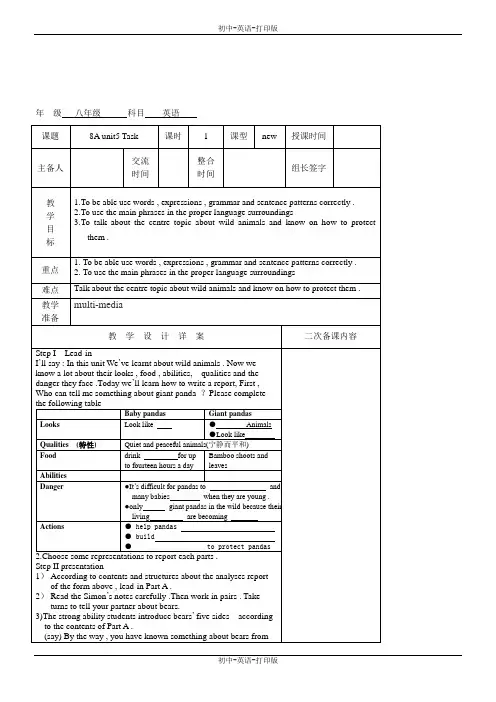
Step I Lead-in
I’ll say : In this unit We’ve learnt about wild animals . Now we know a lot about their looks , food ,abilities, qualities and the danger they face .Today we’ll learn how to write a report, First , Who can tell me something about giant panda?Please complete the following table
牛津译林版英语八年级上册8Aunit5Task课件
Work in 5 people of a group,and each member write one paragraph.(5人一组每人写一段)
are (3) shor. t
Looks
Most bears eat meat and (4) fish , but some also eat
plants and Bears can (6)
(5) insects . run very fast
Food
. They are good at
(7) climbing and (8) swimming . Abilities
Writing skills:
3. Use more adjectives to make your writing vivid(生动的).
Bears are big and heavy. They have large bodies, short and strong legs and large paws. Their tails are short.
Bears move around in the daytime. They sleep through
(9) the winter . They (10) seldom hurt people.
Sadly, many hunters catch bears for their Qualities
牛津译林版八年级英语上册 Unit 5 Wild banimals Task课件

Sadly, many hunters catch bears for their
(11) fur and (12) paws . We should take action
to stop this. Otherwise, there may be no bears left in
Bears are big and (1) heavy . They have large body, short and (2) strong legs and large paws. Their tails
are (3) short . Most bears eat meat and (4) fish , but some also eat
(9) the winter . They (10) seldom hurt people.
Sadly, many hunters catch bears for their Qualities
(11) fur and (12) paws . We should take action
to stop this. Otherwise, there may be no bears left in
1.Write a report on an animal in danger.
2. Finish the paper sheet.
the world.
Danger
are in danger!
______ are in danger!
________________________________________ ________________________________________ ________________________________________ ________________________________________ ________________________________________ ________________________________________
牛津译林八年级英语上册Unit5 Wild animals reading1 课件(共18张PPT)
Task 6: What actions can we take
problems
actions
1. It’s very difficult for pandas to have babies.
1. Help pandas have more babies
2.Bamboo forests are becoming smaller and smaller.
12 months f
20 months a
Task 1:
It’s very difficult for pbaanbdyapsantdoa have babies.
Bbaammbboooffoorrestts are becoming smaller and smaller.
Pandas may not have a place to live or food to eat .
…
Homework
▪ 1.Try to retell the story of Xiwang. ▪ 2.Finish the exercises on P60. ▪ 3.Finish 课课练P47-49.
▪1、书籍是朋友,虽然没有热情,但是非常忠实。2022年4月22日星期五2022/4/222022/4/222022/4/22 ▪2、科学的灵感,决不是坐等可以等来的。如果说,科学上的发现有什么偶然的机遇的话,那么这种‘偶然的机遇’只能给那些学有素养的人,给那些善于 独立思考的人,给那些具有锲而不舍的人。2022年4月2022/4/222022/4/222022/4/224/22/2022 ▪3、书籍—通过心灵观察世界的窗口.住宅里没有书,犹如房间里没有窗户。2022/4/222022/4/22April 22, 2022
新牛津译林版(8A)英语初二上册Unit5 Wild animals task公开课课件

V.
Conclusion
How does an introduction work?
OUTLINE
Introduction
Topic Sentence #1 Topic Sentence #2 Topic Sentence #3 Conclusion
Requirements for a good introduction
What
Why
How
What is the Байду номын сангаасrticle about?
Why do we write the article?
How do we solve the problem?
Rewriting
Bears are in danger
Bears are very lovely wild animals. But they are not as happy as before and they are facing many problems. we need to help them. Bears are big and heavy. They have large bodies, short and strong legs and large paws. Their tails are short. Introduction
Here is an example of an outline
Outline
I.
II.
Introduction
Body Paragraph #1- Topic Sentence: _____________ A. supporting details B. supporting details
牛津译林版英语八上Unit5《Wildanimals》(integratedskills)说课稿

牛津译林版英语八上Unit 5《Wild animals》(integrated skills)说课稿一. 教材分析《牛津译林版英语八上Unit 5 Wild animals》主要介绍了一些野生动物,包括老虎、狮子、熊、猴子等。
本单元以动物为主题,通过学习动物的特点、生活习性以及保护动物的重要性,提高学生对野生动物的认识和关注。
本节课为单元的Integrated Skills部分,主要通过听力、口语、阅读和写作等多种形式,让学生综合运用本单元所学知识。
二. 学情分析八年级的学生已经具备了一定的英语基础,对于一些基本的词汇和句型能够熟练掌握。
但是,对于一些较为复杂的动物特点和保护动物的观点表达,还需要进一步引导和培养。
因此,在教学过程中,需要关注学生的个体差异,针对不同水平的学生给予适当的辅导和激励。
三. 说教学目标1.知识目标:学生能够掌握本节课所学的词汇和句型,了解各种野生动物的特点和生活习性。
2.能力目标:学生能够听懂、会说、会读、会写关于野生动物的短文,提高学生的综合语言运用能力。
3.情感目标:学生能够认识到保护动物的重要性,培养关爱动物的情感。
四. 说教学重难点1.重点:学生能够掌握本节课所学的词汇和句型,运用所学知识进行口语交流和写作表达。
2.难点:学生能够正确使用一般现在时描述动物的特点和生活习性,以及表达保护动物的观点。
五. 说教学方法与手段1.任务型教学法:通过设置各种任务,激发学生的学习兴趣,提高学生的参与度和积极性。
2.情境教学法:创设生动、真实的情境,帮助学生理解动物的特点和生活习性。
3.合作学习法:鼓励学生分组讨论、合作完成任务,培养学生的团队协作能力。
4.多媒体教学手段:利用多媒体课件和视频,丰富教学内容,提高学生的学习兴趣。
六. 说教学过程1.导入:通过展示一些野生动物的图片,引导学生谈论自己喜欢的动物,从而引入本节课的主题。
2.展示:教师通过多媒体课件,展示本节课所学的词汇和句型,让学生初步感知和理解。
Unit5+Wild+animals+Task+-2025学年牛津译林版英语八年级上册
Giant panda
Be a careful viewer
Looks
not very big, thick fur
Food Abilities
animals, sometimes fruit
can see, hear and smell things far away can run for hours without stopping
Is it a perfect report?
Be a careful viewer
black and white stripes live in Africa live mainly on grass
Zebra
How many wild animals do you know?
Be a careful viewer
Language Points
1. They are good at climbing and swimming. be good at doing sth. = do well in doing sth. 擅长做某事 e.g. He is good at drawing. =He does well in drawing. 他擅长画画。
Self-assessment
重点单词和短语: report, tail, insect, move, slowly, daytime, otherwise, be good at, in the daytime
Unit 5 Period 6
书写呼吁保护野生动物的报告: 1.介绍濒危动物的looks、food、 abilities、qualities; 2.介绍濒危动物现在的危险处境 和呼吁大家采取行动保护动物。
苏教牛津译林版初中英语八年级上册Unit 5 Wild Animals Main task教案
苏教牛津译林初中英语重点知识精选掌握英语语法知识,巩固词汇量和各种语态,学好英语基础一定要扎实,大家一起练习吧!牛津译林初中英语和你一起共同进步学业有成!Wild Animals总课题8A Unit 5Wild Animals 总课时8 第 8 课时课题Main task 课型New知识目标1.To present factual information in a report2.To express opinions about animals in danger.3.To produce a particular text-type for an audience usinga given model.能力目标To produce a particular text-type for an audience using a given model.教学目标情感目标To present an article about an animal教学重点Express opinions about animals in danger and how to write a report correctly教学难点Express opinions about animals in danger and how to write a report correctly课前预习Read the new words.教学方法过程性写作教学教学过程教学环节教师活动二次备课Step1. RevisionStep2. Presentatio n We’ve learned a lot about wild animals. We knew their appearance, ability, character, and danger they meet. After learning, we should know how to write a report. First, say something about giant pandas.1. Invite students to talk about what they like about giant pandas.2. Brainstorm any information and general knowledge about the animals.1.Many wild animals are in danger. For example, the giant pandas. So the Wild Animal Club is asking its members to write about this problem for the club newsletter. Here is Millie’s report on giant pandas. Please open your book, turn to page 71, please read it as quickly as you can.Try to fill in the blanks.Baby pandas Giant pandas1____ look likewhite micebeautiful black and whiteanimalslook like bears2____ quiet and peaceful animals3____ drinkmum’smilkeat bamboo shoots andleaves4____There are only about a thousand giantpandas in theworld because their living areas arebecomingStep3 Outline and WritingStep4 SummaryStep5 Homeworkfarmland.If farmers keep taking the land, they willhavenowhere to live.If people hunt them for their fur, thenthere willbe no giant pandas.5____Write to newspapers and magazines aboutthe giantpandas in China.Tell people about theproblems.Ask students to read the model report on their ownto identify th e paragraphs describing factual details about giant pandas.Paragarph 1 – Appearance of giant pandas Paragraph 2—FoodParagraph 3—Babies Paragraph 4—Problemsto giant pandasParagraph 5—How to protect giant pandas2. Read the report in Part A.After reading Millie’s report, we know that if we want to write a report, we need to collect the information. If D aniel also wants to write a reporton bears for the Wild Animal Club, first he needsto collect some information. What kind of information does he need?How can we write a report on an animal in danger? Paragraph 1 — Appearance Paragraph 2 — Ability Paragraph 3 — Character Paragraph 4 — Food Paragraph 5 — DangerBy the way, Do you know something about bears. I know that they have sharp paws. And they can walk upright. (教学生词 paw, upright) I think you are interestedin bears, let’s know more about bears. Open your books, turn to page 72. please read the notes about bears carefully.After reading the notes about bears. Please open your books, turn to page 72, help Simon complete the report with the notes in Part B. I think it’s very easy for you to finish it. Now let’s check the answers.Spend a lot of time d rinking their mums’ milk, ata time,get smaller and smaller, become farmlands, keep taking the land,what action can the club take? Sharp paws, walk upright1. Do more exercise about this key point carefull y.2. Write a report for any wild animal you are familiar with.教学反思相信自己,就能走向成功的第一步教师不光要传授知识,还要告诉学生学会生活。
牛津译林版八年级上册Unit 5 Wild animals Task教案
牛津译林版八年级上册Unit 5 Wild animalsTask教案【课题】:牛津初中英语8A Unit5 Wild animalsTask[Teaching aims and demands]:1. To learn to organize and factual information in a report2. To learn to express one’s own opinion about animals in danger3. To write a report on an animal in danger4. To do something for the animals in danger[Teaching main and difficult points]:1.To learn to organize and factual information in a report2.To learn to express one’s own opinion about animals in danger3.To write a report on an animal in danger[Teaching aids]: multi-media[teaching procedures]:Step1 Lead-inShow a video on the screen by multi-media. Then ask the students what wild animals can you see in the video What’s your favourite wild animal Why do you like itStep2 Presentation1.Do you want to know what Simon’s favourite wild animal is Let’swatch a video and find out.2. Read and sayRead Simon’s notes about bears on P66, ask and answer questions in pairs like this:A: What do bears look likeB: They are/look---. They have---.A: What do they often eatB: They ---.A: What can they doB: They---.A: What qualities do they haveB: They---.A: What problems do they faceB: ---.3.Ask students to help Simon complete his report using his notes in PartA, then ask students to read the whole sentences one by one.4.Guide students to make a conclusion on how to write a report. Present the strategies of writing on the screen.a. Collect some related information.b. Make an outline.c. Think about the sentence patterns, and write them down.d. Make a draft.e. Read through your report, and see if there are any mistakes.f. Decorate and copy.Step3 Writing1.Group workPresent the information about wild animals on the screen, and ask students to write a report in groups with the title“…are in danger”(Work in groups of five. Each student writes one paragraph) Paragraph 1: LooksParagraph 2: FoodParagraph 3: AbilitiesParagraph 4: QualitiesParagraph 5: Danger2.Present the students’ reports in class and make somecomments. (The more encouragement and praise, the better.) Assessment: A A A+ AStep4 MakingMake a poster (with pictures and words) on an animal in danger for school newsletter to call on people to protect eco-environment and wild animals. Discuss in groups before making.Step5 Homework1. Write a completed article about wild animals in danger.2. Continue to make the poster.3. Finish the relative exercises.Blackboard designTaskA report on an animal in dangerUseful expressions: Main ideas: move around slowly para1: Looks:in the daytime para2: Food: sleep through the winter para3: Abilities: otherwise, para4: Qualities: para5: Danger:。
牛津译林版英语八上8aunit5task
活取熊胆,最早由朝鲜发明,上世纪80年代传入中国,目前中 国还有近万只熊每天生产胆汁,这些熊被终身囚禁在铁笼中, 腹部留着永不愈合的伤口。伤口上面长期插着一根金属管,方 便随时抽取胆汁,黑熊因为伤口裸露在外,永不痊愈,所以经 常感染。每头熊都被套上铁马夹,一天被抽取2-4次,最少30毫 升,最多200毫升,为了增加胆汁的流出量,熊场会用特制的 针管抽扎进胆囊取胆汁,每到这个时候,被抽取胆汁的熊都会 疼得惨嚎,把自己的腹部抓得血肉模糊。有些熊因为无法忍受 抽胆的痛苦,精神错乱,还有熊还会作出自杀行为,把自己的 肝肠内脏都拉扯出来!为了防止这样的行为发生,就发明了铁 马甲,不让它们自杀!其实熊胆并不是什么神丹妙药,它的药 用价值也是被所谓的"专家"夸大了!致使误导广大消费者去大 量使用熊胆制品!熊胆汁对于人体只能起到很普通的清热解毒 的功效,这是很多中草药都可以代替得到的!
Tigers are big and strong. They have bright eyes and orange fur with dark stripes.
1 老虎既大又强壮,他们有明亮的眼睛,有深色条 纹的橙色皮毛。 2 他们能跑很快但是只能持续一会。
They can run fast but only for a short while.
Abilities
can run very fast, good at climbing and swimming
move around slowly in the Qualities daytime, sleep through the winter, seldom hurt people
hunters catch them for their