
Unit 1 The lion and the mouse-Sound time课件牛津译林版英语六年级下册
Intonation
(声调)
Intentions 意图 attitudes 态度
Wh-question
A: Do you like summer? B: The season? A: No! The teacher! B: Sure! I do.
A: Hey, look! A duck! B: That’s not a duck. That’s a rabbit! A: It’s totally a duck. See, there’s his bill(喙). B: What are you talking about? Those are ears, silly. A: It’s a duck. And he’s about to eat a piece of bread B: It’s a rabbit. And he’s about to eat a carrot.
Waiting for Rabbits
Kill two birds with one stone
The same thing they have is ________________. How can we read/tell stories nicely?
Intonation is the melody(旋律) of language.
1. Read the story after class. 2. Period 3 on exercise book. 3. Prepare for the dictation.
What funny things might(可能) happen in the story?
Read and find
What do you find funny in the story?
Sam and Bobby are playing table tennis happily.
Billy and Willy cheer for them loudly. Sam is too excited and he hits the ball hard. Then, they cannot find the ball.
Unit 1
The lion and the mouse
Sound time & Culture time & Cartoon time
Brainstorm
story
PASS THE BALL
How to Play
• When the music stops, you must say something about “story”.
Where else can we read funnTyheatonrtoiimse aandlthsethoareries?
The boy who cried wolf
Chinese idiom book (中国成语故事)
The Blind Men and the Elephant
The Bird Jingwei Trying to Fill the Sea
Duck: Quack! Quack! A: Wait. Listen. Did you hear that? I heard duck sounds. Rabbit: Sniff! Sniff! B: That’s funny. I distinctly heard rabbit sounds.
Have you ever read a similar(相似的)story?
The thirsty crow
Aesop’s Fables (伊索寓言)
Greece a book from the Greek story teller,
Aesop.
Aesop’s Fables
The Fox and the Grapes
?
Act or retell
A: Act out the story. (Narrator, Sam, Bobby, Willy and Billy)
OR
B: Retell the story picture by picture. (Four story tellers)
Think and say
• It can be a word, an expression(短语) or a sentence.
PASS THE BALL
story
PASS THE BALL
story
PASS THE BALL
story
PASS THቤተ መጻሕፍቲ ባይዱ BALL
story
PASS THE BALL
story
Predict the story
Finally, Sam and Bobby find a hole in the ground.
Sam has an idea. He brings some water quickly and pours it into the hole.
Think and say
Do you have any other good ideas to get the ball out?
Unit 1 The lion and the mouse(单元解读)六年级英语下册(译林版三起)
六年级下册Unit 1 The lion and the mouse单元解读一、单元内容体现的新课标理念本单元在英语核心素养的育人价值下进行,围绕单元主题“人与社会”展开教学。
本单元学习的主题主要是学习关于一些童话故事以及副词的使用等。
二、单元信息单元分为Story time、Grammar time、Fun time、Sound time、Song time、Cartoon time、Checkout time、Ticking time八部分组成。
主要学习“狮子和老鼠”的故事以及如何使用副词。
在教学上,对本单元内容进行整合以及重组,分为四个课时进行教授。
1.Story time,这一部分是一篇文章,主要是狮子和老鼠的童话故事,在授课时,当做一篇阅读课进行授课。
本篇通话主要讲述了狮子刚开始蔑视老鼠,狮子的强壮与老鼠的弱小相对比,但是老鼠却说自己能够帮助狮子,让狮子不太相信,但还是善良的放走了老鼠。
有一天狮子被猎人抓到了,弱小的老鼠真的救了狮子。
从一开始的不相信到后来的帮助,两者之间的对话语气发生了明显的变化,由此也引出来副词的用法。
另外本篇使用一般过去时叙述,也涉及了一些动词的过去式形式。
2.Grammar time&Fun time, 这两个部分作为一课时按照语法课进行教授,主要学习副词的用法,以及形容词如何变副词。
另外还涉及了一些动词的过去式形式。
Fun time主要是让学生们演绎狮子和老鼠的故事,让学生们进行表演的时候,一定要主语语气。
3.Culture&Cartoon time,这两个部分作为一课时按照对话课进行教授。
Culture time主要是区分文化的不同,在国外伊索寓言讲了许多的小故事,在中国,成语故事里面也有很多有趣的故事。
Cartoon time是一篇对话,主要讲述了Sam和Bobby打乒乓球的故事。
Sam 和Bobby在打乒乓球,由于Sam击球时太用力,把球大掉进了洞里。
译林版小学六年级英语下册--课文翻译
Unit 1 The lion and the mouseStory time故事时间翻译①There was a lion in the forest. He was very large and strong.森林里有一只狮子。
他非常大并且强壮。
②One day, a mouse walked by and woke the lion up. The lion was angry and wanted to eat the mouse. "Please don't eat me. I can help you some day, "said the mouse quietly. "You're so small and weak! How can you help me? "laughed the lion loudly. Then, he let the mouse go.一天,一只老鼠走过,把狮子吵醒了。
狮子很生气,想要吃了这只老鼠。
“请不要吃我。
有一天我能帮助你。
”老鼠小声地说。
“你这么弱小!你怎么能帮助我?”狮子大声地笑。
然后,他放开了老鼠。
③The next day, two men caught the lion with a large net. The lion bit the net with his sharp teeth, but that did not help. "How can I get out? "asked the lion sadly.第二天,两个男人用一张大网抓住了狮子。
狮子用他锋利的牙齿咬那张网,但那不管用。
“我怎么能出去呢?”狮子难过地问。
④Just then, the mouse saw the lion. "I can help you, " he said. Soon, the mouse made a big hole in the net with his teeth.The lion got out. "Thank you!" said the lion happily.就在那时,老鼠看见了狮子。
六年级下册英语-Unit 1 The lion and the mouse 知识点总结以及语法详解 译林版

Unit 1 The lion and the mouse基础知识点总结以及语法细讲★老鼠的复数mice; 鼠标的复数mouses一,词组短语1.in the forest 在森林里rge and strong又大又壮3.★one day 一天4.walk by路过5.★wake …up 唤醒(wake sb up) ★6. be angry 生气7.want to eat the mouse想要吃这只老鼠8.★some day 某一天9.small and weak又小又弱10.let sb. do 让某人干某事11.let the mouse go 让这只老鼠走开★12.the next day 第二天13.catch the lion with a large net用一张大网抓住狮子14.bite the net with his sharp teeth用它锋利的牙齿咬网15.get out 出去16.get out from the net从网中出来★17. just then就在那时18.make a big hole in the net在网上做了一个大洞19.★from then on从那时起20.become friends变成朋友21.help the lion get out帮助狮子逃脱22.s ay quietly平静地说ugh loudly大声地笑24.a sk sadly伤心地问25.say happily高兴地说ugh happily开心地大笑27.a happy boy 一个快乐地男孩★28. sweet shop甜品店29. Aesop’s Fables.[ˈi:sɔps ˈfebəlz ]伊索寓言30. Chinese idiom book汉语成语书31. play ...happily玩得很开心32.★be good at table tennis乒乓打得好33.★cheer for them loudly大声地为他们喝彩34. ★hit the ball hard用力击球35. ★find a hole in the ground发现了地上的一个洞36. too deep太深37. reach it(到达)触碰到它38. have an idea有一个主意(想法)39.bring some water quickly很快带来一些水40.p our it into the hole把它倒进洞[pɔ:]41. ★pour … into 把……倒进42. help him up帮他上来43.go to him去他那里(寻求帮助)44. become happy 变得开心45. look sad看起来伤心二.词块拓展:★ 1.wake …up 唤醒(wake sb up) wake up 醒来; 唤醒, 弄醒; 活跃起来; 激起, 引起Please wake me up at six. 请在六点钟叫醒我。
2015年六年级英语下册Unit 1教案(译林英语)
2015年六年级英语下册Unit 1教案(译林英语)Unit 1 The lion and the mouse ?1銆佽兘鐞嗚В?2細bite, hole, large, sharp, strong, weak, wake up銆?3佷細璇昏〃绀烘椂闂撮『搴忕殑璇嶇粍锛?the next day, just then, from then on 銆?4?璇炬椂1 Story time1.鑳界悊瑙e苟浼氭湕璇绘晠浜嬨€?2.鑳藉垵姝ュ惉鎳傘€佷細璇诲崟璇峫arge銆乻trong銆亀oke銆亀eak銆乶et銆乥it銆乻harp銆乻adly銆乭ole3.杩涗竴姝ュ珐鍥簍here be繃鍘诲紡鐨勫啓娉曞拰璇婚煶銆?4.?毦鐐?1.鑳界悊瑙e苟浼氭湕璇绘晠浜嬨€?2.鑳藉垵姝ュ惉鎳傘€佷細璇诲崟璇峫arge銆乻trong銆亀oke銆亀eak銆乶et銆乥it銆乻harp銆乻adly銆乭ole 3.?Step1: Pre-reading 1. T: Look! Can you guess what my hobby is? S: You like reading, I think. T: Yes. I like reading stories. Do you like stories? What stories do you know? S: The king鈥檚new clothes鈥?T: Today we are going to read another interesting story. Look at the picture. Can you tell me the name? S: The lion and the mouse Unit1 The lion and the mouse T: Look at the lion. What do you think of it? Teach: large strong heavy T: But what is the mouse like? Is it large?... Teach: small weak light Step2: While-reading 1.T: The large and strong lion, the small and weak mouse. What is the story about? First, we know who. What else would you like to know about the story? S: Where? When? What? How? Where? in the forest 2. T: What happened? There are some sentences for you. Let鈥檚readthem together. The lion caught the mouse but let it go. The lion and the mouse became good friends. The lion could not get out from the net. The mouse helped the lion get out. The mouse woke the lion up. 3. Read and match 4. Watch and order 5. Read and think Teach: one day, the next day, just then, from then on 6.Read and think Q: Why did the lion let the mouse go? Q: What happened to the lion? Q: How did the mouse help the lion? Picture1&2 Pic2: How did the mouse say to the lion. Quietly How did the lion say to the mouse? Loudly The mouse was afraid. Picture 3-5 Underline the new words and phrases Teach: bite鈥昩it hole How? Sadly happily 7. T: If you were the mouse. What would you say? I am small and weak, but I am clever and brave(鍕囨暍). I can help the lion! Step3: Post-reading 1. Let鈥檚read. 2. Try to retell. 3. T: What do you learn from the story? Sometimes, the strong can be weak.鍐嶉珮鐨勪汉涔熸湁灞堣韩鐨勬椂鍊欙紝Sometimes, the weak can be strong.鍐嶇?Everyone is good at something.姣忎釜浜洪Let鈥檚help each other!?Step4: Homework Listen and read the story. Retell the story to your friends or family. Copy and recite the phrases. Unit1 The lion and the mouse One day walked by woke up caught let it go The next day caught with a large net bit couldn鈥檛get out Just then saw made a big hole got out From then on became good friends璇炬椂2 Story time (2) Fun time級 1.?2.鑳藉惉鎳傘€佷細璇淬€佷細璇汇€佷細鍐欒瘝姹囷細bite, hole, large, sharp, strong, weak, wake up, let go銆?3.鑳芥牴??1. 瀛︾敓瀵?2.敼缂栧苟琛ㄦ紨鏁呬簨銆?Step1: Revision 1. Greetings 2. Read the story together. 3. T: Long long ago, there was鈥?S: There was a lion. He was very large and strong. T: What happened? One day he next day鈥?just then鈥?from then on鈥?Can you ask some questions about the story? For example, who woke the lion up? Step2: Presentation 1. T: Open your books. Turn to page 8. Let鈥檚read the questions and answer together. Who woke the lion up? Did the lion eat the mouse? How did the man catch the lion? How did the mouse help the lion? What did the lion and the mouse lion? What did the lion and the mouse become? 2. Try to retell the story according to the blackboard. 3. Do the exercise on page 8: Read and order. 4. key words and phrases: Large/big鈥晄mall/little Strong鈥晈eak Sharp鈥昩lunt Wake up/get up/go to bed/go to sleep Want to do/would like to do Some day Let sb do The next day/the following day/the second day Catch the lion with/use o catch Just then/just now Get out/get in From then on/from now on Become friends 5. Fun time T: Now we know a lot about the story. We can also retell it. Right? Can you act it? Look at picture 1, the lion was very strong and large. What would he say? T: Turn to page 10. Work in groups and complete the dialogue. S: 鈥?T: Now let鈥檚act! Step3: Practice 1. Act the story. 2. Exercises on Exercise Book 1. Step4: Homework 1. Listen and read Story time. Try to recite. 2. Review the text and notes. 3. Try to retell or act more stories in groups. 鏉Unit1 The lion and the mouse Notes璇炬椂3 Grammar time & Checkout time(Look and write)1.瀛︾敓鑳界悊瑙e壇璇嶇殑鐢ㄦ硶銆?2.瀛︾敓鑳芥帉鎻″壇璇嶇殑鏋勬垚锛歲uietly, excitedly, fast/slow鈥?3.瀛︾敓鑳芥帉鎻?ite-bit锛寃ake-woke锛宭et-let銆??1.瀛︾敓鑳界悊瑙e壇璇嶇殑鐢ㄦ硶銆?2.瀛︾敓鑳芥帉鎻″壇璇嶇殑鏋勬垚锛歲uietly, excitedly, fast/slow, well鈥?Step 1 Revision 1. Greetings 2. Quick response: 鍔ㄨ瘝杩囧幓寮?Let鈥昹et Bite鈥昩it Wake鈥晈oke 3. Try to retell the story according to the verbs Step 2 Presentation (Grammar time) 1. T: When the lion caught the mouse, the mouse was afraid. So he said quietly. But How did the lion laugh? S: Helaughed loudly. T: The next day, two men caught the lion. He was sad. He asked for help sadly. T: When the mouse help him get out, he became 鈥?S: He became happy. T: So he thanked the mouse 鈥?S: happily. say happily T: Open your books to page9. Let鈥檚read the sentences together. The lion asked sadly. The lion laughed loudly. The mouse said quietly. The mouse said happily. 2. adv. Sad鈥晄adly loud 鈥昹oudly quiet鈥晀uietly happy鈥昲appily T: Can you find out the rules? S: 褰㈠ySummary: ?a. 璇嶅熬鐩存帴鍔爈y excited鈥昬xcitedly beautiful鈥昩eautifully careful鈥昪arefully b. 鍘籩鍔爄ly happy鈥昲appily angry 鈥昦ngrily heavy鈥昲eavily c. 涓嶅彉work hard run fast/slow jump high/low get up early/late d. ood鈥晈ell 3. Checkout time T: Look at the pictures and complete the sentences. The boy is running fast. The girl is shouting excitedly. The children are talking loudly. The people are laughing happily. The man is reading carefully. The woman is crying sadly. Step 3 Practice 1. Lily is a ________ student. She speaks English_______. (good) 2. Ben got up ________ this morning. He was_________ for school. (late) 3. He is a _______ boy. He laughs_________. (happy). 4. The food in Thailand tastes _________.(good) 5. Mary is a _______girl. She always talks __________.( quiet) 6. Nancy is a ________ girl. She dances_________.(beautiful) 7. Tomorrow is New Year's Day. The students are _________. And the English teacher aren't going to assign homework .So the students willshout_________. (excited) 8.Billy slips and falls. He cried ________.(sad) Step 4 Homework: 1. Review 鈥淕rammar time鈥? 2. Preview Cartoon time 3. Do some exercise. Unit 1 The lion and the mouse ?a.璇嶅熬鐩存帴鍔爈y excited鈥昬xcitedly beautiful鈥昩eautifully b. 鍘籩+ily happy鈥昲appily angry鈥昦ngrily heavy鈥昲eavily c. 涓嶅彉work hard runfast/slow jump high/low get up early/late d. ood鈥晈ell璇炬椂4 Sound time& Cartoon time鍐欙級 1.鑳界敤wh-?2.鑳芥帉鎻$壒娈?3.cartoon time锛屽苟鑳芥帉鎻″叾涓??1.鑳界敤wh-?2.cartoon time?Step 1 Revision 1. Greetings 2. T: Boys and girls, do you likesweets? S: Yes/No. T: I like lollipops best. T: Where can we buy sweets? S: In the sweet shop. Step 2 Presentation 1. Sound time T: Look at the picture. Can you say some sentences about it? For example, they are going to the sweet shop. S: 鈥?T: OK!I have some sentences for you. Let鈥檚read them together. We are going to the sweet shop right now (). We want to buy a lollipop. It is for the boy over there. The boy is sad.鍒掔嚎鎻愰棶Where are you going? When are you going to the sweet shop. What do you want to buy? Who is it for? How is the boy? T: Do you think it is rising intonation or falling intonation? S: Falling intonation. T: Let鈥檚read together. T: They are going to buy a lollipop for the boy. What will he say? S: Thank you鈥?T: Well done. You鈥檙e so polite. But I think it doesn鈥檛matter. Because they just want to help the boy, and make him happy. Read sound time together. 2. Cartoon time T: Now we know how to ask questions. Wh- how. S: what, where鈥?T: We are going to learn Cartoon time. Before learning, what would you like to know about the story? S: Who? What? Where? When? How?... T: Who? S: Bobby and Sam. T: Who else? Look at the picture. S: Billy and Willy. T: What are they doing? S: They are playing table tennis happily. T: Look! Sam plays well! Sam is really good at table tennis. T: What happens? Can you guess? S: 鈥?T: Let鈥檚listen! What happens? S: The ball falls into a hole. S:鈥?T: OK. Let鈥檚read the story together. Look andsay(picture 2) Teach: cheer for them loudly hit the ball hard Pic3: T: At last, finally, they find a hole. Is the ball in the hole? S: Yes. T: But Sam鈥?Teach: reach Pic4: T: Sam has an idea. What is the idea? S: Teach: pour in into the hole T: Is there only oneball? S: No. there are so many balls. T: What does it mean? S: 鈥?Step 3 Practice 1. Read the story after the recorder. 2. Read in groups. 3. Share the group work. Step4 Homework 1. Listen and read Cartoon time. Prepare for the acting. 2. Listen and read Sound time. 3. Preview Culture time. Search for stories.Unit 1 The lion and the mouse Who? be good at Where? hit the ball hard What? reach鈥?When? pour 鈥?into鈥?How? Why?...璇炬椂5 Culture time& Checkout time(Think and write) 浜1. heckout time 缁冧範銆?2. 鑳借〃婕擟artoon time銆?3.В銆?4. 鑳藉舰鎴愪簰鐩稿府鍔╃殑濂芥皼鍥淬€?€侀毦鐐?1. heckout time 缁冧範銆?2. 鑳借〃婕擟artoon time銆?3.В銆?Step 1 Revision 1.Free talk 2.Review some phrases Step 2 Presentation 1. T: We learned stories in this unit. What story?S: The lion and the mouse. T: What is this story about? S: Animals T: Do you know where it is from? Teach: Aesop鈥檚Fables T: Look! This is Aesop鈥檚Fables. You can find many animal stories . What stories do you know in Aesop鈥檚Fables? Can you tell us ? The Fox and the grapes The Farmer and the snake T: The book is written by Aesop in ancient Greece. We also have our story book. It is called a Chinese idiom book. We can also find many animal stories in it. Can you tell one? 瀹堟牚寰呭厰銆佷骸缇婅ˉ鐗⑩€︹€?2. T: Do you like stories? You know, Su Hai and Anna aree-friends. Su Hai is writing an email to Anna. Would you like to know her story? S: Yes.. T: But her email is not complete. Can you read and complete it? T: Let鈥檚check your answers. What鈥檚Su Hai鈥檚story? What happened to her? T: Su Hai likes helping people. What about you? What did you learn from the lion and the mouse? S: We should help each other. T:We should help others just like Su Hai. Let鈥檚read the email. Step 3 Practice T: Did you help others? Would you like to share usyour story? Step 4 Homework 1. Read Culture time and Checkout time. 2. Try to help each other.Unit 1 The lion and the mouse Aesop 鈥檚 Fable a Chinese idiom book璇炬椂 6 Ticking time &Exercise級 1.?2.愮敤鑳藉姏鐨勬彁鍗囥€??1.?2. Step 1 Revision 1. Greetings 2. Free talk Step2 Presentation 1. Revision T: Boys and girls, we have finished this unit. What did you learn from this unit? S: We learned 鈥?2. Ticking time T: Well done. Open your books. Turn to Page 15. Can you understand 鈥淭he lion and the mouse 鈥? Can you use 鈥渓oudly 鈥? 鈥渟adly 鈥? Do you know the intonation of wh-questions? Step3 Practice 1. Do the listening on workbook. 2. Check the answers. Step4 Homework 1. Review Unit 1. 2. Finish the workbook.Unit 1 The lion and the mouse Notes。
Unit1 The lion and the mouse(含听力原文+答案+重点解析)译林版
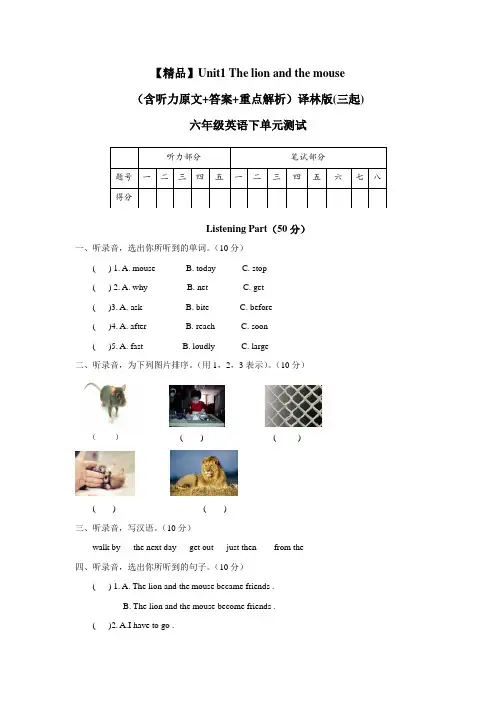
【精品】Unit1 The lion and the mouse(含听力原文+答案+重点解析)译林版(三起)六年级英语下单元测试听力部分笔试部分题号一二三四五一二三四五六七八得分Listening Part(50分)一、听录音,选出你所听到的单词。
(10分)( ) 1. A. mouse B. today C. stop( ) 2. A. why B. net C. get( )3. A. ask B. bite C. before( )4. A. after B. reach C. soon( )5. A. fast B. loudly C. large二、听录音,为下列图片排序。
(用1,2,3表示)。
(10分)()( ) ( )( ) ( )三、听录音,写汉语。
(10分)walk by the next day get out just then from the四、听录音,选出你所听到的句子。
(10分)( ) 1. A. The lion and the mouse became friends .B. The lion and the mouse become friends .( )2. A.I have to go .B. I have to go now .( ) 3. A. Is the ball in the hall ?B. Is the ball in the bag ?( ) 4. A. He can’t reach it .B. I can’t reach it .( ) 5. A .The lion let the mouse go .B. The lion let the mouse run .五、听录音,填单词。
(10分)1. A mouse walked ________and woke the lion .2. I can ________you some day.3. ________ can I get out ?4. There was a ________in the forest.5. He was very________ and strong .Writing Part(50分)一、把无序的字母组成正确的单词并译成汉语。
6B Unit1 The lion and the mouse知识点讲解及练习
Unit1 The lion and the mouse重要短语in the forest在森林里 large and strong 又大又强壮 one day 一天 walk by 路过Wake、、、up吵醒,叫醒 some day 某一天 small and weak又小又弱laugh loudly 大声地笑 let、、、go 让、、、走 the next day 第二天 a large net 一张大网sharp teeth锋利得牙齿 get out 出去 just then就在那时 with his teeth用她得牙齿from then on从那时起 bee friends成为朋友play table tennis打乒乓球 be good at、、、擅长 cheer for、、、为、、、而欢呼too excited 太兴奋 in the ground在地上 in the hole 在洞里Too deep 太深 have an idea 有一个主意 pour、、、into把、、、倒入 well done 干得好1、mouse n、老鼠复数mice【解析】mouse意为“老鼠”,其复数为mice;意为“鼠标”时,其复数为mouses。
【例句】A mouse is always afraid of a cat、老鼠总就是怕猫。
【例题】( )There are some little in the hole、A、mouseB、miceC、mouses2、large adj大得反义词small 近义词big大得;巨大得【解析】large常指面积、范围等,可表示数与量(当它直接用于人时,可表示身体大);big 常指程度、规模、重量等,亦可指人,比较口语化。
【例句】(1)China is a large and beautiful country、中国就是个幅员辽阔又美丽得国家。
(2)He is a big man、她就是个大人物。
六年级下册英语-Unit 1The lion and the mouse 译林版
Unit 1
The lion and the mouse
主讲人:小萌teacher
六年级下册英语-Unit 1The lion and the mouse 译林版
六年级下册英语-Unit 1The lion and the mouse 译林版 六年级下册英语-Unit 1The lion and the mouse 译林版
六年级下册英语-Unit 1The lion and the mouse 译林版
形容词变成副词的基本规则
1)一般情况下在形容词后直接加ly。 quickquickly badbadly
2)以辅音字母+y结尾的形容词,先将y变成i,再加ly。 happyhappily angryangrily
3)去e,加ly truetruly
quiet /’kwaɪət/ adj. 安静的 quietly adv. 小声地,安静地
The old man likes living in a ____q_u_ie_t__ place. Now he is sitting __q_u_ie_tl_y__ in his room.
六年级下册英语-Unit 1The lion and the mouse 译林版
六年级下册英语-Unit 1The lion and the mouse 译林版
sad adj. 难过的;伤心的 反义词:happy
sadly adv.难过地;伤心地 反义词:happily
He was _s_a_d_____ and said _s_a_d_____ “I lost my new watch.” They have won (赢得) the football, so they are _h_a_p_p_y____ and are shouting _h_a_p_p_i_ly___.
译林小学英语六年级下册Unit1-8知识点汇总
Unit 1 The lion and the mouse一、单词mouse老鼠large大的strong强大的, 强壮的quietly小声地, 安静地loudly大声地net网bite咬sharp锋利, 尖的ask问soon不久, 很快happily开心地, 高兴地weak弱的, 软弱的cheer欢呼, 加油hit打, 击ground地面, 地上deep深reach够得着二、词组1. in the forest 在森林里2. very large 很大3. large and strong 又大又强壮4. one day 一天5. walk by 走过6. wake the lion up 吵醒狮子7. be angry 生气8. want to eat the mouse想吃老鼠9. help you 帮助你10. some day 某一天11. say quietly 小声地说12. so small and weak 这么小而弱13. laugh loudly 大声地笑14. let the mouse go 让老鼠走15. the next day 第二天16. two men 两个男人17. catch the lion with a large net 用一张大网捉住狮子18. bite the net 咬网19. his sharp teeth 他锋利的牙齿20. get out 出去21. ask sadly 伤心地问22. just then 就在那时23. make a big hole 弄了个大洞24. in the net 在网里25. say happily 开心地说26. from then on 从那时起27. become friends 变成朋友28. get out from the net 从网里出来29. help sb. do sth. 帮助某人做某事30. a happy boy 一个开心/幸福的男孩31. talk excitedly 兴奋地交谈32. the sweet shop 糖果店33. want to buy 想要买34. a lollipop 一个棒棒糖35. Aesop’s Fables 伊索寓言36. find many animal stories找到许多动物故事37. a Chinese idiom book 一本中国成语书38. play table tennis happily 开心地打乒乓39. be good at table tennis 擅长打乒乓40. cheer for them loudly 为他们大声地欢呼41. too excited 太兴奋42. hit the ball hard 用力打球43. find the ball 找到球44. find a hole in the ground 在地上找到一个洞45. in the hole 在洞里46. too deep 太深47. can’t reach it 够不着它48. have an idea 有一个主意49. bring some water quickly很快拿来一些水50. pour it into the hole 把它倒进洞里51. so many balls 这么多球52. go to a shopping centre 去购物中心53. see a small boy 看见一个小男孩54. on the floor 在地板上55. take him to an office 带他去办公室56. give him a sweet 给他一颗糖57. become happy 变得高兴58. like helping people 喜欢帮助人们59. make a study plan 制定一个学习计划60. read quietly 安静地看书61. a weak animal 一个弱小的动物62. a sharp knife 一把锋利的刀63. walk by走过, 路过64. wake . . . up吵醒, 叫醒65. some day 某一天66. the next day第二天67. just then就在那时68. get out出来, 出去69. from then on从那时起70. pour… into把…. . . 倒入三、重点句型1. One day, a mouse walked by and woke the lion up. 一天, 一只老鼠走过, 吵醒了狮子。
六年级下册英语试题 知识点- Unit1 The lion and the mouse 含听力材料
译林版六年级下册6B U1单元知识点(含专项训练)Unit1 The lion and the mouse一.单词mouse 老鼠large 大的strong 强壮的wake. . . up 吵醒some day 某一天ground 地面quietly 小声地,安静地loudly 大声地quickly 迅速地,快地weak 虚弱的happily 开心地,高兴地happily 开心地,高兴地bite 咬sharp 锋利ask 问soon 很快cheer 欢呼hit 打,击deep 深reach 够得着lollipop棒棒糖二.词组1.make a study plan 制作一个学习计划2.in the forest 在森林里rge and strong 又大且强壮4.one day 一天5.walk by 走过,路过6.wake up 醒来7.wake. . . up 吵醒,叫醒8.wake the lion up 把狮子吵醒9.be angry 很生气10.want to eat the mouse想要吃老鼠11.eat me 吃我12.some day 某一天13.so small and weak 如此/这么小且弱14.let. . . go 释放,放开15.let the mouse go 把老鼠放走16.the next day 第二天17.catch . . . with …用……抓住……18.catch the lion with a large net用一张大网抓住狮子19.bite the net with his sharp teeth用他锋利的牙齿咬网20.get out 出来,出去21.get out from the net 从网中出来/破网而出22.ask sadly 悲伤地问23.just then 就在那时24.a big hole 一个大洞25.make a big hole in the net with his teeth用他的牙齿在网上弄了一个大洞26.help the lion get out 帮助狮子逃出来27.from then on 从那时起28.become friends 成了朋友29.become good friends 变成好朋友30.make friends 交朋友31.make a new friend 交了个新朋友ugh loudly 大声地笑33.say quietly 小声地说/平静地说34.say happily 愉快地说35.a happy boy 一个快乐的男孩ugh happily 开心地笑37.run quickly 快速地奔跑38.shout excitedly 兴奋地喊叫39.talk happily 愉快地谈话40.read quietly 小声地读41.ask sadly 难过地问42.cry sadly 难过地哭,伤心地哭43.the sweet shop 糖果店/甜品店44.a lollipop一个棒棒糖45.Aesop’s Fables 伊索寓言46.Chinese idiom book汉语成语书47.Grimm's Fairy Tales 格林童话48.Andersen's Fairy Tales 安徒生童话49.be good at table tennis乒乓球打得好50.be good at playing table tennis善长打乒乓球51.do well in table tennis 善长乒乓球52.playing table tennis 乒乓球打得好53.cheer for. . . 为……欢呼54.cheer for them loudly大声地为他们喝彩55.hit the ball hard用力击球56.find a hole in the ground在地上发现一个洞57.too deep太深58.reach I 触碰到/到达它59.have an idea有一个主意/想法60.bring some water quickly很快带来一些水61.pour. . .into 把……倒入……62.pour it into the hole把它倒进洞63.In a shopping centre在一个购物中心64.look sad看起来伤心65.help him up帮他起来66.go to him去他那里/走向他67.take him to an office带他到一个办公室68.the office in the shopping centre购物中心里的问询处69.give him a sweet给他一块糖70.like helping people喜欢帮助人71.write an email to her e-friend Anna72.给她的网友安娜写一封电子邮件73.help her complete it 帮她完成它三.重点句子1.The lion was angry and wanted to eat the mouse.这只狮子很生气想要吃那只老鼠。
六年级下册英语知识素材 Unit 1 The lion and the mouse知识点及练习 译林
Unit1The lion and the mouse【教学目标】1.能够掌握loudly,sadly等副词的用法2.能够用英语有条理地使用一般过去时讲述童话故事3掌握large,walk by,wake…up,some day,from the n on的用法4.能够学会“第二天“的英文表达5.掌握help…up用法6.特殊疑问句的语调降调【教学重点】副词在句子中的基本用法;重点四会单词的用法【教学难点】副词的使用【教学过程】一、复习本单元重点单词及其用法1.mouse老鼠n.注意:复数mice发音:ou/au/mouse,house,shout,out,about,mouth,playground/ʌ/country,touch,cousin,y oung/u/should,could,would练习:() A.y oung B.mouse C.h ou se D.out 例:想要吃了老鼠want to eat the mouse让老鼠走let the mouse go抓住老鼠catch the mouse” ”盒子里有一只老鼠。
There is a mouse in the box.狮子有没有吃了老鼠?Did the lion eat the mouse?2. large 大的 adj.反义词:small近义词:big发音:ar /a:/ large, car , farm, card, arm, park, far , star/ ɔ:/warm, quarter练习:( ) A. park B. g ar de n C. warm D .large例:一个大城市 a large city用一张大网抓住狮子 catch the lion with a large net3. strong 强大的,强壮的 adj.例:一头又大又强壮的狮子 a large and strong lion强风 strong wind这头狮子非常强壮。