
新外研版高中英语必修第二册Unit 1 教学设计
Students’ activity
Activity 1
1. T asks Ss to read the sentencesfrom the reading passage and try to figure out the meanings of thewords in bold.
教学目标
1.学生能够了解中国的代表性食物,能初步了解不同国家的代表性食物及其英文表达,激活已有的语言、背景知识,产生对话题的兴趣;
2.学生能够基于已有的生活经验,用英文简单描述和评价不同种类及不同国家的食物。
教学重点
1.引导学生通过视频材料,了解中国的代表性食物;
2.引导学生完成食物与国家的匹配活动,了解世界各国的代表性食物。
Think & Share
T asks Ss to discuss the two questions in groups andshare their opinions. Toffershelp ifneeded.
Ss discuss the questions in groups and share their opinions in class.
内容分析
本板块呈现了一篇反映单元主题的课文,语篇类型为个人故事,讲述了一个中英跨国家庭的饮食故事。课文以跨国家庭中孩子的口吻介绍了中英两国的代表性食物,以及一家人在饮食习惯的碰撞与融合中发生的一些有趣的故事。
教学目标
1.学生能够通过略读获取课文大意,并准确理解和阐述标题的含义;
2.学生能够通过精读,快速找出课文中表达人物对食物的观点的句子,梳理细节;
2. T asksSs to skim the passage andsee if their understanding is correct.
1. Ss share their understanding of the titlein class.
2. Ss read the passage quickly andsee iftheir understanding is correct.
2. Help Ss relate the unit theme to their daily life and raise their interests.
Understanding ideas板块教学设计
(建议时长30–35分钟,教师可根据教学实际酌情调整。)
课型
Reading
主题语境
人与社会——饮食文化
1. Ss complete the tablewith information from the passage.
2. Ss share their answers in class.
Help Ss read for important details of the passage and analysethe characters’attitudes towards different food.
1.Help Ss further explore the topic and the unit theme.
2. Improve Ss’ critical thinking and problem-solvingability.
3.Get Ss to apply whattheyhave learnt in a real-life context.
单元目标
学生能够围绕本单元的主题语境内容,基于单元提供的个人故事、专栏文章、网络点评、菜谱等多模态语篇,综合运用各种语言技能,读懂语篇内容,听懂与点菜相关的对话,讨论并加深对健康饮食的认识,使用新语言描述食物的色香味等特征,恰当使用情态动词给他人提出建议,能够用英文写简单的菜谱并推荐一道美食,深化对单元主题意义的理解与挖掘;同时能够运用单元所学谈论中外饮食文化的异同,正确判断文章中人物的观点和态度,评判不同人的生活方式,反思和改进自己的饮食和生活习惯;通过运用各种学习策略,在自主、合作与探究学习的过程中,结合单元所提供的反思性和评价性问题不断监控、评价、反思和调整自己的学习内容和进程,提高自己理解和表达的效果,最终促进自身语言能力、文化意识、思维品质和学习能力的综合提升。
1. Help Ss better understand some famous Chinese dishes.
2. Provide theme-related background knowledge for Ss and raise their cultural awareness.
ActivitBiblioteka 2Book 2 Unit 1 Food for thought教学设计
单元主题
本单元的主题语境是“人与社会”,涉及的主题语境内容是多元饮食文化和健康的饮食习惯。本单元从介绍不同国家的代表性食物开始,展现了丰富多彩的世界美食和世界各地的餐桌礼仪,丰富学生对饮食文化的认知,引导学生深入思考健康饮食和生活方式的关系,最终达成对多元饮食文化的理解和包容,并且反思和改进自己的饮食习惯。
教学目标
1.学生能够掌握情态动词的基本用法,并根据语境选择合适的情态动词;
2.学生能够初步了解英国的餐桌礼仪,开阔国际视野;
3.学生能够使用恰当的形容词描述食物,能使用恰当的情态动词说服他人;
4.学生能够了解健康饮食的相关知识,增强健康饮食的意识。
教学重点
1.引导学生理解be able to,had better,have to,needn’t,dare not的表意功能;
Ss discuss in group and explain their choices.
Help Ss activate their existing knowledge and get familiar with the topic.
Activity 2
1. T asksSs to read the title of the passage and share their understanding of it.
TrainSs’ reading skillinskimming.
Activity 3
T asks Ss to choose the main idea of the passage in Activity 3.
Ssread the passage andchoose the main idea.
TrainSs’ reading skillingetting the main idea.
2. T collects answers. T can play the video again if necessary.
1. Ss watch the video and list the different types of food introduced in the video.
2. Ss share their answers with the class.
3.学生能够了解中英饮食差异,增强跨文化意识,加深对单元主题的认识。
教学重点
引导学生通过自主阅读和小组合作理解课文大意,梳理文章结构。
教学难点
引导学生关注文中人物对不同食物的情感态度,并从跨文化的角度理解饮食文化。
教学策略
P–W–P阅读模式
Teaching contents
Procedures
Purposes
Using Language板块教学设计
(建议时长80–90分钟,教师可根据教学实际酌情调整。)
课型
Grammar + Vocabulary + Listening + Speaking
主题语境
人与社会——饮食文化、健康生活
内容分析
本板块包括语法部分Modals、词汇部分Food comments和听说部分Healthy Eating。语法部分的两个小语段分别介绍了一款能够帮助人们培养健康饮食习惯的手机应用软件和英国的餐桌礼仪;词汇部分用网络点评的形式呈现了描述食物的词汇;听说部分的材料是餐厅服务员与两位顾客之间的一段对话,引导学生选择正确和健康的饮食。
Activity 4
1. T asksSs tocompletethe table in Activity 4with information from the passage.T can ask Ss to read the passage again if necessary.
2. T asksSs toshare their answers in class.
1. Ss complete the matching in groups.
2. Ss answer the questions, talking about their knowledge of food from different countries.
1. Provide theme-related background knowledge for Ss and raise their cultural awareness.
1. T asks Ss to match the food to the countries on the map in groups. T can introduce some background information if necessary.
2. T asks Ss to answer the questions in Activity 2.
2. T asks Ss to talk about the function of modals andcomplete the matching activity.
1. Ss read the sentences andwork outthe meanings of the words in bold.
大观念框架下基于英语学习活动观的高中英语阅读教学实践——以外研版新教材必修二Unit_lAChild
大观念框架下基于英语学教学实践———以外研版新教材必修二Unit 1A Child of Two Cuisines 为例◎阎安琪《普通高中英语课程标准(2017年版2020年修订)》(以下简称《课标》)提出学科教学要以核心素养为目标,以主题为引领,在单元整体教学目标下,深入研读语篇,通过实践英语学习活动观,发展学生语言能力、文化意识、思维品质和学习能力(教育部,2020)。
因此,英语教师应该跳出传统模式中的碎片化教学,树立单元大观念,深入挖掘单元各语篇的育人价值,厘清单元内各语篇之间的联系,确立单元主题、单元教学目标及所学语篇与单元整体教学设计之间的关系,并以此为基础设计以学生为中心的分课时英语学习活动。
本文以外研版新教材高中英语必修二Unit 1Food for thought 中“主题理解”板块“A Child of Two Cuisines ”为例,探究如何在大观念的框架下基于英语学习活动观设计阅读教学活动,落实英语学科核心素养。
1.核心素养背景下的大观念与单元整体教学设计大观念(Big Ideas 或Big Concepts )指从零散知识中提炼出来的上位观念,反映着学科本质,是关联学科核心知识的纽带,具有概括性、普遍性、迁移性等特征,是落实学科核心素养的重要抓手,也是统摄教与学的原则和方法(王蔷、周密等,2020)。
基于大观念的单元整体教学设计能有效指引教师把握教学本质与方向,指导教学目标的确立、教学内容的组织和教学活动的设计,帮助学生形成单元大观念,促进学科核心素养的融合发展(王蔷、周密等,2021)。
2.英语学习活动观的内涵与维度《课标》首次提出指向学科核心素养发展的英语学习活动观,明确学生为语言学习活动的主体,活动为学习的基本形式。
英语学习过程强调学生通过一系列具有综合性、关联性、实践性的英语学习活动,连结新旧知识,在分析和解决问题中学会用语言理解、表达意义,培养文化意识,发展多元思维,形成正确的价值判断,提升学习能力(教育部,2020)。
高中英语外研版2019必修第二册公开课教案Unit 1 Food for thought
Section ⅡIntegrating skills & Developing ideas 重点单词阅读词汇(在不认识的单词前划√)□download v.□diet n.□manners n.□trick n.□platen.□handle n.□steak n.□incredibly ad v.□bitter adj.□bakery n.□creamy adj.□acid n.□yoghurt n.□swingv.□honey n.□chef n.□recipe n.□blog n.& v.□ranking n.□reconstruct v.□saltyadj.□sour adj.□breast n.□onion n.写作词汇1.function n. (事物的)功能;作用2.tip n. 指点,建议3.custom n. 风俗,习惯,传统4.attack v. 侵袭,侵蚀5.within prep. 在……里拓展词汇6.related adj.有关系的,相关的→relate v.互有关联→relation n.联系;关系often too__tired__to__eat(太累了不想吃) much anyway.2.动名词短语作主语:Cooking__together(一起做饭) gives us a chanceto relax and catch up on each other’s days.3.否定词(no/not/never等)+without...属于双重否定,表示肯定含义:I guess I’ve always been a big meat eater and in this house,no__family__meal__is__complete____without__some__form__of__meat(没有肉的家庭餐是不完整的).4.否定前移:I__still__don’t__think__that__anything__can__beat(我仍然认为没有任何食物能打败) my mum’s homemade sausages, though.Read the passage and choose the best answer.1.What does the passage mainly talk about?A.Five persons’jobs. B.Five persons’ hobbies.C.Five persons’lifestyles. D.Five persons’families.2.Who likes cooking at home according to the passage?A.Ted. B.Mike.C.Max. D.Jenny.3.What does Max mean by saying “and I suppose the fridge could be kin d of cleaner...”?A.He dislikes putting food in the fridge.B.He has eaten all the food in the fridge.C.He doesn’t cook by himself.D.The fridge has broken down.答案:1-3.CDCaddict n.对……着迷的人(教材P5)So, if you’re a sugar addict and aren’t able to say no to chocolate or cola, you had better download it now!所以,如果你是一个爱吃糖的人,不能拒绝巧克力或可乐,你最好现在就下载它。
高中英语外研版(新教材)必修第二册:Unit1 Food for thought SectionⅠStartingout
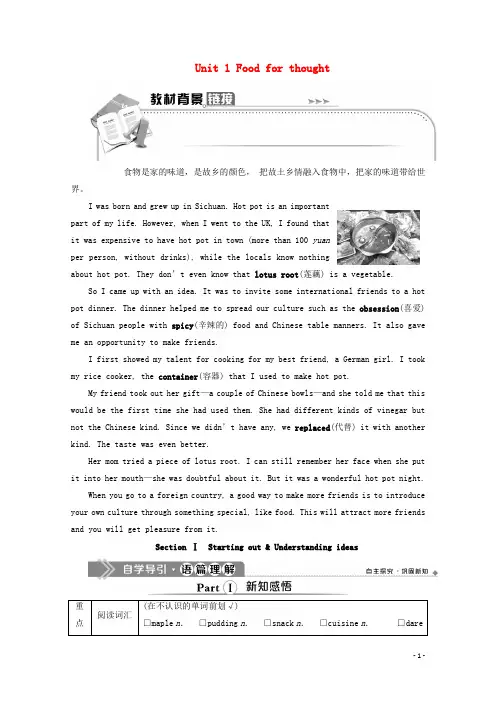
Unit 1 Food for thought食物是家的味道,是故乡的颜色,把故土乡情融入食物中,把家的味道带给世界。
I was born and grew up in Sichuan. Hot pot is an importantpart of my life. However, when I went to the UK, I found thatit was expensive to have hot pot in town (more than 100 yuanper person, without drinks), while the locals know nothingabout hot pot. They don’t even know that lotus root(莲藕) is a vegetable.So I came up with an idea. It was to invite some international friends to a hot pot dinner. The dinner helped me to spread our culture such as the obsession(喜爱) of Sichuan people with spicy(辛辣的) food and Chinese table manners. It also gave me an opportunity to make friends.I first showed my talent for cooking for my best friend, a German girl. I took my rice cooker, the container(容器) that I used to make hot pot.My friend took out her gift—a couple of Chinese bowls—and she told me that this would be the first time she had used them. She had different kinds of vinegar but not the Chinese kind. Since we didn’t have any, we replaced(代替) it with another kind. The taste was even better.Her mom tried a piece of lotus root. I can still remember her face when she put it into her mouth—she was doubtful about it. But it was a wonderful hot pot night.When you go to a foreign country, a good way to make more friends is to introduce your own culture through something special, like food. This will attract more friends and you will get pleasure from it.Section ⅠStarting out & Understanding ideas重点阅读词汇(在不认识的单词前划√)□maple n.□pudding n.□snack n.□cuisine n.□dare重点句型1.现在分词短语作原因状语:Growing__up__in__England(生长在英国) with a British father and a Chinese mother, I’ve enjoyed food from both countries ever since I was able to hold a knife and fork—and chopsticks!2.must have done表示对已发生事情的推测,意为“一定……”:He must__have__thought(当时一定以为) I was joking.3.否定词与比较级连用,表示最高级含义:To me, there’snothing__better__than(没有什么比……好) a crosscultural afternoon tea of English biscuits and a cup of Chinese oolong tea in a fine china cup!ⅠRead the text and fill in the blanks.Brief introduction↓The child, a mixedblood boy, 1.________ the food from both Britain and China.Chinese food↓•Mum has 2.________ memories of the food from her home town in Sichuan.•Dad has come to love hot pot, but 3.________ not try some dishes.•The child enjoys eating things like pigs’ ears.Britain food↓•Dad can cook not only a 4.________“full English breakfast” but also a typical Sunday roast.•They all love roast beef and vegetables.A kind of Chinese food↓The child came across stinky tofu.He thinks maybe he’ll fall in love with it someday.Opinions about the food from the two countries↓The child feels at home with food from both his cultures.答案:1.enjoys 2.sweet 3.dare 4.superⅡRead the text carefully and choose the best answer according to the text.1.From the second paragraph, we can learn that________.A.my dad loves all the Chinese dishes after many years of marriageB.my dad has been used to eating chicken feetC.Chinese can make dishes using every part of an animalD.my grandparents felt surprised when they saw my father for the first time 2.When I asked the butcher if they had pigs’ears, the butcher felt________.A.unbelievable B.indifferentC.puzzled D.ignorant3.Which is the thing all my family enjoy?A.Pigs’ ears.B.Roast beef and vegetables.C.Stinky tofu.D.Blue cheese.4.What’s the meaning of “one man’s meat is another man’s poison” in the last paragraph?A.You are not sure to enjoy what others eat.B.If one man eats others’ meal, he will get poisoned.C.It’s dangerous for one man to try others’ meal.D.What suits one may not suit another.答案:1-4.CABDthanks to幸亏;由于;因为(教材P2)Thanks to this, Dad has come to love hot pot!多亏了这个,爸爸才渐渐喜欢上了火锅!because of 因为;由于as a result of 作为……的结果;由于①Thanks to their selfless support, we have made such achievements.多亏了他们无私的支持,我们才取得了这样的成就。
新教材高中英语Unit1Foodforthought泛读技能初养成课件外研版必修第二册ppt

[知识拓展] (1)be related to (2)relate vt.& vi. relate ...to/with ... relate to (3)relation n. in/with relation to
与……有关 与……有联系;有关联 把……与……联系起来 与……有关联 关系;联系 关于;与……相比
泛读 技能初养成
Unit 1 Food for thought
阅读教材 P9 中的材料,选出最佳选项 1.Which of the following statements is true about Ellie? A.She is often too tired to have dinner. B.She is used to saving part of her meal for the next day. C.Some evenings,she just has toast and a yoghurt with honey. D.She thinks the way she eats is beneficial to her health.
[即学即练] 单句语法填空/完成句子 ①Much of the crime in this area is _re_l_a_te_d__(relate) to drug abuse. ②I can't relate what you said _to_/_w_i_th___ what I saw. ③关于那件事,我有很多话要说。 I have a lot to say _i_n_r_e_la_t_io_n__to__ that thing.
[知识拓展] in case of in this/that case in any case in no case as is often the case
高中英语外研版必修二Module 1 Our Body and Healthy 教学设计
优质资料---欢迎下载Module 1 Our Body and Healthy HabitsI . Four-dimensional Teaching objectives:1. Language ability:1) Listening: Correcting incorrect information.2) Speaking: Putting items in order of importance and practising liaison.3) Reading: Comprehending and choosing correct information.4) Writing: Paragraphing.5) Grammar: Nouns used as verbs and Will/be going to for future actions and use them to talk about the future.6) Learning words about physical illness, body parts and medicine.2. Cultural awareness:1) Knowing about eating habits.2) Knowing about the health systems in different countries.3. Thinking qualities:1) Enable the Ss to realise the relationship between health and eating habits and guide them to form the right eating habits.2) Using the words and expressions learned in this module to preparing a survey about healthy living.4. Learning ability:1) Using proper learning strategies to complete the learning tasks in this module.2) Talking about future using will and be going to.3) Evaluating themselves as students.II. Important points1. Some new language items in this module, especially the new words, phrases and sentence patterns.2. Reading comprehension of the reading passage and vocabulary about physical illness, body parts and medicine.3. Grammar: Will/be going to for future actions.4. Practising listening, speaking and writing about health and healthy habits.III. Difficult points:1. Some new words, phrases and sentence patterns.2. Reading comprehension and writing.3. Grammar: Will/be going to for future actions.IV. Teaching aid: Multi-media teaching systemV. Teaching methods: Individual, pair and group work, interactive and task-based teachingVI. Teaching time: 8 periodsPeriod 1Teaching and learning contents: Introduction and Speaking.Comprehensive teaching and learning objectives:1. To learn some words and expressions related to health.2. To talk about the healthy habits and put them in order of importance.Main and difficult point:Learning some words and expressions related to health and talking about healthy habits.Teaching and learning procedures:Step 1 Lead-in1. Introduce the topic and main teaching contents of this module.2. Introduce the learning contents and objectives of this period.Step 2 Introduction: Vocabulary and speaking1. Task 1 (Ss) Work in pairs to go through the words in the box and get to know their meaning, and then find out which of them are connected with illness.2. Give brief explanations to the new words.1) Which of them are connected with illness?connect vt. 连接,连结/联系connection n. 连接; 联系, 关系(To RB P6)connect …to/with …把……连接到……上; 把……和……连接起来connect …with …把……和……联系起来;由……联想到……be connected with 与……有联系have connection with 与……有联系in connection with 与……有关e.g. The two cities are connected by a railway .e.g. Please connect me with Beijing University.2) diet n. 日常饮食; 规定饮食; vt.& vi.(使)节制饮食(To RB P7)be on a diet节食;在节食go on a diet 节食put sb on a diet 让某人节食e.g. He began his diet a week ago. 他在一星期前开始节食。
2019外研版高中英语选择性必修二Unit1 Presenting ideas板块教学设计
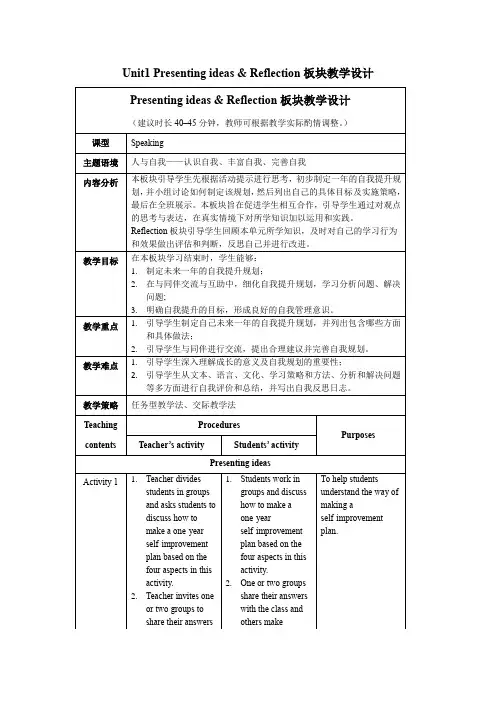
2.To helpstudentscorrectlyunderstand the unit theme.
Reflection
1.Teacher asks students to rate their performances in this unit,summarisewhat they have learnt and think about what they need to improve.
Reflection板块引导学生回顾本单元所学知识,及时对自己的学习行为和效果做出评估和判断,反思自己并进行改进。
教学目标
在本板块学习结束时,学生能够:
1.制定未来一年的自我提升规划;
2.在与同伴交流与互助中,细化自我提升规划,学习分析问题、解决问题;
3.明确自我提升的目标,形成良好的自我管理意识。
Unit1Presenting ideas & Reflection板块教学设计
Presenting ideas & Reflection板块教学设计
(建议时长40–45分钟,教师可根据教学实际酌情调整。)
课型
Speaking
主题语境
人与自我——认识自我、丰富自我、完善自我
内容分析
本板块引导学生先根据活动提示进行思考,初步制定一年的自我提升规划,并小组讨论如何制定该规划,然后列出自己的具体目标及实施策略,最后在全班展示。本板块旨在促进学生相互合作,引导学生通过对观点的思考与表达,在真实情境下对所学知识加以运用和实践。
1.Studentsbrainstormtheir specific goals and action in the plan together.
2020学年新教材高中英语Unit1FoodforthoughtPeriodFourGrammar—Modals1教案外研版必修第二册
Period Four Grammar—Modals(1)感知以下课文原句,完成方框下的小题1....I was able to hold a knife and fork—and chopsticks!2.But there are still some dishes that Dad dare not try even after many years of marriage to my mother.3....Mum and I just have to find a way to get him into the kitchen!4....we’d better not eat too much roast food as it may make us suffer from heat inside our bodies...5.“You needn’t try it if you don’t want to,”Mum said...Choose the meanings to the words in bold above.A.Be afraid to do something.B.Not be necessary to do something.C.Give advice to do or not to do something.D.Be necessary or give strong advice to do something.E.Have the ability to do something.1.E 2.A 3.D 4.C 5.B一、基本特征1.情态动词有一定的词义,不能单独作谓语,需和实义动词或系动词一起作谓语。
She can speak English though she is six.尽管她才6岁,但她会说英语。
2.情态动词一般无人称和数的变化,个别情态动词有现在时和过去时两种时态变化。
新外研版高中英语必修第二册Unit 1 教学设计
Book 2 Uni t 1 Food for thought 教学设计单元主题本单元的主题语境是“人与社会”,涉及的主题语境内容是多元饮食文化 和健康的饮食习惯。
本单元从介绍不同国家的代表性食物开始,展现了 丰富多彩的世界美食和世界各地的餐桌礼仪,丰富学生对饮食文化的认 知,引导学生深入思考健康饮食和生活方式的关系,最终达成对多元饮 食文化的理解和包容,并且反思和改进自己的饮食习惯。
单元目标学生能够围绕本单元的主题语境内容,基于单元提供的个人故事、专栏 文章、网络点评、菜谱等多模态语篇,综合运用各种语言技能,读懂语 篇内容,听懂与点菜相关的对话,讨论并加深对健康饮食的认识,使用 新语言描述食物的色香味等特征,恰当使用情态动词给他人提出建议, 能够用英文写简单的菜谱并推荐一道美食,深化对单元主题意义的理解 与挖掘;同时能够运用单元所学谈论中外饮食文化的异同,正确判断文 章中人物的观点和态度,评判不同人的生活方式,反思和改进自己的饮 食和生活习惯;通过运用各种学习策略,在自主、合作与探究学习的过 程中,结合单元所提供的反思性和评价性问题不断监控、评价、反思和 调整自己的学习内容和进程,提高自己理解和表达的效果,最终促进自 身语言能力、文化意识、思维品质和学习能力的综合提升。
课型 内容分析活动 1 呈现一段与饮食主题相关的视频。
该视频介绍了一位美国人在中 国的美食之旅,展现了中国的代表性美食,如北京烤鸭、大闸蟹、四川 火锅。
活动 2 要求学生看世界地图和各国代表性食物的图片,将这些食 物与对应的国家进行匹配,并结合自身经历讲述对世界美食的了解。
教学目标1. 学生能够了解中国的代表性食物,能初步了解不同国家的代表性食物及其英文表达,激活已有的语言、背景知识,产生对话题的兴趣; 2. 学生能够基于已有的生活经验,用英文简单描述和评价不同种类及不同国家的食物。
教学重点1. 引导学生通过视频材料,了解中国的代表性食物;2. 引导学生完成食物与国家的匹配活动,了解世界各国的代表性食物。
外研版高一英语必修第二册unit 1 教案
三、学习者特征分析
1、中生各种认知能力不断完善,思维能力更加成熟。
。
2、抽象逻辑思维、辩证思维和创造性思维有了很大发展,学习自觉性明显提升。
2
四、教学重点、难点
引导学生通过自主阅读和小组合作理解课文大意,梳理文章结构。
引导学生关注文中人物对不同食物的情感态度,并从跨文化的角度理解饮食文化。
1.When he was six years old, he ____________ drawing.
2.When he went abroad, he ________________ the different culture.
3.I ____________ a group of children playing on the playground.
10.When things aren't going well, he encourages me not ________ (give) up.
Ⅲ.选词填空
thanks to,take todoing,suffer from,according to,deal with,come across,remind... of...,feel at home with
作为一名学生,没有比受到老师表扬更好的了。
4.________________________________________,she decided to comfort him.
发现朋友伤心欲绝,她决定安慰一下他。
七、教学反思
1、坚持联想式教学
2、坚持启发式教学
3、激发学生学习兴趣
4、多与学生沟通和交流
外研版新标准高中《英语》必修第二册Unit 1 Food for Thought听说课教学设计
新标准《英语》必修第二册Unit 1 Food for Thought听说课教学设计课型:Listening and Speaking主题语境:人与社会---饮食文化、健康生活内容分析:本节听说课是外语教学与研究出版社出版的高中英语新教材必修第二册第一单元的听说课。
根据本单元Using Language 板块中的Food comments (Page 6)和Healthy eating (Page 7)两部分来设计。
Food comments部分是以网络点评的方式呈现了描述食物的词汇,同时引导学生借助这些词汇表达自己最喜欢的食物。
Healthy eating部分的材料是餐厅服务人员与两位顾客之间的一段对话,引导学生选择正确和健康的饮食。
学情分析:本节课为高一上学期内容,内容切近学生生活实际,学生经过了必须第一册的学习,已经初步了解新教材听说课的要求,逐步发展了自己的听说技能,但是学生惧怕上听说课,学生需在怎样恰当的运用听说策略“听懂”并“说出”,实现有效输入和输出上还需下功夫。
教学目标:1.学生能够掌握描述食物的色香味等特征的形容词并能恰当使用这些形容词来描述食物。
2.学生能够根据具体语境选择合适的语言给对方提出合理化的饮食建议。
3.学生能听懂与点菜有关的对话,讨论并加深对健康饮食的认识。
学生能够了解健康饮食的相关知识,增强健康饮食的意识;反思和改进自己的饮食习惯,并能够在生活中去落实。
教学重点:1.引导学生用学过的词汇和结构介绍自己喜欢的食物。
2.引导学生获取对话中关于健康饮食的相关信息,并进行归纳,根据语境进行语言输出。
教学难点:引导学生提取并总结提出建议的表达,并迁移和运用于相似的情景交流中。
教学策略:交际法教学法、任务型教学法、听说教学法Teaching procedures:Lead - inTeacher’s activityThe teacher invites the students to talk about blue cheese and stinky Tofu in the passage A Child of Two Cuisines using words they consider appropriate.Students’ activityThe students talk about the food and try to realize they can talk about the food from different aspects.The purposeHave the students know they can talk about certain food from different aspects.Activity 1Teacher’s activi tyThe teacher asks the students to read the comments on the left and match the comments to the pictures.Students’ activityThe students read the comments and match them to the pictures.The purposeHave the students understand the topic-related words in a real context.Activity 2Teacher’s activity1. The teacher asks the students to read the comments again and underline the words that describe food.2. The teacher asks the students to put the underlined words into the correct columns of the table and add more similar words. Students’ activity1. The students read the comments again and underline the words.2. The students put the words into the table accordingly and add more similar ones.The purposeHave the students categorise the words describing different food. Activity 3Teacher’s activityThe teacher asks the students to talk about their favourite food in pairs, using the words they have learnt.Students’ activityThe students talk about their favourite food in pairs, using as many words they have learnt as possible.The purposeGet the students to use the words in a real-life context.Activity 4Teacher’s activityThe teacher asks the students to look at the pictures and listen to the conversation. Then asks the students to tick the food and drinks ordered.Students’ activityThe students listen for the first time, and tick the food and drinks ordered.The purposeHave the students learn to understand the main idea of the listening material.Activity 5Teacher’s activity1. The teacher gets the students to listen to the conversation again and complete the notes. Have the students listen again if necessary.2. The teacher then asks the students to talk about what Harriet says to persuade Janet.Students’ activity1. The students listen to the conversation and complete the notes.2. The students then talk about what Harriet says to persuade Janet. The purpose1. Have the students learn to understand the details of the listening material.2. Have the students learn the way of giving advice.Activity 6Teacher’s activity1. The teacher asks the students to work in pairs, turn to the corresponding pages and read the information.2. The teacher asks the students to act out the conversation to persuade a customer. The teacher provides help to the students when necessary.3. The teacher invites some pairs to act out the conversation in class. Students’ activity1. The students work in pairs and read the information on the corresponding pages.2. The students act out the conversation in pairs.The purposeHave the students practise giving advice in the fixed scene.Activity 6Teacher’s activityThe teacher asks the students to think of a similar situation and have a conversation to persuade others. Provide help to the students when necessary.Students’ activityThe students think about another situation and have a similar conversation.The purposeHave the students practise giving advice in a topic-related real-life context.HomeworkTeacher’s activityThe teacher asks the students to carry out a survey with group members after class to make a list of the healthy food in life and decide one to recommend it to their friends, giving brief description about it.Students’ activityThe students carry out a survey with group members after class to make a list of the healthy food in life and decide one to recommend it to their friends, giving brief description about it.The purposeHave the students better understand our main topic in real life.教后反思:本节课是第四届齐鲁名师建设工程人选“山东省英语学科新高考研讨会”上的一节展示课。