
2014人教版新目标九年级英语Unit 10_you're_supposed_to_shake_hands.Section_B_(2a-2e)reading
尽管我仍然犯很多错误,可它不像过去那样困扰我了。 (1) although 虽然…但是,相当于though,引导让步状 语从句,不能和but连用. (2) make a mistake / make lots of mistakes 犯错 (3) worry vt. “是使某人担心”;该词用作不及物动词, 表示“担心”,worry about sb./ sth. 担心某人或某事. 1.What worries me most is the food. It is not healthy.
Read the sentence and replace the underline words with the phrases.
Dear Laura, Thanks for your message. Yes, I’m having a great time on my student exchange program in France. I was a bit nervous before I arrived here but there was no reason to be. My host family is really nice. They go out of their way to make me feel at home. The grandmother knows that I miss Chinese food a lot. So she actually learned how to make Chinese food! She also has a teenage granddaughter about my age. She’s really kind and she always talks to me in French to help me practice. You wouldn’t believe how quickly my French has improved because of that. I’m very comfortable speaking French now. Although I still make lots of mistakes, it doesn’t worry me like it used to.
France
In France, people are (not) supposed to…
×
People are supposed to eat with knife and fork. People are supposed to put food on the plate.
I am full. It was delicious. elbows
Manners make a man.
观其待人而知其人
When in Rome, do as Romans do.
入乡随俗
Here are some things you need to know about table manners when you visit Korea. First of all, you are (not) supposed to ……
Rose goes out of her way to help Tom with his English.
1.make sth. for sb. = make sb. sth. He made a dress for me. 2.make 还可表示“使处于某种状态, 使成为,”后接名词,形容词或过去 分词做宾语补足语。 The news made me disappointed. 3. make sb. do sth. 使某人做某事
A: feel good about
B: make sb nervous C: try very hard
have a great time “玩得高兴,过得愉 快”,相当于have a wonderful /good/nice time, have fun 或 enjoy oneself exchange n. “交换” 常构成短语 exchange …… for….. 意为“ 用……. 换…..” Can I exchange an apple for four oranges?
×
×
In France, people are not supposed to… In France, people are supposed to…
Let’s predict (预测).
table manners
Fast reading
How do paragraph you know? Match each with the main ideas. Para 1 Lin Yue’s life in France
I’m having a great time on my student exchange program in France
Para 2
Table manners in France
My biggest challenge is learning how to behave at the dinner table
teenage 形容词“十几岁的;青少年 的”,指13岁至19岁这一年龄段。其 名词形式为teenager, “青少年,”指 13岁至19岁的人,用作可数名词。 The teenage actor is very popular.
3. Although I still make lots of mistakes, it doesn’t
2. They go out of their way to make me feel at home. 他们尽力让我感觉自在。
(1) go out of one’s way to do sth 竭尽全力/尽力做 某事,想尽办法做某事 (2) feel at home 感觉在家(一样);感觉自在
1.Rose 竭尽全力来帮助Tom学英语.
learning basic table manners was her biggest challenge.
She never knew what she was supposed to do at the
dinner table.
Explanations table manners 餐桌礼仪
manner 是 “礼貌”的意思, 常以复数 形式出现。 如: • It’s bad manners to talk with a full mouth. 嘴里吃着东西说话是不礼貌的。 • It’s bad manners to laugh at others. 嘲笑别人是不礼貌的.
2. Don’t worry about me. I can look after myself.
Explanations
Scan Para 2 and find out her biggest challenge.
My biggest challenge is learning how to behave at the dinner table.
What do you know about customs in foreign countries?
What do you think is the biggest challenge when visiting a foreign country? e.g. My cousin went to America, and she said that
at home.
3. How does she feel about making mistakes when she speaks French? It doesn't worry her like it used to. 4. What is the biggest challenge she is facing? Learning how to behave at the dinner table.
manner 还可以表示 “风俗;习惯”, 也常以复数形式出现。 如: The manners of the ancient Egyptians 古埃及的风俗习惯
manner 还可以表示 “方法;方式”
“态度;举止”等意思。如:
Don’t you think that David has got a very arrogant manner? 你难道不觉得戴维的态度很傲慢吗? Why are you talking in such a strange manner? 你为什么用这种奇怪的方式谈话。
2. The grandmother learned how to make Chinese food ____________________. 3.The teenage granddaughter always talks to me in French.to help me practice. _______________________
Careful reading
2b Read the letter and answer the questions. 1. Why is Lin Yue in France? She is an exchange student.
Para. 1:
2. Does she enjoy staying with her host family? How do you know? Yes, she does. Because they go out of their way to make her feel
As you can imagine, things are very different from the way they are at home. For example, you’re not supposed to put your bread on your plate. You’re supposed to put it on the table! I thought that was pretty strange at first, but now I’m used to it. Another example is that you’re not supposed to eat anything with your hands except(除…之外) bread, not even fruit. You have to A: slowly learned how to be cut it up and eat it with a fork. Another thing is it’s impolite to say that you’re full. If you don’t want any more food, you should B: be used to do just say, “That was delicious.” Also, you’re not supposed to put your elbows on the table. I have to say that I find it difficult to remember everything, but I’m gradually getting used to it. I don’t find French customs so strange anymore.
2014人教版新目标九年级英语Unit-10-you're-supposed-to-shake-ha
4. What is the biggest challenge she is facing?
× It . ×elbows
In France, people are not supposed to… In France, people are supposed to…
Let’s predict (预测).
table manners
Fast reading
it up and eat it with a fork. Another thing is it’s impolite to say
that just
syaoyu,’“rTe hfualtl.wIafsydouelidBcoion:u’bts.w”eaAnultssoa,neyydomu’tororeendfoootosdu,pypoouseshdotuoldput
was pretty strange at first, but now I’m used to it. Another
example is that you’re not supposed to eat anything with your
hands except(除…之外A): sbrloeawd,lnyotleevaenrnfreuidt. Yhoou whavteotobceut
Read the sentence and replace the underline words
with the phrases.
人教版新目标九年级英语Unit 10 You’re supposed to shake hands.——重点短语句子 素材

12.我不介意/介意干某事/没关系
P761.出国
2.擦掉黑板上的粉笔
3.打包温暖的衣服是重要的||。
4.握手之前你应该脱下你的手套||。
进入之前你应该敲门||。/敲门||,窗
5.关于社交每个国家都有不同的规矩||。
6.如果你想懂得另一种文化是值得麻烦的||。
值得干某事
7.餐桌礼仪
8.尽可能地
5.干某事是不礼貌的
6.敲击空碗
7.指着
8.在餐桌旁
P78 1.为(干)什么而感谢
2.干……之前我有点紧张||。
3.没有理由干某事
4.学习怎样干某事
5.和我年龄相仿/差不多
6.干某事很舒服
7.我最大的挑战是学习在餐桌边怎样表现||。
8.正如你所想像的
9.与……不同
10.用手吃
11.切碎
12.我饱了||。
8.四处走走/匆匆忙忙
10.钟表之都
11.毕竟||,终究12.在中午
13.生气
14.努力干某事
15.避免交通拥挤
16.我认为让别人等待是不礼貌的||。
17.没有/不干某事
18.一些有趣的事情
19.一起去某个地方
20.不是什么大事||。
P771.用手吃
2.把筷子插入食物
3.开始干某事
4.把……放在……上
Unit10.
2.在你们国家当你第一次遇到某人你应该做什么?
3.你应该握手||。
和某人握手
4.被期望/应该干某事
期望某人干某事
P74 5.以错误的方式
6.我一伸出手||,他就鞠躬了||。
7.如果你不鞠躬是不礼貌的||。
8.我只是伸出手站在那儿||。
2014年人教新目标九年级英语Unit10 You're supposed to shake hands.(全单元)课件

1.( B.)In America, the people are supposed to_____ when they meet for the first time. A. bow B. shake hands C. hug D.kiss 2. Korea, are, expected, you, to, bow, in, (.) You are excepted to bow in Korea. ____________________________________________ 3. 当你遇到某人的时候应该怎么做? are supposed ____to do What ______ you _________ ____ ________ when you meet someone? 4. 下次你该问你应穿什么? should ask what you _______ You ______ ______ ______ are supposed to wear next time?
shake hands
bow v. & n. 鞠躬
kiss v. & n.
亲吻,接吻
Different countries have different customs 习惯, 风俗.
what are people in the United States supposed to do when they meet for the first time?
• 快速阅读3a, 回答下面问题: /kə'lʌ mbɪə/ • 1) Are they relaxed about time in Colombia?
哥伦比亚
Yes, they are.
2014人教版新目标英语九年级Unit_10_you're_supposed_to_shake_hands_B_1a-1d
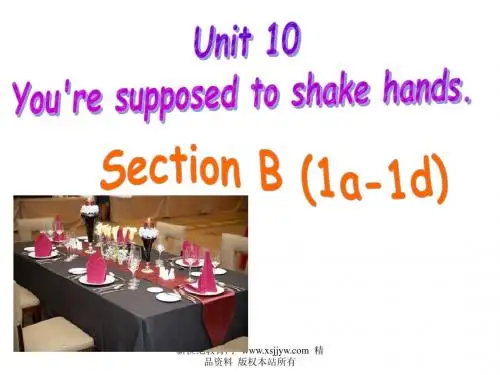
table manners
use your chopsticks to hit an empty bowl
It’s (im)polite to…
In China
be (not) supposed to ….
新世纪教育网 精 品资料 版权本站所有
table manners
新世纪教育网 精 品资料 版权本站所有
餐桌礼仪
• 在宴会上举止要得体,否则就是 失礼,会被人认为没有教养。在 宴席上不可用餐巾擦刀、叉等器 皿;不要把汤匙放在汤碗里。在 餐桌上不要服用任何药物。口中 食物太多时,不要和别人讲话。 在众人面前,不得使用牙签等
新世纪教育网 精 品资料 版权本站所有
新世纪教育网 精 品资料 版权本站所有
1. You’re not supposed to start eating first if there are older people at the table. 2. You shouldn’t point at anyone with your chopsticks. 3. It’s impolite to stick your chopsticks into your food. 4. It’s impolite to use your chopsticks to hit an empty bowl. 5. You are not supposed to talk with your moouth full. 6. It’s impolite to make a big noise when you are eating soup.
plate
新世纪教育网 精 品资料 版权本站所有
table manners
2014年新目标九年级英语Unit10(第五课时)实用课件
2b
Read the letter and answer the questions.
1. Why is Lin Yue in France?
She is there as an exchange student. 2. Does she enjoy staying with her host family? How do you know? Yes , she does.Because she said that they went out of their way to make her feel at home.
____________________________________
In our house, you’re supposed to __________________ When you go out with people, you should
_____________________________________.
Language points
2. My biggest challenge is learning how to behave at the dinner table. (1) challenge既可以用作名词又可以用作动词,作 为名词可以表达“(挑战、决斗、比赛等的)邀请; 挑战书等”,后面有时与介词to相连。如: a challenge to violence 向暴力挑战 give / offer a challenge 挑战 accept / take up a challenge 接受挑战,应战 He challenged anyone to beat him. 他向任何要打败他的人挑战。
2e
Compare the table manners in France and China in your group. How are they the same or different? Make a list.
2014年秋新目标英语九年级课件:Unit 10 You’re supposed to shake hands Section B(2a—2e)
4. 我最大的挑战就是学会在餐桌上时如何表现。 My biggest challenge is__________ how__________ __________ at the dinner table. 5. 我得说我发现记住一切很难, 可是我正逐步地习惯它。 I have to say that I find__________ difficult__________ re m e m b e r e v e r y t h i n g , b u t I ’ m g r a d u a l l y g e t t i n g
_________________________________________________
答案: 1. The grandmother’s granddaughter of Lin Yue’s host family. 2. That was delicious.
1. worry vt. 使烦恼, 使焦虑 【语境领悟】
【自主归纳】 (1)worry作及物动词, 意为“使烦恼, 使焦虑”, 常接sb. 作宾语。
(2)worry作不及物动词, 意为“烦恼, 担心, 发愁”, 常跟介词
about或over。 (3)worry about和be worried______都表示“对„„担心, 忧
虑”。
答案: about
2. except prep. 除„„之外; conj. 除了; 只是 【语境领悟】
*Another example is you’re not supposed to eat anything with
your hands except bread, not even fruit. 另一个例子是除了面 包你不应该用手拿着吃任何东西, 甚至水果也不应该拿着吃。
2014新目标九年级英语上册unit10知识点讲解单元提高题
2014新目标九年级英语上册unit10知识点讲解单元提高题UNIT 10 you are supposed to shake hands?1. be (not)supposed to do sth (涓? (皵杈冭交) should (not)do 锛堜笉锛夊簲璇ュ仛... () ( )1.鈥淗enry, you ______ touch anything in the laboratory without the teacher`s permission.鈥?鈥淪orry, sir.鈥?A. aren`t supposed to B. are surprised to C. are afraid to D. are supposed to ( )2. You are _____to type quickly when talking to each other on QQ so the other person doesn't get bored A. suggested B. supported C. taught D. supposed ( )3. We are supposed to _____a solution to stop people from looking down at their mobile phones while driving cars. A. come up with B. coming up with C. come out D. coming out2. You鈥檙e supposed to shake hands when you meet for the first time?銆愯В鏋愩€憇hake鈫?shook鈫?shaken 鎽囧姩锛岄渿鍔?shake hands 鎻℃墜shake hands ___________sb.涓庢煇浜烘彙鎵?( )1.People in China ________with each other when they meet for the first time.A. bowB. kissC. shake handsD. laugh 2.You鈥檙e supposed to shake ___________ (hand) when you meet your friends.3. expect to do sth ?expect sb. to do sth 鏈熷緟鏌愪汉鍋氭煇浜?( 娌℃湁hope sb to do / hope that sb can/ will do ) I expect so/ not = I hope so / not sb. be expected to do sth. /仛鏌愪簨( )1. Do you think our football team will win the match? 鈥?Yes, we have better players. so I ___them to win. A. hope B. ask C. help D. expect ( )2. Everyone in the class___________ take part in the discussion. A. expect to B. is expected to C. is expecting D. are expect to4. as soon as 鈥滀竴鈥﹀氨鈥︹€?庝富灏嗕粠鐜帮級( )1.Will you please give the Readers Times to Jane? 鈥昐ure锛孖'll give it to her____ she comes back. A. before B. until C. because D. as soon as ( )2. Your uncle will come to see you as soon as he ______ here. A. arrives B. arrived C. will arrive D. is arriving5. hold out ones` hand 浼稿嚭锛堟墜锛?hold on 鎶撲綇; ()?.. hold on to 鍧氭寔; 涓嶆斁寮?hold up 涓捐捣;. ( )1. May I speak to Rachel? 鈥?______ ,but I鈥檓afraid you have the wrong number. A. Yes, please B. hold on C. This is Tom D. Sorry ( )2. Excuse me, could you please tell me if the sports meeting ________ on time? 鈥旽ard to say. If it ____ tomorrow, we鈥檒l have to put it off. A. will hold; rains B. will be held; rains C. will be held; will rain D. holds; will rain ( )3.________ your dreams and I believe one day they will come true. A. hold outB. hold onC. hold on toD. hold up6. a little + n.(涓? = a bit of + n.(涓? a little + adj. = a bit + adj. ( )1. I鈥檝e got only________ money with me today. I鈥檓afraid I can鈥檛help you A. few B. a few C.a bit D. a bit of 娉ㄦ剰锛?not a little = very much / not a bit = not at all 渚嬶細After walking for a long time, he felt not______________ hungry.7. ?drop by sb / sb` s home = come over to sb / sb`s home drop in at + 鍦扮偣in on + sb. ( )1. I often drop ________ my uncle鈥檚home. A.by B. over C. on D. in ( )2. People in Colombia always _______ their friends鈥?homes without ______ plans. A.drop by; make B. drop by; making C. visit; make D. visit; to make ( )3. Will you drop _________us tomorrow evening for a talk? A. on in B. on at C. in at D. in onabout sth 瀵?.寰堝叆杩?8. be mad _________ sb. 瀵规煇浜虹敓姘?be angry________ sb. 瀵规煇浜虹敓姘?渚嬶細She was mad at her husband for forgetting her birthday. ?( )1. The a little boy was so _____ his own magic world that he seldom went out to play with other children. A. good at B. mad about C. popular with D. afraid of ( )2. Mymother________ me because I didn鈥檛finish the homework. A. was surprised at B. is mad with C. was angry at D. was mad at9. take__________ 鑴变笅/(take __________ 鍙栧嚭take __________ 鎷胯蛋take it easy ___________ take ___________ 鍙戠敓take care 灏忓績/ take care ________ 鐓ч【take___________ intake after 锛堟€ф牸锛夌浉鍍?( )1. When you are swimming, ________ your ears. You can use earplugs () to stop water getting into your ears. A. take place B. take part in C. take off D. take care of ( )2. _______ your textbooks and let`s begin our lesson. A. take care B. take away C. take off D. take out ( )3. Jimmy _________his father and they both like helping those who are in trouble. A. takes away B. takes offC. takes outD. takes after10. except 鈥滈櫎鈥︹€︿箣澶栤€?锛堟帓闄ゅ叧绯伙級/ except for (鍦ㄦ暣浣? besides 鈥滈櫎鈥︹€︿箣澶栵紙杩樻湁锛?锛堝苟鍒楀叧绯伙級/ beside = next to 鍦ㄩ檮杩?( )1. All of us went to the park _____ Bob. He had to look after his sick sister. A. besides B. with C. except D. except for ( )2.Is Jack good at basketball? 鈥昚es. ______ basketball he is also good at table tennis. A. Except B. Besides C. But D. Beside ( )3. She did so well in the English exam ________ a spelling mistake. A. except B. besides C. except for D. beside缁?鍚?璁?缁?涓€. 鍗曢€?( )1. Is that your eraser? 鈥昇o, ______ is red. It must be ________. A. my , somebody else B. mine , somebody else鈥檚. C. mine , someone else D. my , someone else鈥檚( )2.There _____ many animals in the forest. But now the number of them _______ getting smaller. A .used to have ; is B. used to be ; is C. used to have ; are D. used to be ; are ( )3. _______ the teachers in their school is about 800 and one fourth of them are _______ teachers. A. A number of ; women B. A number of; woman C. The number of ; women D. The number of; woman ( )4.I could speak ______Japanese_______ Chinese , so I had to talk with him in English. A. not only; but also B. both; and C. neither; nor D. either; or ( )5. Parentsall hope that sick kids should ______ in the hospital. A be taken good care B. take good care C. be taken good care of D. take good care of ( )6.Some robots are ______ to do the same things ______ people. A. enough smart, as B. enough smart, with C. smart enough, as D. smart enough, with ( )7. I have become good friends with some of the students in my school ______I met in the English speech contest last year. A. whom B. where C. which D. who ( )8.Many boys and girls are made _____ what they鈥檙e not _____. A. to do, interested B. to do, interested in C. do, interested in D. doing, interested ( )9. Can you tell me __________ ? ----Sorry , I don鈥檛know . I was not at the meeting , either . A what does he say at the meeting B what did he say at the meeting C what he said at the meeting D what he says at the meeting ( ) 10. The low-carbon(浣庣⒊) lifestyle has influenced our daily life in the last few years. Yes, _______ people are paying attention to saving energy these days. A. Less and less B. Fewer and fewer C. More and more D. Many and many ( ) 11. Mom, when will we leave for grandma鈥檚home to have dinner? ---We will start as soon as your homework ______. A. is completed B. will complete C. has completed D. will be completed ( )12. Have all the students known our class will visit the factory tomorrow? 鈥昚es, every student except the twins ______ about it. A. tells B. told C. was told D. were told ( )13.Do you know the man _____ Bill is talking to at the moment? 鈥旽e 鈥檚Jim. A. which B. whom C. who D. whose ( )14. I am going to spend my summer holiday in Hainan this summer. 鈥旽ow lucky you are! _____ . And don鈥檛forget to e-mail me. A. Congratulations! B. Have a nice time! C. Not at all D. Good-bye! ( )15. How long have you ______ the map?---For two years. I ______ it in the market two years ago. A.bought; had B. had; bought C. had; had D. bought; bought ( )16. I hear your grandfather has an old cup in your home. 鈥昚es, It drinking tea long ago and my grandfather drink tea with it when he was young. A. was used to; was used to B. used for; used to C. was used for; was used to D. was used for; used to ( )17. What鈥檚the most important morning news on CCTV today? 鈥昑he Chinese governmentwarned Japan _____ do harm to China鈥檚territorial sovereignty (棰嗗湡涓绘潈) again and again. A锛巘o not B锛巇idn鈥檛C锛巒ot to D锛巇o not ( )18. We have been friends for nearly twenty years. Nothing can break off our _______. A. friendship B. pleasure C. decision D. experience ( )20. He was so angry at all _____ I was doing _______ he walked out. 銆€A. that; that 銆€B. what; that銆€C. that; what 銆€D. which; what ( )21. You鈥檝e never been to the village, have you? ----________. It is the most beautiful village I鈥檝e ever seen.锟斤拷A. No, never銆€B. No, I have锟斤拷 C. No, only once 銆€ D. Yes, only once锟斤拷( )22. Could you do me a favor and take the box up to the sixth floor? ---- __ ____. No problem at all. 銆€A. With pleasure 銆€B. My pleasure 銆€C. A pleasure 銆€D. Please ( )23. How pleased the father was _____ what his son said! 銆€ A. hearing 銆€B. heard 銆€C. hear 銆€D. to hear ( )24. Is this school ______ they visited the other day? 銆€A. that 銆€B. which銆€C. where 銆€D.the one ( ) 25. She likes music _______ she can sing along _______. A. which; to B. who; with C. whom; to D. that; with ( ) 26. Rose isn鈥檛here today. Is she ill?鈥?________. I saw her at the doctor鈥檚this morning. A. I hope so B. I don鈥檛mind C. I am afraid so D. I don鈥檛think so ( ) 27. The boys are told____ on the wall by his father every day. A. to not draw B. don鈥檛draw C. not draw to D. not to draw ( ) 28.How about going hiking this weekend? -Sorry, I prefer _____rather than_____. A. to stay at home, go out B. to go out, stay at home C. staying at home, goout D. going out, stay at home. ( ) 29.This kind of bicycle looks _____ andsells_______. A锛巒ice , well B锛巒ice , good C锛巜ell , well D锛巊ood , nice ( )30. Which of the two magazines will you take? 鈥旾鈥檒l take______ though I find______ of them is very useful to me. A. all; both B. both; either C. all; neither D. both; neither浜??China is a country with many 1)____________ festivals. The Dragon Head Raising Day(榫欐姮澶? is one of them. This special day is on the 2)____________ day of the second month in the Chinese lunar calendar. It stands for the start of spring and farming. The dragon is important in Chinese. We Chinese people call3)____________ the 鈥渄escendants 锛堜紶浜猴級of the dragon鈥? So people4)____________ the Dragon Head Raising Day with many customs about dragon. On the day in 5)____________ times, people put ashes in the kitchen. This was to 鈥渓ead the dragon into the house 鈥? People believed that with the 6)____________ of the dragon ,they could have a good harvest锛堟敹鑾凤級in autumn. Also, people eat special foods on that day. The foods are usually named 7)____________ dragon. For example ,people eat 鈥渄ragon whisker 鈥?noodles and 8)____________ called 鈥渄ragon teeth 鈥? Today ,many customs have disappeared. But one that has 9)____________ is the cutting of hair. It is 10)____________ that a haircut during the first lunar month may bring luck to the uncles of a family 锟紺mother鈥檚brothers. So many people have their hair cut on the Dragon Head Raising Day. 涓? My life is always filled with sadness and little joy. However, no matter what happens, I can always face it bravely. Last year, I couldn鈥檛believe the 1 that I was allowed to enter the only key (閲嶇偣) high school in my hometown. Then I rushed to my home and told my parents. But my father didn鈥檛seem as 2 as I was. He just kept smoking without saying a word and my mother put her head down and couldn鈥檛help 3. I knew very well what my family was 4. My mum had been ill in bed for 2 years. We lived a hard life and I couldn鈥檛continue my schooling. I felt so unhappy but I could say 5 to my parents. I decided to help my father with his work 6 my family. To my surprise, things completely changed 7 the beginning of the new term. My head teacher came to my family with some money, which had been 8 by my schoolmates. He encouraged me, 鈥淎lways have a dream.鈥?With tears in my eyes, I stepped into the key high school. I have been studyinghard since I entered the high school. Whenever I meet difficulties, I always 9 my teacher and schoolmates. I have a college dream and I must work hard for it, no matte 10 hard lives is. Just as a great man says, 鈥淲hen one door shuts, another opens in life.鈥?锛?锛?. A. idea B. story C. news D. thought 锛?锛?. A. nervous B. excited C. interested D. worried 锛?锛?. A. crying B. laughing C. saying D. shouting 锛?锛?. A. about B. before C. against D. like 锛?锛?. A. nothing B. something C. anything D. everything 锛?锛?. A. support B. to support C. supporting D. supported 锛?锛?. A. after B. since C. at D. on 锛?锛?. A. donated B. spent C. planned D. taken 锛?锛?. A. dream of B. think of C. hear of D. talk of 锛?锛?0. A. what B. which C. that D. how鍥?A man walked into a doctor's office. "Put 1)__________ your tongue(鑸屽ご)," the doctor said. The man did so, and the doctor looked at it quickly. "OK. There is2)____________ serious," the doctor said. "It's clear what's 3)__________ with you. You just need more exercise." "But, doctor," the man said, "I don't think鈥? "Don't tell me what you think," the doctor said. "I am the doctor, not you. I know4)__________you need. I see hundreds of people like you. None of them get enough exercise. They sit in offices all day and then watch TV or 5)__________ the Internet all night. What you need is to walk quickly for at 6)__________20 minutes a day." "Doctor, you don't understand," the patient said. "I鈥?. "There is no excuse," the doctor said. "You must find time for exercise. If you don't, you will get fatter and7)__________ and have health problems in the end." "But I walk every day," the8)___________ said. "锛痟, yes, and I know what kind of walking you mean. You walk a few meters to the office from your house, and a few more meters to a restaurant for lunch and back. " "Please listen to me, doctor!" the man shouted9)__________ the doctor angrily. 鈥淚鈥檓a mailman鈥?the man went on, "and I walk for seven hours every day!" For a moment the doctor kept silent, then he saidslowly, "Put your tongue out again, 9)__________ you?"浜? ВA) Do you need money? Write a letter to Mr. Percy Rose. Maybe he will give you some. Mr. Rose is a rich man, and he likes to give people money. But he usually sends money to old people, sick people and poor children. People who are young and healthy can not get money from him. Sometimes Mr. Rose doesn鈥檛send people money. He sends the things they need 鈥?shoes, a hearing aid, new pots and pans, or some advice. Mr. Rose was very poor when he was a boy. Bow now he is a successful businessman and he wants to help others.( )1. Who can鈥檛get money from Mr. Rose? A. The old and sick. B. The poor and sick. C. The young and healthy. D. The old and poor. ( )2. Why does Mr. Percy Rose give people money? Because ____. A. he was very poor when he was young B. he wants to get 鈥渢hanks鈥?from people C. he has a lot of money and wants to help others D. he worked very hard when he was young ( )3. What does the mother want to give the older daughter? A. Milk. B. Ice cream. C. Shoes. D. Enough money. ( )4. The word 鈥済asoline鈥?here in Chinese means_____. A. 姹芥补B. 鑽?C. 涓€?D. 钀ュ吇鍝?( )5. What can you infer (鎺ㄦ柇) Mr. Rose will give the18-year-old boy and 25-year-old woman? A. A car and a new pot B. Money and a washing machine. C. A hearing aid and a new pan. D. Some advice and a cooking book.B) The weather is getting hotter. You are thirsty after playing basketball or riding home from school. A cold drink may be just the thing. But be careful of what you are drinking. Something that looks cool may not be good for our health. There are plenty of "energy drinks" on the market. Most of them have beautiful colors and cool names. The lists on them tell you they are helpful to your health. Sounds great! These drinks are especially aimed at young people, students, busy people and sports players. Makers sometimes say their drinks make you better at sports and can keep you awake. But after a careful check you may find that most energy drinks have lots ofcaffeine (鍜栧暋鍥? in them. Be careful not to drink too much. Caffeine makes your heart beat fast. Because of this, the International Olympic Committee has limited(闄愬埗) its use. Caffeine in most energy drinks is at least as strong as that in a cup of coffee or tea. Possible health dangers have something to do with energy drinks. Just one box of energy drink can make you nervous, have difficulty sleeping and can even cause heart problems. Scientists say that teenagers should be discouraged from taking drinks with a lot of caffeine in them.( ) 6. Many people like drinking energy drinks because of the following EXCEPT that ________. A. they have beautiful colors and cool names B. they have lots of caffeine C. the markers say they can keep people do better at sports D. they are said to be helpful to health ( ) 7. The main reason for people not to drink too much energy drinks is that they may cause _____. A. heart problems B. nervousness C. sleeping difficulty D. possible health dangers ( ) 8. Which of the following can take the place of the underlined word 鈥渄iscouraged鈥?A. encouraged B. prevented C. helped D. disliked ( ) 9. From the passage we can know that _________. A. advertisements are important in getting people to buy energy drinks B. energy drinks are helpful to teenagers' health C. sports players need to drink a lot of energy drinks D. energy drinks are especially aimed at teenagers ( ) 10. The best title of the passage is________. A. Energy Drinks Are Useful B. Energy Drinks Help Teenagers C. Energy Drinks--- Be careful D. Energy Drinks---Good for HealthC)氫綑( )11. My parents are working all day. I feel lonely. I think no one understands me. ( )12.My parents are very strict with me. I am not allowed to have any fun even listening to the music. I get sick of sitting there and doing exercises again and again. ( )13.My parents have made all the decisions in my life for me. My mother evendecides what socks I should wear.( )14.I do very well in my study. My teachers and parents are proud of me. But I鈥檓not happy at all. I don鈥檛know how to get on with others.( )15. My parents drive me to attend a writing class at weekends. I don鈥檛like to study 7 days a week. I feel tired and hate the schoolwork. A. Let your parents know that you don鈥檛want to be treated as a child all the time. But they can give you some suggestions to help you. B. Talk to your parents at dinner table and let them know you more. And make more friends with neighbors or classmates or teachers. There are still many people around you. C. Studying hard is the first task in students 鈥?school life. However, some after-class activities can do much good to your health and personality. Try to tell your parents that doing something interesting can make you study better. D. Arrange your study well and get a good result. Show your parents that you can manage study by yourself and ask them to give you some playtime. Then you can enjoy the happy weekends. E. Don鈥檛worry. Just take it easy. You will certainly make progress if you can keep it up. F. Try to make friends with your classmates. Be friendly to others. Don鈥檛look down upon others because they are not as good as you in study. G. Get up earlier. Take the way to school as a way to do morning exercise. Enjoy the morning way. Try to be happy.浜? A)淇℃伅褰掔撼璇烽槄璇绘煇缃戠珯璁哄潧涓婂叧浜庘€滈潚灏戝勾鍥版銆?Not only adults but also teenagers have problems in their life. Here is a survey showing the main problems of teenagers. The first one is that they feel stressed out because they have too much homework to do both at school and at home. They have lots of exams to take. And parents usually send them to different classes at weekends. The second one is that more and more teenagers are getting short-sighted. They often read in bed or keep reading for a long time without having a rest. Some of them are crazy about playing computer games. Some spend too much time watchingTV. Another serious problem among teenagers is that many of them are becoming fat. They eat too much food, but they take little exercise. I think teenagers should thinkof ways to deal with the problem. They should make a plan for study and hobbies and find time to relax as much as possible.Information Card The number of the problems that are mentioned in the survey 1._______________ The reason for the teenagers feel stressed 2.____________________ and lots of exams The problem which is caused by computer games 3. ____________________ The things that make teenagers become fat 4. Too much food but ______________ The way for the teenagers to relax themselves 5. By __________________B銆佷功闈㈣〃杈?у鐪嬩簡涓婇潰鐨勮皟鏌ュ悗锛屼綘鎯宠〃杈捐嚜宸辩殑鐪嬫硶锛屽啓涓€绡囬?How Can We Deal With Our Problems鈥濈殑鏂囩珷銆??2銆В?3銆佸懠鍚佸ぇВ鍐抽棶棰橈紝骞朵笖淇濇寔鍋ュ悍鐢熷寲鏂瑰紡銆?How Can We Deal With Our Problems? ______________________(? many teenagers have their own problems in their daily lives. So do I , ___________ _______________ (), I always feel stressed out and findit_____________________________(? because we have 8 classes every day and I ____________________________________________(鑺卞ぇ閲忔椂闂村湪鍐欎綔涓? How do I ____________________________(瑙e喅杩)? Here are two of my suggestions. First of all, I must make a good plan for my study so that I can________________________________________________________(鍚庡仛杩愬姩鏉ユ斁鏉捐嚜宸?. What `s more?___________________________________(鍠濇澂鐗涘ザ) before I go to bed maybe helpful to my sleep. As you see, ________________________________(姣忎釜浜洪兘鏈夌儲鎭? in his life. But we should try to solve the problems by ourselves and have a healthy lifestyle.。
人教版新目标九年级英语教案unit10
人教版新目标九年级英语教案Unit 10 You’re supposed to shake han d.Period 1 SectionA(1a-1c)Knowledge aims:(1)Key Vocabularybow, kiss, be supposed to, shake hands, customs(2) Target LanguageWhat are people in Korea supposed to do when they meet for the first time? They're supposed to bow.Ability aims:1. Train students' listening ability.2. Train students' communicative competence.Emotional aims:Before you meet foreigners, you should some customs. In this way, you can act politely and properly.Key points:Talk about customs and what you are supposed to do.Difficult points:Know about customs of different countries.Teaching methods:1.Scene teaching method2.Listening-and-answering activity to help the students go through with the listening material.Teaching tools:1.A tape recorder 2.PPT课件Teaching procedures:Step I: Review1.Yesterday we finished Unit 9. In this unit, we learned some ways of asking for information politely and express preferences.Make conversations with your friends.A: What kind of music do you like?B: I like music that ____________.2.Write your own sentence:I like music that________________________.I like musicians ________________________.Step II :New lesson1.Presentation:Step 1 1aThis activity introduces some target language.Let students read the instructions.Point to the two lists of words. Read each word and ask students to repeat it.Put up a map of the world on the board. Ask students to explain where each of the countries is.Suggested answers1.Brazil is in South America, next to Peru.2.The United States is in North America, next to Canada.3.Japan is in East Asia, to the east of China.4.Mexico is in North America, on the south of America.5.Korea is in East Asia. It is our neighbor.Look at the sample answer. Tell students to guess if they aren't sure. Answers1.c2.b3.a4.b5.aStep Ⅲ 1bThis activity gives students practice understanding the target language in spoken conversation.Play the tape for the first time. This time, students only listen.Play the tape a second time. Ask them to listen to the recording and check their answers to Activity 1a.Check the answers with the class. Invite a student to read the answers. Step Ⅳ 1cThis activity provides guided oral practice using the target language. Read the instructions to the whole class. Point out the example in the box. Ask two students to read it to the class.Step III:Practice:1. In Japan, the people are supposed to _________(鞠躬) when they meet for the time.2. It's not polite ____________(亲吻) the others in public in China.3. I was supposed to arrive at 8:00, but I (到达) at 9:00.4. When we meet Americans for the first time, we should_________(握手)with them.5. You must know some __________(习俗) before you go to some foreign countries.Step IV:summary:In this class, we've learned some important words, such as bow, kiss, be supposed to, shake hands. We've also learned the target language What are people in Korea supposed to do when they meet for the first time? They're supposed to bow.Step V:.homework:Review the target language.Bb design:Unit 10 You're supposed to shake hands.Section AThe First PeriodTarget Language:A: What are people in Korea supposed to do when they meet for the first time?B: They're supposed to bow.Period 2 SectionA(2a-2d)Knowledge aims:(1) Key V ocabulary :greet, be supposed to(2) Target Language: How was the dinner at Paul's house last night?Ability aims: 1. Train students' listening ability.2. Train students' communicative competence.Emotional aims: When you're invited to a place, you mustn't be late, greet people the wrong way and wear the wrong clothes. That is, you should act according to your host's customs.Key points:What are you supposed to do when you meet someone?Difficult points:How to improve students' listening ability.Teaching methods:1.Listening method to improve students' listening ability. 2.PairworkTeaching tools:1.A tape recorder 2.PPT课件Teaching procedures:Step I: ReviewCheck homework. Ask some pairs to act out their conversations according to Activity 1a.A: What are people in Mexico supposed to do when they meet for the first time?B: They're supposed to bow.Step II :New lesson1.(2a)This activity provides guided listening practice using the target language.Look at the picture and ask students to tell What is happening.Help students understand that the people are at a picnic.Read the instructions and point to the four mistakes on the list. Ask different students to read the mistakes to the class.Ask different students to explain the meaning of each line in their own words. Listen to Maria talking to a boy about what happened at the picnic. She made several mistakes. Listen to the recording and check the mistakes she made.Play the recording. Students only listen the first time.Play the recording again. Get students to check the mistakes Maria made. Check the answers with the class.Answers√ arrived late________ ate wrong food√ greeted Paul's mother the wrong way√ wore the wrong clothes2.(2b)This activity gives students practice in understanding the target language in spoken conversation.Go through the instructions with the class. Point out the blanks in the four sentences. Invite a student to read the first sentence.Play the recording again. Let students fill in the blanks with the words they hear alone.Correct the answers with the class.3.(2c)This activity provides guided oral practice using the target language. Read the instructions for the activity to the class.Look at the example in the box. Ask two students to read the conversation to the class.4.Role-Play conversationShow key points:expecte to do sthhold outTo one’s surpriseStep III:Practice:()1. Jim stood up and shook hands___ both of them.A.byB.withC.forD.to( )2. Chinese never bowed _________the enemiesA.inB.toC.onD.with( )3. John _______ Beijing the day before yesterday.A. arrived atB. arrivedC. reached toD. arrived in( )4. You ________stand in line when waiting for the bus.A. mustn’tB. can’tC. are supposed toD. don’t( )5. She _______some _______in her competition yesterday.A. has made; mistakesB. made; mistakesC. had made; mistakeD. was mistaking; mistakesStep IV:summary:In this class, we've learned key vocabulary greet and be supposed to, the target language How was the dinner at Paul's house last night? What are you supposed to do when you meet someone?Step V:.homework:Ask students to write at least two sentences with the key structure in this class.Bb design:Unit 12 Section A (2a-2d)1.Target Language:How was the dinner at Paul's house last night?2.What are you supposed to do when …You're … You're not …Period3 SectionA(3a-4c)Knowledge aims:(1) Key Vocabularyland, drop by, after all, relaxed, a bit(2) Target LanguageCan you tell me the things I'm supposed to do?Ability aims: 1. Train students' integrating skills.2. Train students' communicative competence.Emotional aims:Different countries have different customs. So you are supposed to do in Rome as the Romans do.Key points:Talk about customs and what you are supposed to do. Difficult points:Know about customs of different countries.Teaching methods: 1.Fast reading to let students get the general idea of the text. 2.PairworkTeaching tools:1.A tape recorder 2.PPT课件Teaching procedures:Step I: ReviewRevisionT: In last period, we summed up the expressions for telling what you are supposed to do. Now I'll check your homework. I'll ask some pairs to act out the conversations before the class.Step II :New lessonStep 1. 3aThis activity provides reading and writing practice using the target language.Show the key words on the screen by a projector.Cali n.卡利(哥伦比亚西部城市)Colombia n.哥伦比亚(南美洲西北部一国家)drop by 访问;拜访Lausanne n.洛桑(瑞士西部城市)Switzerland n.瑞士(欧洲中部国家)land n.国家;国土after all 毕竟Read the words and have students repeat again and again until they can pronounce the words fluently and accurately.Step2.3bRead the passage again and complete the chart.Look at the chart. Tell students what they will write in the chart.Check the answers.Step Ⅲ 3bThis activity provides guided oral practice using the target language.Go through the instructions for the activity with the class.Look at the example in the box. Ask two students to read the conversation to the class.First practice this conversation with a partner. Then talk about your attitude toward being on time and getting together with your friends. Step IV Grammar FocusReview the grammar box Get different students to say the questions and answers.Step III:Practice:be supposed to be expected tobe important to1.When you go abroad ,it __ bring your passport.2. After class,students____ clean the chalk off the blackboard.3.If you visit the northern coast of Norway during the winter season, it ___ pack warm clothes.4.If there are people in the meeting room, you_____ knock before entering.5.In many eastern European countries, you ___ take off your gloves before shaking hands.Step IV:summary:1.key vocabulary2.Grammar focusStep V:.Homework:Finish exercise 4b in the textbook.Bb design:Unit 10 You're supposed to shake hands.Section AThe Three PeriodTarget Language:A: What are you supposed to do when you meet someone for the first time?B: The first thing is ……Period4 SectionB(1a-1d)Knowledge aims:(1) Key Vocabularywipe, napkin, stick, chopstick, rude, point, pick up(2) Target LanguageWe're supposed to eat with chopsticks.Yes, and it's rude to eat with our hands.Ability aims: (1) Train students' ability to understand the target language in spoken conversation.(2) Train students' ability to use the target language.Emotional aims:In order to behave politely at the dinner table, you're supposed to learn some talbe manners.Key points:Target language.Difficult points:1.How to improve students' listening ability. 2.How to use the target language.Teaching methods: 1.Listening method 2.PairworkTeaching tools: 1.A tape recorder 2.PPT课件Teaching procedures:Step I: ReviewCheck homework. Get some students to read out their conversations using the target language in Section A 4c. Collect their conversations and help correct their errors.Step II :New lessonPart 1This activity introduces new vocabulary and provides reading practice using the target language.Look at the picture and ask students to say what is happening in it. (A family is eating a meal.)Look at the title, Mind your manners!Ask: What do you think it might mean?(It means be careful of how you act.)Read the instructions and point to the five statements about manners. Ask students to read the statements.Review the five statements to be sure students understand what each one means. Ask students to act out them. Then ask students to complete the quiz on their own.Part2.2aThis activity gives students practice in understanding the target language in spoken conversation.Read the instructions to the class. Review what an exchange student is and what table manners are. If necessary, translate them into Chinese. Play the recording the first time.Students only listen.Play the recording a second time. As they listen to the recording this time, let students number the pictures.Correct the answers with the class.Step Ⅳ 2bThis activity provides listening practice using the target language.Read the instructions and point to the numbered list of sentence starters and the lettered list of sentence endings. Ask different students to read the two lists.1.You aren't supposed to … a. to stick your chopsticks into your food. 2.It's impolite to… b. point at anyone with your chopsticks.3.You shouldn’t … c. start eating first if there are older people at the tableYou will hear the same recording again. This time as you listen, write the letter of the correct sentence ending after each sentence starter.Look at the sample answer. Read the correctly completed sentence to the class:Step Ⅵ SummaryIn this class, we've learned some key vocabulary, such as wipe, rude, point, pick up. We've also learned the target language by listening and speaking.Step Ⅶ HomeworkTalk about the table manners in your country using the sentence starters in Activity 1a.Bb design:Unit10 Period41.Sentences in Activity 2b:2.Target language:A: We're supposed to eat with chopsticks.B: Yes, and it's rude to eat with our hands.Period5 SectionB(2a-2b)Knowledge aims:(1) Key Vocabularytable manners, behave, be/get used to, cut up, full, fork, You should (2)Practice reading an article.Ability aims: (1) Train students' reading ability.(2) Train students' writing ability.Emotional aims:With the development of society, table manners are more and more important. Sometimes they can help people succeed. So you have to learn more table manners.Key points: Practice reading and writing using the target language. Difficult points:How to write an e-mail message.Teaching methods: 1.Reading comprehension to help students grasp the main idea of the text.2.Writing method 3.Groupwork to make every student work in class.Teaching tools: 1.A tape recorder 2.PPT课件Teaching procedures:Step Ⅰ RevisionReview the target language presented in this unit. Check homework. Ask two students to read out their sentences.SA: You aren't supposed to visited a friend's house without calling first. SB: It's polite to be on time.Step II :New lesson1.Ask and answer.What do you know about customs in foreign countries? What do you think is the biggest challenge when visiting a foreign country?2.2bThis activity provides reading practice using the target language. Teach the new words. Show the following new words on the screen by a projector.manner n. 礼貌;风格;习惯table manners 餐桌礼仪behave v. 行为表现;举止be/get used to 习惯于……cut up 切开;切碎fork n. 叉;餐叉full adj. 饱的;吃胀了的lap n. (人坐着时)腰以下到膝为止的部分;大腿elbow n. 肘;肘部gradually adv. 逐渐地;渐渐地compliment n. 称赞;恭维toast v. 敬酒Call attention to the e-mail message. Invite a student to read the article aloud to the class. Correct any pronunciation errors to make sure the student is providing a good model for the rest of the class.Now read the e-mail. Answer the questions in your exercise book. As students work, move around the classroom and offer help as necessary.Step 3.Read the sentences in 2c and replace the underlined words with the phrases in the box.1.Making mistakes in French used to make Lin Yue nervous.2.It was quite hard for her to feel good about speaking French.3.The host family tried very hard to help Lin Yue.4.Lin Yue has slowly learned how to be like her French friends.Step 4.Review the passage and make notes about French customs in the chart.This activity provides writing practice using the target language.Read the instructions and ask students to finish the exercise.Get students to finish the activity on their own. As students work, move around the room offering help as needed. Ask a student to read his or her message to the class. Have other students add any information that is missing from the first student's report.Step III: Practice:Your pen pal is coming to China on an exchange program. He/She is asking you about Chinese customs and what he/she is supposed to do or not. Make notes in the chart.Step IV: Summary:In this class, we've done a lot of reading, writing and speaking practice using the target language.Step V:Homework:Read the e-mail message in Activity 2b againBb design:Unit 12 You’re supposed to shake hands.Section B (2a-3a)1.What do you know about customs in foreign countries?2.Read the letter and answer the questions in 2b.Period6 SectionB (3b-selfcheck)Knowledge aims:1) Key Vocabularybe excited about doing sth 、some suggestions 、some advice、at the table (2) Target Language: You are supposed to …..You are not supposed to ….Ability aims: 1. Train students' writing ability.2. Train students' communicative competence.Emotional aims:Before you meet foreigners, you should obey some rules. In this way, you can act politely and properly.Key points:Talk about customs and what you are supposed to do. Difficult points:Write a short passage about table manners.Teaching methods: 1.Task-based teaching 2.PairworkTeaching tools: 1.A tape recorder 2.PPT课件Teaching procedures:Step I: Review1.manner n. _________2.table manners _________3.behave v. _________4.be/get used to _________5.cut up _________6.fork n. _________7.full adj. _________8.elbow n. _________9.gradually adv. _________pliment n. _________toast v. _________Step II: New lesson1.Talk about some table manners in China.2.Write a letter to your pen pal to give him/ her advice and suggestions on how to behave properly in China.This activity provides writing practice using the target language.Read the instructions and ask students to look back at Activity 2 Remind students that they made conversations about table manners in their own country.3.Writing practice.Dear Jenny.You must be excited about coming to China soon. Let me give you some suggestions and advice about Chinese customs. When you’re eatin g at the table. It’s impolite to stick your chopsticks into the food.In our house,you’re supposed to watch TV and play computers.When you go out with people, you should tell somebody who is home. Have a safe trip, and I look forward to meeting you soon!Best wishes.Step 3.Self check.1.Fill in the blanks with the words in the box.worth capital basic traffic empty mad knocking2.Think about your culture and make statements.In my culture, when you….You’re supposed to …..You’re not supposed to ……You’re expected to …….It’s impolite to …….It’s important to …..Step III: Practice:Have conversations with your partner.In my culture, you’re supposed to ….. you’re not supposed to …….. Step IV: Summary:In this class, we've done a lot of writing and speaking practice using the target language.Talk with your partners after class.Step V: Homework:Talk about the table manners in your country using the sentence in Self check.Bb design:Unit 10 You’re supposed to shake h ands.1. Write a letter to your pen pal to give him/her advice about table manners.2.Self check.。
2014年秋新目标英语九年级课件:Unit 10 You’re supposed to shake hands Section A(3a—4c)
What are you__________ __________ do when you meet
someone__________ the first time? 答案: supposed to; for
2. 让别人等候是不礼貌的吗?
Is it impolite__________ __________ others__________ ? 答案: to keep; waiting
home.
答案: relaxed
2. drop by顺便访问; 顺便进入 【语境领悟】 *We often just drop by our friends’homes if we have time. 如果我们有时间, 我们就经常顺便到我们的朋友家里拜访。 *I’ll drop in on you if I am free.
答案: 1. 顺便访问
6. off
2. 毕竟
3. 大动肝火
4. 作出努力
5. off
Ⅲ. 句型填词
1. 在我那儿, 我们对时间(的要求)相当宽松。
__________ I’m__________ , we’re pretty relaxed about time.
答案: Where; from
当你第一次与人见面时, 你应该做什么?
如果我有空的话, 我就去拜访你。
*You can drop in at my house at any time. 随时欢迎你来我家拜访。
【自主归纳】 drop ______(by/in)意为“顺便(或偶然)拜访”, 后常接表
示地点的名词。
She often drops by her neighbors’homes. 她常去拜访她的邻 居。
人教版新目标英语九年级Unit10You’resupposedtoshakehands教案.doc
Unit 10: You^re supposed to shake hands.Part 1: Teaching Design第一部分:教学设计Period 1: Matching,Listening and Speaking(What are people supposed to do...?)Objectives•To learn to understand and use supposed to + infinitive•To listen and speak what you are supposed to doProcedures■ Warming up by studying the title “Yoifre supposed to shake hands?9Hello, class・ Is there anyone who is late for school today? I see Li Jianshe is late・ He is not here yet. You have to be here for class before the bell ring・ That is to say you are supposed to be on time for school. By the way do you know what I mean by saying "you are supposed to be on time for school 二be supposed to...其中to是动词不定式符号,不是介词,其后要跟动词原形。
当be supposed to...的主语是“人”时,意为“应该……”;“被期望……”,它可以用來表示劝告、建议、义务、责任等,相当于情态动词should。
如:Everyone is supposed to wear a seat-belt in the car.每个人在汽车里都应该系安全带。