
沪教版七年级上册英语《Module 1 My life Unit 2 Daily life 》课件公开课
Unit
2
Module 1 My life
Daily life
Period 1
Reading
Brainstorming
What do you usually do in your daily life?
Daily activities
What does Christina usually do4in her daily life?
gets up
at 10 a.m.
Sample
S1: Alex, when do you usually get up on the weekend? S2: I usually get up at 10 a.m. on the weekend? S1: What do you usually do then? S2: …
About Sam’s school and his favorite subject
Detailed reading
1 Read and answer the questions below in complete sentences. (Find the supporting sentences)
2 Report to the whole class about your classmate’s daily life on the weekend.
Sample
Here is Alex’s daily life on the weekend. In the morning, Alex usually gets up at …
Christina _g_o_e_s_t_o_s_c_h_o_o_l at 7_:_0_0_a_._m_.
Christina _h_a_s_lu_n_c_h___ at _1_2_:3_0__p_.m__. _.
Christina _g_o_e_s_t_o_b_e_d__ at 1_0__p_.m__._.
Prediction
Look at the title and fill in the blanks.
1 Sam wrote this article. 2 The article is about Sam’s school life .
Fast-reading
Read the first sentence of each paragraph and match the main idea with each paragraph.
Paragraph 1 Paragraph 2
About Sam’s afternoon activities
About Sam
Paragraph 3
About Sam’s feelings towards his school life
Paragraph 4 Paragraph 5
About Sam’s morning active for Sam in groups of four and report his school life to the whole class one by one. (3 min)
Classes start
morning break starts
break ends
1 Why does Sam like Geography best? __B_e_c_a_u_s_e_h_e__e_n_jo_y_s_l_e_a_r_n_in_g__a_b_o_u_t_d_if_f_e_re_n_t__p_la_c_e_s_i_n_t_h_e__w_o_r_ld_._
2 What does “break” mean in Paragraph 3? __“_B_r_e_a_k_” _m_e_a_n__s _a_s_h_o_r_t_t_im__e_b_e_t_w__e_e_n_l_e_ss_o_n_s_._______________ 3 Whom does Sam make music with? __S_a_m__m__ak_e_s__m_u_s_i_c_w_i_t_h_T_o_m__a_n_d__Ja_c_k_.______________________ 4 How does Sam feel about his school life? __S_a_m__e_n_jo__y_s _h_is__sc_h_o_o_l_l_if_e_v_e_r_y_m__u_c_h_.______________________
then
band practice
3 Think: What are the differences between your school life and Sam’s school life?
Sam
Me
Post-activities
1 Walk around the classroom to interview a classmate about his/her daily life on the weekend.
at 8 a.m. at 9:50 a.m. at 10:10 a.m.
afternoon class ends at 3:30 p.m.
In the morning
study Chinese, Maths and English
from 11:50 a.m. to 12:30 p.m. lunch
Look at the pictures and answer like this. e.g. Christina plays the guitar at 9 a.m. .
Christina _g_e_t_s_u_p__ at _6_:_0_0_a_._m_.
Christina _h_a_s_ _b_r_e_a_k_fa_s_t_ at _6_:3_5__a_.m_..
Homework
Interview your parents and draw a timeline of their
workday and report it next Tuesday.
Module1 Unit2 Daily life Reading 英语七年级上册
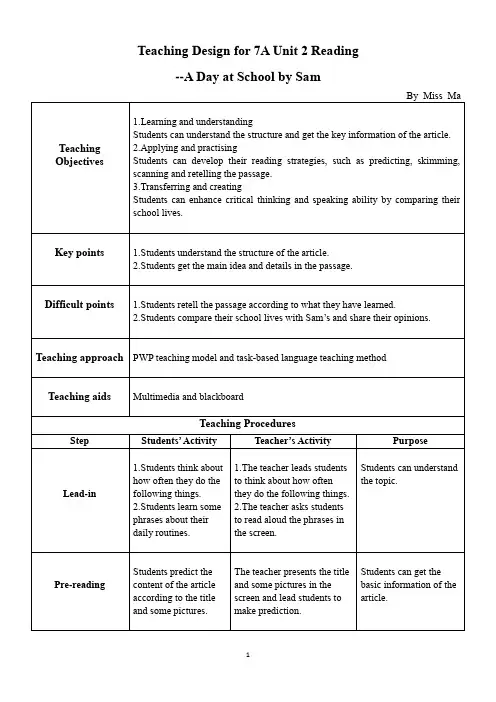
Teaching Design for 7A Unit 2 Reading --A Day at School by SamTeaching Objectives 1.Learning and understandingStudents can understand the structure and get the key information of the article. 2.Applying and practisingStudents can develop their reading strategies, such as predicting, skimming, scanning and retelling the passage.3.Transferring and creatingStudents can enhance critical thinking and speaking ability by comparing their school lives.Key points 1.Students understand the structure of the article.2.Students get the main idea and details in the passage.Difficult points 1.Students retell the passage according to what they have learned.2.Students compare their school lives with Sam’s and share their opinions. Teaching approach PWP teaching model and task-based language teaching method Teaching aids Multimedia and blackboardTeaching ProceduresStep Students’ Activity Teacher’s Activity PurposeLead-in 1.Students think abouthow often they do thefollowing things.2.Students learn somephrases about theirdaily routines.1.The teacher leads studentsto think about how oftenthey do the following things.2.The teacher asks studentsto read aloud the phrases inthe screen.Students can understandthe topic.Pre-reading Students predict thecontent of the articleaccording to the titleand some pictures.The teacher presents the titleand some pictures in thescreen and lead students tomake prediction.Students can get thebasic information of thearticle.While-reading 1.Students read thearticle quickly and tryto match the main ideawith each paragraph.2.Students read thearticle more carefullyfor details and play adoll machine game.3.Students read thepassage again andanswer questions.4.Students review thewhole passage andfinish a time table.1.The teacher leads studentsto skim the passage and findout the main idea.2.The teacher asks studentsto scan for more details andchoose the correct answers.3.The teacher leads studentsto find out the answers to thequestions.4.The teacher asks studentsto review the whole passageand fill in the table.1.Students can have abetter understanding ofthe article afterskimming and scanning2.Students can knowabout the schedule ofSam’s school life.Post-reading 1.Students retell thepassage based on thetime table and theinformation they havejust got.2.Students draw theirown time tables andtry to compare withSam’s school life.1.The teacher leadsstudents to retell the passageby following the sentencestructures and show theexample.2.The teacher asks studentsto have a discussion aboutthe difference between theirschool life and Sam’s, thenshow a example.1.Students can improvetheir speaking ability byretelling.2.Students can enhancecritical thinking bycomparing.Self-assessment Students make anassessment and reflectwhether they haveachieved the learningobjectives.The teacher facilitatesstudents to assess and reflecttheir learning performance.Students can assess theirlearning performancefor themselves.Homework pulsoryInterview one of your classmates about his or her daily life, and make a time table for him or her.2.OptionalWrite an article in 60 words to introduce your daily life and make a vlog.。
七年级英语上 Module 1 My life Unit 2 Daily life课时3 Gra
—No, he usually does his homework at home. 【点拨】do 本身既可以是助动词也可以是实义 动词,本题第一空考查助动词的用法,第二空 考查实义动词的用法。
二、选择方框中的单词填空。 usually often every never times
and Science at school. 2. Mike always __w_a_l_k_s__ (walk) his dog with his
younger sister after school. 3. (易错题)She _d_o_e_s_n_'_t _w_a_t_c_h_ (not watch) TV with
一眼睛看到纸的背面。2022年4月27日星期三2022/4/272022/4/272022/4/27 书籍是屹立在时间的汪洋大海中的灯塔。2022年4月2022/4/272022/4/272022/4/274/27/2022 正确的略读可使人用很少的时间接触大量的文献,并挑选出有意义的部分。2022/4/272022/4/27April 27, 2022 书籍是屹立在时间的汪洋大海中的灯塔。
【点拨】根据原文第一段中句子There are two terms in a school year:可知答案。
17. When do most children begin their school? When they are ______fi_v_e_y_e_a_r_s_o_l,dmost children begin
谢谢观赏
You made my day!
14.【中考·黔南】— ___A___do your parents come to visit
上海教育版七年级上Module 1-Unit2
他们。
Susan helps her mother to clean the house.= Susan helps her mother clean the house.苏珊帮她妈妈 打扫房间。 【同根词】
helpful adj. 有用的;有益的 helpless adj. 无助的
【拓展】 can’t help doing sth. 忍不住做某事 help oneself to sth. 随便用或吃某物 help sb. out 帮助某人摆脱困境 【应用】 ( B )Would you like to help me ________ my homework? A. with do B. do C. to doing 【9】take part in=participate in 参加 I often take part in some activities after school. 放 学后我经常参加一些活动。 【辨析】take part in, attend,join,join in 与 enter for (1)take part in指参加会议或群众性活动等, 指句子主语参加该项活动并在其中发挥了作用。
A. close
B. to close
C. closing
【8】help v. be of use, give assistance to others
帮助
n. the act of helping sb. to do sth. 帮助 help sb.with sth.在某一方面帮助某人 help sb.to do sth.=help sb.do sth.帮助某人做某事 I helped them with this job. 我在这项工作上帮助过
七年级英语上 Module 1 My life Unit 2 Daily life课时5 Wri

does morning exercises. She has breakfast at 8: 30. She has a
little dog. She likes to go to the park with her dog at 9:00. At
10: 50 a. m., Mrs. Black sometimes washes her clothes.
句 型: 1. I am a Grade 7 student. 2. I enjoy learning about different places in the world. 3. We have our morning break at 9:50 a. m. 4. When the bell rings, I run to the playground with my friends. 5. How short it is! 6. I always have a good time at school.
Unit 2 Daily life
课时5 Writing
本单元话题用一般现在时描述自己或者他人一 天的生活。在写作过程中,要按照所给的time line 来描述日常生活,使文章层次感更加清晰。
单 词: enjoy, together, ride, walk, seldom, bell, walk
容是你一天的生活安排。请根据表格内容向大家介绍你
的生活。70词左右。
7:00 a. m. 起床 7:15 a. m. 吃早饭 8:00 a. m. 开始上课
12:00 p. m.
回家吃 午饭
after school
和同班同 学打篮球 5:00 p. m.
回家
after dinner.
牛津版深圳七年级英语上册《Module 1 My life 2 daily life》教学目标
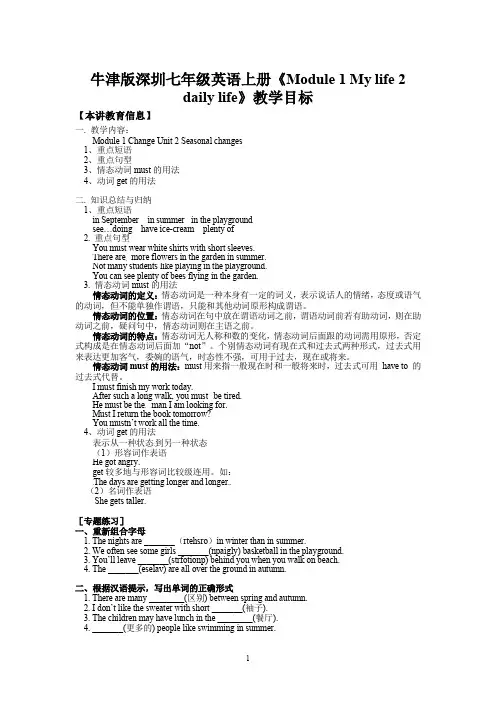
牛津版深圳七年级英语上册《Module1My life2daily life》教学目标【本讲教育信息】一.教学内容:Module1Change Unit2Seasonal changes1、重点短语2、重点句型3、情态动词must的用法4、动词get的用法二.知识总结与归纳1、重点短语in September in summer in the playgroundsee…doing have ice-cream plenty of2.重点句型You must wear white shirts with short sleeves.There are more flowers in the garden in summer.Not many students like playing in the playground.You can see plenty of bees flying in the garden.3.情态动词must的用法情态动词的定义:情态动词是一种本身有一定的词义,表示说话人的情绪,态度或语气的动词,但不能单独作谓语,只能和其他动词原形构成谓语。
情态动词的位置:情态动词在句中放在谓语动词之前,谓语动词前若有助动词,则在助动词之前,疑问句中,情态动词则在主语之前。
情态动词的特点:情态动词无人称和数的变化,情态动词后面跟的动词需用原形,否定式构成是在情态动词后面加“not”。
个别情态动词有现在式和过去式两种形式,过去式用来表达更加客气,委婉的语气,时态性不强,可用于过去,现在或将来。
情态动词must的用法:must用来指一般现在时和一般将来时,过去式可用have to的过去式代替。
I must finish my work today.After such a long walk,you must be tired.He must be the man I am looking for.Must I return the book tomorrow?You mustn’t work all the time.4、动词get的用法表示从一种状态到另一种状态(1)形容词作表语He got angry.get较多地与形容词比较级连用。
沪教版七年级上册英语《Module 1 My life Unit 2 Daily life 》课件公开课 (1)

Careful reading 细读
Read together again and get the details and discuss the sentences you can’t understand with your partners . 小组内读文章获取文章详细信息,疑难句子和组员讨论 。(2分钟) Play a game:Choose a number and answer correctly, and you will get different points. 游戏:小组为单位选一个数字,不同数字后面的题目和 分数不同,回答正确获相应分数。
to school on foot.
Paragraph 3 In the morning, we usually study Chinese, Maths and English.
Paragraph 4 Lunch is from 11:50 a.m. to 12:30 p.m.
Paragraph 5 I always have a good time at school.
Module 1 My life
Reading
Unit 2 Daily Life
A day at school
涪陵第十四中学校 刘江梅
Sing a song
Look and say
看图说短语
brush my teeth ride a bicycle
play the piano
play table tennis wash my clothes watch television
1 How does Sam go to school? He goes to school on foot.
七年级英语上Module1MylifeUnit2Dailylife课时2ReadingII习题课件
D. His
C 32. A. badly B. bad C. nice D. nicely
He is tall. His mother works in a school. She is an
English teacher. She isn’t tall. They often get home
_______33 six o’clock in the afternoon.
_____W__h_en_____d__o_eshe begin his homework?
20. Because my school is close to my home, I go to school on foot.(改为同义句)
My school is close to my home, _______so_ I _____w__a_lkto school.
__b_r_e_a_k__ ?
25. 汤姆参加了很多课外活动。 Tom _____t_a_k_es______p_a_r_t______in_ many after-school
activities.
六、完形填空。【韩城期末】
Peter is an English boy. He is thirteen. He is ______26
26 B 27 B 28 A 29 A 30 D
能力提升练
31 D 32 C 33 C 34 A 35 B
36 C 37 A 38 E 39 B 40 D
答案呈现
能力提升练
答案呈现
41 我是一个来自美国的女孩。
42 He is only 1. 4 meters tall.
43 She wants to know some ways to be thin.
七上Module 1 My life Unit1 Making friends Unit2 Daily life 中考总复习
七上Module 1 My life Unit1 Making friends Unit2 Daily life中考必考词汇、句型讲解Part I 基础知识课前自测一.根据中文写单词1. 年长的(adj.)________2. 山,山脉(n)________3. 完成(v)________4. 梦想(n) ________5. 工程师(n)________6. 爱好(n)________7. 语法(n)________ 8. 国家(n)________9. 声音(n)________ 10. 友好的(adj.)________11. 不常;很少(adv.)________ 12. 乐队(n) ________13. 结束;终止(v)________ 14. 练习(n) ________15. 文章(n) ________ 16. 年级(n) ________17. 休息(n) ________ 18. 想起铃声(v)________19. 铃;钟(n)________ 20.在一起(adv.) ________二.根据中文写短语1. 接近________2. 擅长________3.与…交朋友________4. 全世界________5. 愿意做某事________6.对某人友好________7. 最喜欢的科目________ 8. 欢迎到…________9. 远离________ 10. 去上学________11. 初级中学________ 12. 起床________13. 步行________ 14. 日常生活________15. 参加________ 16. 刷牙________17. 过得愉快________ 18. 打乒乓球________19. 去睡觉________ 20. 骑自行车________三根据句子意思,用所给单词的适当形式填空1.My hobby is _________ (collect) stamps.2.Her dream is _________ ( be) a famous singer.3.He is five years ___________ (old) than his wife.4. Did Bill enjoy ________ (see) the film yesterday?5. The old man looks very ________(friend). We all like him.6. I often practice _______ (play) the violin at weekends.7. I would like ________ (make) friends with you.8. Some of his friends are ___________ (Japan).9. I hope ________ (hear) from you soon.10. He talks with some _________(Germany)to improve his Germany.11. He _________ (brush) his teeth twice a day.12. I _________ (usual) play basketball with my friends at weekends.13. After school, I take part in the school band ____________ (practise).14, My mother loves __________ (live)in the countryside.15. My dream is to travel _______________(difference)places in the world.16. Please send me two _____________(box)of oranges.17. She often helps his parents _________ (do)housework.18. He climbs the mountain _________ (one)a month.19. Tom's bicycle was broken, so he _________ (ride)to school yesterday.20. Jim _________ (have) a lot of homework to do every day.单元重难点解析1.I have an elder sister and an elder brother.elder adj. 年长的辨析elder older两者都是形容词old的比较级形式,区别在于:elder 指“年长的”,常修饰人,用来表示出生顺序的先后和年龄的长幼,常做定语,不可用于than引导的比较状语从句。
沪教版-英语-七上-习题课件:Module 1 Unit2 课时5
2. arrive at 到达(后面接小地方) 【例句】He arrives at his office early every day. 他每天很早到办公室。 【扩展】arrive in 到达(后面接大地方); arrive at = reach = get to 到达 【仿写】(汉译英) (1)我每天很早到学校。 __I a_r_r_iv_e__a_t_s_c_h_o_o_l_e_a_r_ly__e_ve_r_y__d_a_y.__________ (2)他早上到达了深圳。 __H_e_a_r_r_iv_e_d__in__S_h_e_n_z_h_e_n_i_n_t_h_e__m_o_r_n_in_g__. ____
2. 结合话题内容,我们在写作过程中要大 量用到有关日常生活的短语。
【范文赏析】
I get up at six every day. I dress myself quickly and have breakfast at half past six. After breakfast I go to school.
【写作指导】
此篇作文以介绍日常生活为主线,主要内 容是谈论日常生活。写作内容渗透着本单元的 话题和语言目标——谈论某人的日常生活。
在写作过程中要明确以下几点:
1. 由作文要谈及的主要内容决定我们在写 作中要运用“sb. do(es) sth. at+具体时间” 的句型结构,涉及日常生活的固定搭配等等。
student in Shenzhen. __H_e__g_e_t_s_u_p__a_t_s_i_x_e_v_e_r_y____
d_a__y_a_n_d__r_e_a_d_s__E_n_g_l_is_h__fo_r__1_5_m__in__u_te_s_._T__h_e_n_h__e_h_a_s__ b_r_e_a_k_f_a_s_t_. _H_e__g_o_e_s__to__s_c_h_o_o_l_a_t_7__o_'_c_lo_c_k_._H__e_h_a__s___ f_iv_e__le__s_s_o_n_s_i_n_t_h_e__m_o__rn_i_n_g_._T_h_e_n__h_e__g_o_e_s__h_o_m__e_t_o__ h_a__v_e_l_u_n_c_h_._I_n_t_h_e__a_ft_e_r_n_o_o_n_,_h_e__h_a_s__fo_u_r__le_s_s_o_n_s_.___ C__la_s_s_e_s__b_e_g_i_n_a__t _2_:3_0__p_._m_._a__n_d_t_h_e__la_s_t_c_l_a_s_s_i_s_f_o_r__ a_f_t_e_r-_s_c_h_o_o_l_a_c_t_iv_i_ti_e_s_._H__e_g_o_e__s_h_o_m__e__b_y_b_u_s__a_f_te_r___ s_c_h_o__o_l._I_n_t_h_e__e_v_e_n_i_n_g_, _Z_h_a_n_g__Q__ia_n_g__o_f_te_n__w_a_t_c_h_e_s__ T__V_f_o_r_h_a__lf_a_n__h_o_u_r_a__n_d_t_h_e_n__h_e_d__o_e_s_h_i_s_h__o_m_e_w__o_r_k_ f_o_r_t_w_o__h_o_u_r_s_._H_e__a_l_w_a_y_s__g_o_e_s__to__b_e_d__a_t_9_:_3_0_p_._m__. __
沪教版(初中一年级)七年级英语上册:Unit 2 Daily life(Reading)
(2) learn about“了解、知道”。如:你想要了解什么情况? What do you want to learn about? 我的老师要了解我的家庭生活。 My teacher wanted to learn about my home life.
动词的⁃ing 形式,构成句型:enjoy sth “喜爱某物”和 enjoy doing sth “喜爱做某事”,可与like互换。如:
我不喜欢那部电影。
I didn’t enjoy / like the film. 他夏天喜欢游泳。
He enjoys / likes swimming in summer.
2. I love going to school. 我喜欢上学。(P17) love 意为“热爱,喜欢”,后面可以接动词的⁃ing 形式和
动词不定式,构成句型love doing sth (强调习惯性的动作) 或love to do sth(强调某一次特定的动作) “喜欢做某事”。love可与like互 换。如:大多数孩子喜欢玩电脑游戏。
他们每周去一次公园。 They go to the park once a week. 我每周有两个晚上去上美术课。 I go to art classes in the evening twice a week.
注:三次以上用基数词加次数time表示。如: 我每周看三次电视。 I watch TV three times a week.
2. It is about Sam's (school day/holiday).
Pre-reading B2 Read the first sentence of each paragraph in the article on page 17. Then answer the questions below.