
牛津译林版八年级上册重点英语单词短语语法
main 主要的 sights 名胜,风景 culture 文化 Internet 网络 page 页,页面,页码 home page 主页 fine 够好,蛮不错 join 加入,参加 myself 我自己 shine 照耀,发光 clear 晴朗的,清晰的 sky 天,天空 journey 旅行,旅程 boring 乏味的 finally 最后 arrive 到达
【重点短语】
1.一个诚实的男孩 an honest boy
14.使他看起来聪明 make him look smart
2.一个八年级的学生 a Grade 8 student
15.感到无聊 feel bored
3.一次写作比赛 a writing competition
16.讲滑稽的笑话 tell funny jokes
anytime 在任何时候(短语) voice 嗓音 singer 歌手 almost 几乎,差不多 round 圆形的 sense 感觉;观念,意识 humour 幽默(英) bored 无聊的 fit 可容纳,装进 knock 碰,撞;把...撞击成 onto prep 到…的上面 straight 笔直的 sweet 可爱的,惹人喜爱的 smile 微笑 personality 个性 choose 选择;挑选 worse 更差,更糟,更坏 worst 最差,最糟,最坏 height 高,高度 weight 重量
【重点短语】
1.keep fit 保持健康
6.be made of steel 由钢制成
2.enjoy oneself 玩得高兴,过得愉快
7.invite me to join their school trip
3.make a plan for a day trip 制订一日游的 计划
4.take a boat trip 乘船旅游 5.take care 保重
一所混合学校 3.a Reading Week
一个读书周 4.bring in books and magazines 带来书和杂志 5.near the end of…
at most 至多,不超过 daily 每日的,日常的 weekly 每周的 quick 快的 through prep 自始至终,从头到尾 look through 浏览,快速查看 real 真实的,真的 at first 起初,首先 短语 keep(on) doing sth 继续、重复做某事 finish 完成、结束 lunchtime 午餐时间 physics 物理(学) badminton 羽毛球 ideal 理想的
11.from all over the world 来自世界各地 17.take place 发生,举行
12.on the Internet 在网上
18.with your support 在你的支持下
13.put them on his home page 把它们放在 他的主页上
14.1ook at each other 互相对视
16.course 课程;过程
17.already 已经 18.instead .反而, 却 19.attend .经常去;出席 20.cut .剪下, 切下, 割下 21.sentence 句子 22.grape 葡萄 23.spoon.匙, 调羹
39.对某人友好 be friendly to sb 40.十年前 ten years ago 41.写信给某人 write to sb 42.说某人的坏话 say a bad word about sb 43.倾听人们的难 listen to people’s problems 44.因为……而出名 be famous for 45.作为……而出名 be famous as 46.在午餐期间 during lunch time 47.同意某人的意见 agree with sb 48.在左边的那个男孩 the boy on the left 49.A 和 B 都 both A and B
fall 秋天(美) store 商店(美) truck 卡车(美) yard 院子(美) movie 电影(美) mixed 男女混合的;混合的 French 法语 foreign 外国的 language 语言 during prep 在······期间
discuss 讨论、议论 in class 在课堂上 guy 家伙(口) buddy 好朋友,搭档 offer 主动提出,自愿给予 end 结束 baseball 棒球 win 赢得,赢,获胜 least 最少的,最小的 further 较远;(far 的比较级) furthest 最远;(far 最高级) spend 花费(时间或金钱) spend time on 花时间做某事 uniform 制服 chess 国际象棋 【重点短语】 1.fewer advertisements 广告少些 2.a mixed school
4.保密 keep secrets
17.走过课桌 walk past the desk
5.使我开心 make me happy
18.想起我的好朋友 think of my good friends
6.分享我的快乐 share my joy
19.看一则广告 read an advertisement
7.遇到麻烦 be in trouble
23.一名社会意做某事 be willing/ ready to do
24.未来计划 future plans
12.给需要的人让座 give seats to people in need
13.环游世界 travel around the world
25.过来 come over 26.想念我的老同学 miss my old classmates 27.与……交朋友 make friends with
20.帮助有需要的人 help people in need
8.一个我最好的朋友 one of my best friends 21.课外活动 after-school activities
9.对……慷慨 be generous to
22.尽力帮助他们 try to help them
10.撒谎
tell lies
competition 竞赛,比赛;竞争
test 测试,考察 swimmer 游泳者 plan 打算,计划 social 社会的 social worker 社会工作者 ponytail 马尾辫 shy 害羞的 square 方形的
smiling 微笑的,带着笑意的 handsome 英俊的 fat 胖的 hard-working 勤奋的,工作努力的 patient 耐心的 smile 微笑 unhappy 不快乐的,悲伤的 excellent 杰出的,极好的
yourselves 你们自己
themselves 他们自己
by oneself 独立地,独自 itself 它自己 pull 拉;拖;移开 rock 岩石 luckily 幸好,幸运的是 climber 登山者,攀爬者 half-time 中场休息 get on 上车 cost 费用,价钱 rest 休息,歇息 free 免费的 helpless 无助的 useful 有用的,有益的 useless 无用的 cheer 欢呼,喝彩
19.plan a day out 计划外出一天 20.take the underground 乘地铁
Unit 4 Do it yourself
【重点单词】 1.instruction 指示 2.tool 工具 3.glue 胶水 4.rope 绳索 5. scissors 【复】剪刀 6.tape 磁带;胶带 7.DIY 自己动手做 8.repair 修补 9.rose 玫瑰 (花) 10.crazy 着迷的, 狂热的;发疯的 11.once 曾经, 一度 12.mistake 错误, 失误 13.fill 使充满 14.paint.颜料 15.advise 建议, 忠告, 劝告
在……快要结束时 6.offer me help 给我提供帮助 7.read an article by a boy from the USA 读了一个美国男孩的文章 8.spend time on/doing sth. 花时间做某事 9.have fewer weeks off 有更少星期的休假
10.at most 最多 11.look through 浏览,快速查看 12.at first 起初,首先 13.keep (on) doing sth.
28.给我一些忠告 give me some advice 29.住在隔壁 live next door 30.她微笑的眼睛 her smiling eyes 31.面带微笑 wear a smile on one’s face 32.再来一些饮料 some more drinks 33.一些喝的 something to drink 34.任何时间 at any time 35.在将来 in the future 36.在做某事上有 have problems doing sth. 37.在某事上有困难 have problems with sth. 38.和某人分享某物 share sth with sb
Unit1 Friends
【重点单词】 thirsty 口渴的 honest 诚实的;正直的 secret 秘密 keep a secret 保守秘密(短语) joy 欢乐,高兴;乐趣 care 关心,关注,在意 care about 关心,关怀(短语) yourself pron 你自己 teenager (13 至 19 岁的)青少年 magazine 杂志 good-looking 好看的,漂亮的 humorous 幽默的 polite 礼貌的 tidy 爱整洁的,整洁的 make 成为;适合 trust 信任 lie 谎言 joke 玩笑 true 确实的;的确 generous 慷慨的,大方的 willing 乐意的,愿意的 sec 秒
牛津译林版八年级上册英语 Unit 1-Unit 8 语法知识点总结汇编
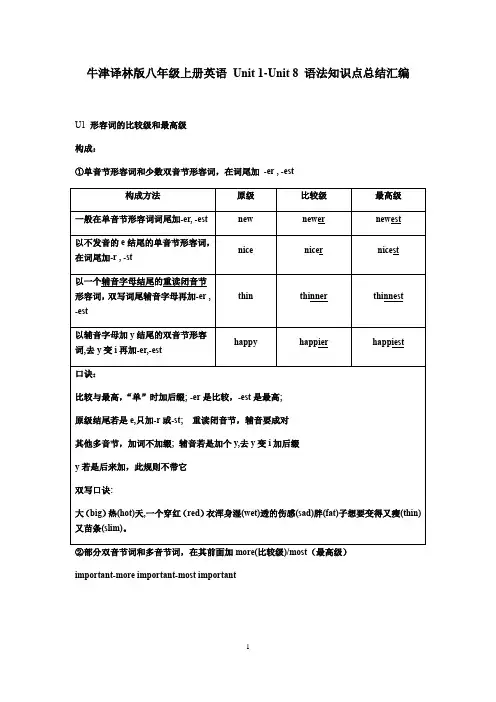
牛津译林版八年级上册英语Unit 1-Unit 8 语法知识点总结汇编U1 形容词的比较级和最高级构成:①单音节形容词和少数双音节形容词,在词尾加-er , -est②部分双音节词和多音节词,在其前面加more(比较级)/most(最高级)important-more important-most important③不规则变化形容词比较级的用法:形容词最高级的用法★最高级和比较级同义句转换:Li Lei is the tallest student in his class.=Li Lei is taller than any other student/the other students/the others in his class.►形容词最高级前若有不定冠词a 表示“非常”Spring is a best season.春天是一个非常好的季节。
U2 ◎数量的比较一、两者数量的比较1.用“more... than. . .”结构表示“...比...多”,more+可名复/不可名。
You have more books than I.你的书比我的多I have more free time than you.我的空余时间比你的多。
2.用“fewer/less... than..."结构表示“......比....少”,fewer+可名复,less+不可名。
Our school has fewer weeks off for the summer holiday than yours.我们学校比你们学校的暑假少放几个星期。
He spends less money on clothes than I.他在衣服上花的钱比我少。
二、三者或三者以上的数量上的比较1.用“the most”表示“最多”,most+可名复/不可名We study the most subjects of all.在所有人当中我们学习的科目最多。
牛津译林版八年级上册重点英语单词短语语法
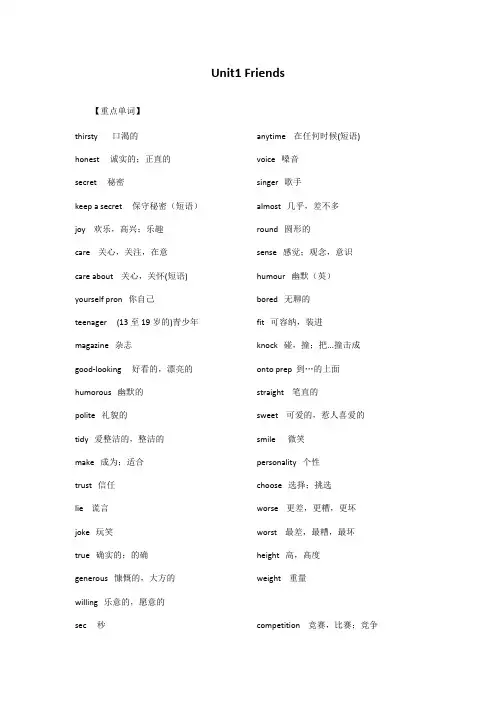
yourselves 你们自己
themselves 他们自己
by oneself 独立地,独自 itself 它自己 pull 拉;拖;移开 rock 岩石 luckily 幸好,幸运的是 climber 登山者,攀爬者 half-time 中场休息 get on 上车 cost 费用,价钱 rest 休息,歇息 free 免费的 helpless 无助的 useful 有用的,有益的 useless 无用的 cheer 欢呼,喝彩
anytime 在任何时候(短语) voice 嗓音 singer 歌手 almost 几乎,差不多 round 圆形的 sense 感觉;观念,意识 humour 幽默(英) bored 无聊的 fit 可容纳,装进 knock 碰,撞;把...撞击成 onto prep 到…的上面 straight 笔直的 sweet 可爱的,惹人喜爱的 smile 微笑 personality 个性 choose 选择;挑选 worse 更差,更糟,更坏 worst 最差,最糟,最坏 height 高,高度 weight 重量
11.from all over the world 来自世界各地 17.take place 发生,举行
12.on the Internet 在网上
18.with your support 在你的支持下
13.put them on his home page 把它们放在 他的主页上
14.1ook at each other 互相对视
邀请我参加他们的学校旅行 8.arrive at the park 到达公园 9.can't wait to get off the bus 迫不及待下车
15.keep the secret to oneself 保守秘密
牛津译林八年级上册英语重点单词
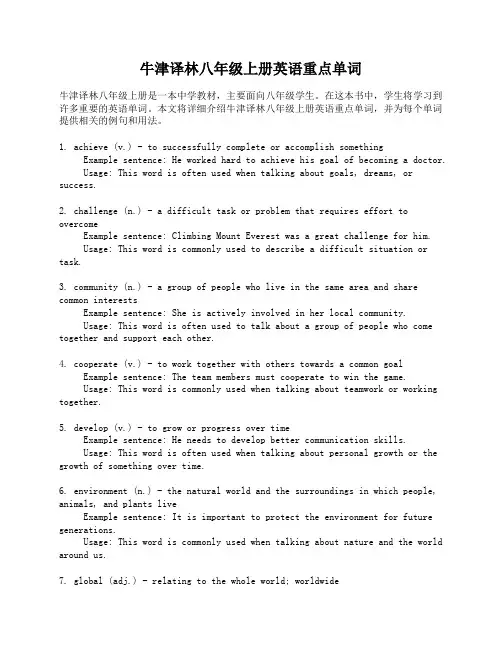
牛津译林八年级上册英语重点单词牛津译林八年级上册是一本中学教材,主要面向八年级学生。
在这本书中,学生将学习到许多重要的英语单词。
本文将详细介绍牛津译林八年级上册英语重点单词,并为每个单词提供相关的例句和用法。
1. achieve (v.) - to successfully complete or accomplish somethingExample sentence: He worked hard to achieve his goal of becoming a doctor.Usage: This word is often used when talking about goals, dreams, or success.2. challenge (n.) - a difficult task or problem that requires effort to overcomeExample sentence: Climbing Mount Everest was a great challenge for him.Usage: This word is commonly used to describe a difficult situation or task.3. community (n.) - a group of people who live in the same area and share common interestsExample sentence: She is actively involved in her local community.Usage: This word is often used to talk about a group of people who come together and support each other.4. cooperate (v.) - to work together with others towards a common goalExample sentence: The team members must cooperate to win the game.Usage: This word is commonly used when talking about teamwork or working together.5. develop (v.) - to grow or progress over timeExample sentence: He needs to develop better communication skills.Usage: This word is often used when talking about personal growth or the growth of something over time.6. environment (n.) - the natural world and the surroundings in which people, animals, and plants liveExample sentence: It is important to protect the environment for future generations.Usage: This word is commonly used when talking about nature and the world around us.7. global (adj.) - relating to the whole world; worldwideExample sentence: The company has a global presence with offices in many countries.Usage: This word is often used to describe something that affects or involves the entire world.8. improve (v.) - to make or become better or more satisfactoryExample sentence: She practices every day to improve her piano skills.Usage: This word is commonly used when talking about getting better at something or making something better.9. opportunity (n.) - a chance or possibility to do or achieve somethingExample sentence: Studying abroad is a great opportunity for personal growth.Usage: This word is often used when talking about chances or possibilities.10. pollution (n.) - the presence or introduction of harmful substances or products into the environmentExample sentence: The factory's waste is causing pollution in the river.Usage: This word is commonly used when talking about the harm caused by human activities on the environment.11. responsibility (n.) - the state or fact of having a duty or obligation to deal with somethingExample sentence: It is our responsibility to take care of the elderly in our community.Usage: This word is often used when talking about duties, obligations, or tasks that one must fulfill.12. strive (v.) - to try hard to achieve somethingExample sentence: Many people strive to become successful in their careers.Usage: This word is commonly used to describe the effort or determination put into achieving a goal.13. technology (n.) - the application of scientific knowledge for practical purposes, especially in industry and engineeringExample sentence: The advancement of technology has greatly improved our lives.Usage: This word is often used when talking about the tools, machines, or techniques used in various fields.14. tradition (n.) - a custom or belief that has been passed down within a society or familyExample sentence: Many cultures have unique traditions that have been passed down for generations.Usage: This word is commonly used to describe long-standing customs or beliefs.15. understand (v.) - to have knowledge or awareness of somethingExample sentence: It is important to understand the needs of others in order to provide proper support.Usage: This word is often used when talking about knowledge or awareness of a particular subject or situation.16. value (n.) - the importance or worth of somethingExample sentence: Many people place a high value on friendship.Usage: This word is commonly used to talk about the importance or worth of something.17. visual (adj.) - relating to the sense of sight or the ability to seeExample sentence: The artist has a keen visual sense, which allows her to create beautiful paintings.Usage: This word is often used when talking about the sense of sight or things that can be seen.18. welfare (n.) - the state of being healthy, happy, and prosperousExample sentence: The government provides welfare programs to assist those in need.Usage: This word is commonly used to describe the overall well-being of individuals or groups.19. wilderness (n.) - a large area of land that is undeveloped, untouched by humans, and usually uninhabitedExample sentence: Exploring the wilderness can be a thrilling experience.Usage: This word is often used when talking about natural areas that are untouched by human civilization.20. wilderness (n.) - a situation or place where there is no civilization, or where life is very hardExample sentence: The refugees lived in a state of wilderness until they found shelter.Usage: This word is commonly used to describe situations or places that lack civilization or are extremely challenging to survive in.21. accommodation (n.) - a place to live or stay in, especially while on atrip or for a short period of timeExample sentence: They found suitable accommodation near the university.Usage: This word is often used when talking about places to stay, such as hotels, apartments, or lodgings.22. acknowledge (v.) - to recognize that something exists or is true, often by saying that you understand or accept itExample sentence: She acknowledged the difficulties but was determined to overcome them.Usage: This word is commonly used to show that you recognize or accept a fact or situation.23. adequate (adj.) - enough or suitable for a particular purpose or needExample sentence: The hotel rooms were adequate for our stay.Usage: This word is often used to describe something that is sufficient or meets certain requirements.24. alternative (adj./n.) - another possibility or choice; something that can be chosen instead of something elseExample sentence: They are considering alternative能源 for their home.Usage: This word is commonly used to talk about other options or choices that can be chosen instead of the usual ones.25. analyze (v.) - to examine something carefully and in detail, often in order to find out why or how it worksExample sentence: The scientists analyzed the data to understand the effects of the new drug.Usage: This word is often used when talking about detailed examination or study of a subject.26. anticipate (v.) - to expect or think that something will happen in the near futureExample sentence: We anticipate a rise in sales next month.Usage: This word is commonly used to talk about expecting or predicting future events.27. appreciate (v.) - to recognize the value or quality of something and thank or reward someone for itExample sentence: She appreciated his help and thanked him accordingly.Usage: This word is often used when talking about recognizing and showing gratitude for something or someone.28. arbitrary (adj.) - based on random choice or personal whim, rather than any reason or systemExample sentence: The rules of the game seemed arbitrary and unfair.Usage: This word is commonly used to describe something that is based on random choice or personal preference, without any logical reasoning.29. aspect (n.) - a part of something, or a way of looking at somethingExample sentence: One aspect of the problem is the lack of available resources.Usage: This word is often used to refer to a particular part or aspect of a situation, object, or concept.30. asset (n.) - something that is owned by a person or company and has valueExample sentence: Good reputation can be a valuable asset for a business.Usage: This word is commonly used to describe items, properties, or qualities that have value and can be owned or controlled by individuals or entities.31. attribute (v./n.) - to say that a quality or skill is responsible for something, or to describe a quality or skill that someone hasExample sentence: He attributes his success to hard work and dedication.Usage: This word is often used when talking about qualities or skillsthat are responsible for certain outcomes or possessed by individuals.32. beneficial (adj.) - good for someone or something, often producing a good effectExample sentence: Eating a healthy diet can be beneficial for youroverall health.Usage: This word is commonly used to describe something that is good or advantageous for a person or thing.33. campaign (n.) - a series of actions designed to achieve a particular aim, often political or militaryExample sentence: The government launched a campaign to reduce poverty in the country.Usage: This word is often used when talking about organized actions or efforts aimed at achieving specific goals.34. category (n.) - a group of similar things that are considered as a unitfor a particular purposeExample sentence: The books are organized into different categories in the library.Usage: This word is commonly used to refer to groups or classes ofsimilar items, objects, or concepts that are treated as a unit for specific purposes.35. celebrity (n.) - a famous person, especially someone known for theirability in a particular fieldExample sentence: She is a celebrity in the world of fashion design.Usage: This word is often used to describe individuals who are widely known and recognized for their talents, achievements, or fame.这些是牛津译林八年级上册英语的一些重点单词,每个单词都有其独特的意义和用法。
Unit3重点内容梳理牛津译林版英语八年级上册

常州市2023年牛津译林版8AU3重点内容梳理一.重点词组来吧,赶快e on需要锻炼来保持健康need to exercise and keep fit玩的愉快enjoy oneself不如…高not as …as…保重take care一座带有大花园的大楼a building with a big garden美国总统the President of the USA由钢制成be made of steel90英尺宽90 feet wide重10万多吨weigh over one hundred thousand tons二.词汇变化1.这个宝藏大约在地下十英尺的地方。
The treasure is about ten feet under the ground.名词英尺foot 复数feet另外一个意思脚foot2.我们昨晚在他的聚会上玩的很开心。
We enjoyed ourselves at his party last night.词组玩的开心enjoy oneself反身代词与主语保持一致,这里的主语是we,反身代词用ourselves 注意复数单词拼写同义词短语玩的开心have a good time /have fun3.事实上,在我家房前的这条河比那条宽得多.In fact, the river in front of my house is wider than this one.句子中出现了比than 说明形容词要对应变成比较级形式形容词宽的比较级更宽的wider4.你知道那儿的澳大利亚人吗?他们正看着你.Do you know the Australians over there ? They are looking at you.名词澳大利亚人Australian,注意名词复数形式,Australians句子后面用的是they代词,说明前面的澳大利亚人是复数形式5.他真的对收集邮票感兴趣。
牛津译林版八年级上册全册各单元重点词汇整理
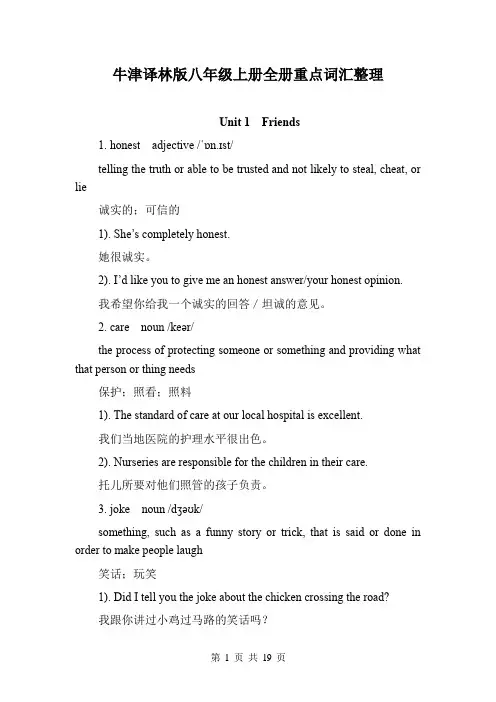
牛津译林版八年级上册全册重点词汇整理Unit 1 Friends1. honest adjective /ˈɒn.ɪst/telling the truth or able to be trusted and not likely to steal, cheat, or lie诚实的;可信的1). She’s completely honest.她很诚实。
2). I’d like you to give me an honest answer/your honest opinion.我希望你给我一个诚实的回答/坦诚的意见。
2. care noun /keər/the process of protecting someone or something and providing what that person or thing needs保护;照看;照料1). The standard of care at our local hospital is excellent.我们当地医院的护理水平很出色。
2). Nurseries are responsible for the children in their care.托儿所要对他们照管的孩子负责。
3. joke noun /dʒəʊk/something, such as a funny story or trick, that is said or done in order to make people laugh笑话;玩笑1). Did I tell you the joke about the chicken crossing the road?我跟你讲过小鸡过马路的笑话吗?2). She tied his shoelaces together for a joke.她跟他开玩笑,把他的鞋带系在了一起。
4. sense noun /sens/an ability to understand, recognize, value, or react to something, especially any of the five physical abilities to see, hear, smell, taste, and feel官能;感觉;知觉(尤指视觉、听觉、嗅觉、味觉和触觉)1).With her excellent sense of smell, she could tell if you were a smoker from the other side of the room.她嗅觉灵敏,在房间的另一端就能知道你是否抽烟。
牛津译林版八年级英语上册 Unit1 Friends 知识点

牛津译林版八年级英语上册Unit1 Friends知识点Unit1 Friends 第一课时Comic strip and welcome to the unit 知识点总结1.honest adj.诚实的;正直的其比较级是more honest,最高级是most honest。
反义词dishonest。
honest是以元音音素开头的单词,表示“一位诚实的……”,前面的冠词要用an,不可用a。
eg:an honest boy一个诚实的男孩care vi.照顾care about 和care for都是由“动词+介词”构成的,当人称代词作宾语时,人称代词应用宾格形式。
eg: Does she care about/for you when you are ill当你生病的时候,她关心你吗3.Can I have some more food 我能再吃些食物吗more用在some,many,any,much,a few等后面,表示“还……”,“再……”,“多……” eg:They need a few more.他们还需要一些。
数词+more+名词=another+数词+名词。
eg:I want to buy two more books.=I want to buy another two books.我想再买两本书。
4. Can I have something to drink 我可以喝点东西吗①动词不定式作定语放在所修饰词之后。
eg:Do you want to have something to eat 你想吃点东西吗②something,anything 作主语时谓语动词要用第三人称单数形式。
③形容词修饰不定代词时应放在不定代词的后面。
eg:I have something important to tell you.我有重要的事情要告诉你。
5. What about some milk来些牛奶如何What/How about...表示建议。
牛津译林版八年级上册全册语法知识点复习总结
牛津译林版八年级上册全册语法知识点复习总结一、形容词的比较级和最高级1. 形容词的比较级用于两个人或事物之间的比较,其结构如下:主语+谓语动词(系动词)+形容词比较级+than+比较对象。
2. 形容词最高级的由用法:形容词最高级用于三者或三者以上的人或物进行比较,其结构为:主语+谓语动词(系动词)+the+形容词最高级+名词+表示范围的短语或从句。
3. 形容词的比较级和最高级是在形容词原级的基础上变化的,分为规则变化和不规则变化。
①规则变化①不规则变化二、比较事物的数量1. 两者之间比较通常用more..than/ less... than 和fewer..than来比较两种事物之间的数量关系。
其中more... than之间加可数名间的复数形式或者不可数名词,less... than 之间加不可数名词,fewer...than 之间加可数名词的复数形式。
例:I has more apples than Lily.我的苹果比莉莉的多。
He eats less food than I for breakfast.他早饭比我吃得少。
Bobby has fewer books than Tim.波比的书比蒂姆的少。
2. 三者或三者以上比较通常用the most、the least、the fewest 来比较三者或三者以上事物之间的数量关系。
the most、the fewest、the least 分别是many/much、few、little 的最高级。
the most 表示“最…;最多”,其后既可接可数名词又可接不可数名词;the fewest 表示“最少”,其后接可数名词的复数形式;the least 表示“最少”,其后接不可数名词。
例:Jack gets the most points of the three boys.在三个男孩中,杰克的得分是最高的。
He has the least milk among them. 他的牛奶是他们之中最少的。
Unit6单词讲解牛津译林版八年级英语上册
1.birdwatchingo解释:观鸟o例句:Birdwatching is a popular hobby among nature lovers.观鸟是自然爱好者中一种流行的爱好。
2.marketo解释:市场o固定搭配:on the market 在市场上o例句:There's a variety of fruits and vegetables in the market.市场上有各种各样的水果和蔬菜。
3.yeaho解释:<口>是的o例句:Yeah, I agree with you. 是的,我同意你的看法。
4.heno解释:母鸡o例句:The hen clucked when she saw the grain. 母鸡看到谷子时咯咯叫了起来。
5.yummyo解释:<口>美味的,可口的o例句:This chocolate cake is really yummy! 这个巧克力蛋糕真是太好吃了!6.craneo解释:鹤o例句:The cranes migrated south for the winter. 鹤为了过冬向南迁徙。
7.sparrowo解释:麻雀o例句:A sparrow is building a nest in our balcony. 一只麻雀正在我们的阳台上筑巢。
8.feathero解释:羽毛o例句:The bird ruffled its feathers. 鸟儿抖了抖羽毛。
9.swano解释:天鹅o例句:The swan glided gracefully across the lake. 天鹅优雅地滑过湖面。
10.eagleo解释:鹰o例句:The eagle soared high in the sky. 鹰在高空中翱翔。
11.broado解释:宽的,宽大的o例句:He has a broad smile on his face. 他脸上露出了开朗的笑容。
Unit2重要知识点牛津译林版英语八年级上册
8A U2【wele】1.have to &must[have to]:“必须,不得不”,强调客观上的需要,有人称,时态的变化(三单has to,过去式had to,将来时will have to),其否定形式为don't/doesn’t/didn’t have to,表示“不必”[must]:“必须”,强调主观意愿和看法,无人称,时态和数的变化,其否定形式为mustn't,表示“禁止,不允许”2.It's like watching TV,but there are fewer advertisements.它(上学)就像看电视,只不过广告少一些。
①like prep.像... +名词/代词/ving②fewfewer +可名复③few ;a few;little;a little区别3.British n.英国人the British=British people=Englishmanadj.英国的British people4.vacation 可数名词/不可数名词“假期”(英:holiday)on vacation在度假take a vacation度假winter/summer vacation寒假/暑假5.fall n秋天(英:Autumn);瀑布vi.落下;跌倒6.movie n.(可数) 电影(英:film)go to a movie/go to the movie看电影6.Shall we go together?“Shall we do......?”提建议的句型➡肯定回答:Why not?/OK./Of course./All right.【提建议的句型】Let’s do sth.You'd better do sth.(你最好做某事)How/What about doing sth?Why not do sth?Why don’t you do sth?Will/Would/Could you please do sth?(请你做下某事好吗?)7.practise vi/vt. 练习,训练practise (doing) sth (英:practise)n.练习(英:practice)【reading】1.in year 8在八年级(英:in Grade 8)在...年级:美in Year +基数词in the +序数词+year英in Grade +基数词in the+序数词+grade2.mix vt.混合➡mixed adj.混合的➡mixture n.混合物3.Among all my subjects,I like French best.①like...best=favourite②France n.法国➡French ①n.法语②adj法国的Frenchman法国人4.Learning foreign language is fun.①learning foreign language 动名词短语,起名词作用(指学外语这件事),后面的谓语动词用单数。
整理牛津译林版八年级上册英语知识点归纳
八年级英语总复习摘要供复习参考八年级英语总复习摘要(供复习参考)(语法部分)一、词汇词汇学习是英语学习的重要部分,掌握一定量的词汇是我们进行口头和笔头交际的基础。
词汇试题的主要测试内容为词语释义、词形转换和词语辨析等等,要求考生既要掌握基本词汇的意义,又要有运用词汇的基本能力,达到语言交际的目的。
(一) 词形转换1、名词的复数形式。
(1)规则变化:一般直接在词尾加s:pen——pens; table——tables①以s、x、o、ch、sh结尾加es:bus——buses; watch——watches, 但radio, photo和stomach后只加s, zero后加es或s均可。
②辅音字母加y结尾的,把y改i加es;city——cities; party——parties③以-f; -fe结尾的,改成v加es:knife——knives; wife——wives, 但roof后只加s。
(2)不规则变化:foot——feet; man——men; child——children; mouse-mice2、形容词、副词的比较级等级的变化。
(1)规则变化:①单音节词和少数双音节词一般在词尾加er/ estsmall——smaller——smallest; clever——cleverer——cleverest②辅音字母+y结尾的,把y变成i加er / est:easy——easier——easiest; heavy——heavier——heaviest③词尾以一个辅音字母结尾的重读闭音节单词,双写该辅音字母加er/ est:big——bigger——biggest; hot——hotter——hottest④多音节词,在词前加上more/ most:slowly——more slowly——most slowly;interesting——more interesting——most interesting(2)不规则变化:good(well) ——better——best;many(much) ——more——most;little——less——least; bad (ill, badly) ——worse——worst;far——farther(further) ——farthest(furthest)4、基数词变序数词主要掌握1~12及20、21等的序数词的形式,其它序数词都是在基数词末尾加th,是有规律可循的。