
unit12_What_did_you_do_last_weekend_Section_B_1(1)
___ snake went into the forest 7 2 ___ put up our tents and cooked food 8 ___ learned a useful lesson 4 ___ saw a snake and shouted to parents for help ___ snakes can’t hear but they can feel things 6 moving
1. 认真阅读八个句子,了解句子意思,掌握 它们所指代的八个事件:蛇进入森林中; 撑起帐篷,做饭;学到一条有用的教训; 看到一条蛇向父母求助;蛇听不到声音但
能感觉到事物的移动;我的爸爸在帐篷里
跳上跳下;乘公共汽车去印度的一个小村
庄;在月光下讲故事,然后睡觉。
2. 带着这八个小事件,再去反复读短文, 分析这个八个事件发生的时间先后, 然后将它们排成正确的顺序。最后, 再按所排列的顺序读一遍这八句话, 确保顺序正确。
She went to the library.
How was Jim’s last weekend?
It was relaxing.
Really? What did he do on Satud played the guitar on Saturday morning.
Describe what you did on your last weekend to your classmates. My last weekend was interesting. I visited my grandparents. They lived in a small village. I fed the chickens and sheep. I went fishing with my grandpa.
weekend?
3. How did Lisa feel when she saw the
snake?
4. What did Lisa and her sister do?
5. What did their parents do? Why
did they do that? 6. What lesson did Lisa learn from the weekend?
6. What lesson did Lisa learn from the
weekend? Snakes don’t have ears but they can ________________________________
feel things moving. It’s important not _________________________________ to go near a snake. _________________
I went to the cinema with my friends.
Hello, Bob. Did you go out last weekend?
Yes, I did. I camped by the lake with my uncle.
What kinds of animals are people 2a sometimes afraid of? Why? Make a list. I think people are afraid of tigers, lions and snakes because they’re scary.
spider bear mouse wolf tigers lions
snakes
high school
tent
put up
put up a tent
scared
wake up
Read about Lisa’s weekend. Tick (√) 2b the right pictures.
their air ride went camping in made a fire was short a small village to cook food
___ snakes can’t hear but feel things moving ___ my dad jumped up and down in his tent ___ took a bus to a small village in India ___ told stories under the moon, then went to sleep
sang and played the guitar studied for a test flew a kite went to the had dinner library with friends
Make a conversation with a partner. 1d Talk about what Sally and Jim did last weekend.
Did Jim do his homework on Sunday?
No, he didn’t. He flew a kite in the park on Sunday afternoon.
What about Sunday evening?
Well, he had dinner with friends.
1e
Make a conversation. Ask what your
partner did last weekend.
Did you do anything interesting last weekend? Not really, but I visited my sister.
Hi, Alice. What did you do last weekend?
kite
fly
fly a kite
swimming pool
Here are some things that Sally and Jim 1a did yesterday. Match the activities with the pictures.
1. sang and played the guitar __ d 2. studied for a test __ c 3. had dinner with friends __ f 4. went to the library __ e 5. flew a kite __ a 6. swam in a swimming pool __ b
Put the phrases in order according 2c to the passage. The use them to retell the story. ___ snake went into the forest ___ put up our tents and cooked food ___ learned a useful lesson ___ saw a snake and shouted to parents for help
___ my dad jumped up and down in his tent 5 1 ___ took a bus to a small village in India ___ told stories under the moon, then went 3 to sleep
1. two weeks ago 两星期前,一段时间 + ago意为“多长时间之前”,是表达过去 的时间。它常与一般过去时态连用。 三天前,我们参观了自然历史博物馆。 We visited the Natural History Museum three days ago. 【辨析】before 意为“在……之前”,
4. What did Lisa and her sister do? They shouted to their parents to let ______________________________ them know the danger. ______________________ 5. What did their father do? Her father jumped up and down in _____________________________ their tent. ____________ Why did he do that? He wanted to wake up the snake. _______________________________
1b
Do you think the activities in 1a are fun?
Draw a happy face
face
or an unhappy
under each picture.
1c
Listen. What did Sally and Jim do last weekend? Complete the chart. Sally did her homework Jim
1. 先认真读这六个问题,掌握其意思。 2. 带着问题再去读短文,在短文中寻找 回答问题的相关依据。比如:回答第 一题的依据是第一段的最后一句话 “Last weekend was interesting and scary.”
第二题的依据是第二段的第一句话
“We went camping in a small village
其后可以跟一个时间的点;表示“在某 个时间点之前”,但不一定用于一般过 去时态。例如:
我常在七点钟前去上学。
I usually go to school before seven.
此外,before也可以单独用,意为“以
前”,可用于一般过去时态中。例如:
以前我不知道那件事情。 I didn’t know that before. 2. put up 意为“搭起;举起” 让我们将帐篷搭起来吧。 Let’s put up the tent. 如果你有什么问题,请举起手来。 If you have any questions, please put up your hands.
(完整word)2015春季七年级英语下册Unit12Whatdidyoudolastweekend课文重难点讲解
Unit 12 What did you do last weekend?课文重难点讲解【教师寄语】:Where there’s a will,there’s a way. 有志者事竟成。
Section A1. What did you do last weekend, Lucy? 露西,你上周末做什么?【解析】 What +did + 动词原形 +其他?答语:主语+动词过去式+ 其他?— What did you buy last Monday?— I bought some apples.do/does →did v 做,行动【拓展】当“last/next/this/ that +时间词”在句中作状语时,其前通常不用介词He went to the cinema with his friends last Sunday.① I ______________(not do) my homework last night.( )②—Did you give Tom a phone call?— Yes , I did. But nobody _____.A. answerB. answeredC. answersD. answering2. Well, on Sunday morning, I played badminton.哦在星期天的早上,我打了羽毛球【解析1】on Sunday morning “在星期六上午”【注】:在具体的某一天,某一天的早上、下午、晚上用介词onon Sunday afternoon 在星期天下午on children’s Day 在儿童节那天on the afternoon of May 8 在三月八号的下午①— What did you do?— I _____________(play) the guitar.( ) ②We played tennis in the park ____ Tuesday.A. inB. onC. atD. for( )③ The accident happened ____ a cold winter early morning.A. inB. atC. onD. for【解析2】played badminton 打羽毛球Play +球类名词(球类名词前不加任何冠词)Play basketball 打篮球 play volleyball打排球 play tennis 打网球3. camped by the lake 在湖边野营【解析】camp v“扎营,搭帐篷” go camping 去野营— Would you like to go ______________(camp) with us this afternoon?— Yes, I’d love to4. I studied for the math test. 我为数学测验而学习。
人教版七年级下册英语Unit12 What did you do last weekend教材听力原文及译文

Unit 12 What did you do last weekend? Section A1b Listen and write the day,morning,afternoon or night below each picture.Bob: Hey, Lucy.Lucy: Hi, Bob.Bob: How was your weekend?Lucy: It was great.Bob: So, what did you do?Lucy: Well, on Saturday morning, I played badminton.In the afternoon, I went to the beach, and atnight, I went to the cinema.Bob: Cool. What about Sunday?Lucy: In the morning, I camped by the lake with my classmates. In the afternoon, we went boating,and at night, I did my homework.2a Listen and underline the words you hear. Teacher: So, did everyone have a good weekend? Students: Yeah, we did, Ms. Clark!Teacher: Good. What did you do last weekend,Becky?Becky: I visited my grandma, and I did my home- work.Teacher: Great. And how about you, Carol? Did you go out?Carol: No, I stayed at home. I studied for the English test.Teacher: Wow, good for you. Jack, how about you?W here did you go?Jack: I went to a farm, and I fed some cows. Teacher: Sounds like you had fun.2b Listen again. Write C for Carol,J for Jack or B for Becky next to the statements in 2a. Teacher: So, did everyone have a good weekend? Students: Yeah, we did, Ms. Clark! 听录音并在每幅图下写上日子:上午、下午或晚上。
英语七年级下册unit12_What_did_you_do_last_weekend_Section
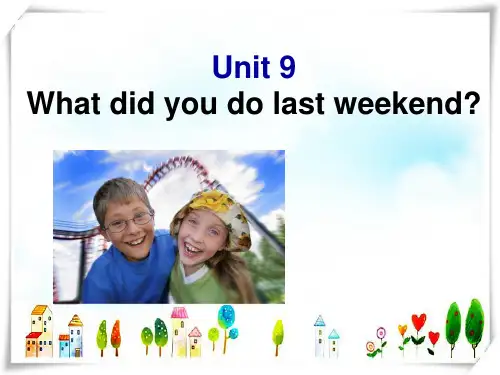
Description
Describe what you did on your last weekend to your classmates.
My last weekend was interesting. I visited my grandparents. They lived in a small village. I fed the chickens and sheep. I went fishing with my grandpa.
√
√
their air ride went camping in made a fire was short a small village to cook food
√
two tigers sleeping shouted to their
near the fire
parents
Careful Reading
Main words
kitimming pool
1a Here are some things that Sally and Jim
did yesterday. Match the activities with
the pictures.
1. sang and played the guitar _d_ 2. studied for a test _c_ 3. had dinner with friends _f_ 4. went to the library _e_ 5. flew a kite _a_ 6. swam in a swimming pool _b_
1b Do you think the activities in 1a are fun?
Unit 12 What did you do last weekend?(解析版)

Unit 12 What did you do last weekend?班级:________ 姓名:________ 得分:________(测试时间:90分钟总分:120分)听力部分(共20分)一、听句子或对话,根据所听内容选择最佳应答句。
句子或对话念两遍。
(共5小题,每小题1分,满分5分)( )1.A.I’m well.B.I studied for the test.C.I like reading.【答案】B【听力】I did some reading yesterday. What about you, Mike?( )2.A.It sounds good.B.It was good.C.OK!【答案】B【听力】How was your weekend?( )3.A.No, he wasn’t.B.Yes, he did.C.Yes, he is.【答案】A【听力】Was your brother at home last Sunday?( )4.A.Yes, they did.B.No, they weren’t.C.Yes, they were.【答案】A【听力】Did your parents go to the movies last night?( )5.A.I do my homework.B.It was great.C.I stayed at home and watched TV.【答案】C【听力】What did you do last weekend, Lucy?二、听对话,根据对话内容选择最佳答案。
对话念两遍。
(共5小题,每小题1分,满分5分)( )6.When did Dale go to the museum?A.Friday.B.Saturday C.Sunday.【答案】B【听力】W:Hi, Dale! Did you visit the museum last weekend?M:Yes, I did. I went there on Saturday afternoon.( )7.Where did the woman go last Sunday?A.She went to a bookstore.B.She went to a zoo near a park.C.She went to a park.【答案】C【听力】M:Did you have a good time last Sunday?W:Yes. We went to a park and had fun.( )8.Where did Jane go last weekend?A.She went to the park.B.She went to the mountain.C.She went to the beach.【答案】C【听力】M:Did you go to the mountain last weekend Jane?W:No. I went to the beach with my cousin Lisa.( )9.Where did Mike go last Saturday?A.To the park.B.To the zoo.C.To the bookstore.【答案】B【听力】W:Did Mike and his friend have fun in the zoo last Saturday?M:Yes, they did.( ) 10.Where did Susan go yesterday?A.To a park.B.To a museum.C.To a supermarket.【答案】A【听力】M:Where did you go yesterday, Susan?W:I went to the park. It’s across from the museum, next to the science museum.三、听短文,根据所听内容选择最佳答案。
unit12_What_did_you_do_last_weekend_Section_A_2 新目标初一英语下册

Where did you go on Dragon Boat Day?
点此播放对话视频
What did you do there?
I went to the countryside.
I watched the boat race.
What did you do last weekend?
点此播放对话视频
阅读Grammar Focus部分,完成
下列句子。 1. 上个周末你做什么了? What did you do last weekend? ___________________________ 2. 我做了我的家庭作业。 I did my __________________ homework.
点此播放听力视频
We went boating. 3. 我们去划船了。_______________
4. 谁去探望了她的奶奶? _______________________ Who visited her Becky did. 5. grandma? 是蓓基?_________ 6. 上个周末她去了哪里? Where did she go last ___________________________ weekend?
1. mouse ຫໍສະໝຸດ 为“老鼠”,复数形式 为“mice”。
他们看到了两只老鼠。
They saw two mice.
2. language 意为“语言”,是可数名词。
英语、汉语、法语是三种不同的语言。
English, Chinese and French are three
different languages.
此类填空题,应主要根据答语的意思
来确定问句中所缺的特殊疑问词是什
unit12 What did you do last weekend教案完整版
课题:Unit 12 What did you do last weekend?(1) Daily greeting to the Ss (日常问候)(2) Show the six pictures and explain the new phrases to Ss.T: Sally and Jim had a busy weekend. Look at the pictures. Can you tell me what they did?T: What did Sally do yesterday?T: What did Jim do yesterday?(Help Ss to use the other phrases in 1a to answer the questions. such as sang and played the guitar, studied for a test, had dinner with friends, went to the library.) (2)Flash the pictures on the screen as quickly as possible. Then ask Ss “What did he/she do?” Have Ss answer the question as quickly as they can.(3) Show the phrases again and help Ss change the verbs from the present tense to the simple past form.Have Ss work on 1b.T: Do you think the activities in 1a are fun? Draw a happy face or an unhappy face under each picture.Give Ss some phrases that they can use, such as zoo, school, beach, my aunt’s, mother, father, my best friend … They can use these phrases to make their conversations.。
人教版七年级英语下册Unit12Whatdidyoudolastweekend教学设计
-教授动词过去式变化规则,并通过练习进行巩固。
2.教学目的:
-帮助学生掌握一般过去时态的语法结构,理解其用法。
-让学生学会动词过去式的变化规律,为实际运用打下基础。
(三)学生小组讨论
1.教学活动设计:
-教师将学生分成小组,每组选择一个周末活动的话题,如:go shopping,go to the movies,play soccer等。
四、教学内容与过程
(一)导入新课
1.教学活动设计:
-教师以提问方式引导学生回顾上一单元的主题,如:“Can you remember what we talked about last unit? What activities do you like to do in your free time?”
二、学情分析
针对人教版七年级英语下册Unit 12 "What did you do last weekend?",学生在之前的学习中已经掌握了基本的英语语法和词汇,能够运用一般现在时态描述日常生活。在此基础上,他们对于一般过去时态的掌握处于初步阶段,需要在本章节的学习中进行巩固和提高。
七年级的学生正处于青春期,好奇心强,喜欢分享自己的经历和见闻。因此,在本章节的教学中,教师应充分利用学生的这一特点,引导他们用英语表达过去发生的活动,激发学生的学习兴趣和表达欲望。
人教版七年级英语下册Unit12Whatdidyoudolastweekend教学设计
一、教学目标
(一)知识与技能
1.学生能够掌握并熟练运用一般过去时态描述过去发生的事情,如:“I went to the park last weekend.”。
Unit-12-What-did-you-do-last-weekend-教案
Unit 12What did you do last weekend?Section A 1 (1a-2d)一、教学目标:1. 语言知识目标:1)掌握以下单词:camp, lake, beach, badminton, sheep, as, natural, butterfly, visitor, tired, stay, stay up late.能掌握以下句型:①—Where did you do last weekend, Lucy?—I went to summer camp.②—How was your weekend?—Pretty good,thanks③—I worked as a guide at the Natural History Museum.④How interesting!2) 能了解以下语法:learn to talk about recent past events.2. 情感态度价值观目标1.帮助学生树立合作学习观点。
2.讲述美好的周末,树立学生享受生活,热爱美好的大自然情感。
二、教学重难点1. 教学重点:1) Key vocabulary.2) Talk about recent past events2. 教学难点:1) Talk about recent past events2) Practice students’ listening, speaking, reading and writing skills.三、教学过程Ⅰ. Warming-up and revisionPoint to the previous Saturday and Sunday on a wall calendar and say, Saturday and Sunday are the weekend. This is last weekend. Then tell some things you did last weekend such as cleaned my house over the weekend. Use quick sketches (in theboard along with gestures to demonstrate the meaning of each activity,Ⅱ.1 a This activity introduces the key vocabulary.Focus attention on the picture. Ask students to tell what they see. Name each activity and ask students to repeat:did my homework, went to the cinema, went boating, camped by the lake, went to the beach,played badminton.Point out the numbered list of activities. Say each one again and ask students to repeat.Then ask students to match each activity with one of the pictures. Say, Write the letter of each activity next to the words. Point out the sample answer.Check the answers.Ⅲ. ListeningWork on 1bThis activity gives students practice in understanding the target language in spoken conversation.Point to the activities in the picture in activity la. Ask students to tell what the person did in each picture. For example, she played badminton, or Lucy went to the cinema. Play the recording the first time. Students only listen.Play the recording a second time. This time say. Listen to the recording and write the days and times Lucy did each thing under the pictures. Point out the sample answer under the picture of Lucy playing badminton; on Saturday morning.Correct the answers.Ⅳ. PairworkWork on 1cThis activity provides guided oral practice using the target language.Point to the example conversation. Ask two students to read the dialogue to the class.Say, now work with a partner. Student A, pretend to be Lucy. Student B, ask questions about what Lucy did on different days and times over the weekend.Talk about the activities in the picture.Students work in pairs. As they talk, move around the room monitoring their work.Offer language or pronunciation support as needed,Ⅴ. ListeningWork on 2a:This activity gives students practice in understanding the key vocabulary in spoken conversation.Point to the five sentences and ask a student to read these sentences to the class.Say, You will hear recording of a conversation. The people will talk about some of the activities and people, but they will not talk about others. Please underline the words you hear on the recording.Play the recording the first time. Students only listen.Play the recording a second time. This time, ask students to underline each word that is said on the tape. Point out the sample answer, grandmother.Correct the answers.1grandma 2 homework 3 English 4 farm 5 cowsⅥ. ListeningWork on 2b:This activity provides listening practice using the target language.Call attention to the pictures of Carol, Becky, and Jack and ask students to identify each person by name.Say, Now I will play the recording again. Listen to the students talking about what they did over the weekend. Write C for Carol, B for B Becky or J for Jack next to each statement in activity 2a. The first one has been done for you.Play the recording the first time. Students only listen.Point out the sample answer, S, in statement 1. Say, Sonia visited her grandmother.Play the recording again. Ask students to write a letter in front of each statement to show what each person did.Check the answers. B B C J JⅦ. Pair workAsk and answer in pairs.Point to the example conversation. Ask two students to read the dialogue to the class.Say, Now work with a partner. Student A, ask questions about what,who or where, Student B answers. Students work in pairs.Ⅷ.Role-play the conversation.1. Ask Ss to look at conversation in 2d. Then Ss read the dialogue by themselves andfind the answer to these questions:① What did Lisa do on her weekend?② What did Paul do on his weekend?2. Ss work in pairs and role-play the conversations.3. Have several pairs perform their conversations for the rest of the class.Homework:1. Copy new words twice.2. Write about what you did last weekend.板书设计:Section A 2 (Grammar Focus-3c)一、教学目标:1. 语言知识目标:1) 掌握以下单词:away, mouse, baby, shout ,shout at, woof, language.2) 继续练习一般过去时态能掌握以下句型:—What did you do last weekend?—I did my homework.—Who visited her grandma?—Becky did.—Where did she go last weekend?—She went to a farm.—Who did she go with?—She went with her classmates.2. 情感态度价值观目标:1.提高学生独立学习能力。
人教版 七年级英语 下册 unit12_What_did_you_do_last_weekend
I did my homework .
It was a little difficult. On
Saturday night, I stayed at home and _h_e_l_p_e_d__m_y__m_o_m__ cg, I _w_e_n_t_t_o__th_e__li_b_r_a_r_y.
cat hen
suggestions
couldn’t find the hen found the hen drove away got the eggs
A: Sure. We learned how to call the fire station and what to do when there is a fire.
Look at the pictures below. What happened yesterday? Then write a short article.
Unit 12 What did you do last weekend?
Look at the pictures below. What did they do last weekend?
play the guitar
She played the guitar.
play basketball
B: ___W__h_a_t__d_i_d_y__o_u__d_o_________ (do)?
A: We watched the firefighters work. What an interesting job they have!
B: __D__i_d_y__o_u__le_a_r_n__a_n__y_th__in__g___ (learn anything)?
七年级下Unit-12-What-did-you-do-last-weekend教案
七年级下册Unit 12 What did you do last weekend一、教学目标:1. 语言知识目标:1)掌握以下单词:camp, lake, beach, badminton, sheep, as, natural, butterfly, visitor, tired, stay, stay up late.能掌握以下句型:①—Where did you do last weekend, Lucy?—I went to summer camp.②—How was your weekend?—Pretty good, thanks③—I worked as a guide at the Natural History Museum.④—How interesting!2) 能了解以下语法:learn to talk about recent past events.◆短语归纳1. do my homework 做我的家庭作业2.go to the cinema 去电影院= go to the movies3. go boating / camping 去划船/ 去野营4. play badminton 打羽毛球5. on Saturday morning 在星期六早上6. work as 以……身份而工作7. have a good weekend 周末过得愉快8. kind of 有点儿9. stay up late 熬夜10. run away 跑开11. shout at 对……大声叫嚷12. fly a kite 放风筝13. high school 中学14. put up 搭起,举起15. in the countryside 在乡下16. get a surprise 吃惊17. make a fire 生火18. each other =one another互相19. so… that…如此……以至于……20. go to sleep 入睡21. the next morning 第二天早上22. look out of…向……外看23. shout to/at 冲……呼喊24. up and down 上上下下25. wake…up 把……弄醒26. over=more than 多于27.By the lake在湖边28.. a swimming pool 一个游泳池29.study for a test.备考30.under the moon在月亮下31.in the sun.在阳光下32.tell stories讲故事33.get/be lost 迷路34.a second language 另一种语言35.visit sb.拜访某人36.feed sheep喂养37.learn from 从...中获得38.in danger 处于危险中◆用法集萃1. go + doing 去做某事2. play + 球类玩……球3. 时间段+ ago ……前4. keep + sb. / sth. + 形容词/ 副词/ 介词短语使……保持……5. so + 形容词/ 副词+ that 句子如此……以至于……6. see sb. doing sth. 看见某人正在做某事7. let sb. do sth. 让某人做某事8. start to do / doing sth. 开始做某事9.finish doing sth。