
财务报表分析 第十版 第七章 答案(部分)
财务报表分析第十版第七章答案(部分)a. Cash Flows from Operations Computation:Net income ................................................................... $10,000 Add (deduct) items to convert to cash basis:Depreciation, depletion, and amortization ............ $8,000Deferred income taxes (400)Amortization of bond discount (50)Increase in accounts payable ................................. 1,200Decrease in inventories .......................................... 850 10,500$20,500 Undistributed earnings of unconsolidatedsubsidiaries and affiliates (200)Amortization of premium on bonds payable (60)Increase in accounts receivable ............................. (900) (1,160) Cash provided by operations ................................... $19,340 b. (1) The issuance of treasury stock for employee stock plans (ascompensation) requires an addback to net income because it is anexpense not using cash.(2) The cash outflow for interest is not included in expense and must beincluded as cash outflow in investing activities (as part of outlays forproperty.)(3) If the difference between pension expense and actual funding is anaccrued liability, the unpaid portion must be added back to income asan expense not requiring cash. If the amount funded exceeds pensionexpense, then net income must be reduced by that excess amount.a. Beginning balance of accounts receivable ........ $ 305,000Net sales ............................................ 1,937,000Total potential receipts $2,242,000Ending balance of accounts receivable ............. - 295,000Cash collected from sales $1,947,000b. Ending balance of inventory ................................ $ 549,000Cost of sales ......................................................... +1,150,000Total ............................................. $1,699,000Beginning balance of inventory .......................... - 431,000Purchases ............................................................. $1,268,000 Beginning balance of accounts payable $ 563,000Purchases (from above) ....................................... 1,268,000Total potential payments ..................................... $1,831,000Ending balance of accounts payable .................. - 604,000Cash payments for accounts payable ................ $1,227,000c. Issuance of common stock.................................. $ 81,000Issuance of treasury stock .................................. 17,000Total nonoperating cash receipts ....................... $ 98,000d. Increase in land .................................................... $ 150,000Increase in plant and equipment ......................... 18,000Total payments for noncurrent assets ............... $ 168,000Exercise 7-5 (20 minutes)Source Use Adjustment Categoryb. X Fc. X Fd. X Ie. X Ff. NCNg. X Ih. NCSi. X Fj. X X OSource Use Adjustment Categoryb. X Fc. NCNd. X Ie. NCSf. NCNg. X Ih. NCSi. NE j. NE Exercise 7-7 (30 minutes)Net Cash from CashIncome operations position2. NE NE +3. + + +4a. - NE NE4b. NE(1)+(2)+(2)4c. - +(2)+(2)5. NE + +6. - + (long-run -) + (long-run -)7. - -(5)+8. + NE NE9. +(3)+(4)+(4)10. NE ++11. + ++12. NE NE +13. NE NE +(1) Deferred tax accounting.(2) Depends on whether tax savings are realized in cash.(3) If profitable.(4) If accounts receivable collected.(5) Depends on whether interest is paid or accrued.Further explanations (listed by proposal number):1. Substituting payment in stock for payment in cash for its dividends will not affectincome or CFO but will increase cash position.2. In the short run, postponement of capital expenditures will save cash but have no effecton income or CFO. In the long term, both income and CFO may suffer due to lower operating efficiency.Exercise 7-7—continued3. Cash not spent on repair and maintenance will increase all three measures. However,the skimping on necessary discretionary costs will adversely impact future operating efficiency and, hence, profitability.4. Managers advocating an increase in depreciation may have spoken in the mistakenbelief that depreciation is a source of cash and that consequently increasing it would result in a higher cash inflow. In fact, the level of depreciation expense has no effect on cash flow—the same amount of depreciation deducted in arriving at net income is added back in arriving at CFO. On the other hand, increasing depreciation for tax purposes will in all cases result in at least a short-term savings.5. Quicker collections will not affect income but will increase CFO because of loweraccounts receivable. Cash will also increase by the speedier conversion of receivables into cash. In the longer run this stiffening in the terms of sale to customers may result in sales lost to competition.6. Payments stretched-out will lower income because of lost discounts but doespositively affect CFO by increasing the level of accounts payable. Cash conservation will result in a higher cash position. Relations with suppliers may be affected adversely.Note: Long-term cash outflow will be higher because of the lost discount.7. Borrowing will result in interest costs that will decrease income and CFO. Cash positionwill increase.8. This change in depreciation method will increase income in the early stages of anasset's life. The opposite may hold true in the later stages of the asset's life.9. In the short term, higher sales to dealers will result in higher profits (assuming we sellabove costs) and, if they pay promptly, both CFO and cash will increase. However, unless the dealers are able to sell to consumers, such sales will be made at the expense of future sales.10. This will lead to less income from pension assets in the future which could cause futurepension expense to increase.11. The cost of funding inventory will be reduced in the future. In the current period netincome may also be increased by a LIFO liquidation from reduced inventory levels.12. The current period decline in the value of the trading securities has been reflected incurrent period income, as has the previous gain. Although the sale will increase cash, it will have no effect on current period income. If the current period decline is deemed to be temporary, the company is selling a potentially profitable security for a short-term cash gain.13. Reissuance of treasury shares will increase cash, but will have no effect on currentperiod income as any “gain” or “loss” is reflected in additional paid in capital, not income. If the stock price is considered to be temporarily depressed, the company is foregoing a future sale at a greater market price and is, thus, suffering current dilution of shareholder value.Exercise 7-9 (60 minutes)a. Cash Collections Computation:Accounts Receivable (Net)Beg [a] 564.1Sales [13] 6205.8 6145.4 Cash collections [b] End [33] 624.5Notes:[a] Balance at 7/29/Year 10 ........................................... $624.5 [33]Less: increase in Year 10 ........................................ (60.4) [61]$564.1[b]This amount is overstated by the provision for doubtful accounts expense that isincluded in another expense category.b. Cash Dividends Paid Computation:Dividends PayableDividend paid [77] 137.5 32.3 Beg [43]142.2 Dividend declared [a] [89]37.0 End [43]Note [a]: Item [89] represents dividends declared, not dividends paid (see also Item [77]).c. Cost of Goods and Services Produced Computation:Inventories4095.5 Cost of products sold [14] Beg [34] 819.8Amount to balance 3982.4End [34] 706.7d. The entry for the income tax provision for Year 11 is:Income tax expense [27] ...................................... 265.9Deferred income tax (current) plug ................ 12.1Income tax payable ............................................ 230.4Deferred income tax (noncurrent) [a] .............. 23.4Notes:(1) The entry increases current liabilities by $12.1 since deferred income tax (current) iscredited by this amount. It also increases current liabilities by $230.4 [124A], the amount of income taxes payable.(2) The [a] is the difference in the balance of the noncurrent deferred income tax item[176] = $258.5 - $235.1 = $23.4.(3) Also, $23.4 + $12.1 = $35.5, which is total deferred tax [59] or [127A]Exercise 7-9—continuede. Depreciation expense has no effect on cash from operations. The credit,when recording the depreciation expense, goes to accumulated depreciation, a noncash account.f. These provisions are added back because they affect only noncashaccounts, the charge to earnings must be removed in converting it to the cash basis.g. The “Effect of exchange rate changes on cash” represents translationadjustments (differences) arising from the translation of cash from foreign currencies to the U.S. dollar.h. Any gain or loss is reported under "other, net"—Item [60].i. Free cash flows =Cash flow from operations –Cash used for capital additions –Dividends paidYear 11: $805.2 – $361.1 – $137.5 = $306.6Year 10: $448.4 – $387.6 – $124.3 = $(63.5)Year 9: $357.3 – $284.1 –$86.7 = $(13.5)j. Start-up companies usually have greater capital addition requirements and lower cash inflows from operations. Also, start-ups rarely pay cash dividends. Free cash flow earned by start-up companies is usually used to fund the growth of the company, especially if successful.k. During the launch of a new product line, the statement of cash flows can be affected in several ways. First, cash flow from operations is lower because substantial advertising and promotion is required and sales growth has not yet been maximized. Second, substantial capital additions are usually necessary to provide the infrastructure for the new product line. Third, cash flow from financing can be affected if financing is obtained to launch this new product line.。
《财务报表分析》教材后附习题答案(最新)
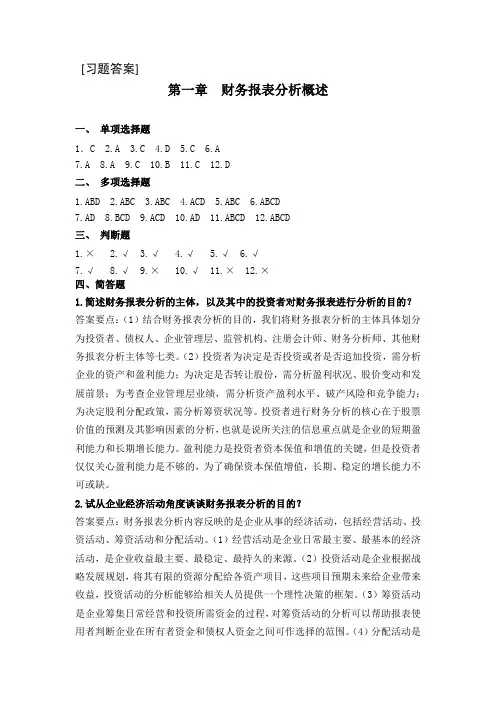
[习题答案]第一章财务报表分析概述一、单项选择题1.C 2.A 3.C 4.D 5.C 6.A7.A 8.A 9.C 10.B 11.C 12.D二、多项选择题1.ABD2.ABC3.ABC4.ACD5.ABC6.ABCD7.AD 8.BCD 9.ACD 10.AD 11.ABCD 12.ABCD三、判断题1.×2.√3.√4.√5.√6.√7.√ 8.√ 9.× 10.√ 11.× 12.×四、简答题1.简述财务报表分析的主体,以及其中的投资者对财务报表进行分析的目的?答案要点:(1)结合财务报表分析的目的,我们将财务报表分析的主体具体划分为投资者、债权人、企业管理层、监管机构、注册会计师、财务分析师、其他财务报表分析主体等七类。
(2)投资者为决定是否投资或者是否追加投资,需分析企业的资产和盈利能力;为决定是否转让股份,需分析盈利状况、股价变动和发展前景;为考查企业管理层业绩,需分析资产盈利水平、破产风险和竞争能力;为决定股利分配政策,需分析筹资状况等。
投资者进行财务分析的核心在于股票价值的预测及其影响因素的分析,也就是说所关注的信息重点就是企业的短期盈利能力和长期增长能力。
盈利能力是投资者资本保值和增值的关键,但是投资者仅仅关心盈利能力是不够的,为了确保资本保值增值,长期、稳定的增长能力不可或缺。
2.试从企业经济活动角度谈谈财务报表分析的目的?答案要点:财务报表分析内容反映的是企业从事的经济活动,包括经营活动、投资活动、筹资活动和分配活动。
(1)经营活动是企业日常最主要、最基本的经济活动,是企业收益最主要、最稳定、最持久的来源。
(2)投资活动是企业根据战略发展规划,将其有限的资源分配给各资产项目,这些项目预期未来给企业带来收益,投资活动的分析能够给相关人员提供一个理性决策的框架。
(3)筹资活动是企业筹集日常经营和投资所需资金的过程,对筹资活动的分析可以帮助报表使用者判断企业在所有者资金和债权人资金之间可作选择的范围。
(财务报表管理)财务报表分析 十版 七 答案(部分)
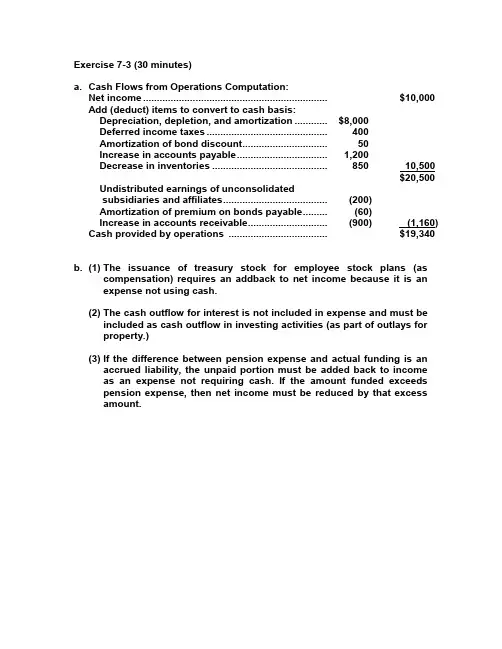
a. Cash Flows from Operations Computation:Net income ................................................................... $10,000 Add (deduct) items to convert to cash basis:Depreciation, depletion, and amortization ............ $8,000Deferred income taxes (400)Amortization of bond discount (50)Increase in accounts payable ................................. 1,200Decrease in inventories .......................................... 850 10,500$20,500 Undistributed earnings of unconsolidatedsubsidiaries and affiliates (200)Amortization of premium on bonds payable (60)Increase in accounts receivable ............................. (900) (1,160) Cash provided by operations .................................... $19,340 b. (1) The issuance of treasury stock for employee stock plans (ascompensation) requires an addback to net income because it is anexpense not using cash.(2) The cash outflow for interest is not included in expense and must beincluded as cash outflow in investing activities (as part of outlays forproperty.)(3) If the difference between pension expense and actual funding is anaccrued liability, the unpaid portion must be added back to incomeas an expense not requiring cash. If the amount funded exceedspension expense, then net income must be reduced by that excessamount.a. Beginning balance of accounts receivable ........ $ 305,000Net sales ............................................. 1,937,000Total potential receipts $2,242,000Ending balance of accounts receivable ............. - 295,000Cash collected from sales $1,947,000b. Ending balance of inventory ................................ $ 549,000Cost of sales ......................................................... +1,150,000Total ............................................. $1,699,000Beginning balance of inventory .......................... - 431,000Purchases ............................................................. $1,268,000 Beginning balance of accounts payable $ 563,000Purchases (from above) ....................................... 1,268,000Total potential payments ..................................... $1,831,000Ending balance of accounts payable .................. - 604,000Cash payments for accounts payable ................ $1,227,000c. Issuance of common stock.................................. $ 81,000Issuance of treasury stock .................................. 17,000Total nonoperating cash receipts ....................... $ 98,000d. Increase in land .................................................... $ 150,000Increase in plant and equipment ......................... 18,000Total payments for noncurrent assets ............... $ 168,000 Exercise 7-5 (20 minutes)b. X Fc. X Fd. X Ie. X Ff. NCNg. X Ih. NCSi. X Fj. X X Ob. X Fc. NCNd. X Ie. NCSf. NCNg. X Ih. NCSi. NE j. NE Exercise 7-7 (30 minutes)Net Cash from Cash2. NE NE +3. + + +4a. - NE NE4b. NE(1)+(2)+(2)4c. - +(2)+(2)5. NE + +6. - + (long-run -) + (long-run -)7. - -(5)+8. + NE NE9. +(3)+(4)+(4)10. NE + +11. + + +12. NE NE +13. NE NE +(1) Deferred tax accounting.(2) Depends on whether tax savings are realized in cash.(3) If profitable.(4) If accounts receivable collected.(5) Depends on whether interest is paid or accrued.Further explanations (listed by proposal number):1. Substituting payment in stock for payment in cash for its dividends will not affectincome or CFO but will increase cash position.2. In the short run, postponement of capital expenditures will save cash but have noeffect on income or CFO. In the long term, both income and CFO may suffer due to lower operating efficiency.Exercise 7-7—continued3. Cash not spent on repair and maintenance will increase all three measures. However,the skimping on necessary discretionary costs will adversely impact future operating efficiency and, hence, profitability.4. Managers advocating an increase in depreciation may have spoken in the mistakenbelief that depreciation is a source of cash and that consequently increasing it would result in a higher cash inflow. In fact, the level of depreciation expense has no effect on cash flow—the same amount of depreciation deducted in arriving at net income is added back in arriving at CFO. On the other hand, increasing depreciation for tax purposes will in all cases result in at least a short-term savings.5. Quicker collections will not affect income but will increase CFO because of loweraccounts receivable. Cash will also increase by the speedier conversion of receivables into cash. In the longer run this stiffening in the terms of sale to customers may result in sales lost to competition.6. Payments stretched-out will lower income because of lost discounts but doespositively affect CFO by increasing the level of accounts payable. Cash conservation will result in a higher cash position. Relations with suppliers may be affected adversely. Note: Long-term cash outflow will be higher because of the lost discount. 7. Borrowing will result in interest costs that will decrease income and CFO. Cashposition will increase.8. This change in depreciation method will increase income in the early stages of anasset's life. The opposite may hold true in the later stages of the asset's life.9. In the short term, higher sales to dealers will result in higher profits (assuming we sellabove costs) and, if they pay promptly, both CFO and cash will increase. However, unless the dealers are able to sell to consumers, such sales will be made at the expense of future sales.10. This will lead to less income from pension assets in the future which could causefuture pension expense to increase.11. The cost of funding inventory will be reduced in the future. In the current period netincome may also be increased by a LIFO liquidation from reduced inventory levels. 12. The current period decline in the value of the trading securities has been reflected incurrent period income, as has the previous gain. Although the sale will increase cash, it will have no effect on current period income. If the current period decline is deemed to be temporary, the company is selling a potentially profitable security for a short-term cash gain.13. Reissuance of treasury shares will increase cash, but will have no effect on currentperiod income as any “gain” or “loss” is reflected in additional paid in capital, not income. If the stock price is considered to be temporarily depressed, the company is foregoing a future sale at a greater market price and is, thus, suffering current dilution of shareholder value.Exercise 7-9 (60 minutes)Notes:[a] Balance at 7/29/Year 10 ........................................... $624.5 [33]Less: increase in Year 10 ........................................ (60.4) [61]$564.1[b]This amount is overstated by the provision for doubtful accounts expense that is included in another expense category.Note [a]: Item [89] represents dividends declared, not dividends paid (see also Item [77]).d. The entry for the income tax provision for Year 11 is:Income tax expense [27] ...................................... 265.9Deferred income tax (current) plug .................. 12.1Income tax payable ............................................ 230.4Deferred income tax (noncurrent) [a] .............. 23.4Notes:(1) The entry increases current liabilities by $12.1 since deferred income tax (current)is credited by this amount. It also increases current liabilities by $230.4 [124A], the amount of income taxes payable.(2) The [a] is the difference in the balance of the noncurrent deferred income tax item[176] = $258.5 - $235.1 = $23.4.(3) Also, $23.4 + $12.1 = $35.5, which is total deferred tax [59] or [127A]Exercise 7-9—continuede. Depreciation expense has no effect on cash from operations. The credit,when recording the depreciation expense, goes to accumulated depreciation, a noncash account.f. These provisions are added back because they affect only noncashaccounts, the charge to earnings must be removed in converting it to the cash basis.g. The “Effect of exchange rate changes on cash” represents translationadjustments (differences) arising from the translation of cash from foreign currencies to the U.S. dollar.h. Any gain or loss is reported under "other, net"—Item [60].i. Free cash flows =Cash flow from operations –Cash used for capital additions –Dividends paidYear 11: $805.2 – $361.1 – $137.5 = $306.6Year 10: $448.4 – $387.6 – $124.3 = $(63.5)Year 9: $357.3 – $284.1 – $86.7 = $(13.5)j. Start-up companies usually have greater capital addition requirements and lower cash inflows from operations. Also, start-ups rarely pay cash dividends. Free cash flow earned by start-up companies is usually used to fund the growth of the company, especially if successful.k. During the launch of a new product line, the statement of cash flows can be affected in several ways. First, cash flow from operations is lower because substantial advertising and promotion is required and sales growth has not yet been maximized. Second, substantial capital additions are usually necessary to provide the infrastructure for the new product line. Third, cash flow from financing can be affected if financing is obtained to launch this new product line.。
财务报表分析课后习题答案

财务报表分析课后习题答案第一章财务报表分析概述一、名词解释财务报表分析筹资活动投资活动经营活动会计政策会计估计资产负债表日后事项二、单项选择1.财务报表分析的对象是企业的基本活动,不是指()。
A筹资活动B投资活动C经营活动D全部活动2.企业收益的主要来源是()。
A经营活动B 投资活动C筹资活动D 投资收益3.短期债权包括()。
A 融资租赁B银行长期贷款C 商业信用D长期债券4.下列项目中属于长期债权的是()。
A短期贷款B融资租赁C商业信用D短期债券5.在财务报表分中,投资人是指()。
A 社会公众B 金融机构C 优先股东D 普通股东6.流动资产和流动负债的比值被称为()。
A流动比率B 速动比率C营运比率D资产负债比率7.资产负债表的附表是()。
A利润分配表B分部报表C财务报表附注D应交增值税明细表。
8.利润表反映企业的()。
A财务状况B经营成果C财务状况变动D现金流动9.我国会计规范体系的最高层次是()。
A企业会计制度B企业会计准则C会计法D会计基础工作规范10.注册会计师对财务报表的()。
A公允性B真实性C正确性D完整性三、多项选择1.财务报表分析具有广泛的用途,一般包括()。
A.寻找投资对象和兼并对象B.预测企业未来的财务状况C.预测企业未来的经营成果D. 评价公司管理业绩和企业决策E.判断投资、筹资和经营活动的成效2.分析可以分为()等四种。
A 定性分析B定量分析C因果分析D系统分析E以上几种都包括3.财务报表分析的主体是()。
A 债权人B 投资人C 经理人员D 审计师E 职工和工会4.作为财务报表分析主体的政府机构,包括()。
A税务部门B国有企业的管理部门C证券管理机构D会计监管机构E社会保障部门5.财务报表分析的原则可以概括为()。
A目的明确原则B动态分析原则C系统分析原则D成本效益原则E实事求是原则6.在财务报表附注中应披露的会计政策有()。
A坏账的数额B收入确认的原则C 所得税的处理方法D存货的计价方法E固定资产的使用年限7.在财务报表附注中应披露的会计政策有()。
财务报告分析_课后答案(3篇)
第1篇一、概述财务报告分析是财务学的一个重要分支,通过对企业财务报表的分析,揭示企业的财务状况、经营成果和现金流量等信息,为投资者、债权人、管理者等提供决策依据。
本篇课后答案将从以下几个方面对财务报告分析进行探讨。
二、财务报表分析1. 资产负债表分析资产负债表是企业财务状况的“快照”,反映了企业在一定时点的资产、负债和所有者权益状况。
以下是资产负债表分析的主要内容:(1)流动比率分析:流动比率是衡量企业短期偿债能力的指标,计算公式为流动资产/流动负债。
一般来说,流动比率大于2表示企业短期偿债能力较好。
(2)速动比率分析:速动比率是衡量企业短期偿债能力的另一个指标,计算公式为(流动资产-存货)/流动负债。
速动比率大于1表示企业短期偿债能力较好。
(3)资产负债率分析:资产负债率是衡量企业负债水平的指标,计算公式为负债总额/资产总额。
一般来说,资产负债率低于50%表示企业负债水平较低。
2. 利润表分析利润表反映了企业在一定时期内的收入、成本、费用和利润情况。
以下是利润表分析的主要内容:(1)毛利率分析:毛利率是衡量企业盈利能力的指标,计算公式为(销售收入-销售成本)/销售收入。
毛利率越高,表示企业盈利能力越强。
(2)净利率分析:净利率是衡量企业盈利能力的另一个指标,计算公式为净利润/销售收入。
净利率越高,表示企业盈利能力越强。
(3)费用率分析:费用率是衡量企业成本控制能力的指标,计算公式为费用总额/销售收入。
费用率越低,表示企业成本控制能力越强。
3. 现金流量表分析现金流量表反映了企业在一定时期内的现金流入和流出情况。
以下是现金流量表分析的主要内容:(1)经营活动现金流量分析:经营活动现金流量是企业日常经营活动产生的现金流量。
正的经营活动现金流量表示企业盈利能力较好。
(2)投资活动现金流量分析:投资活动现金流量是企业投资活动产生的现金流量。
正的投资活动现金流量表示企业投资回报较好。
(3)筹资活动现金流量分析:筹资活动现金流量是企业筹资活动产生的现金流量。
财务报告分析课本答案(3篇)
第1篇一、引言财务报告是企业对外展示其财务状况、经营成果和现金流量等方面的关键文件。
通过对财务报告的分析,我们可以了解企业的经营状况、盈利能力、偿债能力、发展潜力等,为投资者、债权人、管理层等提供决策依据。
本篇报告将结合财务报告分析课本,对企业的财务报告进行分析。
二、财务报告分析概述1. 财务报告分析的目的财务报告分析的主要目的是了解企业的财务状况、经营成果和现金流量,从而评估企业的经营风险、盈利能力、偿债能力和发展潜力。
2. 财务报告分析的方法财务报告分析的方法主要包括比较分析法、趋势分析法、比率分析法等。
(1)比较分析法:通过对企业财务报表中的各项指标与同行业平均水平、历史水平或竞争对手的指标进行比较,评估企业的经营状况。
(2)趋势分析法:分析企业财务报表中各项指标的变化趋势,了解企业的经营状况和发展潜力。
(3)比率分析法:通过计算财务报表中的各项比率,评估企业的盈利能力、偿债能力和运营效率。
三、财务报告分析案例1. 企业概况某企业为一家制造业公司,主要从事某产品的研发、生产和销售。
近年来,企业业务发展迅速,市场份额不断扩大。
2. 财务报表分析(1)资产负债表分析根据资产负债表,我们可以分析企业的资产结构、负债结构和所有者权益状况。
①资产结构分析:企业的流动资产占总资产的比例较高,说明企业具有较强的短期偿债能力。
固定资产占比相对较低,表明企业对固定资产的投入较少。
②负债结构分析:企业的流动负债占总负债的比例较高,说明企业对短期负债的依赖程度较高。
长期负债占比相对较低,表明企业对长期负债的依赖程度较低。
③所有者权益分析:企业的所有者权益占总资产的比例较高,说明企业财务风险较低。
(2)利润表分析根据利润表,我们可以分析企业的收入、成本和利润状况。
①收入分析:企业的营业收入逐年增长,表明企业的市场竞争力较强。
②成本分析:企业的营业成本逐年增长,但增速低于营业收入增速,说明企业的成本控制能力较好。
③利润分析:企业的净利润逐年增长,表明企业的盈利能力较强。
财务报表分析第七章合并报表分析。

• 合并时编制抵销分录:
借:营业收入
1000
贷:营业成本
1000
借:营业成本
2Hale Waihona Puke 0贷:存货200• S公司以300万元的价格将其生产的产品销售给P公 司(从存货变为固定资产),其销售成本为270万元, 因此其销售利润30万元。P公司以300万元作为管理 用固定资产入账。假设P公司按3年采用平均年限法 计提折旧,预计净残值为0。假设该交易年初进行, 全年每月计提折旧(应按270计提,按300计提全年 多计提10万元折旧,也应抵销)。
合并利润表编制举例
利润表 2009年度
单位:万元
项目
P公司
一、营业收入
8700
减:营业成本
4450
营业税金及附加
300
销售费用
15
管理费用
100
财务费用
300
资产减值损失
25
加:公允价值变动收益(损失为“-”)
投资收益(损失为“-”)
500
S公司 6300 4570 125 10 12 90
利 润 表(续)
2.在税后利润基础上,减去少数股东权益部分, 即得到集团净利润
3.抵销集团内部交易项目
• 内部营业收入与内部营业成本的抵销
• 内部固定资产交易所产生的未实现内部销售 利润的抵销
• 内部应收款项计提的坏账准备等减值准备的 抵销
• 内部相互持有债券或借贷款项而发生的利息 收入与利息费用的抵销
• 内部持有股权的投资收益的抵销
• 投资方用于与其他企业股东交换股票的计价, 不是按市价而是按面值计价。投资方的长期 投资入账价值为换出股票的面值
• 被购买企业不存在商誉确认问题
财务报告分析参考答案(3篇)
第1篇一、概述财务报告是企业对外展示其财务状况、经营成果和现金流量的重要文件。
通过对财务报告的分析,可以了解企业的经营状况、盈利能力、偿债能力、运营效率等关键财务指标。
以下是对财务报告分析的参考答案,旨在帮助读者更好地理解和评估企业的财务状况。
二、财务报告分析步骤1. 收集和分析财务报表首先,需要收集企业的资产负债表、利润表、现金流量表和所有者权益变动表等财务报表。
然后,对这些报表进行详细分析,了解企业的财务状况。
2. 分析盈利能力盈利能力是企业经营成果的体现,主要指标有营业收入、净利润、毛利率、净利率等。
(1)营业收入:分析营业收入的变化趋势,了解企业的业务发展情况。
如果营业收入持续增长,说明企业具有较强的市场竞争力。
(2)净利润:分析净利润的变化趋势,了解企业的盈利能力。
如果净利润持续增长,说明企业的经营状况良好。
(3)毛利率:分析毛利率的变化趋势,了解企业的成本控制能力。
如果毛利率持续下降,说明企业的成本控制能力有所下降。
(4)净利率:分析净利率的变化趋势,了解企业的盈利水平。
如果净利率持续下降,说明企业的盈利能力有所下降。
3. 分析偿债能力偿债能力是企业偿还债务的能力,主要指标有流动比率、速动比率、资产负债率等。
(1)流动比率:分析流动比率的变化趋势,了解企业的短期偿债能力。
如果流动比率持续下降,说明企业的短期偿债能力有所下降。
(2)速动比率:分析速动比率的变化趋势,了解企业的短期偿债能力。
如果速动比率持续下降,说明企业的短期偿债能力有所下降。
(3)资产负债率:分析资产负债率的变化趋势,了解企业的长期偿债能力。
如果资产负债率持续上升,说明企业的长期偿债能力有所下降。
4. 分析运营效率运营效率是企业利用资源创造价值的能力,主要指标有存货周转率、应收账款周转率、总资产周转率等。
(1)存货周转率:分析存货周转率的变化趋势,了解企业的存货管理能力。
如果存货周转率持续下降,说明企业的存货管理能力有所下降。
财务报告分析学习通答案(3篇)
第1篇一、单选题1. 下列哪项不属于财务报表?()A. 资产负债表B. 利润表C. 现金流量表D. 营业收入答案:D解析:营业收入属于利润表的内容,不属于财务报表。
2. 财务报表分析的目的是什么?()A. 了解企业的财务状况B. 评估企业的经营成果C. 分析企业的盈利能力D. 以上都是答案:D解析:财务报表分析的目的是多方面的,包括了解企业的财务状况、评估企业的经营成果、分析企业的盈利能力等。
3. 财务报表分析的依据是什么?()A. 会计准则B. 税法C. 财务报表D. 以上都是答案:C解析:财务报表分析的主要依据是财务报表,包括资产负债表、利润表、现金流量表等。
4. 资产负债表反映了什么?()A. 企业的资产状况B. 企业的负债状况C. 企业的所有者权益状况D. 以上都是答案:D解析:资产负债表反映了企业的资产状况、负债状况和所有者权益状况。
5. 利润表反映了什么?()A. 企业的收入状况B. 企业的费用状况C. 企业的盈利能力D. 以上都是答案:D解析:利润表反映了企业的收入状况、费用状况和盈利能力。
二、多选题1. 财务报表分析的方法有哪些?()A. 比率分析法B. 结构分析法C. 比较分析法D. 因素分析法答案:ABCD解析:财务报表分析的方法包括比率分析法、结构分析法、比较分析法和因素分析法等。
2. 资产负债表中的流动资产包括哪些?()A. 现金及现金等价物B. 应收账款C. 存货D. 长期投资答案:ABC解析:资产负债表中的流动资产包括现金及现金等价物、应收账款、存货等。
3. 利润表中的费用包括哪些?()A. 营业成本B. 营业税金及附加C. 销售费用D. 管理费用答案:ABCD解析:利润表中的费用包括营业成本、营业税金及附加、销售费用、管理费用等。
4. 财务报表分析的意义有哪些?()A. 帮助投资者作出投资决策B. 帮助企业管理者进行决策C. 帮助债权人评估企业信用D. 帮助政府制定相关政策答案:ABCD解析:财务报表分析的意义包括帮助投资者作出投资决策、帮助企业管理者进行决策、帮助债权人评估企业信用、帮助政府制定相关政策等。
《财务报表分析》最新完整版课后习题答案
《财务报表分析》最新完整版课后习题答案《财务报表分析》最新完整版课后习题答案目录项目一 (1)项目二 (1)项目三 (6)项目四 (8)项目五 (9)项目六 (9)项目七 (10)项目八 (13)项目一一、单选B C A C D二、多选ABCDE ABCDE ABC AD DE AB ABD三、判断××√实践操作省略项目二一、单选 C D C二、多选ABCD ABE ABCD ABDE ABC ABCDE三、判断××√×√×××√√√四、简答题1、对比保守结构、稳健结构、平衡结构、风险结构这四种资产与资本的适应结构(从主要标志和特点这两个方面进行分析)。
(1)保守结构主要标志:全部资产的资金需要由长期资金(长期负债+所有者权益)来满足特点:风险极低;资金成本较高;筹资结构弹性弱(2)稳健结构主要标志:长期资产的资金需要由长期资金来满足,流动资产的资金需要由流动资金和长期资金共同满足特点:财务信誉优异;负债成本相对较低,具有可调性;资产结构和资本结构都具有一定的弹性(3)平衡结构主要标志:流动资产的资金需要由流动负债来满足;长期资产的资金需要由长期负债和所有者权益来满足特点:风险均衡;负债政策依据资产结构来调整;存在潜在的风险(4)风险结构主要标志:流动资产的资金需要由流动负债来满足;部分长期资产的资金需要也由流动负债来满足特点:财务风险较大;负债成本最低;存在破产的潜在危险五、计算分析题资产负债表变动情况分析表单位:万元分析评价:(1)从资产方面分析该企业本期总资产增加了49400万元,增长幅度为5.03%,从具体项目看:A、主要是固定资产增长引起的,固定资产原值增加了27500万元,增长幅度为2.8%,表明企业的生产能力有所增加。
B、流动资产增加10100万元,增长幅度为1.03%,说明企业资产的流动性有所提高。
特别是货币资金大幅度增加,对增强企业的偿债能力,满足资金流动性需要都是有利的。
财务与会计(2022) 第7章 财务分析与评价 课后作业
财务预会计第七章财务分析与评价课后作业一、单项选择题1.分析企业利润目标的完成情况和不同年度盈利水平的变动情况,预测企业盈利前景,属于( )。
A.企业的偿债能力分析B.企业资产的营运能力分析C.企业的盈利能力分析D.企业的资金实力总体评价2.在下列财务分析主体中,其财务分析的目的除了了解企业的偿债能力外,还要了解企业的资产管理及使用情况、企业的获利能力以及企业的长期发展趋势的是( )。
A.企业经营管理人员B.企业债权人C.企业投资人D.税务机关3.按照特定的指标将客观事物加以比较,从而认识事物的本质和规律并作出正确的评价的分析方法是( )。
A. 比较分析法B. 比率分析法C. 因素分析法D.历史分析法4.甲企业2022 年权益净利率为12%,总资产净利率为6%,权益乘数为2。
2022 年权益净利率为17.5%,总资产净利率为7%,权益乘数为2.5。
按照先总资产净利率再权益乘数的顺序,采用差额分析法分析权益乘数的变动对2022 年权益净利率变动的影响,下列列式正确的是()。
A. (7%-6%) ×2B. (6%-7%) ×2.5C.6%× (2-2.5)D.7%× (2.5-2)5.下列各项财务指标中,能反映企业长期偿债能力的是( )。
A.流动比率B. 已获利息倍数C.现金比率D.营运资本6.较低的现金比率一方面说明企业资产的流动性较差,另一方面表明 ( )。
A.机会成本的增加B.获利能力降低C.短期偿债风险较小D.短期偿债能力较弱7.已知经营杠杆为 2 ,固定成本为 4 万元,利息费用为 1 万元,(假设全部计入当期损益,无资本化利息),则已获利息倍数为( )。
A.2B.4C.3D.18.下列关于资产负债率、权益乘数和产权比率之间关系的表达式中,正确的是( )。
A. 资产负债率+权益乘数=产权比率B. 资产负债率-权益乘数=产权比率C. 资产负债率×权益乘数=产权比率D. 资产负债率÷权益乘数=产权比率9.下列关于企业财务指标作用的表述中正确的是( )。