
期末复习人教版七年级英语下册unit2解析词汇、句型解析及练习(有答案)
期末复习人教版七年级英语下册unit2解析词汇、句型解析及练习Unit2 What time do you go to school?01词汇讲解1. do one’s homeworkdo one’s homework的意思是“做某人的家庭作业”。
短语中的one’s可以用名词所有格或者形容词性物主代词。
例如:What time do you often do your homework?你经常在什么时候做你的家庭作业?2. get dresseddressed在本单元是形容词,意为“打扮好的,穿着衣服的”;get在此是连系动词,后接形容词dressed构成系表结构。
词组get dressed意为“穿上衣服”。
例如:Mary, can you help your baby sister get dressed?玛莉, 你可不可以帮你年幼的妹妹穿衣服?After I get dressed, I have breakfast.我穿好衣服以后吃早饭。
拓展:dressed 的其他常见用法1) dress up, 意为“装扮,乔装打扮”或者“穿上盛装,打扮”。
例如:You needn’t dress up for the party.你不必为这个聚会精心打扮。
2)dress up as,意为“装扮成……,打扮成……”。
例如:The boy often dresses up as a monkey.那个男孩常装扮成一只猴子。
3)well-dressed,意为“穿着考究的;穿着入时的;着装得体的;衣着讲究的”。
例如:a well-dressed lady 一位穿着体面的女士3. take a shower1)shower 名词,意为“阵雨,淋浴”;take a shower 意为“洗澡,洗淋浴”,等于have a shower。
shower前面可以加形容词来修饰。
例如:I often take a shower in the evening. 我经常在晚上洗澡。
I take a cold shower when I feel tired. 我感到累时就洗个冷水澡。
2)类似于“take a shower=have a shower”这样的用法还有:take a look= have a look 看一看take a seat = have a seat 坐下,入座take a rest = have a rest 休息一下4. work1)work不及物动词,意为“工作,劳动”,第三人称单数是works;worker是名词,意为“工人”,复数是workers。
例如:He works very hard. 他工作很努力。
There are 30 workers in the factory. 工厂里有30个工人。
2)work 名词,意为“工作”,是不可数名词,但表示一份工作可以用“a piece of work”。
常用于以下词组:out of work 失业/下岗at work 在上班after work 下班后 go to work 去上班in work 就业3)work 名词,意为“著作,作品”,是可数名词,复数为works。
She is reading a new work on history.她正在看一本关于历史的新书。
Shakespeare’s works are very famous. 莎士比亚的作品很著名。
5. funny1)funny 形容词,意为“有趣的,可笑的,滑稽的,奇怪的”;意为“有趣”时,相当于“interesting”。
例如:What a funny (an interesting) story! 多么有趣的故事啊!Sometimes he is funny; sometimes he seems like a poet.有时他很滑稽, 有时他又像个诗人。
The machine is making a very funny noise.这部机器发出一种很怪的声音。
2)fun 是funny的名词形式,意为“乐趣,娱乐,嬉戏,有趣的事”。
常用于词组have fun doing sth表示“做某事很开心。
例如:Life isn’t all fun; it has its bad moments.人生不仅有乐趣, 也有令人不快的时刻。
Picnics are fun. 野餐是件有趣的事。
We have a lot of fun in the park on weekends.每周末我们都在公园里玩得很快活。
Everybody has fun learning English in our class.我们班每一位都开心得学英语。
6. exercise1)exercise 作动词,意为“运动,锻炼”等时,既可以作及物动词也可以作不及物动词。
例如:Every day I exercise before I go to sleep. (不及物动词)我每天睡觉前锻炼。
We should constantly exercise our muscles. (及物动词)我们应当经常锻炼肌肉。
2)exercise 作名词,意为“练习,操”等时,是可数名词。
意为“锻炼”时,是不可数名词。
例如:We should do eye exercises. 我们应该做眼保健操。
Let's take exercise together. 让我们一起锻炼吧。
7. quarter1)quarter 作名词时,可以译为“四分之一”或者“一刻钟”。
例如:A quarter of the apples are green. 有四分之一的苹果是青的。
It’s a quarter past seven. 七点一刻了。
2)quarter作动词时,可以译为“把…四等分”。
例如:We should quarter the pineapple.我们应该把这个菠萝分成四等份。
8. taste1)taste做行为动词时,既可以是及物动词也可以是不及物动词,意为“吃,品尝,喝,”等。
例如:I can taste something sour. 我尝到了酸味。
(及物动词)Sometimes when you are ill, you can't taste properly. (不及物动词)有时生病时吃什么都没有滋味。
2)taste做连系动词时,后面跟名词或者形容词作表语,构成主系表结构;意为“吃起来,尝起来”。
例如:The soup tastes good. 这汤的味道不错。
The pizza tastes delicious. 比萨饼很好吃。
3)taste 还可以作名词,意为“味道,味觉,品味”等。
例如:I like the taste of wine. 我喜欢葡萄酒的味道。
She has excellent taste in dress. 她在服装方面有极高的品味。
9. lifelife 名词,既可以是可数名词也可以是不可数名词。
作“生活”讲时,是不可数名词;作“生命”讲时是可数名词,其复数是“lives”。
例如:Life is like a journey. 生活像一次旅行。
(不可数)Three people lost their lives in the accident. 事故中三人丧生。
(可数)拓展:常见的使用life的词组有live a … life 过……的日子lose one’s life 丧生save one’s life 救……的命give one’s life 献身come (back) to life 复活10. usually1)usually是频度副词,意为“通常”,常位于系动词、助动词或情态动词之后,实义动词之前,在句子中作状语; 但有时也可以放在句首修饰整个句子。
例如:I usually go to school at seven o’clock.我通常七点去上学。
It is usually in the morning that she sees her patients.她通常在上午看望病人。
Usually, I get up early. 通常, 我起得很早。
2)usually的形容词是usual,意为“通常的,平常的”。
常用于词组as usual,意为“像平常一样”。
它的反义词是unusual,意为“罕有的,不同寻常的”。
例如:She goes to work as usual. 她像平常一样去上班了。
It was an unusual day for summer. 这是夏季少有的一天。
11. brush1)brush 作动词,意为“刷,擦”,三单形式是brushes。
常用于以下短语中:brush one’s teeth / shoes / hair 刷牙/擦鞋/ 梳头。
例如;Please brush your shoes. 请把你的鞋擦一下。
I brush my teeth every day. 我每天都刷牙。
2)brush 作名词,意为“刷子,画笔,毛笔”,是可数名词,其复数是brushes。
例如:I can paint a picture with a brush. 我可以用刷子画画。
We gave him paint and brushes. 我们给了他油漆和几把刷子。
12. toothtooth 名词,意为“牙齿”,可数名词。
其复数形式是特殊变化teeth。
例如:The dentist took out two of my teeth. 牙医拔掉了我两颗牙。
拓展:1)一些名词的复数是不规则变化的。
例如:foot → feet(脚)child → children(孩子)man→men(男人)woman→ women(女人)mouse → mice(老鼠)2)还有一些名词的单复数是一样的。
例如:sheep→sheep(绵羊)deer→deer(鹿)Chinese→Chinese(中国人)Japanese→Japanese(日本人)3)还有些名词是集合名词,本身就是复数的概念,不需要再变复数。
例如:cattle 牛people 人,人们police 警察练一练:Ⅰ. 用适当的词填空,补全下面的短文。
I usually 1 (起床)at six o’clock. I have milk and bread for breakfast. After breakfast, I 2 (洗澡)and then I 3 (上学)by bus. I get to school at a quarter to eight. I have five classes in the morning. And then I have lunch at twelveo’clock. In the afternoon I have two classes. I 4 (回家)at half past four. I get home at 5:00. I 5 (吃晚饭)at about 6:00. After dinner, I 6 (做作业).I 7 (睡觉)at 8:00. My life is busy but not exciting.Ⅱ. 根据句意、首字母或汉语提示,写出正确的单词。
人教版七年级下册Unit2单词+短语+句型(默写版包含答案)
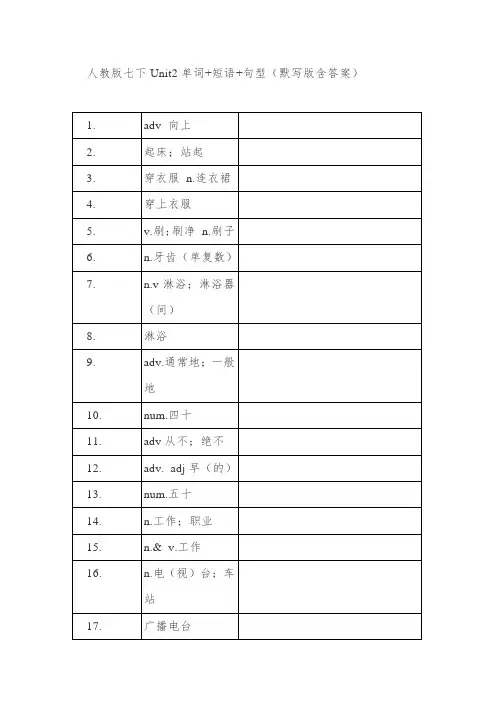
adv从不;绝不
12.
adv. adj早(的)
13.
num.五十
14.
n.工作;职业
15.
n.& v.工作
16.
n.电(视)台;车站
17.
广播电台
18.
adv.(表示整点)……点钟
19.
n.晚上;夜晚
20.
adj奇怪的;滑稽好笑的
21.
v.n锻炼;练习
22.
(在)周末
23.
n.组;群
24.
adj.& adv.最好的(地)
他总是7点去上班。
6.他从不迟到。
7.晚上,我不是看电视就是打电脑游戏。
8.在12点,她午餐总吃许多水果和蔬菜。
9.她知道这对她不利,但它却很好吃!
参考答案
1.
adv向上
up[ʌp]
2.
起床;站起
get up
3.
穿衣服n.连衣裙
dress[dres]v.
4.
穿上衣服
get dressed
5.
v.刷;刷净n.刷子
7.晚上,我不是看电视就是打电脑游戏。
7.In the evening, I either watch TV or play computer games.
8.在12点,她午餐总吃许多水果和蔬菜。
8.At twelve, she eats lots of fruit and vegetables for lunch.
radio station
19.在晚上
at night
20.迟到
be late for= arrive late for
21.......点半
七下人教版Unit 2 知识回顾和练习题答案分析

Unit 2 What time do you go to school?(满分100分)一.单项选择(每小题1分,共10分)从A、B、C、D四个选项中选择可以填入空白处的最佳答案。
( ) 1. Dave usually has dinner ______ seven o’clock.A.inB. atC. onD. of因为时刻点前,我们用介词at( ) 2. Lucy always gets up late and then goes to work, so she ______ eats breakfast.A.alwaysB. oftenC. neverD. sometimes因为她起床很晚,所以这里never最合适( ) 3. Peter plays volleyball ______ runs before breakfast.A.orB. andC. soD. then这里是表示并列的关系,所以用and( ) 4. What ______ your mother usually do after work?A.isB. doC. doesD. areYour mother 是属于第三人单数,所以用does( ) 5. —______ does your sister go to school every day?—She goes to school at seven.A.WhereB. WhoC. HowD. When这里是问时间所以用when( ) 6. I like the tomato soup because it ______ nice.A.tastesB. soundsC. looksD. taste汤是尝起来怎么样,加上第三称单数,所以是tastes( ) 7. Students need to ______ after eating to have good teeth.A. get upB. brush our teethC. clean the faceD. do our homework根据句义,是刷牙( ) 8. Jim has a relaxing ______. He only works on weekends.A.showB. jobC. workD. subject具体工作,应用job( ) 9. —What’s the Engli sh for 8:20?—It’s ______.A.eight past twentyB. eight to twentyB.twenty to eight D. twenty past eight8点20的正确的表达方式是D( ) 10. —What time do you take a shower in the evening?—______.A. On weekendsB. With my friendsC. At about 11:30D. For an hour根据句义,应是C二. 完形填空(每小题1.5分,共15分)先通读下面的短文,掌握其大意,然后从A、B、C、D四个选项中选择可以填入空白处的最佳答案。
Unit2单元知识点归纳总结及配套练习-人教版英语七年级下册
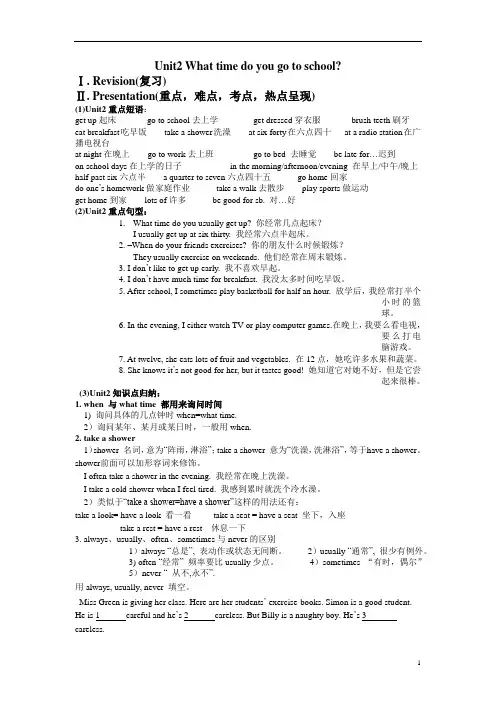
Unit2 What time do you go to school?Ⅰ. Revision(复习)Ⅱ. Presentation(重点,难点,考点,热点呈现)(1)Unit2重点短语:get up起床go to school去上学get dressed穿衣服brush teeth刷牙eat breakfast吃早饭take a shower洗澡at six forty在六点四十at a radio station在广播电视台at night在晚上go to work去上班go to bed 去睡觉be late for…迟到on school days在上学的日子in the morning/afternoon/evening 在早上/中午/晚上half past six六点半 a quarter to seven六点四十五go home回家do one’s homework做家庭作业take a walk去散步play sports做运动get home到家lots of许多be good for sb. 对…好(2)Unit2重点句型:1. --What time do you usually get up? 你经常几点起床?--I usually get up at six thirty. 我经常六点半起床。
2. –When do your friends exercises? 你的朋友什么时候锻炼?--They usually exercise on weekends. 他们经常在周末锻炼。
3. I don’t like to get up early. 我不喜欢早起。
4. I don’t have much time for breakfast. 我没太多时间吃早饭。
5. After school, I sometimes play basketball for half an hour. 放学后,我经常打半个小时的篮球。
人教版七下 Unit2 知识讲解与练习
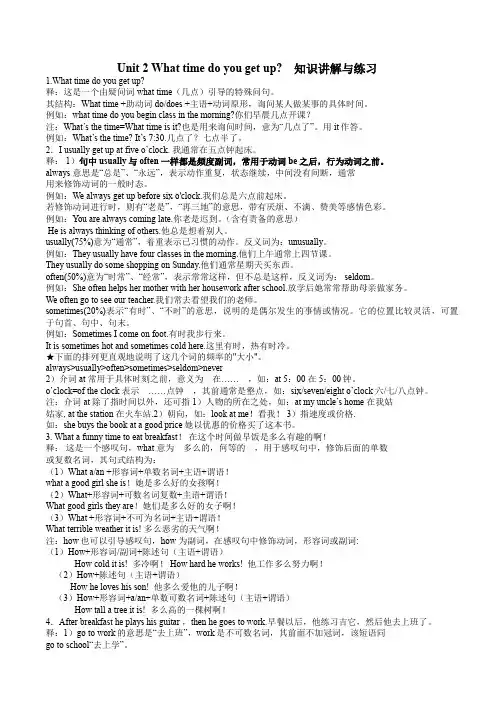
Unit 2 What time do you get up? 知识讲解与练习1.What time do you get up?释:这是一个由疑问词what time(几点)引导的特殊问句。
其结构:What time +助动词do/does +主语+动词原形,询问某人做某事的具体时间。
例如:what time do you begin class in the morning?你们早晨几点开课?注:What’s the time=What time is it?也是用来询问时间,意为“几点了”。
用it作答。
例如:What’s the time? It’s 7:30.几点了?七点半了。
2.I usually get up at five o’clock.我通常在五点钟起床。
释: 1)句中usually与often 一样都是频度副词,常用于动词be 之后,行为动词之前。
always 意思是“总是”、“永远”,表示动作重复,状态继续,中间没有间断,通常用来修饰动词的一般时态。
例如:We always get up before six o'clock.我们总是六点前起床。
若修饰动词进行时,则有“老是”,“再三地”的意思,带有厌烦、不满、赞美等感情色彩。
例如:You are always coming late.你老是迟到。
(含有责备的意思)He is always thinking of others.他总是想着别人。
usually(75%)意为“通常”,着重表示已习惯的动作。
反义词为:unusually。
例如:They usually have four classes in the morning.他们上午通常上四节课。
They usually do some shopping on Sunday.他们通常星期天买东西。
often(50%)意为“时常”、“经常”,表示常常这样,但不总是这样,反义词为: seldom。
人教版七年级下册英语:Unit 2 What time do you go to school知识点讲解及练习题目及答案

Unit 2 What time do you go to school?单元复习题重点知识点讲解1. what time与whenwhat time翻译为“几点”问的是具体的时间,一般回答要具体到小时。
What time do you go to school?I go to school at half past seven o’clock.回答具体到点钟,且注意在几点前边的介词用at。
when也是对时间的提问,但与what time的区别是:用when提问,回答既可以是具体的时间,也可以是不具体的时间,如:in the morning,last year,in 1998等范围大的时间。
向对方询问具体时间时,即几点几分,只能用what time,不能用when。
询问年份、月份、日期时,只能用when,不能用what time。
2. 英语时间的表达(1)整点时间可表示为“钟点数+o’clock”或直接读钟点数,省去o’clock。
如:It’s ten o’clock a. m.现在是上午十点整。
(2)非整点时间可直接采取读数法。
如:It’s eight-thirty. 是八点三十分。
注意时间的表达方式:用数词。
点与分钟之间用连字如:注:英语时刻的表达法:顺读法和逆读法。
顺读法:钟点数+分钟数。
4:25→four twenty-five,6:58→six fifty-eight,7:00→seven o’clock 说明:这种表达不论分钟数是多少,均可使用。
逆读法:分钟为+介词to/past+钟点数,可分两种情况:1)分钟为不超过半小时,用分钟数+past (/pa:st/过+钟点数。
4:23→t wenty-three past four,5:19→nineteen past five.2)分钟数超过了半小时,用(所差的)分钟的+to+(下一个)钟点为。
10:58→two to eleven 7:31→twenty-nine to eight在逆读法中分钟数逢“五”逢“十”可省略minute(s)。
初中英语 人教七年级下册unit2词汇精讲精练(含答案)(共14张ppt)

A. always B. never
C. usually D. sometimes
四、按要求完成句子
1. 我周末通常起床很晚。
I usually get
up
late on weekends.
2. 我通常在6:40淋浴。
I usually take
a
shower at six forty.
3. 我经常在晚上做作业。
D. to have
Chinese aloud in the
B. neither; or
D. only; but also
13. Emma goes to school at 7:30 and she is__late for school.
A never;always B always;often C always;never D often;always
I don't like to get
up
early .
7. 放学后,我有时打半个小时篮球。
After school, I sometimes play basketball
.
for half an hour
8. 在12:00,她吃许多水果和蔬菜作为午饭。
At twelve, she eats lots of fruit and vegetables for lunch
A. always B. usually C. never
D. sometimes
5. He either watches TV
reads books in the evening.
A or B and C to D so
.
.
.
Unit2单元语法知识点的讲解+课后练习2023-2024学年人教版七年级英语下册
七下U2单元语法知识点汇总+单元作文范文语法专题:what time 、when 引导的特殊疑问句一、用法 what time 翻译为“几点”问的是具体的时间,一般回答要具体到小时。
—What time do you go to school? —I go to school at half past seven o’clock.回答具体到点钟,注意在几点前边的介词用at 。
when 也是对时间的提问,但与what time 的区别是:用when 提问,回答既可以是具体的时间,也可以是不具体的时间,如:in the morning ,last year ,in 1998等范围大的时间,例如: —When does he take a shower ? —He takes a shower in the morning.也可用具体时间:I take a shower at 6 o’clock in the morning.【例】完成下列对话。
(1)____________________ is it? It’s seven o’clock. (2)____________________ born?He was born in 1992.(3)____________________ do you get up? It’s five o’clock. (4)____________________ does Jane do her homework?She does it in the evening. (5)____________________ do you exercise?At half past eight at night.二、句子的构成1. 对句子的主语提问,其语序是:疑问词+谓语+其他?(整句是陈述句语序) Swimming is my favourite.What is your favourite? 主语 谓语主语 谓语2. 对句子其他部分提问,其语序是:Be(Am;Is;Are;Was;Were)+主语+其他?特殊疑问词(+被修饰名词)+一般疑问句助动词/情态动词+动词原形+其他?【例】完成图片对话。
人教版七年级英语下册Unit2 单词讲解与练习含答案
人教版七年级英语下册Unit2 单词讲解与练习含答案Unit 2: What Time Do You Go to School。
Key Vocabulary and n1.Up: adverb meaning upward。
antonym: down.2.Get up: ___ to rise from bed or stand up.3.Dress: ___。
noun meaning a one-piece garment for women。
When used as a verb。
the object can only be a person。
not clothes。
For example: "My brother can dress himself." Use "put on" for clothes as the object to ___ "wear" for clothes as the object to indicate the state of wearing。
or for accessories like watches。
as in "wear a watch."4.Get dressed: ___"Dressed" ___ adjective。
meaning "___."5.Brush: ___。
___ singular: brushes.6.___: ___。
___。
plural: ___。
"Brush ___" means to clean___.7.Shower: ___ a device or room for taking a shower。
___.8.___: means to take a shower。
synonymous with "have a shower."ually: ___。
人教版初中英语7年级下册Unit2知识清单与习题(含答案)(最新整理)
Unit 2 What time do you go to school?一、必记单词dress v穿衣服n连衣裙brush v.刷;刷净n.刷子tooth n.牙齿usually adv通常地;一般地forty num.四十never adv从不;绝不early adv.&adj早(的)work v&n.工作station n,电(视)台;车站night n.晚上;夜晚funny adj奇怪的;滑稽好笑的exercise v&n锻炼;练习best adj 最好的adv最好地;最group n.组;群half n.&pron,一半;半数quarter n.一刻钟;四分之一run v跑;奔clean v打扫;弄干净adj干净的walk n.&v.行走;步行quickly adv.很快地either conj或者adv也sometimes adv有时taste v有…的味道;品尝n.味道;滋味life n.生活;生命词汇拓展up(反义词)down brush(单三)brushes tooth(复数)teethalways (反义词)never early(反义词)late work(同义词)jobnight(反义词)dayhalf(复数)halvesrun(现在分词)runningclean(现在分词)cleaningeither…or…(反义词)neither…nor…life(复数)livestaste(单三)tastes二、重点短语get up起床;站起get dressed穿上衣服have/take a shower洗淋浴on weekends(在)周末do(one’s )homework做作业take a walk散步;走一走lots of=many+可数(复数)大量,许多either… or...要么…要么…;或者………或者…brush teeth刷牙have(eat) breakfast /dinner吃早餐/晚餐What time几点,何时go to school 去学校at night在晚上from…to…从……到……in the morning/ afternoon /evening在上午/下午/晚上go to work去上班That's a funny time for…那是做……有意思的时间。
(完整版)人教版新目标七年级下册Unit2词汇短语、固定搭配、知识点、语法详解以及训练、检测等综合资
Unit 2 What time do you go to school?1、重点单词:1.穿衣服;连衣裙v.&n. 三单12.滑稽好笑的adj. n.2.刷净;刷子v&n 三单13.锻炼,练习v.&n.3.牙齿n pl. 14.一半,半数pl.4.通常地;一般地adv adj. 15.一刻钟,四分之一5.四十16.跑,奔v. pt. v-ing.6.从不,绝不adv op. 17.打扫;干净的v.&adj.7.早的(地)adj&adv 18.行走,步行v.&n.8.五十19.很快地adv. adj.9.工作,职业n. 20.有时adv.10.工作n.&v 21.品尝;味道,滋味v.&n11.晚上,夜晚n 22.生活;生命n pl.2、重点短语:1.get up2.go home3.go to school4.clean my room5.get dressed6.go to bed early7.brush teeth8.eat quickly9.eat breakfast10.play sports11.take a shower12.like to do…13.at six forty14.eat lots of fruit and vegetables15.have an interesting job 16.from…to…17.be good for…18.be late for…19.on school days20.unhealthy habits21.on weekends22.healthy activities23.at half past six24.get home from school25.at a quarter past three26.have a healthy life27.at a quarter to seven28.need to do…29.take a walk30.have time to do sth.三、重点句型:1.What time do you usually ?你通常几点起床?2.I usually get up six thirty.我通常六点半起床。