
外研版英语四年级下册Module 9 Unit 2教学课件
Homework
1. 向家人展示自己跟读模仿课文录音的情况。 2. 向家人展示本单元新学的韵句。 3. 询问自己的同伴去过哪里。
Did you go by train?
Did you visit the Great Wall?
Yes, I went to Beijing.
No, I went by plane.
Yes, I did.
Try to do.
用所给单词的适当形式填空。
1. I _w_e_n_t__(go) to Beijing last year. 2. Tom _t_r_av_e_ll_e_d_(travel) to Shanghai last year. 3. They __w_e_n_t__(go) there by bus. 4. We __p_la_y_ed__(play) games yesterday. 5. _D__id__(do) you watch TV yesterday?
visit the Great Wall 参观长城
go to the earth 到地球去
Listen and say. Then sing.
OH, WE LOVE HOLIDAYS! We visited England and we went to London zoo. We saw lots of people and some funny animals too. Oh, we love holidays, holidays, hooray! We want to visit China. We want to see Beijing. We’ll meet the Chinese children. We’ll talk and play and sing. Oh, we love holidays, holidays, hooray!
Guess and say.
Did you go to Hong kong last year?.
Yes, I did.
Did you go to Beijing last
year?.
No, I didn’t. I went to New
York.
Did you visit the Great Wall last year? No, I didn’t. I went to Hangzhou.
外研版·英语·四年级下册
Module 9 Unit 2 Did you have a nice holiday?
第一课时
第二课时
第一课时
Did he, did he? Yes, he did. No, he didn’t.
Did she, did she? Yes, she did. No, she didn’t.
Yes, I did.
I went to the village last year. Did you travel by bike?
No, I didn’t. I went there by bus.
I went to Shanghai last year. Did you travel by bus?
A. visited
B. visit
C. visiting
A ( ) 2. They went to Beijing by _____.
A. plane
B. the plane C. planes
A ( ) 3. Look _____ these beautiful photos of our school.
Yes. Look! It’s very beautiful.
Did you see your friend Lili in Hangzhou?
No, she was on holiday in Shanghai.
记住下列动词的过去式
live --- lived 住,居住 travel --- travelled 旅行 visit --- visited 参观 am/is --- was 是 have --- had 有;度过 come --- came 来 go --- went 去 see – saw 看见,看望
-Did you like the people ? -Yes, they were very nice.
-But they weren’t very beautiful. -Look at these photos.
earth:地球 on the earth: 在地球上 We live on the earth.
Role play.
Did you have a nice holiday?
Yes, we did. We went to the earth.
Do you like the people?
Yes, they were very nice.
But they weren’t very beautiful! Look at these
Homework
1. 熟记本节课所学的单词、短语和句型,必须 会听、说、读、写。 2. 将listen and say.朗读流利。 3. 向你的朋友介绍你上周末做了什么。
第二课时
have a nice holiday 度过愉快的假期
重点单词:holidavyi,seitarththe,WbeeasuttLifaukl,ephoto, famous 重点短语:have a nice 参ho观lid西ay湖, go to the earth, look at, by train, the West Lseakeemy friend 重点句型:一般过去时看的望一我般的疑朋问友句及其回答。
No, I didn’t. I went there by train.
I went to Hangzhou last year. Did you travel by train?
Yes, I did.
Ask and answer. Then write.
Did you have a nice holiday?
Summing up.
本课重点句型: 1. —Did you go there by bus?你坐公交车去的那里吗?
— Yes, I did. 是的,我坐公交车去的。 —No, I didn’t. I went there by train. 不,我没坐公交 车。我坐火车去的。 2. It was great. 它很棒。
No, I didn’t. I went there by plane.
I went to Shanghai last year. Did you travel by plane?
Yes, I did.
I went to Hangzhou last year. Did you travel by plane?
A. at
B. to
C. of
Try to do.
将现在发生的事情转换为过去发生的事情。
1. I live in Beijing. I _l_iv_e_d_in Beijing last year.
2. I go to school by bus today. I _w_e_n_t_ to school by bus yesterday.
Did it, did it? Yes, it did. No, it didn’t.
Did they, did they? Yes, they did. No, they didn’t.
Listen, point and say.
-Did you have a nice holiday? -Yes, we did. We went to the earth.
photos.
Listen and say.
Did you have a nice holiday?
Yes, it was great!
Did you go to Hangzhou?
Yes. We went there
by train.
Did you visit the famous West Lake?
Point, ask and answer.
A: I went to a village last year. B: Did you travel by…? A: Yes, I did. /No, I didn’t. I went there by…
Try to do.
选一选。
B( ) 1. Did he _____ the Great Wall?
3. I feel hungry now. I _f_e_lt__ hungry just now(刚刚).Summ Nhomakorabeang up.
重点单词:holiday, earth, beautiful, photo, famous 重点短语:have a nice holiday, go to the earth, look at, by train, the West Lake 重点句型:一般过去时的一般疑问句及其回答。
Did you visit the famous West Lake? Yes, I did.
Did you see your friend Lili in Hangzhou? No, she was on holiday in Shanghai.
Practise Work in pairs I went to the village last year. Did you travel by bus?
外研版小学英语四年级下册 Module9 Unit2 教学课件PPT

Listen and sing
点击图片,播放视频
earth 地球
Presentation
Listen, point and say
点击图片r
点击图片,播放视频
1.How did Xiaoyong go to Hangzhou?
2.Did Xiaoyong visit the West Lake?
3.Did Xiaoyong see his friend Lili in Hangzhou?
Presentation
Listen
Presentation
Look and answer
点击图片,播放视频
1.How did Xiaoyong go to Hangzhou? He go there by train.
Consolidation
Look and say
—I went to a village last year. —Did you travel by bus? —Yes, I did.
Consolidation
Look and say
—I went to London last year. —Did you travel by train ? —No, I didn’t, I went to there by plane .
1. Listen and imitate. 2. Read the text. 3. Role play.
Listen and imitate
Presentation
Fill in the blanks
Xiaoyong had a nice holiday. It was great. He to Hangzhou by train. He visited the famous West Lake. He didn’t see his friend Lili in Hangzhou, because she is on holiday in Shanghai.
新外研版四年级下册英语 Moudle 9 Unit 2 教学课件
Exercise
一、选出下列每组单词中不同类的一项。
( A)1.A.was
( B)2.A.in
( A)3.A.China ( C)4.A.my ( C )5.A.nice
B.go B.you
B.Beijing
B.her B.beautiful
Ce C.by
C.Shenyang C.he C.concert
___H__e_d_id_n_'t_d_o__h_ou_s_e_w_o_r_k_y_e_s_te_r_da_y_.________ 3.They visited London last week.(改为一般疑问句,并作否定回答) __D__id_t_h_e_y_v_is_i_t _L_o_n_do_n__la_s_t_w_e_e_k_?__N__o_, _th_e_y_d_idn't.
这些照பைடு நூலகம்。
第四页,共十七页。
课文讲解 2 Listen and say.
Did you have a nice holiday, Xiaoyong? 小勇,你假期过得愉快吗?
Did you go
to Hangzhou?
你去了杭州吗?
Yes, it was great! 是的,(过得)很好!
Yes. We went there
新外研版四年级下册英语 Moudle 9 Unit 2 教学课件
科 目:英语 适用版本:新外研版 适用范围:【教师教学】
Module 9 Unit 2
Did you have a nice holiday?
WY•四年级下册
第一页,共十七页。
单词卡
earth /ɜːθ/(名词)地球
Module9Unit2Didyouhaveaniceholiday?(教案)-英语四年级下册

外研版四年级下册英语Module 9《Unit 2 Did you have a nice holiday?》教案一、教材分析:本课是外研版四年级下册Module 9《Unit 2 Did you have a nice holiday?》,主要围绕假期的话题展开。
通过本课的学习,学生将学习新词earth,掌握句型Did you...?,并能够阅读和理解课文大意。
二、教学目标:语言知识目标:1. 全体学生能够在所给的语境中理解本课的新词earth的含义。
2. 全体学生能理解并运用Did you...?这一句型。
3. 能够阅读和理解课文大意。
语言技能目标:1. 全体学生能认读earth生词。
2. 全体学生听懂并进行Did you...?的问答。
3. 大部分学生能通过阅读技巧,抓关键信息,读懂文本。
学习策略目标:1. 主动学习,初步感知和运用阅读方法。
2. 积极思考,并与他人交流合作,共同完成学习任务。
三、教学重难点教学重点:1. 学生掌握阅读方法,理解课文大意。
2. 在活动中渗透阅读技巧,提取Who,where,what,How,Why的关键信息。
教学难点:1. 掌握阅读技巧。
2. 培养学生的质疑能力,提升学生的思维品质。
四、学情分析:学生是四年级的学生,已经掌握了一定的英语基础知识,具备一定的听说读写能力。
他们对于新词和句型的学习具有一定的接受能力,但在阅读理解方面可能存在一定的困难。
因此,在教学过程中需要设计多样化的活动,引导学生主动思考和合作交流。
五、教学过程:Step 1: Warmup1. Greet the students and ask them about their recent holidays. For example, "Good morning, class! How are you today?I hope you all had a great holiday. Now, can you raise your hand and share one fun thing you did during your holiday?"2. Show pictures of different holiday activities, such as swimming, hiking, or visiting a museum. Ask the students to discuss in pairs or small groups what they did during their holidays. Encourage them to use plete sentences to describe their activities.3. Have a class discussion and elicit responses from the students. Ask followup questions to encourage more detailedanswers, such as "Did anyone go swimming? Where did you go swimming? How was it?"Step 2: Presentation1. Introduce the new word "earth" by showing a picture or using real objects related to the earth, such as a globe or a map. Hold up the object and say, "This is the earth. Can you repeat after me? Earth."2. Elicit the meaning of "earth" from the students by asking questions like, "What do we call the planet we live on?" or "What is the name of our home planet?" Listen to their answers and provide a simple definition if needed, such as "The earth is the planet we live on."3. To practice the pronunciation of "earth" together as a class, lead a repetition exercise. Say the word clearly and have the students repeat it several times, emphasizing the correct pronunciation and intonation. Encourage them to pay attention to the vowel sound in the word.Teacher: "Now let's practice saying the word 'earth' together. Repeat after me: 'earth'."Students: "Earth."Step 3: Language Practice1. Introduce the sentence pattern "Did you...?" by askingthe students questions about their holidays using this structure. For example, "Did you go swimming? Did you visit any interesting places?" Model the correct responses and encourage the students to answer using the same sentence pattern.Teacher: "Now, let's talk about your holidays using the sentence pattern 'Did you...?' For example, I can ask, 'Did you go swimming?' and you can answer, 'Yes, I did. I went swimming at the beach.' Let's try it together."Student 1: "Did you go swimming?"Student 2: "Yes, I did. I went swimming at the pool."Teacher: "Great job! Now, let's continue with more questions and answers."2. Organize a pair or group activity where students take turns asking and answering questions about their holidays using "Did you...?" For example, one student can ask, "Did you go hiking?" and the other student can respond, "Yes, I did. I went hiking in the mountains."Teacher: "Now, I want you to work in pairs or small groups. Take turns asking and answering questions about your holidays using the sentence pattern 'Did you...?' Remember to use plete sentences. You can start with questions like 'Did you visit any interesting places?' or 'Did you try any new activities?'"Students work in pairs or groups, asking and answering questions about their holidays using the sentence pattern "Did you...?" The teacher moves around the classroom, monitoring the students' conversations and providing assistance when needed.Teacher (providing guidance): "That's great! Now, try asking followup questions to get more information. For example, if your partner says they went hiking, you can ask 'Where did you go hiking?' or 'How was the hiking trail?'"Step 4: Reading prehension1. Divide the class into small groups and distribute copies of the reading passage to each group. The passage should be related to holidays or vacation experiences.2. Explain the purpose of the reading task and introduce the key questions: Who, where, what, how, why. Write these questions on the board.3. Instruct the students to read the passage silently and underline or circle the answers to the key questions. Encourage them to read carefully and pay attention to the details.4. After reading, encourage the students to discuss their answers within their groups and justify their choices. They can take turns sharing their answers and discussing any differences or similarities.5. Conduct a class discussion to check the students' understanding and elicit their answers to the key questions. Ask different groups to share their answers and provide feedback on their prehension.Step 5: Consolidation and Application1. Ask the students to work individually and write a short paragraph about their own holidays using the sentence pattern "Did you...?" For example, "Write a paragraph about your holiday activities. Start each sentence with 'Did you...?' and describe what you did during your holiday."2. Provide a writing template or guide to support the students in organizing their ideas. Include sentence starters like "Did you go to any interesting places? Did you try any new activities? Did you meet any new friends?"3. Encourage the students to share their paragraphs witha partner and give feedback on each other's writing. They can discuss what they liked about their partner's paragraph and offer suggestions for improvement.六、板书设计:Unit 2 Did you have a nice holiday?Did you...?Who? Where? What? How? Why?七、教学反思:本节课通过引导学生讨论假期活动、介绍新词并练习句型,以及进行阅读理解活动和写作练习,全面培养学生的听说读写能力。
外研社(三起)小学英语四年级下册Module 9《Unit 2 Did you have a nic
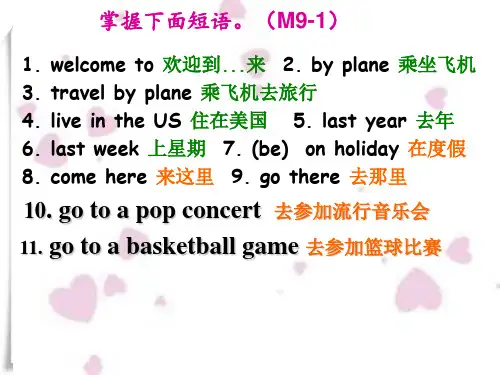
11. go to a basketball game 去参加篮球比赛
• live in Washington DC 住在华盛顿DC • travel by plane 乘飞机旅行 • visit New York 参观纽约
• go to a pop concert去参加流行音乐会 • go to a football game 去参加足球赛 • visit San Francisco参观旧金山
C: Yes, I did.
是的,我...
不,......
No, I didn't. I went there by... 我乘...去那里。
I went to a village last year. Did you travel by.......? Yes, I did. No, I didhn't. I went there by bus.
Yes, I did. No, I didn't. I went to_________.
Did you go to Hong Kong last year?
Yes , I did.
No , I didn’t. I went to…
记住下面动词的过去式
live --- lived 住,居住 travel --- travelled 旅行 visit --- visited 参观 am/is --- was 是 have --- had 度过 come --- came 来 go --- went 去 see --- saw 看见,看望
have a nice holiday 度过愉快假期
visit the West lake 参观西湖
外研版四年级英语下册Module9 Unit2 课件(一起点)
Listen and say.
Listen and answer
What do kangaroos eat and drink? They eat grass and leaves and they
drink water.
Listen and say.
Watch and answer
Where do kangaroos live? They live in Australia.
Tigers eat meat and elephants eat grass.
Look and say.
The small cat drinks milk and the plant
drinks water.
Think and say.
Do and say.
Bring a photo of your favourite animal and introduce it to the class.
Kangaroos eat grass and leaves.
They drink water. You can also see kangaroos in zoos in China.
点击小喇叭或文本框都可以播放音频
Look and say.
Look and read
Look and say.
Listen and say. Then sing.
本节课学习的单词有:
back
本节课学习的重点句型:
Kangaroos eat grass and leaves. They drink water.
Module9
Unit2 Kangaroos live
…
Listen, point and say.
外研版四年级英语下册Module9unit2kangaroosliveinaustralia课件1
Kangaroos live in Australia.
Warm-up
Why, oh why are you looking at the sky? Why, oh why, oh why? Because I lost my kangaroo kite. It flew away, so high! That’s why, that’s why I’m looking at the sky. I’m looking for my kite, so high!
Summary
live in Kangaroos live inAustralia.
jump on They jump on their back legs.
eat Kangaroos eat grass and leaves.
drink They drink water.
Homework
1. Listen to the tape and read after it for 10 times. 2. Try to recite the passage. 3. Talk about other animals according to the passage.
•
1、人才教育不是灌输知识,而是将开发文化宝库的钥匙,尽我们知道的交给学生。
•
2、一个人的知识如果只限于学校学习到的那一些,这个人的知识必然是十分贫乏的22:22:3122:22:3122:2210/14/2021 10:22:31 PM
•
3、意志教育不是发扬个人盲目的意志,而是培养合于社会历史发展的意志。
•
8、先生不应该专教书,他的责任是教人做人;学生不应该专读书,他的责任是学习人生之道。下午10时22分31秒下午10时22分22:22:3121.10.14sentation
四年级英语下册课件-Module 9 Unit 2 Did you have a nice holiday76-外研版(三起)
看视频,回答问题
1、Where did Xiaoyong go on his holiday?
visit New york? go to a concert?
Yes ,he did.
travel by train ?
go to a football game? No, he didn’t.
• New York 纽 约
自由女神像
the Statue of Liberty
Washington DC 华盛顿
A:I went to ……last year.
B:Did you travel by ……? A:Yes,I did./No,I didn't.
I went there by …….
Some students’ holiday
A:I went to ……last year.
B:Did you travel by ……? A:Yes,I did./No,I didn't.
2.--Did she/he …? --Yes, she/he did. -- No, she/he didn’t.
做环境的守卫者。
Homework
1、读写本课单词、短语; 2、听录音跟读本课课文; 3、按照课文第六部分要求,制作 一张关于旅行的调查表,将调查 结果填在表Байду номын сангаас中。
A:I went to ……last year.
(外研版)四年级英语下册教案 MODULE9 unit2
(外研版)四年级英语下册教案Module9Unit 2 Did Dad cook lunch?Teaching aims:Did Dad cook lunch?Teaching importance:Talk about past activities.Teaching difficulities:Using the simple past tense of regular verbs to talk about past activities. Teaching Tools:RecorderTeaching Steps:Step one : Warm upsing a song.On the board,write some regular verbs in their present tense form,e.g.listen,play,help,jump,watch,open,point.Explain to the students that you are going to call out the past tense form of these verbs.Then choose individual students to go to the board,find the verbs and add'-ed'.Step two:Listen and repeatRemind the students that we can add'-ed'or'-d'to regular verbs to make the past simple form. Have the students think of verbs they know and write their suggestions on the board.Try to get the students to tell you whether the verbs are regular or irregular.Step three:chant1Have the studnets look at the pictures and describe what the students aredoing(walking,dancing,jumping)2 Find out if the students enjoy doing some or all of those activities.Discuss their favourite activities.3 Play the spoken version of the song and get the students to repeat the words.Now play the second version and let the students listen to the melody or they can sing along with the music.Explain to the students that they should mime appropriate actions as they say the chant.Step four:Homework------小学资源网投稿邮箱: xj5u@ ----- --1--。
外研版四年级英语下册Module9Unit2Didyouhaveaniceholiday教学课件
Did you go to Hong Kong last year?
Yes , I did.
No , I didn’t.I went to…
Did you visit the Great Wall last year?
No, I did’nt. I went to Hangzhou.
Module 9
Unit 2 Did you have a nice
holiday?
Did you have a nice holiday?
Yes, we did. We went to the earth.
Did you like the people? Yes, I did. They were very nice. But they weren’t very beautiful!
Did you see your friend Lili in Hangzhou?
• No, she was on holiday in ShYes, I did. No, I did’nt. I went there by…
Homework
Did you visit the famous West Lake ?
Yes , I did.
•1、人才教育不是灌输知识,而是将开发文化宝库的钥匙,尽我们知道的交给学生。 •2、一个人的知识如果只限于学校学习到的那一些,这个人的知识必然是十分贫乏的2021/10/142021/10/142021/10/1410/14/2021 10:21:21 PM •3、意志教育不是发扬个人盲目的意志,而是培养合于社会历史发展的意志。 •4、智力教育就是要扩大人的求知范围 •5、最有价值的知识是关于方法的知识。 •6、我们要提出两条教育的诫律,一、“不要教过多的学科”;二、“凡是你所教的东西,要教得透彻”2021年10月2021/10/142021/10/142021/10/1410/14/2021 •7、能培养独创性和唤起对知识愉悦的,是教师的最高本领2021/10/142021/10/14October 14, 2021 •8、先生不应该专教书,他的责任是教人做人;学生不应该专读书,他的责任是学习人生之道。2021/10/142021/10/142021/10/142021/10/14
四年级英语下册 MODULE9 unit2教案 外研版
(外研版)四年级英语下册教案Module9Unit 2 Did Dad cook lunch?Teaching aims:Did Dad cook lunch?Teaching importance:Talk about past activities.Teaching difficulities:Using the simple past tense of regular verbs to talk about past activities.Teaching Tools:RecorderTeaching Steps:Step one : Warm upsing a song.On the board,write some regular verbs in their present tense form,e.g.listen,play,help,jump,watch,open,point.Explain to the students that you are going to call out the past tense form of these verbs.Then choose individual students to go to the board,find the verbs and add'-ed'.Step two:Listen and repeatRemind the students that we can add'-ed'or'-d'to regular verbs to make the past simple form. Have the students think of verbs they know and write their suggestions on the board.Try to get the students to tell you whether the verbs are regular or irregular.Step three:chant1Have the studnets look at the pictures and describe what the students aredoing(walking,dancing,jumping)2 Find out if the students enjoy doing some or all of those activities.Discuss their favourite activities.3 Play the spoken version of the song and get the students to repeat the words.Now play the second version and let the students listen to the melody or they can sing along with the music.Explain to the students that they should mime appropriate actions as they say the chant. Step four:Homework。