
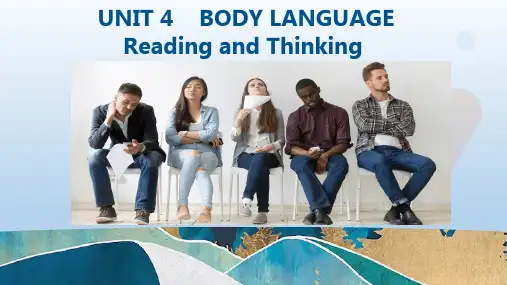
人教选择性必修第一册Unit4 Body Language
_t_o_l_e_a_r_n__ (learn) Part 2.
3. 动词-ing形式用在动词need, want, require等 后表示“需要”时, 用动词-ing形式的主动 形式或者用不定式的被动式表示被动意义。 如:
My mother advised asking a doctor to come and examine my eyes. We’re considering paying a visit to the Science Museum. You can’t avoid making a mistaider, suggest / advise, look forward to, pardon
承认推迟没得想,admit, delay / put off, fancy
avoid, miss, keep / keep on, 避免错过继续练,practise
barriers between groups. 3. By _b__o_w_i_n_g__, we mean "bending our head or
body forward as a sign of respect or shame".
amuse, teach, break down, call on, bow, get through, assess
表语 A good way of saying “I am full” is moving you hand in circles over your stomach after a meal. Perhaps the best example is smiling.
动词-ing形式作宾语 1. 有些动词后只能跟动词-ing形式作宾语,而
Reading body language is not an easy task. It can be __c_h_a_ll_e_n_g_in_g__ because interpreting the signs that another person shows requires _c_o_n_s_id_e_r_i_n_g_t_h_e_w__h_o_le__p_i_ct_u_r_e____. In this sense, it can be compared to a doctor e_v_a_l_u_a_t_in_g__a_p_a_t_i_e_n_t'_s_c_o_n_d_i_t_io_n___.
4. _G_e_t_ti_n_g__th_r_o_u_g_h_ three kilometres of heavy traffic took me almost 25 minutes.
5. We intended to visit the theme park but ended up __c_a_ll_in_g__o_n__ Professor Zhang.
动词-ing形式作表语 ★ 动词-ing形式作表语,说明主语的内容,
指一般性、经常性的动作。如:
My hobby is growing flowers. Her job is looking after the children.
★ 一些表示状态、品质、情绪的动词-ing形式可 作表语。这时系动词可以是be, become, get, look, seem, appear, sound, feel, keep等。如: It’s amazing that you should know that! —What do you think of the story I told you just now? —It sounds interesting. I like it very much. Skiing is more exciting than skating.
7. I can’t help _t_o_c_l_e_a_n_ (clean) the room, for I am too busy.
8. After hearing the joke, we can’t help _l_a_u_g_h_in_g__ (laugh).
9. Water is used to _w__a_te_r__(water) flowers. 10. I am used to _g_e_t_ti_n_g__u_p_ (get up) early. 11. Though it rained, they went on _w__o_r_k_in_g__
in a way ...
predicative
Find other examples from the reading text.
宾语 • However, you should avoid making this
gesture in Brazil and Germany… • Elsewhere, people favour shaking hands,
I’ll remember to post the letter. 我会记着去寄信的。
I shall never forget seeing the famous writer. 我永远不会忘记见到过那位著名作家。
Don’t forget to write to your mother. 不要忘了给你母亲写信。
否认完成停能赏,deny, finish, stop, enjoy / appreciate
不禁介意准逃亡,can’t help, mind, allow/ permit, escape
不准冒险凭想象。 forbid, risk, imagine
2. 有些动词后既可跟动词-ing形式作宾语, 也可跟动词不定式作宾语, 但用法和意 义都有所不同。这些动词是:begin,
Look at the examples below, paying
attention to the italicised parts.
• She enjoys learning about body language
in different cultures.
object
• The crucial thing is using body language
be used to doing 习惯于做某事 be used to do 被用来做某事
can't help doing 禁不住做某事 can't help to do 不能帮助做某事
完成句子。 1. He stopped _to__s_m_o_k_e_ (smoke) and have a rest. 2. He really must stop_s_m__o_k_i_n_g_ (smoke). 3. I once tried _t_o__le_a_r_n_ (learn) French. 4. Let’s try _k_n_o_c_k_i_n_g_ (knock) at the back door. 5. I didn’t to mean __to__h_u_r_t_ (hurt) your feeling. 6. This word means __s_e_tt_in__g_ (set) out at once.
B. 在begin / start, continue之后,用动词-ing 和不定式,意义无甚区别,尤其是当主语是 人的时候。
C. 在动词forget, remember, regret之后,用动 词-ing与不定式意义不同。动名词表示已经 发生的动作;不定式表示将要发生的动作。
e.g. I remember posting the letter. 我记得我已把信寄了。
bowing from the waist, or nodding the head when they meet someone else. • Experts suggest smiling at yourself in the mimor to make yourself feel happier and stronger • … there is nothing better than seeing the smiling face of a good friend
start, continue, like, love, prefer, mean, forget, remember, hate等。
A. 在like, love, hate, prefer等动词之后,用ing或不定式意义上没有什么不同,只是侧 重点有些不同,动词-ing形式表示泛指的动 作,不定式表示具体的一次性动作。
D. 其他。对比分析: go on doing 继续做原来做的事 go on to do 接着做另一件事 mean doing 意味着要做某事 mean to do 想要做某事 stop doing 停止做某事 stop to do 停下来(别的事)
try doing 试着做某事 try to do 努力做某事
The carpet really wants cleaning. = The carpet really wants to be cleaned.
4. 动词-ing形式作介词的宾语。要特别注意: be / get used to, look forward to, pay attention to, stick to, devote to等中的to都 是介词而不是动词不定式符号。如: My father is used to going to bed late and getting up very early. I’m looking forward to receiving your reply.
Complete the passage with the correct forms of the words and phrases.
Unit+4+Body+language+Reading+and+人教版(2019)选择性必修第一册
lack: 1. (n.): absence. 2. (v.): to not have.
2. He is so occupied with writing his graduation thesis that he barely bothers eating well.
3. Little children tend to display their interest by staring at something that they like.
4. They ultimately won the game and demonstrated to all football fans that they they wຫໍສະໝຸດ re a powerful team.
Some gestures seem to have the same meaning everywhere.
Some body language has many different uses.
structure
choose the correct structure of the text.
A
Moving you hand in circles over your stomach after a meal
I’m full.
everywhere
Read for Reading Strategy
1. What is the text type of the passage? A. Narration(记叙文). B. Argumentative Essay(议论文). C. Exposition(说明文). D. Practical Writing(应用文).
高中英语人教版 选择性必修第一册教案讲义:UNIT 4 BODY LANGUAGE
SectionⅣWriting——描述肢体语言【文体感知】肢体语言描述也是新课程标准中的写作要求之一,是对某一肢体语言进行描述和说明,通过一个人的手势、肢体动作我们可以了解到他的思想意识、情绪变化等。
其基本框架如下:首先,介绍常见的某些肢体语言,引入话题。
其次,说明这些肢体语言在不同文化中的含义。
最后,表达期望。
【增分佳句】夺人眼球开头句1.I'm more than delighted to hear from you.很高兴收到你的来信。
2.Now I'm writing to tell you something about body language.现在我正写信告诉你有关肢体语言的一些事情。
亮点出彩篇中句1.People from different cultures may misunderstand the gestures they use.有着不同文化背景的人们对彼此的手势很有可能产生误会。
2.Body language is a way of communication,but not everybody can use the same body language to communicate with others.肢体语言是与人交流的一种方式,但并非所有的人都可以用同一种肢体语言与他人交流。
3.If you want to go out to travel,it is very important for you to figure out the body language there.如果你要外出旅游,了解当地的肢体语言是非常重要的。
4.When your friend is sad,a smile may be more useful than words.当你的朋友伤心的时候,一个微笑或许比语言更有用。
5.Body language is the quiet,secret and most powerful language of all!肢体语言是所有语言中安静、神秘、最强有力的语言!韵味无穷结尾句1.By learning body language we can broaden our mental horizons and increase our knowledge in various fields.通过学肢体语言我们能够开阔我们的精神视野,增加我们在各领域的知识。
高中英语人教版()选择性必修一《Unit 4 Body language》课件ppt(30张PPT)
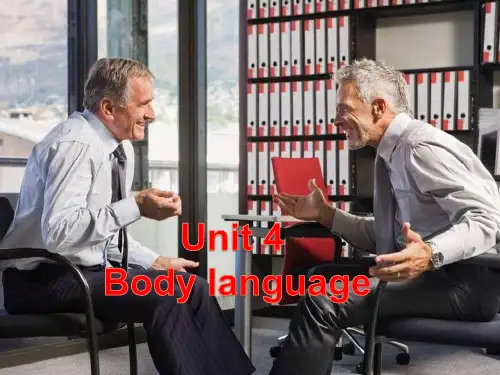
Body language varies from culture to culture.
Reading strategy
Make inferences
Sometimes a passage does not say something directly. However, you can figure it out by looking at the clues in the passage.
1.Who is the master being funny without saying a word? Surf on the internet and find him and write a letter to him to know more about body language. 2.Try to find them in the text and try to use them.
2. Can you think of an example of body language that is appropriate in China but might be misunderstood in another culture? In China, shaking one’s head means “no”, and nodding means “yes”. By comparison, in Bulgaria and southern Albania, the gestures have the opposite meaning.
高中英语人教版 选择性必修第一册教案讲义:UNIT 4 BODY LANGUAGE
Section ⅢUsing Language每/日/金/句:By learning body language we can broaden our horizons and increase our knowledge in various fields. 通过学习肢体语言,我们能够开阔我们的视野,增加我们在各领域的知识。
课前预习设计自读课文疏通文脉大意Read the text on Page 44 carefully and then choose the best answer.1.How can the writer know what makes each student tick?A.By having one-on-one conversations with each student.B.By talking with some students.C.By observing students' body language.D.By asking them to write a letter to the teacher.2.If students are not interested in a lesson, what may they do?A.They may look up and make eye contact.B.They may lean forward and look at the teacher.C.They may lower their heads and look at the watch.D.They may smile when the teacher makes a joke.3.How the students may feel when they have their arms crossed in front of their chests and their legs crossed?A.Happy. B.Excited.C.Shocked. D.Angry.4.Where is the text likely to be taken from?A.A social magazine.B.A science book.C.A research report.D.A health magazine.精读课文疏通理解障碍[读文清障]①educator/'edʒukeɪtə(r)/n.教师;教育工作者;教育家educate v.教育;育人educated adj.受过教育的;有学问的②tick/tɪk/v t.给(试卷、问题等)打钩号v i.(钟表)发出嘀嗒声n.钩号what makes sb. tick 使某人这样做的原因tick all the/one's boxes 投其所好;迎合众人/某人的爱好③be interested in...对……感兴趣④tend to do sth.易于做某事,往往会发生某事⑤make a joke 开玩笑⑥tendency/'tendənsi/n.趋势;倾向have a tendency to do sth.倾向于做某事⑦lower/'ləʊə(r)/v t.把……放低;降低;减少adj.下面的;下方的;较小的low adj.低的;低矮的⑧imply/ɪm'plaɪ/v t.意味着;暗示⑨barely/'beəli/ad v.几乎不;勉强才能;刚刚bare adj.裸体的;裸露的;(树木)光秃秃的;(土地)荒芜的⑩spend time doing sth.花费时间做某事⑪chin/tʃɪn/n.下巴⑫occupy/'ɒkjupaɪ/v t.占据;占用occupy sb./oneself in doing sth.使某人/自己忙于做某事occupy sb./oneself with sth.使某人/自己忙于某事⑬stare/steə(r)/v i.盯着看;凝视n.凝视stare at由于茫然、好奇、无礼或傲慢而长时间地看,意为“凝视”。
Unit4词汇讲解讲义高中英语人教版选择性

选择性必修第一册UNIT 4 Body Language (人与社会)1.interaction [ˌɪntərˈækʃən]: n. 交流; 相互影响interact : v. 相互交流;相互影响interact with sb.interactive : adj. 互动的;交互的;合作的inter: 构词法,表示“相互的;之间”;action n. 行动; 活动; 动作international : adj.国际的;internet : n.互联网;interview: n./v.面试,采访interfere : v.干涉;干预facetoface interactions 面对面的交流1)We use both words and body language to express our thoughts and opinions in our interactions with other people. 在与他人的交往中,我们用话语和肢体语言来表达自己的思想和观点。
2) Lucy interacts well with other children with the class.2. vary [ˈveəri]: vi. (根据情况)变化; 改变various [ˈveərɪəs]: adj. 不同的; 各种各样的; 多姿多彩的various kinds of theme parks 各种各样的主题公园variety [vəˈraɪətɪ]:n. 变化; 种类; 多样化(varieties of; a variety of)variety show 综艺节目varied : adj. 各种各样的;多变化的;varied diet 多样化的饮食variation : n. 变化;差别;变奏曲the regional/seasonal variation 地区性/季节性变化vary considerably/greatly/widely 大不相同vary with... 随...变化/改变vary in...: 在...方面不同/有差异(differ in...)vary from...to...: 从...到...变化; 在...与...之间变化; 从...到...不等(range from...to...) vary from person to person 因人而异拓展:diversifydiversediversity1)Just like spoken language, body language varies from culture to culture.正如口语一样,肢体语言也因文化而异。
人教版高中英语选择性必修第一册 Unit 4 Body Language 单元重点小结

重点语法 动词-ing形式做宾语和表语 1.She enjoys learning about body language in different cultures. 2.We can learn a lot about what people are thinking by watching their body language. 3.Ultimately,my duty is helping every student to learn. 4.Perhaps the best example is smiling.
单元重点小结
重点单词
1.___in__te_r_a_c_t_io_n____ n. 交流;相互影响 →____in_t_e_r_a_c_t_____ v.交流;相互影响 →___in_t_e_r_a_c_ti_v_e____ adj. 相互作用的;相互影响的 2.______v_a_r_y______ vi. (根据情况)变化;改变 →____v_a_r_i_et_y______ n. 变化;多样性;种类 →____v_a_r_io_u_s______ adj. 各种各样的;不同种类的 3.____a_p_p_r_o_v_e_____ vi.赞成;同意 vt. 批准;通过
2.Of course,_____n_o_t___ __e_v_e_r_y_o_n_e__who looks up is paying attention in class. 当然,不是所有抬着头的学生都是在认真听课。
3._____W__h_il_e________ it is easy to perceive when students are interested,bored,or distracted,it is sometimes much harder to distinguish when students are troubled. 尽管学生们何时(对讲课)感兴趣,何时感到无聊或精力不集中 是容易察觉的,但是发现学生何时有困扰有时会难得多。
Unit 4 Body LanguageV-ing总结课件高中英语人教版(2019)选择性必修第一册
look forward to 渴望,盼望
be responsible for 对……负责
insist on坚持
object to反对,抗议
prevent…from 防止,阻止
keep…from 防止,阻止 stop…from 防止,阻止
在下面的短语中,常用动词-ing形式作介词的宾语:
devote…to献身于
aregood ways to learn English.
5. 动词-ing与动词不定式作主语的区别: 动词-ing作主语,常常表示抽象的习惯性或经常性的动作。 而 不定式一般表示一次性、具体性的行为。 Delivering newspapers is his job. 送报纸是他的工作。 To deliver newspapers is his job today. 送报纸是他今天的工作。
【对点训练】 ①(2020·新高考全国Ⅰ卷) And contrary to existing research that says you should avoid _e_a_ti_n_g_(eat)with heavier people who order large portions. ②(2020·天津高考)To help us prepare for the exam, the teacher suggested __r_e_a_d_i_n_g__(read) through our notes. (2)Would you mind __m_o_v_i_n_g__(move) the box for me? (3)We are all looking forward to _v_i_s_it_in_g__(visit) the museum soon.
高中英语人教版 选择性必修第一册教案讲义:UNIT 4 BODY LANGUAGE
Section ⅡLearning About Language每/日/金/句:Body language is the quiet, secret and most powerful language of all!肢体语言是安静的、秘密的,并且是所有语言中最强有力的语言!语言基础集释探究新知发展语言知识1.(教材P40)We make assessments and inferences from body language.我们从肢体语言中做出评估和推论。
◎assessment n.评价;评定(1)make an assessment of 评估……(2)assess v t. 评定;评估;评价assess sth. at 估价为……[佳句]He wrote a very generous assessment of my work.他给我写的工作评价多有赞誉之词。
[练通]——单句语法填空①There is little ________ (assess) of the damage to the natural environment.②They assessed the value of the house ________ over $250,000.③Before we buy a house, we must have the house ________ (assess).2.(教材P41)We intended to visit the theme park but ended up calling on Professor Zhang.我们原打算参观主题公园,但最后却拜访了张教授。
◎call on (短暂地)访问;要求(某人讲话等);正式邀请;号召call at (火车等)停靠;拜访(某地)call in 召集;请来call back 回电话;收回call for 需要;要求;接(人或物)call off 取消call up... 给……打电话;使……想起[佳句]The President called on the people to work hard to make the country rich and strong.总统号召人民努力工作,使国家富强起来。
人教版高中英语选择性必修第一册 UNIT 4 BODY LANGUAGE 写作指导
【妙笔成篇】
Communication methods include not only spoken language but also body language.It refers to eye contact,touch and gestures people use to communicate. Body language is so widely used in our daily lives that it plays a very important role in our daily communication.For example,some people can shake hands to greet each other.When they meet others,they may use smiles to show friendliness,hug to express their love and frown to show their sadness.Therefore,body language is very convenient,which enables people to express their feelings by simple gestures.
(2)句式升级 ⑥将句①升级为not only...but also...结构的句子 Communication methods include not only spoken language but also body language. ⑦将句②升级为so...that...结构的句子 Body language is so widely used in our daily lives that it plays a very important role in our daily communication. ⑧将句④升级为含有定语从句的句子
新人教高中英语选择性必修一Unit4Body Language单元分析
Unit 4 Body language单元分析单元主题:人与社会——肢体语言单元内容分析本单元的主题是“人与社会——肢体语言”,介绍了不同国家、不同文化、不同场合下肢体语言所表达的意义。
以下为教材各部分教学内容的简要分析及教学活动实施建议:1.Opening Page 主题图是由四张反映不同场景中的典型肢体语言的照片拼接而成,包括女孩和长辈交谈时苦恼困惑的场景、工作伙伴分享成功喜悦的场景、日本商务场合握手鞠躬的场景以及火车站家人拥抱送别的场景。
本页还提供了法国作家、社会评论家罗兰·巴特的名言“What I hide by my language,my body utters.”。
这句话表明通过逻辑推理并观察行为表现、肢体语言等,人们会对言语表达的意思形成更为综合的印象。
2.Reading and Thinking:Understand body language 该板块的活动主题是“读懂肢体语言”。
文章从肢体语言的基本功能入手,引出地域文化这一重要因素,说明正确理解和运用肢体语言一定要考虑在地域文化中的得体性。
该活动的版块设计旨在帮助学生更好地理解文本,分析说明文的文体特征,思考本单元的主题意义。
读前活动,教师要引导学生思考肢体语言的意义,从而能更好地体会肢体语言和有声语言一样是我们交流思想、表达感情和传递信息不可或缺的重要手段。
读中活动,学生快速阅读全文,判断对语篇内容的预测是否正确,然后通过查找段落主题句,归纳段落大意,进而梳理语篇结构。
读中活动通过设计各种不同的问题,引领学生全面了解文章的表层含义和深层意义。
读后活动,设计问题,让学生进行头脑风暴,开展辩论。
3.Learning about language 部分包括Build up your vocabulary 和Discover usefu1 structures 两个板块。
Build up your vocabulary本部分的词汇活动围绕话题词汇设计,帮助学生熟悉词性转化,充分融入词块教学。