
2020春新闽教版小学英语四年级下册unit1-3知识点归纳及各单元练习卷
闽教版小学英语四年级下册unit1-3知识点归纳及各单元练习卷
Unit1Days of the Week
Unit1知识点归纳:
单词与词组
often经常
every每一;每个
week星期
Monday星期一
raise升起
national国家的
flag旗
national flag国旗
meeting会议
Tuesday星期二
Wednesday星期三
Thursday星期四
Friday星期五
clean把……弄干净
Saturday星期六
Sunday星期日
have meeting开班会
have sports体育锻炼
重点句型与语法
what do you often do every week?你们每星期经常做什么?
On Monday we raise our national flag.在星期一,我们升国旗。
表示在星期几用介词on
We have a class meeting on Tuesday.我们星期二开班会。
We have sports in the playground.我们在操场上进行体育锻炼。
We clean our classroom on Friday.星期五我们打扫教室。
Our classroom is clean and bright.我们的教室干净、明亮。
clean可以做形容词也可做动词。
I play the violin on Saturday.星期六我拉小提琴。
I play football on Sunday.星期天我踢足球。
play后面跟乐器要加the,play the piano.后面是体育运动不用加冠词,play basketball打篮球,play ping-pong打兵乓球。
第一单元
一、写出下列图片的英语表达。
二、选词填空。
(将正确的选项填在括号里)1.()What do you often do ____Monday?
A.in
B.on
C.at 2.()We dance____the playground.
A.in
B.on
C.at 3.()What do you often do ____week?
A.every
B.each
C.very 4.()What do you often do ___school?
A.in
B.at
C.On 5.()On Sunday I play ___-piano.
A./
B.the
C.a
三、写出下列新年做的事情的英语表达。
星期三星期六
星期二星期四
Unit2第二单元
单词与词组
Stand站
door门
Well done!做得很好!
bright明亮的
close关(门、窗等)
turn off关掉(电灯等)
fan电风扇
all right好的
重点句型与语法
Let’s clean our classroom.让我们一起打扫教室吧。
现在进行时表示现在正在发生的事情,如:Lily is cleaning the desks.李丽正在擦桌子。
结构:be(am/is/are)+现在分词(动词原形+ing)。
具体的动词加-ing的规则如下:
动词后面直接+ing,如:play--playing;clean--cleaning
e结尾的动词,去掉e,加ing.如,dance--dancing,have--having, ride--riding
重读闭音节结尾的单词,双写最后的辅音字母加ing,如,run--running,swim--swimming,get--getting,sit-sitting.
Yang Ming is standing on a chair.杨明正站在椅子上。
He is cleaning the blackboard.他正在擦黑板。
She is cleaning the desk.她正在擦桌子。
What are you doing?你在做什么?
第二单元
一、写出下列图片的英语表达。
三、选词填空。
(将正确的选项填在括号里)
2.()It____Monday.
B.is B.are
C./
3.()Yang Ming is________a chair
B.stand on B.standing on
C.standing at
4.()Our classroom is clean and____now.
B.light B.right
C.bright
5.()Please______the lights.
B.turn off B.close
C.open
6.()Sally is____a bike.
A.ride
B.riding
C.drive
三、写出下列新年做的事情的英语表达。
Unit3第三单元
单词与词组
math数学
English英语
worry担心
music音乐
Chinese语文
art美术
PE体育
help帮助
science科学
interesting有趣的
Ms.女士
this morning今天上午
重点句型与语法
What day is today?今天星期几?It’s Wednesday.
We have math class this morning.我们今天上午有一节数学课。
this afternoon,今天下午,this evening今天晚上。
Be good at擅长做某事后面接名词,代词,或者动名词(动词ing 形式)
It’s very nice of you.你真好。
相当于,You are very nice.
Do you have a science class this morning?你今天上午有没有科学课?
Yes,I do.是的,我有。
No,I don’t.不,我没有。
May I use your science book?我可以用你的科学书吗?表示请求Sure,here you are.当然可以,给你。
第三单元
一、写出下列科目的英语表达。
四、选词填空。
(将正确的选项填在括号里)
3.()I like science class.----Me,____.
C.too B.two C./
4.()____day is today,Sally?
C.which B.what C.when
5.()It’s very nice____you.
C.for B.of C.to
6.()We have____English class,too.
C.Some B.a C.an
7.()Don’t worry.是什么意思?
A./
B.很担心
C.别担心
6.()____you have a science class this morning?
A.Do
B.What
C.When
7.()Do you have a computer class this morning?
----____.。
新闽教版小学英语四年级下册知识点教学教材

新闽教版小学英语四年级下册知识点新闽教版小学英语四年级下册知识总复习Unit 1 Days of the Week Unit 2 Cleaning DaySunday星期日 Monday星期一 Tuesday星期二Wednesday星期三 Thursday星期四 Friday星期五Saturday星期六 week星期 often 经常every 每一,每个 national flag 国旗 meeting 会议clean把.....弄干净 fan 电风扇 Well done!做得好1、What do you often do every week?(你们每星期经常做什么?)2、On Monday we raise our national flag.(在星期一,我们升国旗。
)3、We have a class meeting on Tuesday.(我们星期二开班会。
)4、We have sports in the playground.(我们在操场上进行体育锻炼。
)5、We clean our classroom on Friday.(星期五我们打扫教室。
)6、I play the violin on Saturday.(星期六我拉小提琴。
)7、I play football on Sunday.(星期天我踢足球。
)8、We dance in the playground on Wednesday. 我们星期三在操场上跳舞。
raise our national flag升国旗have a class meeting开班会dance in the playground在操场上跳舞 have sports做运动clean our classroom打扫教室play the violin拉小提琴play football踢足球play basketball打篮球stand on a chair站在椅子上clean the blackboard擦黑板 clean the desks擦桌子clean the chairs擦椅子clean the window擦窗户clean the door 擦门close the door关门turn off the lights关灯 turn off the fans关风扇watch TV 看电视Unit 3 School SubjectsChinese语文 English英语 math数学music音乐 art美术 PE体育science科学 help 帮助 interesting 有趣的—What day is today? —It’s Monday. 今天星期几?今天星期一。
2020春新闽教版小学英语四年级下册unit1-3知识点归纳及各单元练习卷

闽教版小学英语四年级下册unit1-3知识点归纳及各单元练习卷Unit1 Days of the WeekUnit 1知识点归纳:单词与词组often 经常every 每一;每个week 星期Monday 星期一raise 升起national 国家的flag 旗national flag 国旗meeting 会议Tuesday 星期二Wednesday 星期三Thursday 星期四Friday 星期五clean 把……弄干净Saturday 星期六Sunday 星期日have meeting 开班会have sports 体育锻炼重点句型与语法what do you often do every week ? 你们每星期经常做什么?On Monday we raise our national flag. 在星期一,我们升国旗。
表示在星期几用介词onWe have a class meeting on Tuesday. 我们星期二开班会。
We have sports in the playground. 我们在操场上进行体育锻炼。
We clean our classroom on Friday. 星期五我们打扫教室。
Our classroom is clean and bright. 我们的教室干净、明亮。
clean 可以做形容词也可做动词。
I play the violin on Saturday. 星期六我拉小提琴。
I play football on Sunday. 星期天我踢足球。
play 后面跟乐器要加the, play the piano. 后面是体育运动不用加冠词,play basketball 打篮球,play ping-pong 打兵乓球。
第一单元一、写出下列图片的英语表达。
二、选词填空。
(将正确的选项填在括号里)1. ( )What do you often do ____ Monday?A. inB. onC. at2. ( )We dance____ the playground.A. inB. onC. at3. ( )What do you often do ____ week?A. everyB. eachC. very4. ( )What do you often do ___ school?A. inB. atC. On5. ( ) On Sunday I play ___- piano.A. /B. theC. a三、写出下列新年做的事情的英语表达。
闽教版(三起)小学英语四年级下册单元知识总结(全套)

Unit 1 Winter Vacation短语:the Great Wall 长城watch TV 看电视take a boat tour 划船旅行Sun Moon Lake 日月潭play chess with 与……下棋do my homework 做我的家庭作业swim in the sea 在海里游泳句型:How was your winter vacation? It was wonderful.How about you?Were you in China? No, I wasn’t.How was the weather there? It was hot!动词过去式:is/am —was are —wereeat —ate go —wentsee —saw visit —visitedwatch —watched play —playeddo —did take —tookrun —ran come —cameget —got want —wantedswim —swam give —game语法(一般过去时):(1)规则动词过去式的构成有四条规则:①一般在动词原形末尾直接加上-ed。
如:look—looked,visit—visited,watch—watched。
②以不发音的字母e结尾的动词,只需加-d。
如:live—lived。
③末尾只有一个辅音字母的重读闭音节,先双写这个辅音字母,再加-ed。
如:stop—stopped。
④末尾是“辅音字母+y”结尾的动词,先改y为i,然后再加-ed。
如:study—studied。
(2)不规则动词的过去式需要记忆。
如:am/is—was,are—were,go—went,swim—swam,do/does—did, come—came,take—took,have/has—had等。
学习be动词在一般过去时中的回答:如:①Were they in the supermarket? Yes,they were./ No,they weren’t.② Was he in Beijing? Yes, he was./ No, he wasn’t.Unit 2 A Visit to the Zoo短语:over there 那儿go straight 直走have a look 看一下turn left/right 向左/右转behind the hill 在山后take a photo of 给……照相give food to the monkeys 给猴子喂食under the tree 在树下句型:Where are they?There are some elephants behind the hill.What animals did you see, children?Did you give bananas to the monkeys?Did you take any photos?语法:学习过去时did作为疑问句开头的回答:如:①Did you take any photos? Yes, I did. / Yes, I took some photos.②Did you give food to the monkeys? No, we didn’t.③What animals did you see?We saw tigers, bears and elephants.④—Did you have a good time?(你们玩得快乐吗?)—Yes,we did./ Yes,we had a good time.(是的,我们玩得很快乐。
四年级下册英语1到3单元知识点

四年级下册英语1到3单元知识点Unit 1: My School。
In Unit 1, we will learn about "My School." We will explore different areas of the school and learn about the people who work there. Let's dive into the knowledge points covered in this unit.1. Vocabulary:Classroom: A room where students learn and study.Library: A place where you can borrow books.Playground: An outdoor area where children can play.Office: A room where the school staff work.Gym: A place for physical education and sports activities.Cafeteria: A place where students have their meals.2. Sentences:I have English class in the classroom.I enjoy reading books in the library.We play games on the playground during recess.The teachers work in the school office.We have PE lessons in the gym.We have lunch in the cafeteria.3. Grammar:Singular and Plural Nouns: We add -s or -es to make a noun plural.Example: book books, desk desks。
四年级下册英语unit1-unit4知识点(闽教版)
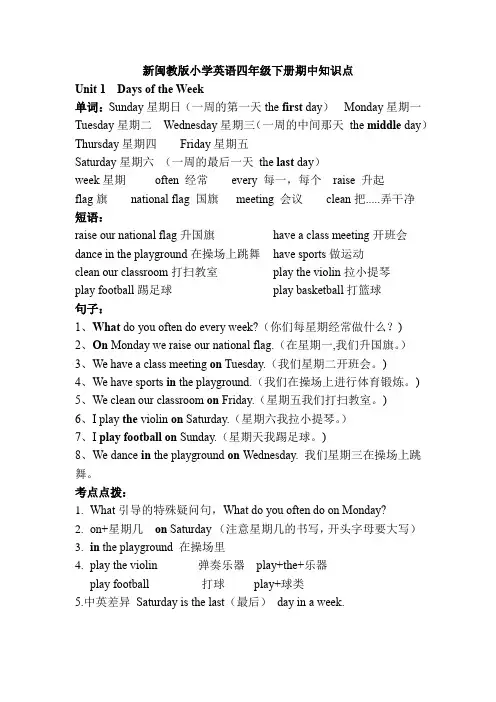
新闽教版小学英语四年级下册期中知识点Unit 1 Days of the Week单词:Sunday星期日(一周的第一天the first day)Monday星期一Tuesday星期二Wednesday星期三(一周的中间那天the middle day)Thursday星期四Friday星期五Saturday星期六(一周的最后一天the last day)week星期often 经常every 每一,每个raise 升起flag旗national flag 国旗meeting 会议clean把.....弄干净短语:raise our national flag升国旗have a class meeting开班会dance in the playground在操场上跳舞have sports做运动clean our classroom打扫教室play the violin拉小提琴play football踢足球play basketball打篮球句子:1、What do you often do every week?(你们每星期经常做什么?)2、On Monday we raise our national flag.(在星期一,我们升国旗。
)3、We have a class meeting on Tuesday.(我们星期二开班会。
)4、We have sports in the playground.(我们在操场上进行体育锻炼。
)5、We clean our classroom on Friday.(星期五我们打扫教室。
)6、I play the violin on Saturday.(星期六我拉小提琴。
)7、I play football on Sunday.(星期天我踢足球。
)8、We dance in the playground on Wednesday. 我们星期三在操场上跳舞。
闽教版四年级下册英语知识点重点复习-打印

闽教版四年级下册英语知识点复习一、动词转换sit→sitting run→running swim→swimming get→getting shop→shoppingmake→making have→having come→comingSing→Singing go→goingpass→passingplay→playing do→doing boat→boatingwash→washing cook→cookingdraw→drawing read→reading eat→eating wear→wearing二、交通工具1、bybus2、bybike3、bymotorcycle4、bycar5、onfoot6、bytrain7、byplane询问做什么交通工具句式为:Howdoyou(they)gotoschool?或者Howdoeshe(she)gotoschool?三、食物吃东西用的动词为第一、二人称(如你、我、我们、他们)时用“have”第三人称(如他、她、它)用“has”:1、wehavehotdogs2、wehavenoodls3、wehavericeandfish4、wehaveicecream5、wehavehamburgers6、wehavedumpling四、单复数1、dumpling→dumplings2、vegetable→vegetable3、hamburger→hamburgers4、egg→egg5、peach→peaches6、grape→grape7、cake→cakes8、apple→apple9、carrot→carrots10、hotdog→hotdog只能是单数表示的东西:1、icecream2、fish3、melon4、rice5、tea6、fruit7、soap8五、房子结构(要注意搞清楚哪些东西是在哪个房间的)1、asittingroom2、abedroom3、adiningroom4、akitchen5、astudy6、abathroom六、方位词(on、in或near)1、一般在某个物体里面的用“in”如:①、Blackboardinmyclassroom②、windowsinmyclassroom③、pianointhemusicroom④、pencilsinmypencil-case⑤、icecreaminthefridge2、如果是在某个物体上面,不被包住的用“on”如:①、clockonthewall②、picturesonthewall③、bookonthetable3、在某个物体的边上就用“near”七、课目(注意有些课目第一个字母要大写,有些整个词都得大写)1、English2、Chinese3、math4、computer5、music6、art7、PE8、science八、句式1、做什么交通工具?Howdoyou(they)gotoschool?或者Howdoeshe(she)gotoschool?回答:I(they)gotoschoolbybus。
小学四年级英语下第一、三、四、六单元知识点
(四下)第一、三单元重点题分析第一单元:1、租船问题,这类问题需要灵活的选择方案。
但原则上还是先考虑做便宜的船或车;不要有空座或相比而言空座少。
比如:实践基地活动,共有40人参加,小车每辆110元,限乘12人,大车每辆150元,限乘18人。
怎样租车最省钱?分析:通过看题发现坐大车便宜。
因为租大车每人没要付的钱比租小车每人需要付的钱少。
所以40人需要40÷18=2(辆)……4(人),剩下的2人,可以做小车,但是空10个座位,剩下2人也可以做大车空16个座位。
但不管坐大车还是小车空的座位都太多,那么就考虑是否可以只坐一辆大车(能装18人),剩下40-18=22人,这22人就可以都去坐小车,需要两辆小车(共24个座位),空2个座位,这样空的座位比较少。
最后结论:这些人租一辆大车,两辆小车最省钱。
列式:150+2×110=370(元)所以这个方案比较好。
又比如:外出学习参观的学生与教师共有480人,小客车限乘25人,租金:375元/辆,大客车:限乘44人,租金:572元/辆,怎样租车最省钱?分析:通过看题发现坐大客车便宜。
因为坐大客车每人付的钱比租小客车每人需要付的钱少。
所以480人都坐大客车,480÷44=10(辆)……40(人)。
余下的40人如果坐大客车那么就空4个座位。
如果坐小客车,需要2辆(也就是50个座位),那么就空出10个座位。
权衡来想,空4个座位肯定要比空10个座位的省钱。
所以这40人还是选择做一辆大客车。
那么这道题一共需要11辆大客车。
用11×572=6292(元)2、分步算式变为综合算式:380-140=240,240÷8=30,15×30=450综合算式:(按照算式出现的顺序来写,先写380-140,加上括号,再写÷8,加上中括号,最后写15×,得出15×[(380-140)÷8]=450)35-18=17,107-17=90,90×12=1080.综合算式:(按照算式出现的顺序来写,先写35-18,加上括号,再在前面写“107-”,加上中括号,再写×12.得出[107-(35-18)]×12=1080)第三单元简便计算:(这部分知识变化较多,是本册重点。
闽教版小学英语四年级下册各单元语法知识点总复习
闽教版小学英语四年级下册各单元语法知识点Unit 1 Days of the WeekWhat do you often do every week?你每个星期经常做什么?On Monday we raise our national flag.星期一,我们升国旗。
We have a class meeting on Tuesday.星期二,我们开班会。
We dance in the playground on Wednesday.星期三,我们在操场上跳舞。
What do you often do on Thursday?在星期四,你们经常做什么?We have sports in the playground.我们在操场上做运动。
We clean our classroom on Friday.星期五,我们打扫教室。
What do you often do on Saturday and Sunday?你们在星期六和星期日经常做什么?I play the violin on Saturday. 星期六我拉小提琴。
I play football on Sunday. 星期日我踢足球。
句型巩固:What do you often do on ?.We raise our national flag on Monday .星期一,我们升国旗。
We clean our classroom on Friday.星期五,我们打扫教室。
I play the violin on Saturday. 星期六我拉小提琴。
I play football on Sunday. 星期日我踢足球。
单元重点:1、特殊疑问句:What do you often do every week?你每个星期经常做什么?What do you often do on Thursday?在星期四,你们经常做什么?2、一般现在时:主要用来表示人或事物的特点,经常或习惯性的动作以及现在的状况;还可以表示客观规律和永恒真理等。
四年级下册英语1~3单元知识点
四年级下册英语1~3单元知识点Unit 1: My FriendsVocabulary:1. Friend - a person you know well and regard with affection and trust2. Classmate - a member of the same class in school3. Teammate - a person who is on the same team as you in a sport or activity4. Neighbour - a person living near or next door to you5. Kind - having a gentle and friendly nature6. Helpful - willing to help others7. Polite - showing good manners towards others8. Cheerful - feeling or showing happinessGrammar:1. Present Simple Tense - used for actions that happen regularly or factse.g. She plays basketball every day.2. Adjectives - words that describe nouns or pronounse.g. He is a kind person.3. Possessive Pronouns - words like my, his, her, their, etc. that show ownershipe.g. This is my book.Skills:1. Listening - listening to descriptions of friends and identifying their qualities2. Speaking - describing their own friends using adjectives and possessive pronouns3. Reading - reading short texts about friends and answering questions about them4. Writing - writing short paragraphs describing their friendsUnit 2: Happy HolidaysVocabulary:1. Holiday - a day when you do not have to go to work or school2. Beach - an area of sand or rocks by the sea3. Camping - staying in a tent or camper outdoors4. Picnic - a meal eaten outdoors on a blanket, usually in a park5. Explore - to travel through an unfamiliar area in order to learn about it6. Adventure - an exciting or unusual experience7. Relax - to rest or do something enjoyable to calm downGrammar:1. Present Continuous Tense - used for actions happening now or in the near futuree.g. They are going camping next weekend.2. Prepositions of Place - words like on, in, at, etc. that show locatione.g. They are having a picnic in the park.3. Comparative Adjectives - comparing two thingse.g. The beach is more beautiful than the park.Skills:1. Listening - listening to conversations about holidays and understanding the activities2. Speaking - talking about their favorite holidays and what they like to do3. Reading - reading about different holiday destinations and answering questions4. Writing - writing a postcard about a holiday they went onUnit 3: Our SchoolVocabulary:1. Classroom - a room in a school where lessons take place2. Library - a place where books and other reading materials are kept3. Playground - an outdoor area where children can play4. Canteen - a place where food and drinks are served in a school5. Teacher - a person who teaches in a school6. Student - a person who is studying in a school7. Principal - the head of a schoolGrammar:1. Prepositions of Time - words like on, at, in, etc. that show when something happense.g. We have PE on Mondays.2. the verb "to be" - used to describe or identify someone or somethinge.g. The library is next to the classroom.3. Imperative Sentences - sentences that give orders or commandse.g. Sit down and be quiet.Skills:1. Listening - listening to directions around the school and following them2. Speaking - talking about different places in the school and what happens there3. Reading - reading a school timetable and understanding the schedule4. Writing - writing paragraphs about their favorite places in the school.。
2020闽教版小学英语四年级下册知识点复习材料(知识点各单元归纳+知识点总归纳+知识点复习要点)
2020闽教版小学英语四年级下册知识点归纳+知识点复习要点附各单元知识点梳理一、动词转换sit→sitting run→running swim →swimming get→getting shop→shopping make→making have→having come→coming Sing→Singing go→goingpass→passing play→playing do→doing boat→boating wash→washing cook→cookingdraw→drawing read→reading eat→eating wear→wearing二、交通工具1、by bus2、by bike3、bymotorcycle4、by car5、on foot6、by train7、by plane询问做什么交通工具句式为:How do you(they) go to school?或者How does he(she) go to school?三、食物吃东西用的动词为第一、二人称(如你、我、我们、他们)时用“have”第三人称(如他、她、它)用“has”:1、we have hot dogs2、we have noodls3、we have rice and fish4、we have ice cream5、we have hamburgers6、we have dumpling四、单复数1、dumpling→dumplings2、vegetable→vegetable3、hamburger→hamburgers4、egg→egg5、peach→peaches6、grape→grape7、cake→cakes 8、apple→apple9、carrot→carrots 10、hot dog→hot dog只能是单数表示的东西:1、ice cream2、fish3、melon4、rice5、tea6、fruit7、soap 8五、房子结构(要注意搞清楚哪些东西是在哪个房间的)1、a sitting room2、a bedroom3、a dining room4、a kitchen5、a study6、a bathroom六、方位词(on、in或near)1、一般在某个物体里面的用“in”如:①、Blackboard in my classroom ②、windows in my classroom ③、piano in the music room ④、pencils in my pencil-case⑤、ice cream in the fridge2、如果是在某个物体上面,不被包住的用“on”如:①、clock on the wall ②、pictures on the wall③、book on the table3、在某个物体的边上就用“near ”七、课目(注意有些课目第一个字母要大写,有些整个词都得大写)1、English2、Chinese3、math4、computer5、music6、art7、PE8、science八、句式1、做什么交通工具?How do you(they) go to school?或者How does he(she) go to school? 回答:I(they) go to school by bus。