
仁爱版七年级英语上册Unit4 Topic2 Section B
_ _ _ _Y_e_s_,_I_'d_ _lo_v_e_ _to_ ?_ _ _ _ _ _ _ _ _ _ _ _ _ _ _ _ _ _ _ _ _
4.是的,我愿意。
____W__h_a_t_/ _H_o_w__a_b_o_u_t_f_ly_i_n_g_a__k_it_e_w__it_h_m__e_?_
七(上)Unit 4 Having Fun
To p ic 2 W o u l d yo u l i k e t o c o o k w i t h u s ?
Section B
学习目标
1、学习并掌握P91—92的生词。 2、能熟读1a并掌握运用其中重点短语和重要
句型。 3、会运用打电话的常用语,学会写电话留言
On Sunday, Kangkang goes out __f_o_r_ a picnic with his friends. They take some __fo__o_d_ with them. Jane _w_a_n_t_s_ Kangkang to sing some songs with her, but he has no time. He _h_a_s_t_o_ cook. Wang Junfeng and Maria would like to help Kangkang. Michael _g_e_t_s___ some water for them. And Steve _f_l_ie_s__ a kite with the dog. They are all very happy!
_c_a_ll_m__e_b_a_c_k__th_i_s_e_v_e_n_in_g_?
Maria’s mother: Sure.
Sally:
_T_h_a_n_k__y_o_u_. _G_o_o_d_b_y_e_.
Maria’s mother: Bye.
自学检测3
Read 2a and complete the telephone message.
自学检测2
Listen to 1a and write what the children do. (视频P91-1a)
Jane_s_i_n_g_s_o_n_g_s_ Kangkang __c_o_o_k____
Michael g_e_t_s_o_m_e_w__at_e_r Wang Junfeng _c_o_o_k__
要点归纳
1.打电话用语: (1). May I speak to Maria?“我可以跟玛丽亚通 话吗”? (2). Who's this, please?=Who's speaking? “请 问你是谁”,其答语是This is... 2. in 在文中是副词,表示“在家”,相当于at
home 3.ask sb. to do sth“要求某人做某事” 4.call sb. back “给某人回个电话”
t__im__e
on my
twoa_agc_yok__shhoopmpein.g
with
you.
8.Could you call me b____ this night?
自学指导2
1.自学内容:课本91页1a 2.自学方法:听录音;精读 3.自学时间:5分钟 4.自学要求:听1a,完成1b;读1a,完成1c,找出重要短语与句子
B: _____1_____ My telephone number is 8556-3677. A: 8556-3677. _____3______
B: Thank you. Goodbye.
A: Bye.
Telephone Message
From: _W__a_n_g_J_u_n__fe_n_g_ To: ___L_i_M__in_g_____ Message: C__a_ll_h_i_m__b_a_c_k__th_i_s a__ft_e_rn__o_o_n_, _h_is__t_e_le_p_h_o_n_e_ n__u_m_b_e_r__is__8_5_5_6_-3_6_7_7_.
A: Hello!
B: Hello! _____5______ A: Sorry. _____2______ Who’s this, please? B: This is Wang Junfeng. ______4______
A: Sure. Does he have your telephone number?
a.时间;次,回 b.放(风筝,飞机模型等);飞行 c.请求;邀请;询问 d.回到(原处);往后 e.晚上;傍晚 f.风筝 g.唱歌 h.路,道路;方式 i.不得不 j. 歌,歌曲
自学检测1
1.Would you like to s_in_g___ a song for me?
2.What about eating some fish this ev_e_n_in_g__?
自学指导3
自学内容:课本92页 自学方法:听录音完成对话,模仿对话内容 自学时间:5分钟 自学要求:通过补全对话,模仿对话内容,学会
打电话用语,学会写电话留言条。
自学检测3
(视频P92-2a)
Listen and complete.
Maria’s mother: Hello!
Sally:
Hello!_M_a_y__I _s_p_e_a_k_t_o_M__a_ri_a?
Maria ___co_o_k_____ Steve __fl_y_a__ki_te______
自学检测2 Complete the passage with the correct form of each word or phrase in the box.
want have to for food fly get
water. (4)---May I speak to Maria? ---Maria isn't in now.
(5)Who's this, please? (6)Could you ask her to call me back this evening?
We can:
1. 运用表示邀请的常用语及其答语. 2.运用打电话的常用语,并会写电话 留言条.
Telephone Message From: __S_a_l_ly___
To: ___M__a_r_ia___
Message: Call Sally back
_th_i_s_e_v_e__n_in_g__.
Mom
自学检测3
Fill in the blanks and then complete the telephone message.
(2) --- Would you like to cook with us? ---Yes, I'd love to.
(3)---How about flying a kite with me? ---I'd like that, but I'm sorry I have no time. I have to get some
1. No, he doesn’t. 2. He isn’t here now. 3. All right. I’ll tell him about it. 4. Could you ask him to call me back this afternoon? 5. May I speak to Li Ming, please?
Maria’s mother: Who’s this, please?
Sally:.
_T_h_i_s_i_s_S_a_l_ly_______.
Maria’s mother: Oh, hello, Sally. Maria isn’t in now.
Sally:
_C_o_u_l_d_y_o_u__a_s_k_h_e_r_t_o____
_____________________________________________________________ ______
7.你呢?
要点归纳
1.have to"必须,不得不",后用动词原形。 eg:(1)I have to do my homework now. “吃/ 喝...”
(2)She has to cook with her mother. 2.Would you like...?表邀请,后用动词不定式。 它的答语是: 肯:Yes, I'd love to. 否:(1)No, thanks.
自学检测2
连线
1.唱一些歌 2.放风筝 3.不得不 4.和我们一起做饭 5.没时间 6.取一些水
a.fly a kite b.sing some songs c.have to d.hh us
自学检测2
汉译英
1.你想W和ou我ld一y起ou唱l歌ike吗t?o sing some songs with me?
5和我一起放风筝怎么样?
I'd like that, but I'm sorry I have no time. I have to get some water.
____________________________________
6.我很Ho乐w意/ ,W但ha是t 对ab不ou起t,yo我u得? 取一些水。
知识小结
当堂训练
用所给单词的适当形式填空
1.Would you like______(go) with us?
to go 2.H ow about _____(eat) s ome fis h?
eating 3.Could you ask them______(call) me back?
仁爱版七年级上册英语优秀教学案例:Unit4Topic2SectionB
本节课的导入我选择了利用图片和歌曲的方式进行。我展示了与一般现在时态疑问句和否定句相关的图片,如学生们在教室里的活动图片,并引导学生用英语描述这些图片。接着,我播放了一首英文歌曲,让学生边听边跟着歌曲一起唱,从而激发他们的学习兴趣,营造轻松愉快的学习氛围。
在导入环节,我注重激发学生的学习兴趣,让他们在轻松愉快的氛围中开始新课的学习。通过图片和歌曲的展示,我引导学生用英语描述现实生活中的情境,激活他们的已有知识,为新课的学习做好铺垫。
三、教学策略
(一)情景创设
1.利用图片、实物等直观手段,创设生动、真实的学习情境。
2.通过多媒体技术,展示与课程内容相关的视频、音频等资料,增强学生的直观感受。
3.运用角色扮演、情景剧等形式,让学生在实际情境中运用英语,提高交际能力。
在教学过程中,我注重情景的创设,让学生在真实的环境中感受、理解和运用英语。我运用图片、实物等直观手段,创设生动、真实的学习情境,激发学生的学习兴趣。同时,我利用多媒体技术,展示与课程内容相关的视频、音频等资料,增强学生的直观感受。此外,我还运用角色扮演、情景剧等形式,让学生在实际情境中运用英语,提高他们的交际能力。
(三)情感态度与价值观
1.学生能够树立正确的学习观念,热爱英语学习。
2.学生能够在学习过程中,培养团队协作精神、自主学习能力和责任感。
3.学生能够认识到学习英语的重要性,提高跨文化交际意识。
在教学过程中,我注重激发学生的学习兴趣,让他们在学习中感受到快乐。我运用人性化的语言,与学生建立良好的师生关系,让他们在轻松愉快的氛围中学习。同时,我还注重培养学生的团队协作精神、自主学习能力和责任感。通过小组讨论、合作完成任务等方式,让学生在实践中培养这些品质。此外,我还引导学生认识到学习英语的重要性,提高他们的跨文化交际意识。
Unit 4 Topic 1 Section B(课件)七年级英语上册堂(仁爱版)

Shopping List
¥7.00 ¥18.00 ¥25.00 ¥5.00
¥100.00 ¥108.00 ¥139.00 ¥180.00
3
Look at the picture and play this number game under the following rule. The student who breaks the rule will be out.
Unit 4 Having Fun
Topic 1 What can I do for you?
Section B
Teaching Objectives
能在购物的情景对话中就“表达购物愿望、征询他人意见和需求、提建议”和“表
1 达感谢和回谢”等进行交流。
2
能够正确地征询他人对服饰的意见和表达自己的喜好;能根据自己的财力,拟定合 适的购物清单;能编写简单的购物对话,表达连贯准确。
⑤ 为什么不…… __w__h_y_n__o_t___
3.能在购物的情景对话中就“表达购物愿望、征询他人意见和需求、提建议”
和“表达感谢和回谢”等进行交流:
-What do you think of this yellow skirt? -I don’t like it at all.
-How do you like the trousers? -They are too long.
What do you think of the trousers?
1a Listen, look and say.
1a Listen, look and say.
Let’s watch!
1b Listen to 1a and fill in the blanks.
Unit 4Topic2 SectionB 教案 仁爱版九年级英语上册
九年级上册Unit 4 Topic 2 I’m excited about the things that will be discovered in the future.Section B【教学构思】一、教材分析:本课属于课标话题人与社会——“科普知识与现代技术(Popular science and modern technology)”中科普知识(Popular science)项目,主要通过Kangkang和Maria谈论火星飞行和理想。
主要教学活动为1a,2,3a和3b,通过Kangkang和Maria谈论火星飞行和理想,进一步学习一般将来时的被动语态和表达观点的句型。
通过2听力练习,训练听力获取信息的能力,了解UFO的科学常识。
3a巩固本课重要句型,掌握正确语音语调,3b仿照例子编对话,训练学生“说”的语言能力,巩固本课所学知识。
二、设计说明:根据学情和本课的语法及话题,本节课的教学设计将听与说相结合,以1a为载体,立足话题,聚焦语法,通过听说练习内化知识;在语言生成阶段,循序渐进,帮助学生学以致用,并通过同伴合作完成学习任务。
本课在重、难点突破的方法上有所创新,教师通过3b仿照例子编制对话,应用本课所学知识,再通过小组活动,鼓励学生谈论自己的理想,培养学生“说”的语言能力。
【教学目标】1. 通过听力活动和朗读对话,掌握对话大意和细节,培养“听”与“读”的语言能力;2. 在对话中学习一般将来时的被动语态和表达观点的句型,正确理解并用于表达;3. 在pair work和小组活动中实践运用所学语言知识,培养“说”的语言能力。
【教学重难点】正确使用一般将来时的被动语态。
【教学方法】任务型教学法【教具】多媒体设备,教学课件【教学过程】Step 1. Greeting.Step 2. ReviewReview the dialogue and descriptions about the future learned in Section A.(设计意图:复习Section A对话和所学关于未来生活的描述,巩固所学知识,导入本课话题。
仁爱版七年级上册英语教学设计:Unit2Topic2SectionB
(二)讲授新知
1.教师呈现本节课的核心词汇和重点句子,如:“family, parent, brother, sister, doctor, teacher, worker, student, I have a ..., He/She is a ...”等。
二、学情分析
七年级学生正处于青春期,他们的认知能力、语言表达能力和逻辑思维能力逐渐增强。在此基础上,针对本章节的内容,学情分析如下:
1.学生已具备一定的英语基础,能够进行简单的词汇和句型交流,但对于一般现在时的掌握程度有限,需要在本章节的学习中加以巩固和提升。
2.学生对家庭和职业话题较为熟悉,有利于激发他们的学习兴趣和参与度,但部分学生对英语学习仍存在恐惧心理,需要教师关注和引导。
2.结合课本Section B的听力材料,完成课后练习1和练习2,提高听力水平,并关注一般现在时的用法。
3.小组合作,编写一段关于家庭成员职业介绍的对话,要求每个成员都有至少一句台词。此作业旨在培养学生的合作精神和口语表达能力。
示例:
- A: Hi, Tom. What does your father do?
2.教学策略:
(1)采用情境教学法,让学生在实际语境中感知和运用一般现在时。
(2)运用任务型教学法,设计各种实践活动,提高学生的英语实际运用能力。
(3)实施分层教学,关注学生的个体差异,满足不同层次学生的学习需求。
(4)注重评价多元化,采用自评、互评和教师评价相结合的方式,激发学生的学习积极性。
3.教学评价:
2.培养学生关爱家人,尊重他人,关注不同职业的特点和价值。
3.培养学生具备合作精神,学会倾听、尊重和关心同伴,形成良好的人际交往能力。
仁爱版英语七年级上册unit4_topic2_预习指导
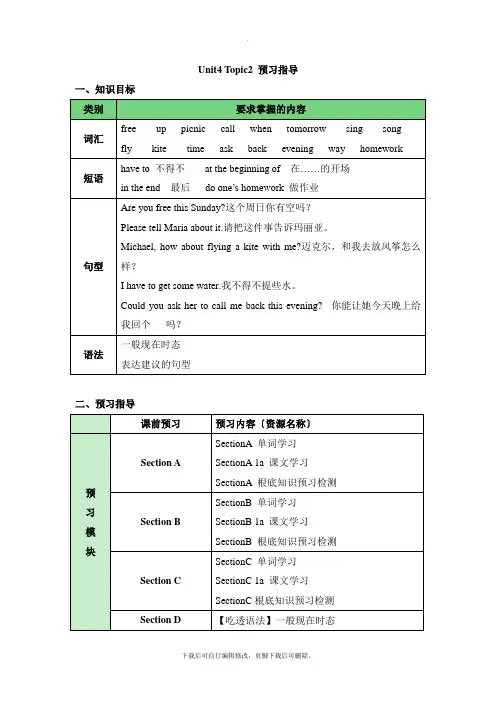
Unit4 Topic2 预习指导一、知识目标
二、预习指导
温馨提示:预习小策略
课前预习要做到看、做、思结合。
看——把新课通读一遍,用笔划出书上重要的和不懂的内容,然后查看学习通同步导学栏目下的词汇、句型讲解等资源,记住要边学边做笔记,如果还有不懂的地方,也要记下来,课堂上认真听讲。
做——学习之后要及时做做题,稳固所学的知识,也可以检测一下自己的预习情况。
思——看的时候要想,要做到手在写字,脑在思考。
预习以后,还要合上课文,对照同步导学栏目小结一下,从而使自己对新教材的“初步加工〞有深刻印象。
建议同学们在精力最正确的时间段学习,每个Section花费大概20分钟。
每天预习一个Section,也可以根据情况适当增减预习量。
下面就开场通同步导学栏目的预习之旅吧!。
仁爱版七年级英语上册unit1-topic2-sectionBPPT课件
.
4
Is she from Canada?
She is Jane.
Is he Li Ming?
He is from Japan.
.
5
He is Li Ming.
他是李明。
Is he Li Ming?
他是李明吗?
She is from Canada. 她来自加拿大。
.
6
Is she from Canada?
Yes, she is. Is he Li Ming?
No, he isn’t. He is Yukio.
.
7
一般疑问句的回答 你知道吗?
— Is she from Canada? — _________.
Yes, she is
是的,她是。
— Is he Li Ming?
Байду номын сангаас
She is from Cuba.
Where is she from?
No, she isn’t. She is Maria.
.
10
2a Look at the pictures.Then practice with your partner.
Deng Yaping/China
Stephen Hawking/ England
1a Look, listen and say.
Look! who is she?
She is Jane.
Is she from Canada?
Yes, she is.
.
3
Look,Kangkang! Is he Li Ming?
Where is he from ?
仁爱版英语七年级上册Unit4Topic2WouldyouliketogoforapicnicSec
(2012版)Unit 4 Topic 2 SectionB参考导学案学习目标1.知识1. ---Would you like to do sth.?--- Yes, I’d love to ./ Sorry , I can’t.2. --- How about flying a kite with me ?--- I’d like that , but I’m afraid I have no time .2.方式音标识词和分块识词法。
3. 情感通过对野餐情景的安排,提高学生的交际及合作能力。
学习重点:电话邀请及如何写电话留言。
学习难点及冲破策略学习难点:如何写电话留言。
学习策略:1.对所学内容能主动练习和实践。
2.踊跃运用所学英语进行表达和交流。
学习流程:【阅读质疑自主探讨】一.走进新课读1a 翻译下面几句话:1. ---Would you like to do sth.? --- Yes, I’d love to ./ Sorry , I can’t.______________________________________________________________________2. --- How about flying a kite with me ? --- I’d like that , but I’m afraid I have no time ._______________________________________________________________________二.阅读提示1:用所给单词或词组的正确形式填空。
want have to for food with fly carry On Sunday, Kangkang goes out ________ a picnic ______ his friends . They take some _____ with them. Jane ______ Kangkang to sing some songs with her , but he has no time. He ____ cook. Wang Junfeng and Michael would like to help Kangkang. Steve ______ water for them. And Maria ____ a kite with the dog. They are all very happy!三.阅读提示2:1.读2a 列举出你以为关键的材料信息。
仁爱版七年级上册英语笔记 Unit3 Topic3-Unit4 Topic1知识点总结
U 3 T3—U4 T11.1)would like = wantwould like没有人称和数的变化I would like an egg.=I want an egg.He would like an egg.= He wants an egg.(would like不能加s)2)would like to do = want to doa. He would like to drink some water.(drink)=He wants to drink some water.b. She would like (visit) the Great Wall.=She the Great Wall.3)I would like=I’d like He would like=He’d like4)a. I’d like an egg.(一般疑问句) Would you like an egg?Yes,please./ No,thanks.b. He’d like a hamburger.he a hamburger?. / .5)Would you like some chicken?(用some 加强语气,表示强调)6)I’d like an egg.What would you like?He’d like some fish.he ?2.1)you—yourself(反身代词)2)yoursel f---yoursel ves(pl.)3.help yourself/yourselves to +n.:随便吃……a. Help yourself (you) to some chicken, Tom.b. Help yourselves (you) to some chicken, kids.4.1)可数名词[C]:有单数和复数的形式.2)不可数名词[UC]:一般没有复数的形式.3)常见的不可数名词有:milk,rice,fish(鱼肉),chicken(鸡肉),(apple/orange) juice,water,bread5.fish:1)作为“鱼” , 是可数名词.fish—fish(pl.)2)作为“鱼肉”, 是不可数名词.some fish6.chicken:1)作为“鸡” , 是可数名词.a chicken2)作为“鸡肉”, 是不可数名词.some chicken7.some + n.(pl.),some+ [UC]some eggssome fish/chicken/milk/apple juice/rice8.---Help yourselves.---Thank you.9.---Would you like…? ---Yes, please. /No, thanks.10.What/How about +sb(宾格)/sth?What about him/her/some milk?11.All right.行,好吧(表示对别人的建议表示赞同)---I’d like some rice and chicken.---All right.k for me.13.Me,too.14.表示建议:---What about …? ---Good idea.15.an ideaa good ideaHomework:1.I’d like a hamburger.(一般疑问句) a hamburger?(肯否回答) ./ .2.She’d like some orange juice.she ?3. , boys and girls.(随便吃些鸡肉吧)4.She likes it very much.(否)She it .5..(我想喝些牛奶).6.他们怎么样??Unit 3 T 3 Section B—D1.1)usually:70-80%,often:50-60%2)usually,often放在be之后,行为动词之前.I usually have breakfast at home.2.have…for breakfast/lunch/supper/dinner1)He usually has an egg and some milk for breakfast.2)We usually have some rice and chicken for supper.3.一日三餐前不加a/an/the,后不加s.What do you usually have for/ breakfast?4.1)He usually has some bread for lunch.What does he usually have for lunch?2)We usually have some juice and fish for dinner.usuallyfor dinner?5.have:1)有2)吃,喝:have milk/bread6.[UC]前面不加a/an/the,后不加s.He has / milk and/ bread for breakfast.7.What/How about +sb(宾格)/sth?8.with带着/有,(表示伴随关系)have chicken/fish with vegetables9.some rice10.three meals(餐):breakfast,lunch,supper/dinner11.food:[UC],食物的总称,作主语,谓语用单数.My favorite food is (be) chicken and fish.12.Chinese /English food13.wait(v.)—waiter(指人)(男服务员)---waitress(女服务员)14.take one’s orderMay I take your order?15.something to drink/eat1)修饰词如不定式(to do) ,形容词修饰something时,放在something之后.2)something:某事(肯定句)anything:任何事(否/疑问)nothing:没有什么事(表否定意思的陈述句)3)Would you like +something?Would you likesomething to eat ?16.[UC]表示数量的表达法:1)a glass of apple juice/watera bag of rice /milk2)a glass of apple juice---two/some glasses of apple juice3) a bag of milk---five bags of milk17.wait/just a moment18.Let me see.让我想一想.I see. 我明白了.19.1)Would you like some vegetables?2)some vegetables/rice20.something to drink21.banana juice----Section C1.eat out2.eat---eating(现在分词)3.would like to doWould you like to have (have) dinner with me?4.have / breakfast/lunch/supper/dinner5.with sb(宾格)6.Would you like to have lunch with him?7.Yes, I’d like/love to.(to不能省略)8.1)May/can I help you?=What can I do for you?2)情态动词may/can/could+动原May I help (help) you?9.sir—madam(对应词)10.What would you liketo eat (eat)?11.Why not+动原? =Why don’t you +动原?Why not study (study) with me? = Why don’t you study with me?12.表示建议:1)What about…? 2)Why not…?肯定回答:Good idea.13.Here you are.14.---Would you like sth to drink?---Yes,please./No,thanks.Section D1.in+地点: in China2.many+n(pl.)many friends3.1)all,bothall指三者或三者以上“都”both指两者“都”2)all,both放在be之后,行为动词之前They are all students.We all like school.4.be kind to sbThe teacher is kind to us.5.have dinner with them6.such as +若干例子7.Sichuan food8.be glad to do sthObama is glad to visit (visit) the Great Wall.9.1)here,there是介词,前不加介词.2)be here/thereI’m glad to be (be) here.10.let sb do sthLet me (I) see (see).Homework:1.他晚饭通常吃什么?he usually?2.你可以点菜了吗??3.Tom,为什么不随便吃些汉堡包呢,?,Tom?4.你想喝些什么东西吗?来两杯香蕉汁.Would you like?.5.She’s glad (be) there.6.I’d like (work) with you.7.Would you like something(say)?8.Why not (tell) him about it.= him about it.9.他对我很友善.He .10.I usually have some rice for lunch.usually for lunch?1.---Do you like…?---Yes, I like …very much/a lot/a little.(No, I don’t like …at all.)Section D1.at / homeHe has a dog at home.2.it’s, its(它是)(它的)a cat. name’s Mimi.3.Tommy =Tom4.Zhou Lan likes it a lot.= Zhou Lan likes it very much.(否)Zhou Lan doesn’t like it at all.5.some,anyShe has some pets.(否)She doesn’t have any pets.(疑问)Does she have any pets?6.1)人称代词:主格---宾格I—me,you-you,he-him,she-her,it-itwe-us,they-them2)形物代—名物代my-mine,your-yours,his-his,her-hers,its-its,our-ours,their-theirsThis is a girl. name is Lily. is twelve. We like .(Her,She,her)Unit 4 T1 Section A1.What can I do for you?=Can/May I help you?2.madam---sir(对应词)3.want to do = would like to do1)She wants to have milk and bread.=She would like to have milk and bread.2)Would you like a glass of apple juice?=Do you want a glass of apple juice?3)Would she like some vegetables?=Does she want any vegetables?4.clothes:衣服的总称,复数名词,作主语时,谓语用复数形式。
七年级英语仁爱版上册Unit2_Topic2_SectionB_优质课教案(吉林省)
Unit2 Looking DifferentTopic 2 what does she look like?Section B:(3-4)教学设计一、Material analysis本节课主要活动是3和4,进一步询问人物外貌特征的表达方法“what does he/she look like?"同时还学习综合颜色、身体部位类单词,以及询问和描述他人外貌特征的表达法,语言板块儿将学习l, w和组合wh的发音规则。
二、Teaching aims1.Knowledge aims能够掌握并应用新学习的单词:letter、sorry、like、look like、tall、will能够用英语询问和描述人物外貌特征的表达方法:she is tall and she has long straight black hair.能够用英语询问人物外貌特征的表达方法:What does the she look like?2.Skill aims能听懂有关询问人物外貌特征的表达方式。
能运用表示询问人物外貌特征的表达方式进行简单的交流。
能根据图片内容口头做对话。
能正确地朗读对话,并能注意语音语调。
能正确书写和使用新学习的单词。
3.Emotional aims能够与同学积极合作参与课堂活动大胆实践。
能够认真、规范地书写单词。
能够培养学生善于观察周围人或物的能力。
三、The key points and difficult pointsKey points1、学会问属于第三人称人物的国籍、外貌、肤色等2、相关形容词的学习:small big long round wide…3,possessive pronounsDifficult points1.have/has在句中的运用及否定表达方式2.物主代词在句中的形式及表达Example: What does the man/woman/boy/girl look like?He/ She is shortHis/her hair is black四、Learning strategies能培养借助图片听说习惯五、Teaching aids教具黑板,图片,多媒体六、Teaching proceduresStep1自主预习一、预习课本P49新单词并识记,完成下面的汉译英。
仁爱版英语七年级上册课文翻译
Unit1Topic1SectionA-2a你好!Hello!你好!Hello!我是康康。
I'm Kangkang.你是迈克尔吗?Are you Michael?是的,我是。
Yes,I am.你好!你是玛丽亚吗?Hello!Are you Maria?不,我不是,我是简。
No,I'm not.I'm Jane.哦,见到你很高兴,简。
Oh,nice to meet you,Jane.见到你我也很高兴。
Nice to meet you,too.你好,玛丽亚!Hi,Maria!你好,康康!Hi,Kangkang!欢迎到中国来!Welcome to China!谢谢。
Thanks.Unit1Topic1SectionB-1a布朗先生,早上好!Good morning,Mr.Brown!很高兴见到你!Nice to see you.玛丽亚,早上好!Good morning,Maria!我也很高兴见到你。
Nice to see you,too.妈妈,这位是我的老师,布朗先生。
Mom,this is my teacher,Mr.Brown.布朗先生,这位是我的妈妈。
Mr.Brown,this is my mom.你好!How do you do?你好!How do you do?Unit1Topic1SectionD-3你好吗?How are you?我很好,谢谢。
你呢?Fine,thanks.And you?我也很好。
I'm okay.早上好,王老师。
Good morning,Miss Wang!早上好,康康!Good morning,Kangkang!见到你很高兴。
Nice to see you.见到你我也很高兴。
Nice to see you too.你好,我是康康。
Hello!I'm Kangkang.你是南希?Are you Nancy?不是。
我是莉莉。
No.I'm Lily.爸爸,这是王老师。