
人教版七年级英语下册Unit3-03
1. How do/does + 某人 + _g_e_t_t_o_某__地___ ? 某人怎么去某地? how是疑问副词, 本句中用来提问__出__行__方__式__ 等。 你叔叔通常怎样去香港?
_H__ow__d_o_es_y_o_u_r_u_nc_l_e _ge_t_t_o_H_o_n_g_K_o_n_g?________
2. 回答方式有两种: A: 某人 + take(s) + _t_h_e_交__通__工__具__ + to 某地。 B: 某人 + get(s) to 某地 + __b_y_交__通__工__具___
我叔叔乘飞机去香港。 _M__y__u_n_c_le__ta_k_e_s__th_e__p_la_n_e__t_o_H__o_n_g_K__o_n_g_. __M_y__u_n_c_l_e_g_e_t_s _to__H__o_n_g_K__o_n_g_b_y__p_l_a_n_e_. _
• 3. How far is it from here?? • _I_t_’_s_f_i_v_e__k_i_l_o_m__e_t_e_r_s_._____
• 4. Do your friends go to school by bus? • _Y_e__s_, _t_h_e_y__d__o_.____________
3. it takes sb. some time to do sth.
意为:_某___事__花__费___某__人__…___…__时__间_____
步行大约要花我15 分钟的时间。
I_t_t_a_k__e_s_m__e__a_b_o_u__t_1_5__m__i_n_u_t_e_s__to__w_ alk.
➢ Key grammar
how引导的特殊疑问句,表示乘坐何种交通工具的方式。how far, how long 引导的特殊疑问句。
First Period 1a-1c Second Period 2a-2d Third Period GF Fourth Period 3a-3c
1.drive 开车 2.car 小汽车;轿车 3.live 居住;生活 4.stop 车站;停止 5.think of 认为;想起
5. ride/their bikes/do/school/your friends/to ___________________________?
1. 看句子末尾的标点,可知这五个句子都是 问句。
2. 先在所给的词汇中找特殊疑问词或助动词 等。
3. 判断该句是一般疑问句还是特殊疑问句。 4. 特殊疑问句:特殊疑问词 + 助动词 + 动词
做作业大约花费简30分钟的时间
I_t__ta_k__e_s_J_a__n_e__3_0_m__i_n_u__te_s__t_o_d__o__h_e_r homework.
4. 如果对时间段提问的话,就用
H__o_w__l_o_n__g + does it take sb. to do sth.?句型。
注意三单形式
A: How does Mary get to Mount Putuo? B: First, she…to…
Next, she…to… At last she…
一、词汇
1.I usually ride my bike to go shopping. 2.Is there a s ubway station near here. 3.It is about 100 k ilometers from this city to South Korea.
How long does it take to walk to school? 5. 对两地间的距离提问下列句型:
H_o__w__f_a_r+ is it _fr_o_m__ 某地 _t_o_ 某地?
从他家到服装店多远?
H_o_w___fa__r is itf_r_o_m__ his home _to_ the clothes store?
How do you get to school
W E L COM E
Unit3
GF+ SectionB
学习目标
➢ Key words & phrases:
train, bus, subway, ride, bike, sixty, seventy, eighty, ninety, hundred,
far, minute, kilometer, new, every, every day
➢Key sentences:
—How do you get to school?
—I ride my bike.
—How does Mary get to school? —She takes the subway.
从北京到上海有多远?
H_o_w___fa_r_ is i_t_ from Beijing _to__ Shanghai?
3a Read and match
仔细读,并配对
1. How does Mike get to school? ___ 2. How long does it take to get home? ___ 3. How far is it from here? ___ 4. Do your friends go to school by bus? ___ 5. Does your dad drive to work? ____
√
B: First he takes the train .
Then he…
takes the bus from the train station to the home
注意三单形式
A: How does your grandpa get to Hangzhou? B: First, he … to … C: Next, he … to … D: At last he …
1.cross 横过;越过
2.river
河;江
3.many 许多
4.village 村庄;村镇
5.between 介于…之间
6.between…and…
在…和…之间
7.bridge
桥
8.boat
小船
9.ropeway 索道
10.year
年;岁
11.afraid 害怕恐惧
12.like
像;怎么样
13.Villager 村民
• 5. Does your dad drive to work? • __N_o__,_h_e__d__o_e_s_n__’t_._________
3b Make question
造句
1. school/you/get to/do/how ___________________________?
2. to/school/get to/does/how long/take/it ___________________________?
3. school/your/ from/it/is/how far/ home/to ___________________________?
4. you/to/walk/do/school ___________________________?
4.It’s four m iles from my house to the station. 5.It’s five m inutes walk from here to my school. 6.Riding is much funnier than t aking a bus. 二、用适当形式填空 1.How about taking (take) a train for a travel? 2.It takes me half an hour to read (read) English everyday. 3.I spend half an hour (in) reading (read) English everyday. 4.Five hours is (be) a very long time. 5.Excuse me, could you tell me how to get(get) to the park.
car bike
bus
subway
train
plane
√ √ √
间接引语
think of 认为 What does Bob think of the trip? 鲍勃认为旅行怎么样? 【拓展】
What do/does sb. think of …? 某人觉得……怎么样? (= How do/does sb. like…?) How does Bob like the trip?
2.It took me half an hourto read(read) English yesterday.
3.I spend half an hour(in) reading(read) English every day. 4.Five hours is (be) a very long time. 5.Excuse me, could you tell me how to get (get) to the park.
Name
Linda
Grace Jack Cindy Mary Jane
c
a
d
very far
I ride my bike to the subway station. Then I take the subway to school.
挑战自己,试用三种以上方式组合上学
First I take ..… to school.
七年级下册英语单词unit3
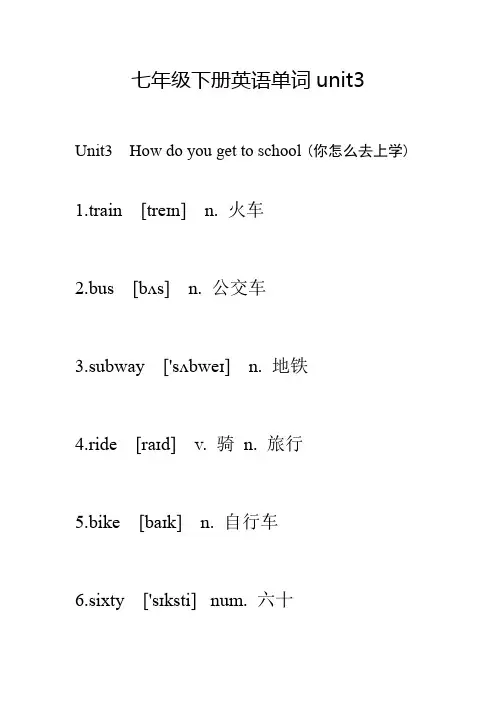
七年级下册英语单词unit3Unit3 How do you get to school (你怎么去上学)1.train [treɪn] n. 火车2.bus [bʌs] n. 公交车3.subway ['sʌbweɪ] n. 地铁4.ride [raɪd] v. 骑n. 旅行5.bike [baɪk] n. 自行车6.sixty ['sɪksti]num. 六十7.seventy ['sevnti] num. 七十8.eighty ['eɪti]num. 八十9.ninety ['naɪnti]num. 九十10.hundred ['hʌndrəd] num. 一百11.minute ['mɪnɪt] n. 分钟12.kilometer ['kɪləˌmiːtə] n. 公里13.new [njuː] adj. 新的;刚出现的14.every ['evri] adj. 每一;每个15.far [fɑː(r)] adv. & adj. 远;远的16.by [baɪ] prep.(表示方式)乘(交通工具)17.drive [draɪv]v. 开车18.car [kɑː(r)] n. 小汽车;轿车19.live [lɪv] v.居住;生活20.stop [stɒp] n. 车站;停止21.cross [krɒs] v. 横过;越过22.river ['rɪvə(r)] n. 河;江23.many ['meni] adj. & pron. 许多24.village ['vɪlɪdʒ] n. 村庄;村镇25.between [bɪ'twiːn] prep. 介于......之间26.bridge [brɪdʒ] n. 桥27.boat [bəʊt] n. 小船28.Ropeway ['rəʊpweɪ] n. 索道29.year [jɪə(r)] n. 年;岁30.afraid [ə'freɪd] adj. 害怕;惧怕31.like [laɪk] prep. 像;怎么样32.leave [liːv] v. 离开33.dream [driːm] n. 梦想;睡梦v. 做梦34.true [truː] adj. 真的;符合事实的35.take the subway 乘地铁36.ride a bike 骑自行车37.every day 每天38. by bike 骑自行车39.think of 认为40.between...and... 在......和......之间e true实现;成为现实42.Dave戴夫(男名)。
七年级下册英语人教版unit3的范文
七年级下册英语人教版unit3的范文My Ideal SchoolIn my ideal school, the environment is beautiful and serene, with lush green trees and flowers blooming all year round. The buildings are modern and equipped with the latest technology, providing an excellent learning atmosphere for students.The teachers in my ideal school are passionate and experienced, who care deeply about the students' growth and progress. They use innovative teaching methods to engage students in learning and inspire them to explore their interests and talents.In addition, my ideal school offers a variety of subjects and extracurricular activities to cater to the diverse interests and needs of students. There are music rooms, art studios, science labs, and sports facilities available for students to develop their skills and hobbies.Moreover, the school emphasizes the importance of teamwork and collaboration, encouraging students to work together and learn from each other. This fosters a sense of camaraderie and unity among the students, making the school a true community.In conclusion, my ideal school is a place where students can learn, grow, and excel in a supportive and nurturing environment. It is a haven for knowledge, creativity, and fun, where every student is valued and encouraged to pursue their dreams.译文:我理想中的学校在我理想中的学校,环境优美宁静,绿树成荫,四季鲜花盛开。
2020-2021学年人教版七年级英语下册Units3---4单元重难点梳理课件
单元语法聚焦三
4.in/on+限定词+交通工具名词(在句中作状语): on a bus/bike, on the train, in his car等。 —How does Lily go to school? —She goes to school on her bike. “莉莉怎样去上学?”“她骑自行车去上学。” 5.on foot意为“步行”。 Lucy goes to school on foot every day. 露西每天步行去上学。
单元语法聚焦三
(5)how much询问不可数名词的数量时,意为“多少”;询问物 品价格时,意为“多少钱”。 How old are your grandparents?你的祖父母多大了? How many factories are there in your hometown? 你的家乡有多少工厂? How much bread is there on the table?桌上有多少面包? How much is the black and white sweater? 那件黑白相间的毛衣多少钱?
(8) by boat
(9) how far
(10) 10 kilometers
单词和词组
1、多长时间 2、三十里分钟 3、对很多学生来说 4、在一个小村庄里 5、穿过小河 6、在A和B之间 7、没有桥 8、害怕 9、实现 10、认为
1.how long 2.thirty minutes 3.for many students 4.in a small village 5.cross the river 6.between A and B 7.there is no bridge 8.be afraid e ture 10.think of
Unit 3 单元整体教学设计【2023春人教七下英语大单元教学备课精品课件】
1.1 围绕核心素养的英语课程目标
核心素养是什么?
核心素养是课程育人价值的集中体现是学生通 过课程学习逐步形成的,是一个人终身发展和 社会需要的正确价值观、必备品格和关键能力, 英语课程要培养的学生核心素养,包括语言能 力、文化意识,思维品质和学习能力等方面, 语言能力是核心素养的基础要素,文化意识体 现核心素养的价值取向,思维品质反映核心素 养的心智特征,学习能力是核心素养发展的关 键要素。核心素养的四个方面相互渗透融合互 动协同发展。
单元主题研读 单元语篇研读
单元目标概览 语篇关联
2.1 单元主题研读
单元主题:人与社会(公共交通) 单元话题:交通 单元功能:谈论出行方式 主题意义:认识各种出行方式,了解出行的路程和时间等基本 要素
2.1 单元主题研读
what:出行方式 how:Section A通过对话呈现对出行方式的提问,引导学生关注 出行方式、路程和时间等信息,Section B通过记叙文语篇阐述不 同的上学方式 why:引导学生关注出行方式、时间、路程等信息,培养基本的 出行意识。
在问题。
3.3 发展需求
1. 学生需要积累更多日常生活中常见的和出行方式有关的单词、 词组等
2. 学生可以把所学熟练应用在口语中。 3. 可以通过学习村里学生艰苦的上学条件,形成珍惜当下的思
想认识。
3.4 发展途径
1. 半开放的问题增强语言技能 2. 加强对口语的讲解和训练 3. 用视频和新闻等有说服力的资料为学生展示更加现实的情况。
2.2 单元目标概览
语言能力: 1. 了解单词、短语、习惯用语和固定搭配等形式 2. 理解常见应用文语篇的主要写作目的、结构特征、基本语言特点和信息组织方式。 3. 根据不同目的,运用各种阅读策略有效获取语篇信息 学习能力: 1. 了解和运用各种阅读技巧,如预测、略读、猜测词义等,提升阅读的想去和能力。 2. 理解运用基本的写作技巧,如审题、选材、、列提纲、修改习作和积累好词好句,
人教版七年级英语下册 Unit 3《How do you get to school》单元测试03含答案

Unit 3How do you get to school?单元测试03听力部分(20分)一、听小对话,选择正确答案(5分)()1. How do Kate often go to school?A.By subway.B.By train.C.By boat.()2. Where does the boy go on the weekend?A.To the library.B.To the classroom.C.To the zoo(动物园). ()3. How long does it takes Li Lei to get to school on foot?A. Ten minutes.B. Eleven minutes.C. Less than ten minutes. ()4. Does John’s cousin come by plane?A. Yes, he does.B. No, he doesn’t.C. I don’t know.()5. Who lives farther (更远)from the school?A.Both Tom and Mary.B.Tom.C.Mary.二、听长对话,回答问题(5分)听下面一段对话,回答第1-2两小题。
()1. Where does Simon work?A. In a bank.B. In a bus station.C. In a subway station. ()2. How far is it from his house?A. 13 miles.B.30 miles.C.60 miles.听下面一段对话,回答第3-5三小题。
()3. Where does Jane live?A. Green City.B. Great Village.C. Green Village.()4. How does Jane get there?A. By train.B. By bus.C. By taxi.()5. How long does it take to get there by train?A. Twenty minutes.B. Thirty minutes.C. One half and a half.三、听短文,完成信息记录表(10分)()1. A. Subway station B. Train station C. Police station()2. A. 10 minutes B. 15 minutes C. 20 minutes()3. A. School B. Radio station C. TV station()4. A. By bike B. By train C. By subway()5. A. Maria’s sister B. Maria’s aunt C. Maria’s cousin笔试部分(80分)四、完形填空(10分)Fred is a bus driver. He always drives the number14 bus. Fred’s bus goes 1 the shopping mall on High Street to the park on Queen Street, then 2 to the shopping mall. Fred 3 work at six o’clock every morning. 4 bus leaves the shopping mall at ten past six. Fred is sometimes 5 to work. When he is early, he sits in his bus and 6 the newspaper until it’s time to go. Fred always stops for 7 on the bus because hehas to finish work at three o’clock in the afternoon. He doesn’t go home by bus. He 8 !He thinks it’s really good for his health. Fred loves his 9 because he can meet different people every day. And he is very 10 .So, the people who travel on Fred’s bus like Fred very much.()1. A. to B. from C. on D. at()2. A. back B. go C. come D. drive()3. A. does B. goes C. starts D. finishes()4. A. Her B.Its C. Their D. His()5. A. late B. busy C. tired D. early()6. A. watches B. looks C. reads D. tells()7. A. breakfast B. lunch C. dessert D. dinner()8. A. drives B. walks C. dances D. sings()9. A. bus B. home C. bus stop D. job()10. A. bored B. heavy C. sad D. friendly五、阅读理解(30分)A()1. The train from Beijing to Shenyang leaves at ________.A. 5:05B. 6:35C. 8:35D. 17:50()2. It takes ________ from Beijing to Shenyang by train.A. 17 hours and 50 minutesB. 24 hours and 25 minutesC.6 hours and 35 minutesD.11 hours and 15 minutes()3. If you want to go to Chengdu from Taiyuan, you can take the ________ train.A. No.11B. No.185C. No.186D. No.271BAnnaI work in a bank from Monday to Friday.My house is near a park and is about ten kilometers from my office. Iusually go to work by train.I usually get up at 6:30a.m. and take the train at 7 a.m. It usually takes me about thirty minutes to get to my office. The train is quick and cheap.I am never late for work.JoeI am a student. My house is near a beautiful lake.My school is across from the lake.I can walk to schoolacross a bridge. It takes me about thirty minutes. But I often go to school by boat, because it is more fun. It takes me about twenty minutes.NancyI am a waiter.I work in a restaurant from Monday to Saturday.I often go to work by bus. It is about fivekilometers from my house to the restaurant. It takes meabout twenty-five minutes to go to work. Sometimes I am late for work because the traffic is very busy.()4. Anna usually arrives at her office at about ________.A.6:30 a.m.B. 7 a.m.C. 7:30 a.m.D. 8 a.m.()5. Joe often ________ to school.A.takes a busB. takes a trainC. walksD. takes a boat()6. The underline word “traffic” means ________ in Chinese.A.餐馆B.交通C.市场D.车站()7. Which is right?A. Sometimes Ann is late for school.B. It takes Joe thirty-five minutes to school.C. Nancy often takes a boat to work.D. Ann works in a bank.CMost people like bikes.Perhaps you ride a bike to school.Riding a bike can be of great fun.Do you know how to ride a bike safely?Careful boys and girls learn to ride their bikes well before they go out on the road.How can you tell whether(是否)you are a good rider?If you can ride a bike in a straight line, you can ride well.If you can’t, you should practice riding in a safe(安全的)place.To be safe on a bike, you need to use both(两个)hands and both feet.Keep your feet on the pedals(踏板)at all times and your hands on the handle bars(扶手).You know that your bike is only for one person.It’s not safe to carry anyone with you.Keep yourself safe when you ride a bike.Watch where you are going all the time.()8.Before you learn to ride your bike well, you can’t ________.A. go to schoolB. ride on the roadC. practice ridingD. carry your things ()9.When riding a bike, it is________ for you not to keep both your hands on the handle bars.A. safeB. dangerousC. importantD. interesting()10.What does the word “rider” mean in the text?A.游客B.骑车的人C.马夫D.运动员()11.The best title for th e passage is“________”.A. How to Ride a Bike SafelyB. Ride a Bike to SchoolC. Ride in A Straight LineD. Don’t Carry Anyone on Your BikeDMany people like to travel by plane because it’s fast, but I don’t like it.An airport is usually far from the city.You have to get there early and wait for hours for the plane to take off and it is often late.You can’t open the windows.You can’t choose the food.Planes are fast, but they still take hours to go out of the airport and into the city.I like traveling by train.I think trains are safe.Railway stations are usually in cities.When you are late for a train, you can catch another one.You can walk around in the train and open the windows.You can see many interesting things on your way.I know it takes a little more time.I also like cars.You can start your journey(旅程)when you want to, and you don’t need to get to a railway station or a bus stop.Also you can carry many things with you in a car.But sometimes there are too many cars on the road.()12.Why do many people like to travel by plane?A.Because you can open the windows.B.Because it is fast.C. Because you can walk around in the plane.D. Because the food is delicious.()13. If you want to carry a lot of things with you, what do you take to go out?A. A car.B. A plane.C. A train.D. A bike.()14. What is the bad thing about the car?A. You needn’t go to a station.B. You can start your journey when you want to.C. There are too many cars on the road.D. You needn’t go to a bus stop.()15. What of the following is right?A. The author likes to take a plane.B. The author doesn’t like-to take a train because it takes more time.C. The author thinks trains are safe.D. People can’t open the windows of the cars.六、词汇运用(15分)A.用方框中所给单词的适当形式填空,每词仅用一次。
人教版七下unit3知识点(K12教育文档)
(完整版)人教版七下unit3知识点(word版可编辑修改)编辑整理:尊敬的读者朋友们:这里是精品文档编辑中心,本文档内容是由我和我的同事精心编辑整理后发布的,发布之前我们对文中内容进行仔细校对,但是难免会有疏漏的地方,但是任然希望((完整版)人教版七下unit3知识点(word版可编辑修改))的内容能够给您的工作和学习带来便利。
同时也真诚的希望收到您的建议和反馈,这将是我们进步的源泉,前进的动力。
本文可编辑可修改,如果觉得对您有帮助请收藏以便随时查阅,最后祝您生活愉快业绩进步,以下为(完整版)人教版七下unit3知识点(word版可编辑修改)的全部内容。
Unit 3 How do you get to school?◆短语归纳1. get to school 到达学校2。
take the subway 乘地铁 3. ride a bike 骑自行车4。
how far 多远 5. from home to school 从家到学校6。
every day 每天7. take the bus 乘公共汽车8。
by bike 骑自行车9。
bus stop 公共汽车站10. think of 认为11。
between … and … 在…和…之间12. one 11—year—old boy 一个11岁的男孩13. play with …和…玩14。
come true 实现15. have to 不得不◆用法集萃1. take… to …= go to … by… 乘…去…2. How do / does (sb)get to …? …是怎样到…的?3. How far is it from … to …? 从…到…有多远?4. It takes sb. some time to do sth. 做某事花费某人多长时间。
5. How long does it take to do sth.? …花费多长时间?6. It is + adj. + to do sth. 做某事是….7. Thanks for + n. / Ving 感谢你(做)某事。
人教版七年级英语下册Unit3 Section A3a-3c课件
You made my day!
我们,还在路上……
根据句意和首字母提示写单词, 完成下列句子。 1. —When did he get here?
—About twenty m_i_n_u_te_s_ ago. 2. It t_a_k_e_s___ her an hour to make dinner for
her family every day. 3. Her home is about thirty k_i_lo_m__e_te_r_s_ away
“从家到学校有多远?”。how much多少, 多少钱; how long多长,多长(时间);how far 多远;how soon多久。
--- ______ do you play football? --- Once a week.
A. How much B. How long C. How often D. How far 答案:C 解析:本题是对疑问副词词组的考察,通 过答句可以判断出是询问动作发生的频率, 所以选择C。
from the airport. 4. My father got up at 6 am. Then he had a
q_u_ic_k____ breakfast and went to work. 5. I got to school e_a_r_ly____ this morning. There
—______ is it from your home to the sctes’ walk. (2011江苏宿迁)
A. How far
B. How long
C. How often
D. How soon
【答案】A
【解析】本题考查词组辨析。how far意为“路 程有多远”;how long 意为“多长时间”; how often意为“多长时间一次”;how soon意 为“多少时间以后”。由答语可知是询问“你 家到学校路程有多远”,故选A。
七年级下册英语unit3知识点人教版
七年级下册英语unit3知识点人教版本文将为大家介绍七年级下册英语unit3的知识点。
unit3主要涵盖了一些基础的英语语法和词汇。
下面我们将分别从以下五个方面来介绍这些内容:班级活动的用语、时间指示法、英文书信格式、形容词的用法及比较级和动词的时态。
接下来我们将逐一解释这些知识点。
班级活动的用语班级活动用语主要包括口语表达和书面表达两种形式。
口语表达主要应用在班级讨论、会议和通知等场合。
书面表达则主要应用在班级通知和邀请函等场合。
在班级活动表达中,需要使用到以下词汇:1. organize(组织)2. attend(参加)3. schedule(计划)4. postpone(推迟)5. cancel(取消)6. remind(提醒)除了这些常用词汇之外,还需要注意词语的用法和句式的结构。
例如:1. We need to organize a meeting to discuss the arrangement of the class party.2. I am unable to attend the meeting due to my illness.3. We have scheduled the meeting to take place on Friday afternoon.4. The meeting has been postponed until next Monday.5. We are sorry to inform you that the class party has been cancelled.6. Just a friendly reminder that the meeting will be held at 2pm on Friday.时间指示法时间指示法是英语语法中非常重要的部分。
在日常生活中,我们需要了解时间的具体表达方法。
以下是一些常用的时间指示法:1. at(表示具体时间点)2. on(表示具体日期或星期几)3. in(表示一段时间)4. ago(表示多长时间之前)5. later(表示多长时间之后)6. before(表示在某个具体时间之前)7. after(表示在某个具体时间之后)需要注意的是,这些时间指示法在具体应用时需要结合具体的语境和句子结构。
Unit3SectionAGrammarFocus(3a-3c)课件人教版英语七年级下册
5. ride/their bikes/do/school/your friends/to __D__o__y_o__u_r__f_r_ie__n_d_s__r_i_d_e__t_h__e_i_r_b__ik__e_s__t_o__s_c_h_o__o_l?
3. 对两地间的距离提问下列句型: _H_o_w__f_ar_ + is it _f_ro_m__ 某地 ___to某地?
如: 从他家到服装店多远? H__ow__f_a_r_ is it _f_r_om__ his home _to_ the clothes
store? 从北京到上海有多远?
H_o_w__f_a_r_ is __it from Beijing _t_o_ Shanghai?
2. 如果对时间段提问的话,就用 _H_o_w__lo_n_g__ + does it take sb. to do sth.?句型
“做某事花费某人多长时间?”
e.g. How long does it take to walk to school? How long does it take to do her homework?
It is only about two kilometers. 询问 距离
No, she doesn’t. She goes by bike. 一般疑问句
No, they don't. They walk.
1. It takes sb. some time to do sth. 意为:___做__某_事__花__费_某__人_…_…__时_间_________ 如: 步行大约要花我15 分钟的时间。
人教版七年级英语下册unit3(详细内容)
人教版七年级英语下册unit3(详细内容)编辑整理:尊敬的读者朋友们:这里是精品文档编辑中心,本文档内容是由我和我的同事精心编辑整理后发布的,发布之前我们对文中内容进行仔细校对,但是难免会有疏漏的地方,但是任然希望(人教版七年级英语下册unit3(详细内容))的内容能够给您的工作和学习带来便利。
同时也真诚的希望收到您的建议和反馈,这将是我们进步的源泉,前进的动力。
本文可编辑可修改,如果觉得对您有帮助请收藏以便随时查阅,最后祝您生活愉快业绩进步,以下为人教版七年级英语下册unit3(详细内容)的全部内容。
人教版七年级英语下册Unit 3 How do you get to school一、单词回顾1、 train[treɪn]火车 2。
bus 公交车 3、subway [’sʌbweɪ]地铁4、ride[raɪd]v.骑n.旅rode.[rəʊd]ridden.['rɪdn。
]5、 bike [baɪk]自行车6、 sixty[’sɪkstɪ]六十7、seventy ['sev (ə)ntɪ]七十8、eighty ['eɪtɪ]八十9、 ninety ['naɪntɪ]九十10、hundred ['hʌndrəd]一百 11、far[fɑː]很 12、minute['mɪnɪt]分钟13、kilometer['kɪlə,mitɚ]公里14、new [njuː]新的15、every [’evrɪ] 每一个16、by [baɪ] 通过,被 17、drive [draɪv]开车 18、live [lɪv] 活的,生动的19、stop [stɒp]停止 20、cross [krɔs]交叉 21、river [’rɪvə]河,江22、many ['menɪ]许多 23、village [’ vɪlɪdʒ]村庄,村民24、between [bɪ’twiːn]介于…之间25、bridge[brɪdʒ]桥 26、boat [bəʊt]小船 27、ropeway ['rop,we] n. 索道空中缆索28、year[jɪə]file:///C:\Documents%20and%20Settings\Administrator\Local%20Settings\Application%20Data\Yodao\DeskDict\frame\20140204094434\index。