
人教版九年级英语Unit4重点知识归纳
Unit4 I used to be afraid of the dark重点知识归纳一、词汇应用1.be silent in class在课堂上保持沉默2.be interested in ... 对……感兴趣3.on a basketball team 在篮球队4.from time to time 时常;有时5.turn red 变红6.get good scores on the exams 在考试中取得好成绩7.wear glasses 戴眼镜8.take up singing 开始唱歌9.deal with her shyness 克服她的羞怯10.not ... anymore 不再……11.in front of crowds 在众人面前12.all the time 频繁;反复13.get tons of attention 被众人所关注;吸引无数目光14.worry about ... / be worried about ... 担心……;担忧……15.be careful about ... 对……小心16.give up your normal life 放弃你正常的生活17.the road to success 成功之路18.fight on 奋力坚持下去;继续战斗19.require a lot of talent and hard work 需要很大的天赋和勤奋20.make it to the top 成功21.give a speech 发表演讲22.in public 公开地;在别人面前23.be nervous about tests 考试紧张24.do well in school 在学校表现好25.cause problems 制造麻烦26.take care of sb. 照顾某人27.influence his schoolwork 影响他的学业28.be absent from classes 缺课;缺勤29.fail his examinations 他考试不及格30.in person 亲身;亲自31.even though 即使;虽然32.think of sb. 想起某人33.become active in many other activities在许多别的活动中变得积极34.send sb. to a boarding school 将某人送到一所寄宿学校35.dare to do sth. 敢做某事36.make the decision to do sth. 决定做某事37.advise sb. to do sth. 建议某人做某事二、重点句型1.I used to be afraid of the dark.我过去常常前害怕黑暗.2.I go to sleep with my bedroom light on.我开着卧室的灯睡觉.3.I used to spend a lot of time playing games with my friends.以前我常常花很多时间和我的朋友们玩游戏.4.I hardly ever have time for concerts.我几乎没有时间去听音乐会.5.My life has changed a lot in the last few years.我的生活在过去几年里改变了很多.6.It will make you stressed out.那会使你紧张的.7.It seems that Yu Mei has changed a lot.玉梅似乎变化很大.三、词汇讲解1. silentsilent是形容词,意为“沉默的;无言的”,其名词形式为silence。
例如:We shouldn’t keep silent when the teacher asks us some questions.当老师问我们问题时,我们不应该保持沉默。
She was silent when her mother asked her questions.她妈妈问她问题她沉默不语。
【拓展】calm; still; quiet与silent的辨析:calm镇静的;平静的指不受干扰时的宁静、平静;指人时表示沉着的、镇定的。
still不动的;静止的指物理上的安静状态。
quiet安静的;静止的指寂静的状态,没有吵闹、骚乱,指人表示娴静、文静。
silent沉默的;无言的主要指人,指不发出声音或不说话,强调无声的状态。
When we face danger, we should keep calm.面对危险,我们应该保持沉着、冷静。
The baby kept still when she was taking photos.当给这个婴儿拍照时,她一动也不动。
Be quiet, everyone. The teacher is coming.同学们,安静!老师来了。
2. helpfulhelpful 形容词,意为“有帮助的”。
例如:The dictionary is very helpful to me.那本字典对我很有帮助。
helpful是由动词help加后缀“-ful”构成的形容词。
动词加后缀“-ful”变成形容词,是一种常见的构词法,类似的这样的词还有很多。
例如:care→ careful use→ useful wonder→wonderful3. score(1)score作动词,意为“得分;获胜”。
例如:Hughes scored two goals before half-time. 休斯在上半场进了两个球.The army continued to score successes in the south.军队在南方不断取得胜利。
(2)score作名词,意为“得分;二十;乐谱”。
例如:I recorded the score in a notebook.我在笔记本上记下了分数。
He bought two scores of apples yesterday.他昨天买了四十个苹果。
Look at the score and try to play that song.看乐谱演奏一下那首曲子。
4. interviewinterview用作动词,意为“采访,面试”。
be interviewed by意为“被……采访”。
例如:We are going to interview the manager of this company.我们将要采访这家公司的经理。
He has interviewed a lot of people for the job.他已面试过很多应聘这份工作的人。
5. dare(1)dare用作实义动词,意为“敢于;胆敢”。
常构成短语dare to do sth.意为“敢于做某事”。
有时to 也可省去(尤其是在否定句或疑问句)。
例如:He didn’t dare to look at her in the eye.他不敢正眼看她。
Did he dare (to) tell her? 他敢告诉她吗?We don’t dare (to) say anything. 我们什么也不敢说。
(2)dare可用作情态动词,用作情态动词时,意思是“敢”,其后接动词原形,通常只用于否定句或疑问句以及if或whether引导的从句中,一般不用于肯定句。
例如:I don’t know whether he dare try. 我不知他是否敢试一试。
I daren’t ask her for a rise. 我不敢要求她加薪。
【注意】dare后通常不接动词的进行式。
6. seldomseldom是副词,意为“很少,不常”,反义词是often,通常置于行为动词之前,be动词,情态动词和助动词之后,是一个表示否定意义的副词。
例如:Mr Brown seldom goes out. 布朗先生很少外出。
【拓展】always, usually, often, sometimes和never是英语中最常见的频度副词。
(1)always 的频度为100%,表示动作重复、状态继续,中间没有间断,意思是“总是”、“永远地”。
例如:The sun always rises in the east and sets in the west.太阳总是东升西落。
(2)usually 的频度为80%左右,意为“通常”、“平常”,即很少有例外。
例如:He usually goes to bed at ten o’clock.他通常10点钟睡觉(3)often 的频度为60%左右,意为“常常”,但不如usually那么频繁,表示动作重复,中间有间断。
例如:He is often late for school. 他上学经常迟到。
(4) sometimes 的频度为40%左右,意为“有时”,表示动作偶尔发生。
可以位于句首,以示强调。
例如:It is sometimes hot and sometimes cold. 天气忽冷忽热。
Sometimes he does it this way and sometimes he does it that way.他有时这样做,有时那样做。
(5) seldom的频度为20%左右,意为“很少”、“不经常”。
例如:I seldom go out these days. 这些天我几乎不出门。
(6) never 的频度为0,意为“从来不”、“永不”。
例如:My parents are never late for work.我父母上班从来不迟到。
7. pridepride是名词,意为“骄傲,自豪”。
常用的结构:take pride in sth. 意为“为某事骄傲”。
They take great pride in her daughter who is now a famous scientist.他们为成为科学家的女儿而感到自豪。
He is the pride of our city. 他是我们城市的骄傲。
【拓展】proud 是形容词,常用结构:be proud of sth. 意为“以……而骄傲”。
I am very proud of being a Chinese. 作为一名中国人我很自豪be proud to do sth. 意为“为做某事而骄傲”。
We are proud to be a league member.我们为成为团员而骄傲。
8. absentabsent是形容词,意为“不在的;缺席的”。
例如:How many students are absent today? 今天有多少学生缺席?Who is absent today?今天谁不在?【拓展】(1)absent的名词是absence,反义词是present,常用结构:be absent from…意为“缺席……”。
人教版九年级英语Unit4知识点梳理及语法讲义(教师版)
—What’s he like?他是什么样的人?
—He’s outgoing.他是外向的。
【拓展延伸】
(1)“What does sb. look like?”意为“某人长什么样?”,只能用来提问人的外貌,不能用来提问人的性格、品质等。其中like是介词,意为“像”。
13. examination(n.考试) —examine(v.考试;审查)
14. exactly(adv.确切地)—exact(adj.精确的)
15. pride(n.骄傲;自豪)—proud(adj.自豪的;骄傲的)
16. general(adj.总的;普遍的)—generally(adv.通常地)
【注意】陈述句和附加问句在人称、数和时态上必须保持一致,
且附加问句的主语必须为代词。
【拓展延伸】反意疑问句的答语
(1)反意疑问句的答语应符合事实。事实是肯定的用yes,事实是否定的用no
(2) 当句式是“前否后肯”的结构时,翻译要以事实为依据,yes翻译为“不是”,no翻译为“是的”
►—Sheisa student,isn’tshe?她是一个学生,不是吗?
3. help(n/v.帮助) —helpful(adj.有帮助的)—helpless(adj.没有帮助的)
4. interview(v.采访;面试) —interviewer(n.采访者)
5. Asia(n.亚洲)—Asian()
6. deal(v.对付;对待) —dealt(过去式/过去分词)
7. shy(adj.害羞的) —shyness(n.害羞;腼腆)
【用法详解】
(1)
(2)19yearold意为“19岁的”(重点)
Unit4+重点短语归纳2024-2025学年人教版英语九年级全册
Unit4 重点短语归纳Section A Part 11.过去常做___________2.被用来做_______________3.习惯做…______________4.有幽默感的__________(adj.)幽默______(n.) 5.沉默的(adj.)_______沉默(n.)______默默地(adv.)_________ 6.对…有帮助______________7.足够勇敢__________ 8.是…队的一员________________9.不时,有时_____________ 10.同时________________11.始终,一直_____________ 12.有时_________13.及时_________ 14.按时__________ 15.变红_________16.看见某人在做…_____________看见某人做…_____________ 17.如此好的一个主意______________18.自从…以来已经…(时间)了。
___________________________19.自从我们上次看见小学同学以来已经三年了。
____________________________________________________________________ ____________20.采访19岁的亚洲的流行歌星________________________21.19岁___________22.开始学习(做)某事_____________23.应付,处理__________ 与_____(how/what)搭配do with与_____(how/what)搭配 deal ______(过)______(过分)Part 21.敢于做… __________31.取得好分数____________2.不再(次数)________________=________(时间)_______________=________ 2.一吨…_____________3.许多______=______4.得到许多关注_________________=_________________ 5.对…小心____________6.害羞的_____(adj.) 害羞_______(n.)7.继续战斗_________8….的数量____________ (单/复数) 9.许多___________(单/复数)10.少量的_______________ 大量的________________11.担心…_________=___________ 12.成功做到_________13.约定在…时间/地点_______________14. 需要某物__________15.需要做…____________ 16.需要某人做…________________17.害怕…____________ 18.放弃________ 19.警卫________20.在…前(外)____________ 在…前(内)_____________21.私人时间___________ 22.闲逛_________ 23.公开地_______24.看关于欧洲的历史的书______________________25.非洲的文化_____________ 26.人群,观众_______(可数n.)27.拥挤的_________(adj.) 28.在观众前_______________29.做演讲____________ 30.公众,众人__________Section B part 11.画画______________=_______________2.一只蚂蚁_________3. 其他昆虫 ____________4.是足球队的一员_____________5.穿(后+衣物,指状态)______穿(后+衣物,指动作)______ 给...穿衣服(后+人) _______穿...颜色的衣服 _________ 6.一直,总是____________7.对...感到紧张 ____________ 8.担心..._________=__________9.步行去学校____________ =_______________10.一位来自农村的15岁的普通男孩_________________________________11.在...方面做得好____________ = _____________12.很难相信... _______________13.很少_______(肯定词/否定词)14.制造麻烦 _____________ 15.搬去... _________16.在一起度过许多时间___________________17.照顾__________=___________18.当心,小心_________=__________=__________19.想念______, 错过_____ 20.孤独的,荒凉的________21.独自的,独自地_______ 22.高兴的 ______ (反义词)_______ 23.高兴,幸福(n.)__________(反义词)__________part 21.影响__________(n./v.)2.对...有影响_________________3.缺席...___________4.对...没有兴趣_________________=______________________5.对...有兴趣__________________=______________________6.考试不及格______________7.未能做...____________8.决定做..._______________ =________________9.一个寄宿学校____________ 10.建议做...___________11.建议某人做..._____________ 12.亲自_________13.发现在那里生活困难__________________14.为...骄傲/自豪 ___________ =_____________15.精确的(adj.)______精确地(adv.)_______ 16.即使_________17.总的,普遍的,常规的(adj.)________ 一般地,通常地________18.总体的介绍_____________ 19.乘24小时的火车____________20.到达...________=________ 21.到达(大地方)_________到达(小地方)________ 22.参加(组织/人)_____参加(活动)__________=_________ 23.总是做..._____________24.与某人交流_______________ =__________________25.在最近几年____________________ (时态:_________)参考答案Section A Part 1ed to do…2.be used to do…3.be used to doing...4. humorous humor5.silent silence silently6. be helpful to sb./ sth.7.brave enough 8.on a … team9.from time to time 10.at the same time11.all the time 12. at times13.in time 14.on time15.turn red 16.see sb. doing… see sb. do…17.such a great idea18. It has been+一段时间+ since...19. It has been three years since we last saw our primary school classmates.20. Interview 19- year- old Asian pop star21.19 years old 22.take up ( doing) sth.23.deal with how what dealt dealtPart 21.dare to do…2.not…anymore= no more not…any longer= no longer3.a ton of…4.tons of = lots of5.get tons of attention=get lots of attention6.be careful about…7.shy shyness8.fight on9.the number of…10.a number of...11.a small number of… a large number of…12.worry about = be worried about 13.make it14.make it+时间/地点15.require sth.16.require doing…17. require sb. to do…18.be afraid of…19.give up 20. guard21.in front of…in the front of…22.private time 23. hang out 24.in public25.read books on European history 26. African culture27.crowd 28.crowded 29. in front of crowds30.give a speech 31.the public 32.get good scoresSection A Part 11.paint a picture = draw a picture2. an ant3.other insects4.on the soccer team5.wear put on dress be in+颜色6.all the time7.be nervous about 8.worry about = be worried about9.walk to school = go to school on foot10.a normal 15- year- old boy from the countryside11.do well in…=be good at…12.It's hard to believe that.. 13.seldom14.cause some problems 15.move to…16.spend a lot of time together17.look after = take care of 18. take care= look out= be careful 19. miss miss 20. lonely21.alone 22. happy unhappy 23. happiness unhappinessPart 21.influence2.have an influence on sb/ sth3. be absent from4.be/ become less interested in…=take/ show less interest in…5.be/ become interested in…=take/ show interest in…6.fail the examination7.fail to do…8.decide to do …= make a decision to do…9.a boarding school 10. advise doing sth.11.advise sb. to do sth. 12. in person13.find life there difficult 14. be proud of…take pride in…15.exact exactly 16. even though 17. general generally 18. general introduction 19. take 24- hour train20.get to…reach…21.arrive in…arrive at…22.join take part in…= join in…23.be always doing...municate with…= have communication with…25.in the past/ last few years完成时。
人教版九年级全一册英语Unit4单元语法知识点总结
人教版九年级全一册英语Unit4单元语法知识点总结本单元重点短语的具体用法1. used to do:表示过去常常做某事,但现在不再这样做了。
例如:I used to play basketball, but now I prefer swimming.(我过去常打篮球,但现在我更喜欢游泳。
)2. deal with:意为处理、应对。
例如:How do you deal with stress?(你如何应对压力?)3. be proud of:表达为某事感到骄傲。
例如:I am proud of my son's achievements.(我为儿子的成就感到骄傲。
)4. take pride in:与be proud of 意思相近。
例如:She takes pride in her work.(她为自己的工作感到自豪。
)5. from time to time:意思是有时、偶尔。
例如:I still see him from time to time.(我仍然有时会见到他。
)6. in public:指在公共场合。
例如:She is very shy and doesn't like to speak in public.(她很害羞,不喜欢在公共场合讲话。
)7. in person:亲身、亲自。
例如:You should go and see it in person.(你应该亲自去看看。
)8. take up sth:开始做某事,占用(时间或空间)。
例如:He has taken up painting in his spare time.(他在业余时间开始画画。
)9. not...anymore:不再......。
例如:She doesn't live here anymore.(她不再住在这里了。
)10. worry about:担心、担忧。
例如:Don't worry about the exam, just do your best.(不要担心考试,尽力就好。
人教版九年级英语unit4语法知识点
人教版九年级英语unit4语法知识点人教版九年级英语Unit 4语法知识点在英语学习中,语法是非常重要的一部分。
掌握语法知识可以帮助我们正确理解和运用英语。
本文将介绍人教版九年级英语Unit 4的语法知识点,帮助大家更好地学习和应用。
一、现在完成时现在完成时用来表示过去发生的动作对现在的影响或结果。
它的结构是主语 + have/has + 过去分词。
例句:1. I have finished my homework.(我已经完成作业。
)2. He has gone to the supermarket.(他已经去超市了。
)我们可以使用现在完成时来描述过去发生的事情对当前状态的影响。
比如 "I have lost my key."(我丢了我的钥匙)表示我现在没有钥匙。
二、情态动词情态动词用来表示说话者对某个动作或状态的态度、可能性、允许性等。
常见的情态动词有 can, could, may, might(可以)、must(必须)、shall, should(应该)、will, would, need等。
例句:1. You can go to the party.(你可以去参加派对。
)2. He must finish his homework before playing games.(他必须先做完作业再玩游戏。
)情态动词有一些特点:后面接动词原形,表示客观的态度或可能性;情态动词本身没有人称和数的变化;句子中情态动词和动词基本形的变化最小。
三、虚拟语气虚拟语气用来表示非真实或假设的情况。
在条件从句中,用虚拟语气来表示可能不会实现的愿望、假设或建议等。
常见的虚拟语气形式有:would/could/might +动词原形。
例句:1. If I were a bird, I would fly in the sky.(如果我是一只鸟,我会在天空飞翔。
)2. I wish I could go with you.(我希望我能和你一起去。
人教版英语九年级全册Unit 4-Unit 6复习课件
3. humorous adj. 有幽默感的,滑稽有趣的 变形: humor n.幽默
4.silent adj. 不说话的,沉默的 remain/stay/keep silent 保持沉默 in silence 安静地,无声地=silently n.silence 5.helpful adj.有用的,有帮助的,乐于助人的 be helpful to sb. 对某人有帮助
6.general adj.总的/普遍的/常规的 n. 将军---generally adv.一般地/普遍地 in general =generally speaking 一般来说
7.introduction n.介绍 brief introduction 简介 make an introduction 做介绍 introduce oneself自我介绍 introduce A to B 把A介绍给B
14. in the last /past +时间段 在过去的...里 15. be there for 随叫随到;不离……左右
U5背诵知识点
• chopsticks [ˈtʃɒpstɪks] n. 筷子 two pairs of chopsticks • coin [kɔɪn] n.硬币 corner n.角落 • fork [fɔ:k] n.餐叉 a knife and fork 一副刀叉(做主谓单) • a knife and a fork 一把刀和一个叉(做主谓复) • blouse [blaʊz] n.(女士)短上衣;衬衫 • silver [ˈsɪlvə] n. 银,银器; adj.银色的 silver hair银发 gold金 • glass [glɑːs] n.玻璃 玻璃杯 a piece of glass a glass of一杯.. • 眼镜 a pair of glasses • cotton [ˈkɒtn] n.棉;棉花不可数,mutton 羊肉不可数 • fair [feər] n. 展览会;交易会 • environmental [ɪnˏvaɪərənˈmentl] adj. 自然环境的;有关环境的
Unit4 基础重点知识背写人教版英语九年级全册
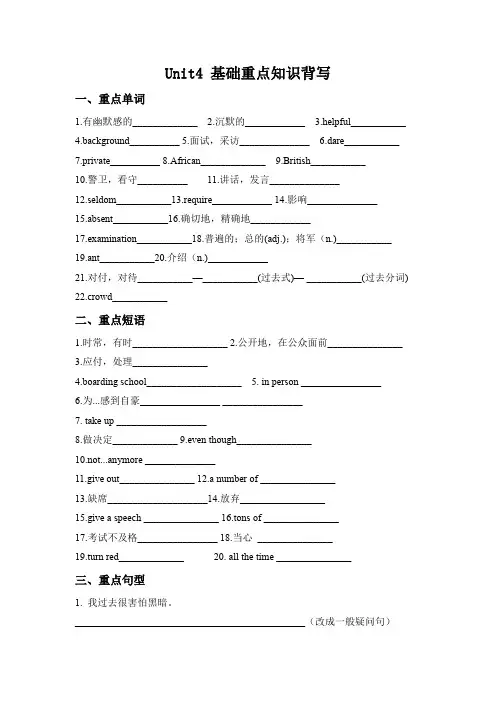
Unit4 基础重点知识背写一、重点单词1.有幽默感的_____________2.沉默的____________3.helpful___________4.background__________5.面试,采访______________6.dare___________7.private__________8.African_____________9.British___________10.警卫,看守__________ 11.讲话,发言______________12.seldom___________13.require____________ 14.影响______________15.absent___________16.确切地,精确地____________17.examination___________18.普遍的;总的(adj.);将军(n.)___________ 19.ant___________20.介绍(n.)____________21.对付,对待___________—___________(过去式)— ___________(过去分词)22.crowd___________二、重点短语1.时常,有时___________________2.公开地,在公众面前_______________3.应付,处理_______________4.boarding school___________________5. in person ________________6.为...感到自豪________________ ________________7. take up __________________8.做决定_____________ 9.even though_______________10.not...anymore ______________11.give out_______________ 12.a number of _______________13.缺席____________________14.放弃_________________15.give a speech _______________ 16.tons of _______________17.考试不及格________________ 18.当心_______________19.turn red_____________ 20. all the time _______________三、重点句型1. 我过去很害怕黑暗。
人教版英语九年级Unit4单元知识点归纳
人教版英语九年级Unit4单元知识点归纳
Unit4 I used to be afraid of the dark.
【重点短语】
1. be more interested in 对…更感爱好
2. on the swim team 游泳队的队员
3. be terrified of 胆怯
4. gym class 体操课
5. worry about 不安
6. all the time 向来,总是
7. chat with 与…闲聊
8. hardly ever 几乎从不
9. walk to school = go to school on foot 步行去上学
take the bus to school = go to school by bus 乘车去上学
10. as well as 不仅…而且...
【考点详解】
1. used to do sth. 过去经常做某事(这个学问点考的无数,大家要注重这个短语的意思,还要记着used后面用的是不定式to do) 如:He used to play football after school.
放学后他过去经常踢足球。
2. play the piano 弹钢琴(play后面假如跟西洋乐器,大家
记住,中间要加the,假如是中国乐器,不加the,如:play erhu)。
人教版英语九年级Unit4单元知识点归纳
人教版英语九年级Unit4单元知识点归纳Unit 4: I Used to Be Afraid of the DarkWhen I was younger。
I used to be afraid of the dark。
Iwould always worry about what was XXX were under my bed orin my closet。
I would always sleep with a XXX.Despite my fear of the dark。
I was on the swim team and loved being in the water。
I also enjoyed gym class and being active。
I was more interested in sports than in reading or watching TV.I hardly ever walked to school。
I would always take the bus。
even though my school was not far from my house。
I would chat with my friends on the bus ride to school.As I got older。
my fear of the dark slowly went away。
I realized that there was nothing to be afraid of and that the dark wasjust a natural part of life。
Now。
I can sleep without a nightlight and am not afraid of the dark anymore.Looking back。
I realize that my fear of the dark was just a phase that I went through。
Unit4知识语法点2023-2024学年人教版九年级英语全册
unit 4 I used to be afraid of the dark1.I used to be afraid of the dark.我过去查查怕黑used to 意为“曾经,过去常常”表示过去一度存在或经常发生,但现在已经不存在的动作或状态。
其后接动词原形,且不与表示过去的时间状语连用。
其否定形式为didn’t use to或used not toI used to live with my parents.我以前和父母住在一起(现在不住一起)He didn’(说明现在是戴眼镜的)2形容词silent 意为“沉默的”常用短语:be/keep silent 保持沉默其名词为silence 沉默,寂静;常用短语:in silence 沉默,寂静The classroom was in silence when the teacher came in.当老师进来时,教室是安静的.3.This party is such a great idea!这次聚会真是个好想法!形容词such,表示“这样的,如此的”,such是用来修饰名词的,因此such的常见结构是:1) such+a(an)+adj.+单数可数名词+thatHe is such a clever boy that everybody likes him. 他非常聪明,大家都非常喜欢他。
He was such an honest man that he was praised by the teacher.他因非常诚实而受到了老师的表扬。
2)such+adj.+复数可数名词+thatThey are such interesting novels that I want to read them once again.这些小说非常有趣,我想再读一遍。
3)such+adj.+不可数名词+thatHe has made such great progress that the teachers are pleased with him.他进步得很快,老师们对他感到很满意。
Unit4知识清单人教版英语九年级全册
九年级Unit 4 基础知识清单Section A1.humorous adj. 有幽默感的;滑稽有趣的2.silent adj. 不说话的;沉默的3.helpful adj. 有用的;有帮助的4.score n.&v. 得分;进球5.background n. 背景6.interview v. 采访;面试n. 面试;访谈n adj. 亚洲(人)的n. 亚洲人8.deal v. 对付;对待9.dare v. 敢于;胆敢10.ton n. 吨; (pl.)大量;许多11.private adj. 私人的;私密的12.guard n. 警卫;看守v. 守卫;保卫13.require v. 需要;要求14.European adj. 欧洲(人)的n. 欧洲人15.African adj. 非洲(人)的n. 非洲人16.British adj. 英国(人)的17.speech n. 讲话;发言18.public n. 民众adj. 公开的;公众的单词变形1.shy—shyness (n.)2.help—helpful (adj. 有帮助的)3.speak—speech (n. 讲话;发言)—Asian (adj.)5.Africa—African (adj.)6.silent—silence (n.)—silently (adv.)7.humor—humorous (adj.)短语1.be afraid of害怕2.not enough to do sth.不足以做某事3.get good grades in…在……方面取得好成绩4.be more interested in…对……更感兴趣5.from time to time时常;有时6.talk to/with…和……谈话7.see sb. doing sth.看见某人在做某事8.take up doing sth.开始做某事9.deal with/do with应对;处理10.dare (not) to do sth.(不)敢做某事11.not…anymore不再……12.all the time一直;总是13.worry about…担心……14.be very careful about…非常注意……15.be prepared to do sth.准备好做某事16.give up (doing)…放弃(做)……17.fight on继续战斗18.require a lot of talent需要很多天赋19.make it to the top能成功到达顶峰20.a very small number of一小部分21.eat a lot of vegetables吃大量的蔬菜22.listen to pop music听流行音乐23.watch scary movies看恐怖片24.in public公开地;在别人(尤指生人)面前25.at least至少句子1.他过去个子真矮。