
晴天夜晚,可以看到天空中有许多星星。
短文阅读及写话
(一)天上有多少星星
晴天夜晚,可以看到天空中有许多星星。
有人说天上的星星数不清,其实是可以数清楚的。
在一个地方,夜晚看到的星星大约有3000多颗,如果把地球另一边天空也算起来,加在一起,天空中肉眼看到的星星共有6000多颗。
如果用望远镜去看,星星就更多了。
那些闪闪发光的星星都是一个个的“太阳”,但它们离我们太远了,所以才看成一颗颗的星星。
1、在文段上标上自然段,数一数总共有( )个自然段。
2、给下面的问题选择正确的答案。
(1)天空中用肉眼能看到的星星总共有( )。
A 、600多颗
B 、3000多颗
C 、6000多颗
(2)( )夜晚,可以看到天空中有许多星星。
A 、晴天
B 、雨天
C 、阴天
(3)有人说天上的星星数不清,( )。
A 、其实真的数不清
B 、其实是可以数清楚的
C 、其实是不可以数清楚的
3、小朋友,天空中的星星准备召开一个舞会,来了很多星星,但是有两个冒充天上的星星也来了,请你睁大眼睛找一找,把混在星星中的两个冒充者圈出来。
火星
水星 海星 金星 木星 土星 北极星 五角星
4、在晴朗的夜晚,走出家门到外面看看星星的景色吧。
把你看到的,想到的写下来。
(二)电话里传来的暖气
今年冬天来得格外早。
大雪早已盖满了原野,封住了每一条小道。
豪猪先生已经三天没见到小白兔了。
他非常想念自己的好朋友,他知道小白兔是非常怕冷的。
豪猪先生自言自语地说:“我应该给小白兔送去一点暖气了。
”
小白兔家的电话铃响了。
他拿起电话,电话里传来了豪猪先生温暖的语气,他正在读一篇文章:“那一年,我来到热带森林里,头上是火辣辣的太阳,人们大汗淋漓,四周到处是绿树红花……”
小白兔再也不冷得发抖了。
紧贴耳朵的电话筒,给他送来了一阵阵暖气。
1、给短文标上自然段,并数一数共有()个自然段。
2、给下面的问题选择正确的答案。
(1)()给小白兔打了电话。
A、野猪
B、豪猪
C、小鹿
(2)和“今年冬天来得格外早”中的“格外”意思相近的词是()。
A、非常
B、特别
C、分外
D、以上都对
(3)小白兔再也不冷得发抖了,是因为()。
A、他来到了热带森林
B、他头上是火辣辣的太阳
C豪猪先生给他送来了友谊
3、请在文中找出合适的字词填空。
大汗()()()树()花火()()
自()自()
4、小白兔听了豪猪先生的电话,感受到了豪猪先生送来的温暖,你觉得小白兔会在电话里说些什么话呢?请在横线上写下来。
(三)数雨滴的孩子
沙沙沙,沙沙沙,下雨啦!
竺可桢搬来一张小板凳,坐在屋门旁,出神地望着房檐上滴落的小雨滴,轻轻地数着:“1、2、3、4、5……”
数着、数着,他像发现了什么奇迹。
房檐下的大石板上怎么有一个一个的小坑呢!小雨滴正好滴在小坑里,叭、叭、叭地响。
他去问妈妈,妈妈说:“孩子,这叫水滴石穿啊!别看小小的的雨滴没什么了不起,可是,日子长了,大石板上就被滴出一个个小坑来了。
读书,做事情也是这个道理,只要坚持做下去,就一定能成功的。
”
竺可桢记住了妈妈的话。
后来,他专门研究气候,成为世界闻名的科学家。
1、在短文上标上自然段,并数一数共有()个自然段。
2、给下面的问题选择正确的答案。
(1)文中写竺可桢数雨滴非常认真的词是()。
A、认真
B、入神
C、全神贯注
D、出神
(2)数着数着,他像发现了什么奇迹。
房檐下的大石板上怎么有()呢!
A一个小坑B、一个一个的小坑C、两个小坑
(3)竺可桢后来专门研究(),成为世界闻名的科学家。
A、环境
B、气候
C、天气
3、“沙、沙、沙”是小雨的声音,“叭、叭、叭”是水滴在石坑上的声音,生活中还有很多的声音,请你给以下的声音找一下主人。
小狗小鸡青蛙闹钟
“呱、呱、呱”是的叫声;
“汪、汪、汪”是的叫声;
“滴答、滴答”是的叫声;
(四)草芽
沉默的冬天终于过去了。
我漫步在温暖向阳的河边,寻找春天的踪迹……
我惊喜地看到:有一排小小的草芽儿,从潮湿的泥土中伸出来。
它们的样子,就像是一枝枝纤细的笔尖。
你看,他们正蘸着嫩绿的颜色,在大地上写出第一首诗。
1、给短文标上自然段,数一数总共有()自然段。
2、沉默的冬天过去了,()来临。
A、春季
B、夏季
C、秋季
3、“我”在温暖向阳的河边,寻找()
A、小鱼的踪迹
B、小虾的踪迹
C、春天的踪迹
D、水草的身姿
4、草芽就像一枝()
A、针尖
B、纤细的笔尖
C、刀尖
D、剑
5、小朋友,根据文章给以下几组词语连线。
沉默的温暖向阳的春天的潮湿的纤细的嫩绿的
笔尖河边冬天颜色泥土踪迹
6、像纤细的笔尖一样的小草在文中“我”的眼里就是春天到来的踪迹,小朋友,请你写一写在你眼里宣告春天来临的是什么。
(五)比脖子
一次,长颈鹿、乌龟、水牛碰到一起。
长颈鹿一抬头,摘下了树梢的红果子,得意地说:“我的脖子特别长,这果子,你们能摘到吗?”
乌龟毫不示弱,把脑袋塞进壳里,很快又伸了出来,说:“你们看,我脑袋平时伸在外面,遇到危险很快缩进去,全靠这脖子灵活。
”
水牛在旁边一声不吭。
长颈鹿问:“牛大哥,你怎们不说话呀?”
水牛说:“你们都有好脖子给自己带来方便。
我只有粗笨、结实的脖子,拖犁、拉车……为人来干活。
”
听了水牛的话,长颈鹿和乌龟都羞愧得红了脸。
1、给短文标上自然段,并数一数这个文段有()个自然段。
2、根据短文内容,给下面的问题选择正确的答案。
(只填序号)
(1)长颈鹿一抬头,摘下了()的红果子。
A、树枝
B、树梢
C、树下
(2)乌龟说:“你们看,我脑袋()伸在(),遇到()很快缩(),全靠这脖子灵活。
”
A、外面
B、进去
C、危险
D、平时
(3)水牛脖子的特点是()。
A、特别长
B、很灵活
C、粗笨、结实
3、小朋友,你知道“长”的反义词是什么吗?答对了,就是“短”。
请你找一找,把意思相反的词连起来。
危险高大灵活缩进去抬头
笨拙安全低头矮小伸出来
4、聪明的小朋友,你能说一说谁的脖子最棒吗?为什么呢?
(六)童年的问号
童年是一首诗,童年是一个梦,童年还是一串长长的问号。
有一个英国男孩儿,叫牛顿。
他看见苹果从树上掉下来,便想:“苹果为什么落到地上,而不是飞向天空呢?”
还有一个英国男孩儿,叫瓦特。
他看见水开了,瓶盖不住地上下跳动,就问姨妈:“瓶盖为什么会跳舞呢?”
古时候,中国有个小男孩儿叫张衡。
他常常依偎在奶奶的怀里,张望晴朗的夜空,一边数一边问:“天上到底有多少颗星星?”
童年,就这样在问号中慢慢长大。
后来,牛顿、瓦特、张衡都成了伟大的科学家。
1、给短文标上自然段,并数一数这个文段有()个自然段。
2、根据短文内容,给下面的问题选择正确的答案。
(只填序号)
(1)牛顿是()人。
A、美国
B、英国
C、中国
D、意大利
(2)发明蒸汽机的是英国的()。
A、牛顿
B、张衡
C、瓦特
(3)中国男孩张衡童年的问号是()
A、天上的星星有多少颗
B、苹果为什么落在地上
C、瓶盖为什么会跳舞
3、文中的“上下跳动”里的“上下”是相对的,小朋友,包含这样相对字的词语还有很多,请你尝试着填一填空格吧!
()低不平内()兼修哭()不得()因后果
()材小用
早出()归
()右为难
声()击西
来()自如
()硬兼施
南辕()辙
黑()不分
4、小朋友,你有没有对什么特别地好奇,那么你的问号是什么呢?请在下面写下你的问号,再写出你认为的答案吧!
我的问号:。
白天看到一个太阳晚上看到无数个星星的作文

标题:白天与夜晚的星辰太阳
在白天,我们看见一个太阳,它犹如一颗巨大的火球,高悬在天空,照亮了整个世界。
它的光芒四射,让人无法直视,它的温暖,让大地生机勃勃。
而在夜晚,我们看见无数个星星,它们犹如点点明珠,镶嵌在黑暗的夜空中。
它们的光芒虽然微弱,但却足以照亮整个夜空,它们的存在,让夜晚不再黑暗,让人们对未知的世界充满好奇。
白天和夜晚,太阳和星星,它们都是天空的使者,它们的存在,让我们的世界变得更加美好。
我们应该珍惜它们,保护它们,让它们继续照亮我们的世界,让我们的生活更加美好。
为什么夏夜晴空看上去星星特别多
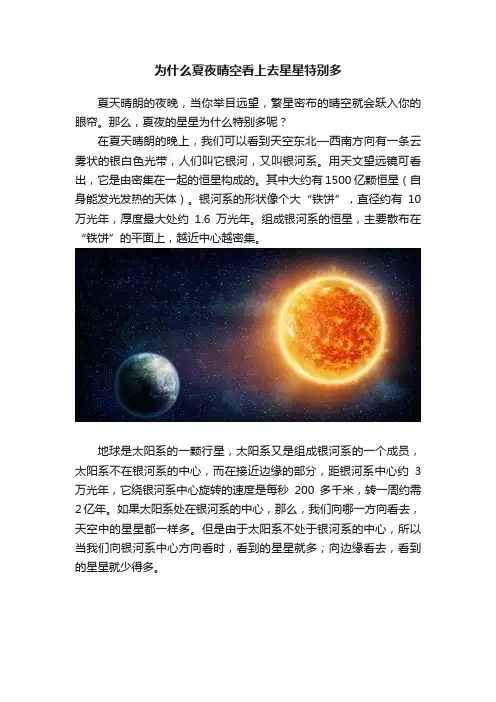
为什么夏夜晴空看上去星星特别多
夏天晴朗的夜晚,当你举目远望,繁星密布的晴空就会跃入你的眼帘。
那么,夏夜的星星为什么特别多呢?
在夏天晴朗的晚上,我们可以看到天空东北—西南方向有一条云雾状的银白色光带,人们叫它银河,又叫银河系。
用天文望远镜可看出,它是由密集在一起的恒星构成的。
其中大约有1500亿颗恒星(自身能发光发热的天体)。
银河系的形状像个大“铁饼”,直径约有10万光年,厚度最大处约1.6万光年。
组成银河系的恒星,主要散布在“铁饼”的平面上,越近中心越密集。
地球是太阳系的一颗行星,太阳系又是组成银河系的一个成员,太阳系不在银河系的中心,而在接近边缘的部分,距银河系中心约3万光年,它绕银河系中心旋转的速度是每秒200多千米,转一周约需2亿年。
如果太阳系处在银河系的中心,那么,我们向哪一方向看去,天空中的星星都一样多。
但是由于太阳系不处于银河系的中心,所以当我们向银河系中心方向看时,看到的星星就多;向边缘看去,看到的星星就少得多。
夏天,地球转到太阳和银河系的中心,银河系的中心部分(最明亮部分)正好是在夜晚出现。
所以在一年四季中,只有夏季看到的星星最多。
为什么夜空中有星星

为什么夜空中有星星夜空中的繁星,一直以来都是人们瞩目的对象。
这些闪烁的光点,给人带来了美的享受,也引发了对宇宙深奥奥秘的好奇。
为什么夜空中有星星?让我们以科学的视角来揭秘这个问题。
首先,星星是由于宇宙中的恒星而形成的。
恒星是太空中的大型天体,它们主要由氢和氦等气体组成。
恒星通过核聚变反应而释放出巨大的能量,这些能量以光和热的形式辐射出来,形成了耀眼的星光。
其次,我们能够看到夜空中的星星,主要是因为它们的光线能够到达地球。
光是一种电磁波,它在真空或其他介质中传播时,速度是恒定的。
光线从恒星射出后,经过漫长的宇宙旅程,最终到达我们的眼睛。
这些光线穿越黑暗的夜空,经过大气层的折射和散射,最终进入我们的视野,形成了星星的光芒。
但是,并非所有恒星都能成为我们可以看到的星星。
为了能够在夜空中显露出来,恒星必须满足一定的条件。
首先,恒星的亮度必须足够高,才能在宇宙中发出足够的光线。
其次,恒星必须与地球的距离适中,这样才能保证它们的光线在穿越大气层后仍然足够明亮。
此外,大气层的状况也会影响我们观察到的星星数量和亮度。
夜空更清澈无云的时候,我们能够看到更多的星星。
除了恒星,还有一些其他因素也影响着我们观察到的星星数量。
例如,行星、卫星、彗星等天体也会在夜空中呈现出光点的形式。
它们在宇宙中的位置和轨道也会影响它们在地球上的可见度。
最后,星星的分布也是非常有规律的。
我们通常可以在夜空中看到星座,它们是由亮星和暗星所组成的特定图案。
星座是人们通过观测夜空中的星星而形成的,不同文化背景下形成了不同的星座图案。
这些星座给人们提供了一种导航工具,帮助我们在星空中找到方向,并用来识别不同的季节和时间。
总结一下,夜空中有星星是因为宇宙中存在着恒星,并且它们的光线能够到达地球。
恒星的亮度、距离以及大气层的状况都会影响我们观察到的星星数量和亮度。
此外,行星、卫星和星座等因素也会给夜空增添更多的光点和美丽。
夜空中的繁星,是宇宙的奇迹,也是我们对宇宙探索和思考的起点。
为什么夜晚能看到星星?

为什么夜晚能看到星星?
为什么夜晚能看到星星?
在夜晚,我们能看到星星的原因有几个方面。
首先,我们需要了解光的传播和
观察条件对于观察星星的重要性。
1. 光的传播:光是一种电磁波,它可以从光源(如太阳、星星)发射出来,并
在空间中传播。
当光线遇到物体时,会发生反射、折射或吸收。
在夜晚,当太
阳下山后,地球上的物体不再直接受到太阳的照射,因此天空变暗,星星的光
线才能更容易地被我们观察到。
2. 大气层的作用:地球的大气层对于观察星星也起到了重要的作用。
大气层中
含有空气和微小的颗粒物,如尘埃和水蒸气。
当星光穿过大气层时,会与这些
颗粒物相互作用。
这种作用导致了光的散射,使星光在天空中呈现出明亮的点
状形式。
这就是我们看到的星星。
3. 空气透明度:星星的观察也受到空气透明度的影响。
当空气中的颗粒物较少时,光线能够更容易地穿过大气层,使星星的亮度更加清晰。
而在城市等地区,由于空气中的污染物较多,空气透明度相对较低,星星的亮度可能会受到一定
的影响。
综上所述,夜晚能看到星星的原因是因为太阳下山后,地球上的物体不再直接
受到太阳的照射,天空变暗;大气层中的颗粒物使星光发生散射,呈现为明亮
的点状形式;空气透明度也会影响星星的观察效果。
这些因素共同作用,使我
们能够在夜晚欣赏到美丽的星星。
描写夜空星星的句子

描写夜空星星的句子1、满天密密麻麻的小星星,落在镜子似的河面上,像珍珠玛瑙,闪闪发光。
2、夜晚,晚风轻拂,轻轻的吹动着窗帘,星空上的明月很是耀眼,那看似小巧的星星也镶嵌在旁边。
在这样的夜晚,可以暂时不去想那些令人忧伤烦恼的事情,可以静静的一边品着香茶或是咖啡观赏着这夜晚的天空。
3、几颗大而亮的星星挂在夜空,仿佛是天上的人儿提着灯笼在巡视那浩瀚的太空。
4、天空中镶满了小星星,她们尽着自己的力量把点点滴滴的光融成淡淡的亮光,不像阳光那样灿烂,也不像月亮那么冷漠。
5、看!一颗穿着淡银婚纱的流星给这个夜空添加了一丝绚丽、喜悦与温暖,流星的转眼即逝给人流下了无限遐想和无尽的孤寂。
6、墨蓝色的天空中挂着许多小星星,它们仿佛刚刚从银河里洗过澡似的,亮晶晶的。
7、我们等候着青春,却错过了彼此……但我永远会记得,那年夏天,最灿烂、最寂寞的星空。
8、一颗流星拖着长尾巴似的蓝色碟光,在夜空中划出一条长长的弧线,好大一会儿才渐渐地消失了。
9、抬头遥望星空,夜空深邃依旧,群星灿烂依旧,田野的蛙虫奏着优美动听的乐曲。
10、我爱你,星星,你有着迷人的魅力,你有着调皮捣蛋的性格,你有着五彩缤纷的衣服。
11、夜空因星星而美丽,世界是因理想而成功的,夜空数不清的星星,代表着世界无数的理想,星星越多,夜空越美丽,“理想”如果可以坚持下去,百折不挠,是可以实现的,如果实现的理想越多,世界不是越多成功吗?12、夜幕像一条无比宽大的毯子,满天的星星像是缀在这毯子上的一颗颗晶莹而闪光的宝石。
13、月亮出海了。
在腾空的一瞬间,它仿佛猛地一跳,浑身披满水花,让多情的大海把它冲洗得分外明丽和洁净。
14、看着满天的繁星,渐渐地,我的眼睛模糊了,我好像看见无数萤火虫在我的周围飞舞。
我望着那些可爱的星星,仿佛看见它们在对我眨着眼睛,对我说着悄悄话呢。
15、每当夜幕降临的时候,那深蓝深蓝的帷幕上就缀满了一颗颗闪闪发亮的“宝石”,像一双双智慧的眼睛,不停的闪动,那就是月亮妈妈的无数孩子——满天的星星。
形容夜晚晴朗的天空

形容夜晚晴朗的天空夜晚晴朗的天空,是一幅宏伟壮观的画卷。
伫立在这样一片明净的星空下,仿佛能感觉到无穷无尽的宁静和祥和。
这里有浩瀚无垠的太空,有闪闪发光的星辰,有银河奔流的梦幻。
让我们一同探索这暗夜中的天空,享受这美丽迷人的时刻吧。
第一眼看到这个天空,我们被那璀璨奇幻的星空所吸引。
无垠的深蓝色背景中,闪耀着点点星辰。
它们有大有小,有圆有方。
它们时而黯淡无光,时而光彩夺目。
它们仿佛是神秘的点点珠子,点缀在海洋般的夜空中,散发着不可言喻的诱人光芒。
一些星辰排列成奇形怪状,仿佛璀璨的群星在向人类展示无限的想象力。
沿着眼前的视线,望着那无垠的星空。
不知不觉,在远方看到一组星座,那是勾陈、织女、牛郎、天狼、天狗等,它们不规则地散落在空中。
我们可以通过这些星座,去回忆那些传说和历史,去了解这一方天地的发展和演变。
星座的故事还让我想起,人类面前的未知的宇宙空间,我们所知太少,太窄。
显得那星空庞大的更为朦胧。
除此之外,那沉静的夜空中还隐隐约约地出现着其他的美景。
如菲薄的月亮,如远处芒刺的山峰,如时不时在霓虹中环绕而过的飞机、飞行器等。
这些东西,犹如一个又一个与众不同的珍珠,散落在那广袤而神秘的宇宙间。
而每一个珍珠呈现的形状和色彩,都在回荡着自己那独特的美丽。
深夜的天空偶尔会散落些别致的云彩,明亮的星星透过云层,显得更加纯净和神秘。
云彩所呈现的是天空另一种美丽的一面,它们呈放射状,就像宇宙中的恒星一样。
有时它们呈波纹状,仿佛在夜晚中掀起了柔和的小浪花,让人情不自禁地联想到某种神秘与魔幻。
在这之中,淡灰色的云层与深蓝色的星空交相辉映,使人心境更加迷醉。
夜幕降临时,灯光中的城市给了我的感官非常大的冲击:变幻的霓虹,光影交错,星星点点,这一切任何一个点滴都印在心底。
百姓们兴致高涨,嬉戏玩乐,我们被投射到一种独特的美感中:星星、灯光、夜晚还有晚风,这所有特色孕育出了城市的美丽夜生活,充满了生活的活力和激情。
夜晚晴朗的天空,虔诚和平静的思绪光阴倒流回了更为沉静、更为神秘的中世纪时期,它们在天空中表象,犹委屈了人类的向往和它们之间的距离,由于距离,因而他们成为一个更为微妙、更为不可理解的梦境。
白天看到一个太阳晚上看到无数个星星的英语作文
白天看到一个太阳晚上看到无数个星星的英语作文全文共3篇示例,供读者参考篇1The Celestial Dance: Marveling at the Sun and StarsEver since I was a little kid, I've been fascinated by the celestial dance that plays out in the sky day and night. During the day, the magnificent sun reigns supreme, radiating its brilliant warmth and light. But when night falls, the sun's solo performance gives way to an ensemble cast of twinkling stars that illuminate the inky blackness with their mesmerizing glow. This dynamic contrast between day and night has captivated my imagination for as long as I can remember.The rising sun heralds the start of each new day, gently peeking over the horizon and gradually bathing the world in its radiant splendor. As the morning progresses, the sun climbs higher into the sky, casting its golden rays upon the earth and breathing life into every corner of our world. I've spent countless hours simply gazing up at the sun, marveling at its sheer power and majesty. Despite its immense size and distance from Earth,the sun's brilliance is so intense that I can scarcely look directly at it without squinting.Yet, as awe-inspiring as the sun is during the day, it's the night sky that truly sets my soul alight with wonder and curiosity. As the sun dips below the horizon, the inky blackness of space slowly unveils its celestial treasures, one twinkling star at a time. Before long, the entire night sky is awash in a dazzling display of countless pinpricks of light, each one a distant sun like our own, shining across the vast expanse of the cosmos.I've spent many a night lying on my back, gazing up at the stars in quiet contemplation. Their sheer number is staggering, and the realization that each one represents an entire solar system, or even an entire galaxy, is simply mind-boggling. As I trace the familiar constellations with my eyes, weaving together the ancient mythological tales they represent, I can't help but feel a profound sense of humility and insignificance in the face of such cosmic grandeur.But the stars' allure extends far beyond their sheer abundance and mythological associations. Each one is a unique and fascinating entity, with its own story to tell. Some burn with a brilliant white-hot intensity, while others radiate a warm, reddish glow. Some appear to twinkle and dance, while others shine witha steady, unwavering light. And some even explode in spectacular fashion, their dying gasps visible from Earth as fleeting bursts of brilliance before fading back into the cosmic darkness.As I ponder the celestial dance of the sun and stars, I can't help but feel a deep sense of awe and reverence for the natural world and the vast, unknowable mysteries of the universe. The sun, our nearest star, sustains all life on Earth with its warmth and light, while the countless other stars that adorn the night sky hint at the existence of countless other worlds, some perhaps even harboring their own forms of life.Yet, for all their grandeur and magnificence, the sun and stars also serve as a humbling reminder of our own fragility and insignificance in the grand scheme of the cosmos. We are but tiny specks in a vast, ever-expanding universe, our existence a mere blink of an eye in the cosmic timeline. And yet, we are also inextricably linked to the celestial dance that unfolds above us, our very existence made possible by the fusion reactions that power the stars and the elements they forge and disperse throughout the cosmos.As I gaze up at the heavens, I can't help but feel a profound sense of connection to something larger than myself, somethingthat transcends the boundaries of our tiny planet and spans the entire universe. The sun and stars are not just mere celestial objects, but rather the embodiment of the fundamental forces that govern our existence and the very fabric of reality itself.In the end, my fascination with the sun and stars is more than just a passing fancy or casual interest. It is a deep, abiding love and respect for the natural world and the cosmic mysteries that surround us. It is a recognition of our place in the grand tapestry of the universe, and a reminder that even in our most profound moments of existential crisis or personal struggle, we are part of something larger, something ancient and enduring, something that will endure long after we are gone.So, whether I'm basking in the warmth of the sun's radiant glow or losing myself in the twinkling tapestry of the night sky, I am forever in awe of the celestial dance that unfolds above me, a dance that has been playing out for billions of years and will continue to do so for billions more. And in those quiet moments of contemplation and wonder, I feel a profound sense of connection to the cosmos, a connection that transcends the boundaries of time and space and reminds me of the beauty, majesty, and mystery that surrounds us all.篇2The Wonders of the Celestial Worlds AboveHave you ever really stopped to ponder the celestial wonders that surround us? I must admit, for most of my life I took the beauty of the heavens for granted. The sun rose each morning, and I went about my day without much thought. The stars twinkled at night, and I paid them little mind. It wasn't until I was a bit older that I began to appreciate the trulyawe-inspiring marvels overhead.During the day, the sun is the star of the show - quite literally! That blazing orb in the sky is what makes life possible on our planet. As I gaze up at the sun, I'm amazed by its immense power and scale. It is a whirling sphere of hot plasma, fusing hydrogen nuclei into heavier atoms through nuclear fusion. This continuous reaction pours out tremendous amounts of energy in the form of light and heat.The sun is absolutely colossal - its diameter spans nearly 1.4 million kilometers! To put that in perspective, you could line up 109 Earths across the sun's disk. Despite its gargantuan size, the sun is actually considered an average-sized star. There are many larger stars out there burning even more ferociously in the cosmos.Yet from our vantage point here on Earth, the sun appears to be just the right size and brightness for life to flourish. Its heat warms our world to the perfect temperature for liquid water to exist. Its light allows plants to grow through photosynthesis, providing the base for virtually all food chains. The sun's rays even help generate Vitamin D in our bodies. Truly, the sun is the giver of life itself.Of course, we can't stare directly at the sun's brilliant face for long. Its dazzling light is simply too intense for our weak eyes. But that doesn't stop me from admiring the sun through a proper filter during the day. I've seen images of sunspots - dark blotches on the sun caused by intense magnetic activity. I've watched footage of solar flares bursting from the sun's surface, sending charged particles hurtling through space at millions of miles per hour. The sun is not just a static ball of fire - it is a roiling, chaotic sphere of plasma constantly changing and shifting in mind-boggling ways.Then, when night falls, an entirely new kind of spectacle emerges overhead. The inky black canvas of the night sky becomes a sparkling tapestry woven with thousands - no, millions - of twinkling stars. Every one of those pinpricks of light is a searing star, not so different from our own sun. Some areyounger, bluer, and more energetic. Others are older, redder, and nearing the ends of their stellar lives. A few may have burned out long ago, now existing as dense remnants invisible to our eyes. Together, they form the vast, sweeping spiral arms of our home galaxy, the Milky Way.On a clear night away from city lights, I could spend hours outside gazing upon the breathtaking expanse of the Milky Way arching across the heavens. Within its billion-mile diameter are hundreds of billions of stars. Our sun is just one solitary, unremarkable resident among that multitudinous stellar population. Yet our sun has qualities that make it rare and precious - it resides in one of the Milky Way's sparse outer arms, far from the galaxy's chaotic, crowded core. It is situated in a relatively uncrowded region of space with very little interstellar dust and gas to obscure the view. And most篇3The Great Celestial ShowHave you ever really stopped to ponder the heavens? I mean, have you truly taken the time to gaze up at the cosmic wonders that grace our skies? If you haven't, you're missing out on one of the greatest shows nature has to offer – a spellbinding spectaclethat plays out in the celestial theater twice a day, every single day.Let me set the stage for you. It's early morning, that magical time when night is loosening its grip and day is stirring awake. You step outside, and there it is – the star of the show itself, the sun! Ah, that brilliant golden orb, regal and radiant, slowly cresting over the horizon. It's like the curtain rising on an epic performance, revealing our solar system's reigning diva ready to deliver yet another showstopping turn.As the sun continues its stately ascent into the sky's dome, you can't help but be awestruck by its dazzling light and warmth caressing your face. This is no mere lightbulb in the heavens, my friends. No, this is a true celestial superstar, a searing sphere of plasma measuring over a million miles across and burning at temperatures that would make the heart of a raging furnace feel like a lazy summer afternoon. Mind-boggling, isn't it?Yet for as hypnotic as the sun's morning unveiling is, it's just the opening act. You see, the real mind-blowing extravaganza unfolds after that fiery diva has had her time in the spotlight and decided to call it a day, exiting the celestial stage as regally as she arrived. As night falls and the sky's inky curtain draws closed,an entirely new effervescent ensemble begins to assemble, ready to enchant us with the evening's performance.First, a few bright harbingers twinkle to life as night's dusky veil settles over the horizon, sending shivers of goosebumps along your arms. Those pinpoint blazes of brilliance are likely the evening's featured players – Venus, Jupiter, Mars, perhaps –warming up with their solo sets before the real celestial chorus kicks into full revelry. Watching those first few golden gems wink into existence is always a breathtaking thrill for me, a tantalizing preview of the cosmic magic about to unfold.Then, as the velvet backdrop of night grows complete, it begins – a veritable tsunami of starlight, an incandescent explosion rendering the sky alive with thousands upon thousands of shimmering fires. Out they pop, wave after wave of twinkling pinholes piercing the celestial dark, a blizzard of blazing lanterns strewn across the heavens like a glittering wildsown spangling of celestial diamonds flung from some divine jeweler's satchel. It's utterly breathtaking, an excessive embarrassment of riches calculated to leave your gaping senses reeling and your overbrimmed mind struggling to take in such undreamt-of splendor.And that's just the big picture view from Earth's surface. Zoom in a little closer on those glimmering specks with a telescope, and a vast new dimension of overwhelming grandeur comes spinning into focus. Whirlpools of stars wheel across your view, entire galaxies of unfathomable size and composition blooming into view like titanic celestial cities, each one an inconceivable conflagration burning with the fire of billions upon billions of individual suns in a single colossal congregation of stellar light and heat and raw power.Whole clusters of these galactic leviathans parade across the eyepiece in intricate winding whirlpools of unfurling light, pulled into frenzied pirouettes by the relentless cyclonic tugs of gravity, all dancing together in an eternal cosmic ballet of dizzying revolutions. The human eye, so accustomed to the modest scale of our Earthly surroundings, simply cannot compute the immensities it's witnessing, the unimaginable abysses of space and time that these colossal pinwheels occupy, the ludicrous volumes of matter they contain, the wild pyrotechnics of atomic fire at their bright hearts. It's a privilege just to glimpse these marvels, a humbling opportunity to brush up against the achingly beautiful complexities of a universe so much vaster than our tiny planet-bound senses could ever have allowed us to conceive.And to think, this is just the grand finale sky show that plays after that celestial diva, the sun, has had her turn! The heavens' dual performance is a true cosmic double-header, a chance to daily witness both the mighty warmth-giver during her solar solo act as well as the dazzling encore chorus of stellar gemfire after she has departed the stage. It's a festival for the eyes and the soul, an extravagant twice。
白天看到一个太阳晚上看到无数个星星的作文
白天看到一个太阳晚上看到无数个星星
的作文
哎呀呀,白天的时候呀,我一抬头就能看到一个大大的太阳挂在天空中呢,哈哈!
那个太阳可亮啦,照得人暖洋洋的,嘿呀。
我总喜欢盯着太阳看一会儿,不过妈妈说不能看太久,不然眼睛会不舒服的,嘿嘿。
白天的天空好蓝好蓝呀,哎呀,看着就特别舒服。
可是到了晚上呢,哇哦,那就完全不一样啦,哈哈!晚上的天空中会出现无数个星星哟。
我每次看到那些星星就特别兴奋,嘿呀,感觉它们就像在和我眨眼睛呢。
有时候我还会和星星们说说话,哎呀呀,虽然它们不会回答我,但我就是觉得特别好玩。
我会数星星,可是怎么数也数不清呀,嘿嘿,星星实在是太多啦。
我还会找那些特别亮的星星,哎呀,然后想象着它们上面是不是有很多好玩的东西呢。
晚上看着星星的感觉可奇妙啦,哈哈,我真的好喜欢白天的太阳和晚上的星星呀,嘿呀嘿呀!。
为什么夜晚会出现满天星?
为什么夜晚会出现满天星?一、星星的本质星星是宇宙中燃烧的恒星,它们散发出的光芒穿过亿万光年的距离,最终在夜空中闪耀。
恒星是热核聚变反应在内部不断进行,释放出大量的能量和光线,这些光线经过漫长的传播,才能在地球上的夜晚被我们看到。
1. 星星的亮度和距离星星的亮度与其表面温度和大小有关,而看似亮的星星可能实际距离我们较远,只能通过望远镜看到。
而那些看似暗淡的星星可能离我们更近,故而在夜晚也会变得明亮起来。
2. 星空的视觉效果由于地球的自转和公转,我们在不同的时间和地点看到的星星也不同,形成了夜空中璀璨的星空景象。
而在无云的晴朗夜晚,星星的光线会更为突出,使得星空更加清晰。
3. 星系和星云在夜空中,除了单个的星星外,我们还能看到星系和星云。
星系是由成千上万颗星星组成的集合体,如银河系是我们所在的星系。
而星云则是由气体和尘埃组成的云状结构,经过恒星的辐射会形成绚丽多彩的景观。
二、观赏星空的技巧想要欣赏满天星,除了等待夜幕降临外,还需一些技巧。
1.选择合适的时间和地点观赏星空最好选择无光污染的地方,远离城市的喧嚣。
此外,选择晴朗的夜晚,可以减少云层的遮挡,使星星更为清晰。
2.使用望远镜或者天文镜如果条件允许,可以使用专业的望远镜或者天文镜观测星星和星系。
这样不仅能观察到更多细节,还可以欣赏到更加迷人的星空景象。
3.借助手机应用现在有很多天文学相关的手机应用,可以帮助我们辨别星座、星系等天体,甚至模拟夜空的变化。
使用这些应用可以提高观测的乐趣,让我们更好地了解星空的奥秘。
三、星星的奥秘与意义星星作为宇宙中的光点,承载着人们对未知的好奇和探索欲望。
1.启迪人类思想古代人们通过观测星空,规划农事、航海和建筑等活动,星星在一定程度上启示了人类的智慧和创造力。
2.激发人们的梦想星星闪烁的夜空总能勾勒出美好的幻想和无限的想象,激发着人们对未来的憧憬和探索。
3.促进人类对宇宙的探索星星作为宇宙中的一部分,是宇宙探索的重要目标,人类一直在努力探索星际旅程,希望能够了解更多宇宙的奥秘和终极真理。
为什么夜空中有星星?
为什么夜空中有星星?
首先,我们需要了解星星是什么。
星星实际上是遥远的太阳,它们
发出的光在夜空中看起来像闪烁的点。
这些太阳与我们的太阳类似,它们都是恒星,是由氢气和一些其他元素组成的巨大的气体球。
现在让我们来解释为什么夜空中有星星。
首先,我们知道地球是一
颗行星,它绕着太阳旋转。
当地球自转使得一天结束后,太阳消失
在地平线以下,夜晚开始降临。
而在夜晚,我们可以看到星星是因
为太阳的光线不再遮挡它们,而它们自身的光辐射则变得更加明亮。
此外,地球的大气层也对我们看到星星起到了一定的作用。
大气层
中的气体和颗粒会散射太阳光,使得白天的天空看起来是蓝色的。
但在夜晚,这些散射的颗粒减少了,夜空变得更加透明,这样我们
就能看到更多的星星。
总的来说,夜空中有星星是因为地球自转使得太阳的光线不再遮挡
它们,同时大气层的散射减少了,使得我们可以清晰地看到星星的
光芒。
这就是为什么夜空中有星星的原因。