
新目标九年级英语 Unit14 必会知识点归纳
新目标九年级英语Unit14 必会知识点归纳1.scoring two goals in a row during a soccer compettion.在一场足球赛中_______两球。
识记点1____________ 连续几次地Up until last year, the price of gold rose for at _________________________直至去年,黄金价格已经连续上涨至少11年。
扩展in a row还可表示“____________”。
They were __________________________.他们整齐地站成一行。
2.Someone _______________ to _________________ from _______ by a teacher.有人被一个老师建议跑完步后休息一下。
识记点2:________________________某人被建议做某事【用法】advise是动词,意为“建议"。
常有三种用法:advise sb. (not) to do sth.意为“建议某人(不要)做某事”。
______________________________________all the time.我的妈妈建议我不要总是待在家里。
2. advise doing sth.意为“建议做某事I ____________ the money to Project Hope.我建议把钱捐给希望工程advise+that从句”表示“建议…."。
that从句应用"should+动词原形”的虚拟语气。
The man advises that we (should) walk on the other side of the road.那个人建议我们在路的另一边行走。
拓展:advice的用法advice是_______的名词形式, 意为“建议;忠告;劝告”,为_______名词。
advice的常用短语为__________ advice,意为“一条建议”。
识记知识点3 _______________休息一下【用法】break作名词,意为“(工作间、课间等的)休息;暂停", take a break是固定短语,意为“休息一下”,相当于_______ a break.There is usually a _________ ______ between classes.通常在课间有10分钟的休息时间。
Let's ______________.让我们休息一会儿。
"take a +n.”构成的短语take a risk承担take a picture照相take a bath洗澡take a walk散步take a rest休息take a look看一看3.He gave really clear ___________ during P. E. class.他在体育课上给出非常清楚的指导。
识记点4 instruction指示;命令instruction作_______名词,意为“指示;命令”。
4.know that Ms. Lee was always patient wth you in math class.我知道李老师在数学课上对你总是有耐心。
识记点5 ______________对有耐心用法patient是形容词,意为“忍耐的;有耐心的”,常用短语be patient with意为“对......有耐心”。
The doctor is very__________ with his _________.那位医生对待他的病人十分有耐心。
知识拓展patient的名词形式patient的名词形式____________意为“耐心”。
My ___________ has completely run out.我没有一点儿耐心了。
5.She helped you to _________ the answers yourself ____________ how difficult theywere.不论题目有多难,她都会帮助你让你自己算出答案。
--识记点6 ____________解决;算出;实现,其中out为副词,如果接名词作宾语,名词放在短语之间或之后均可;如果是接代词作宾语,则代词必须放在work与out________。
.He tried everything possible to work out the problem.他尝试用一切可能的方法解决这个问题。
由“动词+out"构成的短语try out试用;测试;实验run out用光;耗尽get out出去look out当心,小心give out分发hand out发放知识点7no matter how不论怎样【用法]no matter how意为“无论怎样”,相当于________,引导状语从句。
_____________________________, I still can't pass the exam.不管我如何努力尝试,我仍然无法通过考试。
__________________________________, we will miss you.不论我们离你多远,我们都会想念你。
no matter+疑问词”结构no matter常与疑问词搭配使用,如no matter what(无论什么) ,no matter who(无论是谁) , no matter where(无论何地) , no matter when(无论何时)等。
以上词组分别相当于whatever/whoever/wherever/whenever._____________________ I said, my cousin refused to leave.不论我说什么,我的表妹都拒绝离开。
_____________________, you may make friends.无论你走到哪里,你都可以交到朋友。
I told him to come back ____________________________.我告诉他不管什么时候他想回来都可以。
6.Yes, and Mr. Brown ______ me to do____ ____ _____ in science.是的,布朗老师引导我在科学方面做得更好。
识记点8guide sb, to do, sth.引身某人做某事The waiter will guide you to eat in the dining hall.这名服务员会引导你去餐厅吃饭。
拓展:guide还可作名词,意为“导游”.When we travel in a new place, we _______________ to help us.当我们在一个新地方旅游时,我们需要一个导游来帮助我们。
识记点9do well in在.....做得好, 相当于_______________。
do better in是do well in的比较级形式, 意为“在做得更好”。
7.He always took the time to________ things _____ me clearly whenever I couldn'tunderstand anything.不论何时我遇到任何不理解的事情,他总会花时间给我解释清楚。
8.She ___________ me in English class.她在英语课上鼓励我。
encourage sb. to do sth.表示“鼓励某人做某事". encourage的反义词为___________。
I __________________________________ and to prepare for the exarm carefully.我鼓励她努力学习并认真准备考试。
encourage的名词形式_______________He needs all the support and _______________he can get.他需要他能得到的一切支持和鼓励。
9._________________ her, I_____ ___ more _____ and my exam scores doubled.因为她,我更加努力,我的考试分数翻倍了。
时间点12___________付出努effort作名词,意为“努力",put in effort是固定短语,意为“付出努力”,其中in可用into替换。
If you want to study well, __________________________________.如果你想要学习好,你必须付出许多努力。
Do the right thing, put in the extra effort and you will get good marks.做正确的事,投的精力,你将会有好的分数。
10.___________ get _______of them a card and gifit to say thank you?我们给他们每人寄一张卡片和一份礼物来表示谢谢,好吗?识记点13Shall we...? 我们…好吗?shall的主语必须是第一人称I或we,句型Shall /we------?表示建议并征求对方意见,意思是“我/我们……好吗?"助动词shall意为“将会”,其后接动词原形,表示一般将来时。
回答这类表示建议的句型, 常用Good idea./Sure. /Certainly./Yes,let's...等。
常见的表达建议或要求的句式Let's do...让我们做……吧。
”How/Wha abot doing...? ".怎样?""Why not+动词原形?"“为什么不.?"Would you like to do... 你愿意做吗?"Shall we do... 我们做...好吗?"You'd better (not) do .."你最好(不)做..._______可指两个或两个以上中的“每一个”,而________只可指三个或三个以上中的“每一个”,不能指两个中的“每一个”。
可以说each of my eyes,不能说every one of my eye,但可说every one of my toes(脚趾)。
新目标九年级英语unit 14知识点
新目标九年级英语unit 14知识点Unit 14 is an important unit in the New Target Ninth Grade English book. It covers various knowledge points that are essential for students' language development. In this article, we will explore some of these knowledge points in depth.Firstly, Unit 14 focuses on the topic of "Natural disasters". This topic not only helps students improve their English skills but also raises their awareness of the impact of natural disasters on the environment and human life. Through learning about different types of natural disasters such as earthquakes, hurricanes, and tsunamis, students can deepen their understanding of nature's power and the importance of disaster prevention.One important aspect of this unit is the vocabulary related to natural disasters. Students are introduced to words and phrases such as "earthquake", "tornado", and "flood". By learning these vocabulary words, students can enhance their ability to describe and discuss natural disasters in English. Additionally, the unit provides exercises to help students practice using these words in real-life contexts.In addition to vocabulary, Unit 14 also focuses on the use of modal verbs. Modal verbs play a crucial role in expressing possibility,necessity, or obligation. In this unit, students are exposed to modal verbs like "can", "could", "must", and "might". By using these modal verbs correctly, students can express their own opinions and predictions about natural disasters. For example, they can say, "We must be prepared for earthquakes" or "Tsunamis can cause extensive damage".Furthermore, Unit 14 introduces the concept of passive voice. Passive voice is used to shift the focus from the subject of a sentence to the object. In the context of natural disasters, passive voice is commonly used to describe the damage caused by such events. For instance, students can learn to say, "Many houses were destroyed by the earthquake" or "The city was flooded by heavy rain". Understanding and using passive voice correctly can greatly improve students' writing and communication skills.Another important aspect of this unit is the reading passage on natural disasters. The reading passage provides students with valuable information about the causes and effects of natural disasters. By reading and analyzing the passage, students can broaden their knowledge and develop critical thinking skills. They can also learn useful reading strategies such as skimming and scanning to locate specific information.Moreover, Unit 14 includes grammar exercises to reinforce students' understanding of the content. These exercises involve structuring sentences, using appropriate verb tenses, and applying the knowledge learned throughout the unit. By completing these exercises, students can consolidate their understanding and improve their overall English proficiency.In conclusion, Unit 14 of the New Target Ninth Grade English book covers a range of knowledge points related to natural disasters. By learning vocabulary, modal verbs, passive voice, and reading passages, students can enhance their language skills and gain a better understanding of the impact of natural disasters. This unit provides a comprehensive and engaging learning experience, making English learning more enjoyable and relevant for students.。
Unit 14(单元复习课件)九年级英语全一册列(人教新目标Go For It!)

04
Grammar
Grammar
一般现在时
NOW 结构:do/does
用法
1.表经常发生的事情、存在的动作或状态 She sings with the band Crazy Boy.
2.表内心活动感情等 I don't think you are right.
3.描述客观真理 Birds fly in the sky.
2.表示发生在 过去 而对 现在 产生影响、
带来结果的动作
She has been to the United States.
3.表示过去发生的动作 持续 到现在,并可能 还要延续下去.
I have learned English for 8 years.
标志性词汇
for + 时间段 / since + 过去时间点(从句); already / yet / ever / never / just / recently / lately /so far / in the past few years
4.表预定的行为
The train leaves at 9.
标志性词汇
every day, often, sometimes, three times a week…
Grammar
一般过去时
past
NOW
结构:did
标志性词汇
用法
1.表过去发生的事情或存在的状态 Suddenly, the clouds cleared and the rain stopped. 2.表过去经常发生的事情 I was very thin in my childhood. 3.带有确定的过去的时间状语 Did you meet yesterday? He left just now.
新目标九年级英语Unit14知识点汇总

新目标九年级英语Unit14知识点汇总Unit14是新目标九年级英语教材中的最后一个单元,它主要讲解了名词和动词的特殊用法。
通过学习这些知识点,我们能够更好地理解和运用英语,提高我们的语言水平。
一、名词的复数形式名词的复数形式是英语中一个非常基础的知识点。
在大多数情况下,我们只需要在名词后面加上一个“s”就可以了。
例如,cat的复数形式是cats,book的复数形式是books。
然而,有一些名词的复数形式不规则。
例如,child的复数形式是children,man的复数形式是men,woman的复数形式是women。
这些名词的复数形式需要我们记住。
除了不规则的复数形式,还有一些名词是不可数名词,它们没有复数形式。
例如,rice、water、milk等。
这些名词前面不能用a或an,而要用some或a glass of等。
二、名词所有格名词所有格表示某个名词所属的关系。
一般来说,名词所有格可以在名词后面加上一个’s来表示。
例如,my father’s car表示“我父亲的汽车”。
当名词以s结尾时,我们可以只在名词后面加一个’。
例如,parents的所有格是parents’。
但是当名词是单数形式,并且以s结尾时,我们仍然需要加上’s。
例如,Mr. Jones的家是Mr. Jones’s house。
三、动词的过去分词动词的过去分词是表示动作已经完成或者被动语态的一种形式。
大多数动词的过去分词可以通过在动词后面加上-ed或-d来构成。
然而,也有一些动词的过去分词是不规则的。
例如,go的过去分词是gone,see的过去分词是seen。
这些不规则的过去分词需要我们记住。
动词的过去分词在英语中非常常用。
它可以作为动词的补语,修饰名词或者代词。
例如,I have seen that movie.(我看过那部电影。
)四、动词不定式动词不定式是表示动作未完成或者将来发生的一种形式。
一般来说,动词不定式可以在动词前面加上to来构成。
新目标英语九年级Unit_14_知识要点归纳
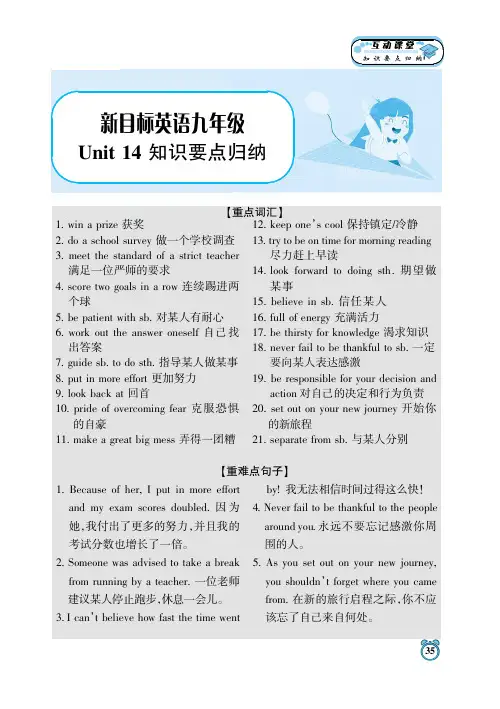
栏注纳1.win a prize 获奖2.do a school survey 做一个学校调查3.meet the standard of a strict teacher 满足一位严师的要求4.score two goals in a row 连续踢进两个球5.be patient with sb.对某人有耐心6.work out the answer oneself 自己找出答案7.guide sb.to do sth.指导某人做某事8.put in more effort 更加努力9.look back at 回首10.pride of overcoming fear 克服恐惧的自豪11.make a great big mess 弄得一团糟12.keep one ’s cool 保持镇定/冷静13.try to be on time for morning reading 尽力赶上早读14.look forward to doing sth.期望做某事15.believe in sb.信任某人16.full of energy 充满活力17.be thirsty for knowledge 渴求知识18.never fail to be thankful to sb.一定要向某人表达感激19.be responsible for your decision and action 对自己的决定和行为负责20.set out on your new journey 开始你的新旅程21.separate from sb.与某人分别【重点词汇】【重难点句子】1.Because of her,I put in more effort and my exam scores doubled.因为她,我付出了更多的努力,并且我的考试分数也增长了一倍。
2.Someone was advised to take a breakfrom running by a teacher.一位老师建议某人停止跑步,休息一会儿。
新目标人教版九年级英语(10—14单元)知识点总结
新目标人教版九年级英语(10—14单元)知识点总结(Unit 10- Unit 14)汇总Unit 10 XXX.一.重点词组1. be XXX被期望/要求做某事;应该2. XXX握手3. drop by顺便拜访4. after all毕竟;终归5. pick up拾起;捡起接某人6. make a noise发出噪音7. table manners餐桌礼仪8. get used to惯于9. XXX对…随意/放松10. get mad大动肝火;气愤11.clean…off把…擦掉12.take off脱下(衣服);(飞机等)起飞13.make an effort作出努力14.make sb XXX使某人感到宾至如归15.cut up切开;切碎16.be expected to do被期待做…17.make friends with与…交朋友18.XXX…就…19.to one’s surprise令某人吃惊的是20. be different from与…不同21.on time按时in time及时二.重点语法1.(1)suppose:猜测;假定XXX透露施展阐发“推测;假定”,that可省例:XXX.(2)be XXX被期望做某事,应该做某事。
相当于should 和ought to例:XXX.XXX to say hello to the foreigners.【练】You are supposed _____ hands when you meet for the first time.A. to shakeB. shakeC. shakingD. shook2. make plans to do == plan to do.打算做某事例She has made plans to go to Beijing.=She has planed to go to Beijing.go out of one’s way to do特意,专门做某事例:He went out of his way to make me happy.3. In Switzerland,it’XXX.阐发:it是方式主语,不定式是真正的主语。
人教新目标九年级unit14单元知识点

人教新目标九年级unit14单元知识点人教新目标九年级Unit 14 单元知识点在九年级英语学习中,Unit 14 是一个相对重要的单元,它涵盖了很多有趣且实用的知识点。
下面我们来逐一介绍。
首先,我们来讨论关于"讲故事"的相关内容。
在这个单元里,我们学习了如何用英语来讲故事。
通过学习故事的开头、结尾以及主要情节的表达方式,我们可以有效地提高自己的英语口语能力。
通过多次练习,我们可以变得更加自如地运用这些表达方式,使得自己的故事更加生动有趣。
其次,我们学习了一些与"改进"有关的词汇。
比如,我们学会了如何用英语表达自己对某个事物的建议或改进意见。
这对我们在团队合作或者社交交流领域都是非常有用的。
我们可以用一些句型如"I suggest/advise (that)..." 或者 "You'd better..." 来提出自己的意见。
这样的学习可以帮助我们更好地与他人合作并增进彼此之间的理解和沟通。
另外一个重要的主题是关于"文化差异"的学习。
在九年级英语课程中,我们不仅学习了一些国家、地区的文化知识,还学会了如何尊重和理解不同文化背景的人。
这对于我们建立开放的国际视野和培养跨文化交流的能力非常重要。
我们可以通过学习和了解不同文化背景的习俗、信仰或者历史事件,来更加广泛地认识世界各地的人和事物。
此外,本单元还包括对"职业规划"的一些简单介绍。
我们了解了一些常见的职业,并学习了如何用英语来表达自己的未来职业规划。
通过这样的学习,我们可以更好地了解各种不同职业的特点和要求,并为自己的未来进行合理的规划。
通过尝试不同的职业描述和对比,我们可以更准确地了解自己的兴趣和优势,进而选择适合自己的职业。
最后,我们学习了一些与"环保"有关的词汇和句型。
这一部分内容在当今社会中尤为重要。
九年级英语全册Unit14IremembermeetingallofyouinGrade7知识点汇总人教新目标版
Unit 14 I remember meeting all of you in Grade 7Section A1. in a row连续几次地eg: This is her third win in a row.排成一排eg:They were standing neatly in a row.2.work out算出eg:He couldn't work out the math problem.发展,进行eg:Everything worked out fine.解决eg:She worked out the problem with his help.制订We worked out a plan very soon.3.put in more effort投入更多的努力eg: I put in more effort to improve the safety of the work place.put in投入,花费eg: I've put a lot of energy in improving my English.安装eg: We put in a new air conditioner when we moved here.4.ptake pride in=be proud of对……感到骄傲;eg: I took pride in Chinese inventions after visiting the museum last week.5.prepareprepare (for) ...(为……)做准备=get ready foreg:The students are getting ready for the coming sports meeting.eg: The students are preparing for the coming sports meeting.prepare ... for ...为……准备……=get ... ready for ...eg:Mother is getting a birthday cake ready for my birthday.eg: Mother is preparing a birthday cake for my birthday.prepare to do sth.准备做某事=get ready to do sth.eg: You should get ready to have the P.E. class.eg:You should prepare to have the P.E. class.6.make a mess弄得一团糟eg:She makes a mess of the job.mess 短语in a mess杂乱不堪;陷入困境eg:He found his room in a mess.mess up 把……弄糟7.It's time(for sb.)to do sth.到(某人)该做某事的时候了eg:It's time for me to cook breakfast.8.graduatev.毕业短语graduate from...从……毕业eg:He graduated from a college last year.9.一般现在时经常性的动作或当前的状态常与sometimes,often,usually,always,every day,once a week...连用一般现在时代替一般将来时连词if,unless 引导的条件状语从句eg: If a pan of oil catches fire, turn off the gas and cover the pan quickly.10.一般过去时过去某一时间发生的动作或存在的状态与yesterday,last week,two months ago,in 1990...连用eg:Tom finished his homework yesterday.11.一般将来时将来发生的动作或情况常与tomorrow,next day,in the future等连用eg:I'll visit the museum tomorrow.am/is/are going to +V.原表示主语打算在最近或将来要做某事eg:What are you going to do tomorrow ?表示有迹象表明某事将要发生eg:Look at the dark clouds. There is going to be a heavy rain.Section B1.believe in信任;信赖辨析believe in信任某人,相信某人的价值,可指信仰,信奉(真理、宗教)等后+名词,代词作宾语eg:The students believe in John.believe相信某人所说的话,与这个人的品质无关后+名词、代词或从句eg:I believe what you said.短语believe it or not信不信由你2.congratulatev.祝贺常用短语congratulate on sb.向某人祝贺congratulate sb. on sth.为某事向某人祝贺3.辨析none可指人也可指物,常暗示一定范围通常与of 连用eg: None of us enjoy getting up early.no one只能指人不能与of 连用eg:No one knows about it.4.ahead of在……前面ahead短语go ahead表示同意对方的请求eg:—May I start ?—Yes,go ahead.ahead of更早,早于,领先eg:He left one day ahead of me.ahead of time提前,提早eg:The work was done ahead of time.5.along with连同;除……以外还=together with就远原则eg: Lucy along with her parents is going to Shanghai next month.6.responsibleadj.有责任心的eg:My Chinese teacher is a responsible man.短语be responsible for sth.对某事负责任eg:Who is responsible for the project ?be responsible to sb.对某人负责eg:Our duty is to be responsible to the people.7.separateadj.单独的,分离的eg:They sleep in separate beds.v.分开,分离常与from 连用eg:Please separate the white shirts from the colored ones.辨析separate把原来连在一起的分隔开来常和from 连用eg:The fence separates the garden from the yard.divide把整体分成若干部分常和介词into 连用eg:The apple is divided into two parts.8.set out出发;启程=set off短语set out for ...出发前往……set out to do sth.开始(着手)做某事Section A1. in a row连续几次地eg: This is her third win in a row.排成一排eg:They were standing neatly in a row.2.work out算出eg:He couldn't work out the math problem.发展,进行eg:Everything worked out fine.解决eg:She worked out the problem with his help.制订We worked out a plan very soon.3.put in more effort投入更多的努力eg: I put in more effort to improve the safety of the work place.put in投入,花费eg: I've put a lot of energy in improving my English.安装eg: We put in a new air conditioner when we moved here.4.ptake pride in=be proud of对……感到骄傲;eg: I took pride in Chinese inventions after visiting the museum last week.5.prepareprepare (for) ...(为……)做准备=get ready foreg:The students are getting ready for the coming sports meeting.eg: The students are preparing for the coming sports meeting.prepare ... for ...为……准备……=get ... ready for ...eg:Mother is getting a birthday cake ready for my birthday.eg: Mother is preparing a birthday cake for my birthday.prepare to do sth.准备做某事=get ready to do sth.eg: You should get ready to have the P.E. class.eg:You should prepare to have the P.E. class.6.make a mess弄得一团糟eg:She makes a mess of the job.mess 短语in a mess杂乱不堪;陷入困境eg:He found his room in a mess.mess up 把……弄糟7.It's time(for sb.)to do sth.到(某人)该做某事的时候了eg:It's time for me to cook breakfast.8.graduatev.毕业短语graduate from...从……毕业eg:He graduated from a college last year.9.一般现在时经常性的动作或当前的状态常与sometimes,often,usually,always,every day,once a week...连用一般现在时代替一般将来时连词if,unless 引导的条件状语从句eg: If a pan of oil catches fire, turn off the gas and cover the pan quickly.10.一般过去时过去某一时间发生的动作或存在的状态与yesterday,last week,two months ago,in 1990...连用eg:Tom finished his homework yesterday.11.一般将来时将来发生的动作或情况常与tomorrow,next day,in the future等连用eg:I'll visit the museum tomorrow.am/is/are going to +V.原表示主语打算在最近或将来要做某事eg:What are you going to do tomorrow ?表示有迹象表明某事将要发生eg:Look at the dark clouds. There is going to be a heavy rain. Section B1.believe in信任;信赖辨析believe in信任某人,相信某人的价值,可指信仰,信奉(真理、宗教)等后+名词,代词作宾语eg:The students believe in John.believe相信某人所说的话,与这个人的品质无关后+名词、代词或从句eg:I believe what you said.短语believe it or not信不信由你2.congratulatev.祝贺常用短语congratulate on sb.向某人祝贺congratulate sb. on sth.为某事向某人祝贺3.辨析none可指人也可指物,常暗示一定范围通常与of 连用eg: None of us enjoy getting up early.no one只能指人不能与of 连用eg:No one knows about it.4.ahead of在……前面ahead短语go ahead表示同意对方的请求eg:—May I start ?—Yes,go ahead.ahead of更早,早于,领先eg:He left one day ahead of me.ahead of time提前,提早eg:The work was done ahead of time.5.along with连同;除……以外还=together with就远原则eg: Lucy along with her parents is going to Shanghai next month.6.responsibleadj.有责任心的eg:My Chinese teacher is a responsible man.短语be responsible for sth.对某事负责任eg:Who is responsible for the project ?be responsible to sb.对某人负责eg:Our duty is to be responsible to the people.7.separateadj.单独的,分离的eg:They sleep in separate beds.v.分开,分离常与from 连用eg:Please separate the white shirts from the colored ones.辨析separate把原来连在一起的分隔开来常和from 连用eg:The fence separates the garden from the yard.divide把整体分成若干部分常和介词into 连用eg:The apple is divided into two parts.8.set out出发;启程=set off短语set out for ...出发前往……set out to do sth.开始(着手)做某事。
新版新目标英语九年级unit14知识点总结
Unit14IremembermeetingallofyouinGrade7.SectionA1.rememberdoing得做某事remembertodo着要做某事2.withone ’shelp=withsb=with’st he lphelpofsb在某人的帮助下helponeselftosth随.便吃⋯⋯helpsb.withsth. helpsb.(to)dosth.can’thelpdoingsth情.不自禁做某事忍不住做某事helpsbout帮助某人解决3.advisesb〔.not〕todosth.建某人〔不要〕做某事advisedoingsth建.做某事advise关于...某人建advisethat从句(should+do)4.instruction 指示,命令followtheinstructio nsforinstructionsonhowtodosth如何做某事的指示instructionstodosth做某事的指示onsb’sinstructions 遵守...的指示遵照某人的指示5.bepatientwith ⋯⋯有耐心6.workout解决,算出,果bepatientofsth忍耐某事workoutfine/well 奏效8.9.7.guidesb.todosth指.某人做某事 guidesb.tosp指引某人去某地10.encouragesb.todosth鼓.励某人做某事encouragesb.insth.在某方面鼓励某人/助某人的某种行11.preparefor...做准preparetodosth准做某事10.makeamess弄得一糟beinamess乱七八糟境狼getsbintoamess使某人陷入狼的境messup搞乱弄getintoamess陷入困境,遇到麻wishtodosth.希望做某事wishsb.todosth.希望某人做某事wish+that从句〔表示以的愿望〕hopetodosth希.望做某事hope+that从句〔表示可以的“希望〞或能到达的“期望〞〕12.It’stimetodosth到了.做某事的了。
九年级unit14单元知识点
九年级unit14单元知识点九年级Unit 14单元知识点Unit 14是九年级英语教材中的一个重要单元,主要讲解了有关交通与旅行的话题,涉及到了词汇、语法、听力、口语和写作等方面的知识点。
下面将详细介绍本单元的主要知识点,以帮助同学们更好地学习和掌握这部分内容。
一、词汇本单元的词汇主要包括以下几个方面:交通工具、交通信号、旅行和方向。
1. 交通工具(Means of Transportation)- car(汽车)- bus(公交车)- bike(自行车)- subway(地铁)- train(火车)- plane(飞机)- ship(船)2. 交通信号(Traffic Signs)- traffic light(红绿灯)- stop sign(停车标志)- yield sign(让行标志)- pedestrian crossing(人行横道)- speed limit(限速标志)3. 旅行(Travel)- trip(旅行)- journey(旅程)- tourist(游客)- passport(护照)- luggage(行李)- ticket(车票/机票)4. 方向(Directions)- north(北)- south(南)- east(东)- west(西)- turn left(左转)- turn right(右转)- go straight(直走)二、语法本单元的语法部分主要涉及到情态动词的用法和一般现在时的被动语态。
1. 情态动词(Modal Verbs)- must(必须)- can(能够)- may(可能)- should(应该)- might(可能)2. 一般现在时的被动语态(Passive Voice in Simple Present)- 主语 + am/is/are(be动词的相应形式)+ 过去分词三、听力与口语通过听力和口语练习,同学们可以提高他们的听力理解和口语表达能力,使他们更好地运用所学知识。
新目标九年级英语Unit14知识点总结
新目标九年级英语Unit14知识点总结新目标九年级英语Unit 14 知识点总结Unit 14 主题为 "Wonders of the world",通过学习该单元的内容,我们可以了解到世界上许多著名的自然景观和人造奇迹。
本文将以知识点总结的形式,对本单元的学习内容进行归纳和概括。
第一部分:Natural wonders of the world本单元的第一部分介绍了一些世界上著名的自然景观,如大峡谷、尼亚加拉瀑布等。
在学习这些自然奇观的过程中,我们学习了一些与自然地理相关的词汇和短语。
首先,我们了解了一些描述自然景观的词汇,如"impressive"(令人印象深刻的),"stunning"(令人惊叹的),"breathtaking"(令人窒息的),"majestic"(庄严的)等。
这些词汇可以帮助我们更好地表达对自然美景的赞美之情。
其次,我们学习了一些表示位置和方向的词汇和短语,如"be located in"(位于),"be surrounded by"(被...包围),"flow into"(流入),"rise"(上升),"at the foot of"(在...脚下)等。
掌握这些词汇和短语可以帮助我们描述自然景观的位置和特征。
第二部分:Man-made wonders of the world本单元的第二部分介绍了一些世界著名的人造奇迹,如埃菲尔铁塔、金门大桥等。
在学习这些人造奇迹的过程中,我们学习了一些与建筑和工程相关的词汇和短语。
首先,我们了解了一些描述建筑和工程的词汇,如"architectural masterpiece"(建筑杰作),"engineering marvel"(工程奇迹),"iconic landmark"(标志性地标)等。