
高一英语北师大版必修三教学案:Unit 7 Section 3 Word版含答案
Ⅰ.根据首字母提示及英文释义写出单词
1.opposite:_completely different
2.escape:_to succeed in getting out of a place where you are kept by force 3.recognise:_to know someone or sth.you have seen or heard before 4.recover:_to be well again after an illness
5.terrify:_to fill someone with terror or fear
6.float:_to stay at the top of liquid
Ⅱ.根据词性及汉语意思写出单词
7.horrible adj.可怕的,令人厌恶的→terrible (近义词)
8.float v t.浮,漂→sink (反义词)
9.terrify v t.让人感到恐惧→terrifying adj.令人恐惧的→terror n.恐怖,恐惧10.survive v i.幸存,生存下来→survivor n.生还者,幸存者
11.sink v i.下沉,沉没→sank (过去式)→sunk (过去分词)
12.disagree v i.意见不合,不同意→disagreement n.不同意
Ⅲ.补全短语
1.in the end最后,终于
2.make sense有意义,讲得通
3.tie ...to ... 把……系在……
4.all at once 突然
5.pick up拾起,搭车等
6.be located in/on位于……,定位于……
7.at/on the edge of 位于……的边缘;在……沿上
8.soon afterwards 不久以后
9.less than 少于
10.in the direction of 朝……的方向,向着……
1.Our boat survived, and I was trying to recover when my elder brother put his mouth close to my ear, and screamed out the terrifying word “Whirlpool!”
我们的船保住了,我正竭力回过神来,就在这时,哥哥把嘴凑到我耳旁,大声说出那个令人胆战心惊的词“漩涡!”
[句式分析]“be doing ... when ...”表示“正在……,这时(突然)……”。
句中when为并列连词。
[佳句赏析]我正在街上走,这时突然听到有人喊我。
I was walking along the street when I heard someone calling my name.
2.As you can see, I did escape.
如你所见,我的确逃脱了。
[句式分析]该句为谓语强调句式。
用助动词did加强escape的语气。
[佳句赏析]你错了。
你的确冤枉了他。
You were wrong. You did do him wrong.
Have you ever seen the following films about seas? What do you think of them? Choose one of them and tell your classmates.
FindingNemo tells the story of clownfish Marlin and his only son Nemo. Nemo is a clownfish in Chinese. In the sea, Marlin and Nemo lead a safe and quiet life. Like all the fathers, Marlin tries to protect his son from being hurt. But Nemo is eager to explore the reef (岛礁).One day, Nemo was captured by a cruel man. Then he put Nemo and many fish to a big tank. After the coward (胆小的) father knew it, he went to rescue his son and of course all the animals in Barrier Reef helped him find his naughty son, Nemo. In doing so, Marlin overcame his fear and rescued his son.
In my opinion, FindingNemo is similar to TheLionKing. I like Nemo, a boy who likes risking very much. He is very lovely and always full of naughty.
Ⅰ.Fast-reading
True (T) or False (F).
1.The writer is an old man.()
2.The writer and his brothers were trapped in the whirlpool.()
3.The writer tried his best to tie himself to a barrel to help him float.() 4.The writer and his brothers caught no fish that day.()
5.At last the writer escaped, but his brothers didn't.()
6.Some fishermen jumped into the sea and saved the writer and his brothers.() 答案:1~6FTTFTF
Ⅱ.Careful-reading
Read the text carefully and then fill in the chart with the information in the text.。
【教学设计】北师大版必修)3Unit 7

本校属农村高中校,使用的是北师大版英语教材,其中的听力课语速较快,部分听力材料与学生的知识面有脱节,听力任务设置难。学生要在短时间内听懂并迅速处理听力信息,最终完成听力任务难度非常大,这大大挫伤学生的学习信心。因此本课题试图遵循英语语言的本质,在前人对于词汇研究的基础上,结合本校农村高中学生实际出发,改编教材的听力和Culture Corner,重新设置任务,以此让学生学习掌握相关词汇。以期对于农村高中在听力课上英语的词汇教学有一定的借鉴意义。
教学设计内容
设计主题
北师大版教材改编听译课《普通高中课程标准实验教科书•英语(必修)3》
Unit7Culture CornerZheng He and His Seven Voyages
1.整体设计思路、指导依据说明
高中英语课程的总目标是发展自主学习和合作学习的能力,形成有效的英语学习策略,培养学生的综合语言运用能力,特别注重提高学生用英语进行思维和表达的能力。
treasurerulerneighbouringon board
so thatcropset sail across the Indian Ocean
sinkmastthunderstormsailor
3.Teaching goals
To pronounce correctly and know the words involved in the monologue
To listen carefully andtry tosummarizethe monologue
高一英语北师大版必修3教案:Unit7TheSeaPeriod1 含解析 精品
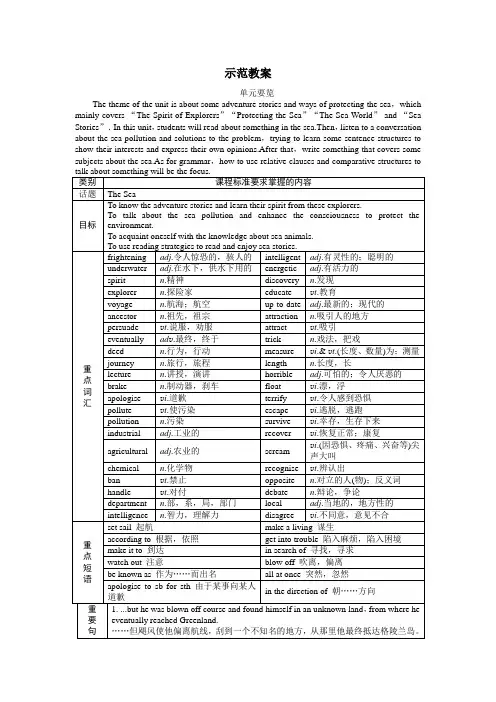
示范教案单元要览The theme of the unit is about some adventure stories and ways of protecting the sea,which mainly covers “The Spirit of Explorers”“Protecting the Sea”“The Sea World” and “Sea Stories”.In this unit,students will read about something in the sea.Then,listen to a conversation about the sea pollution and solutions to the problem,trying to learn some sentence structures to show their interests and express their own opinions.After that,write something that covers some subjects about the sea.As for grammar,how to use relative clauses and comparative structures toPeriod 1Warm-up and Lesson 1The Spirit of Explorers整体设计Analysis of the teaching materialsThis is the first period of the unit,which is about the Vikings' exploration.Focusing on the language and some specific information,students can understand the text better and learn spirit from explorers by reading.The adequate vocabulary to describe the sea in the Warm-up has laid a solid foundation for Lesson 1.Therefore,the combination of Warm-up and Lesson 1 is a better choice.At the same time,more activities should be designed to help students find some specific information and use new words repeatedly.What's more,understanding the key words in the text and using what they have learnt to describe the discoveries are the important part of this period too.In order to help the students do the job well,teachers should put emphasis on it.Three-dimensional targetsKnowledge and skills1.To make the students master some new words and expressions in this lesson:spirit,explorer,voyage,deed,journey,unknown,eventually,further,achieve,control,land,set sail,get into trouble,follow one's directions,be believed to be,persuade sb to do sth,find oneself in...2.To use the key words and useful expressions they have learnt in this lesson to describe the discoveries.3.To improve the students' reading ability by scanning and skimming.Process and methods1.Use sea sounds and pictures of the sea to lead in the new text to arouse the students' interest.2.During Pre-reading,the introduction of the basic information about the Vikings can help students better understand the text.3.In While-reading,a table and some questions are used to help students find some specific information about the text.4.For Post-reading,students can talk about the discoveries of explorers and form the overall comprehension of the spirit of explorers.Emotion,attitude and value1.To show the students how to cooperate with each other,help each other and learn from each other.2.To cultivate students' appreciation of the spirit of explorers and stimulate them to be brave and overcome difficulties in their life.3.To experience the pleasure of success in communication and cooperation.Teaching & Learning methods1.Task-based language teachingThe text deals with some voyages of explorers.Pictures related to the theme will be presented by multimedia computers to further students' understanding,which makes for the improvement of the teaching efficiency.At the same time,it also can make the students work effectively during the whole class.2.The whole language approachInstruct students to begin with reading the title;then get the overall perception before the detailed understanding of the article,inspire students to participate in discussion to improve their abilities of language fully.Teaching important & difficult points1.To improve students' reading ability by finishing some tasks.2.To know more about the voyages to America and enrich their knowledge about explorers.3.To talk about the questions in Post-reading and learn from explorers.Teaching proceduresStep 1Lead-inLet students listen and match the four sea sounds with the photos in the Warm-up part.Answers:B(Wind in the sails)C(A whale's song)A(A storm at sea)D(The underwater world)Then ask students some questions concerning the sea.Such as:What does the sea make you think?Do you know some activities related to the sea?Possible answers:dStep 2Pre-reading1.Ask students to look at stories about early sea exploration.Before reading,look at the questions below.Which of the following people do you think arrived in America first?a.Christopher Columbusb.Ancient Greeksc.Chinese sailorsd.Vikings(Possible answer:d)2.Do you know something about the Vikings?(Possible answer:The Vikings were a group of people whose ancestors came from Scandinavia.They dominated the seas and coasts of Northern Europe between the 8th and 10thcenturies.)Step 3While-reading1.Students read the article quickly and match the headingsPara.1,2a.About the VikingsPara.3 b.Biarni's journey to GreenlandPara.4 c.Leif's trip to NewfoundlandPara.5 d.About Eric the RedPara.6 e.The end of the introductionAnswers:(Para.1,2—a,Para.3—d,Para.4—b,Para.5—c,Para.6—e)2.Students read the text carefully to find the specific information to fill in the blanks.(1)They ______ this long before Columbus ever______.(2)______the old stories,Eric the Red was forced to leave Iceland because he had committeda murder.(3)A man called Biarni set sail from Iceland ______Eric's party.(4)But he was blown off course and found himself in an______ land,from where he ______reached Greenland.(5)Leif followed Biarni's directions and sailed to what is believed to be the coast of ______Canada.Answers:(1)achieved,set sail(2)According to(3)in search of(4)unknown,eventually (5)present-dayachieve:succeed in doing sthset sail:start a sea journeyaccording to:as stated by sb or in sthin search of:look forunknown:never heard ofeventually:finallypresent-day:nowStep 4Post-reading1.Task:Encourage students to use their own words to talk about the Vikings' three major discoveries.Students are required to work in groups to talk about the topic by referring to diagram given above and the map below.2.Summary(1)We have learned some stories about the Vikings.(2)Besides,we have learned about the attitudes towards exploration.(3)We should learn the spirit from them and try to overcome all the difficulties in our life.Step 5Homework1.Read Culture Corner.2.Who is the greatest explorer in your heart?Can you tell us his exploration stories?Write a composition to introduce him or her to us.Step 6Blackboard designUnit 7The Sea Lesson 1The Spirit of ExplorersPara.1,2About the VikingsPara.3 About Eric the RedPara.4 Biarni's journey to GreenlandPara.5 Leif's trip to NewfoundlandPara.6 The end of the introduction教学参考Viking refers to a member of the Scandinavian seafaring traders,warriors and pirates who raided and colonized wide areas of Europe from the late 8th to the 11th century.These Norsemen used their famed ships to travel as far east as Constantinople and the V olga River in Russia,and as far west as Newfoundland.This period of Viking expansion is commonly referred to as the Viking Age of Scandinavian History.Eric the Red(950~1003)founded the first Nordic settlement in Greenland.Born in Norway,he discovered and named Greenland.The appellation “the red” most likely refers to his hair color.Greenland is a self-governing Danish province located between the Arctic and Atlantic Oceans,east of Canada.Though physiologically and ethnically an Arctic island nation associated with the continent of North America,politically and historically Greenland is closely tied to Europe,specifically Iceland,Norway,and Denmark.Greenland is the world's largest island by area.Iceland is a country in north-western Europe.It is the least populous of the Nordic countries and the second smallest with a population of about 313 000 and a total area of 103 000 km2.Iceland's official written and spoken language is Icelandic,but English and Danish are also widely understood and spoken.Located on the Mid-Atlantic Ridge,Iceland is volcanically and geologically active on a large scale;this defines the landscape in various ways.The interior mainly consists of a plateau characterized by sand fields,mountains and glaciers,while many big glacial rivers flow to the sea through the lowlands.Biarni was a Norwegian explorer who is believed to be the first European to view themainland of North America.Greenlanders' saga tells that he was sailing from Iceland to visit his parents,but he was blown off course by a storm.Although he reported seeing low-lying hills covered with forests some distance farther to the west,he did not land and explore the new lands.In 1002,however,Leif Ericson followed Biarni's route.The result is thought to be the Viking settlement in Newfoundland.Leif Ericson was a Norwegian explorer often thought to be the first European to have landed in North America.Leif was the son of Eric the Red.According to the Norse sagas,he set out in the year 1002 to follow Biarni's route,but going north.He found land,named it Vinland and established a Norse settlement.It has been tentatively identified with Newfoundland,Canada.Newfoundland is a large island off the east coast of North America,and the most populous part of the Canadian province of Newfoundland and Labrador.Some believe Newfoundland might be the island called Vinland as referred to in Norse documents.。
2017-2018学年北师大版高中英语必修3全册教学案含答案

2017-2018学年高一英语(北师大版) 必修三全册教学案Killer whales have the secondheaviest brains among marine mammals (after Sperm whales, which have the largest brain of any animal). They can be trained in captivity (囚禁;关押) and are often described as intelligent, although defining and measuring “intelligence” is difficult in a species whose environment and behavioral strategies are very different from those of humans.Killer whales imitate others, and seem to deliberately teach skills to their kin. Off the Crozet Islands, mothers push their calves onto the beach, waiting to pull the youngster back if needed.People who have interacted closely with killer whales offer numerous anecdotes demonstrating (证明) the whales' curiosity, playfulness, and ability to solve problems. Alaskan killer whales have not only learned how to steal fish from Iong lines, but also have overcome avariety of techniques designed to stop them, such as the use of unrated (未分级的;未征税的) lines as decoys. Once, fishermen placed their boats several miles apart, taking turns retrieving (恢复;取回) small amounts of their catch, in the hope that the whales would not have enough time to move between boats to steal the catch as it was being retrieved. A researcher described what happened next: The killer whale's use of dialects and the passing of other learned behaviours from generation to generation have been described as a form of animal culture.Section_ⅠWarmup__&_Lesson_1_—_Prereading[原文呈现]VIKING VOYAGES①TO AMERICAThe Vikings②were the first Europeans to reach America③. They achieved④this long before⑤Columbus ever set sail⑥.The Vikings were a group of people whose ancestors⑦came from Scandinavia⑧. They controlled the seas and coasts of Northern Europe between the 8th and 10th centuries AD⑨. By around 900 AD, there were many places in Northern Europe where the Vikings chose to live⑩. In 982 AD, when a man called Eric the Red⑪decided to set sail further⑫west, there were as many as 10,000 Vikings living in Iceland ⑬.[读文清障]①voyage/'vɔIIdʒ/n.航海;航空②Viking/'vaIkIŋ/n.维京人,北欧海盗③名词中心词被序数词或the last 等修饰时,其后通常用动词不定式作后置定语。
2020-2021学北师大版高中英语必修3教案:Unit7 The Sea Word版含解析
Unit 7 The Sea□water skiing n. □spirit n. □iceberg n. □whirlpool n.□windsurfing n. □sailor n. □coral n. □soul n.□seal n. □ancestor n. □crab n. □net n.□a ctor n. □presentday adj. □uptodate adj. □shopkeeper n.□actress n. □brake n. □trick n. □bay n.□boxing n. □scream vi. □schoolboy n. □wildlife n.□float vi. □overfishing n. □centimetre n.□leak vi.□underwater adj. □port n. □barrel n. □sta dium n.1.(2019·全国卷Ⅱ) A lunchtime escape allows her to keep a boss from tapping her on the shoulder.解脱2.(2019·天津卷)If a predator can eat several species,it can survive the extinction (灭绝) of one of them.避免3.(2017·全国卷Ⅰ)Ground water evaporates (蒸发) and collects on the sheet until small drops of water form,run down the material, and fall off into the cup.积聚;聚集[单词拼写·运用]核心单词语境运用1.evaluate vt.评估,评价2.sign n.手势;符号3.hunt v.打猎,猎杀用所给词的适当形式填空。
北师大版高中英语必修3 Unit 7《The sea》(Section Ⅰ)word教案

Unit 7 The sea Section ⅠWarmup & Lesson 1你对大海了解多少?阳光照耀下她妩媚多姿;狂风暴雨下她凶猛狂暴,除此以外还有什么呢?The first thing to remember is that the sea is verybig.When you look at the map of the world you will find thereis more sea than land.The sea covers three quarters(四分之一) of the world.The sea is also very deep in some places.It is not deepeverywhere.Some parts of the sea are very shallow.But in some places the depth of the sea is very great.There is one spot,near Japan,where the sea is nearly 11 kilometers deep!The highest mountain in the world is about 9 kilometers high.If that mountain were put into the sea at that place,there would be 2 kilometers of water above it!What a deep place!If you have swum in the sea,you know that it is salty.You can taste the salt.Rivers,which flow into the sea,carry salt from the land into the sea.Some parts of the sea are saltier than other parts.There isone sea,called the Dead Sea,which is very salty.It is so salty that swimmers cannot sink!Fish cannot live in the Dead Sea!In most parts of the sea,there are plenty of fishes and plants.Some live near the top of the sea.Others live deep down.There are also millions of tiny living things that float in the sea.These floating things are so small that it is hard to see them.Many fish live by eating these.The sea can be very cold.Divers who go deep down in the sea know this.On the top the water may be warm.When the diver goes downwards,the sea becomes colder and colder.Another thing happens.When the diver goes deeper,the water above presses down on him.It squeezes(挤、压) him.Then the diver has to wear clothes made of metal.But he cannot go very deep.Some people who wanted to go very deep used a very strong diving ship!They went down to the deepest part of the sea in it.They went down to a depth of eleven kilometers!Section ⅠWarmup & Lesson 1Ⅰ.重点单词1.____________(n.) 探险家2.____________(adj.) 不知道的,未知的3.____________(adj.) 令人惊恐的,骇人的4.____________(n.) 水手,海员5.____________(vt.) 说服,劝服6.voyage(n.) ____________7.ancestor(n.) ____________8.eventually(adv.) ____________9.journey(n.) ____________10.apologise(vi.) ____________答案:1.explorer 2.unknown 3.frightening 4.sailor 5.persuade 6.航海;航空7.祖先,祖宗8.最终,终于9.旅行,旅程10.道歉Ⅱ.重点短语1.discuss____________sb. 和某人讨论2.set____________ 启航3.according____________ 根据,依照4.get____________trouble 陷入麻烦;陷入困境5.return____________sp. 返回某地6.prepare____________ 为……做准备7.make it____________ 到达8.in search____________ 寻找,寻求9.be known____________ 被称为;被叫作10.blow____________course 吹离航线答案:1.with 2.sail 3.to 4.into 5.to 6.for 7.to 8.of 9.as 10.off Ⅲ.重点句型1.where引导的地点状语从句By around 900 AD,there were many places in NorthernEurope________________________________(那里有海盗选择居住).2.find+n./pron.+介词短语Biarni was hoping to join his father who was with Eric,but he was blown off course and found______________________(自己在一个未知的地方),from where he eventually reached Greenland.3.what引导的名词性从句Leif followed Biarni’s directions and sailed to______________________(被认为是)the coast of presentday Canada.答案:1.where the Vikings chose to live 2.himself in an unknown land 3.what is believed to beⅠ.Read the text carefully and choose the best answer according to the text.1.The text mainly talks about ________.A.how the Vikings arrived in AmericaB.how Europeans settled in AmericaC.Columbus’ first discovery of AmericaD.the life story of Eric the Red2.Which of the following is TRUE about Eric the Red?A.He was welcomed back after finding Greenland.B.He talked some people into going to Iceland.C.A violent crime was the main reason for his leaving Iceland.D.The story of Eric the Red was handed down by mouth.3.The text is mainly written to ________.A.offer informationB.argue with othersC.persuade readersD.prove a theory答案:1~3.ACAⅡ.Fill in the blanks according to the text.The Vikings,1.____________ ancestors came from Scandinavia,reached America long 2.____________ Columbus ever set sail.According to the old stories of Iceland and Norway,Eric the Red committed a murder,3.____________ which he got into trouble.He reached Greenland and returned to Iceland.He 4.____________(persuade) some people to go back with him to Greenland and 14 ships make 5.____________ to Greenland with him.Not long after this,Biarni set sail from Iceland in search of Eric’s party.6.____________(fortunate) he was blown off course and found7.____________(him) in an unknown land,from where he eventually reached Greenland.In 1002,Eric the Red’s son Leif sailed to what is 8.____________(believe) to be the coast of presentday Canada.Eric the Red and Leif’s deeds are 9.____________ first records we have of Europeans 10.____________(sail) to the Americas.答案:1.whose 2.before 3.for 4.persuaded 5.it6.Unfortunately 7.himself 8.believed 9.the 10.sailingvoyage n.航海;航空;航程;航行(教材P8)VIKING VOYAGES TO AMERICA北欧海盗美洲之行go on/make/take a voyage to... 去……航海①The Titanic sank on its maiden voyage.泰坦尼克号首航便沉没了。
2017-2018学年北师大版高中英语必修3全册教学案含答案
2017-2018学年高一英语(北师大版) 必修三全册教学案Killer whales have the secondheaviest brains among marine mammals (after Sperm whales, which have the largest brain of any animal). They can be trained in captivity (囚禁;关押) and are often described as intelligent, although defining and measuring “intelligence” is difficult in a species whose environment and behavioral strategies are very different from those of humans.Killer whales imitate others, and seem to deliberately teach skills to their kin. Off the Crozet Islands, mothers push their calves onto the beach, waiting to pull the youngster back if needed.People who have interacted closely with killer whales offer numerous anecdotes demonstrating (证明) the whales' curiosity, playfulness, and ability to solve problems. Alaskan killer whales have not only learned how to steal fish from Iong lines, but also have overcome avariety of techniques designed to stop them, such as the use of unrated (未分级的;未征税的) lines as decoys. Once, fishermen placed their boats several miles apart, taking turns retrieving (恢复;取回) small amounts of their catch, in the hope that the whales would not have enough time to move between boats to steal the catch as it was being retrieved. A researcher described what happened next: The killer whale's use of dialects and the passing of other learned behaviours from generation to generation have been described as a form of animal culture.Section_ⅠWarmup__&_Lesson_1_—_Prereading[原文呈现]VIKING VOYAGES①TO AMERICAThe Vikings②were the first Europeans to reach America③. They achieved④this long before⑤Columbus ever set sail⑥.The Vikings were a group of people whose ancestors⑦came from Scandinavia⑧. They controlled the seas and coasts of Northern Europe between the 8th and 10th centuries AD⑨. By around 900 AD, there were many places in Northern Europe where the Vikings chose to live⑩. In 982 AD, when a man called Eric the Red⑪decided to set sail further⑫west, there were as many as 10,000 Vikings living in Iceland ⑬.[读文清障]①voyage/'vɔIIdʒ/n.航海;航空②Viking/'vaIkIŋ/n.维京人,北欧海盗③名词中心词被序数词或the last 等修饰时,其后通常用动词不定式作后置定语。
北师大版高一英语必修3_Unit7_Culture_Corner_名师教学设计
Unit7 Culture Corner 名师教学设计1.教学目标知识与技能:通过阅读活动获取细节信息。
通过探究学习和合作交流,对信息进行理解和深加工。
情感态度与价值观:感受郑和不畏艰苦的航海精神,和中国睦邻友好的外交政策2.学情分析所教学生为昌平一中实验班学生,有较好的英语基础和清晰的思维。
学生对郑和下西洋的历史故事有初步了解。
通过本单元第1课的学习后,学生有一定的获取细节信息的技能,归纳出航海探险家的精神品质。
由于是借班上课,本节课采取在课堂上阅读补充材料的方式,引导学生提出问题,并通过阅读活动自主探究学习,以对子形式交流获取的信息,使学生感受到中国长久以来一贯的爱好和平的国家意愿、体会中国对世界人民的友善。
学生的自主学习意识很强,本节课上应设计课堂活动帮助学生实现自主学习。
3.重点难点重点:通过阅读活动获取并处理细节信息。
难点:对获取的细节信息进行加工,培养思维的逻辑性和缜密性。
预设问题的解决办法:采用KWL阅读策略对学生已有的背景知识进行评测并建立阅读目的,满足自主学习方式。
引导学生通过文本具体信息挖掘深层信息,深入思考郑和下西洋的原因,通过阅读补充材料,了解郑和做出的贡献和郑和下西洋的历史意义,体会中国长久以来的睦邻友好的外交政策,归纳郑和的个人品质。
教学活动【导入】Pre-reading:Leading in the topic and motivatingT:Ask Ss to play a guessing game.Ss:Guess who the man is according to the key words.(设计意图:通过猜测人物游戏引入本节课中心人物郑和。
)T:Ask Ss what they have known about Zheng He.Ss:Tell the class what they have known about Zheng He.T:Ask Ss what they want to know about Zheng He and his seven voyages in this period.Ss:Each student writes down at least one question he or she has about Zheng He and his voyages.(设计意图:运用KWL阅读策略,帮助学生对已有背景知识进行评测,并建立阅读目的。
高一英语北师大版必修三教学案:Unit 7 Section 3 含答案
Ⅰ.根据首字母提示及英文释义写出单词1.opposite:_completely different2.escape:_to succeed in getting out of a place where you are kept by force 3.recognise:_to know someone or sth.you have seen or heard before 4.recover:_to be well again after an illness5.terrify:_to fill someone with terror or fear6.float:_to stay at the top of liquidⅡ.根据词性及汉语意思写出单词7.horrible adj.可怕的,令人厌恶的→terrible (近义词)8.float v t.浮,漂→sink (反义词)9.terrify v t.让人感到恐惧→terrifying adj.令人恐惧的→terror n.恐怖,恐惧10.survive v i.幸存,生存下来→survivor n.生还者,幸存者11.sink v i.下沉,沉没→sank (过去式)→sunk (过去分词)12.disagree v i.意见不合,不同意→disagreement n.不同意Ⅲ.补全短语1.in the end最后,终于2.make sense有意义,讲得通3.tie ...to ... 把……系在……4.all at once 突然5.pick up拾起,搭车等6.be located in/on位于……,定位于……7.at/on the edge of 位于……的边缘;在……沿上8.soon afterwards 不久以后9.less than 少于10.in the direction of 朝……的方向,向着……1.Our boat survived, and I was trying to recover when my elder brother put his mouth close to my ear, and screamed out the terrifying word “Whirlpool!”我们的船保住了,我正竭力回过神来,就在这时,哥哥把嘴凑到我耳旁,大声说出那个令人胆战心惊的词“漩涡!”[句式分析]“be doing ... when ...”表示“正在……,这时(突然)……”。
北师大版高中英语必修三(Unit7TheSea)教案资料
北师大版高中英语必修三(Unit7TheSea)教案资料一鼓作气(课中强化类训练)●Exercises for new words(生词专练)Ⅰ.Complete the following sentences with proper words in the correct forms.(用单词的适当形式完成句子。
)1.Though he lives in America now,his a__________ is Chinese.His grandfather was born in Fujian,China.2.It’s still u__________ whether he will go with us because he hasn’t decided.3.He a__________ to me for stepping on my foot.4.China is an a__________ country because 80% of the population are peasants.5.I know the Yangtze River is the longest river in China but I don’t know its exact l________.6.The famous __________ (探险家)told us some of his experiences yesterday.7.Tomorrow I will visit some of the __________(当地的)people.8.Black is the __________(相对物)of white.9.I __________(辨认)him immediately though we had not met for ten years.10.The __________(发现)of oil in Alaska excited all the America.答案:1.ancestor 2.unknown 3.apologized/apologised 4.agricultural 5.length6.explorer7.local8.opposite9.recognized/recognised10.discoveryⅡ.Multiple choice(单项填空)1.Bob’s doctor suggests __________ for a few days.A.that he is restingB.his restingC.him to restD.that he rests答案:B suggest 表示“建议……”时,后面可以接动名词作宾语,该句中resting为宾语,前面的his为动名词resting的逻辑主语。
北师大高一英语必修三unit7-全单元教案
Unit 7 The Sea教材分析I.涉及内容本单元内容主要围绕海洋展开,主要涉及:海洋探险的故事;海洋污染的现状、缘由及危害;对海洋动植物;相关的海洋故事。
II.教学目标1.知识目标:2.语言技能:3.情感态度目标:学习探险家勇于探索的精神,培养开创意识;培养环境意识,自觉维护人类赖以生存的环境4.文化意识目标:了解中、西方海洋探险及探险家的事迹;了解海洋动植物、海洋资源、海洋污染等,增强环境保护意识III.教学重点和难点1.教学重点:(1) 本单元的生词和短语(2) where, when, why, prep. + which/whom(3) 表示比较的形容词定语从句2.教学难点:(1)对海洋及环境保护话题的询问和要求做出恰当的反映(2)运用表达个人观点和见解的交际用语IV.教学计划:本单元分为六个课时:第一课时:Warm-up第二课时:Lesson 1第三课时:Lesson 2第四课时:Lesson 3第五课时:Lesson 4第六课时:Communication workshopV.教学步骤:Period 1 Warm-up1. learn the new words of this part.2. To arouse Ss’ interest in the sea.Teaching Procedures:Step 1. Leading-in:Show some pictures about the film: Finding Nemo.This is a story about sea. Show some pictures about sea and the animals in the sea.Step 2. Warming upExercise 1.Listen and match the four sea sounds with the photosExercise 2.Let Ss read the Key Words and discuss which activities they know, which they can guessand which they need to look up in the dictionary.In pairs, Ss discuss which activities they do and which they would like to do (or would not like to do) and where they could do them.The pairs report back to the class about what they would like to do and where.Ss see if there are any activities that nobody in the class has done.Exercise 3. Ss listen to find out which activity each person is talking about and not to worry about understanding every word. Listen twice if necessary.Exercise 4. Ss read the key words and then listen again. Let Ss find which key words does each speaker use to describe their activity.Step 3. PracticeAsk Ss to think of a sporting activity they do and to choose some adjectives to describe how it feels. Ss discuss their activities in pairs.Step 4. HomeworkPreview Lesson 1.Period 2Lesson 1 The Sprit of ExplorerTeaching goals:1. To practise reading for specific information.2. To practise using relative clauses with when, where and why.3. To practise using relative clauses with prepositions and relative pronouns.4. To review and consolidate the relative pronouns.Step 1. Leading-inLet Ss discuss who arrived in America first, using their knowledge from history class.a) Christopher Columbus b) Ancient Greeks c) Chinese sailors d)Vikings. And then let student discuss other people they know, who have lived or arrived in America.Let student guess the meaning of the words listed and find Chinese meaning on page 108. Then if possible, elicit more discussion about these places, such as location, climate, people and their lives.Step 2. Reading1. Have Ss look at the map on page 8&9 and then encourage Ss to scan the text to find out about the Vikings’ three major discoveries.Get Ss to read the text again for specific information about the three discoveries. Then in pairs, complete the table in Exercise 3 with the information they get. Check the answers and then get Ss to read the text aloud.2. Encourage Ss to work in pairs and ask as many questions about the text as they can. In pairs, do Exercise 4 with the given questions and their own questions.Check the answer in class.Step 3.Words and phrases1. Do exercise 6 on page 92. Phrases:1) They achieved this long before Columbus ever set sail.早在哥伦布启航前,他们就已经到达那里了。