
人教版 七年级上册 英语知识点 全 第四单元 unit 4 知识点
名师推荐 精心整理 学习必备
Unit4重点词汇:where、table、bed、bookcase、sofa、chair、on、under、come、desk、tidy、always...
1、 重点短语:
on the sofa 在沙发上 on the table 在桌上
on your head 在你的头上 under the chair在椅子下
under the bed 在床下 under the table 在桌下
in your schoolbag 在你的书包里 in the bookcase 在书柜里
in your grandparents’ room 在你爷爷奶奶的房间里
come on 快点
2、 where引导的特殊疑问句,用于询问“某人或某物在哪里”,若谓语动词为be动词,其结构为“Where + be + 主语?”,be动词要与后面的主语保持一致。
其答语,用“主语+be+表示地点的的介词短语”为避免重复,句中的主语一般用代词代替。
----Where is/are...?
----It’s/They’re on /in/under...
----Where is my English book?
----It’s on the desk.
1)My clock is on the table?(就画线部分提问)
________ ________ your clock?
2)你的爸爸在哪?(翻译下列句子)
______________________________________________
3、 on 在……的上面(接触) on the sofa/desk/table/bed on the tree 在树上(本身固有的)
in 在……的里面 in your schoolbag/room in the tree 在树上(外来的事物)
under 在……的下面(正下方) under your bed/desk
若表示“某物在某地”则用“物 + be + 介词短语”结构。
e.g. It’s under your bed.
( )The teaching building has five floors. My classroom is _______the third
floor.
A. on B. at C. to D. on
( )My baseball is _______the floor, _______the table.
A. on;under B. on;on C. under;under D.under;on
5、 辨析table和desk:
table 指“圆桌,饭桌”,是用餐,会谈或消遣时所用的桌子,一般不带抽屉。 A table for two,please.请安排两人衣着的位置。
at table 在进餐,在吃饭 at the table 在桌子旁
desk 指“书桌;课桌”,是读书,办公时所用的桌子,一般带有抽屉。 There are many desks in our classroom.
在我们的教室里有许多书桌。
6、含有介词短语的陈述句变一般疑问句步骤:
1)把be动词放在句首;2)注意第一人称和第二人称的转换;3)把句号改为问号;4)用yes和no 来回答。
e.g. The keys are on the sofa .-------Are the keys on the sofa?
将下列陈述句改为一般疑问句; 教学重、难点 掌握方位介词的用法 名师推荐 精心整理 学习必备
The new pen is in my schoolbag._____________________________________
His coat is on his bed._____________________________________________
The books are on the table._________________________________________
7、 come on “快点;加油” e.g. Come on, it’s getting dark.
1)“来吧,行啦”用来表示请求、鼓励、劝说等;
e.g. Come on, Kate. Don’t be shy.
2)“加油”,用于体育竞赛等场合鼓励队员;
e.g. “Come on!” shouted the Class One students.
3)“来,过来”,用于招呼别人
e.g. Come on! This way, please.
( )__________,we’ll be late.
A. Come B. Come in C. Come on D. Go
8、I don’t know.(don’t = do not)
know “认识,知道”为实意动词 ,其否定形式应借助于助动词do或does,再加not构成。除第三人称用doesn’t外,其他人称均用don’t.(注意动词须用原形)
e.g. He doesn’t know.
She ________(know) his name.(填动词的正确形式)
9、tidy 1)adj.“整洁的、整齐的”,常见短语:be tidy 整洁的;keep tidy 保持整洁;a tidy +n.一个整洁的……
e.g. The room is very tidy./He is a tidy boy.
2)v(及物动词),“使整洁”,短语:tidy (up) sth.使某物整洁
e.g. I must tidy(up)my room.
3)v(不及物动词),“收拾,整理”,短语:tidy up 收拾,整理
e.g. Please tidy up after dinner.
9、but 连词“但是,然而”,表转折关系,可以连接两个并列成分或分句,不能与though/although 同时出现在一个句子中。
and 连词“和、同、与”,常用于表示并列关系或意义的递进,意为“而且”。
e.g. I’m tidy,but Gina is not.
He knows me and I know him.
( )Tony is a quiet student, ________he is active in class
A. so B. and C. but D.or
10、everywhere adv. “到处、各个地方”,不能在其前使用in、at、to ,可做表语。========everyplace
e.g. In spring ,we can see flowers everywhere. Dust is everywhere.(作表语)
He follows me everywhere and it makes me feel so trapped.(我觉得我被困住了)
We shouldn’t throw rubbish_______(到处)to protect the environment.
11、always 频度副词,“总是”,1)一般用于一般现在时中; 2)通常放在助动词、be动词、情态动词之后,行为动词之前;
注意:1)always 后面的动词用一般现在时,主语是第三人称单数,动词应用三单形式,其他用原形;
2)对频度副词提问,用——how often
3)常见的频度副词还有:usually, often, sometimes, ever, never等。 名师推荐 精心整理 学习必备
e.g. I always watch TV at night./She always likes to ask why.(放在动词前)
In much of China,spring is always very short.(放在be动词之后)
The trains are always on time.
He can’t always do the same thing.(用于情态动词后)
( )---Do you often go fishing with your father?
---Yes, _____.I like fishing very much.
A. never B. always C. ever
12、ask 1)v.(及物动词)“问,询问”
e.g. Don’t ask me---I don’t know.
2)v.(不及物动词)“问”
e.g. If you don’t know, you must ask.
相关短语:
ask for 要求,请求 ask sb. for help 向某人寻求帮助
ask sb.(not)to do sth. 要求某人(不要)做某事
【能力提升】
】根据句意及首字母提示完成单词
1.My schoolbag is u______ the table.
2.I have a c____. It can tell me the time.
3.He is a boy, b____ I’m a girl.
4.Gina’s book is everywhere. She isn’t t_______.
5 ---W______ are my CDs? ---They are on the table.
】句型转换
1. His key are on the table.(对画线部分提问)
_______ _______ his keys?
2. I know his name.(改为否定句)
I _______ _______ his name.
3. They’re on the chair.(改为单数形式的句子)
_______________________________________________
4.It’s in the schoolbag.(改为复数形式的句子)
______________________________________________
5.This is my room.(改为一般疑问句,并作出肯定回答)
----________this ________ room?
人教版七年级英语上unit4-导学案(知识点解析)
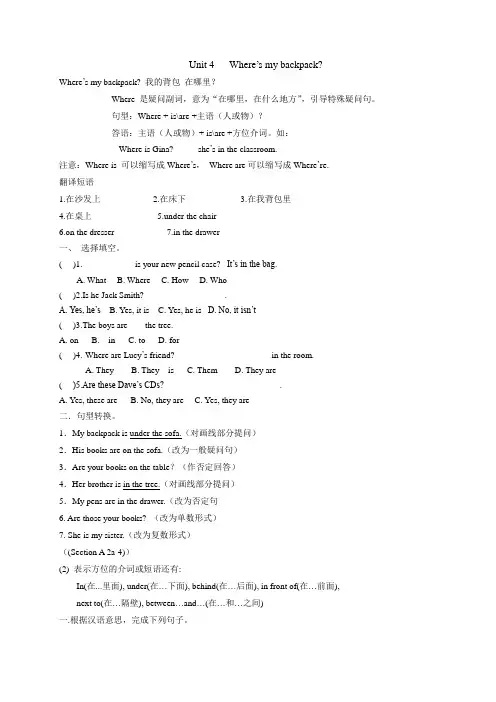
Unit 4 Where’s my backpack?
Where’s my backpack? 我的背包 在哪里?
Where 是疑问副词,意为“在哪里,在什么地方”,引导特殊疑问句。
句型:Where + is\are +主语(人或物)?
答语:主语(人或物)+ is\are +方位介词。如:
-Where is Gina? -she’s in the classroom.
注意:Where is 可以缩写成Where’s, Where are可以缩写成Where’re.
翻译短语
1.在沙发上_______ 2.在床下___ _____ 3.在我背包里__________
4.在桌上________ 5.under the chair___________
6.on the dresser________ _7.in the drawer__________
一、 选择填空。
( )1. ___________ is your new pencil case? It’s in the bag.
A. What B. Where C. How D. Who
( )2.Is he Jack Smith? _________________.
A. Yes, he’s B. Yes, it is C. Yes, he is D. No, it isn’t
( )3.The boys are ___ the tree.
A. on B. in C. to D. for
( )4.-Where are Lucy’s friend? -___ in the room.
人教版七年级英语上册1--4单元知识点总结
人教版七年级英语上册1--4单元知识点总结
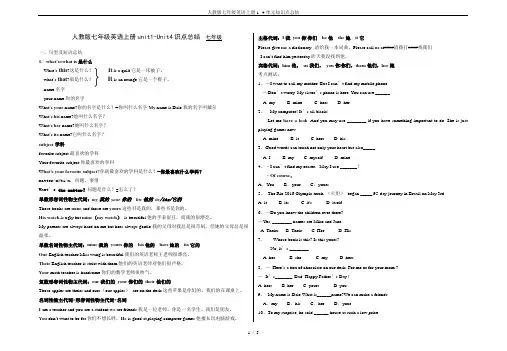
1 / 5 人教版七年级英语上册unit1-Unit4识点总结 七年级
一、句型及短语总结
1. what’s=what is是什么
What’s this?这是什么? It is a quilt.它是一床被子。
what’s that?那是什么? It is an orange.它是一个橙子。
name名字
your name你的名字
What’s your name?你的名字是什么?=你叫什么名字.My name is Dale.我的名字叫戴尔.
What’s his name?他叫什么名字?
What’s her name?她叫什么名字?
What’s its name?它叫什么名字?
subject学科
favorite subject最喜欢的学科
Your favorite subject你最喜欢的学科
What’s your favorite subject?你就最喜欢的学科是什么?=你最喜欢什么学科?
matter/mætə/n. 问题,事情
What’s the matter?问题是什么?=怎么了?
单数形容词性物主代词:my我的 your你的 his他的 its/its/它的
These books are mine and those are yours.这些书是我的,那些书是你的。
His watch is ugly but mine(my watch) is beautiful.他的手表很丑,而我的很漂亮。
My parents are always hard on me but hers always gentle.我的父母对我总是很苛刻,但她的父母总是很温柔。
单数名词性物主代词:mine我的 yours你的 his他的 hers她的 its它的
Our English teacher Miss wang is beautiful.我们的英语老师王老师很漂亮。
人教版英语七年级上册期中考试(Unit 1-Unit 4)知识点总结

第 1 页 共 17 页 人教版英语七年级上册期中考试(Unit 1-Unit 4)知识点总结
Unit1 My name's Gina
【教材内容解析】
Section A
1. My name’s Gina. (P. 1)
My name’s...意为“我的名字是……”,是自我介绍时常用的句型,name's是name的缩写形式,提问“你叫什么名字?”用“What is your name?”。
My name’s Sally.=I’m Sally.
2. I’m Jenny. (P. 1)
I’m Jenny.相当于My name is Jenny.。自我介绍时,用I’m或者My name is...均可,前者更加随意些。
I am Mary.=My name is Mary.
3. ---Nice to meet you!
---Nice to meet you, too. (P. 1)
英美人初次见面或者经第三方介绍认识时,常说Nice to meet you!,回答时用Nice to meet you, too!
---This is Li Ming.
---Nice to meet you!
---Nice to meet you, too!
4. What’s your name? (P. 1)
“What’s your name?”用来询问对方的姓名的一般用语,答语为“My name is...”。
---What’s your name?
---I’m Mary/My name is Mary.
5. I’m Ms. Brown. (P. 1)
Ms.意为“女士”,用于女子的姓氏或者姓名前,不指明是否结婚。
Ms. Green is our math teacher.
6. And what’s her name? (P. 2) 第 2 页 共 17 页 and用作连词,意为“而且、又、和”,本句中的and起到承上启下的作用。
人教版英语 七年级上册各单元知识点详解
第1页 Starter Unit 1 Good morning.
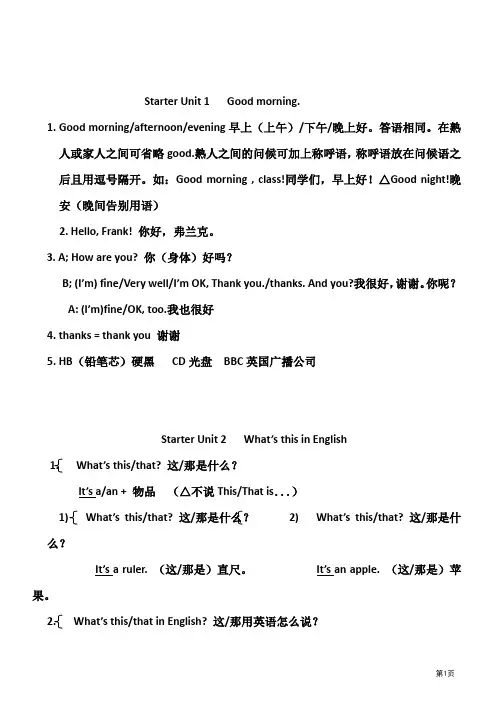
1. Good morning/afternoon/evening早上(上午)/下午/晚上好。答语相同。在熟人或家人之间可省略good.熟人之间的问候可加上称呼语,称呼语放在问候语之后且用逗号隔开。如:Good morning , class!同学们,早上好!△Good night!晚安(晚间告别用语)
2. Hello, Frank! 你好,弗兰克。
3. A; How are you? 你(身体)好吗?
B; (I’m) fine/Very well/I’m OK, Thank you./thanks. And you?我很好,谢谢。你呢?
A: (I’m)fine/OK, too.我也很好
4. thanks = thank you 谢谢
5. HB(铅笔芯)硬黑 CD光盘 BBC英国广播公司
Starter Unit 2 What’s this in English
1.
What’s this/that? 这/那是什么?
It’s a/an + 物品 (△不说This/That is...)
1) What’s this/that? 这/那是什么? 2) What’s this/that? 这/那是什么?
It’s a ruler. (这/那是)直尺。 It’s an apple. (这/那是)苹果。
2. What’s this/that in English? 这/那用英语怎么说?
第2页 It’s a/an + 物品 (△不说This/That is...)
in + 语言:用某种语言 in Chinese/English/Japanese用汉/英/日语
人教版英语七年级上册所有单元知识点总结

精品文档
. 七年级各单元知识点汇总
Unit1 My name’s Gina.
重点短语
1. your/his/her/my name 你的/他的/她的/我的名词
2. first name 名字
3. middle school 中学
4. telephone number 电话号码
5. last name 姓
6. in China 在中国
重点句型
1.—What’s your name? 你叫什么名字?
—Alan 艾伦
2.—I’m Jenny. Nice to meet you. 我是珍妮。见到你很高兴。
—Nice to meet you, too.见到你我也很高兴。
3.—Good morning! I’m Cindy. 早上好!我是辛迪。
—Hello, Cindy! I’m Dale.你好,辛迪!我是戴尔。
4.—My name’s Linda. Are you Helen? 我是琳达。你是海伦吗?
5.—What’s her name? 她叫什么名字?
—She’s Jane. 她是简。
6.—Is he Jack? 他是杰克吗?
—No, he isn’t. His name’s Mike.不,他不是。他的名字是迈克。
7. What’s your phone number?你的电话号码是多少?
It’s 587-6275. 它是587-6275。
8. My friend is in China.我的朋友在中国。
重点语法
1. 形容词性物主代词
人称代词 第一人称 第二人称 第三人称
主格 I you he she it
形容词性物主代词 my your his her its
2. Be动词的一般现在时形式:am, is, are
I用am You 用are
Is 用于他他它
Unit2 This is my sister.
人教版新目标七年级上册英语课本-第四单元精选全文

精选全文完整版(可编辑修改)
Unit 4 Where’s my schoolbag?
Language Goal: Talk
about where things are
语言目标:谈论物品的位置
1a
Match the words with the
things in the picture.
将单词与图中物品配对。
1. table __________
2. bed ____________
3. bookcase _________
4. sofa ___________
5. chair ____________
6. school __________
7. books ___________
8. keys ____________
1b Listen and number the things in the picture [1-4]. 听读音,为图中物品编号。
1c Practice the conversation in 1a with your partner. Then make your own
conversations using the words in the box.
练习1a中的对话,然后与同伴用方框中的单词编新对话。
on in under
A: Where’s the schoolbag?
B: It’s under the table.
2a Listen and number the things [1-6]. 听录音,为物品编号。
2b Listen again. Find the things from 2a and number them in the picture [1-6].
再听一遍录音,找出2a中的物品编号。
2c Ask and answer questions about the things in the picture in 2b.
新人教版7年级英语上册知识点总结
七年级上册英语 各单元知识点汇总
Starter Unit 1-3 知识梳理
【重点短语】
1. good morning/afternoon/evening 早上/下午/晚上好 2. good night 晚安
3. thank you = thanks 谢谢你 4. in English 用英语
5. CD 光盘,激光唱片 6. BBC 英国广播公司
7. NBA (美国)全国篮球协会 8. P 停车场,停车位
9. kg 千克,公斤 10. S 小号的
11. M 中号的 12. L 大号的
13. UFO 不明飞行物
ad广告 ABC基础知识 BBC英国广播公司 A.D.公元 B.C.公元前
CBC加拿大广播公司 V胜利 CAAC中国民航 OK好吧 ID身份
DDD国内长途直播
IDD国际长途直播 HK香港 CD光盘 CBA中国篮球协会 P.E.体育 IT信息技术 DJ音乐节目主持人 TV电视 PC个人电脑 IQ智商 EQ情商 MBA工商管理学硕士 W.C.洗手间 MTV音乐电视 USA=US美国 UK 英国 UN联合国 VCD视频高密光盘 WTO世贸组织 WHO世界卫生组织 DVD数字化视频光盘
人教版七年级上册英语期中考试知识点整理:Unit4
人教版七年级上册英语期中考试知识点整理:Unit4
一.重点词组
e of 2 .in the room 3. in the bookcase 4.
on the chair 5.under the table 6. I don’t know 7. behind
在……后面
二. 重点句型.
1.Where’s the +东西 ? -----It’s + on in under
+ 介词短语
2.Where are your his her + 东西 ? --- They’re on in under +介词短语
三.知识点
1.介词:是用以放在名词或代词之前,表明该名词与其它词之间某种关系的一类词。(不能单独使用,需与某一名词或代词等搭配成介宾短语)(on in under)eg: on the
bed
2. 定冠词 the 的用法:
a. 常用在特指的单复数名词前,指某人,某物,某些人或某些物. eg: The students are boys.
b . 用于双方都知道的人或物.eg: The girl is my friend.
c. 上文提到的人或物, 下文再次提到. eg: I have
a pen. The pen is red.
d. play 后跟球类名词是,不用the. 乐器前一定要用 the. ( play basketball play the drums )
3.. Here is my room. ( here is = this is )
4.. have has : 表示“拥有” “占有”. eg: I
have a computer.
以上就是为大家整理的人教版七年级上册英语期中考试知识点整理:Unit4,大家还满意吗?希望对大家有所帮助!
相关标签搜索:七年级期中复习
(完整word)人教版七年级英语上册知识点总结及习题,推荐文档
七年级英语上册
Start Unit 1 Good morning!
1、Good morning! 早上好!
Good after noon!下午好!
Good eve ning 晚上好!
其回答都是其本身。
2、 Nice to meet you !回答是:Nice to meet you !或 Nice to meet you ,too!
3、 How do you do? 答语仍然是: How do you do?
4、 How are you? 答语是: Fine./I'm fine./I'm OK.Thanks.And you?
5、 动词be的一般现在时态:
我(I)用am ,你(you)用are, is连着他(山6)她(she)它(it )。
单数名词用is,复数名词全部都用are。
变否定,很简单,在be后把not加。
变疑问,be前提,句末问号莫丢弃。
变特疑,特殊疑问词加上一般疑问句。
Start Unit 2 What's this in English?
1、 this 这“,这个”指示代词,用来指代距离较近的单个的人或物。反义是 that, 用 来指代距离比较远的单个的人或物。this的复数是these;that的复数是those.
含有this/that把this/that提句首,其肯定回答是: Yes,it is否定回答是:No,it isn't.
含有these/those把these/those提句首,其肯定回答是:Yes,they are否定回答是:No,they aren't.
2、 in+语言声音方式,用……语言(声音、方式)”例如:in English用英语”
3、 a+辅音音素开头的单词或字母(读音)
an+元音音素开头的单词或字母(读音)
4、 What's this in English?回答是:It's a/an+可数名词单数。 2
5、 What're these in English?回答是:They are+可数名词复数或不可数名词。3
人教版英语七年级上册知识点归纳
人教版英语七年级上册知识点归纳
Starter Unit 1
知识点:
1。 短语归纳:
good morning 早上好 good afternoon 下午好 good evening 晚上好
name list
名单 an English name 英文名字
2。 必背典句:
(1) Good morning, Alice! 早上好,艾丽斯!
(2) Good afternoon!
下午好!
(3) Hi, Bob! 你好,鲍勃!
(4) Hello, Frank! 你好,弗兰克!
(5) Good evening
晚上好!
(6) -How are you? 你好吗?
—I’m fine, thanks。 How are you? 我很好,谢谢.你好吗?
—I’m OK。 我很好。
3.英语中常见的问候语
在英语中,见面时的问候语有很多常用的有:
① Hello! “你好!”是比较随便、不分时间的一种问候语,通常用于打招呼、打电话。表示惊讶或引起对方注意。对方应答仍用Hello!
② Hi! “你好!"的使用比hello!更随便,在青年人中使用更为普遍。
③ Nice to meet you! “很高兴见到你!"是两个初次见面、经介绍相识的人互相打招呼的用于。回答时可以说Nice to meet you, too。或者Me, too。表示“见到你很高兴”
④ How do you do? “你好!”用于初次见面,是非正式的打招呼用语。对方应答语应是“How do you do?"
How are you? 表示问候 How are you? 意为“你好吗?”,为询问对方身体状况的问候语,应答语一般是“I'm
fine. Thank you. / I’m very well。 Thank you。 / I’m OK。