
六年级下册英语-Unit2知识点归纳 译林版(三起) (2)
6下Unit2 Good habits知识点班级姓名词组
1. have many good habits有许多好习惯
2. get up early 起床早
3. never go to bed late从不晚睡觉
4. brush one’s teeth刷牙
5. before bedtime睡觉前
6. put his things in order
把他的东西整理得井井有条
7. do well at home在家做得好
8. finish one’s homework 完成某人的家庭作业
9. before/after dinner 晚饭前/晚饭后
10. go to bed late睡觉晚
11. listen to his teachers听他的老师们说
12. keep his room clean and tidy
保持他的房间干净而整齐
13. help his parents帮助他的父母
14. have some bad habits有一些坏习惯
15. feel sleepy in the morning早晨感到困
16. do his homework late at night
做他的家庭作业做到夜里很晚17. know him well 很了解他18. last night/yesterday evening昨夜
19.walk fast走得快
20. have breakfast on time按时吃早饭
21. four short horses四匹矮马
22. run through the grass跑步穿过草地
23. wash one’s face洗脸
24. come to see her来看望她
25. show you around our house
带你参观我们的房子
26. go into the living room走进客厅
27. big and clean又大又干净
28. small and nice 又小又好看
29. see a lot of toys on the floor
看见许多玩具在地板上
30.put your books and toys in order
把你的书和玩具摆放整齐
31. under/behind the bed在床下面/后面
32. run fast/slowly跑得快/跑得慢
33. walk fast /slowly走得快/走得慢
34. sing well/badly唱得好/唱得差
35.whose bedroom 谁的卧室
36.a messy bedroom 一间凌乱的卧室
句型
1.He gets up early in the morning and never goes to bed late.他早上起床早,从来不晚睡。
2.My sister brushes his teeth in the morning and before bedtime. 我妹妹在早上和睡觉前刷牙。
3.I always put my things in order. 我总是把我的东西整理得井井有条。
4.We usually finish our homework before dinner. 我们通常在晚饭之前完成家庭作业。
5. They listen to their teachers at school. 他们在学校听老师的话。
6.He also does well at home. 他在家也表现得好。
7.He keeps his room clean and tidy. 他保持他的房间既干净又整齐。
8.He often does his homework late at night and does not go to bed early.
他经常做作业做到深夜并且不早睡。
9.He sometimes feels sleepy in the morning. 他有时在早上感觉困。
10.Wang Bing knows Liu Tao well. 王兵很了解刘涛。
11.Did you go to bed late last night?
Yes, I did./ No, I didn’t.你昨晚睡得晚吗?是的,我是。
/不,我不是。
12.Let me show you around our house. 让我带你参观我们的房子。
13.I always have my lunch on time. 我总是准时吃午饭。
14. You should put your books and toys in order. 你应该把你的书和玩具放得井井有条。
15. The man is singing badly. 男士正唱歌唱得糟糕。
16.The boy is doing well at school. 男孩在学校表现得很好。
语法知识
副词状语的顺序:
1.句末/尾时:方式状语-地点状语-时间状语:地点和时间状语内部的顺序由小到
大。
如:I ate some noodles at school yesterday. 昨天我在学校吃了一些面条。
2.句首时:时间状语-地点状语
如:When and where did you meet yesterday? 你们昨天什么时候,什么地方见面的?
3.频率副词位于助动词和情态动词之后、行为动词之前。
常见的频率副词有:
always, usually,
often, sometimes, never. 但sometimes, often 等可以放在句首或句尾,usually 可放在句首。
如:(1)Sometimes I get up early .=I sometimes get up early . 我有时起得早。
(2)The workers usually have lunch at the factory. 工人们通常在工厂里吃午饭。
(3)They often do their homework in the evening. 他们经常在晚上写作业。
(4)She was always later for school last year. 她去年上学总是迟到。
译林英语六年级下册Unit 2知识梳理

六下Unit 2 Good habits(一)背背默默单词:1. habit 习惯2. never 从不3. finish 完成4. tidy 整洁的5. sleepy困的;困倦的6. early 早的7. late 迟;晚8. slowly 慢地9. badly 差地;不好10. order 顺序;规则11. form 形成;养成12. learn 学习;学会13. brush 刷;毛笔14. keep 保持15. messy 凌乱的16. bedtime 就寝时间词组:1. try to form good learning habits 努力养成良好的学习习惯2. a good/bad boy一个好/坏男孩3. have many good/bad habits有许多好/坏习惯4. get up early 早起5. never go to bed late 从不晚睡6. brush one’s teeth刷牙7. before bedtime 在睡觉前8. at home 在家9. put sth in order 把东西放整齐10. finish one’s homework完成(某人的)作业11. before dinner 在吃晚饭前12. listen to the teachers 听老师们的话13. at school 在校14. do well 表现好15. keep the room clean and tidy 保持房间整洁16. help one’s parents 帮父母17. do one’s homework 做(某人的)作业18. at night 在夜晚,在晚上19. feel sleepy 犯困20. know sb well 对某人了解21. last night 昨晚22. walk fast 走得快23. come to see sb 来看某人24. show sb around 带某人参观25. go into 走进26. living room 起居室27. on the floor 在地板上28. under the bed 在床下29. run fast/slowly跑得快/慢30. walk fast/slowly走得快/慢31. sing well/ badly唱得好/坏32. do well/badly做得好/坏33. get up early/ late起得早/晚34. go to bed early /late睡得早/晚35. go to school early/late上学早/晚36. on time 准时37. run through the grass 奔跑穿过草地38. pick one 挑一张39. whose bedroom 谁的卧室40. short horse 矮腿马句子:1. He gets up early in the morning and never goes to bed late. 他早上起得很早并从来不晚睡。
译林版小学英语六年级下册第二单元知识点
译林版小学英语六年级下册第二单元知识点【Story time部分】课文详细解读1.a good boy一个好男孩2.many good habits许多好习惯3.get up early起床早get up动词短语,动词后用副词进行修饰,后面接early副词,意为”早地”;early 做形容词有“早的”含义,故其属于”形容词和副词同形”;同类用法的还有:wake up late醒得晚,study hard努力学习,run fast跑得快,jump high跳得高。
4.go to bed early/late睡觉早/晚5.brush one’s teeth刷牙6.before bedtime睡觉前before在…之前→after在…之后after lunch午餐之后7.put…in order把…整理得井井有条order秩序in order按顺序地、井井有条地8.finish one’s homework完成某人的家庭作业finish完成,结束→begin开始9.listen to one’s teachers听某人的老师们讲课10.at school在学校at+局域性的小地点at the park在公园,at the supermarket在超市11.do well做得好,well此处是副词“好地”12.keep his room clean and tidy保持他的房间干净整洁结构为keep sth.+形容词,意为”保持…”13.have some bad habits有一些坏习惯①have a good habit有一个好习惯,②关于bad的短语:be bad for对…有坏处→反义短语:be good for对…有好处14.do his homework late做他的家庭作业做得晚15.feel sleepy感到困倦feel作为感官动词,后面直接加”形容词”,不需变副词;sleepy困倦的16.know sb.well非常了解某人17.walk fast走得快本单元核心形容词整理:messy脏乱的→tidy整洁的clean干净的→dirty脏的fast快地→slowly慢地early早的/早地→late晚的/晚地good好的→bad坏的/差的well好地→bad坏地【Grammar time部分】单元核心语法解读频率副词:用于表示做某事/某种行为发生的频率大小,一般放在主语和谓语动词之间。
译林版小学英语六年级下册第二单元知识点

Unit2Good habits一、重点单词习惯habit干净的;整齐的tidy快的fast从不never迟的late完成finish差的badly困的sleepy慢速地slowly二、重点短语1、a good boy一个好男孩2、have many good habits有许多好习惯一个坏习惯a bad habit3、get up early in the morning在早晨早早得起床4、never go to bed late从不晚睡觉5、go to bed early早早睡觉6、before bedtime睡前7、go to bed late last night昨晚很晚睡觉8、finish his homework完成家庭作业9、finish primary school小学毕业10、before dinner在晚饭前11、after lunch午饭后12、shouldn’t go home late不应该晚回家13、do well at home在家做得好14、keep his room clean and tidy保持房间干净并整洁15、also help his parents do housework也帮助他的父母亲做家务16、do his homework late at night在晚上家庭作业做得晚17、brush his teeth刷他的牙齿18、feel sleepy感觉困倦19、know her well非常了解她20、always put things in order总是把东西摆得井井有条21、walk fast/slowly走得快/慢22、run very fast跑得非常快23、listen to his teacher at school在学校听老师讲24、have breakfast on time准时吃早饭25、short horses矮矮的马26、run through the grass(跑)穿过草丛27、wash your face at seven o’clock在七点洗你的脸28、come to see her来看她29、show you around the house带你参观房子30、go into the living room进入起居室31、big and clean又大又干净32、small and nice小而干净33、a lot of books and toys许多书和玩具34、on the floor在地上35、under the bed在床下36、put your books and toys in order把你的书和玩具整理好37、sing badly唱得不好38、do badly做得不好39、swim well游得好40、pick one挑一个41、pick up捡起来(pick it up/pick them up)42、pick apples摘苹果43、in the street在街上三、重要知识点动词第三人称单数变化规则(1)直接在动词后+slike-likes play-plays(2)以s,x,sh,ch接尾的动词+eswash-washes watch-watches brush-brushes(3)以辅音+o接尾的动词:+esgo-goes do-does(4)以辅音+y接尾的动词:变y为i+esfly-flies study→studiesEg:用所给词的适当形式填空(一般现在时)1.She______(do)homework by herself.2.Jack______(go)home by bike.3.The giant______(climb)up the beanstalk(豆茎).4.Her mum______(run)to the goose.5.He______(do not)like apple副词和频率副词1.副词的分类I always have breakfast on time.(on time意为“按时,准时”)(1)时间副词:常见的有now,then,soon,ago,lately,later,before,early,today,tomorrow, yesterday,tonight,suddenly,still,just等。
六年级下册译林版英语第二单元知识点
六年级下册译林版英语第二单元知识点English:The second unit of the sixth grade book is about daily routines and time expressions. It introduces vocabulary related to daily activities such as "get up", "have breakfast", "go to school", and "do homework". Students also learn how to express time in English, including how to ask and tell the time, such as "What time is it?" and "It's 7 o'clock". The unit also covers the use of "at", "on", and "in" to talk about time, such as "at 7 o'clock", "on Monday", and "in the morning". In addition, students learn about the use of adverbs of frequency, such as "always", "usually", "often", "sometimes", and "never", to describe how often they do certain activities.中文翻译:六年级第二单元是关于日常作息和时间表达的知识。
Unit2 Grammar time(练习及解析)_译林版(三起)六年级英语下册-经典教学教辅文档
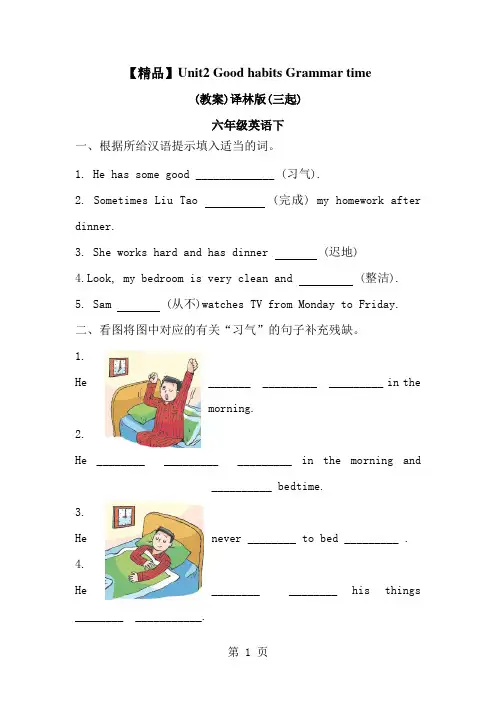
【精品】Unit2 Good habits Grammar time(教案)译林版(三起)六年级英语下一、根据所给汉语提示填入适当的词。
1. He has some good _____________ (习气).2. Sometimes Liu Tao (完成) my homework after dinner.3. She works hard and has dinner (迟地)4.Look, my bedroom is very clean and (整洁).5. Sam (从不)watches TV from Monday to Friday.二、看图将图中对应的有关“习气”的句子补充残缺。
1. He _______ _________ _________ in themorning.2.He ________ _________ _________ in the morning and__________ bedtime.3.He never ________ to bed _________ .4.He ________ ________ his things ________ ___________.5.He usually ___________ his homework __________ __________.6.He _________ his room _________ and __________.7.He often ________ his homework________ at night.8.He does not _______ to bed _________. 9.He sometimes _________ __________ in the morning.三、根据短文内容判断,对的写“T”,错的写“F”。
Mrs White is a housewife. She is always busy in the morning. She gets up early and cooks breakfast. She has two children, Leo and May. Leo is ten years old and May is eight years old. They get up at seven o’clock. Leo makes his bed and washes quickly. May does not make her bed. Her bedroom is often messy. After breakfast, Mrs White takes them to school by car. Then, she goes to the supermarket and buys food for dinner.One day, Mr White has a meeting in the office. He does not come home for dinner. Mrs White is busy in the kitchen.Leo and May are waiting for dinner at the table. Leo sa ys:” Dad isn’t at home. I’m the head of our family today. I can sit on Dad’s chair.” May says,” You should sit on Mum’s chair.”( ) 1. Mrs White has two sons.( ) 2. Leo is ten years old.( ) 3. May always put her things in order.( ) 4. Leo likes his father’s chair.( ) 5. May thinks her mother is the head of the family.答案及解析:一、habits finishes late tidy never二、1. gets up early2. brushes his teeth before3. goes late4. always puts in order5. finishes before dinner6. keeps clean tidy三、F T F F T解析:1.由文中关键句“She has two children, Leo and May. Leo makeshis bed and washes quickly. May does not make her bed.”可知,Leo是男孩,May 是女孩,故Mrs White has two sons.为F。
Unit2Goodhabits(讲义)-译林版英语六年级下册

Unit 2 Good habits必备词汇短语habit (名词)习惯slowly(副词)慢速地never(副词)从不badly (副词)差地,不好late(副词)迟,晚good habits 好习惯finish(动词)完成show...around 带......参观tidy(形容词)干净的,整齐的brush one's teeth刷牙fast(副词)快地get up early 很早起床put...in order 把……整理得井井有条go to bed late睡觉晚bad(形容词)不好的,坏的sleepy(形容词)困的,困倦的last night 昨夜句子归纳1.He gets up early in the morning and nevergoes to bedlate.他早晨很早起床,且从不晚睡觉。
2. Did you go to bed late last night,LiuTao?你昨夜睡得很晚吗,刘涛? Yes , but Im not sleepy.是的,但是我不困。
3.You shouldn't go to bed late ,Liu Tao.你不应该很晚睡觉,刘涛。
练一练一、选择题1.We put our things _________ order. ()A.in B.on C.at 2.—Where is Bobby? We can't ______ him in the bedroom. ()—I'm here, under the bed.A.watch B.see C.look D.have 3.The teachers always tell us eating _______fast food is bad for our health. () A.too much B.too many C.too little 4.Can you teach _________ English? ()A.I B.me C.my5.We _______ any dancing classes on Friday. ()A.are having B.aren’t having C.don’t have D.are have 二、填空题三、补全对话/短文A: 11B: Yes. I am a good boy. I get up early in the morning. A: 12B: Yes, and I also brush teeth in the morning.A: Is your bedroom messy?B: 13A: How do you put your things?B: 14A: Great! You really have good habits.B: 15四、句型转换五、连词成句21.should, shoes, in, you, put, your, order (.)22.basketball, he, in, the, plays, afternoon (.)23.always, order, puts, Helen, at, her, in, things, home (.)24.boy, the, up, gets, late (.)25.brushes, he, teeth, his, in, the, morning (.)六、阅读理解Choose the best answer. 根据短文选择最佳答案。
译林英语六下Unit2知识点(K12教育文档)
译林英语六下Unit2知识点(word版可编辑修改)编辑整理:尊敬的读者朋友们:这里是精品文档编辑中心,本文档内容是由我和我的同事精心编辑整理后发布的,发布之前我们对文中内容进行仔细校对,但是难免会有疏漏的地方,但是任然希望(译林英语六下Unit2知识点(word版可编辑修改))的内容能够给您的工作和学习带来便利。
同时也真诚的希望收到您的建议和反馈,这将是我们进步的源泉,前进的动力。
本文可编辑可修改,如果觉得对您有帮助请收藏以便随时查阅,最后祝您生活愉快业绩进步,以下为译林英语六下Unit2知识点(word版可编辑修改)的全部内容。
Unit2 Good habits一、词组【四会词组】1。
good habits 好习惯2。
bad habits 坏习惯3。
never go to bed late从不晚睡觉4。
walk fast 快速地走4。
finish his homework before dinner 晚饭前完成他的作业6。
keep his room clean and tidy 保持他的房间又干净又整洁【三会词组】1. try to form good learning habits 试着形成好的学习习惯2。
get up early in the morning早上早早地起床 3. before bedtime睡觉前4. put his things in order把他的东西放得井井有条5。
at home在家6。
feel sleepy in the morning早上觉得困7.do well at home在家做得好8. know Liu Tao well很了解刘涛9. last night昨晚10。
go into Tina's bedroom进入蒂娜的卧室11。
do badly at school在学校做得不好12。
run slowly跑得慢二、句子【四会句子】1。
译林版六年级英语下册第二单元知识点
Unit 2 Good habits 知识点梳理一、四会单词1. habit 习惯2. never 从不3. late 迟,晚4. finish 完成5. tidy 干净的,整齐的6. fast快地二、三会单词1. bad 不好的,坏的2. sleepy 困得,困倦的3. slowly 慢速的地4. badly 差的,不好三、短语积累1. good habits 好习惯2. bad habits 坏习惯3. 16. get up early 起床早4. go to bed late 睡得晚5. brush his teeth(单数tooth) 刷牙6. before bedtime 睡觉前7. put … in order 8. finish his homework把……整理得井井有条完成他的家庭作业9. before dinner 吃饭前10. listen to his teachers 听他老师的11. do well 做得好12. keep…clean and tidy 保持……干净整洁13. help his parents 帮助他的父母14. do his homework late 迟做作业15. feel sleepy 感到困倦16. know him/her well 非常熟悉他/ 她17. last night 昨夜18.walk fast 走的快19. show… around 带领……参观20. run fast 跑得快21. sing badly 唱得不好22. go into 走进23. walk slowly 走得慢四、四会句型1. I walk fast in the street. 在街上,我走得快。
2. We / They do well at home. 我们/ 他们在家表现不错。
3. He gets up early in the morning. 他早上早早起床。
最新译林 六年级下册 Unit 2 知识点总结
Unit2 Good habits March 7, 201512hobbby爱好;业余爱好;喜欢 habit习惯—指某人有规律地经常做某事,3①Telling the truth is a very good and telling lies is a bad .4②Reading is a good as well as a nice to keep.5③My cousin has a of stamps.6④—What's another girl's hobby? —She is interested in r_______ books.7⑤吃太多的糖果对人们的牙齿没有好处。
8Eating too much ____ ___(糖果) is not good for people's teeth. It’s a bad . 9⑥This is not a match. We're playing chess just for _____.10A. habitB. hobbyC.funD. Game11⑦---Don’t have so much junk food, Andy.12---Sorry, I won’t. I’ll have more fruits and form a good eating _____.13A.hobby B.habit C.list D.menu1415一,词组、短语或句子161.★try to form good learning habits 17试着形成好的学习习惯182. have many good habits有许多好的习惯193. ★get up early in the morning早上早早20地起床214. ★never go to bed late从不晚睡觉225. brush his teeth刷牙236. ★before bedtime睡觉前247. ★at home在家258. ★put his things in order26把他的东西放得井井有条279. finish his homework before dinner28在晚饭前完他的作业2910. listen to his teachers at school30在学校听他老师的话3111. ★do well at home在家做得好3212. ★keep his room clean and tidy33保持他的房间又干净又整洁3413. help his parents帮助他的父母3514. have some bad habits有一些坏习惯3615. do his homework late at night37晚上很晚做他的作业3816. go to bed early早睡觉3917. ★feel sleepy in the morning早上觉得40困4118. ★know Liu Tao well很了解刘涛4219. went to bed late last night昨晚睡觉很43晚4420. ★I’m not sleepy.我不困。
Unit 2 Good habits(单元解读)六年级英语下册(译林版三起)
六年级下册Unit 2 Good habits单元解读一、单元内容体现的新课标理念本单元在英语核心素养的育人价值下进行,围绕单元主题“人与习惯”展开教学。
本单元学习的主题主要是学习如何用一般现在时和频率副词表述一个人的好习惯和坏习惯等。
二、单元信息单元分为Story time、Grammar time、Fun time、Sound time、Song time、Cartoon time、Checkout time、Ticking time八部分组成。
主要学习关于习惯的一些表达。
在教学上,对本单元内容进行整合以及重组,分为四个课时进行教授。
1.Story time,这一部分是一篇文章,主要介绍了Wang Bing和Liu Tao的一些习惯。
文章首先介绍了Wang Bing有许多好习惯,比如早起等。
接着介绍了Liu Tao也是一名好学生,但是他也有许多坏习惯。
本节课当做一节阅读课进行授课,通过提问题来学习本篇文章,有目的的进行阅读,提升学生的阅读技能,以及学习如何表述习惯。
2.Grammar time&Fun time, 这两个部分作为一课时按照语法课进行教授,主要用副词如何形容一个人的习惯,以及频率副词放在一般现在时中如何使用。
并且进行练习巩固。
3.Song&Cartoon time,这两个部分作为一课时按照对话课进行教授。
Song time主要是时一首歌曲,在欣赏歌曲的同时,让学生们学唱,提高学生的兴趣,并且活跃课堂氛围。
Cartoon time是一篇对话,主要讲述了Tina的朋友们去她家拜访,对比了Tina和Bobby的卧室,一个很干净整洁,一个却很杂乱,形成了鲜明的对比。
本课时也是按照阅读课进行授课。
4.Sound time, Checkout time&Ticking time这三个部分作为一课时按照语音和复习课进行教授。
Sound time主要教授or组合在单词中的发音规则。