
《Unit 4 Natural disasters》
A. in B. on C. at
【5】notice v. be aware of something or someone 看 (或听)到;注意到;意识到 n. a written announcement in a place where everyone can read it 告示;通知 Luckily, I noticed where you had left the car. 幸好,我 注意了你停车的地点。 Every factory has received the notice. 每家工厂都接到 了通知。 【拓展】 notice=realize=be aware of 注意到;意识到 She didn’t notice her mistake yet.=She didn’t realize her mistake yet.=She wasn’t aware of her mistake yet. 她还没有意识到她的错误。
【3】dead adj. no longer functioning, for example, because it no longer has any electrical power(因为缺 电)不运行的,不转动的;no longer living 死的 The line is dead. 电话线路坏了。 The little dog is dead. 小狗死了。 【同根词】 (1) die v. 死亡 How many people died in the war? 在这次战争中有多 少人死亡? (2) dying adj. 垂死的 Everyone misses their friends when they are dying. 每 个人在垂死时都想念他们的朋友。 (3) death n. 死亡 War brings death and famine. 战争带来死亡和饥荒。
【同根词】 miss v. 错过;想念
二、根据汉语写出下列词组 1. 自然灾害 ___________________ natural disaster pass by 2. 通过;经过___________________ 3. 持续;坚持___________________ stick with 4. 闲坐___________________ sit around 5. 没有时间做…… ___________________ have no time to do 6. 不被理睬;不被注意___________________ fall on deaf ears 7. 盯着看;凝视___________________ stare at in surprise 8. 惊讶地___________________
过去式和过去分词分别为awoke, awoken。
She was awoken by the noise. 她被响声弄醒了。 I could not relax and still felt wide awake. 我不能放松下 来,仍然觉得没有一点儿睡意。
【同根词】
wake v. 醒来;叫醒
Please wake him up at six. 请在六点钟叫醒他。 【拓展】 (1)wake up 醒;醒来 They wake up every morning to work for their families and their future. 他们每天早上一醒来,就在 为了他们的家庭和未来而奔波。 (2)awake的反义词是asleep。
【4】stare v. look at someone or something for a long time 盯着看;凝视;注视
Ben continued to stare out of the window. 本继续凝视着
窗外。 【拓展】 stare at 盯着看;凝视;注视 Every time we stopped, everybody would stare at us. 每次我们停下来,每个人都会盯着我们。 【应用】 ( C )He stared ______ the blackboard and listened
【应用】 A ( )He notices the danger to the children. (选出可以替 换画线部分的最佳选项) A. is aware of C. doesn’t realize 【6】awake v. (make sb.) not sleep (使)醒来 adj. not sleeping 醒着的 B. is unaware of
三、翻译下列句子 1. 很多城市会被淹没和消失。 Many cities would be flooded and disappear. ___________________________________________ 2. 它开始让我担心。 It started to worry me. ___________________________________________ 3. 昨晚,我梦见了一场大洪水。 ___________________________________________ Last night, I dreamt about a great flood. 4. 我抽不出时间闲坐着担心洪水。 ___________________________________________ I can’t afford to sit around and worry about the ___________________________________________ flood.
【应用】 (1)( B )The line is dead. (选出可以替换画线部分的最 佳选项)
A. works
C. is not alive
B. doesn’t work
(2) The old man ___________ (dead) last year. died (3) The hero is not afraid to face ___________ (dead). death
【应用】 ( B )You should leave immediately. (选出可以替换画线 部分的最佳选项) A. at times B. at once C. on time
【8】missing adj. cannot be found 失踪的;cannot
find 找不到的;something has been removed or has come off, and has not been replaced 缺失的 They are looking for the missing girl. 他们正在寻找那个 失踪的女孩。
Are you awake or asleep? 你是醒着还是睡着?
【应用】 wakes He often ___________ (awake) up at seven in the morning.
【7】immediately adv. without any delay 立即;马上; 即刻 We have to act immediately and fight for it. 我们必须立 即采取行动,并为之战斗。 【同根词】 immediate adj. 立即的 You can get back immediate answers. 你可以即刻得到 回答。 【拓展】 immediately=right now=at once=right away 立即;马 上;立刻 How I wish I could go there immediately/ right now/ at once/ right away! 我恨不得马上去那儿!
【2】pass v. go past someone or something without stopping通过,经过;take something in your hand and give it to someone传递 I always pass the post office on my way to school. 在我去 学校的路上总要路过邮局。 【拓展】 (1) pass the exam 通过考试 He worked hard and passed the exam. 他努力学习并通 过了考试。 (2) pass by 经过 I passed by your house last night. 我昨天晚上经过 你家。 (3) pass out 晕倒 She passed out when she heard the bad news. 她听到 这坏消息后晕了过去。 (4) pass sth. to sb.=pass sb. sth. 给某人传递某物 He passed the bread to Brown. 他把面包递给布朗。
【应用】
(1)( B )He failed the exam. (选出可以替换画线部分的最
佳选项)
A. passed
B. didn’t pass
C. succeeded
(2)( C )She fainted after the hard work. (选出可以替换画 线部分的最佳选项) A. passed by B. passed to C. passed out
5. 好像他们不想离开。
___________________________________________ It seemed that they did not want to leave.
词汇精析
【1】badlyad v. severely严重地;厉害地 它的比较级和最高级分别是worse, worst。 I slept very badly last night. 昨天夜里我睡得很不好。 【同根词】 bad adj. 坏的;严重的;劣质的 Only bad weather can stop our plans for the picnic. 只有 坏天气才能阻止我们的野餐计划。 【拓展】 do badly in... 在……方面做得很糟糕 He does badly in school tests. 他在学校考试中成绩 不好。 【应用】 bad They met _________ (badly) weather on their way to school.
人教版(2019)必修第一册Unit4 Natural Disasters课件(共28张PPT)
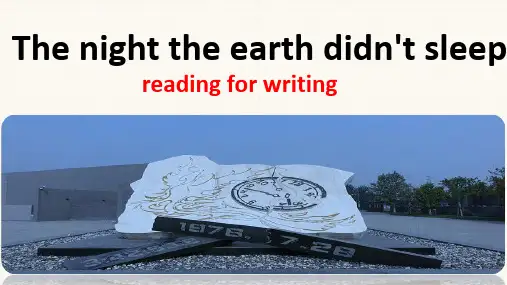
1. Who came to help Tangshan “breathe again”? 2. Has Tangshan revived itself finally?
Add more details to finish your own mind map.
Task 4: Writing a summary of the text.
Video clip
Which city: Tangshan Which year:
Step 1
Fast reading
Finish the following questions
1. Find out the topic sentence(主题句) of each para.
Para 1 Strange things were happening in the countryside of northeast Hebei.
Para 2 At 3:42, everything began to shake.
Para 3 Para 4
Everywhere survivors looked, there was nothing but ruins.
But hope was not lost.
Para 5 Tangshan started to revive itself and get back up on its feet.
The night the earth didn't sleep
reading for writing
learning objectives:
• learn t the basic historic truth of Tangshan Earthquake
Unit4NaturalDisasters词汇讲解清单-高中英语人教版

BIU4词汇学案1.disaster n.灾难;灾害词块:an air disaster 空难;a natural disaster 自然灾害2.tornado n.(pl.oes oros)龙卷风;旋风拆分:撕裂(torn)ado(阿朵)房屋的是“龙卷风”(tornado)3.drought n.旱灾;久旱派生:dry v.(把...)弄干→drought n.旱灾;久旱词块: severe drought 严重旱灾ndslide n.(landfall)(山地或悬崖的)崩塌;滑坡合成: land(n.土地)+slide(v.滑动,滑落)→landslide n.5.slide vi. &vt.(slid,slid)(使)滑行;滑动对比: side n.一边,一侧词块:slide into a room 偷偷溜进房间;slide sth. into a drawer 把...偷偷塞进抽屉6.tsunami n.海啸词块:set off a tsunami 引发海啸7.flood n.洪水;大量vi.淹没;大量涌入vt.使灌满水;淹没对比:food,flood→食物在“洪水”过后被运往灾区搭配:v. flood in/into 大量涌入;flood out of 蜂拥而出;be flooded with 被挤满...8.volcanic eruption火山喷发9.magnitude n.(地)震级;重大10.rescue n.&vt.营救;救援搭配:v. rescue sb.from... 从...营救n. e to one’s rescue 援救某人; rescue workers救援人员11.damage vt.损害;破坏n.损坏;损失联想:大(da)+妈(ma)+歌(ge)→大妈的歌具有破坏力搭配:n. do /cause damage to 对...造成损害12.destroy vt.摧毁;毁灭派:destruction n.毁坏;destructive adj.具有破坏力的13.e vacu ate vt.疏散;撤出vi.撤离词源e向外空(动词后缀)→evacuate 疏散;撤离14.helicopter n.直升机词块:~ parents 直升机式父母归类jet喷气式飞机→fighter战斗机→bomber轰炸机→helicopter直升机15.death n.死;死亡派生:dead adj.死的,去世的→death n.死;死亡th 名词后缀:状态;die v.死词块:be frightened/scared to death吓死;be bored to death 无聊死16.affect vt.影响:(疾病)侵袭;深深打动搭配:affect sth 影响...;be affected by/ be influenced by 被...影响易混:effect n.影响have a great effect on sth 对...产生影响;e into effect 生效17.shelter n.避难处;居所;庇护vt.保护;掩蔽vi.躲避(风雨或危险)拆分:她she+lt(“”拼音首字母)+er(“儿”)→她带着和儿子躲在“避难处”搭配:n. under the shelter of ...在...的庇护下;v. shelter sb./sth (from sb./sth.) 庇护...18.crack n.裂纹;裂缝vi.&vt.(使)破裂19.as if似乎;好像;仿佛语境:She looks as if she were ten years younger.她看起来好像年轻了十岁。
必修一 UNit 4 Natural Disasters 核心单词+重点句型 筑基讲义(原卷版)

必修1Unit4Natural Disasters精品句式1.A terrible storm hit/struck...,killing..一个可怕的地震发生在….杀死了….2.It was a cool autumn night when the earthquake happened.A large number of buildings fell down and roads were destroyed,leaving a great many people homeless.地震发生在一个凉爽的秋夜。
大量的建筑物倒塌,道路被毁,许多人无家可归。
3.With the help of the rescue team,people who were the trapped in the flood were saved.在救援队的帮助下,困在洪水中的人们得救了。
4.Clearly/Obviously/In my opinion/It seemed that people were shocked.显然/在我看来/似乎人们震惊了。
6.The whole city was in ruins after the earthquake.地震后整个城市成了一片废墟。
7.Human activity is an indispensable factor causing natural disasters.人类自身的活动是造成自然灾害的一个不可或缺的因素。
8.In the past hundred years,there have been frequent natural disasters,such as floods, droughts,earthquakes,and new deserts.在过去的几百年里,自然灾难不断,例如洪水,干旱,地震和沙漠化。
9.The disasters have killed millions upon millions of people,destroyed countless homes, and wiped out numerous pieces of fertile land.灾难杀死了无数人,损毁了很多房子,破坏了很多肥沃的土地。
必修一Unit4 NATURAL DISASTERS
必修一Unit4 Natural Disasters词语拓展1.destroy vt. 摧毁;毁灭—destruction n. 摧毁;毁灭;破坏—destructive adj. 造成破坏的;毁灭性的2.affect vt. 影响;深深打动—effect n. 效果;影响3.shock vt. 使震惊—shocked adj. 吃惊的;震惊的—shocking adj. 令人震惊的4.breathe vi./vt. 呼吸—breath n.呼吸的空气—breathless adj.气喘吁吁的—breathlessly adv. 气喘吁吁地5.suffer vt./vi. 遭受;受苦—suffering n. 痛苦—suffer n. 受难者;患者6.survive vt/vi 幸存;幸免;生存—survivor n. 幸存者—survival n.幸存7.calm vt/vi 使震惊;adj. 镇静的;沉着的--calmly adv.镇定地--calmness n. 平静;镇定知识点拓展1.rescue n.& vt.营救;救援[例句]We had given up the hope of rescue.我们那时已经放弃了营救的希望。
①She seemed to be waiting for someone to come ______ her rescue.②This boy ________(rescue) from the running river.③A wealthy businessman came to ________(they) rescue with a generous donation. 2.damage vt.损害;破坏n.损坏;损失[例句]The earthquake damaged several buildings.地震使一些建筑受到了破坏。
[例句]You have damaged my bicycle.You won’t have it again.你把我的自行车弄坏了。
Unit4Naturaldisasters句子成分基本句子结构讲义高中英语人教版
句子成分 & 基本句子结构知识框架知识讲解句子成分My friend,Tom, found his money missing on the way home yesterday.Hewas worried.1. 主语(subject )— S句子的主体,是句子说明的人或事物,通常由名词、代词、数词、名词化的形容词、不定式(短语)、动名词(短语)或从句担任。
句子成分 补语 状语 定语 主语 谓语 宾语 基本句子结构主语+谓语 主语+谓语+宾语主语+连系动词+表语 主语+谓语+双宾语 主语+谓语+宾语+宾补 主语+谓语+状语 主语+谓语+宾语+状语There be 句型 同位语 表语The apple is red.Four and five makes nine.The sick and the old need our help.Running is good for health.2. 谓语(verb)—V表示主语的动作或状态,由动词担任He often reads newspapers.The plane takes off at 8 o’clock.3. 宾语(object)—O表示动作的对象或行为承受者,一般位于及物动词(短语)或介词之后,通常由名词、代词、形容词、数词、名词化的形容词、不定式(短语)、动名词(短语)或从句担任直接宾语:direct object —DO间接宾语:indirect object —IOWhere did you buy that?I wish to call on you.We should help the poor.Do you understand what I mean?4. 表语(predicative)—P位于系动词之后,说明主语的特征、类属、状态或身份,通常由名词、代词、形容词、数词、副词、介词短语、不定式(短语)、分词短语或从句担任Please feel free to say what you really think.e to see me tomorrow when I am at work.She is singing.Dancing is her favorite activity.5. 宾语补足语(object plement)—C位于宾语之后,对宾语进行补充说明的成分,通常由形容词、分词(短语)、不定式(短语)、名词、介词(短语)或副词担任I found the book very interesting.Do you hear Tom singing?Please make yourself at home.Please keep the dog out.注意:主动语态变被动语态后,宾语补足语就变成了主语补足语Someone considered him to have stolen the money.He was considered to have stolen the money by someone.6. 定语(attributive)修饰或限定名词或代词的成分,通常由形容词、代词、数词、名词(所有格)、动名词(短语)、副词、介词短语、不定式(短语)、分词(短语)或从句担任Open your mouth and put on your tongue.It’s a fine day today.Put the child in the sleeping bag.Let’s try another way to do this.7. 状语(Adverbial)—A用来修饰动词、形容词、副词或句子,可以表示时间、地点、原因、目的、结果、比较、程度、条件、方式、让步等。
Unit 4 Natural Disasters教学设计-高中英语人教版(2019)必修第一册
指导思想1.普通高中英语课程标准根据《普通高中英语课程标准(2017年版)》,英语课程教学将秉承“立德树人,学科育人”的教学理念,明确以培养英语学科核心素养为课程目标,聚焦发展学生的语言能力(基础要素)、文化意识(价值取向)、思维品质(心智特征)和学习能力(发展条件)。
关注学科育人价值,关注学生思维发展,关注核心素养落地。
2.课程六要素整合理念六要素为主题语境、语篇类型、语言知识、文化知识、语言技能和学习技能。
课程六要素是一个相互关联的有机整体,共同构成核心素养发展的内容基础。
学生围绕某一具体语境,依托不同类型语篇,运用语言技能获取、梳理、整合语言知识和文化知识,并运用各种学习策略,提高理解和表达的效果。
3.英语学习活动观英语学习活动观是一种遵从“育人”理念,以英语学科核心素养为目标,学生为主体教师指导的教学活动组织形式。
该教学主张由三类具有关联性、递进性的学习活动构建,依次是学习理解类活动、应用实践类活动、迁移创新类活Step 3: First reading (8 mins):news Tsunami Hits Asia: Over 6,500 Dead, T asks Ss to make a judgement of a sample summary and then write a summary of their own version.Here is one summary of the news report.Read and check the main points it includes. Then write your own version.Writing1)Firstly, ss read the text and write a list of main elements(details), filling the first column of the table. T then give the suggested answers.P1: Strange things happened in the countryside before the earthquake.P2: An earthquake hit Tangshan, China on 28 July 1976.P3: More than 400,000 people were killed or badly injured.P4: Nearly everything in the city was destroyed.P5: The government and soldiers came and began rescuing and rebuilding the city.2)After that, ss write down the main idea of each paragraph based on the elements(details) in the first column, filling the second column of the table.Step 7: Drafting (15 mins)Step 9: Revising (5 mins)Ss get back their draft back and revise it according to the feedback they get from their partners. Students are encouraged to put forward questions on what they are not understand.Homework。
人教版高中英语必修一Unit4NaturalDisasters知识点梳理(带答案)
人教版高中英语必修一Unit4NaturalDisasters知识点梳理单选题1、Try to avoid such things ________will do you harm, unless you don't care about the rumors from all directions. A.thatB.asC.whichD.as that答案:B考查定语从句。
句意:除非你不在乎四面八方的谣言,否则尽量避免那些对你有害的事情。
在定语从句中缺少主语,且先行词things被such修饰,所以应用关系代词as。
故选B。
2、Peter can be really difficult at times ________ he’s a nice person in general.A.even ifB.as thoughC.as ifD.if only答案:A考查状语从句。
句意:彼得有时真的很难缠,即使一般情况下他是一个很好的人。
A. even if即使,尽管; B. as though似乎,好像; C. as if似乎,好像; D. if only要是...就好了。
空前表示Peter有时候很难缠;空后句子表示他通常情况都是很好很和善的人,前后有转折关系,只有A项even if可以引导让步状语从句,符合题意。
故选A项。
3、A sport with a broom on ice ________ requires bowling ________ makes curling one of the most unique sports out there.A.that … precisionB.that … diversityC./ … precisionD./ … diversity答案:A考查定语从句和名词词义辨析。
句意:冰壶是一项要求精准度的运动,它在冰上要使用冰刷,这使得冰壶成为最独特的运动之一。
Unit4Naturaldisasters课件牛津深圳版英语九年级下册
16.in surprise=surprisingly 惊奇地
17.fall on deaf ears=be paid no attention 不被理睬
第 12 页
18.for now=for the time being=at the moment=at present 暂时 19.don't have time=have no time=be busy with 没时间 20.afford to do=have enough time/money to do 负担得起 21.be careful!=look out!=Watch out!=Take care! 当心,小心 22.sit around=have nothing to do=lie around 无所事事 23.everywhere=here and there 到处
第9页
4.deaf adj. 聋的―→deafness n.聋;听力不佳 5.immediately adv. 立即;马上;即刻―→immediate adj. 立即的;直接的 6.missing adj. 失踪的―→miss v.丢失
第 10 页
三、同义词语记背 1.be dead=no longer working 失灵了,不工作了 2.alive=not dead 活着的 3.stick with=continue with=continue to do 持续;坚持 4.be deaf=not able to hear 聋的 5.notice=see=pay attention to=realize 注意到 6.realize=understand=know 意识到,知道 7.realize sth.=make sth. come true=make sth. become real 实现 8.awake sb.=wake up sb. 叫醒某人
Unit-4-Natural-Disasters-高中英语人教版2019必修一
And in Seoul, a landdsalimdeaged
a library and a
supermarket in a southern neighbourhood.Tchaeusleadndslide
was
by the heavy rain that has fallen in Seoul over
Type of information
number number place
activities
time
Tips: Listen for details Think about what you are listening for before you listen: numbers, dates, times, addresses, activities, people or places, reasons, etc.
5.When did people see the tornado in Memphis? A.At 12:00 am. B.At 9:00 pm. C.At 9:25 am. 6.Which buildings were damaged in Seoul? A.A library and a supermarket. B.A police office and a library. C.A hospital and a post office. 7.What caused the landslide in Seoul? A.The snow storm. B.The heavy flood. C.The heavy rain.
Unit 4 Natural Disasters 单元整体教学说课 课件高中英语人教版必修第一册
1.单元概述
By the end of the unit, we will be able to:1. identify different natural disasters and list how to take preventive and rescue measures to strengthen the awareness of precaution and flexibly use theme-related words & expressions as well as attributive clauses to comprehend and express;2. explore the signs, damage and rescue in an earthquake and the cause and damage in a tsunami, write a summary of a news report by concluding the main points to prevent and reduce the losses;3. describe a disaster and summarize disaster safety measures and precautions by giving a presentation on natural disasters, focusing on thinking about the relationship between nature and human.
Байду номын сангаас2.学习活动
核心问题3:学习任务的教育性(驱动性、关联性、挑战性)
Period 1 建构与主题“自然灾难”相关的主题词汇,为后面活动的开展奠定语言基础。初步探讨当人类面临自然灾害的威胁时,应该树立防灾意识,不断研究和认识自然灾害,提高在灾害中逃生和生存的能力。