
牛津沪教版英语七年级上期中重点知识点复习
七年级上期中重点复习一、复习思路按照期中考试范围U1-U5,分基础,语法和阅读等模板进行复习,上节课已经复习词汇,短语,本次课以复习语法为主。
二、复习要点一.人称代词:形容词性物主代词名词性物主代词反身代词人称单数复数单数复数单数复数第一人称my our mine ours myself ourselves第二人称your your yours yours yourself yourselves第三人称his, her, its their his, hers, its theirs himselfherself themselves2.祈使句祈使句imperatives指的是表示命令、请求、建议或劝告的句子。
其主语you常省略,谓语动词用原形,句末用感叹号或句号,读降调。
1. 祈使句基本句型(1)do型:动词原形+其他Stand up, please. = Please stand up. Look at the blackboard.(2)be型:Be + n./adj.Be a good boy! Be careful!Be careful! = Look out! = Take care!(3)let 型:Let + 宾语+ 动词原形+ 其它成分Let me help you. Let’s go to school together.(4)带主语型You, Jim, go to my office after class. You boys read the first part.2. 祈使句的否定(句型转换)(1) Don't + 动词原形Don't stand up. Don't be careless.Don't let them play with fire.(2)Let型的否定式有两种:“Don't + let + 宾语+ 动词原形+ 其它成分and“Let + 宾语+ not + 动词原形+ 其它成分”。
Don't let him go. / Let him not go.Let them not play with fire.(3)no开头,用来表示禁止性的标志语。
No smoking! No fishing!No parking! No swimming!3. 祈使句的回答祈使句的动作通常是表示将来发生的动作,所以回答祈使句时,一般用will或won’t。
(单项情景交际)在回答具有否定意义的祈使句时,要注意两点:1) 形式一致(即Yes与will保持一致;No与won’t保持一致)2) 事实一致(回答时,要注意分析上下文语境中所提供的条件)Eg:--- Don’t go out, please. It’s raining heavily outside.---- Yes, I will. I have to meet my brother at the airport. (不)3.现在完成时现在完成时1.现在完成时的定义:现在完成时表示动作发生在过去,但与现在情况有联系有影响,即用一个发生在过去的动作来说明现在的情况。
2、现在完成时的谓语构成:助动词have/has + 动词的过去分词3、常用时间状语:(1)与包括“现在”在内的时间状语连用,如:by now(到现在为止), so far(迄今为止), thesedays(这些天来), this year, this month, today, in the past few years(在过去的几年以来)等;e.g.We have planted many flowers this year.China has changed a lot in the past few years.I have learned two thousand words so far(by now).It has rained these days.(2)与副词连用,如:just, before, already,never,ever,yet,Recently,since, for等e.g. Have you ever watched Harry Potter?The new book have not arrived yet.Have you heard from him yet?They have already finished their homework.I have never seen an alien.He has just come.We have seen the movie before.My mother has worked here since 1949.I have taught English in this school for six years.4、用法:(1)表示过去发生的或已完成的某一动作对现在造成的影响或结果。
“干了/干过某事”e.g. I have finished my work.She has read all these books.The man has lived in China.比较:I have seen the film.(我了解电影的内容)I saw the film last week.(只说明上周看过电影)He has lived here since 1972.(现在他还住在这里)He lived here in 1972.(不涉及现在是否住在这里)(2)表示从过去开始,持续到现在的动作或状态,可以和表示一段时间的状语连用。
“干某事多长时间”for +段时间since +时间点/一般过去时的句子(都用How long 提问)→配套练习P44 A例:We have learned English for three years.We have learned English since three years ago.How long have you learned English?They have known each other since they were young.How long have they known each other?用for 或since 填入下列句子:1.He has lived here _____ six years.2.Our teacher has taught at this school _____ 1972.3.We have lived in this street _____ 1975.4.His daughter has been abroad _____ a year and half.4.一般现在时A 一般现在时通常用来描述:①现在的事实。
②经常发生的动作。
③真理、基本事实或常见现象。
在肯定句中,若人称为第三人称单数,则后面的行为动词需要加s,构成否定句和疑问句时,助动词要选用does。
B 一般现在时表示现在在内的一段时间经常反复发生的动作或存在的状态。
be动词有am,is,are三种形式,“有”动词有have和has两种形式。
其他动词在一般现在时里用原形,但主语是第三人称单数时,动词词尾要加“s”或“es”。
行为动词一般现在时的基本结构:肯定句:主语+谓语否定句:主语+do(es)n’t+动词原形一般疑问句:Do(es)+主语+动词原形五.一般过去时. Simple Past Tense( 一般过去时)★动词过去式构成(1)由动词原形加-ed构成: happen-happened, show-showed, start-started, follow-followed, open-opened, ask-asked, look-looked, walk-walked(2)以字母e结尾的直接加-d: move-moved,notice-noticed(3)以辅音字母加y结尾的变y为i加-ed:hurry-hurried, cry-cried(stay- stayed:元音字母加y结尾的直接加ed)(4)以“辅音字母+元音字母+辅音字母(w和y除外)”结尾,双写结尾的字母再加-ed: stop-stopped,prefer-preferred, travel-travelled(5)不变的:put-put,set- set,cost-cost,let-let(6)不规则的:am/is- was,are- were,hold-held,know--knew,say- said,run- ran,ring- rang,steal-stole, go-went, leave-left, give-gave, take- took, get-got, stand- stood核心记忆:动词的不规则变化大体分为四类:AAA类:cost, cost, cost ABA类:come, came, comeABB类:get, got, got ABC类:fall, fell, fallen二.Time expressions referring to the simple past tense(与一般过去时相关的时间短语)1.一般过去时表示过去某个特定时间发生的动作或存在的状态时,这种情况常和just now, yesterday, last year,in 1999,two days ago等表示过去的时间状语连用。
一般过去时亦可与today,this week,this month,this year等表示现阶段的时间状语连用。
A. cleanlyB. cleanC. clearD. clearly3. The baby is only five months old. He can _________ read __________ write.A. both…andB. not…butC. either…orD. neither…nor4. The mother is very thin after the ___________. (ill)5. It’s _____________ nice of you to stop my son from going to the Internet Cafes. (real)6. Look, it’s ____________. We’d better not go to the beach now. (cloud)7. Your suggestion ________ pretty nice. Let’s discuss it later.A. looksB. soundsC. becomesD. hears8. Qu Yuan was a great poet. His job at that time was __________ advice to the King.A. gaveB. giveC. to giveD. gives9. ___________ it is to chat with friends while playing cards!A. What great funB. What a great funC. How funD. How funny10 Police want drivers to drive ______________ at night. (careful)11.The trip to New Zealand was very _____________, I think. (pleased)12.What ___________ weather we are having now! (freeze)13. Alice does shopping on Sunday mornings. (改为否定句)14.Alice ___________ ___________ shopping on Sunday mornings.15. They will repair the fridge in five days. (改为被动语态)The fridge ___________ ____________ repaired in five days.16.Practise speaking English more, _________ you will succeed in next year’s speech contest.A. andB. orC. whenD. if17. The plane from Heathrow will arrive _________ one o’clock this afternoon.A. atB. untilC. sinceD. after18.Mr. Lu asked them to stay ____ his family in August.A toB withC forD up19. Our car is ____ than yours.A more cheapB most cheapC cheapD cheaper20. My parents are doctors. But of them works in a hospital, they have their own clinic.A. both, neither B all, none C. all, none D. both, nobody21. I like to live in the (suburb).22. I'm new here, but my (neighbourhood) are all friendly to me.23..Tom's wedding day is ____________ next Saturday afternoon, so the new couple should buy enough____________ before this weekend.A. on, furnitureB. on, furnituresC. /, furnitureD./, furnitures24.. There ____________ a charity party tonight. Would you like to join us?A. will beB. will haveC. will hasD. be25.Are you looking forward ____________ a volunteer for the World Expo 2010 in Shanghai?A. to beB. for becomeC. to beingD. for being26. Please stop ________ (recommendation) these low-quality products to the customers.28.This elegant lady made one of the most creative ________ (advertise) for Presto in the competition,29.A good ________ (begin) is the key to learn a foreign language well.30.She to visit her aunt if it tomorrow.A wont go rains B.won't go will rainC.doesn't go rainsD.doesn't go will rain31. I have . I am going to visit the dentist.A stomach ache B.toothache C.teethache D.backache32.Would you please tell me something you (do )in the coming Saturday?34.My cousin (live ) in Sichuan for many years.35..My diet is healthier than yours (同义句转换)Your diet is than mine .36.I got up late ,he got up late too.(合并为一句)got up late.37. You can take _______ escalator to get to the department store.A. aB. an C . the D. /38. We should help keep our school__________..A. clearlyB. beautifulC. beautifullyD. wonderfully39.Jack always_________his homework at home.A. forgetsB. leavesC. turnsD. picks40. You mustn't___________.A. run to downstairsB. run downstairsC. run in downstairsD. running downstairs41.Tom often goes late to school. (改为同义句)Tom__________often________ ________ school.四.课后作业I. Choose the best answer1. Mike is ___________ doctor. He always wears ___________ uniform at work.A. a, anB. an, anC. an, aD. a, a2. Today is my birthday. I have got a lot of gifts ___________ my friend.A. fromB. toC. byD. of3. How long does it take you ___________ to make this chocolate cake?A. learnB. learningC. to learnD. learned4. The Summer Palace is ___________ the north-west of Beijing.A. onB. inC. atD. by5. Animals are our friends. Would you like ___________ some money for the SPCA?A. raiseB. to raiseC. giveD. to give6. ___________ expensive computer you want to buy!A. HowB. WhatC. What aD. What an7. We are glad to see our hometown is developing ___________ these years than before.A. quicklyB. much more quicklyC. very quicklyD. most quickly8. Lily has two good friends. ___________ of them ___________ policemen.A. All...areB. Both... areC. All...isD. Both...is9. Tom ___________ any help because he can finish the work on time himself.A. doesn't need toB. need toC. doesn't needD. needn't to10. About ___________ people are waiting for the president to meet them.A. two thousandB. two thousand ofC. thousands ofD. thousand11. Lily and Lucy are twins from ___________. They like ___________ films very much.A. Americans; AmericaB. America; AmericansC. American; AmericasD. America; American12. ---- What's he doing?---- He's ___________ his pen. But he can't ___________ it.A. looking for; look forB. finding; findC. looking for; findD. finding; look for13. Did you see some things ___________ in the sky?A. flewB. flyingC. to flyD. flies14. The question is ___________ difficult ___________ our students. Few of them can work it out.A. So...toB. very...forC. enough...forD. too… for15. The Smiths ___________ a big wardrobe for their new flat.A. has boughtB. buysC. have boughtD. buy16. Susan and David go to the same school, ___________ they are in different grades.A. soB. andC. butD. or17. Your grandmother has been to Europe, ___________?A. does sheB. doesn't sheC. has sheD. hasn't she18. --- You look so beautiful today.--- ____________.A. No, I am not beautiful.B. Thank you.C. Not at ail.D. I'm not so beautiful as you.II. Complete the sentences with the given words in their proper forms.l. Ben doesn't like cleaning the room. His bedroom is always very ___________ (tidy)2. ---- Can you tell me your ___________?---- Yes. I'm Chinese. (national)3. There are more and more new drivers in our city. They should drive ___________ on the road. (safe)4. We should do our best to ___________ people from killing animals. (prevention)5. My little sister is very ___________ in collecting stamps. (interest)6. I can't do the ______question, but I've done all the others. (two)7. This year we have a new classmate. He is a ___ boy. (Britain)III. Rewrite the following sentences as required.1. She has dinner with her grandparents once a week. (改为一般疑问句)___________ she ___________ dinner with her grandparents once a week?2. He did something to help the poor woman. (改为否定句)He ___________ ___________ to help the poor woman.3. We went to France to spend our holidays last summer. (对划线部分提问)___________ ___________ you go to spend your holiday last summer?4. We will buy a new flat. There are three bedrooms in the new flat. (合并成一句)We will buy a new ___________ ___________ three bedroom.5. I am the same height as my mother. (保持句意不变)I am ___________ ___________ as my mother.Part 3 Reading and Writing (40%)I. Reading comprehension.(A)Naming ChildrenIn the United States children have a family name, or a last name, and a first name. Most also have a middle name. But not all the people name children in the same way.To name a baby, some parents begin by saying the names of the child's ancestors(祖先). The baby may smile or cry when their parents say an ancestor's name. The parents think that the ancestor is reborn(再生) in the baby. So they give the baby that name.Some people change their names. Navaho Indians(纲瓦伙族印第安人) change their names when they want new' ones. The Navahos can use the mother's last name. They may want an English name. The Navahos do not think it important to keep the same name.In some parts of Africa, a baby's name is a secret. People there believe(认为) that the name is a part of the child. No strangers can know it.True or false1. In the United States all the children have a middle name.2. All the people in the world name their children in same ways.3. Some children have their ancestor's names.4. Navaho Indians can never use another name.5. People in some parts of Africa don't like to tell strangers their children's names.(B)A bag is useful and the word "bag" is useful, too. It reminds (使想起) us of an interesting phrase, i.e. "to let the cat out of the bag". In meaning it is the same as "to tell the secret". And there is an old interesting story about it.Long ago, when farmers wanted to sell chickens at the market, most of the time they would just throw the chickens in cloth bags. But cats were cheaper than chickens, so many farmers would put cats into the cloth bags instead of chickens. One day, a woman asked a man for a chicken. The man gave her a cloth bag in which there was a cat. The woman begged to see the chicken. When the man opened the cloth bag, a big black cat ran out. Not a chicken! The man's secret was out and everyone knew it.Now when someone lets out (泄漏) a secret, he "lets the cat out of the bag". And that is the story where the interesting phrase comes from.Choose the best answer1. The phrase "to let the cat out of the bag" came from ____________.A. a woman and a chickenB. a man and a catC. a chicken and a catD. an interesting story2. The woman wanted to buy _____________.A. a cloth bagB. a chickenC. a black catD. a bag and a chicken3. Why did the farmers put cats into their cloth bags instead of chickens?A. Because the farmers liked cats.B. Because people liked cats.C. Because cats were cheaper than chickens.D. Because cats were easy to find.4. At the end of the second paragraph (段落), "it" refers to _____________.A. there was a chicken in the man's bagB. there was a cat in the cloth bagC. the cloth bagD. the man's cat5. John "Jets the cat out of the bag" means that he _____________.A. makes everyone know a secretB. puts the cats away from the bagC. buys a cat in the bagD. sells the cat in the bag(C)Choose the words or expressions and complete the passageMr White works in an office. He liked reading in bed when he was at school. It was bad for his 1 and now he has near sight (近视). But he wouldn't want anybody else to know about it and he never wears a pair of glasses. It often brings him some trouble.One winter morning he was sent to a village school on business (出差). He 2 a bus at a stop in a small town. Then he had to walk there. The road to the village wasn't smooth. He fell over some times and it 3 his clothes dirty. He got to the village. Suddenly it began to blow and it got colder. He was looking for the school while his 4 was blown off(吹落). He began to run after it but he couldn't get it. He couldn't understand why his hat ran into a house as if (好像) it had 5 . And he ran into the house, too.A woman stopped him and shouted angrily, " 6 are you running after my hen for?"1. A. ears B. nose C. mouth D. eyes2. A. took off B. got off C. got on D. came on3. A. let B. made C. gave D. felt4. A. clothes B. bag C. hat D. glasses5. A. legs B. hands C. shoes D. arms6. A. What B. Why C. Which. D. Who(D)Read the passage and fill in the blanks with proper words.Which animal do we need m 1 ? Dogs? Horses? No! The answer to the question is cows. Why cows? Cows give us milk. And milk is one of our most important k 2 of food.Suppose(假设) that all the milk cows make in one year was put i 3 bottles. And suppose these bottles were put side by side. The line of bottles would go all around the world 400 t 4 . That is a lot of milk, less than half of it is used for d 5 and cooking. Most of it is used to make butter cheese, ice cream and many other things. It takes many cows to give us that much milk. But not as many as it used to. A cow used to give only about 1,500 quarts(夸脱) of milk a year. Now a fine cow may g 6 more than 3,000 quarts in a year.Why do cows give more milk today? Now farmers have better cows. The cows get b 7 care and better food.(E)It's our turn!Five Beijing students in their training uniforms are taking a break from practicing for the National Day celebrations.This summer, many Beijing middle school students had a different kind of vacation. Instead of hanging out with friends or traveling, they were training hard for the National Day celebrations.To mark the 60th anniversary(周年纪念) of China this year, the students will perform a group display in a big parade (游行) on Tian’anmen Square on October I.Students are training from 7:30 am to around 10:00 am or from 4 pm to 6:30 pm. It is to avoid(避开)the summer heat.They wear white hats, T-shirts and dark-blue trousers. The hats and T-shirts are printed with a red logo(标志), the number "60".The first week of training was PE. Students practiced standing and squatting (蹲). Then they moved on to practice the group display. They use colored sheets in the shape of flowers as a prop (道具). When we watch the parade on TV, we will see them making colorful patterns (图案) with them."It's a wonderful chance for us," says Li. "When my parents were in college, they also took part in a national day celebration. Now it's my turn!"Answer the questionsl. Do students wear uniforms when they are training?2. Where will they perform a group display on October 1 ?3. How long are students training in the afternoon?4. What are primed with a red logo, the number "60"?5. What do they use as a prop(道具)?6. How do you like the 60th anniversary (周年纪念) of China this year?。
初一沪教版牛津英语知识点汇总
初一沪教版牛津英语知识点汇总Module1Unit1一,核心词汇1.first第一2.second第二3.third第三4.fourth第四5.fifith第五6.sixth第六7.party派对,聚会8.begain开始9.bring带来10.wear穿着11.favourite最喜欢的二,词组1. at Peter’s birthday party在Peter的生日聚会上2. on the 19th of September在9月19日3.on Sunday在周日4.at two o’clock在两点5. in the afternoon在下午6. at night 在晚上7. sb. be tired某人很累8. my favourite color我最喜欢的颜色9. That sounds interesting.那听上去有趣10. I can’t wait!我等不及了!11. Happy Birthday!生日快乐12. Welcome to my party.欢迎来我的派对13. a pair of orange trousers一条橙色的裤子14. make a birthday invitation制作一张生日请帖15. make a hat制作一顶帽子16. have some fun过得高兴17. birthday present生日礼物三,词汇解释1.bring,take,carry辨析bring是指把人或物从别处带到说话人所在的地方。
例如:Bring me some water, please.请给我取点水来。
carry及物动词,“搬运,运送”,一般是指搬运较重的物品。
例如:carry a box on one’s shoulder扛着箱子carry a baby on one’s back 背着孩子“携带,带”例如:Almost every teacher carries a watch.差不多每位教师都带着一只表。
2024秋沪教牛津新七年级英语上册知识点清单(背诵版)

2024秋沪教牛津新七年级上知识点清单handout(背诵版)Unit 1 Friendship重点词汇一、词性分类1.Nounsguitar吉他courage勇气;胆量friendship友谊;朋友关系admiration钦佩;赞赏respect尊敬;尊重support支持;鼓励trust信任;信赖survey调查quality品质;品德appearance外貌thought想法end 结局heart心2. verbsimprove改进;改善describe描述;形容rise 上升3. adjectiveshonest诚实的patient有耐心的confident自信的;有自信心的personal个性的caring 关心他人的;体贴人的straight直的dark褐色的;乌黑的same同—的;相同的basic基本的;基础的glad高兴的;愉快的4. adverbshowever然而二、词性转换1. courage n.勇气;胆量—encourage v.鼓励2. admiration n.羡慕;钦佩—admire v.羡慕;钦佩3. respect n.尊敬;尊重—respectful adj.表示敬意的;尊敬的4. support v.支持—supportive adj.支持的;鼓励的5. trust n.信任—trustful adj.轻信的trustworthy adj.值得信赖的6. appearance n.外貌;出现—appear v.出现;显得;似乎7. improve v改进;改善—improvement n.改进;改善8. describe v描述—description n.描述9. honest adj.诚实的—honesty n.诚实—dishonest adj.不诚实的10. patient adj.有耐心的—patience n.耐心impatient adj.没有耐心的11. confident adj.自信的;有信心的—confidence n.信心三.一词多义1. respect n.& v尊敬;尊重 3. trust n. & v.信任;信赖2. support n.& v支持;鼓励 4..straight adj.直的adv.笔直地;径直重点短语1. be good at擅长10. watch over照管;监督2. turn to sb. for help向某人求助11. rise into 上升到3. after school放学后12.cry out大叫;叫喊4. be willing to do 愿意做某事13. cry oneself to sleep哭着入睡5. thanks to多亏了14. wake up醒;醒来6. count on依靠(=depend on)15. come and go来去7. medium height中等身高16. take somebody's place替代某人8. modern dance现代舞17. come along 出现9. take care of照顾(= look after / care for)核心句式1. What do you like doing?你喜欢做什么?2.Li Hua is helpful and patient.李华乐于助人且有耐心。
牛津沪教版英语七年级上期中重点阅读复习
牛津沪教版英语七年级上期中重点阅读复习本文档将重点回顾牛津沪教版英语七年级上册的阅读部分,帮助学生进行期中复。
以下是复的重点内容:Unit 1: Greetings本单元主要研究问候语和自我介绍。
重点内容如下:- 研究并理解常用的英语问候语,如"Hello!"、"Good morning!"等。
- 能够用英语自我介绍,介绍自己的名字、年龄、兴趣爱好等。
- 阅读简单的对话和短文,理解其大意。
Unit 2: School Life本单元介绍了学校生活和相关的课程。
重点内容如下:- 研究并理解有关学校生活的词汇和短语,如"schoolbag"、"classroom"等。
- 了解学校日常活动和课程表,如"English class"、"Math class"等。
- 阅读有关学校生活和日常课程的短文,理解其内容。
Unit 3: My Family本单元围绕家庭成员展开。
重点内容如下:- 研究并掌握描述家庭成员的词汇,如"father"、"mother"等。
- 了解家庭成员之间的关系,如"brother"、"sister"等。
- 阅读描述家庭成员和家庭活动的短文,理解其意思。
Unit 4: Hobbies本单元介绍了各种各样的爱好和兴趣。
重点内容如下:- 研究并理解关于爱好的词汇和短语,如"singing"、"playing football"等。
- 掌握询问和描述爱好的句子,如"What's your hobby?"、"I like playing basketball."等。
- 阅读有关爱好和兴趣的短文,理解其内容。
以上是牛津沪教版英语七年级上册的阅读部分的重点复习内容。
2024年沪教牛津版七年级英语上册 Unit2重点短语句型和知识

2024年新沪教牛津版初一上册Unit 2重点短语和知识一.重点短语compare with与...作比较would like to do sth.想要做某事be different from与...不同brush teeth刷牙go to school去学校do sports做运动do the dishes洗碗do some reading阅读go home回家do one’s homework做作业do the housework做家务wash clothes洗衣服have a lot to say about关于...有很多要说的in the morning在早上teach us by playing games通过做游戏教我们do some morning exercise做一些早间锻炼do morning exercises做早操from...to...从...到...after that在那之后take part in参与(活动)look forward to期望the answer to the question问题的答案be close to靠近be excited about对...感到激动in fact事实上in daily life在日常生活中solve problems解决问题all the time一直at times偶尔have classes上课have breakfast吃早餐get up起床on foot走路tell sb. About sth.告诉某人某事write to写信给某人full of energy精力充沛the breaks between classes课间休息get ready for准备好be ready to do sth.准备好去做某事half an hour半小时go to bed上床睡觉keep a diary记日记pick up取回;开车接hurry to充忙去某地in a hurry匆忙in time及时on time准时;按时in a good mind有好心情a happy ending一个美好的结局二.重点句型1.Which of these things do you do every day?这些事情中哪件是你每天都做的?2.What about you?你呢?3.---What do you usually do on weekends?你周末通常做什么?---I often exercise.我经常锻炼。
上海牛津英语七年级上期中复习
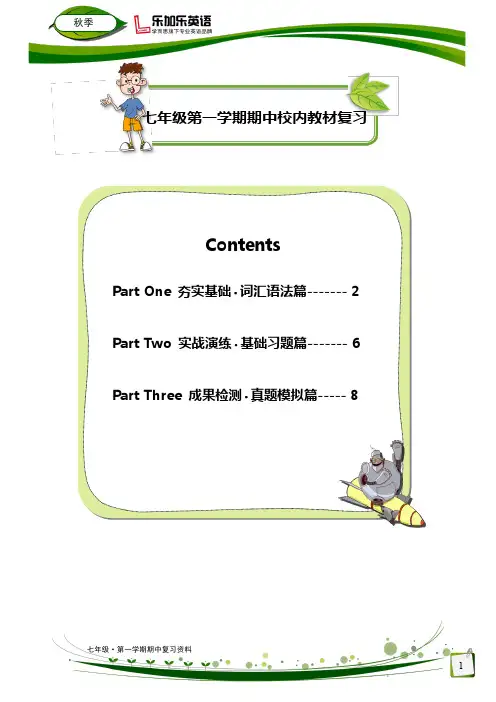
prevent sb. from doing sth. 防止某人做某事= stop/keep sb. from doing sth. prevent sth. from sth. 保护„以防受到„ = keep/save sb. from sth. 6. cruelty n. 残酷 词性转换:cruel adj. 残酷的,悲惨的
4
秋季
例:I have visited the factory. I visited the factory last year. 考点:瞬间动词的完成时不与一段时间连用,需要转换成相应的持续性动词 She has got married
already. She has been married for 5 years. 常用瞬间动词变延续性动词表:
He raised his arms above his head. The national flag is rising.
3. interest n. 吸引力;趣味 have find (no/great…) interest in (doing) sth. 对„(没)有(很大)兴趣 be interested in 对„感兴趣 词性转换:interest v. 使„感兴趣
七年级·第一学期期中复习资料
2
秋季
take care of = look after 照顾,照料 9.unkind adj. 不友善的
be unkind to sb. 对„不友善 反义:be kind to sb. 对„友善 词性转换:unkindness n. 不友好 kindness 友善 10. safely adv. 安全地 词性转换:save v.拯救
牛津上海版初一英语知识点总结
牛津上海版初一英语知识点总结第一篇:牛津上海版初一英语知识点总结牛津上海版初一英语知识点总结牛津上海版英语词组及短语(中英对照版)1.在左上角2.在右上角3.下棋4.笔友5.和某人住在一起6.担任……工作7.在学校8.在中间9.最美好的祝愿10.戴着眼镜的那个女孩子11.在右边12.在左边13.在学校的足球队里14.一年级,二班15.女子篮球队16.男子接力比赛17.在世界上18.全世界19.在……旁边20.对……友好21.热衷于……22.擅长于……23.语文24.数学25.地理26.生物27.历史28.化学UNIT1—4at the top-left corner at the top-right corner play chesspenfriendlive with somebobywork as at schoolin the middlebest wishesthe girl in glasseson the righton the lefton the school football teamClass Two,Grade Onegirls’ basketball teamboys’ relay racein the world all over the worldnext to / besidebe friendly to be keen onbe good atChinesemathsgeographybiologyhistorychemistry29.体育P.E.30.音乐music 31.政治politics 32.物理physics 33.少先队员Young Pioneer 34.小学pramay schol 35.初中middle school/junior high school 36.高中senior middle school 37.大学university/ college 38.做运动do exercise 39.做眼保健操do eye exercises 40.做早操do morning exercises 41.照相take pictures/photos 42.喜欢做某事like/enjoy doing sth.43.想要做……want to do sth./ would like to do sth./ 44.注意……pay attention to 45.写下,记录下write down 46.从左边/右边from the left/right 47.收到某人的来信hear from sb.;get/receive a lettere from sb.48.锻炼身体do sports 49.持续一段时间last for 50.一两个小时one hour or two/ one or tow hours 51.在街道上in the street 52.在……的开始at the beginning of 53.在……的结尾at the end of 54.保安guard 55.建筑工人construction worker 56.牙科医生dentist 57.会计师accountant 58.去游泳go swimming 59.去海边go to the sea 60.去滑雪go skiing 61.去滑冰go skating 62.去购物go shopping 63.去观光go sightseeing 64.去远足go hiking 65.去跑步go running 66.去慢跑go jogging 67.去跳舞do dancing 68.去航行go sailing 69.去约会70.到达(4种表达方法)arrive in/at;reach;get to 71.花费时间(金钱)的表达方法: sb.spend…on sth./sb.spend...(in)doing sth./ sb.pay…for stth./ sth.cost sb.some money/ it takes sb….to do sth.72.主管be in charge of 73.照顾look after/take care of 74.独生子女the only child 75.开会have a meeting 76.迟到be late for 77.除……之外except/ except for 78.从周一到周五from Monday to Friday/ on weekdays 79.刷牙brush the teeth 80.洗脸wash face 81.追赶(某人)go after sb./ run after sb.82.及时in time 83.按时on time 84.盯着、凝视stare at 85.跑开run away 86.下车get off(the bus)… 87.上车get on(the bus 88.捡起pick up 89.思考think about 90.匆忙in a hurry 91.从……冲出来strom out of/ rush out of 92.熬夜stay up late 93.生某人的气be angry with sb 94.在……的一边on the side of 95.在……的另一边on the other side of 96.等候wait for 97.拿出hold out/ take out 98.跌倒fall over 99.戴着手铐in handcuffs 100.四处走走go/walk around 101.找出,查明find out 102.说谎tell a lie 103.立刻in a flash/ at once/ right away/immediately 104.将来in the future 105.在意、关心care about 106.查询(生词)look up 107.四处看look around 108.有一个选择have a choice 109.正在那个时候at that moment 110.毫无疑问地without question 111.走到跟前、走近come over 112.改变注意change one’s mind 113.尽可能快as soon as possible 114.有时间玩乐have time for fun 115.在……顶部on the top of… 116.或……或……either……or…… 117.既不……也不……neither……nor…… 118.不仅仅……而且……not oly… but also… 119.将……与……比较(将……比作) compare with/ compare toUnit 5---Unit6重点词组Unit 5 1.灭绝;消失die out 2.因……而死die of 3.得知,获悉learn about 4.和……一样the same as 5.因…而著名be famous for 6.同时at the same time 7.以……为基础be based on 8.充满……be full of 9.根据according to 10.依(某人)之见in one’s opinion 11.因为;由于because of 12.超过more than/ over 13.同类的 of this kind 14.做(某事)有一些困难have difficulty with sth./ have difficult in doing sth./ find it difficult to do something.15.全世界范围内all over the world 16.其余的;剩下的the rest of…… 17.既不…也不…neither ……nor…… 18.对……有用处be useful for 19.一等奖the first prize 20.害怕……be a fraid of…… 21.至多有up to 22.生育give birth to…… 23.也;还as well as 24.……方面的专家expert on…… 25.完全地,彻底地competelyUnit6一、词组1.能够be able to / can 2.成为现实;实现come true 3.从现在起from now on 4.到达arrive at/in;get to………;reach…… 5.生病get sick 6.一会儿in a moment/minute 7.和平地in peace 8.破碎地in pieces 9.在太空in space 10.将来in the future 11.降落于……land on 12.看起来像look like 13.部分part of 14.而不是15.耗尽;用完not …but…run out ofUnit 7--8词组:1.从现在起from now on 2.躺下lie down 3.入睡fall asleep 4.从(某地)逃走5.太……以致于……6.过了一会儿7.逃离8.对准;瞄准9.熄灭10.广播、公布11.听起来象12.从……出来13.告诉……实情14.生气15.事实上16.开……的玩笑17.给……提供某物18.过着幸福的生活19.过着艰苦的生活20.过去常常做(某事)21.过去常常不做(某事)22.数以亿计23.除……之外,还……按时24.全世界25.给某人拍照26.例如27.在过去28.广交朋友29.在周末30.赶快31.立刻escape fromtoo…to…;so…that…moments laterbe out of……aim at…go uoutput outsound likecome out oftell the truthbe angry withsb./ get angry in factpaly jokes onprovide……with…live a happy lifelive a hard lifeused to do sth.didn’t use to do sth.billiions ofas well asall over the worldtake photo for …for examplein the pastmake a lot ofat the weekendhurry upin a second/at once/right away/immediately32.考虑think of 33.中国出口品交易Chinese Export Commodities Fair第二篇:上海牛津英语4AM1知识点总结.M1U1 Meeting new people 1.词汇:classmate 同学schoolmate 校友deskmate 同桌friend朋友 meet 遇见people人们eleven 十一twelve十二thirteen 十三fourteen 十四fifteen 十五sixteen 十六seventeen 十七eighteen 十八nineteen 十九twenty二十student number 学号sit 坐skip跳绳live居住near在……附近year年well好mask 面具2.词组:my classmate 我的同学go to the park 去公园ride a bicycle骑自行车 skip a rope 跳绳live near the school住在学校附近walk to school走路去学校play basketball 打篮球like reading喜欢阅读years old 岁—Nice to meet you!很高兴遇到你!—Nice to meet you,too.我也很高兴遇到你!See you!再见!3.语法:形容词性物主代词his,her,your,my,its,their,our 形容词性物主代词(所有格后必须加名词。
2024年沪教牛津版七年级英语上册同步知识背默 Unit3 The seasons知识清单(默写版)
【同步100分背默】Unit3 The seasons知识清单一.重点词汇背默1.n.脚印;足迹2. adj.潮湿的3. adj.深的4. adj.铺满沙子的;含沙的5. v.踢;踹6. n.镇;市镇7. n.特色;特征8. n.南;南方9. adj.晴朗的10. adv.喧闹地;响亮地11. n.雷声12. n.闪电13 adj.新鲜的14. v.采集(植物、水果等)15. adj.安静的;平静的16. n.蛇17. prep.自始至终;从头到尾18. n.区域;地区二.重点词汇拓展1.deep adj.深的;厚的深深地;在深处浅的2.south n.南,南方adj.向南的北方南部的,南方的3.clear adj.清晰的;明亮的;清楚的清晰地;明亮地;清楚地→ 把……清空;清理;丢掉4.peace n.和平,宁静和平的,宁静的5.divide v.分,划分→ 把……分成……6.decide v.决定;下决心→ 作出决定→ .决定做某事7.culture n.文化;文明与文化有关的;文化的8.continue v.继续→ 继续做某事.9.rain n.雨,雨水v.下雨多雨的10.snow v.下雪n.雪下雪的;多雪的11.sun n.太阳晴朗的,阳光充足的→ 在太阳下12.wind n.风有风的,多风的13.swim v.游泳,游游泳→ 去游泳14.shelf n.架子,搁板,隔层→ 在架子上15.succeed v.成功成功成功的,有成就的成功地→ .成功做某事三.重点短语背默the trees. 在秋天,一切都变了。
叶子变成棕色、红色或黄色,并开始从树上掉下来。
12.Farmers the harvest. 农民们正忙于收割。
13.It is great to at this time of year. 每年的这个时候全家外出是很棒的。
14.Children they love to play in the snow. 孩子们喜欢冬天是因为他们喜欢在雪地里玩耍。
2024年沪教牛津版七年级英语上册 Unit1重点短语和知识
2024年新沪教牛津版初一上册Unit 1重点短语和知识一.重点短语talk with/to sb. about sth.与某人交谈某事like doing/ to do sth.喜欢做某事each other相互;互相make friends with sb.与某人交朋友ride a bicycle骑自行车do crossword puzzles做纵横字谜paint pictures画画read books读书watch movies看电影listen to music听音乐a lot=very much非常be good at擅长于be good for对...有好处turn to sb. for help向某人寻求帮助sth. happens to sb.某事发生在某人身上sb. happens to do sth.某人恰巧做了某事share sth. with sb.与某人分享某事after school放学后be willing to do sth.愿意去做某事thanks to多亏;由于thanks for为...而感谢help sb. With sth.帮助某人某事help sb. (to) do sth.帮助某人做某事count on=depend on依赖;依靠teach sb. sth.教某人某事not only...but also不仅...而且a better me一个更好的自己a description of...的描写get along with与...相处agree with sb.同意某人的观点be sure about确信want to do sth.想要做某事look after照顾home address家庭住址role model榜样;楷模dream job梦想的工作go ahead继续refer to参考be related to与...相关a good way to do sth.做某事的好方法think of想起wait for等待watch over照管;监督rise into升到cry out大喊;大叫cry oneself to sleep哭着入睡wake up醒来take place发生(偶然性)take one’s place替代take the place of sb.替代某人As the months and years came and went年复一年,日复一日二.重点句型1.What is your friend like? 你的朋友是什么样的?2.It is + adj. for sb. to do sth.对某人来说做某事是怎样的。
(完整word版)牛津沪教版英语七年级上期中重点知识点复习
七年级上期中重点复习一、复习思路按照期中考试范困ULl:5,分基础,语法和阅读等模板进行更习,上节课已经复习词汇,短语, 本次课以5[习语法为主。
二、复习要点一.人称代词:二.祈使句祈使句imperatives指的是表示命令、请求、建议或劝告的句子.其主语you常省略,谓语动词用原形, 句末用感叹号或句号,读降调。
1.祈使句基本句型(1)do型:动词原形+其他Stand up, please. = Please stand up. Look at the blackboaid(2)be 型:Be + n./adj.Be a good boy! Be carefill!Be careful? = Look out? = Take care!(3)let型:Let +宾语+动词原形+其它成分Let me help you. Lefs go to school together.(4)带主语型You, Jim, go to my office after class. You boys read the first part.2.祈使句的否定(句型转换)⑴DoiTt+动词原形Don't stand up. Don't be careless.Don't let them play with fire.(2)Let型的否定式有两种:“Dont +let+宾语+动词原形+其它成分and**Let4-宾语+not+动词原形+其它成分”。
Don't let him go. / Let him not go.Let tliem not play with fire.(3)n。
开头,用来表示禁止性的标志语.No smoking! No fishing!No parking! No swimming!3.祈使句的回答祈使句的动作通常是表示将来发生的动作,所以回答祈使句时,一般用win或won'匕(单项情景交际)在回答具有否定意义的祈使句时,要注意两点:1)形式一致(即Yes与will保持一致;No与won' t保持一致)2)事实一致(回答时,要注意分析上下文语境中所提供的条件)Eg: - Don' t go out, please. It' s raining heavily outside.-- Yes, I will I have to meet my brother at the airport (不)三.现在完成时现在完成时L现在完成时的定义:现在完成时表示动作发生在过去,但与现在情况为联系发影响,即用一个发生在过去的动作来说明现在的情况c2、现在完成时的谓语构成:助动词ha\ehas +动词的过去分词3、常用时间状语:(1)与包括“现在”在内的时间状语连用,如:by now (到现在为止),so far (迄今为止),these days (这些天来),this year, this month, today in the past few years (在过去的几年以来)等; e g We have planted many flowers this year.Chma has changed a lot m tlie past few years.I have learned two thousand words so for(by now).It has rained these days.(2)1 j 副词连用,如:just, before, akeady,never,ever,yet,Recently, since, for 等e g Have you ever watched Hany Potter?Tlie new book have not amved yet.Have you heard from him yet?Tliey have already fiiushed theu, homeworkI have never seen an alien.He has just come.We have seen the movie before.My mother has worked here smce 1949.I have taught English m this school for six years.4、用法:(1)表示过去发生的或已完成的某一动作对现在造成的影响或结果。
七年级上册英语知识点总结沪教牛津
U5单词和短语1.be able to do sth. /can 同义转换单选be(am, is, are,was,were)的形式的考察2.more than/over(U8)同义转换3.have to/must 同义转换两者区别:客观需要/主观看法/have to 有各种时态形式4.breathe/bri:ð/V. /breath n. 给单词写单词5.such as…列举整体之中的部分同类人或事物作例,之前一般用逗号和主句隔开,之后没有逗号,直接加名词性短语,相当于like或for example6.without+(doing)sth.=if there is no sth.同义转换10给词填空7.be nervous about/of (doing) sth.8.leave+SP“离开某地”/ leave for+SP“动身去某地”/leave+SP.+for+SP.“离开某地去某地”9.tie (tying) (lie lying die dying)10.work V.“运转,运行”N.工作(不可数)作品(可数)工厂(works)11. in one’s sleep “在某人的睡梦中;在某人睡着的时候”12.a large/small amount of +N[U] 大/少量的13. space 太空(前用零冠词,不可数)14. feel…about… “对……感到……”句型1. Tomorrow I’ll be o ne of the first students to travel into space.One of+N(复)“......中之一”;first 后接名词复数时“第一批”、“第一组”X Kb1 .C om2.The Moon is around(=about)380,000 kilometres from the Earth , so it’ll take us about four days to get there. A.对距离提问用how far…;区分how soon…再过多久,对将来的一段时间提问,回答一般是,in+时间段/how often…“隔多久”对频率提问(期末) /how long…“持续多长时间”回答一般是,时间段或for+时间段/how many…/how much… B.It takes(V.花费) sb. some time to do something / doing sth. takes sb. some time/ sb spend some time(或money) doing sth. / on sth./ sth. / sth. costs (sb.) +金钱(doing) sth. costs (sb.) +时间 C.get(到达)to+SP.“到达某地”接here、there、home时,to要省略。