
仁爱九年级英语第一次月考试题
九年级英语第一次月考试题Ⅰ.单项选择。
(15分)( )1.The Greens _____ China for seven years.A.have come toB.have been toC.have come inD.have been in( )2.—Could you tell me _____?—Sorry, I don’t know.A.where are my socksB.where can I find my socksC.where my socks areD.where my socks put( )3.It’s necessary for you _____ exercise every day.A.takingB.to takeC. takeD. takes( )4.—_____ you _____ your homework yet?—Yes, I _____ it ten minutes ago.A.Did; do; finishedB.Have; done; have finishedC.Have; done; finishedD.Will; do; finish( )5.Xi’an is a city with many places of interest and _____ tourists come here every year.A.thousand ofB.thousandC.thousandsD.thousands of( )6.This is the most beautiful park I have _____ visited.A.everB.yetC.neverD.already( )7.—Can you write the number eighty-five thousand, six hundred and twenty-six? —Yes, it is _____.A.85,626B.856,620C.58,662D.58,626( )8.Now most families have only one child _____ our country’s one-child policy.A.soB. becauseC. because forD. because of( )9.—David has made great progress recently.—_____, and _____.A.So he has; so you haveB.So he has; so have youC.So has he; so have youD.So has he; so you have( )10.China has the _____ population in the world.A.smallestB.mostrgestrge( )pared with last year, our pay _____ about ¥500 every month.A.has increased byB.has increasedC.increased byD.increased to( )12.—It seems _____ you like to work with children.—Yes, they are so lovely.A.thatB.whatC.toD.as( )13. In our class _____ of the students _____ girls.A.third fifths; isB.third fifth; areC.three fifth; isD.three fifths; are( )14.Our teacher told us that light _____ much faster than sound.A.traveledB.travelsC.is travelingD.was traveling( )15.—In the old days, most teenagers had to work for the landlord (地主) in the field to help _____ their families, because their families couldn’t _____ education for them. A.support; supply B.afford; support C.support; afford D.afford; give二.完形填空。
(10分)What is the population of China? There are more than a billion and three hundred million people in China. It is almost one fifth of the world’s population. How to control the population growth is a big problem. Some people think ( 1 ) to control the population growth. But I don’t quite agree ( 2 ) them, because where there’s a will, there is a way. The question is that we should make it ( 3 ) how serious the population problem is. Ourfarmland is becoming less and less to everyone. We have already got too many mouths to feed. ( 4 ) we control the population growth, many people will die ( 5 ) hunger. Too fast population growth has been and will be bad for our nation. Though laws (法律) have been ( 6 ) to control the population growth, in some places ( 7 ) is done to carry out(贯彻)the law. We should make people ( 8 ) that it is foolish of them to bring too many children into the world. They should ( 9 ) do what they have been doing for many years.We are fighting against the fast population growth. Yes, the fighting won’t end ( 10 ) everyone knows its importance and does something for it.1. A. that is impossible for B. impossible of C. that is impossible of D. it impossible2. A. to B. for C. with D. on3. A. known to everybody B. known by everybody C. know D. is know by4. A. If not B. Unless C. Until D. If5. A. of B. about C. from D. out of6. A pass B. passed C. broken D. thought7. A. many B. little C. a lot D. much8. A. to know B. to learn C. know D. learning9. A. not longer B. not more C. no longer D. no more10. A. until B. after C. when D. as三、阅读理解(40分)AI have been a news reporter for the past fifteen years. The job has taught me many unforgettable lessons. I have seen wars, poverty and death, but I have also seen courage (勇气), hope and happiness.In India, I saw many homeless children. Some were as young as four year old. They lived in the streets begging(乞讨)or stealing. But then q wonderful lady called Rosa opened a home for them. Within one year she was looking after two hundred children. She clothed them, fed them and taught them. She gave them hope.Another time, I was in Turkey after a terrible earthquake. I found an old lady whose house was broke down. Her son was missing and people said there was no chance that he was still alive. But the lady did not give up hope. For four days, she moved heavy stones one at a time. She did not stop until she found her son. He was alive.Here in China, I was surprised when I met a young boy who had had twenty operations and spent nearly his whole life in hospital. I thought he would be sad, but when I met him, his smile was so warm and welcoming.In life, we need models that we can learn from. When my life is difficult, I try to remember the courage and goodness of these three people.判断正(T)误(F)1. The underlined word “poverty” probably means the state of being poor.2. A man was looking after two hundred children.3. The old lady’s son was saved by some people.4. The speaker was surprised while meeting the sick boy because he was in hospital all his life.5. The main purpose of the speaker is to ask people to live with hope and courage.BToday is November 9. It’s time for us to learn a lot more about fire, especially what to do if we are caught in a fire:1. Shout out.If you smell smoke or see fire, shout out “Fire”! Shout as loudly as you can, because people may be asleep.2. Call 119.Never try to put out(扑灭) the fire yourself, even if it is a very small one! Get help from your parents or call 119.3. Keep down close to the floor.If there is a lot of smoke in your room, keep down close to the floor.4. Test the door.Test the door before you open it. If the door is cool, open it carefully. If the door is hot, do not open it! Try to find a different way out.5. Get out.If you can, get out of your home as soon as possible.6. Don’t use the lift.Never use the lift during the fire. It may also go wrong.7. Don’t go back.Never go back into a burning building!判断正(T)误(F)6. The passage is mainly about what to do when you are caught in a fire.7. We should use the lift when fire breaks out because the lift may keep us safe.8. If you leave an expensive thing at home, you should go back.9. If you see fire, try to put out the fire yourself.10. When fire break out, we should call 119 at once.CMost people in Britain live in small family groups. More than a quarter of homes in Britainhave only got one person in them. Some of these are old people but some are people of twenty or thirty who choose to live alone. 35% of homes have two people in them, and another 17% have three people. 15% have four people in them, and the other homes have five or more.The families in Britain are small. It is unusual for parents to have more than two children. When children are about eighteen or nineteen, they leave their parents’ homes, and they often go to different cities. Sometimes they only visit their parents two or three times a year.11. How many homes in Britain have 3 people living in them?A. 8% of homes.B. 15% of homes.C. 17% of homesD. 35% of homes.12. At what age do children in Britain usually leave their parents’ homes?A. About 18 or 19.B. About 20 or 21.C. About 25 or 26.D. About 30 or 31.13. What is the passage?A. An invention.B. A report.C. A. playD. A joke.14. What does the passage mainly tell us?A. Young people in Britain.B. Old people in Britain.C. Families in Britain.D. The population in Britain.15. According to the passage, which of following is right?A. There are 25% of homes have 3 people in them.B. There are 25% of homes have 2 people in them.C. There are 25% of homes have 1 people in them.D. There are 35% of homes have 3 people in them.DUncle Li and Uncle Wang are good friends. They live next to each other and their farms are both at the foot of the mountain. So they can help each other. But neither of themlikes to use his head. They're both poor though they work hard. Most villagers have built new houses, but they still live in the low and broken houses. They never find out why. Once Uncle Li went to town to buy some medicine for his wife. In the town he heard the apples in a city were expensive. He told Uncle Wang about it as soon as he went back. They decided to carry some apples to the city. They borrowed some money from their friends and bought nearly 1,000 kilograms of apples in the villages and carried them to the city on a tractor. Bad luck! A lot of apples has already been carried there when they arrived. A few days later they had to sell them at a low price. They felt unhappy and returned to their village."I can't understand why we sustained (蒙受) losses in business while others always profit (盈利)" Uncle Li asked one day."The tractor was too small. " Uncle Wang said without thinking. "We'll carry more apples on a truck next time!""I agree!" said Uncle Li. "How foolish (傻的) we were !"16. Uncle Li and Uncle Wang live in the low and broken houses because __________.A. they hope to save moneyB. they're both poorC. their farms are at the foot of the mountainD. they're not far from their farms17. Once Uncle Li went to town to .A. buy some applesB. visit a friendC. buy some medicine D sell some apples18. The two farmers carried the apples to the city to _________.A. make a journeyB. visit some places of interestC. meet their friendsD. make a profit19. The two farmers had to sell their apples at a low price because ________.A. theirs weren't as good as the others'B. theirs were much less than the others'C. a lot of apples had been already carried to the cityD. they forgot to carry them on a truck20. Which of the following is true?A. The two farmers found out why they were poor.B. The two farmers will soon get rich.C. Neither of the farmers is clever.D. The two farmers decided to buy a truck. 四.选择适当的句子补全对话。
仁爱英语九下第一次月考英语试卷及答案

仁爱英语九年级下学期第一次月考英语试卷(考试时间:90分钟总分:100分共6页,第6页为答案卷)Ⅰ.单项选择(60分,每小题1分)( ) 1. There were _____ trees in this area many years ago. But now 80% of the trees _____.A. a number of; are goneB. the number of; are goneC. a number of; is disappearedD. the number of; is disappeared( ) 2. --Waiter, I’d like some Yangzhou Fried Rice.--Sorry, sir. Yangzhou Fried Rice ______ only for lunch and dinner.A. servesB. was servedC. is servingD. is served( ) 3. --Are you planning to Disneyland?--Yes,______ next Monday.--By air. That's wonderful.A. I'm going there by busB. I will take a train thereC. I'm flying thereD. I'm going to ride a bike there( ) 4. --How can I improve my spoken English?--You have to practice _______ as much as you can.A. speakB. speakingC. spokenD. to speak( ) 5. --What's the matter with you.-- ______--Never give up. Practice makes perfect.A. I am not feeling wellB. I have difficulty remembering the new wordsC. I'm worried about my mother's healthD. I broke Grandma Li's window ( ) 6. _______ tomorrow, I will see you off at the bus station.A. Whenever you ,are leavingB. Whenever you leaveC. Whenever do you leaveD. Whenever are you leaving( ) 7. When we realize yesterday is gone forever, we find we're growing up ______A. little by littleB. step by stepC. one by oneD. side by side ( ) 8. My dad bought me a new MP4, but I don't know _______ .A. what to useB. which one to useC. how to use itD. when to use it( ) 9. We _______ to close the windows before we left the lab.A. tellB. toldC. are toldD. were told( ) 10. ______ spending our vacation in a hotel, why not try hiking in the country?A. Instead ofB. Because ofC. Thanks toD. As for ( ) 11. We'll never give up working on the experiment, _______ difficult it is.A. howeverB. wheneverC. whateverD. wherever( ) 12. --Do you think it will do us good or harm?-- . Let's beg for God's help.A. It's hard to sayB. I'm sureC. It's impossibleD. You are right( ) 13. --If possible, I would like to watch the 2012 Olympics _______--Good idea. You will ______ games.A. in person; be fond of the excitingB. in person; fond of the excitedC. myself; be fond of the excitedD. myself; fond of the exciting( ) 14. If you are weak _______ a subject, ______and asking a teacher for advice can help.A. to, working hardB. in, work hardC. to, work hardD. in, working hard ( ) 15. --Call me as soon as your homework ______ tomorrow, OK?--All right. I'm looking forward to _______ with you.A. will be finished; go swimmingB. is finished; go swimmingC. will be finished; going swimmingD. is finished; going swimming( ) 16. --I hope you'll have a good time after the exams.-- ______ .A. Thank you, the same to youB. I'm very glad to hear thatC. We willD. You, too( ) 17. --Do you think you will lose the game?--No, ______A. I hope soB. I'm sureC. I hope notD. I'm afraid so( ) 18. --Would you please ______ the TV a little? Jack is doing his homework.--Terrible sorry. I will.A. turn downB. turn upC. turn offD. turn on( ) 19. --Boys and girls! Please _______ your composition after class.--Oh, my god. I ______ it at home.A. hand in; forgotB. hand in; leftC. hand out; forgotD. hand out; left ( ) 20. This book ______ Li Lei's, because there is his name on it.A. can't beB. may beC. might beD. must be( ) 21. --How much will you ?--Judy, I don't do it for money, but for experience. Besides, it's voluntary work.A. spendB. costC. be paidD. pay for it( ) 22. Electricity was many centuries ago and electric lights were laterA. discovered; discoveredB. invented; inventedC. discovered; inventedD. invented; discovered( ) 23. --Are you going to Beijing by plane?--It's fast, but expensive. So I am not sure. I take a train.A. shouldB. mayC. mustD. will( ) 24. --Your sweater looks nice. Is it made ______ wool ?--Yes, and it's made Beijing.A. of; byB. of; inC. from; byD. from; in( ) 25. --How time flies !--That's true. It _______ 10 years since we met last time.A. wasB. hasC. isD. will be( ) 26. --I have a good news to tell you ! Chang'e I was sent up into space successfully.-- ______A. Bad luck !B. Don't worry.C. Nothing serious !D. Wonderful! ( ) 27. He ______ in the classroom just now; he ______ be there now.A. heard to sing; mayB. was heard sing; mustC. heard sing; mustD. was heard to sing; may( ) 28. The passenger may use the room as long as he ______ it right now.A. sweptB. will sweepC. is sweepingD. sweeps( ) 29. China is planning to ______ another satellite next month.A.. send upB. send intoC. send forD. send away( ) 30. --I hope you don't mind my pointing out your mistakes.-- ______ .A. Not at all.B. You're welcome.C. Of course.D. It's a pleasure. ( ) 31. -- ______ I to write to say thank you?--Yes, I think you _______ .A. Ought; oughtB. May; mayC. Need; need D, Must; must ( ) 32. Excuse me, may I ask you a question? But I won't ______ much of your time.A. look upB. stay upC. take upD. wake up ( ) 33. --The story is so amazing! It's the most interesting story I've ever read.--But I'm afraid it won't be liked by _______ .A. everybody .B. somebodyC. anybodyD. nobody( ) 34. ______ was reported that _______ tourists visited Geyuan Garden last month.A. That; two thousandB. It; two thousandC. This; two thousands ofD. It; two thousands( ) 35. --Would you like to go to the concert with me?--I'd love to,______ I can't. I have a lot of homework to do.A. orB. butC. soD. and( ) 36. Usually people in Japan and Korea ______ when they meet for the first time.A. are supposed to kissB. are supposed to bowC. supposed to kissD. supposed to bow ( ) 37. --What a heavy rainstorm yesterday!--Yes. The flood _______ the old bridge over the small fiver.A. kept awayB. washed awayC. went awayD. put away( ) 38. --Can I come this evening or tomorrow morning?-- is OK. I'm free today and tomorrow.A. EitherB. NeitherC. BothD. None( ) 39. I know ______ about the matter because ______ them told me about it.A. anything; none ofB. something; allC. nothing; neither ofD. nothing; some of ( ) 40. I have had two dictionaries _________ .A. one and a half years agoB. since one and a half yearsC. for one and a half years agoD. since one and a half years ago( ) 41. _______ the students are good at English. Some of them can't even write out the 26 English letters.A. AllB. None ofC. Not allD. Neither of( ) 42. During the Spring Festival, the heavy snow ______ many people home.A. kept; goingB. stopped; goingC. made; goD. would like; to go ( ) 43. --Why did Miss Wang look so worried when we saw her?--Because she wondered ______ .A. where did the other students goB. when would the policeman comeC. what her students have doneD. if her students had got there safely( ) 44. There was a blind man ______ the violin in the park when I got there yesterday.A. playedB. playingC. playD. plays( ) 45. It was snowing hard ______ we had to stay at home and watch TV.A. thatB. soC. butD. because( ) 46. Their parents have ______ New York for a few months.A. arrived inB. been toC. leftD. been in( ) 47.--How do you learn English so well?-- ______ chatting with my uncle in America on line.A. WithB. ByC. ForD. In( ) 48.--Why don't you take the T-shirt, Linda?--I have only $10, I can't ______ it.A. borrowB. affordC. sellD. bring( ) 49. How is Ann? I _______ her for a long time.A. didn't seeB. won't seeC. didn'tD. haven't seen( ) 50. --Where you _______ ? Mr. Li is looking for you everywhere.--Well, to the library. I found a nice book on science.A. have; goB. have; been C, have; gone D. are; going( ) 51.--Have you improved your written English ?--Yes, I've improved it.A. already; yetB. yet; yetC. already; alreadyD. yet; already( ) 52.--The population of our city is ______ than that of yours.--You're right.A. moreB. fewerC. largerD. less( ) 53. --She has been to the Great Wall.-- _______ .A. So has heB. So he hasC. Neither has heD. Neither he has( ) 54. I read both books _______ I could compare them in my view.A. in order toB. so as toC. so thatD. or( ) 55. Our government always _____ the homeless children ______ clothes and food.A. gives; withB. offers; withC. provides; withD. provides; to( ) 56. -- ______ free education, the poor children in our hometown can go back to school.--So can the poor children in our hometown.A. Instead ofB. Thanks toC. BecauseD. As for( ) 57. Slow down, please. I can't ______ you two.A. come up withB. keep up withC. keep in touch withD. get along with ( ) 58. In the past few years there ______ great changes in my hometown.A. have taken placeB. have beenC. have happenedD. were( ) 59.--Why won't you go to the movie with me, Betty?--Because I ______ it twice.A. seeB. sawC. have seenD. will see( ) 60. It's four years since Mike ______ to Tibet.A. has beenB. is comingC. will comeD. came Ⅱ.情景交际(5分,每小题1分)Ⅲ.完型填空(5分,每小题0.5分)E-mails are really helpful to students. For one thing, students can hand in their reports or homework 1 sending e-mails and get back the corrected copies in the same way. They can also practice writing 2 e-mails. If their spelling is wrong and there are some 3 in grammar, the computer will point them out and even correct them. Writing on a computer 4 having a personal writing tutor(家庭教师). For another thing, students can 5 their friends through e-mails easily. They can type all their 6 on the computers and then send them out. Usually, they can 7 the replies quickly. What's more, 8 talking on the phone, they have more time to correct the wrong words in front of a computer. Besides, using e-mails is 9 than talking on the phone. 10 using e-mails has many benefits (好处), students shouldn't be too crazy for it and forget what they should do.( )1. A. on B. by C. with D. in( )2. A. because of B. instead of C. out of D. with the help of ( )3. A. mistakes B. words C. sentences D. articles( )4. A. likes B. like C. is like D. looks like( )5. A. come up with B. keep in touch with C. keep away from D. come into being ( )6. A. names B. messages C. books D. advice( )7. A. accept B. receive C. afford D. understand ( )8. A. unlike B. different C. like D. by( )9. A. safer B. cheaper C. more friendly D. more expensive ( )10. A. Because B. Because of C. But D. ThoughⅣ.阅读理解(20分,每小题1分)(A) 根据短文内容判断正(T)误(F)Although we may not realize it, when we talk with others we make ourselves understood not just by words. We send messages to the people around us also by body movements. A smile and handshake show welcome. Waving one's hand is to say "Goodbye." Nodding the head means agreement, while shaking it means disagreement. In China and some English-speaking countries, these body movements have the same meanings. But not all body languages mean the same things in different countries. For example, nodding the head in some Asian countries means not "Yes.", but "No."When we speak a foreign language, it's important to know the meanings of the body movements in the foreign countries. In Russia, France and some of South American countries men kiss each other when they meet. Men don't kiss each other in China or English-speaking countries. In England, older people usually shake hands when they meet someone for the first time, however, young people don't shake hands. In France, people shake hands in the office every morning. French people kiss each other more often than English people when they meet or leave.( ) 1. We talk with other people just by words.( ) 2. Nodding the head doesn't mean" Yes." in some Asian countries.( ) 3. From this passage, we can know that men in Brazil usually kiss each other when they meet.( ) 4. In France, men just kiss each other when they meet.( ) 5. In China and some English-speaking countries, all the body movements have the same meanings.(B) 根据短文,选择正确的答案。
九年级仁爱英语第一次月考试卷

九年级英语月考试卷第一部分一、选择填空( 25分)( ) 1. We __________ our breakfast. We __________ it at school at 6:30.A. have had; have hadB. have had, hadC. had, have hadD. had, had( )7. we felt tired, we felt happy.A. Though; \B. Though; butC. If; butD. Not only; but also ( ) 3. Don’t touch anything __________ your teacher tells you to.A. ifB. thoughC. unlessD. even though( ) 4. He __________ to school by bike, but now he __________ to school on foot.A. used to going; get used to goB. used to go, gets used to goingC. used to go; gets used to goD. get used to going; used to go( ) 5. He was ________ the work.A. successful to finishB. successfully in finishingC. success in finishingD. successful in finishing( ) 6. Mrs. King has __________China for over 3 years.A. gone toB. been toC. come toD. been in( ) 7. ─By the way, where is Li Lei?─He __________ swimming.A. has beenB. has been toC. has goneD. has gone to( ) 8. ─Have you ever __________ my stamps?─Yes, I __________ them on your desk yesterday.A. saw; sawB. saw; seenC. seen; sawD. seen; was seeing( ) 9. ─You have made great progress in English.─__________.A. So I do.B. So do I.C. So I haveD. So have I.( ) 10. I didn’t know what __________ to her last night.A. was happenedB. happeningC. happenedD. was happen( ) 11. Mr. Green has bought a MP3 as a present, but _______ his son _______ his daughter likes it.A. not only; but alsoB. neither; norC. both; andD. either; or( ) 12. Japan is a __________ country while China is a __________ country.A. developing; developedB. developing; developingC. developed; developingD. developed; developed( ) 13. __________ it rains tomorrow, we’ll still go to the Great Wall.A. IfB. WhenC. ThoughD. Even though( ) 14. I didn’t know ______ because it was very noisy.A. what did you sayB. what you saidC. what you sayD. what do you say( ) 15. One-child policy has ______ controlling China’s population.A. done well inB. been good atC. worked good inD. worked well in( ) 16. In China, about ______ of people live in the country.A. three fifthB. third fifthC. third fifthsD. three fifths( ) 17.The Greens _____ China for seven years.A. have come toB. have been toC. have come inD. have been in( ) 18. It’s necessary for you _____ exercise every day.A. takingB. to takeC. takeD. takes( ) 19.Xi’an is a city with many places of interest and _____ tourists come here every year.A. thousand ofB. thousandC. thousandsD.thousands of( ) 20.This is the most beautiful park I have _____ visited.A. everB. yetC. neverD. already( ) 21.Now most families have only one child _____ our country’s one-child policy.A. soB. becauseC. because forD. because of( )22.—In the old days, most teenagers had to work for the landlord (地主) in the field to help _____ their families, because their families couldn’t _____ education for them.—What a pity!A. support; supplyB. afford; supportC. support; affordD. afford; give ( ) 23. Mr. Black said, “I have walked a long way this week.”Mr. Black said that ______ a long way ______.A. I had walked; last week.B. he had walked; that week.C. I walked; last weekD. he has walked; last week.( ) 24. ─Why don’t you come and have lunch with me?─Thanks, but I have ______ had mine.A. everB. alreadyC. stillD. yet( ) 25. When I saw children working for a cruel boss, I felt sorry ______ them.A. toB. forC. onD. with( ) 26. of the workers works hard.A. EveryB. Every oneC. EveryoneD. No one( ) 27. Not only he but also I the movie already.A. has seenB. have seenC. sawD. sees( ) 28. —David has made great progress recently.—and .A. So he has; so you haveB. So he has; so have youC. So has he; so have youD. So has he; so you have( ) 29. —What’s the population the U. S. A. ?—The U. S. A. has population of 297 million.A. of; aB. of; \C. in; aD. in; \( ) 30. I sat in the front of the classroom hear clearly.A. so thatB. in order thatC. in order toD. when二、完形填空(10分)The United States and Great Britain took the war on Iraq (伊拉克) in late March, 2003. 26 over twenty days American soldiers were in Baghdad (巴格达市), the 27 of Iraq. They ended the government (政府) of Saddam. 28 Iraqis died in the war. Saddam was 29 at first. No one knew 30 he’s dead or alive.In some parts of the city there was no light because of the war. Some oil wells (油井) were set on fire. Now the Iraqis need food, water and 31 . Many soldiers and people who were hurt in the war need medical care. People also need 32 tofind their family members.After the war, some Iraqis broke into Saddam’s palace, government buildings, and stores. They 33 many things from Iraqi Museums. Many Iraqis are angry that the U.S. soldiers didn’t stop the robbers (抢劫者). So far there is 34 no government of Iraqis.The reason for American soldiers taking the war is that they are 35 weapons of mess destruction (大规模杀伤性武器). But by June 6th, 2003 they hadn’t found any at all.( ) 1.A.For B.After C.By D.During( ) 2.A.city B.town C.capital D.village( ) 3.A.Thousand B.Thousands C.Thousand of D.Thousands of( ) 4.A.tired B.run C.gone D.forgotten( ) 5.A.whether B.when C.how D.that( ) 6.A.spaceships B.flowers C.people D.medicine( ) 7.A.an idea B.a way C.a plane D.a bridge( ) 8.A.bought B.borrowed C.stole D.brought( ) 9.A.still B.ever C.yet D.already( ) 10.A.looking at B.looking for C.giving up D.putting downⅣ、阅读理解(20分)(A)One day a snake was looking for food. She found a hole and went into it. “Hooray!” It was a house for mice. She said to herself happily. There, she saw some little babies of mice. “They are good dinner for me!”She came to them and asked,“Where are your parents?” The babies answered, “They went out for food.” “Food? Good!” said the snake. “Come on and listen to me. I came here to see your parents and tell them not to steal the people’s grain any longer or I will kill you all.” The little m ice worried about their own safety. “Don’t be afraid, my body is like the hole. It is a safe place. When I open my mouth, you can come into it one by one. Then we will wait for your parents coming back. Are you clear?” The little babies came into the snake from her mouth one by one.A moment later, the mice’s parents came back with some grain. Just then they found a snake in their room. “Who are you? Why did you come into our house?” “Where are our babies?” asked the mice’s parents. The snake answered coolly, “I am a judge of the people. I knew you did a lot of bad deeds. You often steal lots of food stuff of the people. Today, I came to sentence you to death. Your babies have been in my body. Don’t you want to see them?” With these words, the snake flew at the mice. 根据短文内容,判断下列句子的正(T)与误(F)。
初中英语九年级仁爱版上册第一次月考考试试卷及答案

学校 班级 考号 姓名__________________________◆◆◆◆◆◆◆◆◆◆◆◆◆◆◆装◆◆◆◆◆◆◆◆◆◆◆◆◆◆◆订◆◆◆◆◆◆◆◆◆◆◆◆◆线◆◆◆◆◆◆◆◆◆◆◆◆◆◆◆九年级第一学期第一次月考试题英语试题(仁爱版)听力部分笔 试 部 分一、单项选择(15)( )1. You should the new words that you don’t know how to spell. A . look for B .look up C .look after D.look down ( )2.--Your mother didn’t go to work this morn ing,did she? -- .Though she was not feeling well.A.Yes, she did.B.No,she didn’t.C.No,she did.D.Yes, she didn’t.( )3. I play the piano when I was a young boy. A.didn’t used to B.wasn’t used to C.didn’t use to D.wasn’t use to( )4. This book is a bit hard. read something easier?A.Why not toB.Why not youC.Why don’tD.Why not ( )5. Some of my friends like to remember new words aloud. A.with reading B.by reading C.to read D.read ( )6. ---They had a lot of strict rules at home last year. --- .A. So we had.B.So do we.C. So we did.D. So did we. ( )7.--Would you like to go for a walk with us? -- ,but I’m too busy.A.No, I can’t.B.I’d love.C.I’d love toD.Yes,I will.( )8.--Mum,this T-shirt is for me.Could you buy me a one? --OK,let’s go.A.much too small,smallerB.much too small,largerC.too much large ,largerD.too much large;smaller( ) 9.--Do you always spend lots of time computer games?--No,but I spend much time my homewok.A.to play;in Bto play;on C.playing; on D.playing;in ( )10. The boys listened to the music making flashcards.A. insteadB. instead ofC. notD. afraid of( )11.--Do you think the rain will stop tomorrow?-- . It has rained for half a month.It’s too wet. A.I hope that. B.I’m afraid it willC.I’m sure it willD.I hope so. ( )12.No children to watch this kind of movie because it’s too scary.A.should allowB.shouldn’t be allowedC.should be allowedD.don’t allow( )13. The students in Grade Three have so much homework to do every day. Sothey have to every night. A. give up B. end up C. stay up D. in the end( )14.A lot of students have tried,but have passed the exam. A.a few B.few C.a little D.little ( )15. Lin Fen a lot in the last six years.A. has changeB. changesC. is changingD. has changed二、完形填空(10)How can you think in English? I think the best way is to practice as what a football player does every day. During the 16 the football player will pass the ball to his teammates over and over again. So he won’t have to 17 passing the ball in the game, he will just do it. You can 18 yourself to think in English this way. The first step is to think of the words that you use daily, simple everyday words 19 book or shoe or tree. For example, whenever you ___20____a “book” you should think of it in English instead of in your mother language.After you have learned to think of several words in English, then move on to the next step —thinking in 21 . Listening and repeating is a very useful 22 to learn a language. Listen first and don’t care too much about 23 you fully understand what you’re hearing. Try to repeat what you hear. The more you listen, the 24 you learn. After you reach a higher level, ____25 having conversations with yourself in English. This will lead you to think in English.16. A. practice B. break C. game D. day 17. A. wait for B. think about C. look at D. give up 18. A. allow B. train C. tell D. ask 19. A. in B. about C. like D. from20. A. buy B. keep C. borrow D. see21. A. sentences B. passages C. lessons D. classes22. A. idea B. step C. way D. pan23. A. which B. whether C. how D. why24. A. harder B. less C. later D. more25. A. remember B. stop C. start D. finish三、阅读理解(40)APeople at home keep asking me, "Is it hard to learn Chinese? Why have you learned it so well?" Well, there's one thing that makes Chinese easy to learn: there are so many people to talk to. You've probably heard that it's the most spoken language. Today it's also one of the most written languages online. And with so many Chinese people interested in learning English, it couldn't be easier to find a friend for language learning. You just have to know where to look for them.The really good place to look for them is QQ. QQ has the same status(地位) in China as AIM (AOL Instant Messenger) does in the US. It is reported that at any moment, up to 9,000,000 people are using QQ. They're at work, or in a web café(网吧), or at home, and the information of the users can be found. If you sign on with your address set to "abroad", you'll soon find that many thousands of them are interested in speaking to you! This is a great way for you to learn Chinese, and for them to learn English. I think that it's a very interesting way of cultural contact(文化交流), too, for ordinary people from around the world to be able to have one-on-one contact.26. In the first paragraph(段落), the writer tells us ___________.A. why his family members want to learn ChineseB. where you can find people to talk to for language learningC. the easiest thing to do is learning ChineseD. Chinese isn’t so hard to learn as his friends think27. From the second paragraph we know that QQ and AIM are __________.A. addresses for the Internet usersB. documents you need to get onlineC. tools for people to talk onlineD. programmes of a computer28. Offices, web cafes and homes ____________.A. attract the most people to learn ChineseB. provide both QQ and AIM in ChinaC. are the best places for English learnersD. have the most people online29. The writer wrote this passage mainly to __________.A. tell a way of learning ChineseB. show what the Chinese people are doingC. tell the important of learning ChineseD. show the difference between AIM and QQ 30. The writer of this passage is probably ___________.A. a Chinese who works abroadB. an expert who works at homeC. an American who works in ChinaD. a salesman who sells softwaresB31.We can in the Modern World.A.watch movie DVDs B.buy music tapes C.read English books 32.If you want to drink some coffee,you may go to .A.the 3rd floor B.the 4th floor C.the 5th floor 33.We can see that Miss Gina Brown works for .A.Mr.Peter Green B.Mr.Larry Smith C.the English teachers 34.We can see tllat the Modern World is the name of .A.a school building B.an English school C.an English magazine 35.How many floors are owned by the New City Music Center in Building E&M?A.Three.B.Five.C.Six.CWe live in the computer age. People use computers to do much of work. But few people know how to look after them . Remember the following when you use your computer:1. Keep your computer in a dry cool room. Too much or too little heat is bad for computers. Damp (潮湿) is also bad for them.2.Do not let people smoke near your computer. Smoke of all kinds is very bad for many parts of a computer.3.Do not eat or drink when you are near your computer. Pieces of food and a little water in the keyboard are also bad for a computer.4.Keep your screen clean and do not have it too bright. They are bad for your eyes. Make sure the screen is not too far from or too near to your eyes. Some people use different glasses when they use a computer.()36. Computers can _______ people to do a lot of work.A. useB. helpC. makeD. take()37. Few people know how to _______ their computers.A. look atB. try outC. look forD. take care of()38. A computer works well at a temperature of _______.A. 0oCB. -5oCC.20oCD.35oC()39. ---Smoke isn’t good for many parts of a computer, is it? ---_______.A. Yes, it isB. No, it isn’tC. Yes, a littleD. Not at all()40. A dirty screen or a very bright screen is ________ for your eyes.A. badB. goodC. usefulD. helpfulDA. Think bigB. Start smallC. Follow theleadersD. Find the workyou loveE.Be prepared towork hard四、短文填空(10小题,每小题1分,共10分)阅读短文,用方框内所给单词的正确形式填空,使短文意思通顺、完整。
九年级上册仁爱英语第一次月考考试试卷
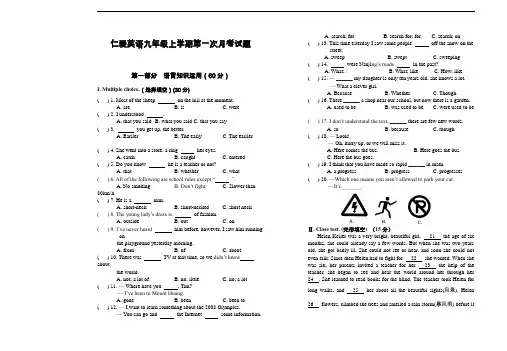
仁爱英语九年级上学期第一次月考试题第一部分语言知识运用(60分)I. Multiple choice.(选择填空)(30分)( ) 1. Most of the sheep on the hill at the moment.A. areB. isC. were( ) 2. I understood.A. that you saidB. what you saidC. that you say( ) 3. you get up, the better.A. EarlierB. The earlyC. The earlier ( ) 4. She went into a store, a ring her eyes.A. catchB. caughtC. entered ( ) 5. Do you know he is a teacher or not?A. thatB. whetherC. what( ) 6. All of the following are school rules except “”.A. No smokingB. Don’t fightC. Slower than 80km/h( ) 7. He is a man.A. short-neckB. short-neckedC. short neck ( ) 8. The young lady’s dress is of fashion.A. outsideB. outC. on( ) 9. I’ve never heard him before, however, I saw him running onthe playground yesterday morning.A. fromB. ofC. about( ) 10. There was TV at that time, so we didn’t knowaboutthe world.A. not; a lot ofB. no; littleC. no; a lot ( ) 11. — Where have you , Tim?—I’ve been to Mount Huang.A. goneB. beenC. been to ( ) 12. — I want to learn something about the 2008 Olympics.— You can go and the Internet some information.A. search; forB. search for; forC. search; on ( ) 13. This time esterday I saw some people off the snow on the street.A. sweepB. sweptC. sweeping ( ) 14. were Nanji ng’s roads in the past?A. What; /B. What; likeC. How; like ( ) 15. — ______ my daughter is only ten years old, she knows a lot.— What a clever girl.A. BecauseB. WhetherC. Though ( ) 16. There ______ a shop near our school, but now there is a garden.A. used to beB. was used to beC. were used to be( ) 17. I don’t understand the text, ______ there are few new words.A. soB. becauseC. though( ) 18. — Look!— Oh, hurry up, or we will miss it.A. Here comes the bus.B. Here goes the bus.C. Here the bus goes.( ) 19. I think that you have made so rapid ______ in math.A. a progressB. progressC. progresses ( ) 20. —Which one means you aren’t allowed to park your car.—It’s _______.Ⅱ. Close test. (完形填空) (15分)Helen Keller was a very bright, beautiful girl. 21 the age of six months, she could already say a few words. But when she was two years old, she got badly ill. She could not see or hear, and soon she could not even talk. Since then Helen had to fight for 22 she wanted. When she was six, her parents invited a teacher for her. 23 the help of the teacher, she began to see and hear the world around her through her 24 . She learned to read books for the blind. The teacher took Helen for long walks, and 25 her about all the beautiful sights(风景). Helen26 flowers, climbed the trees and smelled a rain storm(暴风雨) before it- 2 -△△△△△△△△△△△△△△△△△△△△△△△△△△△△△△△△△△△△△△△△△△△△△△△△△△△△△△△△△△△△△△△△△△△△△△△△△△△△△△△△△△△△△△△△△△△△△△△△△△△△△△△△△△△△△△△△△△△△△△△△△△△△△△△△△△△△△△△ △△△△△△△△△△△△△△△△△△△△△△△△△△△△△△△△△△△△△△△△△△△△△O O O O(装 订 线 内 不 答题)O O O O--------------------------------装---------------订----------------线----------------------------------came. She also learned how to swim and 27 a horse. After she 28 , she became a famous writer in America. Her first and most famous 29 is The Story of My Life . Her story has 30 new hope to many blind and deaf(聋的) people. It has given light to those in darkness and encouraged (鼓舞) them to live and work. ( ) 21. A. At B. On C. In( ) 22. A. how B. what C. when ( ) 23. A. With B. In C. Under ( ) 24. A. eyes B. ears C. hands ( ) 25. A. told B. spoke C. asked ( ) 26. A. watched B. touched C. listened ( ) 27. A. take B. drive C. ride ( ) 28. A. grew up B. finished school C. was young( ) 29. A. work B. paper C. book ( ) 30. A. broughtB. takenC. madeⅢ.Communication (情景交际)(15分)(A) Choose the best response from A to E. ( ) 31.How often do you write to your parents ? ( ) 32.Must we come here tomorrow ? ( ) 33.Could you please do me a favor ?( ) 34.What should we do to keep our bodies clean ? ( ) 35.Why not to cycling this Sunday ?(B) Choose the best response from A to E according to the dialogue. Linda: Hi, Bruce! How was your trip? Bruce: (36)Linda: Where did you go?Bruce: I went to Qingdao with my classmates. Linda: (37)Bruce: It’s one of the most beautiful cities in the east of China. I like it verymuch.Linda: How long did you stay there?Bruce: We stayed there for a week. (38) Linda: Which is your favorite place?Bruce: (39) When I was there, I lost myself in the beautiful scenery.Linda: What interesting things did you do there?Bruce: Lots of things, such as swimming, boating, and fishing. (40) Linda: Oh, really? I can’t wait to go there.B C第二部分 阅读理解(45分)IV . Reading comprehension (45分)(A)Need some ways on learning English? We have some great ones for you this time and we’re sure they will help you to learn English more easily and more fun.( ) 41. Find something interesting about your English study. Why not watch your favorite film in English? You could also read the lyrics of pop songs, or surf the internet and learn more about your favorite basketball or football players.( ) 42. Studying 15 minutes each day is much better than studying 2 hours once each week. Studying is much more fun if you don’t feel t ired. ( ) 43. Read English texts as often as you can. This could be news, short stories or novels. Choose an interesting text that is not too difficult for you. Don’t look up every new word -even without a dictionary you will understand a lot if you are interested in the topic.( ) 44. Choose your favorite music. Have paper and pen ready as you may want to write down useful words or phrases. Listening to your favorite English songs is another cool way. Read first and find out what the song is about. Pick some words or phrases that you would like to learn. A dictionary may also be useful.( ) 45. With your friends, you can repeat your English vocabulary, do your homework and help each other with English grammar. Maybe yourfriends have a better way of studying. Or, maybe you can give them cool advice!Choose the best topic.(选择最佳标题)(5分)(B)Jim went to school to study history, but when he finished his first year, he didn’t pass the exam and the teacher said to him, “You have to leave school.”When the boy’s father heard this news, he was much worried. Hecame to the school to see the teacher. He found the teacher in the office and asked the teacher to let Jim go on with his studies the next year.“He is a good boy. He always does well in history,” said Jim’s father, “and if you let him pass the exam this time, he will do better next year and pass the exam.”“No, no, that’s impossible!”answered the teacher, “Last month I asked him when Napoleon (拿破仑)died and he didn’t know.”“Please sir, give him another chance.”said Jim’s father,“You know we don’t have any newspapers in our house, s o nobody in our family knew that Mr. Napoleon was ill.”Judge the following sentences(T) or false(F).(判断正误)(10分) ( ) 46. The boy in this story was good at history.( ) 47. The boy’s father went to the teacher’s office and talked with him about his son.( ) 48. The teacher let all his students pass the exam. ( ) 49. After that, the teacher let the boy pass the exam. ( ) 50. The boy’s father was not good at history.(C)I’ve got some information for everyone going to Britain next month. As you know, you’ll be staying with a family for two week s. Now the most important thing is money. You should take about £30 in cash(现金) and about £200 in traveler cheques(支票). Then when you arrive at the airport you’ll be met by our host (主人) family. You must remember to wear a red shirt so the family will find you easily. I’ve told them to lookout for the red shirts. You’ll also need to take with you 4 photos of yourself and, of course, it’s very important that you take the school letter. While you are there, if you have any problems, you can call our agent . I’ll give you her office phone number now. it’s 580-4436 and the person to ask for is Mrs. Belcher, that’s B -E-L-C-H-E-R. She’s in the office from 9:00 a.m –5: 00 p.m. every day. OK! That’s everything. Have a good trip.Fill in each blank according to the passage. (根据短文内容填空,词数(D)Mary and Tom go to the West City Supermarket to do some shopping. Here are the prices of the things in the supermarket and their shoppingof milk; 1kg of steak; 3kg of bananasTom’s shopping list: 1 box of butter(Australia); 1kg of steak(Australia); 3 apples (Canada); 2kg of bananas(Thailand)(泰国)Choose the best answers according to what you read. (根据表格所提供的信息选择最佳答案。
九年级仁爱英语第一次月考试卷
九年级英语月考试卷第一部分一、选择填空( 25分)( ) 1. We __________ our breakfast. We __________ it at school at 6:30.A. have had; have hadB. have had, hadC. had, have hadD. had, had( )7. we felt tired, we felt happy.A. Though; \B. Though; butC. If; butD. Not only; but also ( ) 3. Don’t touch anything __________ your teacher tells you to.A. ifB. thoughC. unlessD. even though( ) 4. He __________ to school by bike, but now he __________ to school on foot.A. used to going; get used to goB. used to go, gets used to goingC. used to go; gets used to goD. get used to going; used to go( ) 5. He was ________ the work.A. successful to finishB. successfully in finishingC. success in finishingD. successful in finishing( ) 6. Mrs. King has __________China for over 3 years.A. gone toB. been toC. come toD. been in( ) 7. ─By the way, where is Li Lei?─He __________ swimming.A. has beenB. has been toC. has goneD. has gone to( ) 8. ─Have you ever __________ my stamps?─Yes, I __________ them on your desk yesterday.A. saw; sawB. saw; seenC. seen; sawD. seen; was seeing( ) 9. ─You have made great progress in English.─__________.A. So I do.B. So do I.C. So I haveD. So have I.( ) 10. I didn’t know what __________ to her last night.A. was happenedB. happeningC. happenedD. was happen( ) 11. Mr. Green has bought a MP3 as a present, but _______ his son _______ his daughter likes it.A. not only; but alsoB. neither; norC. both; andD. either; or( ) 12. Japan is a __________ country while China is a __________ country.A. developing; developedB. developing; developingC. developed; developingD. developed; developed( ) 13. __________ it rains tomorrow, we’ll still go to the Great Wall.A. IfB. WhenC. ThoughD. Even though( ) 14. I didn’t know ______ because it was very noisy.A. what did you sayB. what you saidC. what you sayD. what do you say( ) 15. One-child policy has ______ controlling China’s population.A. done well inB. been good atC. worked good inD. worked well in( ) 16. In China, about ______ of people live in the country.A. three fifthB. third fifthC. third fifthsD. three fifths( ) 17.The Greens _____ China for seven years.。
九年级上册仁爱英语第一次月考考试试卷
仁爱英语九年级上学期第一次月考试题第一部分语言知识运用(60分)I. Multiple choice.(选择填空)(30分)( ) 1. Most of the sheep on the hill at the moment.A. areB. isC. were( ) 2. I understood.A. that you saidB. what you saidC. that you say( ) 3. you get up, the better.A. EarlierB. The earlyC. The earlier ( ) 4. She went into a store, a ring her eyes.A. catchB. caughtC. entered ( ) 5. Do you know he is a teacher or not?A. thatB. whetherC. what( ) 6. All of the following are school rules except “”.A. No smokingB. Don’t fightC. Slower than 80km/h( ) 7. He is a man.A. short-neckB. short-neckedC. short neck ( ) 8. The young lady’s dress is of fashion.A. outsideB. outC. on( ) 9. I’ve never heard him before, however, I saw him running onthe playground yesterday morning.A. fromB. ofC. about( ) 10. There was TV at that time, so we didn’t knowaboutthe world.A. not; a lot ofB. no; littleC. no; a lot ( ) 11. — Where have you , Tim?—I’ve been to Mount Huang.A. goneB. beenC. been to ( ) 12. — I want to learn something about the 2008 Olympics.— You can go and the Internet some information.A. search; forB. search for; forC. search; on ( ) 13. This time esterday I saw some people off the snow on the street.A. sweepB. sweptC. sweeping ( ) 14. were Nanji ng’s roads in the past?A. What; /B. What; likeC. How; like ( ) 15. — ______ my daughter is only ten years old, she knows a lot.— What a clever girl.A. BecauseB. WhetherC. Though ( ) 16. There ______ a shop near our school, but now there is a garden.A. used to beB. was used to beC. were used to be( ) 17. I don’t understand the text, ______ there are few new words.A. soB. becauseC. though( ) 18. — Look!— Oh, hurry up, or we will miss it.A. Here comes the bus.B. Here goes the bus.C. Here the bus goes.( ) 19. I think that you have made so rapid ______ in math.A. a progressB. progressC. progresses ( ) 20. —Which one means you aren’t allowed to park your car.—It’s _______.Ⅱ. Close test. (完形填空) (15分)Helen Keller was a very bright, beautiful girl. 21 the age of six months, she could already say a few words. But when she was two years old, she got badly ill. She could not see or hear, and soon she could not even talk. Since then Helen had to fight for 22 she wanted. When she was six, her parents invited a teacher for her. 23 the help of the teacher, she began to see and hear the world around her through her 24 . She learned to read books for the blind. The teacher took Helen for long walks, and 25 her about all the beautiful sights(风景). Helen26 flowers, climbed the trees and smelled a rain storm(暴风雨) before it- 2 -△△△△△△△△△△△△△△△△△△△△△△△△△△△△△△△△△△△△△△△△△△△△△△△△△△△△△△△△△△△△△△△△△△△△△△△△△△△△△△△△△△△△△△△△△△△△△△△△△△△△△△△△△△△△△△△△△△△△△△△△△△△△△△△△△△△△△△△ △△△△△△△△△△△△△△△△△△△△△△△△△△△△△△△△△△△△△△△△△△△△△O O O O(装 订 线 内 不 答题)O O O O--------------------------------装---------------订----------------线----------------------------------came. She also learned how to swim and 27 a horse. After she 28 , she became a famous writer in America. Her first and most famous 29 is The Story of My Life . Her story has 30 new hope to many blind and deaf(聋的) people. It has given light to those in darkness and encouraged (鼓舞) them to live and work. ( ) 21. A. At B. On C. In( ) 22. A. how B. what C. when ( ) 23. A. With B. In C. Under ( ) 24. A. eyes B. ears C. hands ( ) 25. A. told B. spoke C. asked ( ) 26. A. watched B. touched C. listened ( ) 27. A. take B. drive C. ride ( ) 28. A. grew up B. finished school C. was young( ) 29. A. work B. paper C. book ( ) 30. A. broughtB. takenC. madeⅢ.Communication (情景交际)(15分)(A) Choose the best response from A to E. ( ) 31.How often do you write to your parents ? ( ) 32.Must we come here tomorrow ? ( ) 33.Could you please do me a favor ?( ) 34.What should we do to keep our bodies clean ? ( ) 35.Why not to cycling this Sunday ?(B) Choose the best response from A to E according to the dialogue. Linda: Hi, Bruce! How was your trip? Bruce: (36)Linda: Where did you go?Bruce: I went to Qingdao with my classmates. Linda: (37)Bruce: It’s one of the most beautiful cities in the east of China. I like it verymuch.Linda: How long did you stay there?Bruce: We stayed there for a week. (38) Linda: Which is your favorite place?Bruce: (39) When I was there, I lost myself in the beautiful scenery.Linda: What interesting things did you do there?Bruce: Lots of things, such as swimming, boating, and fishing. (40) Linda: Oh, really? I can’t wait to go there.B C第二部分 阅读理解(45分)IV . Reading comprehension (45分)(A)Need some ways on learning English? We have some great ones for you this time and we’re sure they will help you to learn English more easily and more fun.( ) 41. Find something interesting about your English study. Why not watch your favorite film in English? You could also read the lyrics of pop songs, or surf the internet and learn more about your favorite basketball or football players.( ) 42. Studying 15 minutes each day is much better than studying 2 hours once each week. Studying is much more fun if you don’t feel t ired. ( ) 43. Read English texts as often as you can. This could be news, short stories or novels. Choose an interesting text that is not too difficult for you. Don’t look up every new word -even without a dictionary you will understand a lot if you are interested in the topic.( ) 44. Choose your favorite music. Have paper and pen ready as you may want to write down useful words or phrases. Listening to your favorite English songs is another cool way. Read first and find out what the song is about. Pick some words or phrases that you would like to learn. A dictionary may also be useful.( ) 45. With your friends, you can repeat your English vocabulary, do your homework and help each other with English grammar. Maybe yourfriends have a better way of studying. Or, maybe you can give them cool advice!Choose the best topic.(选择最佳标题)(5分)(B)Jim went to school to study history, but when he finished his first year, he didn’t pass the exam and the teacher said to him, “You have to leave school.”When the boy’s father heard this news, he was much worried. Hecame to the school to see the teacher. He found the teacher in the office and asked the teacher to let Jim go on with his studies the next year.“He is a good boy. He always does well in history,” said Jim’s father, “and if you let him pass the exam this time, he will do better next year and pass the exam.”“No, no, that’s impossible!”answered the teacher, “Last month I asked him when Napoleon (拿破仑)died and he didn’t know.”“Please sir, give him another chance.”said Jim’s father,“You know we don’t have any newspapers in our house, s o nobody in our family knew that Mr. Napoleon was ill.”Judge the following sentences(T) or false(F).(判断正误)(10分) ( ) 46. The boy in this story was good at history.( ) 47. The boy’s father went to the teacher’s office and talked with him about his son.( ) 48. The teacher let all his students pass the exam. ( ) 49. After that, the teacher let the boy pass the exam. ( ) 50. The boy’s father was not good at history.(C)I’ve got some information for everyone going to Britain next month. As you know, you’ll be staying with a family for two week s. Now the most important thing is money. You should take about £30 in cash(现金) and about £200 in traveler cheques(支票). Then when you arrive at the airport you’ll be met by our host (主人) family. You must remember to wear a red shirt so the family will find you easily. I’ve told them to lookout for the red shirts. You’ll also need to take with you 4 photos of yourself and, of course, it’s very important that you take the school letter. While you are there, if you have any problems, you can call our agent . I’ll give you her office phone number now. it’s 580-4436 and the person to ask for is Mrs. Belcher, that’s B -E-L-C-H-E-R. She’s in the office from 9:00 a.m –5: 00 p.m. every day. OK! That’s everything. Have a good trip.Fill in each blank according to the passage. (根据短文内容填空,词数(D)Mary and Tom go to the West City Supermarket to do some shopping. Here are the prices of the things in the supermarket and their shoppingof milk; 1kg of steak; 3kg of bananasTom’s shopping list: 1 box of butter(Australia); 1kg of steak(Australia); 3 apples (Canada); 2kg of bananas(Thailand)(泰国)Choose the best answers according to what you read. (根据表格所提供的信息选择最佳答案。
九年级英语上学期第一次月考试卷仁爱版
九年级英语上学期第一次月考试卷一、听力理解(20小题;每小题1分,共20分)第一节听下面5段对话。
每段对话后有一个小题,从题中所给的A、B、C三个选项中选出最佳答案,并将其标号填入题前括号内。
每段对话读两遍。
()1.What day is it today?A.Clean-up DayB.Christmas DayC.Teachers’Day()2.Where does Peter usually hang out with his friendsA.At Bill’s houseB.At the parkC.At the mall()3.What is Liu Xin asked to doA.Take care of a babyB.Look after the shoesC.Look after the house()4.What was the weather like last nightA.RainyB.SunnyC.Windy ()5.Where does the conversation happenA.At a post officeB.At a shopC.At a bookstore第二节听下面几段对话或独白。
每段对话或独白后有几个小题,从题中所给的A、B、C三个选项中选出最佳选项,并将其标号填入题前括号内。
每段对话或独白读两遍。
听下面一段对话,回答第6 至第8 小题。
()6.What is the name of the movieA.Happiness in lifeB. Late autumnC.The flowers in the war()7.How much will the two people pay for the movieA.16yuanB.60 yuanC.120 yuan()8.What are they talking about A. Lessons B.movie C.Books听下面一段对话,回答第9 至第10 小题。
仁爱版九年级英语下学期 第一次月考试题及答案
第一次月考九年级英语试卷(满分:150分; 考试时间:120分钟)第Ⅰ卷(90分)Ⅰ.听力测试:(每小题1分,计30分)A. 从A、B、C三幅图中找出与你所听内容相符的选项,每段对话读2遍。
(5分)1.2.3.4.5.B. 听下面5段对话,从中选出能回答所给问题的正确答案,每段对话读2遍。
(5分)6.How often does the woman go swimming?A.Sometimes.B.Never.C.Every day.7.How many girls students are there in the class?8.Who are the two speakers?A.They're workers.B.They're old friends.C.They're classmates.9.Where did Cathy go last Saturday?A.To the lake.B.To the beach.C.To the park.10.What does the boy want to do in this conversation?A.Buy a pen.B.Change a pen.C.Take a pen.C.听下面4段对话或独自,选出能回答所给问题的正确答案,每段对话读2遍。
(15分)听第l段材料。
回答第l1至15题11.What's new in Andy's life?A.New neighbors.B.A new garden.C.A new school friend.12.What did Andy do when he saw a boy in the garden?A.He played basketball with him.B.He asked the boy some questions.C.He introduced himself and talked to him.13.Why was Andy confused(迷惑的)?A.The boy got angry.B.The boy cried suddenly.C.The boy asked him the same questions again.14.Where did Andy see a boy again?A.At school.B.In the garden.C.On the street.15.What is the relationship between the two boys?A.They're friends.B.They're classmates.C.They're twin brothers.听第2段材料。
仁爱版九年级第一学月考试题
城郊一中九年级第一次月考英语试题(所有题的答案要填到答题卡上,请看清序号,不要填错)第一部分听力(20分)Ⅰ.听对话,选择正确图片。
每段对话读两遍。
(5分)1._____2._____3._____4._____5._____Ⅱ.听句子,选择与所听句子意思相近的选项。
每个句子读一遍。
(5分)( )6.A.Tom is a student. B.Tom is a teacher. C.Tom likes school. ( )7.A.He saw a film yesterday. B.He didn’t see the film.C.He had a good time.( )8.A.She works hard. B.She teaches well.C.She is a good woman.( )9.A.School ended a little earlier.B.School ended as early as usual.C.School didn’t end so early as usual.( )10.A.Tom doesn’t like the heavy traffic, but I like it.B.I don’t like the heavy traffic, but Tom likes it.C.Tom doesn’t like the heavy traffic. I don’t like it, either.Ⅲ.听句子,选择正确答语。
每个句子读一遍。
(5分)( )11.A.Y es, they have. B.No, she hasn’t. C.Y es, he did. ( )12.A.Of course not. B.No, never. C.Y es, I do. ( )st year. B.Before 3 years. C.Since 3 years ago. ( )14.A.I’ve no idea. B.Can I have some fish? C.Y es, you can. ( )15.A.It is tall. B.They are wide. C.She is in the office.Ⅳ.听短文,选择正确答案。
九年级英语第一次月考试题 仁爱湘教版
九年级英语第一次月考试题仁爱湘教版第Ⅰ卷选择题(五大题,共70分)注意:将选择题的答案代号填写在相应答题卡上。
I.对话理解(28)A)听小话,每段对话你将听到前面的1-3句,从每小题的三个选项中选出能完成对话最后1句的最佳答语.每段对话听两遍.(共5分,每小题1分)1.A. his name is Jim B. he’s studying in America C. he comes from America2. A. oh , I won’t B. it doesn’t matter C. I’m sorry to hear that3. A. they taste very goodB. they are 2 yuan a kilogramC. they arrived yesterday4. A. a large bowl , pleaseB. noodles are my favoriteC. chicken and cabbage noodles5. A. for about two weeksB. I went there by planeC. it is two thousand kilometers from hereB)听小话,根据你听到的内容从每小题的三个选项中选出正确答案.每段听两遍.(共5分.每小题1分)6. How’s the weather?A. it’s coldB. it’s coolC. it’s hot7. what does Wang Mei look like?A. short and thinB. tall and fatC. short and fat8. what kind of noodles would the man like?A. pork and potato noodlesB. beef and potato noodlesC. beef and tomato noodles9. what do you think of Ming’s last weekend?A. it was greatB. it was interestingC. it was busy10. what does Alan want to be in the future?A. an actorB. a doctorC. a pilotII.篇章理解听下面A、B篇的两段对话和C篇的一段短文,并从每小题的三个选项中选项出一个正确答案。