
初一七年级英语下册外研版Module 10 A holiday journey 教案
Module 10 A holiday journeyUnit 1 What did you do?一、教学目标:1. 语言知识目标:1) 能够正确使用下列单词和词组:so, guess, excited, enjoy,meet sb, drive sb,movie stars...2) 能听懂谈论旅行经历的对话,准确辨别并理解句子中不规则动词的过去式。
2. 情感态度价值观目标:培养学生的合作精神,发展其思维和想象等能力。
二、教学重难点1. 教学重点:能听懂谈论旅行经历的对话。
2. 教学难点:能运本单元的词汇、一般过去时谈论自己和他人的旅行经历。
三、教学过程Step 1 Warming-up and lead in1. Organize the students to enjoy a video of Los Angeles and answer:1)What can you see in Los Angeles?2)What can you do in Los Angeles?2. Free talk:1)Where did you go last summer holiday?2)How did you go there?3)How long did you stay there?4)Did you have a good time?Step 2 Work in pairs1. Ask the students to read the places in Activity 1.a ) California b) Hollywood c) Los Angelesd) Pacific Ocean e) Santa Monica f) Disneyland2. Look at the map carefully in Activity 1.3. Ask the students to find the places on the map.4. Play the recording and ask the students to number the places as you hear them.5. Check their answer with a partner.6. Call back the answer from the whole class and check the answer.Step 3 Listen and read1. Guide the students to listen to the conversation in Activity 2 and choose the bestanswers:1) Tony is going to ____ on holiday.A. HollywoodB. Los Angeles2) Betty is going _____ this year.A. ParisB. Los Angeles2. Organize the students to read the conversation and fill in the form about Betty’sholiday two years ago.3. Read the conversation and answer the questions.1) How did Betty get to Los Angeles?2) How did Betty get to her friends’ home?3) Why was Betty excited at Disneyland?4) How long did she stay in Disneyland?5) Where did she go swimming?4. Play the recording again .Check the answers.5. Act it out.6. Ask the students to remember the past tense verbs form in the conversation.go — went enjoy — enjoyed do — did take — tookget — got fly — flew meet — met drive — droveis — was stay — stayed see — saw swim — swamStep 4 Complete the sentences1. Ask the students to read the words in the box in Activity3.2. Read through the sentences.1) It ________ us a long time to find his home last Saturday.2) We had a wonderful party last night and everybody _________________.3) My family went to Hainan ______________ last summer.4) ___________________ I went back to our family home and _________ mygrandparents.3. Complete the sentences with the correct form of the words and expressions from the box.4. Check the answers:Step 5 Post-reading1. Get the Ss to retell the conversation with the table.2. Ask the students to talk about their special holiday in pairs according to thequestions in activity 5.Step 6 Listen and repeat1. Play the recording once without stopping.2. Play the recording again and stop at the end of each line. Ask the whole class to repeat.3. Listen and notice the underlined stressed words.1) When did Betty go to Los Angeles?2) How long did it take her to get there?3) Where did she go?4) Who met her at the airport?5) What did she see there?5. Now say the sentences aloud.Step 7 Language points1. Where are you going on holiday, Tony?on holiday意为“在度假;在休假”,其中介词on表示“正在……;在……状态中”。
类似的短语还有:on duty(值日),on show(展览),on fire(着火)等。
e.g. John is on holiday in Shanghai.将下面的汉语句子翻译成英语。
他正在美国度假。
He is on holiday in America.2. So what did you do?so的用法:1) 副词, 意为“那么(尤指用于引出新话题);这么,那么(用于强调质量、感觉或数量)”。
2) 连词,意为“所以,因此”。
eg. I like trip, so I like holidays. 我喜欢旅游,所以我就喜欢假期。
3) 介词,意为“如此,这样”。
eg. I think so. 我认为如此。
3. We went to Disneyland, and guess what?Guess what? 用于向对方讲述一件自己认为会让对方感到惊讶的事情之前,字面意思是让对方猜,但通常是紧接着说出想说的事情。
e.g. —You are so happy!—Guess what? I found my lost watch.将下面的汉语对话翻译成英语。
——你看起来很兴奋!——你猜怎么着?我赢了一台电脑。
—You look so excited!—Guess what? I won a computer.4. I was so excited!excite,excited和exciting辨析:excite 动词,意为“使……激动”。
excited形容词,意为“激动的,兴奋的”,修饰人。
eg. The woman was so excited when she saw her lost boy.当她看到她丢失的孩子时, 那个女人是如此激动。
exciting形容词,意为“令人激动的,兴奋的”,修饰物。
eg. The news is exciting. 那个消息是令人激动的。
Step 8 Exercises一、写出下列词的过去形式。
1. go2. have3. leave4. take5. get6. meet7. spend 8. see 9. swimKeys:1.went2.had3.left4.took5.got6.met7.spent8.saw9.swam二、完成句子1.你假期打算做什么?What are you going to do _______?2. 我上周五在北京玩得很愉快。
Last Friday I____ _ ____ ____ in Beijing.3. 昨天我哥哥去机场接我。
My brother me ___ _____ ____yesterday.4. 昨晚我回到宾馆后就看报纸。
I ____ the hotel and _____ the newspaper last night.5. 问你爸妈好。
_____ your mum and dad.Keys:1. on holiday2. had a good time3. met; at the airport4. came back to; read5. Say hello toStep 9 HomeworkRemember the words of Unit 1 and prepare the text of Unit 2.Unit 2 This morning we took a walk.一、教学目标:1. 语言知识目标:1) 能够正确使用下列单词和词组:arrive , relax , sell , top , on , wonderful, light,till, world-famous, palace...2) 能读懂描述旅行经历的文章,明白其中所叙述的时空关系,掌握整体理解的技能。
外研版七年级英语下册Module 10 A holiday journey 课件(91张)

—About two hours.
A. What time
B. How long
C. How soon
D. How often
4. She was
to see the
picture.
A. excited; exciting B. exciting; excited
C. excited; excited D. exciting; exciting
us and
their home.
4. ——那你们都做了什么呢?
—So what
you
?
——哦, 我们首先去了迪斯尼乐园, 你猜怎么着?
—Well,
, we went to Disneyland, and
?
5. 你们看见电影明星了吗?
you
any movie stars?
答案: 3. met; drove us to 4. did; do; first; guess what 5. Did;
see
1 went to Los Angeles two years ago with 2 . They went there by 3 and it
4 about nine hours. She was so 5 to meet Snow White and 6 . In Hollywood they 7 see any movie stars, but they 8 in the Pacific Ocean.
2. how long多长时间 【语境领悟】 *How long did it take to get there? 花了多长时间到那里? *How long is the river? 这条河有多长?
外研版七下英语 Module 10 A holiday journey Unit 2
"by+交通工具名词或交通媒介名词" 型短语总结:
by train/car/taxi/bus 乘火车/小汽车/出租车/公共汽车
by subway/underground 乘地铁
by plane/air 乘飞机
by boat/sea/water 乘船
by land 经陆路
by spaceship乘宇宙飞船
典例2 改为同义句,每空一词。 (重庆中考A卷)Kate takes a bus to school every day. Kate goes to school _b_y__ __b_u_s _every day.
We were tired so we relaxed at home and began our tour of the city yesterday. 我们很累,所以在家休息了一下,昨天才开始我们的城市之 旅。(教材P62)
sth."帮助某人做某事"为固定结构,第二空应用动词原形relax。故选B。
In the evening we had dinner in a French restaurant. 晚上我们在一家 法国餐厅吃了饭。(教材P62)
French/frentʃ/ adj. 法国的;法语的 n. 法国人;法语 (1)[形容词]法国的;法语的 (本句义项) I don't like French food. 我不喜欢法国食物。 (2)[名词]法国人;法语 I can speak French. 我会说法语。
arrive与get
两者意为"到达"时均为不及物动词,区别如下:
arrive get
后接"at+地点名词(小地点)" 或 "in+ 地点名词(大地点)"。 后接"to+地点名词"。
外研版七年级英语下册《Module 10 A holiday journey unit 2》教学设计
外研版七年级英语下册《Module 10 A holiday journey unit 2》教学设计一. 教材分析外研版七年级英语下册《Module 10 A holiday journey unit 2》主要讲述了学生在假期中的旅行经历。
本节课的主要内容是让学生能够听懂、说出一篇关于假期旅行的短文,并能够运用所学知识进行简单的交流和表达。
教材中包含了相关的词汇、语法和对话,通过本节课的学习,学生能够提高自己的英语听、说、读、写能力,为今后的学习和生活打下坚实的基础。
二. 学情分析七年级的学生已经掌握了一定的英语基础知识,具备一定的听、说、读、写能力。
他们对英语学习充满热情,乐于参与各种课堂活动。
但部分学生对英语的学习兴趣不高,学习积极性有待提高。
因此,在教学过程中,教师需要关注学生的个体差异,调动学生的学习积极性,激发他们的学习兴趣。
三. 教学目标1.知识目标:–学生能够掌握本节课的重点词汇和短语。
–学生能够听懂、会说、会读、会写关于假期旅行的短文。
2.能力目标:–学生能够运用所学知识进行简单的交流和表达。
–学生的听、说、读、写能力得到提高。
3.情感目标:–学生能够激发对英语学习的兴趣,培养积极的学习态度。
–学生能够学会合作、交流、分享,培养良好的团队精神。
四. 教学重难点•重点词汇和短语的掌握。
•听懂、会说、会读、会写关于假期旅行的短文。
•情态动词的运用。
•复杂句型的理解与运用。
五. 教学方法1.任务型教学法:通过设定各种真实的任务,让学生在完成任务的过程中运用所学知识,提高实际运用能力。
2.情境教学法:创设各种真实的语境,让学生在特定的语境中学习、运用英语。
3.互动式教学法:鼓励学生积极参与课堂活动,进行师生互动、生生互动,提高课堂活力。
4.激励性评价:关注学生的个体差异,及时给予积极的反馈和鼓励,提高学生的自信心。
六. 教学准备1.教师准备:–熟悉教材内容,明确教学目标。
–设计好各种教学活动,准备相关教具。
外研版七英下(WY)精品教学课件 Module 10 A holiday journey Unit1

Summary
Lingling and her friends are talking about their holidays. Tony will go to Los Angeles. Betty __w_e_n_t__ there two years ago. It ___to_o_k___ her about nine hours to get there. Her friends ___m__e_t __ her at the airport.
Presentation
3 Complete the sentences with the correct form of the words and expressions from the box.
have a good time on holiday
see take
two years ago
Consolidation
1. excited adj. 激动的;兴奋的 ◆ I was so excited! ◆ She was so excited about the great holiday. ◆ This movie is so exciting.
Consolidation
【探究总结】excited/exciting 辨析
Objectives
Key structure: a) Where are you going on holiday? b) How long did it take to get there? c) Who was with you? d) What did you do?
Lead in
Words and expressions
词汇 意义
外研版英语(新标准)七年级下册Module 10 A holiday journey教学设计
Module10 A holiday journey一、教学内容:Unit 1 What did you do?二、课型:Listening and speaking三、教学目标:1. 能够正确使用下列单词和词组:so, guess, excited, enjoy,meet sb, drive sb, moviestars2、能听懂谈论旅行经历的对话,准确辨别并理解句子中不规则动词的过去式。
3、能够正确使用一般过去时的特殊疑问句以及过去时的不规则动词。
4、能运用一般过去时谈论自己和他人的旅行经历。
四、教学重难点:1、能听懂谈论旅行经历的对话。
2、能运本单元的词汇、一般过去时谈论自己和他人的旅行经历。
五、教学准备:本课指导学生通过听力获取信息,培养学生听力技能。
课堂上采用多媒体手段辅助教学,在轻松愉快的氛围中,在较真实的语境下,并联系学生生活实际,结合已有的知识和经验,运用所学的语言基础知识自我学习、互相学习,让学生在语言实践中相互启发、生成,体验成功。
培养学生的合作精神,发展其思维和想象等能力。
在教学过程中,采用多媒体手段辅助教学,利用各种图片和习题任务贯穿整个教学过程。
因此,本节课需准备:PPT课件、挂图、录音机、课堂练习表格、奖品。
六、预习要求:1、根据音标自学本课新单词;2、查找相关资料,找出你认为本课较重要的语言点和短语。
达标训练题I. 写出下列词的过去形式。
go _________________ have _________________ leave _________________ take _________________ get _________________ meet _________________ spend _________________ see _________________ swim _________________ do _________________ II. 将下列句子翻译完整。
外研版英语七年级下册 module 10重要知识点
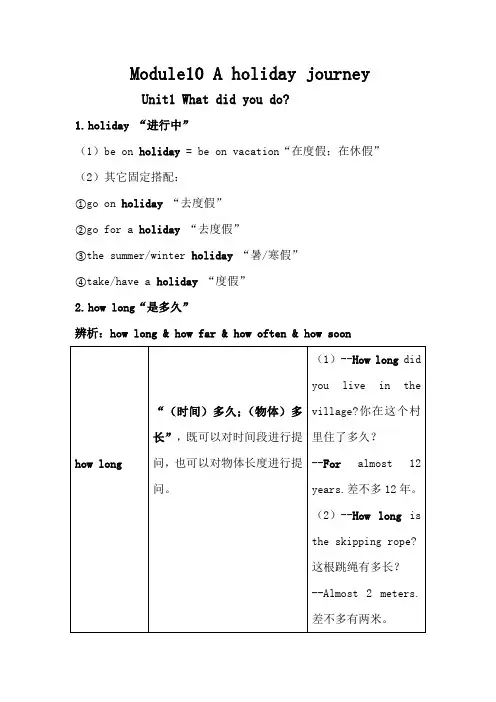
Module10 A holiday journeyUnit1 What did you do?1.holiday “进行中”(1)be on holiday = be on vacation“在度假;在休假”(2)其它固定搭配:①go on holiday“去度假”②go for a holiday“去度假”③the summer/winter holiday“暑/寒假”④take/have a holiday “度假”2.how long“是多久”辨析:how long & how far & how often & how soon3.take用法辨析:take & spend(1)take常用句型It takes/took (sb.)some time to do sth. “做事花费(某人)多少时间”,其中it代替to do sth.,做句子的形式主语,而句子的真正主语是不定式短语to do sth.(2)spend常用句型①sb.spends/spent some time/monet on sth. “某人在某事上花了多少时间/金钱”。
②sb.spends/spent some time/money (in) doing sth. “某人花费多少时间/金钱做某事”一言辨异:It won’t take you much time to finish the work and you just need to spend about 15 minutes on it.完成这项工作不会花费你很多时间,你只需要花费大约15分钟左右即可。
4.“如此,那么的”so(1)用作连词,“这么;那么;这么看来”。
So you promise to help us to finish the work?那么你的意思是你答应帮助我们完成这项工作喽?(2)用作连词,“因此;所以”,引导结果状语从句。
2020-2021学年七年级英语外研版下册Module10Aholidayjourney教案
一、教学内容
本节课选自2020-2021学年七年级英语外研版下册Module 10 "A holiday journey",教学内容主要包括以下几部分:
1. Unit 1:深入学习一般过去时,描述过去发生的旅行事件。
3.成果分享:每个小组将选择一名代表来分享他们的讨论成果。这些成果将被记录在黑板上或投影仪上,以便全班都能看到。
(五)总结回顾(用时5分钟)
今天的学习,我们了解了一般过去时在描述旅行经历中的基本运用、重要性和相关的句型结构。通过实践活动和小组讨论,我们加深了对一般过去时的理解。我希望大家能够掌握这些知识点,并在日常生活中灵活运用。最后,如果有任何疑问或不明白的地方,请随时向我提问。
3.思维品质:培养学生独立思考、合作交流的能力,激发学生对旅行话题的兴趣,提高学生的创新思维和批判性思维。
4.学习能力:通过阅读、听力、口语及写作练习,培养学生自主、合作、探究的学习方式,提高学生英语学习兴趣和自信心。
三、教学难点与重点
1.教学重点
(1)一般过去时的正确运用:本节课的核心语法点是运用一般过去时描述过去发生的旅行事件。学生需要掌握动词过去式形式,如visited、arrived、bought等,并能运用这些词汇构建完整的句子。
5.写作任务:根据课文内容,编写一段关于自己假期旅行的短文,巩固一般过去时的运用。
二、核心素养目标
本节课的核心素养目标主要包括以下几方面:
1.语言能力:通过学习本模块,学生能够熟练运用一般过去时描述过去发生的旅行事件,掌握旅行关词汇和句型,提高英语口语表达和书面表达能力。
2.文化意识:通过课文学习,了解不同国家的旅游景点和文化背景,增强学生的国际视野和文化意识。
(完整word版)外研社七年级英语下册Module10-A-holiday-journey知识点复习
MODULE 10 A Holiday Journey1.短语:2.go there 到那里3.enjoy…a lot 非常喜欢… a lot 很, 非常4.drive sb.to…开车送某人去…5.go back to our family home 回到我们家到达: arrive 不及物动词, 接here ,there, home等地点副词时省略介词。
arrive in+大地点arrive in Chinaarrive at +小地点arrive at the schoolarrive homeget 不及物动词get to +地点接地点副词时, 省略toreach 及物动词reach+地点6.the day before yesterday 前天the day after yesterday 后天7.at the airport 在机场8.works of art 艺术作品9.such as 例如10.have dinner 吃晚饭11.take a walk 散步=go for a walk12.street market 街头市场13.do some shopping 购物14.buy…for sb.为…买…15.hope 希望没有hope sb to do sth 这一结构hope to do 希望做…hope +句子16.have to do...不得不做17.wait in line排队等候cut in line 插队18. a special holiday 一个特殊的假期19.Pacific Ocean 太平洋20.on holiday 度假on sale 出售on duty 在值日on leave 在休假on fire 着火21.at the station 在车站22.do different things 做不同的事情23.all day一整天= the whole day24.take lots of photos 照许多照片25.at the top of 在…顶端how long 表示“多久, 多长时间”, 用来提问时间的长短, 常用“for+一段时间”或“since+时间点/一段时间+ago”或“since+从句”作答。
+Module+10++A+holiday+journey 外研版七年级英语下册
wonderful经常用于答语中,相当于great, excellent, fantastic等,意为“棒极了; 好极了”。
wo n d er f u l
n. 宫殿
The palace was built in the fifteenth century.
p a l ace
Module 10 A holiday journey
adj. 太平洋的 They spent many days cruising the northern Pacific Ocean.
It’s so hot today, but there are so many
people climbing the mountain. They’re so
sel l
at the top of 意为“在……的顶端”。
n. 顶端
He got to the top of the mountain at eight.
t op
He didn’t arrive till/until the concert began.
conj. 直到……为止
ti l l
be excited about 对……感到兴奋/激动; be excited to do st
v. 到达
作不及物动词,意为“到达”。常见用法如下: arrive in + 大地点(如国家、大城市等) arrive at + 小地点(如城镇,机场等) arrive + 地点副词(home, here, there等)
Can you arrive in Beijing next week? How did you arrive here?
a rri ve
2024七年级英语下册Module10Aholidayjourney教学设计(新版)外研版
-每个小组选择一名代表进行分享,其他学生进行评价和提问。
6.总结与作业布置(5分钟)
-教师对本节课的内容进行总结,强调一般过去时的运用和旅行相关词汇的记忆。
-布置作业:要求学生写一篇关于自己旅行经历的短文,使用一般过去时描述。
总用时:45分钟
教学过程设计要求紧扣实际学情,突出重难点,通过创新活动和课堂提问等方式,促进学生的积极参与和思考。教师应根据学生的反馈和理解程度,适时调整教学节奏和难度,确保学生能够理解和掌握新知识。同时,教学过程要注重师生互动,鼓励学生主动参与和表达,培养他们的语言能力和思维品质。
2.语法:一般过去时是学生已经学习过的时态,本节课将引导学生运用一般过去时描述过去发生的事情,巩固已有知识。
3.阅读理解:学生通过之前的阅读练习,已具备一定的阅读理解能力,本节课将通过一篇有趣的旅行故事,提高学生的阅读兴趣和阅读能力。
核心素养目标分析
本节课的核心素养目标主要分为三个方面:语言能力、文化意识和思维品质。
-开展旅行主题的英语角活动,鼓励学生用英语讨论旅行相关的主题,如旅行计划、旅行目的地等,提高学生的语言运用能力和思维能力。
-布置与旅行相关的英语写作作业,要求学生写一篇关于自己梦想旅行的文章,培养学生的写作能力和创造力。
-引导学生进行旅行相关的项目研究,如研究不同国家的旅行习俗和文化,培养学生的研究能力和文化意识。
板书设计
1.目的明确:板书设计应紧扣本节课的教学内容,突出一般过去时的用法和旅行相关词汇。
2.结构清晰:板书应分为几个部分,包括课题、教学重点、语法点、词汇表和课堂活动等,使学生能够一目了然地了解本节课的主要内容。
3.简洁明了:板书设计应简洁明了,突出重点,避免冗长的文字描述。使用关键词和符号,使学生能够快速理解和记忆。