
2013年春季七年级英语下册Unit10 I‘d like some noodles Section B-1
2a What do you do or eat on your birthday?
I usually have a birthday party. My friends come to my party. We have a great time.
I usually eat noodles and eggs for breakfast.
dumplings
porridge
onion
fish
pancake
green tea
pancakes
porridge
soup
orange juice
green tea
fish
Do you like to drink these things?
a glass of water
a bag of milk
In the UK, people sometimes put a candy in a birthday cake. The child with the candy is lucky.
In China, it is getting popular to have a cake on your birthday.
blow
candy
cut up
different
UK
popular
lucky
idea
Read the passage. Judge Yes (Y) or No 2b (N) of the sentences.
1. ____ The number of candles on the birthday Y cake is the person’s age. 2. ____ In the UK, when the child has the birthday Y cake with the candy, he/she is lucky.
Really? I like fish, porridge and pancakes. But I don’t like onions.
I like orange juice, and soup. But I don’t like green tea.
Well. I like porridge and fish. But I don’t like orange juice.
2c
Read the article again and answer the questions.
1. How can a person make his or her birthday wish come true? If he or she blows out all the candles ____________________________________ in one go, the wish will come true. ______________________________ 2. What do people in the UK sometimes put in a birthday cake? _________________________________ They usually put a candy in a birthday cake.
1a
Match the words with the pictures.
b 1. ____ meat
h 4. ____ green tea
i 7. ____ onions
c g dumplings 5. ____ orange juice 8. ____ fish 2. ____ d a e 3. ____ porridge 6. _____ soup 9. ____ pancakes f
chicken and cabbage noodles.
Guessing game
What size bowl of noodles would I like? a small bowl of noodles
a medium bowl of noodles
a large bowl of noodles
Country
UK
birthday cake
Food
Special meaning
Blowing out candles on a cake makes a wish come true. It is lucky to find a candy in a cake. Long noodles mean long life. Eggs mean life and good luck.
3. Why do people never cut up birthday noodles in China? Because the long noodles are a symbol _________________________________ of long life. _________________________________ 4. Why do people eat special foods on their birthday? _________________________________ Because they want to bring good luck _________________________________ to the birthday person.
But many people still eat very long noodles for their birthday. They never cut up the noodles because the long noodles are a symbol of long life. In some places, Chinese people also eat eggs on their birthday. They are a symbol of life and good luck.
1d Listen again. Check your answers in 1c.
A: Hello, House of Dumplings. B: Hello! I want to order some food, please. A: Sure. B: I’d like chicken, fish and cabbage, please. A: Uh-huh. B: And twelve dumplings. A: What kind of dumplings would you like? B: Beef and carrot dumplings, please. A: OK. What else? B: Umm … I’d like some soup, too.
A: What do you like ? B: I like …, … and … / meat I don’t like …, …or…. pancakes
dumplings
soup
Байду номын сангаас
fish
rice
green tea
porridge
orange juice
1c
Listen and complete the food order form. ORDER FORM
I can have a big birthday cake and a lot of gifts.
My father usually buys me some new clothes.
My mum usually make a big dinner for me.
world
answer
cake
a cup of tea
a bottle of juice
a tin of coke
a cup of coffee
Guessing game
What kind of noodles would I like?
I’d like tomato noodles.
beef and tomato noodles. mutton and potato noodles.
A: OK. What kind of soup would you like? B: Tomato soup.
A: OK. One tomato soup then. Would you like any drinks?
B: One large green tea and two small orange juices.
What would people like to eat on their birthday? The answer would be different in different countries.
There’re 9 candles and I’m nine years old.
In many countries, people have birthday cakes with candles. The number of the candles is the person’s age. The birthday person must make a wish and blow out the candles. If he or she blows out all the candles in one go, the wish will come true.
Address: 15th North Street Telephone number: ___________ 398-2845 Order: cabbage chicken Dishes: _______, fish, _________ carrot dumplings Dumplings: 12 beef and ____________________ tomato soup Soup: one _____________ green tea two Drinks: one large _________ and _____ small ________ orange juices.
【人教版】七年级下册:Unit 10 I'd like some noodles讲义(含解析)
Unit10 I'd like some noodlesSentences: order food– What kind of noodles would you like?–I’d like beef and tomato noodles.– What size (bowl of noodles) would you like?–I’d like a large/medium/small bowl of…–What’s your address?– My address is 15 North Street.– Can I help you ?–I’d like some… , please.– May I take your order?–Oh, yes. I’d like some soup.Passage: your mealsAn ad for a restaurantOrder FoodGrammar:would like (sth. / (sb.) to do sth. )重难点精讲词汇:Staple food: noodles, dumplings, rice, pizza, hamburger, pancake, cake…Meat: beef, mutton, chicken, fish, steak, sausage….Vegetables: cabbage, potatoes, tomatoes, mushrooms, onions….Drinks: juice, green tea, black tea, mineral water, lemonade,soda, coffee, iced tea…Soup: porridge, beef soup…..Snacks: apple pie, French fries, potato chips, candy…Others: saladSize: large, medium, smallWelcome.Can I help you? / What can I do for y ou?May I have a menu, please?Do you have a menu in Chinese?Would you like something to drink before dinner?May I order, please?What would you like?Do y ou have today's special?Could you tell me how to eat this?I’d like …, please.May I have …, please.This is not what I ordered.Check, please.How much are they?Thank you a lot.More useful expressionsA: May I have your order?B: I’d like some noodles, please.A: What kind of noodles would you like?B: What kind of noodles do you have?A: We have beef, chicken, mutton, cabbage, po tato, toma to …B: Are there any vegetables in the mutton noodles?A: Yes, there are some carrots.B: OK, I’d like the mutton noodles then.A: Sure. What size would you like?B: What size do you have?A: We have large, medium and small bowls.B: Oh, a medium bowl, please.Conversation 1Waiter: What would you like?Customer: Let me think about it. Are there any vegetablesin the beef noodles?Waiter: Yes, there are some carrots and tomatoes.Customer: OK. I’ll have the beef noodles.Waiter: What size would you like?Customer: I’ll just have a small bowl, please.Waiter: OK. So that’s one small bowl of beef noodles.Customer: Thank you.Conversation 2The Ice-cream and Pancake HouseWould you like to eat ice-cream or pancakes?At our restaurant, we have some great specials. We have different kinds of fruit ice-cream, like strawberry, banana or orange. Would you like a big bowl for four yuan or a small one for just two yuan? You can also order our delicious pancakes. They’re only five yuan.可数名词与不可数名词可数名词:1)有单数复数之分2)可以用some, any, few, a few, many, a lot of 来修饰。
2013年春季七年级英语下册Unit10_I‘d_like_some_noodles_Section_B-1

a bottle of juice
a tin of coke
a cup of coffee
Guessing game
What kind of noodles would I like?
I’d like tomato noodles.
beef and tomato noodles. mutton and potato noodles.
Let’s Chant
What would you like? What would you like?
Noodles, noodles. I’d like noodles.
What kind of noodles? What kind of noodles?
Beef and potato, beef and potato.
2a What do you do or eat on your birthday?
I usually have a birthday party. My friends come to my party. We have a great time.
I usually eat noodles and eggs for breakfast.
In the UK, people sometimes put a candy in a birthday cake. The child with the candy is lucky.
In China, it is getting popular to have a cake on your birthday.
A: OK. What’s your address, please?
B: 15 North Street.
人教版七年级英语下册unit 10 I'd like some nooodles. 全单元教案
Unit 10 I’d like some noodles.Period 1 section A 1a-1cTeaching Aims and Demands1.Knowledge objects(1)Key words: noodles, beef, mutton, chicken, cabbage, potatoes, tomatoes.(2)Target Language: What kind of noodles would you like?I’d like beef and tomato noodles, please.(3)Listening practice and speaking practice(4)To learn the countable and uncountable nouns.2.Ability objectsTo train students’ ability of listening and speaking.Teaching Focuses1. To learn the names of food and the countable and uncountable nouns;2. To learn how to order food;3. To make pair work.Teaching ProceduresStep 1 Presentation1. Teach the new words of food used in noodles.2. Look at the numbered list of ingredients. Read and repeat.Step2. PresentationPractice “would like”1.A: What would you like? B:I’d like.....2.A:What kind of meat would you like? B:I’d like.....3.A:What kind of drink would you like? B:I’d like.....4. Ask students to match each word with the foods in 1a.5.Show the sign ___Special 1, Special2, Special3 to understand their meanings.Step3. Grammar1.Present the countable and uncountable nouns.2.List many words, and let the students discuss in groups and tell us what kinds of nouns thesewords are.Step4. PresentationPresent the target language as following:A: What would you like?B:I’d like.....A: What kind of noodles would you like?B: I’d like beef and tomato noodles, please.Step5. Practice the drill1、Read the conversation above.2、Ask students to work in pairs. One person is the waiter, the other one is the customer. Thenlet them perform the conversation in front of the classroom.Step6. Listening1b1、Show three bowls of noodles in picture. Ask: What ingredients are in these noodles?2、Play the recording the first time .Students only listen.3、Play the recording a second time and correct the answers.Step7. PresentationMake a survey to your friends. Ask: What kind of noodles would you like? Fill in the form, then make a report.Step8. PresentationPresent the target language as following:A: What size bowl of noodles would you like?B: I’d like a large / medium / small bowl of noodles.Step9. Role playLet the students perform the conversation as following, imagining they are in a restaurant (Each student can be both the waiter and the customer):A: What kind of noodles would you like?B: I’d like beef and tomato noodles, please.A: What size bowl of noodles would you like?B: I’d like a large / medium / small bowl of noodles.Step10. Listening1、Listen and check the names of the foods they hear in 2a.2、Listen and fill in the blanks in 2b.Play the recording a second time.Step11.Pair work1. Ask and answer questions with your partner. Use the information in 2a.2. Show the conversations of 2a on the big screen to the Ss.3. Make a model for the Ss.T: What kind of noodles would you like?S1: I'd like beef noodles, please.…3. Ss work in pairs and practice the conversations.Step 12. Role-play1. Ask Ss to read the conversation in 2d and find the answer to this question:What would they like?(They would like one large bowl of beef soup, one gongbao chicken, and one mapo tofu with rice.)2. Check the answers with the Ss.3. Ss work with their partners and role-play the conversation.Step 13 . Language points1. May I take your order? 你可以点菜了吗?也可以说“Can I take (have) your order?”,“Are you ready to order?”这些都是服务员请客人点菜的礼貌用语。
七年级英语下册Unit10-I27d-like-some-noodles
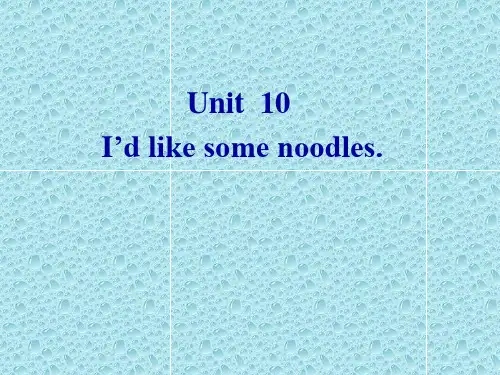
a large bowl of noodles
What size bowl of noodles would he/she like? He/She’d like a…bowl of noodles.
small
medium
large
2a. Listen and check the names of the foods you hear.
1. ___a____ potato 2. __s_o_m_e__ beef 3. __s_o_m_e___ milk 4. ____a____ strawberry 5. __s_o_m__e__ chicken 6. ___a_n____ egg 7. __s_o_m__e__ mutton 8. ___a_n____ apple 9. ____a____ tomato
1. __√____ noodles 5. _√____ tomatoes 2. __√____ beef 6. _√____ cabbage 3. ______ mutton 7. _√____ potatoes 4. __√____ chicken 8.__√___ vegetables
2b. Listen again . Complete the sentences.
I’d like chicken and cabbage noodles.
I’d like mutton and potato noodles.
I’d like pork and cabbage noodles.
I’d like egg and tomato noodles.
1a. Match the words with the foods. 1. mutton ___g__ 2. beef ___b__ 3. noodles ___c__
初中英语七年级下册 Unit10I’d like some noodles.SectionB(2a-

初中英语七年级下册Unit10I’d like some noodles.SectionB(2a-selfcheck)教学设计一. 教材分析初中英语七年级下册Unit 10 “I’d like some noodles.” 主要介绍了一些关于食物和饮料的词汇以及日常的点餐用语。
本节课主要围绕着去餐馆点餐的情景,让学生们能够运用所学的词汇和句型去进行真实的交流。
Section B (2a-self check) 部分包含了两个任务:2a和2b。
2a是一个故事,讲述了两个学生在餐馆的点餐经历。
2b是一个调查问卷,旨在让学生们练习如何询问和回答关于食物和饮料的喜好。
二. 学情分析七年级的学生已经掌握了一些基本的英语语法和词汇,对于日常的交流已经有了一定的掌握。
但是,他们在口语表达和听力理解方面还存在一定的问题。
因此,在教学过程中,需要注重培养学生的口语表达能力和听力理解能力。
三. 教学目标1.能够掌握和运用本节课所学的食物和饮料的词汇。
2.能够理解和运用本节课所学的点餐用语。
3.能够通过调查问卷的方式,询问和回答关于食物和饮料的喜好。
4.能够提高口语表达能力和听力理解能力。
四. 教学重难点1.重点:掌握食物和饮料的词汇,理解和运用点餐用语。
2.难点:能够用英语进行真实的点餐情景交流。
五. 教学方法1.任务型教学法:通过设计各种任务,让学生在实践中学习和运用语言。
2.情境教学法:创设真实的情境,让学生在特定的情境中学习和运用语言。
3.交际法:鼓励学生进行真实的交际,提高口语表达能力和听力理解能力。
六. 教学准备1.食物和饮料的图片和词汇卡片。
2.餐馆点餐的视频或录音。
3.调查问卷的打印版和电子版。
七. 教学过程1.导入(5分钟)通过展示一些食物和饮料的图片,引导学生进行复习,为新课的学习做好铺垫。
2.呈现(10分钟)a)展示2a的故事,让学生听懂故事内容,并回答相关问题。
b)分组讨论:让学生分组讨论他们喜欢的食物和饮料,并鼓励他们用英语进行表达。
七年级英语下册Unit10I’dlikesome

Unit 10 I'd like some noodles 重点解析Section A1. What would you like?你想要点什么?原句是what引导的特殊疑问句,用来询问对方想要什么。
回答一般用“I would like (可以缩写成I'd like)...”。
would like意为“想要”,相当于want,其中would没有人称和数的变化。
would like常用于以下结构:★would like +名词/代词,表示“想要某物”。
如:I'd like an apple.我想要一个苹果。
★would like to do sth.表示“想要做某事”,是委婉客气的说法。
如:We'd like to go to the movies this evening.今晚我们想去看电影。
★would like sb. to do sth.表示“想要某人做某事”。
如:He would like me to help him with his English.他想让我帮助他学英语。
I'd like...变一般疑问句时把would提前,即Would you like...?意为“你想要……吗?”,也是征求别人意见的常用句型,语气较委婉。
Would you like to do ...?意为“你想做……吗?”回答一般为Yes, I’d like to./ I’d like to, but I...如:—Would you like some beef?你想要一些牛肉吗?—Yes, please./ No, thanks.好的。
/不,谢谢。
—Would you like to go shopping with me?你愿意和我一起去购物吗?—Yes, I’d like to./ I’d like to, but I have to visit my friend.是的,我愿意。
七年级英语下册《Unit10_I’d_like_some_noodles_教新目标版整1单元
I’d like pork and cabbage noodles.
I’d like egg and tomato noodles.
1a. Match the words with the foods. g 1. mutton _____
2. beef _____ b
c 3. noodles _____
3a. Complete the conversation below.
1. May I have your order?___ D 2. What kind of noodles A would you like?____ 3. We have beef, chicken, mutton, cabbage, potato, tomato…____ F 4. Yes, there are some C carrots.___ 5. Sure. What size would E you like?____ 6. We have large, medium B and small bowls.____ A: What kind of noodles do you have? B: Oh, a medium bowl, please. C: OK, I’d like the mutton noodles then. D: I’d like some noodles, please. E: What sizes do you have? F: Are there any vegetables in the mutton noodles?
可修饰可数名词复数或不可数名词,常 用于疑问句和否定句。如:
I can’t see any tea. 我没看见茶叶。 Do you have any friends at school? 你在学校有些朋友吗?
七年级英语下册 Unit 10 I’d like some noodles重点单词及句型背诵、默写
本文档仅供文库使用。
百度文库是百度发布的供网友在线分享文档的平台。
百度文库的文档由百度用户上传,需要经过百度的审核才能发布,百度自身不编辑或修改用户上传的文档内容。
网友可以在线阅读和下载这些文档。
百度文库的文档包括教学资料、考试题库、专业资料、公文写作、法律文件等多个领域的资料。
百度用户上传文档可以得到一定的积分,下载有标价的文档则需要消耗积分。
当前平台支持主流的doc(.docx)、.ppt(.pptx)、.xls(.xlsx)、.pot、.pps、.vsd、.rtf、.wps、.et、.dps、.pdf、.txt文件格式。
Unit 10 重点短语及句型背诵(留存备用考前复习)Key Phrases重点短语1. beef noodles/ soup牛肉面/牛肉汤2. take one's order 点菜3. would like(表意愿)愿意;喜欢4. birthday cake生日蛋5. a/one (medium/large) bowl of... (中/大)碗.... ...6. what size多大(碗)7. beef and carrot noodles 牛肉胡萝卜面 8. green tea绿茶9. what kind of noodles哪种面条 10. blow out吹灭11. the number of... ....的数量 12. make a wish许愿13. in different countries在不同的国家 14.in one go一口气,一下子15. come true(梦想)实现 16. get popular受欢迎;流行17. a symbol of long life 长寿的象征 18. cut up切碎19. bring good luck to... 给.....带来好运 20. put .. in...把..放.....21. be short of短缺;缺乏 22. put on戴上;穿上23. around the world世界各地Key Sentences 重点句型1. I'd like some noodles. 我想要一些面条。
2013年春季七年级英语下册Unit10 I‘d like some noodles Section_B-1
可数名词和不可数名词
可数名词: 可以计数的名词称为可数名词。 一般有
单数与复数两种形式, 前面可加a, an或数词来修饰.
不可数名词: 不可计数的名词称为不可数名词。 没有复数形式, 前面不能用不定冠词a, an, 也不能 直接加数词, 但可以跟某些量词短语搭配, 表示数量。如: a glass of water, two cups of tea.
是考虑用在肯定句、疑问句还是否定句中,
与名词的可数与否无关。
2
some的用法: some意为“一些”,可作形 容词和代词。它常修饰可数名词复数。
如:some books 一些书,
some boys 一些男孩,
some 常用在 肯定句中。
也可修饰不可数名词:
some water 一些水,some tea 一些茶叶,
(2) 不可数名词做主语时,谓语动词只能用 单数形式。例如: 在碗里有一些羊肉汤。 There ___ is ______ some mutton soup in the bowl. 【拓展】如果不可数名词前有复数名词短 语修饰时,谓语动词须用复数形式。如: 房间里有两袋子大米。 ______ There ____ are two bags of rice in the room.
用 a, an或 some填空。
a 1. _______ potato some beef 2. _______ some milk 3. ________ a 4. ________ strawberry some chicken 5. ________ 6. ________ egg an 7. ________ some mutton 8. ________ apple an a 9. ________ tomato 10. ______ some noodles
Unit10《I’d-like-some-noodles》教学设计精选全文完整版
可编辑修改精选全文完整版Unit10《I’d like some noodles》教学设计一、教材分析本堂课是针对七年级下册Unit 10I’d like some noodles而展开的,本课的阅读部分重点介绍了世界各地的生日饮食习惯,学生不仅要学会说语言,更要了解语言背后的文化知识,同时需要结合本课所学句型进行对话练习;此外,初中英语教学的最高境界是渗透多元文化视域,让学生以中国文化作为精神依附,有针对性地借鉴外国优秀文化成果,从而使英语教学在动态、连续的发展过程中顺应时代需求,针对本课饮食文化教学内容来说,学生需要善于捕捉时事热点,在后疫情时代,各国促生了新的礼节方式,英语课堂要引导学生了解疫情下各国的风俗礼仪,增加学生的文化积累,让学生在具体交际时能使用正确的用语和礼节,这也降低了跨文化交际错误的产生。
二、教学目标各国文化在世界范围内各自发展,文化多元化不是各国文化的相互同化或逐渐趋同,而是随着世界政治经济的高速发展,各国文化在相互吸收的基础上形成的一种相互交叉的生活方式。
本课也将从多元文化视域的角度出发,制定“多样化”的课堂设计,旨在激发学生的学习兴趣,补充生活体验,让学生的思维得到发散。
具体课堂目标设计如下:1. 知识领域:学生能够运用和掌握以下词汇:around the world、different、lucky、popular、candle、age等,掌握与饮食有关的表达、生日食品的含义;2.技能领域:运用思维导图简要复述文章大意,进行口头语段及语篇表达,并将其运用于个人讲述、集体讨论及课外采访中来。
3.情感领域:通过相关材料的学习与训练,深入体会中西方饮食文化的差异,体验生日文化气息,最终能在真实的跨文化交际中进行比较深入、得体的交流。
三、教学重难点1.教学重点:熟练掌握本课的重点单词和短语make a wish, blow out等,并了解中西方生日、饮食文化的差异;2.教学难点:学生需要掌握本课的重要语法点:the number of 与 anumber of的差别,if引导的条件状语从句,区别可数名词与不可数名词;四、教学准备基于创新教育的大背景下,教师需要在现代教育技术基础上重新审视各专业的特点,教学方式和策略也需要对照标准进一步更新,目前现代教育技术与英语教学跨领域融合的模式也给教学发展带来了新的机遇和挑战,本课教学中就采用了混合式教学模式,促进线上线下教学的相互融通,使现代教育技术与英语教学相融合。