
新人教版必修一Unit 2 Travelling Around 单元
第1-2课时
Listening and Speaking Listening and Talking
Project
Book1 Unit 2 Travelling Around 课时安排
第3-4课时 Discovering Useful Structures Assessing Your Progress
以《课标》课程方案为依据,在必修和选修性必修基础上 设计的拓展、提高、整合性单元教学,构建多元的英语课程结 构,以学生兴趣和未来发展需要,从课程发展现状出发,调整 课程结构,以主题语境、语篇类型、语言知识、文化知识、语 言技能和学习策略等六要素构成课程内容,创设具有综合性, 关联性和实践性的英语学习活动,引导学生采用自主合作的学 习方式,参与主题学习的探究活动,确保语言能力、文化意识、 思维品质和学习能力的同步提升,构建与课程目标一致的课程 内容和教学方式。
单元学习目标与重难点
在本单元学习之后,学习者能够运用一般将来时简要地介绍和描述
旅游计划、描写旅游景点特色,不断了解不同地域文化和社会变化;
面对各地不同生活所带来的挑战学会负责,敢于担当;拓展自己的
想象力,描述自己所会遇到的具体问题以及解决的方式。
为此本单元的学习目标设计5个方面: In this unit, you will: 1. Read about tours to Peru and China. 2. Listen to people discuss their travel plans. 3. Talk about preparing for travel and how to make reservations
育人主题:学会自主准备旅游 准备旅游
中外名胜 法国埃菲尔铁塔
德国新天鹅堡 中国丽江、天山……
学生拓展类
最心爱的地方 …… 最难忘的旅行
……
学生关注类 新天鹅堡
九寨沟 ……
活动意图说明:通过本环节的探究,学生加深对共同话题 细节表达的正确学习。
完整性和目标性 看图描写
Eiffel Tower, the symbol of Paris was built in 1887 to commemorate the 100th anniversary of the French Revolution. It is named after its designer, Eiffel. The 320-meter-high tower is a hollow steel framed structure and shoots straight up to the clouds. It weighs 9000 tons.
Reading and Thinking 第5-6课时 Make guesses of new words
第7-8课时
Reading for writing Watching for writing
活动意图说明:通过单元分析,可以突出话题的主题共性。 该环节设计的主要意图是帮助学生理清文章主旨和脉络结构, 加强对语篇主题和话题的整体理解。
核心素养
1.语言听力:在社会情境中,以听、说、读、看、写等方式理解和表 达意义,以及在学习和使用语言的过程中形成的语言意识和语感。 2.文化意识:对中外文化的理解和对优秀文化的认同,是学生在全球 化背景下表现出的跨文化知识态度和行为取向。树立人类命运共同体意 识成为对社会有责任感的人。 3.思维品质:在逻辑性、批判性、创新性等方面所表现的能力和水平。 有助于提升分析和解决问题的能力,使学生能够从跨文化视角观察和认 识世界,对事物做出正确的价值判断。 4.学习能力:指积极运用和主动调试英语学习策略、拓宽英语学习渠 道、努力提升英语学习效率的意识和能力。
use to describe your trips?
Read and write. 1.What is a travel plan? 2. How will you plan?
本单元的难点 Learn to write a travel plan.
活动意图说明:通过本环节的探究,学生加深对主题技能 目标的正确把握。
单元整体分析意义
新课标还指出,单元是承载主题意义的基本单位,单 元教学目标是总体目标的有机组成部分。
单元教学目标,要以发展学科核心素养为宗旨,并围 绕主题引领的学习活动进行整体设计。
每个课时的目标设定都要为达成单元整体目标服务, 有机结合课程内容6要素,避免脱离主题意义或碎片化的 呈现方式,在此基础上,教师将本单元的内容进行相应的 整合,并关注主题语境下的整体性。
for a trip. 4. Write a travel plan. 5. Learn about travelling at home and abroad.
本单元学习的重点内容
Look and discuss. 1.Where do you think the travellers in the photo are? 2.Do you like travelling? Who do you like to travel with? 3.What places have you travelled to? What words can you
社会 实践
全国 卷二
球队参 加比赛
举办音乐节
全国 卷三
单元综合分析
单元分析 人教版教材单元整体分析
人教版(新版) Unit 2 Travelling Around
Core of Learning
美国学者埃德加·戴尔(Edgar Dale)1946年提出了“学习 金字塔”(Core of Learning)的理论,该理论认为在语言学习 中,阅读能够记住学习内容的10%;聆听能够记住学习内容的 20%;看图能够记住30%;看影像,看展览,看视频,现场观摩, 能够记住50%;参与讨论发言,能够记住70%;做报告,给别人 讲,亲身体验,动手做能够记住90%。同时,高中英语教学鼓 励学生通过自主探究,自我发现和主动实践等学习方式,形成 具有高中特点的英语学习的过程和方法。所以,教师作为教学 的组织者,在本单元的教学设计中,采用了多种任务形式的教 育教学活动,让学生在主动学习与参与中掌握教学的重难点。
Unit Two
Travelling Around
主讲专家:马成霞 特级教师 北京理工大学附属中学
(新版)人教版 Book 1 Unit 2 Travelling Around 单元课时教学设计
指 导 思指导
思想
想
单元 分析
学情 分析
目标 分析
教法 学法
教学 过程
2
指导思想 人教版教材单元整体分析
Teaching Objectives
1 单元教学设计说明 2 单元学习目标与重难点 3 单元整体教学思路 4 单元教学目标
活动意图说明:通过本环节的思考和讨论,学生加深对主题目标 的正确理解。
本单元的学习目标设计:
1.学生了解关于 Travelling Around 不同语篇的学习目的以及有关表 示将来的现在进行时及一般将来时句式的相关结构特征。 2.学生在不同语篇学习中理解学会使用这两种时态,并运用所学的语 法知识描写真实和想象的著名旅游地点以及自己或者他人相关生活中 的不同地点和不同特色以及不同需要的叙述。 3.学生学习有关旅游计划以及以电子邮件相关格式的相关话题的词汇 和句式语言,能够用文字描述自己所选择的旅游图片和在不同地点旅 游或者不同国家旅游所需要的帮助。 4.拓展学生思维,提高学生批判性、分析性和评价性的能力。
Teaching Emphasis 1 学习和掌握有关旅游计划和与电子邮件相关的话题的相
关词汇和现在进行时、一般将来时的句式。
2 理解和使用正确的时态,并学会描述有关旅游计划以及
电子邮件相关话题的图片和故事情景。
3 了解并学会不同体裁语篇概要写作的结构特征和写作风格。
Teaching Difficulties
写作方法概述,描写图片,即找出图片中的要点写成段落 主题句,然后对要点形成解释2~4句加结论,过渡词加结论 (即观点,也就是对要点的情感表达)。
活动意图说明:通过本环节的探究,学生加深对共同话题细 节表达的正确学习。
A层 My Favorite Trip
Hi! I am extremely delighted to make a brief introduction to you! It’s well-known that Eiffel Tower, the symbol of Paris was built in 1887 to commemorate the 100th anniversary of the French Revolution. It is named after its designer, Eiffel. The 320-meterhigh tower is a hollow steel framed structure and shoots straight up to the clouds. It weighs 9000 tons.I’m sure you’ll fall in love with it once going there.
1 了解并学会有关旅游计划、电子邮件的相关话题以及不
同体裁语篇概要写作的结构特征和写作风格。
2 能够初步运用现在进行时表将来以及一般将来时来介绍
有关旅游计划,如著名景点旅游规划,不同国家特色旅 游规划等。
话题1:
准备旅游
话题2: 分享旅游规划
话题3: 组织安排预定
话题4: 分享旅游日程及
注意事项
活动意图说明:通过本环节的探究,学生加深对共同话题 多元目标的正确学习,旨在培养学生“学中做”的能力。
人教版(新版) Unit 2 Travelling Around
人教版高中英语必修第一册 Unit 2 Travelling Around Section Ⅰ
( T )4.There are some unique animals and plants in the
Amazon rainforest.
( F )5.Cusco was the capital of the Inca Empire in the 12th
century.
二、阅读第26~27页的课文,选择最佳答案 1.What is the author's intention of writing the second text?
2.Machu Picchu Tour is suitable for those who are
.
A√.fit
B.outgoing
C.positive D.humorous
3.Where does the second text probably come from? A.An agricultural report. B.A medical journal. C.A science textbook. √D.A travel magazine.
【合作探究】 记一记·长知识 apply to有关;涉及;适用于
What I am saying applies only to some of you. 我所说的只涉及你们中的一些人。
读一读·细观察 阅读下列句子,写出句中黑体词的词性及含义 (1)To my delight,I was chosen from hundreds of applicants to attend the opening ceremony. 词性___名__词_______ 含义___申__请__人_____ (2)I am filling in an application form for a new job. 词性___名__词_______ 含义___申__请_______
【新人教版】高一英语上册必修一同步课件Unit 2 Travelling Around (单词课件)
Vocabulary
3. pack n. 包裹;一包 v. 包装;塞满;收拾行李
He paid 10 yuan for a pack of cigarettes.
Please don’t crease the blouse when you pack it.
形容词: packable 名词: packability 过去式: packed 过去分词: packed 现在分词: packing 第三人称单数: packs
Reading and Thinking
Vocabulary
• narrow • flat • emperor • site • official • flight • soldier
accommodation unique
path destination admire civilization
• path
n. 小径
• Diligence is the path to the moutain of knowledge.
• site n. 地点 • He sped his car off the accidental site.
• destination n. 目的地 • Open the suitcase as soon as you reach your
• narrow
adj. 狭窄的,有限的;勉强的;精密的;
•
n. 海峡;狭窄部分,隘路 v. 使变狭窄,变窄
• A dark narrow passage led to the main hall.
• accommodation n. 住处,膳宿;调节 • They were unhappy with their accommodation.
人教版必修一Unit2 Travelling around单元检测卷(A卷)(含解析)
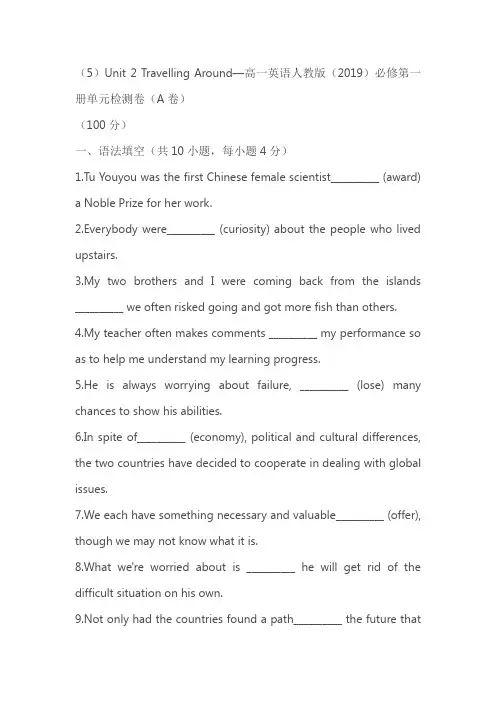
(5)Unit 2 Travelling Around—高一英语人教版(2019)必修第一册单元检测卷(A卷)(100分)一、语法填空(共10小题,每小题4分)1.Tu Youyou was the first Chinese female scientist__________ (award)a Noble Prize for her work.2.Everybody were__________ (curiosity) about the people who lived upstairs.3.My two brothers and I were coming back from the islands __________ we often risked going and got more fish than others.4.My teacher often makes comments __________ my performance so as to help me understand my learning progress.5.He is always worrying about failure, __________ (lose) many chances to show his abilities.6.In spite of__________ (economy), political and cultural differences, the two countries have decided to cooperate in dealing with global issues.7.We each have something necessary and valuable__________ (offer), though we may not know what it is.8.What we're worried about is __________ he will get rid of the difficult situation on his own.9.Not only had the countries found a path__________ the future thatdid not run over the relics of the past, but they had also leant that they could work together to build a better tomorrow.10.Time permitting, you can spend several days exploring the wetland park and enjoying the plants and animals unique__________ the place.二、阅读理解(共4小题,每小题5分)The term "pseudo-working" is used to describe how many of us study. The pseudo-worker looks and feels like someone who is working hard—he or she spends a long time in the library and is not afraid to push on late into the night—but because of a lack of focus and concentration, he or she doesn't actually accomplish much.This phenomenon can be seen on most college campuses. For example, at Dartmouth there was a section of the main library that was open twenty-four hours a day, and the students I used to see there late at night crowded in groups, drinking coffee. They were definitely pseudo-working. The roommate who flips through her chemistry notes on the couch while watching TV is pseudo-working.By placing themselves in distracting environments and insisting on working long hours, these students are damaging their brain's ability to think clearly and efficiently accomplish the task at hand.In the end they get half the results with twice the effort.The bigger problem here is that most students don't even realize that they're pseudo-working. To them pseudo-working is work—it's how they've always done it, and it's how all of their friends do it. It never crosses their mind that there might be a better way. Straight-A students, on the other hand, know all about pseudo-working. They fear it. It not only wastes time, but also is mentally tiring.In fact, the most important skill in becoming a straight-A student is the ability to get work done quickly and with a minimum of wasted effort. Some cognitive science research concludes that about fifty minutes is the optimal learning period to maximize the material amount integrated per time unit. So how do these students achieve this goal To understand their secret to success, consider the following simple formula (公式) :work accomplished=time spent ×intensity of focus.Pseudo-working features a very low intensity of focus. Therefore, to accomplish something by pseudo-working, you need to spend a lot of time. The straight-A approach on the other hand, increases intensity in order to use less time.11. Which of the following phenomena is NOT pseudo-workingA. Alex takes an online class while having snacks at a study lounge.B. Lucy spends a long time in the library on her essay while listening to music.C. Emily and Sara read their favorite books as they talk about entertainment news.D. Nick is busy taking notes while attending a training course in an academic hall.12. What's the major problem of most students compared with straight-A studentsA. They are unaware of the fact that they are pseudo-working.B. They have never thought about how to improve their study efficiency.C. They are doing something to harm their brain's ability to think clearly.D. They are willing to spend much time studying in a distracting environment.13. What does the underlined word "optimal" mean in Paragraph 5A. Least.B. Best.C. Delicate.D. Accurate.14. What does the author want to stress by mentioning the formulaA. The length of time spent on study counts.B. Getting work done quickly means everything.C. Concentration plays a key role in study.D. The effective study approach is very important.三、七选五(共5小题,每小题5分)With gas prices rising and airport security lines snaking longer than ever, why not book your next domestic vacation on a train Compared to other alternatives, it's comfortable and relaxing. Here is some advice on how to make a trip by rail as pleasant as possible. Plan ahead.Most long-distance trains, especially the sleeping car accommodations, sell out very quickly. 15.________But no matter when you travel, it's a good idea to make your reservations at least 90days in advance.Use a travel agent.Consider turning your travel plan over to a travel agent and letting him double-check all the details, make suggestions, and then handle the actual reservations. A good one can sometimes find you discounted tickets. 16. ________Then you won't have to walk through several cars on a moving train three times a day for your meals. Bring a blanket.When you're riding on trains, you won't be provided with a blanket for free, even if your trip is an overnight one. 17. ________In the summer in particular, the air conditioning can make them quite cold.Arrive early.Most trains operate just once a day and some run only three times a week, so missing yours can be a disaster. 18. ________Note: The times listed on the schedules are departure times, not arrival times. Have fun.19. ________Read a book, knit, do a crossword puzzle, or simply watch the world unfold outside the window. To calculate your speed as you do, divide 3,600 (the number of seconds in an hour)by the number of seconds it takes you to travel one mile (the distance between two mileposts). If it takes the train 53 seconds to travel one mile, you're going about 67.92 mph.A. Train trips aren't for impatient types.B. You'll have views from both sides of the train.C. The temperature on rail cars is often hard to control.D. That's particularly true during busy summer months.E. You might have to wait longer than 24 hours to catch the next one.F. Chances are the cost will be a lot less than the cost of one bedroom.G. He may also book you in a sleeping car that's right next to the diner.四、完形填空(共15小题,每小题1分)Last month I took my son Tom to see his grandparents in thecountryside. When we arrived, my father and mother were so 20 to see us.At the lunch table, Tom told me proudly, "Dad, I saw a hen flying." "It's 21 . How can a hen fly " I said without thinking. "Dad, in the yard, our dog ran after a hen. Finally the hen was forced to a 22 When she found there was no other way out, the 23 hen, suddenly flew up to the roof and escaped successfully. Dad, why can a hen fly " I thought for a while and said, "Maybe because of love. The hen loves her own 24 . Itis the love that sets off her inner power and she flies." Tom nodded. He seemed to have 25 .Last weekend we visited Tom's grandparents again. I heard Tom 26 from the yard, "Dad! The dog is running after the chickens!" I ran out of the house 27 . The hen ran to a group of 28 followed by the dog. The hen stopped and turned around suddenly and 29 the dog angrily, with her two wings 30 her children.I ran fast and 31 between the dog and the hen, shouting at the dog to drive it away. " Dad, why didn't the hen fly away when she knew she couldn't 32 the dog " asked Tom. I thought for a while and said, "Maybe because of love. The love for her 33 is more than that for her own life. " Tom thought for a long time and nodded.In fact, in our life, we will do the same as the hen did. Whenever in 34 ,a mother's first thought is always to protect her children.20. A. amazed B. proud C. happy D. annoyed21. A. impossible B. interesting C. normal D. unique22. A. room B. corner C. path D. wall23. A. hungry B. angry C. delighted D. frightened24. A. babies B. strength C. life D. wings25. A. admitted B. decided C. understood D. failed26. A. talking B. laughing C. quarreling D. shouting27. A. quickly B. easily C. excitedly D. quietly28. A. ducks B. dogs C. kids D. chickens29. A. hit B. faced C. challenged D. passed30. A. contacting B. warning C. protecting D. preventing31. A. lay B. worked C. sat D. stood32. A. defeat B. remember C. believe D. change33. A. brothers B. parents C. children D. friends34. A. difficulty B. danger C. doubt D. power答案以及解析一、语法填空1.答案:to be awarded解析:考查非谓语动词。
Unit2TravellingAround单元主题词汇及句型讲义高中英语人教版

单元主题词汇及句型——旅行(Travel)一、旅行准备(travel preparations)1.为旅行做准备:prepare for the trip2.准备旅行:get ready to travel3.旅行计划:travel plan4.旅行安排:travel arrangements5.即将到来的假期:the ing holiday/vacation6.即将来临:around the corner7.提前:in advance/ahead of time/ahead of schedule8.国内外旅行:travel at home and abroad9.环游欧洲:travel around Europe10.环球旅行:roundtheworld trip11.出发去旅行:set off on a journey around the world12.拿到护照:get a passport13.申请签证:apply for a visa14.为旅行做预定:make reservations for a trip15.一个计划好的时间表:a planned schedule16.预订机票:book flight/air tickets17.机票坐席:flight class头等舱(first class)商务舱(business class)经济舱(economy class)18.支付方式:method of payment19.支付:make a payment20.预订酒店房间:book a hotel roomcheck in(在旅馆、机场)登记check out结账离开(旅馆等)21.房间类型:kind of room标间(2 single beds)双人床(double bed)大床房(king bed)22.预订晚餐餐桌book a table for dinner23.租车:rent a car24.买一本旅游指南:buy a guidebook25.打包一些衣服:pack some clothes26.拿几件轻便的毛衣和一件外套:take a few light sweaters and a coat27.调查当地天气:research the local weather28.获取必要的信息(旅游网站,旅游手册,旅游指南,百科全书,……)get necessary information(travel website, travel brochure, guidebook, encyclopedia...)29.Look in a guidebook30.准备好钱(信用卡,现金,……)prepare money (credit card, cash, ...)31.制定一个旅行计划(行程,交通,住宿,……)work out a travel plan (itinerary, transport, acmodation, ...)32.tour, tourist, travel, traveler33.包办旅游:package tours自行积累:_____________________________________________________________________ _____________________________________________________________________ _____________________________________________________________________二、旅行出行1.当地导游local guide2.公路highway3.缆车cable car4.乘船游览cruise5.乘火车:take/ride trains6.动身去某地:leave for7.出发:set off/out自行积累:_____________________________________________________________________ _____________________________________________________________________ _____________________________________________________________________三、旅行目的地旅游目的地:travel destination旅游景点:tourist sites名胜古迹:places of interest著名景点:famous sights旅游胜地:tourist attractions自行积累:_____________________________________________________________________ _____________________________________________________________________ _____________________________________________________________________四、旅行目的1.探索文明:explore the civilization2.远足:go hiking3.观光:go sightseeing4.享受自然美景:enjoy natural beauty5.探索和享受美食:explore and enjoy the cuisine6.享受当地美味的食物:enjoy the excellent local food7.欣赏雕像:admire/appreciate statues8.欣赏建筑:admire the architecture9.享受美丽的乡村:enjoy the beautiful countryside10.真正理解我们这个奇妙的星球的浩瀚:truly understand the immensity(浩瀚无际)of our wonderful planet11.开阔眼界:broaden one’s view/horizonscolorful, amazing, unique, wonderful, interesting, unbelievable, usual, breathtaking,impressive, satisfactory, enjoyable自行积累:_____________________________________________________________________ _____________________________________________________________________ _____________________________________________________________________五、句型:1. 我计划去······旅行因为······I’m planning to travel to... because/as/for...I’m leaving for... because/as/for...I can’t wait to go... because/as/for...Because it is an amazing sight, I can’t wait to go.2.我一直都梦想着去······I have been looking forward to seeing...I have been longing for...I’ve always wanted to visited...I’m dying to see...How exciting it is to...It’s my dream destination because...3.You can spend three days exploring colorful lakes, amazing waterfalls, and extremely beautiful mountains.你可以花三天的时间来探索丰富多彩的湖泊,令人惊叹的瀑布,和极其美丽的山脉。
人教版(2019) 必修第一册 Unit 2 Travelling Around词汇练习(含答案)

Unit 2 Travelling Around 词汇练习-、词性转换1. — vi.&vt.申请;请求vt.应用;涂(油漆、乳剂”n.申请人玲n.申请2.vt.使吃惊;使惊讶玲adj.惊奇的;惊喜的1 adj.令人惊奇的;令人惊喜的玲n.惊讶;惊愕3.vt.筹备;安排玲n.安排;筹备4.adj.极度的玲adv.极其;非常5.n.电力供应;能量;力量;控制力好adj.强有力的;有权势的;有影响力的6.n.办公室玲a可.官方的;正式的;公务的n.官员;要员今n.军官7.vt.辨别出;承认;认可好n.认出;认可;承认8.vt.容纳(乘客等)一n.住处;停留处;膳宿9.vt.钦佩;赞赏好adj.值得赞扬的;令人钦佩的10.n.建筑设计;建筑学玲n.建筑设计师11.adj.民用的;国内的今n.平民;老百姓今n.文明;文明世界12.adj.经济(上)的;经济学的玲n.经济;节约二、词块翻译1.申请2.控制;接管3.正因为如此4,除......以外5.包价旅游6.构成;形成7.信用卡8.(在旅馆、机场等)登记9.结账离开(旅馆等)Unit 2 Travelling around 词汇基本练习 (一)1、语境填词1.Our school intends to give an(amaze) evening party in the lecture hall tomorrow evening2.W you are in trouble, don/t hesitate(contact) me.3.Nowadays, facial(recognize) has been on the rise at some public places in big cities.4.The flower(arrange) in Japan is not just a form of decorating flowers; it's an art.5.English is the(office) language of more than 60 countries including Britain and Australia.6.Many foreigners have great(admire) for traditional Chinese culture.7.He accompanied us to the place of interest and provided(accommodate) for us.8.The car(narrow) missed an old man.9.The company is still in control of him.10.We applied our minds finding a solution to our problem.11.It is your teamwork and good spirits impress us deeply.12.Will we get more(power) without learning from other countries?∣∣∙单句情境写作l.Go down this street(直到你看到一所学校).2(直到他病得很重时)that he knew the importance of health.3.l,m hoping to(EH请)a job in a community, which will give me some work experience in this field.4. When fear(控制)the mind, most of us will be at a loss and don't know what to do.5.If you can start the conversation with a question(∣除了)“What do you do for a living?", you'll be able to get a lot more interesting conversation out of whomever it is you are talking to.图片答案:1.amazing 2.to contact 3z recognition4.arrangement5.official6.admiration7.accommodations 8.narrowly 9.thel0.to ll.that 12,powerful答案:1.Until you see a school 2.It was not until he got seriously ill 3.apply for 4.takes control of 5.other than。
人教版高中英语必修一 UNIT 2TRAVELLING AROUND TRAVELLING
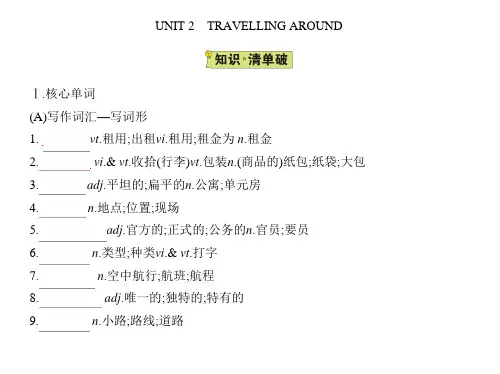
Ⅰ.核心单词 (A)写作词汇—写词形 1. rent vt.租用;出租vi.租用;租金为 n.租金 2. pack vi.& vt.收拾(行李)vt.包装n.(商品的)纸包;纸袋;大包 3. flat adj.平坦的;扁平的n.公寓;单元房 4. site n.地点;位置;现场 5. official adj.官方的;正式的;公务的n.官员;要员 6. type n.类型;种类vi.& vt.打字 7. flight n.空中航行;航班;航程 8. unique adj.唯一的;独特的;特有的 9. path n.小路;路线;道路
UNIT 2 TRAVELLING AROUND Ⅴ.必备语法 1.Over the October holiday, my parents and I are planning (plan) to go to Xi'an to see the Terracotta Army. 2.We are taking (take) the train, leaving the day before the October holiday begins. 3.We are arriving (arrive)at 9:30 a.m. and will start sightseeing right away...
It's amazing that there are more than 8,000 statues, and no one in modern times knew about them until the 1970s. 7.每尊雕塑面部都不同,使得研究人员相信每尊雕塑都是一个真正的士兵的复制 品。 Each statue has a different face, leading researchers to believe that each one is a copy of a real soldier.
Unit 2 Traveling Around 教案
Unit 2 Traveling Around 教案一、单元主题分析本单元主题主要是人与自我,其中部分也涉及人与社会。
本单元围绕旅行这一主题展开,要求学生们在课本及以外的生活常识中,学会自我管理、自我认识,了解货币常识,树立理财意识,理性消费,能够丰富充实、积极向上的生活。
同时也要了解世界各国的文化景观,建筑等,并学会与人在旅行中进行跨文化沟通交流。
二、单元内容本单元内容是人教版必修一模块第二单元Travelling Around,单元的主题是旅行,涉及的话题有:计划制定、行前安排、景点介绍、旅游文明行为以及旅游业发展利弊的讨论等内容。
语篇类型有:百科全书式的介绍文本、旅游宣传册、电子邮件、议论文、日常对话、电话交流等体裁和形式。
语篇类型:第一部分是介绍性文本,第二部分是旅游宣传册,第三部分是电子邮件说明旅行计划和日程的文体结构。
三、单元目标通过本单元的学习,学生需要达到以下能力:1.语言知识能力:掌握语音,词汇,语法,表达和语篇等方面的内容。
掌握本单元核心词汇、词块,理解并掌握本单元语法及长难句;在语境中理解所学词汇和语法知识,学会运用现在进行时态表达个人想法,进行人际交流。
2.语言技能能力:锻炼听、说、读、写的能力学习.能够抓住关键词,理解听力文本大意,通过快速浏览标题,图片和图表等能够识别文本类型并采取相对应阅读策略。
3.文化意识能力:了解中国和秘鲁等国家的著名景点和文化特色,培养爱国情怀,拓展国际视野,树立文明旅游意识;使学生获得文化知识,理解文化内涵,比较文化异同,汲取文化精华,形成正确的价值观,坚定文化自信,形成自尊、自信、自强的良好品格,具备一定的跨文化沟通和传播中华文化的能力。
4.思维品质能力:能够合理对音频和文本中的旅游利弊进行分析判断,找到解决途径,从而培养批判性思维能力;能够结合实际生活,利用旅游资源及文化特色,形成个人见解并学会制定切实可行的旅游计划;明白旅行的意义,不仅开拓了学生的国际视野,而且还在一定程度上培养了学生的爱国情怀和树立文明的游客意识。
高中英语人教版必修一《Unit 2 Travelling Around (40张PPT)课件
Language Learning
We’re leaving for Shanghai tomorrow. =We will leave for Shanghai tomorrow.
The plane is arriving in 10 minutes. =The plane will arrive in 10 minutes.
visit. Melin: Oh, that's nice! So what's the weather like there? Paul: It should be pleasant during the day, but it might be cold at
night, so I am taking a few light sweaters and a coat. Meilin: What are you planning to see there?
Paul: Hey, Meilin! So what are you doing for the coming holiday?
Meilin: I am travelling around Europe for two weeks with my aunt and uncle.
Paul: Europe? Oh, I've always wanted to go there! Meilin: Yes, me, too. I'm so excited. I am planning to
Speaking
Choose a travel destination and think about what you would do to prepare to travel there. Then share your travel plans with a partner.
人教版高中英语必修一Unit2TravellingAround知识点总结全面整理(带答案)
人教版高中英语必修一Unit2TravellingAround知识点总结全面整理单选题1、During the Chinese New year's holidays, one tradition the Chinese enjoy is stuffing and ________ jiaozi, their fav orite food, to be served with their New Year's Eve meal.A.packingB.wrappingC.shapingD.covering答案:B考查动词词义辨析。
句意:在中国的新年假期,中国人喜欢的一个传统是包饺子,他们最喜欢的食物,在他们的除夕晚餐。
A. packing打包;B. wrapping包裹;C. shaping塑造;D. covering覆盖。
根据上文“is stuffing and”指包饺子,应用warp。
故选B。
2、Most students don’t like Tom,because he ______ always ________.A.is;lyingB.do;lieC.is;lieD.does;lying答案:A考查时态。
句意:大多数学生不喜欢Tom,因为他这是说谎。
现在进行时和always连用,表示不满或批评的感情色彩。
这里是表示对Tom的不满,所以用现在进行时be doing,主语是he,谓语动词是lie,故选A项。
3、Parents and children should communicate more to ________ the gap between them so that they can better und erstand each other.A.fillB.narrowC.widenD.strengthen答案:B考查动词词义辨析。
句意:家长和孩子应该多多交流,来缩小他们之间的代沟,以便他们能够更好的彼此理解。
人教版高中英语必修一《Travelling Around》SectionB PPT课件
○22 that 引导的宾语从句,作动词 guess 的宾语。 ○23 and 连接两个并列的谓语动词 write 和 send。
○24 不定式作动词 hope 的宾语。
Your friend,
Richard
我想今天就写到这里吧!我很快会再给你写信和发照片的! 你对即将到来的假期有什么安排吗?期待收到你的来信。
【即学即用 2】 判断并翻译句子
(1) The guest _is arriving and we must go to meet him at the airport.
is arriving 表示:__将__来____发生的动作 客人__就_要__到_了__, 我们必须到机场接他。 (2) Don’t disturb him. He is doing his homework now. is doing 表示:___正_在____发生的动作 不要打扰他。现在他__正_在__写_作__业____。
UNIT 2 Travelling Around Section B
单元语法图解
一、现在进行时表示将来
【典例呈现】 ◎The workers are returning home the day after tomorrow. 这些工人将在后天回家。 ◎We’re meeting at 9:00 a.m. at park near our school. 我们将在上午九点学校附近的公园见面。 ◎They’re starting for Hong Kong tomorrow morning. 明天上午他们将动身去香港。 ◎We are spending next winter in Sanya. 我们明年冬天要在三亚过。
【即学即用 1】 完成句子 (1)今年我将出版一本书。 I __a_m_____ _p_u_b_lis_h_in_g_ a book this year. (2)今晚有一些朋友要来参加露丝的生日聚会。 Some friends__a_r_e____ __in_g_____ to Ruth’s birthday party this evening.