
施心远听力教程1(第三版)第三单元文本及答案
Unit 3 Talking about PeopleSection 1 Tactics for ListeningPart 1 PhoneticsA. Listen and repeat1. A: Where were you at one o’clock?B: At one o’clock? At my mother’s.2. A: Let’s ask him to let us go.B: He won’t let us go.3. A: I saw them together.B: Where did you see them?B. Complete the following short dialogue as you listen to the tape. Pay special attention to the weak forms, link-ups and contractions.Friend: Hi, Linda. I hear you and John got married (l) last month. Linda: Yeah, we did, (smiling) Three weeks (2) ago.Friend: Well, congratulations!Linda: Thank you.Friend: Did you (3) have a big wedding?Linda: No, we got (4) married at City Hall. We didn’t want to spend very much because (5) we’re saving to buy a house. Friend: Where did you (6) have the reception?Linda: Oh- we (7) didn’t have a reception. We just (8) invited a few friends over for drinks afterwards. Friend: What (9) did you wear?Linda: Just a skirt and blouse.Friend: Oh!Linda: And John wore a (10) jacket and jeans.Friend: Where did you (11) go for your honeymoon?Linda: We (12) didn’t have a honeymoon. We went back to work the next day. Ah, here comes (13) my bus.Friend: Listen. (14) I’d love to help celebrate. Why don’t you two (15) come over for a drink next week?Linda: Sure. We’d love to. (16) I’ll talk to John and (17) call you Monday. Friend: Great. See you (18) next week.Linda: Bye.Part 2 Listening and Note-takingBob: Look at that, Angela. True-Value is going to sell hi-fi’s for 72.64 pounds. I’m going to buy one. We can save at least 20 pounds.Angela: Yes, and look at the washing machines. They’re going to sell some washing machines for 98.95 pounds, go we can save 22 pounds. A washing machine is more important than a hi-fi.Bob: By the way, Angela, do you know how much money we’ve got? About 200 pounds, I hope.Angela: Here’s the bank statement. I didn’t want to open it. Oh, dear.Bob: What’s the matter?Angela: We haven’t got 200 pounds, I’m afraid.Bob: Well, come on. How much have we got?Angela: Only 150 pounds 16.Things they want to buy Price Money they can savea hi-fi72.64 pounds at least 20 poundsa washing machine98.95 pounds22 poundsExercise B:Money to pay for the things to buy: 171.59 poundsMoney to be saved: 42 poundsMoney they think they can have: 200 poundsMoney they actually have: 150.16 poundsTapescript:Bob: Look at that, Angela. True-Value is going to sell hi-fi’s for 72.64 pounds. I’m going to buy one. We can save at least 20 pounds.Angela: Yes, and look at the washing machines. They’re going to sell some washing machines for 98.95 pounds, go we can save 22 pounds. A washing machine is more important than a hi-fi.Bob: By the way, Angela, do you know how much money we’ve got? About 200 pounds, I hope.Angela: Here’s the bank statement. I didn’t want to open it. Oh, dear.Bob: What’s the matter?Angela: We haven’t got 200 pounds, I’m afraid.Bob: Well, come on. How much have we got?Angela: Only 150 pounds 16.Section 2 Listening ComprehensionPart 1 Words or Message?A.:1. John Bishop was very popular because he founded a company that made stationery products from recycled materials.2. The gross domestic product of our country has been stationary for many years at about 7.5 percent even if we had been retarded (or confronted with) by the world economic recession.B:1. Only be training hard every day can you become a good athlete.2. He is a more persuasive speaker than his brother.3. Never have we had more apples than this year.1. The only way you can become a good athlete is by training hard every day.2. He speaks more persuasively than his brother.3. We’ve had more apples this year than ever before.Part 2 DialoguesDialogue 1 What’s He Like?Exercise A: Listen to the dialogue and complete the following notes.Age: 35 or 36Appearance: good-lookingHobbies: sports—football basketball and tennisMarriage status: single / not marriedExercise B: Listen to the conversation again and answer the following questions. 1. What is he good at? How does his friend know that?(He is good at tennis. His friend knows that because he plays at the same tennis club where she plays.)2. Does he live alone? Has he got a companion?(Yes, he lives alone. But he has a companion, his dog.)Exercise C: Listen to some extracts from the dialogue and complete the following sentences with the missing words.I don’t know him very well. He’s a bit...shy, I think. He isn’t married. He lives in a flat on his own. Well, just him and his dog.Tapescript:A: Tell me about your new manager. What’s he like?B: Oh, terrific. He’s tall, good looking.., well, I think he’s good looking, anyway ... and he’s about 35 or 36. He’s very interested in all kinds of sports — football, basketball... oh, and tennis. My friend told me he’s very good at tennis. He plays at the same tennis club ... the club where she plays ... you know.A: Oh, is he friendly? I mean, in the office...B: Well, I don’t know him very well. He’s a bit...shy, I think. He isn’t married. He lives in a flat on his own. Well, just him and his dog.Dialogue 2 How Old Are You?Exercise A: Listen to the interview and complete the following report.Name of the interviewee: Keith.Keith is (1) 37 years old. He’s got (2) two children. One is (3)11 and the other is (4)13. He is a (5) printer’s reader and copy editor at the (6) Oxford University Press. He starts work at (7) 7:30 and finishes at (8) 4:15 with a (9) 45-minute lunch break. He goes to work by (10) bicycle and train.He is interested in (11) antiques. He dislikes (12) decorating and is not awfully (13) keen on gardening. He reads quite a lot, (14) newspapers, books, especially (15) books of history.He doesn’t (16) smoke and drinks (17) only occasionally. He doesn’t (18) go to the church often.Exercise B:1. Man 2: Things I don’t like—I don’t like decorating. I’m not awfully keen on gardening.2. Man 1: Yeah. And what kind of books do you read?Man 2: Erm—tends to be more along history lines.Tapescript:Man 1: All right, Keith. How old are you?Man 2: Thirty-seven.Man 1: Thirty-seven, yeah? And, erm, you married?Man 2: Yes.Man 1: Yeah. Have you got children?Man 2: Two.Man 1: Yeah. What are their names?Man 2: Toby and Lucy.Man 1: Toby and Lucy. How old are they?Man 2: One’s 11, that’s Lucy; and Toby’s 13.Man 1: Yeah. Tell me about your job, Keith.Man 2: Well, I work at the Oxford University Press. I’m a printer’s reader and copyeditor.Man 1: Erm, what sort of hours of work do you have?Man 2: Erm, 7:30 in the morning.Man 1: You start work at 7:30?Man 2: Yes. I start at 7:30 in the morning and finish at 4:15. That’s with a 45-minute lunch break.Man 1: Yeah. Do you like it that way? Do you like starting very early?Man 2: No, I don’t. No.Man 1: How do you go to work?Man 2: Er, well, I cycle from here to Didcot Station, and then catch the train.Man 1: Tell me one or two things you like doing, and one or two things you don’t like doing. What do you like doing? What do you do for enjoyment?Man 2: Well, I’m quite interested in antiques*.Man 1: Yes.Man 2: Things I don’t like —I don’t like decorating. I’m not awfully keen on gardening.Man 1: OK. What reading — what sort of— what newspaper do you read?Man 2: The Times.Man 1: The Times, yeah.Man 2: And The Sunday Times.Man 1: Yeah. And what kind of bonks do you read?Man 2: Erm—tends to be more along history lines. Not novels, generally, more general history. Local history especially.Man 1: Yeah, OK. Do you smoke, Keith?Man2 : No.Man 1: You drink?Man 2: Occasionally.Man 1: Yeah. Do you go to church?Man 2: Not very often, no.Man 1: Right. Thank you very much indeed.Part 3 Passage Cycling AccidentsExercise A:1. What do young children often find difficult to do when riding bicycles?2. When choosing a bike for a child, what should you ensure?3. How old should a child be when the child is allowed out on the road on a bike?4. What do you know about the Cycling Proficiency Test?5. Before a child is allowed out alone, what should he be able to do?6. What is parent’s advice to their children when they are out on a bike in the dark?7. What is the parents’ responsibility?8. What can be life-saving?Exercise B:1. Make sure that your child’s bike has the right size of frame and that the saddle and handlebars are correctly adjusted. When sitting on the saddle, a child’s feet should comfortably touch the ground and hands must be able to work the brake levers.2. For night-time riding, lights must be working and reflectors must be clean. Tapescript:Cycling accidents often happen because children are allowed out on the roads before they’re really ready. After all, it takes time to learn to ride a bike safely, and riding safely means much more than just staying on. For example, a child must be able to turn and look behind, and do hand signals without wobbling. And at the same time as handling the bike safely, the child must be able to cope with the roads and traffic.How to prevent accidents? Make sure that your child’s bike has the right size of frame and that the saddle and handlebars are correctly adjusted. When sitting on the saddle, a child’s feet should comfortably touch the ground and hands must be able to work the brake levers. Make sure children can ride safely and can cope with roads and traffic before you let them out along. As a general rule, children under nine years old should never be allowed out on the roads on a bike alone. An adult should always be with them.Encourage your child to go in for a Cycling Proficiency Test. You can get details of courses from your Road Safety Officer at your local authority. Look in your telephone directory for the local authority number. But remember that these courses are often fun in school playgrounds, so it’s important to make sure that what’s learnt is then put into practice on the roads. Make sure that your child understands road signs.Explain, for example, that “crossroads” does not mean “cross the road”. Words like “one-way street” and “traffic island” can also be difficult for children to understand. Make sure that your child wears reflective clothing when out on a bike,especially in the dark or in bad weather. For night-time riding, lights must be working and reflectors must be clean.Bicycle maintenance can be life-saving. It’s up to parents to check their children’s bikes regularly and get repairs done properly. Teach your child, too, to check brakes and lights regularly.Section 3 Oral WorkPart 1 Questions and AnswersExercise: Listen to the dialogue and then answer some questions about it. You will hear the dialogue and the questions only once. Answer each question with a complete sentence after you have heard it.Questions:1. What was Mr. White doing this morning?(He was writing his book this morning.)2. According to Mr. White, was the book coming along all right?(No, he thought the rest of the book would be difficult to write.)3. What did Mrs. White expect?(He expected that Mr. White would find the answers interesting to work out.)4. Why did Mr. White think the house was easy to work in?(Because he would at least be able to think)5. When would the school holidays start?(They would start in a week.)6. Was it possible for Mr. White to work in the house during the school holidays? (No, it was impossible for him to work in the house.)7. Could Mr. White work in the garden this morning?(Yes, he could work in the garden this morning.)Why? (Because it was peaceful and quiet)8. Why should Mr. White make most of it while the garden was peaceful and quiet? (Because peace and quiet would be hard to find in the garden pretty soon.) Tapescript:Mrs. White: How did your writing go this morning? Is the book coming along all right?Mr. White: I’m not sure. I think the rest of it will be difficult to write. There are still some problems to solve.Mrs. White: I expect you’ll find the answers interesting to work out.Mr. White: If I can work them out. Thank goodness the house is easy to work in. I shall at least be able to think.Mrs. White: You’ve forgotten something. Peace and quiet will be difficult to guarantee much longer.Mr. White: Good, heavens, yes. The school holidays start in a week, don’t they? The house will be impossible to work in while they last.Mrs. White: Well, some extra noise is hard to avoid. But I’ll keep them away from the study as much as I can. That’ll be all right to work in.Mr. White: What about the garden? It was beautifully peaceful and quiet out there this morning.Mrs. White: Well, you’d better make the most of it while it lasts. Peace and quiet will be hard to find in the garden pretty soon, I’m afraid.Part 2 RetellingTo the American people, education is very important. The first twelve years of public school are free of charge. As a result, about 93 percent of the teenagers from fourteen to seventeen years old are in high school.However, 200 years ago, education was not free. American elementary schools were only for rich people. Most young people were not in school.The first public high school was in 1832. The purpose of the school was to prepare students for college. Its most important subjects were mathematics and foreign languages.Nowadays, American education is a big business. There are about 45 million students in the nation’s elementary schools and high schools. Each year there are about three million high school graduates. The main purpose of high school is still to prepare students for college. There are also job-training programmes in high school and programmes to teach useful skills for everyday life - for example, driver training, first aid, and even cooking.Section 4 Supplementary ExercisesPart 1 Listening Comprehension My NephewExercise: Listen to the passage and choose the best answer to each of the following questions.1. What did Tony’s uncle intend to do for Tony’s birthday this year?2. What did Tony’s uncle buy for his birthday the year before last?3. Why were Tony’s parents unthankful for the gift?4. What was Tony’s attitude towards the things to buy?5. What did he suddenly spot in a shop?6. How did his uncle persuade Tony to change his mind?7. What did Tony look like when his uncle saw him fifteen minutes later?8. What can be inferred from the passage?l. D 2. B 3. D 4. A 5. B 6. C 7. C 8. DTapescript:This year I decided to do something to regain my reputation as a kindly uncle. My nephew, Tony, had never forgiven me for the dictionary I had bought him as a birthday present last year. His parents had no reason to be grateful to me either ?because the year before, I had presented their dear son with a pot of paste* and some funny pictures .Instead of sticking* them into a book, Tony had naturally covered every wall in the house with them. This year, therefore, I decided to let him choose for himself.We went into a big toy shop but Tony was highly critical of everything he saw. In vain* did I show him toy after toy; he was not to be tempted*. Then I saw his eyes light up: he had discovered something he really did approve of: a large tin drum. I was quite pleased, too, until I thought what Tony’s mother would say when she saw it. Nobody would get any sleep for weeks. I led Tony away quickly, saying that the drum was too expensive. If that was how I felt, Tony replied jokingly, then I could buy him the big model railway in the shop window. Now that was really expensive, so I quickly changed the subject.Tony asked for permission to go off on his own and I made the most of my opportunity to sit down and rest my aching feet. Fifteen minutes passed but there was still no sign of Tony. I began to get worried and got up to look for him, I asked a young lady if she had seen a little boy in a grey suit. She looked about her helplessly and pointed out that there were so many little boys in grey suits. I was just beginning to despair*, when I saw a strange figure dressed in peculiar purple* clothes. The figure was wearing a false beard and a cave man’s* axe* in one hand, and a space gun in the other. It was, of course, Tony, who informed me at once that he was the first cave man to fly into space.Part 2 Oral WorkIn a recent broadcast, I heard a woman say that she felt guilty because she spent£20 at an auction sale. She was afraid her husband might accuse her of being extravagant. I find this attitude difficult to understand, for, obviously a married woman has as much right to spend £20 as her husband. Sometimes both husband and wife go out to work. But, in a case where the woman stays at home to look after the children, it is still unfair that she should feel guilty about spending a small sum of money on herself.Exercise: Listen to the passage and then give your opinion on the following topic. Do you agree with the speaker that the woman’s attitude is wrong?Part 3 Video Mars Rover: “A Mars Scientist’s Dream Machine”1. What’s the name of the Mars rover that was launched by the American space agency in November 2011?It is known as “Curiosity”.2. Where is it supposed to land?It is supposed to land at the foot of a mountain within a deep, 150-kilometer-wide hole called Gale Crater.3. What energy is used to support the Mars rover’s many activities and how long will the power last?The nuclear reactor supports the Mars rover’s many activities and it can maintain the operation of the rover for about two Earth years/one Martian year.4. What are the tasks of the Mars rover?They are: 1) collecting sample rocks and soil on Mars; 2) measuring the chemical make-up of rocks and soil; 3) looking for any organic material that might be present and the habitable environment for microorganisms.5. Give a brief description of the new rover.The new rover is a car-sized vehicle—much larger than the early ones. It contains a plutonium-fueled nuclear reactor that will provide plenty of power for scientific activities. The vehicle also has 17 cameras, a laser and a big six-foot robotic arm. Inside the rover, there are two very capable scientific laboratories.Tapescript:The American space agency launched its Mars Science Laboratory, also known as “Curiosity,” in November of 2011. The car-sized vehicle is supposed to land on Mars in August 2012. This computer model shows what scientists expect will happen when the spacecraft carrying "Curiosity" reaches the red pl anet. Curiosity” issupposed to land at the foot of a mountain within a deep, 150-kilometer-wide hole called Gale Crater. Deputy project scientist Ashwin Vasavada tells about “Curiosity.”“This is a Mars scientist’s dream machine. We’re so excited to have this rover going to Mars this year. It’s going to be the virtual presence for over 200 scientists around the world to explore Mars and Gale Crater that we’ll talk about. This rover is not only the most technically capable rover ever sent to another planet, but it’s actually the most capable scientific explorer we’ve ever sent out.”“Curiosity” is much larger than earlier rovers. It has a plutonium-fueled nuclear reactor that will provide plenty of power for “Curiosity’s” many activities. The vehicle also has 17 cameras, and a laser that can examine the chemical make-up of rocks.“What really dominates the design of this rover is the fact that it has this ability to sample rocks and soils on Mars for the first time, and so it has a big six-foot [1.8 meter] robotic arm. And the rover is partly that big because it holds two very capable scientific laboratories inside the rover.”One instrument measures the minerals in rocks and soil. Another looks for chemicals and any organic material that might be present. The goal of the experiment is to learn if Mars ever had environmental conditions that could have supported microorganisms.“This mission is really about looking for those habitable environments, and not detect ing life itself.”Vasavada says the mountain within Gale Crater will provide plenty of information about the development of Mars. That is because each layer of rock contains new clues.“It has some geologic evidence that water was around. We hope, in fact,to search for organics with this mission. That’s another requirement for life as we know it.”The nuclear reactor on “Curiosity” has enough power to operate on the surface of Mars for about two Earth years, which is the same as one Martian year.补充阅读:职业访谈与工作面试是一回事吗说起职业访谈(Informational Interview),很多人都不清楚是什么意思。
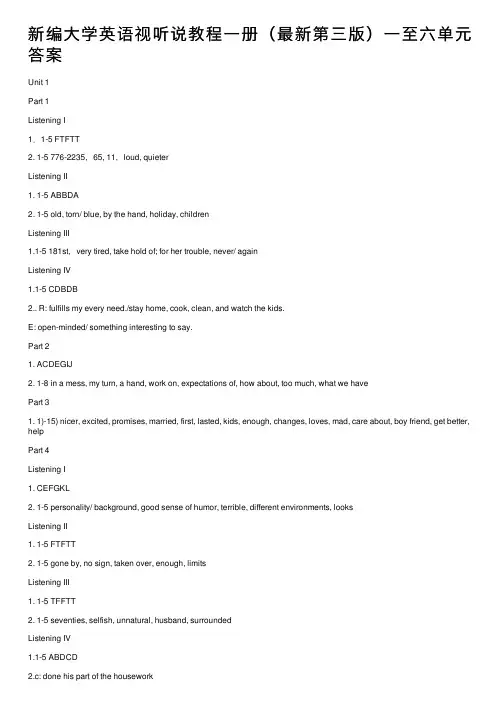
新编大学英语视听说教程一册(最新第三版)一至六单元答案
新编⼤学英语视听说教程⼀册(最新第三版)⼀⾄六单元答案Unit 1Part 1Listening I1.1-5 FTFTT2. 1-5 776-2235,65, 11,loud, quieterListening II1. 1-5 ABBDA2. 1-5 old, torn/ blue, by the hand, holiday, childrenListening III1.1-5 181st,very tired, take hold of; for her trouble, never/ againListening IV1.1-5 CDBDB2.. R: fulfills my every need./stay home, cook, clean, and watch the kids.E: open-minded/ something interesting to say.Part 21. ACDEGIJ2. 1-8 in a mess, my turn, a hand, work on, expectations of, how about, too much, what we havePart 31. 1)-15) nicer, excited, promises, married, first, lasted, kids, enough, changes, loves, mad, care about, boy friend, get better, helpPart 4Listening I1. CEFGKL2. 1-5 personality/ background, good sense of humor, terrible, different environments, looksListening II1. 1-5 FTFTT2. 1-5 gone by, no sign, taken over, enough, limitsListening III1. 1-5 TFFTT2. 1-5 seventies, selfish, unnatural, husband, surroundedListening IV1.1-5 ABDCDh: high priority withw: responsibilityUnit 2Part 1Listening I1. 1-5 TFTFT2. 1 He moved to Newton.2 She wrote down the new address on it.3 It was thrown away. / The professor threw it away.4 The professor’s daughter.Listening II1. 1-5 TFFFT2. 1)-12) far, away, lucky, forget, parked, over, route, miss, smile, drove, laughter, usual Listening III1. 1-5 FTTFF2. ABD/ FGIListening IV1. 1 It’s about some ways of helping people improve their memory.2 She’s a communications trainer who teachers memory skills.3 Record, retain and retrieve.4 Using very intense visual images.2. 1 1)-4) records, figure out, organize, filing system,2 5)-9) elaborate, broken up, see, loudly, forgetPart 21. 1 4 6 72.1-8 turn in, worry about, growing up, gone, on the right side, last night, turned out tobe, take/ off, lately, fixing for, made a mistake, turn onPart 31. 1 He is a 25-year-old Italian, who has an exceptional memory.2 He is demonstrating the art of memory.3 How, where and why information is stored.4 When he was 11 years old.5 Determination. / Hard work and exercise.2. 1-7 randomly, repeats them, backwards, recall every detail/ a year old, more forgetful families, heredity/ environment, the brain/ specific genes, a vacation/ a regular guyPart 42. 1 The night before they left home.2 he questioned his wife about the things she had packed.3 On top of the piano.Listening II1. 1-3 BCA2.1 3 4 6Listening III1. CBDAA2.1—C 2—A 3—BListening IV1. BDF2. 1-6 her grandmother, a small area, a better sense, three or four, by smell, soap/ perfume Uint3Part1Listening I1. w: French, the united states, mushrooms, umbrellam: German, Spain, milk, bullfight ticket2. 1-5 T T T F FListening II1. 1-4 lecture, teller, give a lecture, never even smiled, exhausted2. 1-5 C A B A BListening III1. 1 4 62. A-E love, unity, purity, happiness, desire,6-8 yellow rose, yellow tulip, carnationListening IV1. 1-5 F T F T T2. 1-4 husband, made a awful mistake, full of love, for wordsPart 21. 1-9 F F T T F T T T T2. 1-8 lack communication skills, take the initiative, first thing, becoming boring, non-verbal language, facial expression, annoying, elsewhere, change for the betterPart 31. 1 Eyes, face, head, shoulders and hands.2 She prefers Barack’s.5 Relaxed.2. 1)-12) examine, slight, intensity, contrast, relaxed, simplicity, confidence, negotiation, cool, information, resolution, passion. Part 4Listening I1. 1-8 C A B C A B A CListening II1 His left eye.2 A special kind of wood.3 His wooden eye.4 A less attractive girl.5 She had a particularly big nose.6 Would you like to dance?7 Excited.8 Would I? Would I?9 Angry and hurt.10 Wood eye.Listening III1.1-8 make their space, spread your towels, coat/ small bag, library,one corner/ chair, across from/ briefcase, stiffened/ head, invaded2. 1-6 F F T T T FListening IV1. 1 Intimate, personal, social, and public.2 Culture.2. B A C DUnit 4Part1Listening I1. 1-5 A C C A C2. 1-5 T F T F FListening II1.1-6 T F T T F T2. 1-7 this semester, need to know, different, the rules/ use, do our homework, reading about, questions/ answers Listening III1. 2 3 1 4 5 62. 1-10 history, major, not, 2009, 2010, title, computer, out, shelf, reserveListening IV1. 1-5 A C B B A2. G: competed, sang, laughed, children,LN: turn, next,LV: acting them out,Lo: demonstrated, clapping our hands, posters, cards,Ldv: stories, lay, shut, musicPart 21. 1-10 T F T F F F T T F T2. 1-10 What can I do, like sports, under construction, schoolwork, more about him, quit school, the tuition fee, in a rush, student loans, student centerPart31.1-10 disaster, picture, totally, unbelievable, review, consider, particular,independently-minded, medicine, worthPart 4Listening I1. 1-5 A B C A D2. 1-5 T T T F FListening I1. 1-5 B C A A CListening III1. 1-7 B C B C B A BListening IV1. 1-7 activity, information, writing, different, skills, position, involves,8 You cannot possibly discover all that you need to know at once.9 Don’t be discouraged if your work is not perfect at first.10 You should expect progress, not perfection, from yourselfUnit 5Part11. 42312. 1-10 cold, red, thick, warm, small, use, finished, middle, covered, rabbitsListening II1. 1 It took place in Laos.2 A buffalo.4 Because the farmer was very intelligent.5 He said he was afraid the tiger might kill his buffalo when he was gone.6 He took his plow and hit the tiger.2 1-5 FTFTFListening III1. 125792. 1 In the early hours yesterday.2 Sleeping.3 In the games room.4 A lit cigarette end.5 Because smoking is forbidden in the games room.Listening IV1. 1-5 BADCB2. 1-5 living species, international/ reached, less demand/ used to, organizations, Atlantic/ PacificPart 21. ACDFH2. 1-8 for generations/ well-known, came across, a pair of, black/ small, happen to, in the audience/ call on, became aware, further study/ types ofPart 31. 1-10 dictionaries, Garden, forest, signals, 135, energy, move, across, logging, remaining2. 1)-10) tough, devised, rubs, fatten, hibernate, flexible, grasp, monkey, cigarPart 4Listening I1. 1 He was a waiter.2 On a beach.3 For a short time.4 A dog.5 A sea lion.2. 1-5 up/ down, struggling, jumped through, came by, puzzled.Listening II1. 1-6 FTTFTF2. 1 A monkey, an ox and an elephant.2 Because they are frightened.3 He takes hold of the lion, knocks it against the tree and stamps on the lion.4 In order to show he is the most powerful.2. 1-10 good, young, once, hate, mouse, idea, unless, number, months, produceListening IV1. 1-5 BCABC2. 1-3 plays games/ new skills/ their efforts, boat/ follow them, dollars/ cents/ loving/ home/ drink.Unit 6Part 1Listening I1. 1-6 BCDAAA2. 1-8 midnight, barking, silver, glowed, face, windows, identify, curtainsListening II1. 134679102. 1-5 BACADListening III1. 1-8 TFTFFTFF2. 1-7 north, in the middle of, giant snake, above water, 20 meters, gone, nearerListening IV1. 1-5 CDABC2. 1-10 dead or alive, no signs, in good order, 10-pound note, unfinished, plenty of, feature of the mystery, in its place, struggle, diseasePart 21. 1-6 DCDCAB2. 1-9 dressed in, rudely, whenever/ wherever, much more advanced, intelligent, what exactly, survive, show you around, used up.Part 31. 1-5 BDDCA2. 1-5 claimed/ from the inside out, long wondered/ three million, eight/ watched by/ around, constructed/ 137-meter, believes/ suggests/ above.Part 4Listening I1. 1-6 TFTTFT2. 1 About 1, 280 miles.2 More than 800.3 On Easter Sunday in 1722.4 Over 100 tons.5 How they were transported and why they were built.。
英语听力教程1第三版答案

英语听力教程1第三版答案《英语听力教程1(第三版)》是一本针对初学者的英语听力教材,共分为10个单元。
以下是该教程书中第三版的答案解析,总结了各个单元的重点内容和习题答案。
第一单元:日常问候本单元主要讲解了日常问候的表达方式和常见的问候语。
重点习题涵盖了问题的回答、口语练习和听力理解等方面。
第二单元:自我介绍本单元围绕自我介绍展开,主要掌握个人信息、职业、国籍等基本介绍方式。
习题涉及口语练习、听力理解和对话练习等。
第三单元:购物本单元重点介绍了购物场景中的常用表达和交流方式。
习题涵盖了听力理解、对话练习和口语练习等方面。
第四单元:时间和日期本单元主要教授如何表示时间和日期,包括时钟、月份、星期等的表达方式。
习题集中在听力理解、对话练习和口语练习等方面。
第五单元:家庭和朋友本单元涵盖了家庭和朋友的介绍,重点掌握家庭成员和朋友关系的表达方式。
习题涉及听力理解、对话练习和口语练习等方面。
第六单元:餐厅和点餐本单元主要讲解了在餐厅点餐和支付的相关表达方式。
通过听力理解、对话练习和口语练习等习题来巩固所学知识。
第七单元:学校生活本单元聚焦于学校生活中的常见表达方式和话题,如上课、作业和课余活动等。
习题内容包括听力理解、对话练习和口语练习等。
第八单元:旅行和交通本单元重点介绍了旅行和交通方面的常见表达和对话内容。
习题涵盖了听力理解、对话练习和口语练习等方面。
第九单元:医院和身体本单元围绕医院和身体健康展开,重点掌握与医生交流和描述身体状况的表达方式。
习题内容包括听力理解、对话练习和口语练习等。
第十单元:娱乐和休闲本单元主要介绍了娱乐和休闲活动,如看电影、听音乐和运动等。
习题集中在听力理解、对话练习和口语练习等方面。
总体而言,《英语听力教程1(第三版)》的答案解析涵盖了每个单元的重点内容和习题练习,帮助学生更好地理解和掌握所学知识。
这本教材不仅满足初学者的听力需求,还注重口语练习的实践,从而提升学生的综合英语能力。
U3 听力教程第三版施心远学生用书答案

Unit 3Section One Tactics for ListeningPart 1 PhoneticsStress, Intonation and AccentScriptListen to some short conversations and circle the prominent word or words in the sentence.1. A: Do you want some grapes?B: No, thanks, I don’t like them.2. A: What do you think of Scotland?B: I’ve never been there.3. A: My son’s called David.B: How old is he?4. A: Can I book a table for tonight, please?B: Certainly. How many is it for?A: There’ll be three of them.5. A: Can you get some cornflakes?B: Do you want a large or small packet?A: A small one.Key1. A: a. want b. grapesB: a. like b. them2. A: a. think b. ScotlandB: a. been b. there3. A: a. called b. DavidB: a. old b. he4. A: a. book b. tonightB: a. certainly b. manyA: a. three b. them5. A: a. get b. cornflakesB: a. large or small b. packetA: a. small b. onePart 2 Listening and Note-TakingA TerritoryScriptA. Listen to some sentences and fill in the blanks with the missing words.1. When we talk about a territory, we mean a defended space.2. These signals are important, because they warn the visitor that he is entering a foreigncountry.3. People behave differently when they’re in someone else’s house.4. In public places, people automatically mark out an area of personal space.5. It won’t be next to him or at the other end of the room, but halfway between.B. Listen to a talk about territory. Take notes and complete the following outline.When we talk about a territory, we mean a defended space. Animals have their territories, which they mark out with their personal scent. The scent is their territorial signal. Human beings have other territorial signals. There are three kinds of human territory, marked by different territorial signals.First, there are the Tribal Territories, which in modern terms are known as countries.Countries have a number of territorial signals. The borders are often guarded by soldiers and they usually have customs barriers, flags, and signs. Other signals of the tribal territory are uniforms and national anthems. These signals are important, because they warn the visitor that he is entering a foreign country and, while he is there, he must behave like a visitor.Second, there is the Family Territory, at the center of which is the bedroom. This is usually as far away as possible from the front door. Between the bedroom and the front door are the spaces where visitors are allowed to enter. People behave differently when they’re in someone else’s house. As soon as they come up the driveway or walk through the front door — the first signals of family territory —they are in an area which does not belong to them.They do not feel at home, because it is full of other people’s belongings — from the flowers in the garden to the chairs, tables, carpets, ornaments, and other things in the house. In the same way, when a family goes to the beach or to the park for a picnic, they mark out a small territory with towels, baskets, and other belongings; other families respect this, and try not to sit down right beside them.Finally, there is the Personal Territory. In public places, people automatically mark out an area of personal space. If a man enters a waiting room and sits at one end of a row of chairs, it is possible to predict where the next man will sit. It won’t be next to him or at the other end of the room, but halfway between. In a crowded space like a train, we can’t have much personal territory, so we stand looking straight in front of us with blank faces. We don’t look at or talk to anyone around us.KeyA. 1. When we talk about a territory, we mean a defended space.2. These signals are important, because they warn the visitor that he is entering aforeign country.3. People behave differently when they’re in someone else’s house.4. In public places, people automatically mark out an area of personal space.5. It won’t be next to him or at the other end of the room, but halfway between.B. A TerritoryI. Territory, a defended spaceA. Territory is marked by territorial signals.a. Animals mark out their territories with their personal scent, their territorialsignals.b. Human beings have three kinds of human territory, marked by differentterritorial signals.II. Three kinds of human territoryA. Tribal Territories or countriesa. Countries have a number of territorial signals.1. The borders, guarded by soldiers, with customs barriers, flags, and signs2. Uniforms and national anthemsB. Family Territorya. Family Territory signals1. The front door2. The drivewayb. When a family goes to the beach or to the park for a picnic, they mark out asmall territory with towels, baskets, and other belongings.C. Personal Territorya. In public places, people automatically mark out an area of personal space.b. In a crowded space, we stand looking straight in front of us with blank faces. Section Two Listening ComprehensionPart 1 Sentence IdentificationScriptIdentify each sentence as simple (S), compound (CP), complex (CPL) or compound-complex (C-C). You will hear each sentence twice. Write the corresponding letter(s) in the space provided.1. Surely you remember the last movie we saw together.2. A perfectionist about everything, his aunt Beatrice had made him painfully aware ofhis shortcomings.3. She felt a momentary glimmer of satisfaction, but this soon faded to a feeling ofshame when she saw the hurt look on Alec’s face.4. There will still be difficulties, but they can be overcome.5. Planting annuals gives a good temporary show, but it is also no way to construct apermanent garden.Key1. CPL2. S3. C-C4. CP5. CPPart 2 DialoguesDialogue 1 Credit CardScriptListen to the dialogue and choose the best answer to each of the questions you will hear.A: I, recently touring around America, found there was a chap I was with ... He ... we were booked in by an American organization into a hotel, paid for by them,but theywould not let him go through the lobby to his room unless they had a credit cardnumber to prove that he was a human being that was trustworthy. (Right, right.) Inother words we’ve got to the stage now with credit cards,however friendly youlook, however wealthy you look, or however nice you look ... (That’s right, itdoesn’t matter, they just want to see that number.) Excus e me,where is your creditcard?B: Because you know you can’t rent a major automobile in the States, you know, you can’t rent without, without using a credit card, you can’t, you know like you weresaying, go into a hotel?A: I think that what’s underne ath that is the socie ty in which you’re only good if you have numbers attached to you, (Mm.) that are computerised, (Yeah.) and can traceyou, and everybody’s insured against everybody else (Yeah.) and …that side ofcredit I find rather upsetting.B: It’s kind of ugly, isn’t it?A: Like a lot of people, it’s a great facility, if you’re disciplined with it.Questions:1. Why was one man stopped at the lobby of the hotel by the hotel staff?2. Why is having a credit card so important?3. In what way does one speaker consider a credit card upsetting?B. Listen to an extract from the dialogue and complete the following sentences withthe missing words.A: I think that what’s underneath that is the society in which you’re only good if you have numbers attached to you, (Mm.) that are computerised, (Yeah.) and can traceyou, and everybody’s insured against everybody else (Yeah.) and …that side ofcredit I find rather upsetting.B: It’s kind of ugly, isn’t it?A: Like a lot of people, it’s a great facility, if you’re disciplined with it.KeyA. 1. D 2. D 3. CB. A: I think that what’s underneath that is the society in which you’re only good if youhave numbers attached to you, (Mm.) that are computerised, (Yeah.) and can traceyou, and e verybody’s insured against everybody else(Yeah.) and … that side ofcredit I find rather upsetting.B: It’s kind of ugly, isn’t it?A: Like a lot of people, it’s a great facility, if you’re disciplined with it.Dialogue 2 Card InsurancesScriptListen to the dialogue and decide whether the following statements are true (T) or false (F).A: I’ll tell you about one awful experience that h appened to me, erm, I took out, erm … one of these card insurances that cover a ll your cards (Mm.) should yourcards be stolen and I had my handbag snatched* in a store and immediately got thestore security, who were very quick, got me into their office and we phoned all ofthe credit cards that I had on me, within ten minutes.B: Which is what they tell you to do?A: Yeah. When, I suppose by the time we’d got to all of them it w as about half an hour after the bag had been snatched. Got up to the top floor of the office, started ringinground, and the whole thing was done within half an hour. Erm, when the bag wassnatched it went through apparently a chain of people, out of the store, and it wenttwo miles away and they managed to ... three different people had spent over£2,000 on four of my cards …B: But you’re only liable* for the first 50.A: I wasn’t liable for any of it. Because thank goodness I had this insurance.B: None of it. Yeah.A: But...B: Touch wood* quick. That was …A: ... They’d spent it within twe nty minutes of stealing.B: That’s incredible, isn’t it?A: And the thing that absolutely horrified me was I was close to limits on two of the cards, the ones that I do clear every month. (Mm — mm.) I was close to the limitI’m allowed on those, and they, both of those cards they went into banks, said theywere me, and got (No!) well over what the top limit would have been.B: Really! Well it just goes to show, you could walk into a bank and get more than you could possibly ever pay off*!A: I couldn’t probably, because I go in, and they say, “No, you’ve spent it all already!”B: Right, right.Key1. One insurance covers the loss of one particular credit card.2. The woman lost her credit cards because she left her handbag in a store.3. She telephoned all the credit card companies about the stolen cards within tenminutes.4. A chain of people were involved in the robbery.5. Usually there is a 50-pound-limit of overdraft on each card.6. The speaker usually clears some cards every month.7. The thief spent more than what the speaker had in her cards.8. If the police cannot find the thieves, the speaker will probably have to pay off. Part 3 PassageCredit CardsScriptB. Listen to the passage and choose the best answer to each of the questions you willhear.The system of bank credit cards operates in much the same way as a store credit account except that the holder is not restricted to making purchases in one place.Cards can be presented at any place where the bank card sign is displayed, and that could be at a shop, a service station, a hotel, a restaurant or in fact at all kinds of businesses.The sales assistant imprints the card details onto a sales voucher* which the customer signs, and the card is then returned to the customer. Each month the bank sends the holder a credit card statement setting out where purchases were made and totalling what is owing. A payment has to be made within 25 days of the date of the statement, but not necessarily the full amount. If the customer pays in full within this time the use of the card does not cost anything. But if he decides to pay only the minimum repayment shown on the statement —£5 or 5% of the outstanding* balance*, whichever is the greater — he automatically chooses to use th e system’s extended repayment facility. The re maining balance is then carried forward and attracts interest at the rate of 2.25% per month.Bank credit cards are more versatile than store credit accounts in that they also enable people to obtain cash. Any bank displaying the bank card sign will arrange a cash advance* for a card holder, whether or not he is one of their own customers. For money drawn in this way the bank makes a charge at the rate of 2.25% a month, calculated daily from the day the advance is obtained. Details of cash advances appear on the monthly bank card statement.The bank credit card system operates entirely separately from cheque accounts, but nevertheless it is a customer’s previous relation ship with his bank that is used as a guide to the amount of credit he will be extended. When a card is issued, a personal credit limit is imposed indicating the maximum that can be owing at any one time. This is confidential* between customer and bank and does not appear on the card.Questions:1. In what way does a bank credit card differ from a store credit account?2. Where can you use bank credit cards?3. When making payments what should a customer do after the sales assistant imprintsthe card details onto a sales voucher?4. After receiving a credit card statement, within how many days does the holder have topay?5. When is the system’s extended repayment fac ility automatically used by thecustomer?6. What can a bank credit card holder get at any bank displaying the bank card sign?7. How much does the bank charge for the advance?8. What will decide the extension of a customer’s amount of credit?C. Listen to the passage again and discuss the following questions.KeyA. The system of bank credit cards operates in much the same way as a store credit accountexcept that the holder is not restricted to making purchases in one place. Bank credit cards can be presented at any place where the bank card sign is displayed and in fact at all kinds of businesses. Bank credit cards also enable people to obtain cash.B. 1. A 2. C 3. C 4. B 5. D 6. D 7. B 8. BC. 1. Bank credit cards can be presented at any place where the bank card sign is displayed,e.g. at a shop, a service station, a hotel, a restaurant, etc.2. Each month the bank sends the holder a credit card statement setting out wherepurchases were made and totalling what is owing.3. The customer can pay in full within 25 days of the date of the statement or he can payonly the minimum repayment shown on the statement.4. Because they also enable people to obtain cash.5. When a card is issued, a personal credit limit is imposed indicating the maximum thatcan be owing at any one time.D. 1. Bank credit cards are more versatile than store credit accounts in that they also enablepeople to obtain cash.2. When a card is issued, a personal credit limit is imposed indicating the maximum thatcan be owing at any one time.Part 4 NewsNews item 1 Wealth GapScriptA. Listen to the news item. Fill in the blanks with the number you have heard andanswer the questions. Then give a brief summary about the news item.A report from the nonprofit group Oxfam says the richest one percent of people in theworld will have a majority of the wealth on the planet in 2016. The report was released Monday ahead of the annual World Economic Forum meeting this week in Davos, Switzerland.The global wealth of the richest people on Earth climbed to 48 percent in 2014. That has increased from 44 percent in 2009. It is likely to pass 50 percent in 2016. The report said the80 wealthiest people in the world own $1.9 trillion. That is nearly the same amount shared bythe 3.5 billion people at the bottom half of the world’s income scale.Oxfam is asking governments around the world to deal with a number of issues of inequality. The organization is calling on governments to prevent companies and rich individuals from avoiding taxes. It is asking governments to shift taxes from labor and consumption to wealth and income.One proposal is to invest in free public services such as healthcare and education. The organization also wants governments to introduce minimum wages for workers, equal pay for women, universal* childcare and elderly care services.B. Listen to the news item again and complete the following sentences.KeyA. 1. In 2009, the global wealth of the richest people throughout the world was 44 percentand that climbed to 48 percent in 2014. It may pass 50 percent in 2016.2. 80 wealthiest people in the world own $1.9 trillion which is almost the same amountof the world’s income shared by 3.5 billion people at the bottom.1. Oxfam is asking governments around the world to deal with a number of issues ofinequality. It also is asking governments to shift taxes from labor and consumption towealth and income.2. The organization is calling on governments to prevent companies and rich individualsfrom avoiding taxes.3. It proposes that governments should invest in free public services such as healthcareand education.This news item is about a report showing one percent of people worldwide own most ofthe world’s wealth.B. 1. Oxfam, a non-profit group, released a report before the annual World EconomicForum meeting in Davos, Switzerland.2. According to the report, in 2016, one percent of richest people in the world own amajority of the wealth on Earth.3. Oxfam wants governments to introduce minimum wages for workers, equal pay forwomen, universal childcare and elderly care services.C. 1. The report said the 80 wealthiest people in the world own $1.9 trillion. That is nearlythe same amount shared by the 3.5 billion people at the bottom half of the world’sincome scale.2. The organization is calling on governments to prevent companies and rich individualsfrom avoiding taxes.News item 2 Britain’s Longest Serving RulerScriptA. Listen to the news item and decide whether the following statements are true (T) orfalse (F). Then give a brief summary about the news item.Queen Elizabeth II is set to reach an important milestone* this week —becoming Britain’s longest-ruling head of state.Queen Elizabeth has worked with 12 British prime ministers, from Winston Churchill to David Cameron. At age 89, she continues to travel and attend official events.Elizabeth came to power after the death of her father, King George VI, on February 6, 1952. At the time, she was only 25 years old. She officially became queen in June of 1953.The queen is part of the last generation of Britai n’s royal family to be educated at home.The Associated Press reports that she is the first British ruler to have sent an email (1976) or use Twitter, the social networking service (2014).British officials say Queen Elizabeth wants the record-setting occasion to be a quiet event and that the day will be “busin ess as u sual”. The Queen is expected to leave her private home at Balmoral, Scotland to open the new Scottish Borders Railway. She will also take a steam train ride on the new railway from Edinburgh with her husband, Prince Philip.B. Listen to the news item again and complete the following sentences.KeyA. 1. Queen Elizabeth came to power after the death of her father, King George V, onFebruary 6, 1952.2. At the age 25, she officially became Queen of the United Kingdom.3. Queen Elizabeth has worked with 12 British prime ministers, from WinstonChurchill to David Cameron.4. She is the first British ruler to have sent an email or use Twitter.5. She is the last generation of Britain’s royal family to be educated at home.6. The Queen expects to open the new Scottish Borders Railway and take a steamtrain ride on the new railway from Edinburgh with her husband, Prince Philip.This news item is about Queen Elizabeth II becoming Britain’s Longest Serving Ruler.B. 1. Queen Elizabeth II reaches an important milestone this week — becoming Britain’slongest-ruling head of state.2. The Queen wants the record-setting occasion to be a quiet event and that the day willbe “business as usual”.C.British officials say Queen Elizabeth wants the record-setting occasion to be a quietevent and that the day will be “business as usual”.Section Three Oral WorkRetellingMother and DaughterScriptListen to a story and then retell it in your own words. You will hear the story only once. You can write down some key words and phrases.Ten year old Anja Lea did not want to wash the dishes. She and her mother were arguing.The mother was threatening her and bribing her. I asked Anja Lea how much she felt understood by her mother about why she did not want to do the washing up. Here is a copy of our dialogue.“Okay, so Mom wants you to do the dishes and y ou don’t want to. Plus Mom said she isn’t going to take you to school until you do them? Is that right so far?”“Yes.”“Okay, so you are probably feeling forced ...?”“Yes.”“And punished ...?”“Yes.”“And threatened ...?”“Yes.”“Okay. And how much do you feel understood by your mom? From 0-10?”“Zero!”I then asked Anja Lea to explain why she didn’t want to do the dishes. The more shetalked and the more I listened, the more she felt understood. Somewhere along the way, she started washing the dishes without any more arguments or protest! In a few minutes I asked her how much she felt understood by me. She said 8. I asked her what else she wanted me to understand. When she told me, I checked again to see how much she felt understood. This time it was a perfect 10 and the dishes were finished too!But that is not the end of this story. When she was in the car on the way to school Anja Lea voluntarily apologized to her mother for giving her such a hard time. The mother apologized in return, they both accepted the other’s apology and then shared a few tears and a loving hug.Section Four Supplementary ExercisesPart 1 PassageYour Legal Rights in the SalesScriptA. Listen to the passage and choose the best answer to each of the questions you willhear.Just who is doing the favour for whom in the sales? Are the shops really giving us shoppers a chance to buy bargains? Or are we just helping them to clear their shelves twice a year to make way for new lines* —buying up* the rubbish they would otherwise throw away?In most sales there is a bit of both. Some bargains are more genuine than others. Some price claims are true, while others are misleading or plain false.If the sale notice says “Coats — reduced from £30 to £10”, it should, by law, be true.The rules are that, unless a shop says otherwise, the coats must have been on sale at the higher price for at least 28 consecutive days in the previous six months. They can, however, get around it by saying “Last week £30. Now £10.”Be a bit suspicious about a ticket which just sa ys “Sale price £5.” It may mean the goods are specially bought in for the sale and does not necessarily indicate any reduction.And there is nothing to prevent the shopkeeper boasting: “Worth £50, only £20” or even “Normally £300, only £150.”Another practice which is frowned upon, though not illegal, is an imprecise offer, like “Up to £10 off latest models.” It give s no clear idea of how much you have to spend or exactly what you have to buy to benefit.If you see a price claim you do not believe or feel to be misleading, you can complain to the local Trading Standards Office — the town hall will put you in touch.If you see a notice saying “No refunds on sales goods,” ignore it, but don’t forget it. It is illegal for shops to say this and you should report it to the Trading Standards Officer. He can order the signs to be removed.Sale or no sale, nothing can remove your right to get your money back if the goods arefaulty. If on the other hand, you just change your mind about something you buy in the sale, the shop does not have to give you anything back.Goods labelled “seconds” have their own pecul iar problems. You cannot expect something described as “seconds” to be perfect in every way, but the shop has no right to sell you anything that is not fit for the purpose for which it was made.A “slightly imperfect” kettle should still boi l water and you can demand your moneyback if it doesn’t. So take your spectacles with you and never be afraid to ask what is substandard about the thing you are about to buy.Questions:1. Who will most sales benefit?2. What is not true about the goods labelled as “Sale price £5”?3. Wh at can a customer know from a sales notice which says “Up to £10 off latestmodels”?4. What is illegal for shops to say?5. When can a customer claim his money back?6. What cannot a customer expect of something described as “seconds”?7. What should a cu stomer ask about a “seconds” he is about to buy?8. What can a customer claim if the goods are faulty?B. Listen to the passage again and discuss the following questions.KeyA. 1. C 2. B 3. C 4. A 5. D 6. C 7. B 8. DB. 1. In most sales, some bargains are more genuine than others and some price claims aretrue, while others are misleading or plain false.2. Because they want to make way for new lines.3. The shopkeepers’ boasting, like “Worth £50, only £20” or even “Normally £300, only£150;” and an imprecise offer, like “Up to £10 off latest models.”4. The shop has no right to sell you anything that is not fit for the purpose for which itwas made.5. You can’t get a refund when you just change your mind about the things you buy inthe sale.Part 2 VideoSlew of New Products Unveiled at Consumer Electronics ShowScriptWatch the video film and answer the questions.At the International Consumer Electronics Show in Las Vegas, you can find just about anything.Automobile enthusiasts are in luck this year.Renault revealed an electric race car. Audi unveiled a self-driving A7 — these cars park themselves. Last year, the technology needed for their driver less sedan* took up the entirerear end of the car. This year, the computer fits on a card about the size of an iPad.Induct* showed off its self-piloted shuttle, call ed the Navia. The company’s Max LeFevre says it’s also 100 percent electric.“It’s a shuttle, so it’s for public transport for 8 to 10 passengers. It works with lasers which work kind of like a bat. You know, it sends out beams that bounce off the walls and other things in the environment. In that way the vehicle can create the map of the environment.”Ford made headlines with its solar car —the C-MAX Solar Energi. Solar cells are mounted on the car’s roof, but the trick,says Ford Motor Company’s Dave McCreadie, is the solar canopy*.“It boosts the power of the solar panels by essentially magnifying the sun. So it takes a larger square footprint area of the sun and concentrates down onto the solar panels. The purpose of this is to enable the customer to recharge their vehicle off the grid.”The Ford C-MAX Solar Energi is still just a concept. But if you’re looking for something more tangible*, 3D printers are capable of producing more complex, high-quality designs, and the cost of a 3D printer is falling. Some cost less than $500.But 3D Systems has created something new: 3D-printed food.“Today we’re debuting* two food-safe 3D printers and they’re the first food-safe 3D printers to be offered.”The company’s Liz Von Hasseln says the ChefJet and ChefJetPro use melted sugar to create sweet creations like candy and cake decorations.“So you might say, ‘I want to work on a cak e topper or I want to work on a drink sweetener and the software will start you out wi th an object that’s kind of the appropriate size and shape, and you can add complexity from there.”The sugary 3D printers are expected to cost between $5,000 and $10,000 when they go on sale.Key1. That’s because they have got an electric race car by Renault, a self-driving andself-parking Audi A7, a self-piloted shuttle by Induct and the Ford C-MAX SolarEnergi.2. This year, the computer fits on a card about the size of an iPad.3. It works with lasers and sends out beams that bounce off the walls and other things inthe environment. As the result, the vehicle can create the map of the environment.4. They use melted sugar to create sweet creations like candy and cake decorations.5. They will cost between $5,000 and $10,000.。
听力教程1施心远主编Unit

2. health centers
3.$800 a year
4. accident and sickness insurance $500 a year
B:
hospital services √
brith control ×
laboratory tests √
X-rays √
undernutrition-hunger greater investment in nutritional services and improvements to health systems poor to middle-income countries in Africa,Asia and Latin America More than three and a half million mothers and children under five die in poor countries each year because of undernutrition
News Item 2
A: the retirement of Bill Gates as the head of world's biggest computer software company, Microsoft.
B: 1. Last week, Bill Gates retired from full-time work at the world's biggest computer software company, Microsoft.
Section Four: Supplementary Exercises
Passage 1: 1, C; 2 A; 3 D; 4 B; 5 D; 6 C; 7 B; 8 D
施心远听力教程1-(第三版)第三单元文本及答案
Unit 3 Talking about PeopleSection 1 Tactics for ListeningPart 1 PhoneticsA. Listen and repeat1. A: Where were you at one o’clock?B: At one o’clock? At my mother’s.2. A: Let’s ask him to let us go.B: He won’t let us go.3. A: I saw them together.B: Where did you see them?B. Complete the following short dialogue as you listen to the tape. Pay special attention to the weak forms, link-ups and contractions.Friend: Hi, Linda. I hear you and John got married (l) last month. Linda: Yeah, we did, (smiling) Three weeks (2) ago.Friend: Well, congratulations!Linda: Thank you.Friend: Did you (3) have a big wedding?Linda: No, we got (4) married at City Hall. We didn’t want to spend very much because (5) we’re saving to buy a house. Friend: Where did you (6) have the reception?Linda: Oh- we (7) didn’t have a reception. We just (8) invited a few friends over for drinks afterwards. Friend: What (9) did you wear?Linda: Just a skirt and blouse.Friend: Oh!Linda: And John wore a (10) jacket and jeans.Friend: Where did you (11) go for your honeymoon?Linda: We (12) didn’t have a honeymoon. We went back to work the next day. Ah, here comes (13) my bus.Friend: Listen. (14) I’d love to help celebrate. Why don’t you two (15) come over for a drink next week?Linda: Sure. We’d love to. (16) I’ll talk to John and (17) call you Monday. Friend: Great. See you (18) next week.Linda: Bye.Part 2 Listening and Note-takingBob: Look at that, Angela. True-Value is going to sell hi-fi’s for 72.64 pounds. I’m going to buy one. We can save at least 20 pounds.Angela: Yes, and look at the washing machines. They’re going to sell some washing machines for 98.95 pounds, go we can save 22 pounds. A washing machine is more important than a hi-fi.Bob: By the way, Angela, do you know how much money we’ve got? About 200 pounds, I hope.Angela: Here’s the bank statement. I didn’t want to open it. Oh, dear.Bob: What’s the matter?Angela: We haven’t got 200 pounds, I’m afraid.Bob: Well, come on. How much have we got?Angela: Only 150 pounds 16.Things they want to buy Price Money they can savea hi-fi72.64 pounds at least 20 poundsa washing machine 98.95 pounds22 poundsExercise B:Money to pay for the things to buy: 171.59 poundsMoney to be saved: 42 poundsMoney they think they can have: 200 poundsMoney they actually have: 150.16 poundsTapescript:Bob: Look at that, Angela. True-Value is going to sell hi-fi’s for 72.64 pounds. I’m going to buy one. We can save at least 20 pounds.Angela: Yes, and look at the washing machines. They’re going to sell some washing machines for 98.95 pounds, go we can save 22 pounds. A washing machine is more important than a hi-fi.Bob: By the way, Angela, do you know how much money we’ve got? About 200 pounds, I hope.Angela: Here’s the bank statement. I didn’t want to open it. Oh, dear.Bob: What’s the matter?Angela: We haven’t got 200 pounds, I’m afraid.Bob: Well, come on. How much have we got?Angela: Only 150 pounds 16.Section 2 Listening ComprehensionPart 1 Words or Message?A.:1. John Bishop was very popular because he founded a company that made stationery products from recycled materials.2. The gross domestic product of our country has been stationary for many years at about 7.5 percent even if we had been retarded (or confronted with) by the world economic recession.B:1. Only be training hard every day can you become a good athlete.2. He is a more persuasive speaker than his brother.3. Never have we had more apples than this year.1. The only way you can become a good athlete is by training hard every day.2. He speaks more persuasively than his brother.3. We’ve had more apples this year than ever before.Part 2 DialoguesDialogue 1 What’s He Like?Exercise A: Listen to the dialogue and complete the following notes.Age: 35 or 36Appearance: good-lookingHobbies: sports—football basketball and tennisMarriage status: single / not marriedExercise B: Listen to the conversation again and answer the following questions.1. What is he good at? How does his friend know that?(He is good at tennis. His friend knows that because he plays at the same tennis club where she plays.)2. Does he live alone? Has he got a companion?(Yes, he lives alone. But he has a companion, his dog.)Exercise C: Listen to some extracts from the dialogue and complete the following sentences with the missing words.I don’t know him very well. He’s a bit...shy, I think. He isn’t married. He lives ina flat on his own. Well, just him and his dog.Tapescript:A: Tell me about your new manager. What’s he like?B: Oh, terrific. He’s tall, good looking.., well, I think he’s good looking, anyway ... and he’s about 35 or 36. He’s very interested in all kinds of sports —football, basketball... oh, and tennis. My friend told me he’s very good at tennis. He plays at the same tennis club ... the club where she plays ... you know.A: Oh, is he friendly? I mean, in the office...B: Well, I don’t know him very well. He’s a bit...shy, I think. He isn’t married. He lives in a flat on his own. Well, just him and his dog.Dialogue 2 How Old Are You?Exercise A: Listen to the interview and complete the following report.Name of the interviewee: Keith.Keith is (1) 37 years old. He’s got (2) two children. One is (3)11 and the other is (4)13. He is a (5) printer’s reader and copy editor at the (6) Oxford University Press. He starts work at (7) 7:30 and finishes at (8) 4:15 with a (9) 45-minute lunch break. He goes to work by (10) bicycle and train.He is interested in (11) antiques. He dislikes (12) decorating and is not awfully (13) keen on gardening. He reads quite a lot, (14) newspapers, books, especially (15) books of history.He doesn’t (16) smoke and drinks (17) only occasionally. He doesn’t (18) go to the church often.Exercise B:1. Man 2: Things I don’t like—I don’t like decorating. I’m not awfully keen on gardening.2. Man 1: Yeah. And what kind of books do you read?Man 2: Erm—tends to be more along history lines.Tapescript:Man 1: All right, Keith. How old are you?Man 2: Thirty-seven.Man 1: Thirty-seven, yeah? And, erm, you married?Man 2: Yes.Man 1: Yeah. Have you got children?Man 2: Two.Man 1: Yeah. What are their names?Man 2: Toby and Lucy.Man 1: Toby and Lucy. How old are they?Man 2: One’s 11, that’s Lucy; and Toby’s 13.Man 1: Yeah. Tell me about your job, Keith.Man 2: Well, I work at the Oxford University Press. I’m a printer’s reader and copyeditor.Man 1: Erm, what sort of hours of work do you have?Man 2: Erm, 7:30 in the morning.Man 1: You start work at 7:30?Man 2: Yes. I start at 7:30 in the morning and finish at 4:15. That’s with a 45-minute lunch break.Man 1: Yeah. Do you like it that way? Do you like starting very early?Man 2: No, I don’t. No.Man 1: How do you go to work?Man 2: Er, well, I cycle from here to Didcot Station, and then catch the train.Man 1: Tell me one or two things you like doing, and one or two things you don’t like doing. What do you like doing? What do you do for enjoyment?Man 2: Well, I’m quite interested in antiques*.Man 1: Yes.Man 2: Things I don’t like —I don’t like decorating. I’m not awfully keen on gardening.Man 1: OK. What reading — what sort of— what newspaper do you read?Man 2: The Times.Man 1: The Times, yeah.Man 2: And The Sunday Times.Man 1: Yeah. And what kind of bonks do you read?Man 2: Erm—tends to be more along history lines. Not novels, generally, more general history. Local history especially.Man 1: Yeah, OK. Do you smoke, Keith?Man2 : No.Man 1: You drink?Man 2: Occasionally.Man 1: Yeah. Do you go to church?Man 2: Not very often, no.Man 1: Right. Thank you very much indeed.Part 3 Passage Cycling AccidentsExercise A:1. What do young children often find difficult to do when riding bicycles?2. When choosing a bike for a child, what should you ensure?3. How old should a child be when the child is allowed out on the road on a bike?4. What do you know about the Cycling Proficiency Test?5. Before a child is allowed out alone, what should he be able to do?6. What is parent’s advice to their children when they are out on a bike in the dark?7. What is the parents’ responsibility?8. What can be life-saving?Exercise B:1. Make sure that your child’s bike has the right size of frame and that the saddle and handlebars are correctly adjusted. When sitting on the saddle, a child’s feet should comfortably touch the ground and hands must be able to work the brake levers.2. For night-time riding, lights must be working and reflectors must be clean. Tapescript:Cycling accidents often happen because children are allowed out on the roads before they’re really ready. After all, it takes time to learn to ride a bike safely, and riding safely means much more than just staying on. For example, a child must be able to turn and look behind, and do hand signals without wobbling. And at the same time as handling the bike safely, the child must be able to cope with the roads and traffic.How to prevent accidents? Make sure that your child’s bike has the right size of frame and that the saddle and handlebars are correctly adjusted. When sitting on the saddle, a child’s feet should comfortably touch the ground and hands must be able to work the brake levers. Make sure children can ride safely and can cope with roads and traffic before you let them out along. As a general rule, children under nine years old should never be allowed out on the roads on a bike alone. An adult should always be with them.Encourage your child to go in for a Cycling Proficiency Test. You can get details of courses from your Road Safety Officer at your local authority. Look in your telephone directory for the local authority number. But remember that these courses are often fun in school playgrounds, so it’s important to make sure that what’s learnt is then put into practice on the roads. Make sure that your child understands road signs.Explain, for example, that “crossroads” does not mean “cross the road”. Words like “one-way street” and “traffic island” can also be difficult for children to understand. Make sure that your child wears reflective clothing when out on a bike,especially in the dark or in bad weather. For night-time riding, lights must be working and reflectors must be clean.Bicycle maintenance can be life-saving. It’s up to parents to check their children’s bikes regularly and get repairs done properly. Teach your child, too, to check brakes and lights regularly.Section 3 Oral WorkPart 1 Questions and AnswersExercise: Listen to the dialogue and then answer some questions about it. You will hear the dialogue and the questions only once. Answer each question with a complete sentence after you have heard it.Questions:1. What was Mr. White doing this morning?(He was writing his book this morning.)2. According to Mr. White, was the book coming along all right?(No, he thought the rest of the book would be difficult to write.)3. What did Mrs. White expect?(He expected that Mr. White would find the answers interesting to work out.) 4. Why did Mr. White think the house was easy to work in?(Because he would at least be able to think)5. When would the school holidays start?(They would start in a week.)6. Was it possible for Mr. White to work in the house during the school holidays? (No, it was impossible for him to work in the house.)7. Could Mr. White work in the garden this morning?(Yes, he could work in the garden this morning.)Why? (Because it was peaceful and quiet)8. Why should Mr. White make most of it while the garden was peaceful and quiet? (Because peace and quiet would be hard to find in the garden pretty soon.) Tapescript:Mrs. White: How did your writing go this morning? Is the book coming along all right?Mr. White: I’m not sure. I think the rest of it will be difficult to write. There are still some problems to solve.Mrs. White: I expect you’ll find the answers interesting to work out.Mr. White: If I can work them out. Thank goodness the house is easy to work in. I shall at least be able to think.Mrs. White: You’ve forgotten something. Peace and quiet will be difficult to guarantee much longer.Mr. White: Good, heavens, yes. The school holidays start in a week, don’t they? The house will be impossible to work in while they last.Mrs. White: Well, some extra noise is hard to avoid. But I’ll keep them away from the study as much as I can. That’ll be all right to work in.Mr. White: What about the garden? It was beautifully peaceful and quiet out there this morning.Mrs. White: Well, you’d better make the most of it while it lasts. Peace and quiet will be hard to find in the garden pretty soon, I’m afraid.Part 2 RetellingTo the American people, education is very important. The first twelve years of public school are free of charge. As a result, about 93 percent of the teenagers from fourteen to seventeen years old are in high school.However, 200 years ago, education was not free. American elementary schools were only for rich people. Most young people were not in school.The first public high school was in 1832. The purpose of the school was to prepare students for college. Its most important subjects were mathematics and foreign languages.Nowadays, American education is a big business. There are about 45 million students in the nation’s elementary schools and high schools. Each year there are about three million high school graduates. The main purpose of high school is still to prepare students for college. There are also job-training programmes in high school and programmes to teach useful skills for everyday life - for example, driver training, first aid, and even cooking.Section 4 Supplementary ExercisesPart 1 Listening Comprehension My NephewExercise: Listen to the passage and choose the best answer to each of the following questions.1. What did Tony’s uncle intend to do for Tony’s birthday this year?2. What did Tony’s uncle buy for his birthday the year before last?3. Why were Tony’s parents unthankful for the gift?4. What was Tony’s attitude towards the things to buy?5. What did he suddenly spot in a shop?6. How did his uncle persuade Tony to change his mind?7. What did Tony look like when his uncle saw him fifteen minutes later?8. What can be inferred from the passage?l. D 2. B 3. D 4. A 5. B 6. C 7. C 8. DTapescript:This year I decided to do something to regain my reputation as a kindly uncle. My nephew, Tony, had never forgiven me for the dictionary I had bought him as a birthday present last year. His parents had no reason to be grateful to me either »because the year before, I had presented their dear son with a pot of paste* and some funny pictures .Instead of sticking* them into a book, Tony had naturally covered every wall in the house with them. This year, therefore, I decided to let him choose for himself.We went into a big toy shop but Tony was highly critical of everything he saw. In vain* did I show him toy after toy; he was not to be tempted*. Then I saw his eyes light up: he had discovered something he really did approve of: a large tin drum. I was quite pleased, too, until I thought what Tony’s mother would say when she saw it. Nobody would get any sleep for weeks. I led Tony away quickly, saying that the drum was too expensive. If that was how I felt, Tony replied jokingly, then I could buy him the big model railway in the shop window. Now that was really expensive, so I quickly changed the subject.Tony asked for permission to go off on his own and I made the most of my opportunity to sit down and rest my aching feet. Fifteen minutes passed but there was still no sign of Tony. I began to get worried and got up to look for him, I asked a young lady if she had seen a little boy in a grey suit. She looked about her helplessly and pointed out that there were so many little boys in grey suits. I was just beginning to despair*, when I saw a strange figure dressed in peculiar purple* clothes. The figure was wearing a false beard and a cave man’s* axe* in one hand, and a space gun in the other. It was, of course, Tony, who informed me at once that he was the first cave man to fly into space.Part 2 Oral WorkIn a recent broadcast, I heard a woman say that she felt guilty because she spent£20 at an auction sale. She was afraid her husband might accuse her of being extravagant. I find this attitude difficult to understand, for, obviously a married woman has as much right to spend £20 as her husband. Sometimes both husband and wife go out to work. But, in a case where the woman stays at home to look after the children, it is still unfair that she should feel guilty about spending a small sum of money on herself.Exercise: Listen to the passage and then give your opinion on the following topic. Do you agree with the speaker that the woman’s attitude is wrong?Part 3 Video Mars Rover: “A Mars Scientist’s Dream Machine”1. What’s the name of the Mars rover that was launched by the American space agency in November 2011?It is known as “Curiosity”.2. Where is it supposed to land?It is supposed to land at the foot of a mountain within a deep, 150-kilometer-wide hole called Gale Crater.3. What energy is used to support the Mars rover’s many activities and how long will the power last?The nuclear reactor supports the Mars rover’s many activities and it can maintain the operation of the rover for about two Earth years/one Martian year.4. What are the tasks of the Mars rover?They are: 1) collecting sample rocks and soil on Mars; 2) measuring the chemical make-up of rocks and soil; 3) looking for any organic material that might be present and the habitable environment for microorganisms.5. Give a brief description of the new rover.The new rover is a car-sized vehicle—much larger than the early ones. It contains a plutonium-fueled nuclear reactor that will provide plenty of power for scientific activities. The vehicle also has 17 cameras, a laser and a big six-foot robotic arm. Inside the rover, there are two very capable scientific laboratories.Tapescript:The American space agency launched its Mars Science Laboratory, also known as “Curiosity,” in November of 2011. The car-sized vehicle is supposed to land on Mars in August 2012. This computer model shows what scientists expect will happen when the spacecraft carrying "Curiosity" reaches the red pl anet. Curiosity” issupposed to land at the foot of a mountain within a deep, 150-kilometer-wide hole called Gale Crater. Deputy project scientist Ashwin Vasavada tells about “Curiosity.”“This is a Mars scientist’s dream machine. We’re so excited to have this rover going to Mars this year. It’s going to be the virtual presence for over 200 scientists around the world to explore Mars and Gale Crater that we’ll talk about. This rover is not only the most technically capable rover ever sent to another planet, but it’s actually the most capable scientific explorer we’ve ever sent out.”“Curiosity” is much larger than earlier rovers. It has a plutonium-fueled nuclear reactor that will provide plenty of power for “Curiosity’s” many activities. The vehicle also has 17 cameras, and a laser that can examine the chemical make-up of rocks.“What really dominates the design of this rover is the fact that it has this ability to sample rocks and soils on Mars for the first time, and so it has a big six-foot [1.8 meter] robotic arm. And the rover is partly that big because it holds two very capable scientific laboratories inside the rover.”One instrument measures the minerals in rocks and soil. Another looks for chemicals and any organic material that might be present. The goal of the experiment is to learn if Mars ever had environmental conditions that could have supported microorganisms.“This mission is really about looking for those habitable environments, and not detect ing life itself.”Vasavada says the mountain within Gale Crater will provide plenty of information about the development of Mars. That is because each layer of rock contains new clues.“It has some geologic evidence that water was around. We hope, in fact,to search for organics with this mission. That’s another requirement for life as we know it.”The nuclear reactor on “Curiosity” has enough power to operate on the surface of Mars for about two Earth years, which is the same as one Martian year.补充阅读:职业访谈与工作面试是一回事吗说起职业访谈〔Informational Interview〕,很多人都不清楚是什么意思。
教案听力教程1施心远1到16单元

教案听力教程1施心远1到16单元UNIT 1Section One Tactics for ListeningPart 1 PhoneticsExercise: Complete the following short dialogue as you listen to the tape. Pay special attention to the weak forms, link-ups and contractions.Woman 1: I've got good news (1) for you! Woman 2: Oh, yes? Woman 1: I'm getting married.Man: Well, well! (2) Who's the lucky man? Do we know him? Woman 1: Of course you (3) know him! It's David! Woman 2: (4) That's wonderful news! Man: I'm sure (5) you'll be very happy. Woman 2: (6) When's the wedding?Woman 1: Next June. (7)we're going to have a big June wedding! Woman 2:Are we invited?Woman 1: Of course! I hope you (8) can all come. Part 2 Listening andNote-taking Telephone rings for a long time.Operator: Redman Electronics. Can I help you? Voice: At last! Why don'tyou answer the phone?Operator: I'm sorry. I was downstairs. Voice: Well, can I speakto Mr. Redman please?Operator: I'm afraid he isn't here at the moment. He's on holiday. He's in the South of France.Voice: What about Mr. Gray ― extension 322. Operator: Mr. Gray's at home. Voice: Well, may I speak to Mr. Redman's secretary? Operator: She isn't in today. She's at her sister's. Voice: I see. Then I'd like to speak to Mr.Gray's secretary. Operator: Miss Jones? Voice: That's right.Operator: Sorry. She isn't in. She's gone to the hairdresser's. Voice: Who is intoday?Operator: Well, I am. But I'm going home soon. Who is it please?Exercise A: Listen to the conversation and take notes. Exercise B: Complete the following sentences. Where are they? Mr. Redman is on holiday in the South of France. Mr. Gray is at home.Mr. Redman's secretary is at her sister's.Mr. Gray's secretary, Miss Jones, is at the hairdresser's.Section Two Listening ComprehensionPart 1 DialogueDialogue 1 HelloWoman 1 : Professor Andrews, this is Dr. Baxter. Woman 2: How do you do? Man: How do you do? Man l: Hello, Al. How are you?Man 2: Fine, thanks, Eric. Nice to see you again. Woman I: Sally, do you know Steve? Woman 2: No, how do you do? Man: Hello, Sally. I'm glad to meet you.Man l: Tony, I'd like to introduce my friend Mary Parker. Man 2: Oh, hello. I've heard so much about you. Woman: Hello.Woman: May I introduce myself? My name is Susan Roper. Man: Oh, hello. I'm John Lee. I'm sorry, I didn't catch your name. Exercise: Listen to some people talking at a party. Who is talking to whom? Who has known whom before? Complete the following sentences. Names in the box are for your reference.1. Professor Andrews is talking to Dr. Baxter.2. A1 is talking to Eric.3. Sally is talking to Steve.4. Tony is talking to Maw Parker.5. Susan Rotteris talking to John Lee.6. A1and Eric have known each other before.7. Tony has known Mary Parker before.Dialogue 2 welcome to BristolEtienne has just arrived in England,Etienne: Hello, Are you Mrs. Baker? I'm Etienne Bertrand, from Switzerland. Mrs. Baker: Hello, Etienne. Come in. Welcome to Bristol. Etienne: Hello.Pleased to meet you, Mrs. Baker. Mrs. Baker: Oh, call me Nicola. And this is my husband, Nigel. Mr. Baker: How was your trip? No hijacks? Etienne: No, it was all right, thank you. But the plane was late and theairport was crowdedMr. Baker: Well, it's the holiday season. You expect it at this time of the year. Here, let me take your bags upstairs. Etienne: Oh, that's all right. I'll take this one. it's heavy. Mr. Baker: Well. Here's your room. I hope it's big enough for you and not too cold. We do have central heating but it doesn't work very well There are extra blankets in the cupboard, I think. Oh, well … Nicola, where are the blankets? Let's go down and meet the rest of the family.Exercise: Listen to the dialogue and decide whether the following statements are true or false. Write T or F in the space provided. Discuss with your classmates why you think the statement is true or false.T 1. Etienne Bertrand is from Switzerland. (I'm Etienne Bertrand, from Switzerland.)T 2. The Bakers are expecting Mr. Bertrand. (Mrs. Baker says\probably been hijacks in recent days. (Mr. Baker says \No hijacks?\draw a conclusionthat they were serious.)F 4. the plane was late because there had been a hijack attempt. (The planewas late probably because it was the holiday season.)T 5. The airport is usually crowded at this time of the year. (It is the holiday season.)T 6. It is probably still cold. (Mr. Baker mentions central heating and tellsEtienne to use extra blankets if he feels too cold.) F 7. The central heating doesn't work. (It doesn't work very well.)T 8. Mr. Baker can't find the blankets. (Mr. Baker asks Mrs. Baker where the blankets are.)感谢您的阅读,祝您生活愉快。
施心远《听力教程1》unit 3
Listening —Speaking Book 3Unit 1Warm Up1. This is Joe: When I was in high school, I was really into sports. In college I found out that my true calling is to be a science fiction writer! After high school, my girlfriend, Melissa, and I went to different colleges. After a while, we just drifted apart.2. This is Lindsay: My junior year of college I lived in Europe as an exchange student. I ended up going back to New York for graduate school.3. This is Chris: My dad owns a flower shop. He always wanted me to take over for him when he retired, but flowers really aren’t my thing. Right now I’m working as an apprentice to a famous chef. Someday I hope to have my own television cooking show.4. This is Allison: As a teenager, I had my own unique style and way of thinking. I was a free spirit, while my boyfriend, Brad, was very conservative. Everyone was really surprised when Brad and I decided to get married. I guess they thought we’d eventually break up.Listening Task1.A: Jake Sutton! Is that you, man? How are you?B: Hey, Andrew! I didn’t recognize you for a moment. Long time no see!A: Yeah, wow, I haven’t seen you since high school graduation! What’ve youbeen up to?B: I’ve been back East, at college.A: College? Where?B: Boston. B.U.A: Oh, cool.B: And this past year, I got to go to Spain as an exchange student.A: Spain? No kidding? I remember you always hoped for an internationallifestyle.B: Exactly.A: So how was it, amigo?B: Oh, man, it was so great. I got to see a lot of Europe.A: Yeah? Like where?B: All over. Italy, France, Greece, and my homestay family was really nice.They’ve invited me back again if I want to go to graduate school there. A: Sounds like we won’t be seeing you for another few more years then, eh? B: I dunno. Half of me wants to go. Half of me wants to stay here. You know,1/3页when I was there, I missed home a lot more than I thought I would.A: I can imagine.2.A: So, Terry, How have you been?B: Good, good.A: How are things going? Did you graduate this year?B: Me? Nah! I went to State, but after my second year, I realized that what Ireally want to do is take over for my mom in the restaurant.A: Oh, that’s right. Your family owns a little restaurant. Well, I mean, it’s not solittle, but …B: So I came back home and started apprenticing as a chef.A: Really? That is so cool! You know, now that I think about it, it makes perfectsense for you. Even back in high school, you could cook up a storm. So, how is it being in the business?B: Well, I love to cook, but, man, I have a lot to learn about running a business.I’m really glad my mom’s around to teach me.A: Well, I’ll have to come by to try your cooking. What nights do you work? B: Take your pick. I’m there seven nights a week.3.A: Ken? Ken Mackney, is that you?B: U h, yeah, I’m Ken Mackney.A: It’s me. Barry Simmons. You know, Mr. Jones’s calculus class, senior year? B: Um, so, how’s it going? What are you up to these days?A: I’m pretty busy. I’m working as an accountant in the city.B: Oh, that’s great! It sounds l ike you really put your math skills to good use. A: Yeah. And I got married last fall. Hey, you might actually know my wife, TinaChan, Jason Chan’s little sister?B: Tina. Is she the one who went to Harvard Medical School?A: No, that was Lisa Fong. Tina went to art school.B: Oh! Well, I guess you and Tina are a good match, then. You were alwaysinto art, too, weren’t you?A: No, not really. That’s my brother Tom you’re thinking of. You don’tremember very much from high school, do you?B: No, I guess not! It’s been a long time!4.A: Hi, Kate. It’s me, Cindy Lohan. You remember me, don’t you?B: Cindy, Cindy. I can’t seem to place the name. Oh, my gosh, yes! I doremember you! But …A: But what?B: Well, it’s just that you don’t look like the free-spirited Cindy I remember. Youlook so, so normal.A: Normal? I guess you’re referring to my hair?B: Yeah. I mean, you’re just a regular brunette now. When I knew you。
施心远听力教程1 (第三版)第三单元文本及答案
Unit3TalkingaboutPeople Section1TacticsforListeningPart1PhoneticsFriend:Well,congratulations!Linda:Thankyou.Friend:Didyou(3)haveabig wedding?Linda:Oh-we(7)didn’t haveareception.Wejust(8)invitedafew friendsoverfordrinksafterwar ds.Friend:What(9)didyou wear?Linda:Justaskirtandblouse.Friend:Oh!haveahoneymoon.Wewentbacktoworkthenextday.Ah,herecomes(13)mybus..Wecansaveatleast20pounds.Angela:Yes,andlookatthewashingmachines.They’regoingtosellsomewashingmachinesfor98.95 pounds,gowecansave22pounds.Awashingmachineismoreimportantthanahi-fi.Bob:Bytheway,Angela,doyouknowhowmuchmoneywe’vegot?About200pounds,Ihope.Angela:Wehaven’tgot200pounds,I’mafraid.Bob:Well,comeon.Howmuchhavewegot?Angela:Only150pounds16..Wecansaveatleast20pounds.Angela:Yes,andlookatthewashingmachines.They’regoingtosellsomewashingmachinesfor98.95 pounds,gowecansave22pounds.Awashingmachineismoreimportantthanahi-fi.Bob:Bytheway,Angela,doyouknowhowmuchmoneywe’vegot?About200pounds,Ihope.Angela:Wehaven’tgot200pounds,I’mafraid. Bob:Well,comeon.Howmuchhavewegot?Angela:Only150pounds16.A.:B:2.Hespeaks morepersuasivelythanhisbrother.3.We’vehadmoreapplesthisyearthan everbefore. Part2DialoguesDialogue1What’sHeLike?Age:35or36Appearance:good-lookingHobbies:sports—footballbasketballandtennisMarriagestatus:single/notmarriedExerciseB:Listentotheconversationagainandanswerthefollowingquestions.A:Tellmeaboutyournewmanager.What’shelike?B:Oh,terrific.He’stall,goodlooking..,well,Ithinkhe’sgoodlooking,anyway...andhe’sab out35or36.He’sveryinterestedinallkindsofsports—football,basketball...oh,andtennis.M yfriendtoldmehe’sverygoodattennis.Heplaysatthesametennisclub...theclubwheresheplays. ..youknow.B:Well,Idon’tknowhimverywell.He’sabit...shy,Ithink.Heisn’tmarried.Helivesinaflaton hisown.Well,justhimandhisdog.Dialogue2HowOldAreYou?ExerciseA:Listentotheinterviewandcompletethefollowingreport.Man2:Erm—tends tobemore alonghistorylines.Tapescript:Man1:Allright,Keith.Howoldareyou?Man2:Thirty-seven.Man2:Yes.Man1:Yeah.Haveyougotchildren?Man2:Two.Man1:Yeah.Whataretheirnames?Man2:No,Idon’t.No.Man1:Howdoyougotowork?Man2:Er,well,IcyclefromheretoDidcotStation,andthencatchthetrain.Man2:Well,I’mquiteinterestedinantiques*.Man1:Yes.Man2:ThingsIdon’tlike—Idon’tlikedecorating.I’mnotawfullykeenongardening. Man1:OK.Whatreading—whatsortof—whatnewspaperdoyouread?Man1:Yeah.Doyougotochurch?Man2:Notveryoften,no.Man1:Right.Thankyouverymuchindeed.Part3PassageCyclingAccidents1.Whatdoyoungchildrenoftenfinddifficulttodowhenridingbicycles?2.Whenchoosingabikeforachild,whatshouldyouensure?3.Howoldshouldachildbewhenthechildisallowedoutontheroadonabike?4.WhatdoyouknowabouttheCyclingProficiencyTest?Cyclingaccidentsoftenhappenbecausechildrenareallowedoutontheroadsbeforethey’rereally ready.Afterall,ittakestimetolearntorideabikesafely,andridingsafelymeansmuchmorethanju ststayingon.Forexample,achildmustbeabletoturnandlookbehind,anddohandsignalswithoutwob bling.Andatthesametimeashandlingthebikesafely,thechildmustbeabletocopewiththeroadsand traffic.tablytouchthegroundandhandsmustbeabletoworkthebrakelevers.Makesurechildrencanridesafe lyandcancopewithroadsandtrafficbeforeyouletthemoutalong.Asageneralrule,childrenundern ineyearsoldshouldneverbeallowedoutontheroadsonabikealone.Anadultshouldalwaysbewiththe m.EncourageyourchildtogoinforaCyclingProficiencyTest.YoucangetdetailsofcoursesfromyourR oadSafetyOfficeratyourlocalauthority.Lookinyourtelephonedirectoryforthelocalauthority number.Butrememberthatthesecoursesareoftenfuninschoolplaygrounds,soit’simportanttoma-waystQuestions:1.WhatwasMr.Whitedoingthismorning?(Hewaswritinghisbookthismorning.)(No,hethoughttherestofthebookwouldbedifficulttowrite.)3.WhatdidMrs.Whiteexpect?(HeexpectedthatMr.Whitewouldfindtheanswersinterestingtoworkout.)4.WhydidMr.Whitethinkthehousewaseasytoworkin?Mrs.White:Howdidyourwritinggothismorning?Isthebookcomingalongallright?Mr.White:I’mnotsure.Ithinktherestofitwillbedifficulttowrite.Therearestillsomeproblem stosolve.Mrs.White:Iexpectyou’llfindtheanswersinterestingtoworkout.Mr.White:IfIcanworkthemout.Thankgoodnessthehouseiseasytoworkin.Ishallatleastbeabletot hink.Mrs.White:You’veforgottensomething.Peaceandquietwillbedifficulttoguaranteemuchlonger .However,200yearsago,educationwasnotfree.Americanelementaryschoolswereonlyforrichpeopl e.Mostyoungpeoplewerenotinschool.Thefirstpublichighschoolwasin1832.Thepurposeoftheschoolwastopreparestudentsforcollege .Itsmostimportantsubjectsweremathematicsandforeignlanguages.Nowadays,Americaneducationisabigbusiness.Thereareabout45millionstudentsinthenation’selementaryschoolsandhighschools.Eachyearthereareaboutthreemillionhighschoolgraduates. Themainpurposeofhighschoolisstilltopreparestudentsforcollege.Therearealsojob-training programmesinhighschoolandprogrammestoteachusefulskillsforeverydaylife-forexample,driv ertraining,firstaid,andevencooking.Section4SupplementaryExercisesPart1ListeningComprehensionMyNephewl.DTapescript:ThisyearIdecidedtodosomethingtoregainmyreputationasakindlyuncle.Mynephew,Tony,hadneve rforgivenmeforthedictionaryIhadboughthimasabirthdaypresentlastyear.Hisparentshadnorea sontobegratefultomeeither?becausetheyearbefore,Ihadpresentedtheirdearsonwithapotofpas te*andsomefunnypictures.Insteadofsticking*themintoabook,Tonyhadnaturallycoveredeveryw allinthehousewiththem.Thisyear,therefore,Idecidedtolethimchooseforhimself.WewentintoabigtoyshopbutTonywashighlycriticalofeverythinghesaw.Invain*didIshowhimtoya ftertoy;hewasnottobetempted*.ThenIsawhiseyeslightup:hehaddiscoveredsomethinghereallyd idapproveof:alargetindrum.Iwasquitepleased,too,untilIthoughtwhatTony’smotherwouldsay whenshesawit.Nobodywouldgetanysleepforweeks.IledTonyawayquickly,sayingthatthedrumwast ooexpensive.IfthatwashowIfelt,Tonyrepliedjokingly,thenIcouldbuyhimthebigmodelrailwayi ntheshopwindow.Nowthatwasreallyexpensive,soIquicklychangedthesubject.££Part3VideoMarsRover:“AMarsScientist’sDreamMachine”1.What’sthenameoftheMarsroverthatwaslaunchedbytheAmericanspaceagencyinNovember2011?Itisknownas“Curiosity”.2.Whereisitsupposedtoland?Itissupposedtolandatthefootofamountainwithinadeep,150-kilometer-wideholecalledGaleCr ater.3.WhatenergyisusedtosupporttheMarsrover’smanyactivitiesandhowlongwillthepowerlast?TheAmericanspaceagencylauncheditsMarsScienceLaboratory,alsoknownas“Curiosity,”inNov emberof2011.Thecar-sizedvehicleissupposedtolandonMarsinAugust2012.Thiscomputermodelsh owswhatscientistsexpectwillhappenwhenthespacecraftcarrying"Curiosity"reachestheredpla net.Curiosity”issupposedtolandatthefootofamountainwithinadeep,150-kilometer-widehole calledGaleCrater.DeputyprojectscientistAshwinVasavadatellsabout“Curiosity.”“ThisisaMarsscientist’sdreammachine.We’resoexcitedtohavethisrovergoingtoMarsthisyear.It’sgoingtobethevirtualpresenceforover200scientistsaroundtheworldtoexploreMarsand GaleCraterthatwe’lltalkabout.Thisroverisnotonlythemosttechnicallycapablerovereversen ttoanotherplanet,butit’sactuallythemostcapablescientificexplorerwe’veeversentout.”“Curiosity”ismuchlargerthanearlierrovers.Ithasaplutonium-fuelednuclearreactorthatwi llprovideplentyofpowerfor“Curiosity’s”manyactivities.Thevehiclealsohas17cameras,an dalaserthatcanexaminethechemicalmake-upofrocks.ismission.That’sanotherrequirementforlifeasweknowit.”Thenuclearreactoron“Curiosity”hasenoughpowertooperateonthesurfaceofMarsforabouttwoE arthyears,whichisthesameasoneMartianyear.补充阅读:职业访谈与工作面试是一回事吗说起职业访谈(InformationalInterview),很多人都不清楚是什么意思。
施心远 听力教程3 (第1版) Unit 3
Section One---Part Two
Script: B: Hullo. Is that Reception? R: Yes, madam. B: This is Mrs. Bates. Room 504. I sent some clothes to the laundry this morning, two of my husband’s shirts and three of my blouses. But they’re not back yet. You see, we’re leaving early tomorrow morning. R: Just a moment, madam. I’ll put you through to the housekeeper. H: Hullo. Housekeeper. B: Oh, hullo. This is … I’m phoning from Room 504. it’s about some clothes I sent to the laundry this morning. They’re not back yet and you see… H: They are, madam. You’ll find them in your wardrobe. They’re in the top drawer on the left. B: On, I didn’t look in the wardrobe. Thank you very much. Sorry to trouble you. H: That’s quite all right . Goodbye. B: Goodbye.
9. participating in NATO border defense, surveillance or peace-keeping operations.
听力教程3-施心远-原文
unit 1 V ocabularySection 1Part 1 PhoneticsKey:for you; who’s; know him; That’s ; you’ll be; When’s; We’re; can all; Part 2 . Listening and Note-takingextension n.电话分机There are telephone extensions in every office.每间办公室都有电话分机。
Electronicshairdresser’soperatorKey:on holiday; South of France; home; her sister’s; the hairdresser’s DialogueSection 2Part 1Dialogue 1.Key :1.Professor Andrews Dr.Baxter.2. Al Eric3. Sally Steve4. Tony Mary Parker5. Susan Roper John Lee6. Al Eric7. Tony Mary ParkerDialogue 2.hijack vt劫持They planned to hijack a plane. 他们计划劫持一架飞机。
central heatingcupboardblanketSwitzerlandextraKey :1. T2.T3.T4.F5. T6.T7.F8.TPart 2Passageflavour n.味道vt.给...加味I don't like the flavour of onion.我不喜欢洋葱的味道。
vanilla n.香草He used to love milk flavoured with vanilla. 他过去常爱喝带香草味的牛奶.cafe n.咖啡馆,小餐馆This cafe keeps late into the night这家咖啡馆一直开到深夜。