
2020年江苏中考英语第一部分教材知识研究——八年级(下)Unit 4
1. German 2. French 3. Canadian 4. stomachache 5. succeed; successful; successfully; achieve success 6. confident; be confident in.../have confidence in... 7. wrote; written; writer; write to 8. manager
八年级(下) Unit 4
重点单词 词块拓展 词形词块
拓展
同义释义
补充词块
重点句式
语法
1. not as shy as I used to be 2. different types/kinds of 3. going to bed 4. am interested in 5. how to travel 6. keep the books clean 7. don’t have to
八年级(下) Unit 4
重点单词 词块拓展 词形词块
拓展
同义释义
补充词块
重点句式
9. translation; translator; translate...into... 10. advice 11. unable; disabled; ability 12. cooking; cook meals
考
try ____B____ a bike?
点
A. ride
B. riding C. rode D. to ride
5. Try _s_m__il_in_g_/_t_o_s_m__il_e_(smile)at your life when you are in
2
trouble, and you will soon be happy again.
to carry it out.
八年级(下) Unit 4
返回目录
8. 参加这次比赛是提升自我的一个好机会。哪怕失败,我
考
也要试一下。
点
Taking part in this competition is a good opportunity to
improve myself. I will ____h_a_v_e_a__tr_y_____ even though I
点
_s_u_c_c_e_s_s_(succeed)belongs to those who never give up.
3
12. It took him much time to do the experiment, but he
finally succeed in __fi_n_i_sh_i_n_g_(finish)it.
点
look after my baby sister.
1
A. are
B. am
C. is
D. were
八年级(下) Unit 4
满分点拨 考 点 1
返回目录
八年级(下) Unit 4
返回目录
考点 2 try的用法(P51)(淮安:2014.21)
考
考点抢测
点
3. Our group members are trying ____C____ the problems so
返回目录
八年级(下) Unit 4
返回目录
重点单词 词块拓展 词形词块
拓展
同义释义
补充词块
重点句式
语法
16. refuse; refuse to do sth 17. librarian 18. habit; good habits; develop/form a habit of... 19. classical; classical music 20. hand; hand in; hand out; hand sb sth/hand sth to sb; wash
重点单词 词块拓展 词形词块
拓展
同义释义
补充词块
重点句式
语法
动词短语 1. open up 2. fall over 3. borrow...from... 介词短语 4. on time 5. at a time 名词短语
返回目录
6. library card 7. afterschool activity 其他短语 8. so far 9. and so on 10. be tired out
:2018.6)
考
考点抢测
点
9. —What do you think of the speech given by our head-
teacher in the meeting?
3
—It’s very wonderful. His speech succeeded in ___B_____
praise from other teachers.
返回目录
八年级(下) Unit 4
重点单词 词块拓展
词形词块 拓展
同义释义 补充词块
1. 疑问词+动词不定式(见本书P208) 2. must/have to的用法(见本书P204)
重点句式
语法
返回目录
八年级(下) Unit 4
返回目录
教材词句攻关
1. C 2. B 6. experiences 10. writer 14. hand in
考
考点 1 either的用法(P51)(宿迁:2016.48;盐城:2018.8)
点
考点抢测
1
1. —I’m not sure what I can do to cheer her up.
—I’ve no idea, ____A____. Let’s ask others for help.
A. either
八年级(下) Unit 4
返回目录
满分点拨
(1)success作名词,意为“成功”(宿迁:2015.26;盐城:2017.19; 淮
考
安:2018.6)。如:We all believe that hard work is the key to
success. 我们都相信努力工作是成功的关键。
点
(2)success的动词形式为succeed,是不及物动词,无被动语态。
八年级(下) Unit 4
返回目录
延伸训练
6. I am not sure whether I can manage_t_o_f_i_n_is_h__(finish)my
考
writing in such a short time.
点
7. 既然已经做出决定,我们就必须尽自己最大的努力去执
行。
2
Now that the decision has been made, we must _t_r_y_o_u_r__b_est
B. also
C. too
D. as well
八年级(下) Unit 4
返回目录
考
2. Either my father or my mother ___C_____ going to attend
the parents’ meeting because one must stay at home to
教材词块自主测
目
教材词句攻关
录
练讲重难点
八年级(下) Unit 4
重点单词 词块拓展 词形词块
拓展
同义释义
补充词块
重点句式
语法
教材词块自主测
1. novel 2. knowledge 3. spare; in one’s spare time 4. ugly 5. against 6. until; not...until... 7. finger
that we can finish the task on time.
2
A. solve
B. solved
C. to solve
D. to solving
八年级(下) Unit 4
返回目录
4. It’s a little far from your school to your home. Why not
3
常用搭配:succeed in doing sth.成功做某事。如:There is
no doubt that we will succeed in designing the project. 毫无
疑问,我们会成功地把这个项目设计出来。
八年级(下) Unit 4
返回目录
考
(3)success的形容词形式为successful, 意为“ 成功的 ”。如:a
拓展
(1)try构成的常用短语:
返回目录
考
点
2
(2)try to do sth表示“尽力去做某事”,强调尽力去做,但不
一定成功;而manage to do sth表示“设法完成某事”,强
调通过努力完成某件事情。
八年级(下) Unit 4
返回目录
考点 3 success的用法(P57)(宿迁:2015.26; 盐城:2017.19; 淮安
返回目录
八年级(下) Unit 4
重点单词 词块拓展 词形词块
拓展
同义释义
补充词块
重点句式
语法
8. tiny 9. continue; continue to do/doing sth 10. lift; lift one’s hand 11. army; a huge army of... 12. shoulder 13. review; read reviews 14. renew 15. series; a series of; TV series
Unit4-江苏省扬州市江都区牛津译林版八年级英语下册知识点梳理
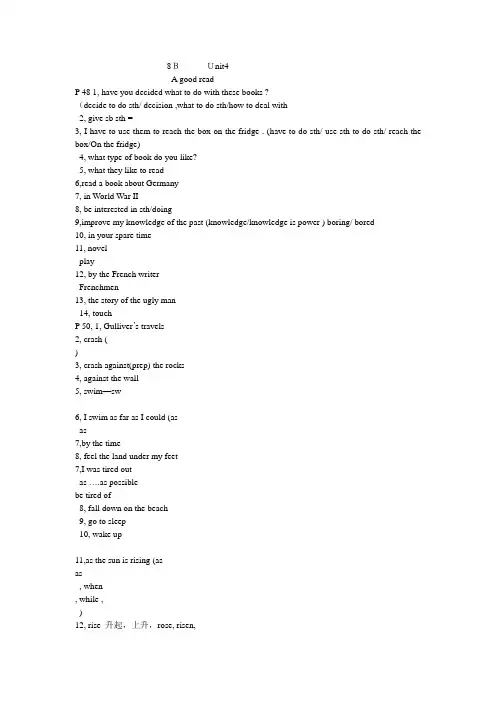
Unit4-江苏省扬州市江都区牛津译林版八年级英语下册知识点梳理8B Unit 4 知识要点和语法一.单词知识点讲义1.read n. 读物 read er n. 读者read v. (read-read-read)a good read 一本好的读物an interesting read 一本有趣的读物some goo d reads 一些好的读物do some reading 阅读2.cooking n.烹饪,烹调cook v. 煮 n. 厨师 cook er n. 厨具do some cooking 烹饪3.novel (novels) n. 长篇小说story (stories) n. 短篇故事writing novels 写小说4.Germany n. 德国German n. 德国人 adj. 德国的in GermanyEinstein was born in Germany.an German 一个德国人many German san Germany car5.knowledge n. 知识【U】know---know ledgeKnowledge is power. 知识就是力量。
much knowledge 许多知识6.spare adj. 空闲的;多余的in one’s spare time=in one’s free time在某人的空余时间Do you have a spare ticket?你有多余的票吗?7.French adj. 法国的France n. 法国French man n. 法国人(Frenchmen)in France 在法国come/be from France 来自法国Hugo (雨果) was a French writer.8.writer n.作家,作者 writing n. 写作a piece of writing 一篇写作Mo Yan is one of the most famous ________in the world.9.ugly adj.丑陋的 (uglier-ugliest)反义词:beautiful/good-looking/prettyQuasimodo(卡西莫多) was an ugly man, but he was very kind.10.touch vt. 感动,触动,触摸Don’t touch tigers.不要摸老虎。
2024年中考英语(江苏省盐城地区)教材考点梳理专练课件八年级下册Unit4(1)

B. Chinese is more popular than any other language
C. Chinese is becoming more and more popular
D. foreign students can only learn Chinese in their countries ( A )4. Where can we probably read the passage?
A. In a newspaper.
B. In a diary.
C. In a novel.
D. In an invi
四
五
三、 (2023·云南改编)阅读下面短文,从所给选项中选出能填入空白 处的最佳选项,使短文通顺、意思完整,其中有一项为多余选项。(词 数:214 建议用时:5分钟) A. Challenge yourself. B. They are cool bookworms. C. You can also read reviews online. D. Let me tell you how to write book reviews. E. Changing into a new type of book is not easy. F. Here are some suggestions on how to pick a great book.
一
二
三
四
五
Vocational workshop programs are also springing up in Tajikistan. In 2022,Tajik Technical University,joined by a college in Tianjin,started a Luban Workshop,in which students could learn about technologies and vocational skills. It was the first of its kind in Central Asia.
八年级下册英语Unit4语法解析
八年级下册英语Unit4语法解析语法是语言词与句构成规律的总结。
它是学习一门语言的基础,那么八年级下册英语Unit4语法你都掌握了吗?接下来店铺为你整理了八年级下册英语Unit4语法解析,一起来看看吧。
八年级下册英语Unit4语法概念讲解以上方框中的句子讲述的是一个新的语法:直接引语和直接引语(Direct speech and Reported speech)。
1. 定义:(1)直接引述别人的原话,叫直接引语。
(直接引语一般前后要加引号)Mr. Black said, "I'm busy." 布莱克先生说:“我很忙”。
(2)用自己的话转述别人的话,叫间接引语。
(间接引语在多数情况下构成宾语从句,不用引号)Mr. Black said that he was busy. 布莱克先生说他很忙。
2. 直接引语变间接引语在以下几方面发生变化:直接引语改为间接引语时,都使用陈述语序,但是因为原句的句式不同,所以变成间接引语时所用的连词要调整。
(1)直接引语是陈述句,变成间接引语时要用连词that引导,连词that也可省略。
Tom said, "We are listening to the pop music."→Tom said that they were listening to the pop music.(2)直接引语是一般疑问句,变成间接引语时要用连词if或whether引导。
从句再改成陈述句语序,时态随主句的时态而变化。
主句中的谓语动词为said时,要改为asked. 没有间接引语时,可以加一个间接宾语(me, him或us等)。
"Do you know where she lives?" he asked.→He asked if / whether I knew where she lived.(3)直接引语是特殊疑问句,变成间接引语时用相应的疑问词引导,从句要改成陈述句语序,时态随主句的时态而变化。
(最新版)苏教版初中英语初二八年级下册第四单元知识点总结归纳重难点汇总复习资料大全 (2)【精品推荐】
重点短语及交际用语一.词组take more exercise 多锻炼walk to school 步行上学three time a week 每周三次keep healthy 保持健康join the army 参军the love of one’s country爱国心want to be 想成为……play cards 玩牌play games 做游戏get …from…从……获得(得到)……would like(sb.)to do sth 想要(某人)干某事less than 不到how much/many 多少keep fit 保持健康not at all 根本不;一点也不feel worried 感到忧虑Good luck with sth/to sb祝好运be busy doing sth忙于干……give sb sth.=give sth to sb 给某人某东西二、日常用语We need an egg and a tomato for the soup.我们需要一只鸡蛋和一个西红柿做汤。
Would you like a glass of water?你想要杯水吗?Let’s make a pancake.我们做个薄煎饼吧。
How to keep fit?怎样保持身体健康?三、知识讲解1. Let’s have a hamburger.我们吃个汉堡包。
①let's=let us, let后面用动词原形即Let’s do sth.“让我们干……吧。
”例如:Let’s have a rest.让我们休息一下吧。
Let’s play games.让我们做游戏吧。
〖注意〗let’s开头的祈使句,其反意疑问句在句末加shall we?表示包括听话人在内的一种建议。
如果不表示建议,而是提出一种请求,表示允许,不包括听话人在内时,则let us不缩写成let’s,其反意疑问句为will you?我们踢篮球,好吗?(表示建议)让我们看看你的图画,可以吗?(表示请求允许)2.have动词,“吃、喝;有”。
2020年江苏中考英语第一部分教材知识研究——八年级(下)Unit 1
八年级(下) Unit 1
返回目录
短语
含义及用法
例句
考
be used to do
Wood is used to make paper. 意为“被用来做某事”。
sth
木材被用来造纸。
点 拓展
1
be used for sth/doing sth =be used to do sth.两个短语意义
相同,后面跟的动词形式不同。
1
many different kinds of art works.
八年级(下) Unit 1
返回目录
满分点拨
短语
含义及用法
例句
考
used to do sth 意为“过去常常做某
点
(淮安:2014.64) 事”,暗指现在不做了。 He used to live in a small village, but now he has been
A. being
B. be
C. been
D. to be
八年级(下) Unit 1
返回目录
2. The old couple are used ____B____ up early in the morning to
do some exercise every day.
考
A. getting B. to getting C. to be got D. to get
事正在进行中,常位于句中
仍在工作。
点
I have already sent her the
表示“已经”,用于肯定句
2
already
invitation. 我已经给她发过请柬了。
表示惊讶、怀疑等语气,用 Has he returned already?他已经
苏教版初中英语8下unit 4知识点
21,startclimbing all over me
22, around遍及,四周,大约
23,shout at
24, the loud noise
voice
sound
25,make sb do sth /adj
26, fall over
27, continue doing /to do sth
soon
later
when
2, first
second
next
then
finally
3, and ,
also
too
again
and then
either
moreover
4,for example
5, because
since
as
so
as a result
6,never
in fact
7, but
however
-------of the door .我够不到门的顶部
9, this book can -------
--------
-------
------- English grammar
二
三
四
五
六
七
)
32, try to do
try doing
try one’s best time to do sth
33, push
pull one hand free
manage to do sth
break the ropes
34, lift my left hand into the air
(n)
35, a huge army of tiny people
最新江苏专版译林八下U4知识点总结
江苏专版译林八下U4知识点总结------------------------------------------作者xxxx------------------------------------------日期xxxx江苏专版译林八下U4知识点总结1.A good read 一本好的读物解析:read,名词,意为读物”,常用单数形式。
如: ------A good read is like a great friend.一本好读物像一个好朋友。
拓展:read,动词,意为“阅读,读书”,常用于看书、看报等。
reader,名词,意为‘读者;读本”。
如: ------ How many English books have you read?你读过几本英语书?2.Have you decided what to do with these books, Hobo?霍波,你已决定怎么处理这些书了吗?解析:do with意为“对付,处理”,相当于及物动词,在特殊疑问句中,do with与what搭配使用,强调处理的对象。
如: ------What did you do with that camera you found?你是怎么处置你发现的那个照相机的?拓展: deal with也意为“对付,处理”,用于特殊疑问句中时,与how搭配使用,强调处理的方式、方法。
如: ------ I don't know how to deal with the problem.我不知道怎样处理这个问题。
------You can ask Mr Li for help.你可以向李老师寻求帮助。
3.I'm reading a book about Germany in World War I .我正在看一本关于第二次世界大战中德国的书。
解析: Germany,名词,意为“德国”,其形容词形式为German,意为“德国人的;德语的;德国的”。
英语八年级下u4知识点
英语八年级下u4知识点英语八年级下Unit 4 Knowledge PointsUnit 4 is about school life, and it covers a lot of different topics related to education, culture, and social norms. In this article, we will discuss the key knowledge points that students should focus on when studying this unit.1. VocabularyOne of the most important things to learn in Unit 4 is the vocabulary related to school life. This includes words and phrases such as "homework," "classroom," "exam," "teacher," "principal," "textbook," and many more. Students should make sure to learn these words and understand how to use them in sentences. They can practice by writing sentences or paragraphs using the vocabulary words, or by taking quizzes to test their knowledge.2. GrammarAnother important aspect of Unit 4 is the grammar. Students will learn about verb tenses, such as present, past, and future, and how touse them correctly in different situations. They will also learn about adverbs, prepositions, and other parts of speech, and how to use them to make their writing clearer and more precise. Practice exercises and worksheets can help students master these grammar topics.3. CultureUnit 4 also covers culture and social norms, which are important for students to understand. They will learn about different customs and traditions related to school life in different countries, such as the importance of uniforms in Japan, or the emphasis on sports and competition in the U.S. By learning about different cultures and social norms, students can gain a broader perspective on the world and develop their cross-cultural communication skills.4. ConversationUnit 4 also provides opportunities for students to practice their conversational skills. They will learn how to introduce themselves, ask and answer questions, and hold basic conversations with others. Role-playing and group activities can be useful tools for practicing these skills, as well as listening to and watching English-language media.5. WritingFinally, Unit 4 includes opportunities for students to practice their writing skills. They will learn about different types of writing, such as essays, letters, and stories, and how to structure them effectively. They will also learn about the importance of using clear, concise language and how to revise and edit their work. Writing practice exercises, peer editing, and teacher feedback can help students improve their writing.In conclusion, Unit 4 of the English 8th-grade curriculum covers a wide range of topics related to school life, and students should focus on mastering the key knowledge points related to vocabulary, grammar, culture, conversation, and writing. By doing so, they can develop their English skills and gain a deeper understanding of different cultures and social norms.。
八年级英语下册Unit4单元知识点
八年级英语下册Unit4单元知识点八年级英语下册Unit4单元知识点八年级英语Unit4单元知识需要掌握每一个重要的知识点,会让你在Unit4单元英语考试中顺利通过。
以下是店铺给你推荐的八年级英语下册Unit4单元知识点归纳,希望对你有帮助!Unit4单元知识点:重点短语一1. have free time有空闲时间2. allow sb. to do sth. 允许某人做某事3. hang out with sb. 与某人闲逛4. after-school classes课外活动课5. get into a fight w ith sb. 与某人吵架/打架6. until midnight直到半夜7. talk to sb. 与某人交谈8. too many太多9. study too much学得过多10. get enough sleep有足够的睡眠11. write sb. a letter给某人写信12. call sb. up打电话给某人13. surprise sb. 令某人惊讶14. look through翻看15. be angry with sb. 生某人的气16. a big deal重要的事17. work out成功地发展;解决18. get on with不 11睦相处;关系良:19. fight a lot经常吵架/打架20. hang over笼罩21. refuse to do sth. 拒绝做某事Unit4单元知识点:重点短语二offer to do sth. 主动提出做某事so that以便mind sb. doing sth. 介意某人做某事all the time一直in future今后make sb. angry使某人生气worry about sth. 担心某事copy one’ s homework抄袭某人的作业be oneself做自己family membersspend time alone独自消磨时光give sb. pressure给某人施压have a fight w ith sb. 与某人吵架compete w ith sb. 与某人竞争free time activities业余活动get better grades取得更好的成绩give one’ s opinion提出某人的观点learn exam skills学习应试技巧practice sports体育训练cause stress造成压力cut out删除Unit4单元知识点:重点句型1. I studied until mid night last night so I did n‘t get enough sleep.我昨晚学习到半夜所以睡眠不足。
苏教版初中英语8下U4知识点讲解教学文案
8B Unit4 A good readComic strip&Welcome to the unit1. Have you decided what to do with these books? 你已经决定怎样处理这些书了吗?do with意思是:“对付,处理”,相当于及物动词,在特殊疑问句中,do with 与what 搭配使用。
例:What do you do with this problem? 你怎样处理这个问题?拓展:deal with也意为“对付,处理”,用于特殊疑问句中,与how 搭配使用。
例:I don’t know how to deal with the problem. 我不知道怎样处理这个问题。
2. I have to use them to reach the box on the fridge.我得用它们来够冰箱上的书。
1)use sth. to do sth.意思是:“用某物来做某事”,也可用为use sth. for (doing) sth.。
被动语态为:sth. be used to do sth.例:We use computers to play games.= Computers are used to play games. 我们用电脑玩游戏。
2)reach 为及物动词,意为“够到,到达”I’m too short to reach the apple on the tree. 我太矮了,够不着树上的苹果。
3. They improve my knowledge of the past. 它们提高我对过去的认识。
Knowledge是名词,意为“知识,认知,学问”,后可接of的短语作定语或that从句作同位语,表示关于某方面的知识或对某人或某事的了解或理解,此时knowledge前须加定冠词the。
例:He is poor in money, but rich in knowledge. 他贫于金钱,但富于学问。