
译林版英语三年级下册Unit6 教案
T:NowI’m Liu Tao’s mum and you’re Liu Tao. Let’s act.
Ss act in roles.
4.同样的方法教授P2-P3
5.出示P4,让学生自己尝试说对话。
T: Look at this picture, what time is it?
Listen to the dialogues and find out the time
Homework
1.Read the dialogues after the tape and imitate the pronunciation.
2.Readand reciteStory time.
二度修改
T: Yes.It’s time for lunch. Now you can play this game in groups.
Ss: (小组内开展活动)
2.教师出示一个钟面,钟面朝着老师,老师拨完时间,让学生猜测
T: What time is it?
Ss: It’s…
T: Yes. / No. It’s time for….(做动作)
It’s time for….
Learning tip: Use‘please’to be polite.
出示课文P1 Listen and complete:Wake up, Taotao.(板书Wake up)
引导学生填空____ _____ is it, Mum?
It’s seven ______ .
1. Free talk
T: Hello,boys and girls.
S: Hello.
T: How are you today?
S: Fine, thanks.
2.Brain storm
T:Can you count from one to twelve?
Show a long hand and a short hand.What’sthis?
2.能在真实的情景中正确运用What time is it?/Hurry up./It’s ... o’clock./It’s time for...
课前准备
pictures,cards,taperecord,配套软件
课时
第一课时
教学过程:
Step 1.Greeting and warm up
1. Greetings.
T: Yes. It’s time for lunch.
T: And look, is it twelve o’clock?
Ss: No, it isn’t. It’s six o’clock.
T: Yes, it’s time for dinner. This is my day.
T: Now ,look at this picture. Who’s he?
2.能在真实的情景中正确运用What time is it?/Hurry up./It’s ... o’clock./It’s time for...
重点、难点
1.能正确地听、说、读单词wake up, mum, o’clock, breakfast, dinner, these, here’s = here is, class, bed, OK, lunch, eleven, twelve, bag
2.能在真实的情景中正确运用What time is it?/Hurry up./It’s ... o’clock./It’s time for...
重点、难点
1.能正确地听、说、读单词wake up, mum, o’clock, breakfast, dinner, these, here’s = here is, class, bed, OK, lunch, eleven, twelve, bag
2.T: Do you know what it is?
Yes, it’s a clock.
It can tell us the time.
Today, we will talk about the time. (Teach: time)
Step 2.Presentation and practice .
3.能听懂、会说、会读、会写单词class, bed, OK, lunch, eleven, twelve, bag
4.会诵读歌谣:Wake up, Eddie
5.能听懂、会说、发音准确:字母t在单词中的读音。
单元教学重点、难点:
重点
句型:What time is it?/Hurry up./It’s ... o’clock./It’s time for...
板书设计
Unit 6 What time is it?
A: What time is it?
B: It’s…o’clock.
It’s time for…
译林版英语三年级下册第六单元教学设计方案NO:2
教学内容
Unit 6 What time is it?
课型
新授课
时间
教学目的
1.能正确地听、说、读单词wake up, mum, o’clock, breakfast, dinner, these, here’s = here is, class, bed, OK, lunch, eleven, twelve, bag
Please ask and answer in pairs.
3. T: What’s the time?
Ss:It’s ten o’clock.
T:It’s time for class. (重点教句型)
We can do different things at different time.
Step 3. Learn to say .
教学内容
Unit 6 What time is it?
课型
新授课
时间
教学目的
1.能正确地听、说、读单词wake up, mum, o’clock, breakfast, dinner, these, here’s = here is, class, bed, OK, lunch, eleven, twelve, bag
1. T:Iis it? (反复,然后带读)
Oh, it’s four. We can also say“It’s four o’clock”. (带读)
2. T: Look at these three clocks.
Can you talk about the time like this?
4.歌谣:Wake up, Eddie
5.语音:字母t在单词中的发音。
八课时
单元教学目标:
1.能听懂、会说、会读、会运用句型:What time is it?/Hurry up./It’s ... o’clock./It’s time for...
2.能听懂、会说、会读词汇wake up, mum, o’clock, breakfast, dinner, these, here’s = here is
T:It’s time for class.Hello, boys and girls.
S: Hello,...
T: Nice to see you.
S: Nice to see you, too.
1.T:Last lesson, we learned the numbers. Can you count from one to ten?
What are Liu Tao and his Mum saying?
Discuss in two, and try to say.
Show‘bed’, learn‘time for bed’
6. Read and act in roles
7. Try to retell the story.
T: Who wants to show us your clock? (让学生拿出自己设计的钟面)
S1: What time is it?
Ss: It’s….
Ss show their clocks(小组合作游戏)
A: What time is it?
B: It’s…o’clock. (渗透非整点时间表达法)
2.能在真实的情景中正确运用What time is it?/Hurry up./It’s ... o’clock./It’s time for...
课前准备
pictures,cards,taperecord,配套软件
课时
第二课时
教学过程:
Step 1 Free talk and motivation
Ss:Yes! (Ss count from one to ten, PPT show the numbers at the same time.)
T: Please look and guess what number is missing?
Ss: Eleven, twelve. (Teach‘eleven, twelve’)
Ss:He’s Liu Tao.
1.Watch the cartoon初步感知课文
T: Let’s watch the cartoon and try to choose a title about the story.
A. Liu Tao’s Day B. Liu Tao’s weekend
2. T: This is Liu Tao’s Day. Can you help to finish Liu Tao’s timetable?
词汇:wake up, mum, o’clock, breakfast, dinner, these, here’s = here is, class, bed, OK, lunch,eleven, twelve, bag
三年级下册英语-Unit 6 第5课时 B let's talk 教案
能在图片、实物或情景的帮助下运用句型How many…do you have ? I have…询问或谈论拥有物品的数量。
情感
目标
能够在教师的启发下,知道英文数字16-20以内的基数词的构词规律
教学重点
1. How many…do you have?
2. Open it and see! You have…
三、【板书设计】
Unit 6 How many?
(B)Let's talk
How many…do you have?
Open it and see! You have…
四、【教后反思】
S1:I have...
Ⅳ.实践
应用
1.学生四人一组,摆出自己的一些物品,模仿Let's find out进行对话练习。
如:How many rulers do you have, Wu Yifan?
I have... rulers.
Ⅴ.总结
反馈
1.Let’s read the passage in the book.
教学难点
名词复数的读音。
教学方法
任务型教学法
二、【教学流程】
环节
师生活动
二次备课
I.复习
热身
1.1.教师播放“One, two, three, four, five”歌曲的录音带,让学生跟随录音一起唱。
2.师生问答
T: Good morning, boys and girls.
Ss: Good morning,
6.教师播放Let’s talk部分的内容。
让学生注意听:How many crayons does Wu Yifan have?看完课件后,让一些学生来回答这个问题。再放课文录像,让学生逐句跟读,并解释“Open it and see!”的意思。然后同桌间互问:How many pencils pens/ rulers/ erasers do you have? Open it and see!对方根据实际情况用I have…来回答。
译林英语三年级下册Unit 6 What time is it四课时教案
Unit 6 What time is it?第一课时Teaching contents教学内容:Story timeTeaching aims and learning objectives教学目标:1.能听懂,会说,会读句型What time is it? It’s…o’clock. It’s time for…2.能听懂,会运用日常用语 Hurry up! Wake up.3.能听懂,会说,会读单词breakfast, lunch, dinner, eleven, twelve。
4.能让学生学会合理安排时间。
5.能正确地理解、掌握对话内容,并能朗读、表演对话。
Focus of the lesson教学重点:1.能听懂,会说,会读单词breakfast, lunch, dinner, eleven, twelve;熟练运用句型“What time is it? /It’s …o’clock. It’s time for…”。
2.能正确地理解、掌握对话内容,并能朗读、表演对话。
Predicted area of difficulty教学难点:单词breakfast、twelve、dinner的读音Teaching aids教具准备:单词卡片,多媒体,实物Teaching procedures教学过程:Step 1: Warming up1. Greeting.2. Free talk.T: How old are you?Ss: I’m…3. Game: Say the next number. (Review the numbers from one to ten.)Step 2: Presentation and practice1. 教师出示11与12两张数字卡片,教学新单词:eleven, twelve,o’clock,与句型:What time is it? /It’s …o’clock.。
三年级英语下册 Unit 6(17)教案 人教版PEP

【课题】Unit Six At the Zoo【教学重点】听、说、认读几个形容词 small, big, long, short。
听懂含有形容词的几个指令,并按指令做动作。
【教学难点】单词small 中[ l ] 的发音,舌头要上卷。
【教具准备】1 教师准备教材配套的录音带。
2 教师准备Let’s learn 部分的课件。
3 学生准备动物玩具,每人带1-2个。
4 教师准备所学单词卡片和图片。
【教学过程】1 热身、复习 (Warm-up/Revision)(1)日常口语会话展示。
(2)教师播放“Hide and Seek”的歌曲录音,师生边唱边做动作。
(3)利用字母卡片复习26个英文字母。
用升、降两种语调读字母,注意每个字母的发音做到准确到位。
2 呈现新课 (Presentation)(1)游戏:猜动物。
T: Listen to me, children. Guess what it is.It has a long nose. It has two big ears and a short tail. It’s gray. 教师在说谜语时,可适当配合一些手势或动作。
S: It is an elephant.T: Yes. Good. It is an elephant.(2)在播放之前,教师说:You will see a beautiful picture. Look at it carefully andtell us: What’s in it?/What are they?教师快速展示系列动物图片:giraffe, elephant, monkey, mouse, rabbit, tiger。
学生根据看到的图片说说动物单词。
培养观察力和记忆力。
(3)继续展示图片:An elephant and a mouse. 对比大象和老鼠。
T: What are they? They are an elephant and a mouse. Oh, Look! The elephant is very big. But the mouse is very small. 教师强调big 和) small 。
三年级下册英语教案-Unit6《Isthisyouskirt》(Lesson35)|人教(精通)
三年级下册英语教案-Unit 6《Is this you skirt》(Lesson35)|人教(精通)教学内容本课教学内容选自《人教精通版》三年级下册英语第六单元《Is this your skirt?》。
本课是第35课,教学内容包括学习衣物相关的词汇,如:skirt,T-shirt,pants,socks等。
学生将通过听、说、读、写等练习,掌握如何用英语询问和描述衣物,并学会使用指示代词“this”和“that”。
教学目标1. 知识目标:学生能够听懂、会说、会读本课单词和句型。
2. 能力目标:学生能够在真实情境中运用所学词汇和句型询问和描述衣物。
3. 情感目标:培养学生合作学习的精神,提高学生的学习兴趣。
教学难点1. 指示代词“this”和“that”的用法区别。
2. 衣物词汇的发音和记忆。
教具学具准备1. 教学课件2. 录音机3. 衣物实物或图片4. 学生练习册教学过程1. 导入:通过展示衣物图片,引导学生复习已学过的衣物词汇,为新课的学习做好铺垫。
2. 新课展示:通过课件展示本课词汇和句型,引导学生学习并模仿。
3. 操练:通过听录音、跟读、角色扮演等方式,让学生熟练掌握本课词汇和句型。
4. 小结:对本节课所学内容进行总结,巩固知识。
板书设计1. Unit 6 Is this your skirt?2. 主要词汇:skirt,T-shirt,pants,socks等。
3. 主要句型:Is this your skirt?Yes,it is. / No,it isn't.作业设计1.抄写本课单词和句型。
2.完成练习册相关练习。
3.用所学句型和家长进行对话练习。
课后反思本节课通过丰富的教学活动,让学生在愉快的氛围中学习英语,提高了学生的学习兴趣。
在教学过程中,注重引导学生观察、发现和总结,培养了学生的自主学习能力。
在今后的教学中,应更加注重学生的个体差异,关注每一个学生的学习进度,使每一个学生都能在英语学习中取得进步。
英语三年级下册 Unit 6 第四课时 教案
B: OK/Great!
A:Let’s make a puppet.
B: OK/Great!
A:How are you?
B: I’m fine, thank you./ Very well, thanks.
2.一分钟演讲:找一到两位同学上台做小报告大约需要三到五分钟,并在此环节设置表达奖和倾听奖。
T: Oh, your bag is heavy!What’s in your bag?
S: Book.
T: How many books do you have?
S:…
(二)情景创设,理解语意
课件创设一个全班同学去写生的情境,让学生自己讨论并准备写生用的工具,用How many…do you have?来询问学生并让学生区别这句话和How many…do you see?的区别。然后教师拿出一个大盒子告诉学生这是自己准备的魔力盒,并让学生猜一猜里面有什么。
一、热身(Warm-up)(此环节用时5分钟)
说唱做演/玩赛,激情引趣
(一)歌曲、歌谣中情绪热身
Let’s chant: P59
师生齐唱第六单元A部分P59的Let’s chant
(二)复习旧知中知识热身
Free talk
T: How are you?
S: I’m fine, thank you.
T: Where are you from?
T:Look, this is a magic box.Guess,what’s in it?(摇一摇,让学生猜几次)猜中就说Open it and see.猜不中也说Open it and see.让学生理解语意。
(三)交际练习,版式呈现
2024年译林版新三年级英语下册全册教案
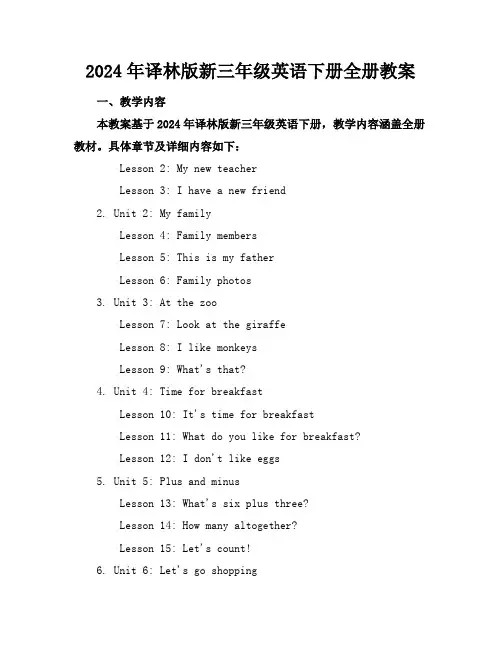
2024年译林版新三年级英语下册全册教案一、教学内容本教案基于2024年译林版新三年级英语下册,教学内容涵盖全册教材。
具体章节及详细内容如下:Lesson 2: My new teacherLesson 3: I have a new friend2. Unit 2: My familyLesson 4: Family membersLesson 5: This is my fatherLesson 6: Family photos3. Unit 3: At the zooLesson 7: Look at the giraffeLesson 8: I like monkeysLesson 9: What's that?4. Unit 4: Time for breakfastLesson 10: It's time for breakfastLesson 11: What do you like for breakfast?Lesson 12: I don't like eggs5. Unit 5: Plus and minusLesson 13: What's six plus three?Lesson 14: How many altogether?Lesson 15: Let's count!6. Unit 6: Let's go shoppingLesson 16: Can I help you?Lesson 17: How much is it?Lesson 18: I want this one二、教学目标1. 掌握基本的日常英语对话,如问候、介绍、询问喜好等。
2. 学习并运用英语描述家庭成员、动物、食物、数字等。
3. 培养学生运用加减法进行简单计算的英语表达能力。
三、教学难点与重点1. 教学难点:数字的加减法运算、购物场景的英语表达。
三年级下册英语优质教案-Unit 6 How many? B Let’s talk 人教PEP
Unit6 B Let’s talk教案课题:三下Unit 6 How many? B Let’s talk教材:《小学英语PEP(人教版)》课型:对话课年级:三年级下册上课时长:40分钟一、教学内容:1. 教学重点:(1) 理解对话大意,并用正确的语音语调朗读和表演对话。
(2) 在语境中运用How many ... do you have? I have ...来询问他人物品有多少和回答他人的提问。
2. 教学难点:知道How many ... do you have? 和How many ... do you see? 的区别以及正确地回答相关的提问。
二、教学目标:1. 语言知识、技能目标:(1) 能够理解对话大意,并用正确的语音语调朗读和表演对话。
(2) 能够在情景中积极运用How many ... do you have? I have ... 来询问他人物品有多少和回答他人的提问。
(3) 知道How many ... do you have?和How many ... do you see? 的区别以及正确地回答相关的提问。
2. 情感态度、学习策略目标:(1) 培养学生学习英语的兴趣,激发学生敢于开口说。
(2) 在课堂任务中积极合作,共同完成任务,具备合作精神。
三、学情分析:三年级是小学生学习英语的基础阶段,这一阶段的重要任务在于激发并保持学生学习英语的兴趣。
三年级的学生,喜欢直观形象思维,活泼好动,喜欢尝试新事物,既好奇又好强,表现欲强;学习英语的热情高,擅长模仿,乐于表演。
通过一个多学期的英语学习,学生已经具备简单的交流技能和词汇。
本节课通过设计不同的语境让学生用How many ... do you have?来询问他人所拥有的物品,并能做出相应的回答。
让孩子在仿真的情境中体会语音知识。
整节课注重对学生英语学习兴趣的培养,鼓励他们大胆说、积极做、大胆地表现自己。
四、教学内容分析:本节课选自《小学英语PEP(人教版)》三年级下册第六单元How many ... do you have? B Let’s talk第四课时,是一节对话课。
译林版三年级下册英语说课稿- Revision of Unit5-6
译林版三年级下册英语说课稿- Revision of Unit5-6一、教学目标1.复习并掌握 Unit 5 和 Unit 6 的单词、句型和重点语法;2.提高学生听、说、读、写的能力;3.培养学生的合作意识和有效沟通能力。
二、教学内容1. 单词1.Unit 5apple, pear, orange, banana, watermelon, fruit salad, this, that, these, those, how, grrr2.Unit 6dog, cat, bird, rabbit, mouse, panda, animal, can, climb, jump2. 句型1.Unit 5–What’s this/that? It’s an apple/pear/orange/banana/watermelon.–What’s in the fruit salad? Apples, pears, oranges, bananas and watermelons.–How do you spell ______? A-P-P-L-E(横线处填数词)。
2.Unit 6–It’s a ______. (dog/cat/bird/rabbit/mouse/panda)–Can it ______? (climb/jump)3. 重点语法1.Unit 5学生能使用“this/that/these/those”来描述所见物品2.Unit 6能正确理解“can”表示一种能力。
三、教学过程1. 学前导入•观看图片,提问学生:这是什么?(进入 Unit 5)例如:apple_picapple_picWhat’s this?学生回答:“It’s an apple.”•导入Unit 6需使用与之相关的图片例如:dog_picdog_picWhat’s this?学生回答:“It’s a dog.”2. 重点讲解(1)对话模拟•使用真实物品展示例如:What’s this?(展示真实水果)It’s an apple.What’s that?(展示真实动物)It’s a dog.•单词和句型讲解和操练例如:1.教师展示水果图片和字母卡片,利用“How do you spell…” 句型辅助学生进行单词的书写和口语训练。
译林版(三起)三年级上册英语教案:Unit6 Colours(第1课时)
译林版(三起)三年级上册英语教案:Unit6 Colours(第1课时)课程背景本课程为三年级上册英语教材的第六单元,共包含八个课时,本次教案为该单元的第一课时。
本单元主要介绍各种颜色的单词和用法,旨在帮助学生了解英语中颜色的表达方式,并能使用颜色词汇进行简单的交流。
教学目标1.学生通过本课的学习,能够正确地听、说、读和写颜色的单词;2.学生能够运用颜色单词进行简单的表达,比如“the balloon is red”;3.学生增加对英语的兴趣,积极投入学习。
教学重点1.颜色单词的理解和正确发音;2.能够准确地使用颜色单词进行简单的表达。
教学难点学生在口语表达时,能够流利地运用颜色单词进行简单的句子构思。
教学方法1.问答式教学法;2.图片教学法;3.语音教学法。
教学过程1. Warm-up(5分钟)老师出示一些颜色的图片,例如红色的苹果,黄色的花朵等,让学生观察图片并说出颜色名称。
2. Presentation(10分钟)老师通过PPT出示各种颜色的单词和相应的图片,帮助学生理解颜色的单词,并练习正确的发音。
3. Practice(15分钟)老师出示一些颜色的物品,例如一只黄色的小鸭子,一朵红色的花等,让学生运用刚才学习的颜色单词进行描述,并在班级内展示。
4. Listening and Speaking(10分钟)老师播放一段短对话,例如:•A: What color is the apple?•B: It’s red.让学生听懂对话内容,并回答问题。
5. Production(10分钟)老师分组让学生进行小组活动,要求学生利用颜色单词造出不同颜色的句子,并在小组内相互分享。
6. Consolidation(5分钟)老师再次出示图片,让学生概括并说出图片中所有物品的颜色,巩固学生学到的颜色单词。
教学反思本次教学中,老师通过多种教学方法帮助学生理解和掌握颜色单词。
通过让学生运用颜色单词进行描述,增加了学生的语言实践能力。
Unit6Howmany?PartALet’slearn(教案)人教PEP版英语三年级下册
Unit 6 How many?Part A Let’s learn(教案)人教PEP版英语三年级下册教学内容本课为人教PEP版英语三年级下册Unit 6 How many?Part A部分。
教学内容主要围绕数字1120的英语表达及如何询问数量。
通过本课的学习,学生能够掌握1120的英文数字词汇,并能够运用Let’s learn部分的句型“How many…can you see?”进行数量提问。
教学目标1. 知识与技能:学生能够听懂、会说、会读本课的数字词汇1120,并能用英语询问数量。
2. 过程与方法:通过图片、游戏等直观教学手段,让学生在生动活泼的情境中学习英语数字,提高学生的听说能力。
3. 情感态度价值观:培养学生对英语学习的兴趣,激发学生探索和发现知识的欲望。
教学难点1. 数字词汇1120的正确发音及记忆。
2. 句型“How many…can you see?”在实际语境中的运用。
教具学具准备1. 教具:多媒体课件、图片、卡片。
2. 学具:学生自备数字卡片。
教学过程1. 热身活动:播放英语儿歌,营造英语学习氛围,引导学生复习已学过的数字词汇。
2. 导入新课:通过图片展示,引导学生观察并猜测本课主题。
3. 新课呈现:利用多媒体课件,展示数字1120的英文表达,教授并纠正学生的发音。
4. 实践活动:分组进行数量提问游戏,让学生在实际语境中运用所学知识。
5. 巩固提高:通过听、说、读、写等多种形式,巩固学生对数字词汇的记忆。
板书设计1. Unit 6 How many?Part A Let’s learn2. 主要内容:数字1120的英文表达、句型“How many…can you see?”3. 关键词汇:eleven, twelve, thirteen, fourteen, fifteen, seventeen, eighteen, nineteen, twenty作业设计1. 听力练习:听懂并模仿Let’s learn部分的录音。